
Home » 2021 (Page 2)
Yearly Archives: 2021
Face to Face with Tennessee Williams
Anthony Laura and Face to Face Films embarked a journey artistically when we were no longer allowed to do so physically. His reading series, THEATRE INTERRUPTED began during lockdown and explored classic American drama by imbuing it with fresh energy by offering “dream roles” to young artists, allowing them to tackle plays by Albee, Miller, and Williams and other great playwrights in a safe environment while proving quality virtual, entertainment to audiences all across the world.
July’s entry:

THE GLASS MENAGERIE
JULY 31ST 1:00 PM BROADWAY ON DEMAND
KRISTEN SEAVEY: AMANDA WINGFIELDALEXANDRA SALTER: LAURA WINGFIELDSAMUEL CRUZ: TOM WINGFIELDGABE CALLEJA: JIM, THE GENTLEMAN CALLER
Ai spoke with Laura and company about climbing thr mountain of Tennessee Williams … again.
What sparked your decision to direct THE GLASS MENAGERIE?
ANTHONY M. LAURA: The Glass Menagerie has been on my radar more than normally the past two years. One of the themes I deal with in my work very heavily is illusion, and Menagerie was seminal in conquering that theme. I found myself rediscovering the play as I approached it and was enthralled with every aspect of it again, as if I was reading it for the first time. It is remarkably specific and haunting. I wanted new audiences to experience the magic of the Wingfield’s. My goal is putting it on a virtual platform was to allow everyone who watched to experience the words, the pain and the humanity that the play captures. These characters are etched in our memories for a reason. It was so exciting working with this remarkable cast and exploring the truth of this world. I was able to also see the effect that Tennessee Williams had on me as a writer with my work and how grateful I have been to further learn from his gifts.
What was your prior experience with the play?
GABE CALLEJA: I came across Glass Menagerie quite often in scene study classes before, but I had never seen it from start to finish in its entirety. So for the most part, I was coming in pretty fresh with just a basic understanding of the events of the play.
ALEXANDRA SALTER: I had very little experience with the play, I had only read it once before.
KRISTEN SEAVEY: I worked on a scene in high school and that’s about it. Very limited and barely knew what the play is about. The only memory I had was a line that Laura says with peculiar punctuation: “My Glass! – Menagerie”. I can confirm that this is a line that 15-year-olds working on scenes from a play they didn’t understand thought was hilarious. With characters like Amanda there’s a fine balance. Amanda is theatrical. Out of all of the characters in the play, she’s the one who is the most over the top. On one hand, I think Amanda is a character that is easier to be too “over the top” with and not connect with the humanity and with the fears and insecurities she has—the things a modern audience can still connect with in a story set almost a century ago. We worked on pushing those boundaries and finding a balance of bringing out Amanda’s theatrics while keeping it honed in to her reality and the natural realism I bring to my own work. Really understanding each moment and each line and the motivations behind them to clearly tell the story with the right balance of theatrics and realism.Also trusting myself that I’m capable of tackling such a famous and delicate role.
SAMUEL CRUZ: I saw the play the first time I went to New York with Cherry Jones and Zachary Quinto. It was the first time I had seen a play that made me feel depressed after watching it. I thought that was so cool and raw as a high school drama kid. I then performed the gentleman caller scene in class where I copied exactly what I saw on broadway.
What did you and Anthony work on in rehearsals?
GABE CALLEJA: We focused on Jim’s vulnerability and specificity with each character that he interacts with or talks about throughout the play.
ALEXANDRA SALTER: Anthony and I worked a lot on Laura’s injury; how it looked and what it felt like. We also focused on what her driving need is in the play. She needs to feel loved and seen. And we specified what that would be like coming from Amanda, Tom, and someone outside the family (like a gentleman caller), and how it would feel to have that all ripped away.
KRISTEN SEAVEY: Tennesse Williams is a tough cookie, and there are two camps actors can fall into when working on his writing. The first is not connecting with the heart of the material and going so theatrical it’s borderline caricature, and the second is too understated where you’re missing important parts of the character’s personality out of fear of “going too big”.
SAMUEL CRUZ: Obviously everything that you normally work on when producing a play, but I think a lot of work and focus was put on the relationship between the family. It plays a huge role in the circumstances of the story, and is what ends up being so poignant. He personally worked with me on the two places we see Tom in the play; the present and the memory which opened up my view and my further appreciation for the play.
What does the play mean to you?
GABE CALLEJA: After the table read, I was quite taken aback at how much I was able to relate to the play and these characters. It has quickly become one of my favorites and I would love another crack at this play on the stage one day. It’s a story that is so simple yet highly compelling. Every thought and action seemes deliberate and reveals so much more than is on the page.
ALEXANDRA SALTER: It means so much to me to be playing this iconic role. It is an honor to tell Laura’s story and to bring Tennessee Williams words to life.
KRISTEN SEAVEY: I have a special place for the classics from the early to mid twentieth century and it’s always a special time when I get the rare opportunity to work on them.
SAMUEL CRUZ: Honestly, I don’t think I have an answer to this quite yet. Working in general after such a long time has meant the world to me. Getting back into doing what I love has been invigorating. As for how this play will effect me, I couldn’t tell you yet. I’m still deep into this process. I’m sure it’s going to stick with me for awhile. Tom is unlike any character I have been given the opportunity to explore.
What did you discover about the play while working on it?
GABE CALLEJA: I discovered that the best written characters are those that are trying to justify their flaws in their thoughts and actions. No one is complete and we are all doing the best we can. Sometimes that leads to miscommunications that can blossom into captivating and compelling conflict. This play executes this notion perfectly.
ALEXANDRA SALTER: Throughout this process I discovered how important Laura’s glass menagerie really is. It is a representation of her, and as we go along in the play, we see how the glass reflects what Laura is feeling and how she is changing.
KRISTEN SEAVEY: Tennessee Williams’ writing has everything you need right there, you just have to peel back the layers and work together to understand it both emotionally and physically.
SAMUEL CRUZ: For me, this play has been a lot about rediscovering. Feeling again what’s it’s like to live with a character for a couple weeks and really get to know them in me. I’ve discovered a lot of things about myself throughout. I think I realized this play is a lot more sad than I initially thought. I’ve also learned a great amount about Tennessee’s life and how it parallels this play. Thats been the real heartbreak in the process for me. But also discovering that the play really seems like a ‘what if’ scenario.
What would you say to someone who isn’t familiar with the play?
GABE CALLEJA: There is a beautiful rawness to this play. You constantly feel like you want to save the characters from themselves but they are all stuck in their situations, some looking to escape, some without the means to. This creates such a palpable tension that is relatable and engaging to watch.
ALEXANDRA SALTER: This is the first memory play ever produced. This new style opened up a whole new way to explore a character’s experiences. The Glass Menagerie is told told through Tom’s perspective, a character based off Williams himself.
How has working on the play changed the way you hear the name Tennessee Williams?
GABE CALLEJA: There is good reason as to why Tennessee Williams is a household name to even non theater-goers. His reputation and work speaks for themselves. I’ve had the pleasure of working or watching a few of his plays in the last year, and, suffice to say, he has become one of my favorite playwrights. I expected his work to be impressive, but there’s such a deep and full characterization in his style that you can’t help but relate and fall in love with his characters.
ALEXANDRA SALTER: I have always had the utmost respect for Tennessee Williams. That respect has only grown after working on this play, knowing the characters are based off him and his family. I have been given the opportunity to look through a window to his past, and I am so grateful to him for sharing his story, no matter how difficult it may have been to tell.
KRISTEN SEAVEY: This is my second Tennessee Williams play with Face to Face and certainly! First that something so big can be told clearly in a virtual format and second that younger actors are capable of working on roles they might not yet be cast in.
SAMUEL CRUZ: It has just furthered my appreciation for him. I’ve always known him the be one of the best playwrights to exist. When you live with work for awhile you will of course have more of an understanding of the artist. I feel like I got a little more close to him. Maybe understood a little more what it was like to be him.
What do you want people to come away with after seeing this?
GABE CALLEJA: The play works hard to create the circumstances that leave you feeling a mix of hopefulness and hopelessness by the end. It is a rich, paradoxical feeling that is provocative and leaves you wondering about the fate of the characters in the play. If we can achieve that for our audiences, I would call that a success!
ALEXANDRA SALTER: I want people to come away from the play understanding that we all need the same thing in life. We all want to be accepted and loved no matter who we are. At the end of the day, everyone wants to feel like they belong.
KRISTEN SEAVEY: A better understanding of classic writing like Tennesse Williams and of The Glass Menagerie itself, especially if their only experience is reading it once in high school.
SAMUEL CRUZ: I would say that my high school self was right in some way. I think in life you inevitably have to make tough decisions, and you might not always make the right decision. But you just have to keep trying and keep living. Memory is a helpful stepping stone but we are only given one direction. Forward.
Life According to Akshata Honnavar
Review by Bob Greene
Akshata Honnavar, in her short piece, A Story Called Life, found a way to offer us a new take on an age old theme.
This brief interlude shares a day in the life of everyone. Snippets of every everyday existence swathed in lovely background music and well-spoken, well-written poetry.

While this them has certainly been explored, most entries present in a presentational form – allowing camera effects to frame attractive faces who are – like any Sunday New York Times cover story – staring directly into the lens, prompting us to say “oh they’re like me.”
This doesn’t always work.
Akshata Honnavar hands us stories in each face. Not looking at the camera, not all contented, not all pretty, but we meet the world. Some summon sad imagery, other troubling, other whimsical, we meet a true melting pot. The location allows us to imagine “big city” with even the more rural locales inferring a getaway more than a neighborhood. We are placed on a journey of emotions more than people and the poetry, while well-written and spoken, also lends to the same concept. Inferring life can be tragic and joyous – sometimes simultaneously, the story tells us that life is not easily explained as it is all things at the same time. The voice is not a perfect announcer voice but an accented oration. Enough of an accent that – again – we see that everybody means everybody.
Ms. Honnavar ends her piece by having everyone then look directly into the camera. Saving this usual feature for the end, we get the same feeling we would get watching the final sequence of Fellini’s Nights of Cabiria, when the title character – following hardship after hardship – smiles as if to say “oh well, this is the story called life.”
Ms. Honnovar has a promising future as an empathetic filmmaker. Here’s looking forward to more elaborate expressions of her creativity.
HAMLET returns!

Shakespeare Sports Theatre Company brings its acclaimed production back – for a LIVE run at The Clemente, 107 Suffolk St, New York City, August 26-29. Contact ShakespeareSportsTheatreCompany.com for further info and or visit: www.eventbrite.com/e/hamlet-tickets-158244322027?aff=efbneb for tickets.
Shakespeare’s most enigmatic play was scheduled to be presented in August 2020 at downtown’s cutting-edge Clemente by Shakespeare Sports. Working quickly, producer Carrie Isaacman and director Michael Hagins reworked the production to appear virtually. That production won accolades. Now, the same teams join together to bring back their Hamlet, LIVE, at the same place, same dates, just one year later.

Michael Hagins returns as director of the production. Hagins is synonymous with innovative physicality in his classical productions as well as writer of plays dealing in social justice.
Returning to the role of Prince Hamlet is Matthew Tiemstra. Jan Ewing of Hi Drama said “His energy and enthusiasm was evident, and his descent into madness particularly effective.” Joining him again is Mary Sheridan who – in the same review – was cited as “convincingly play[ing] Gertrude, Hamlet’s mother, with love and an uneasy concern as she watched her son self-destruct” and Aaron David Kapner who was called “a stitch” with “great charm and subtle humor” as Guildenstern and Osric. Mr. Kapner will be assuming the role of Polonius in this new production.
The company is completed by returning members, Brad Summer, Charlie M. Alemán, Gigi Principe, Tucker Dally Johnston, with Benny Acevedo joining the company.
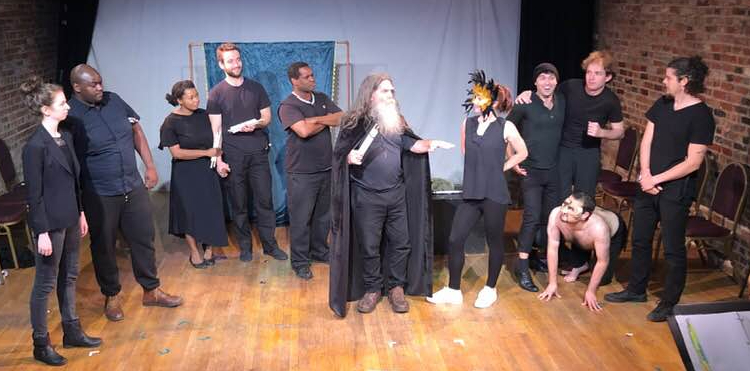
The Off-Off-Broadway Review Award winning Shakespeare Sports Theatre’s mission is to carry through Shakespeare’s works to the current times of how we, as Americans, view what Shakespeare saw from his life and times by creating theatre on the other side of the rainbow of our ancestors who created America.
Royal Pain: The Tragedy of Ivan VI
Review by Alice Greenwald, PhD.
Historical drama – more than likely thanks to The Crown – has become a marketable item on television and film but good ones on stage have not taken hold yet. A plausible hypothesis is that these dramas need a heavy dose of fill-in-the-blanks for all those closed door and lost years sequences. Something the cinema can do quickly that takes a budget to do for live performance. But the current entry in at category might change that.
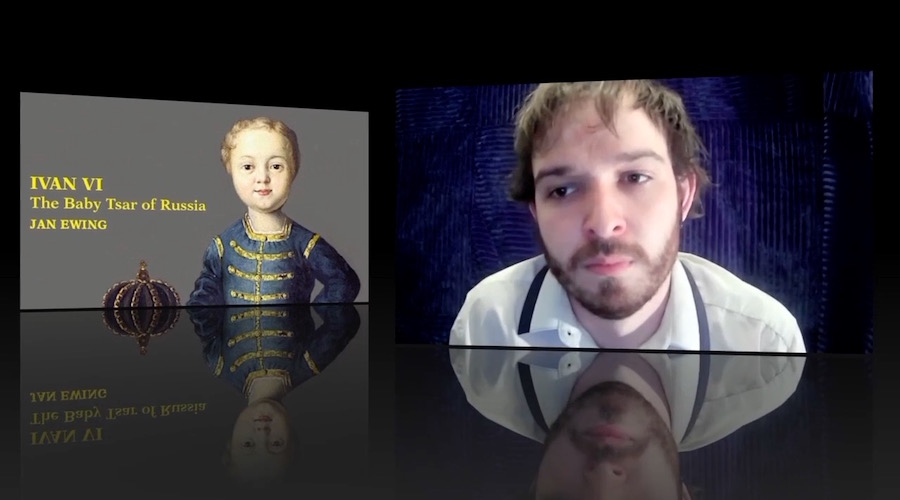
Jan Ewing’s dark and racy IVAN VI takes on the story of tragedy of power corrupting even the most innocent – the grandson of Ivan V, Peter the Great’s older brother, crowned, anointed and deified at the age of two-months, he was then forcibly removed by his cousin, Elizabeth, at fifteen months, and thrown into prison. The play opens in 1764 when Tsar Ivan VI is 24 years old. Alone in a cell for 20 years, his only companions are two guards – one a sadistic commander and the other who has deep and conflicting feelings toward the young innocent boy. He is also haunted by two spirits acting as his conscience. Are they just figments of his imagination or are they two creatures trapped between earth and hell forced to watch the painful proceedings. Outside his cloister, as one might imagine, there are increased rumblings among the people that Ivan should be placed back on the throne and revolution is in the air.
Ewing created an engrossing script and a lavish virtual production complete with music, precision and fascinating edits and cutaways, and quick – almost subliminal narration. Ironically, the extent of effects the show requests is not much faraway from the zoom version, making it highly marketable for regional, showcase, as well as NYC professional. Ewing handed us rich expansive dialogue that reads like a classic 19th century melodrama with ample supplies of sex and violence. This is not a condemnation as his choices were honest and completely necessary. Ewing served as director as well, making sure the cast lives up to his work … and they did.
Patrick Hamilton, and Gabriele Angieri set the pace as guards condemned to watch over the boy-now-man basically for the rest of his life. Hamilton allows a softness even in his aggressive words, giving us a seek peek to an inspired twist supplied by Ewing regarding Ivan; while Angieri’s presence stepped though the screen to give us a hardened soldier getting tired of loving his country and his rulers. Another formidable pair were Kristyn Koczur and Steven Mark Singer as the two tortured spirits keeping Ivan company. Playing it like a noir Noel Coward and Gertrude Lawrence, these affected specters served as de facto narration and exposition while haunting the titular Ivan. It’s a rare trick to make us laugh and cringe – Koczur and Singer did this admirably. Their natures gave us a chance to wonder whether they were specters or hallucinations from the jailed Ivan.
And speaking of the baby tsar of Russia, Matthew Tiemstra, ran the gamut of emotions and feelings during this relativity short (for an historical drama) play. Crying, laughing, yearning, hating, lucid, dream-like, convulsing, heaving, hoping, praying, living and the other thing, were served up to the audience by this exquisite actor. One can imagine – when this play takes on a live run – Tiemstra should reprise his role.
Zoom serves a noble purpose in awakening audiences to quality works such as Ivan VI for free or cheaply. Many companies will sadly abandon this unique opportunity so we’d better grab the gold while we can.
Ivan VI by Jan Ewing is now being solicited for a full run or cinematic presentation. Here’s hoping it happens.
Interview Series: Face to Face with Face to Face
While summer 2021 will begin a partnership between Smith Scripts, U.K. and Face to Face Films, producer/director Anthony Laura concludes his spring season with a pair of new works from his own hand.
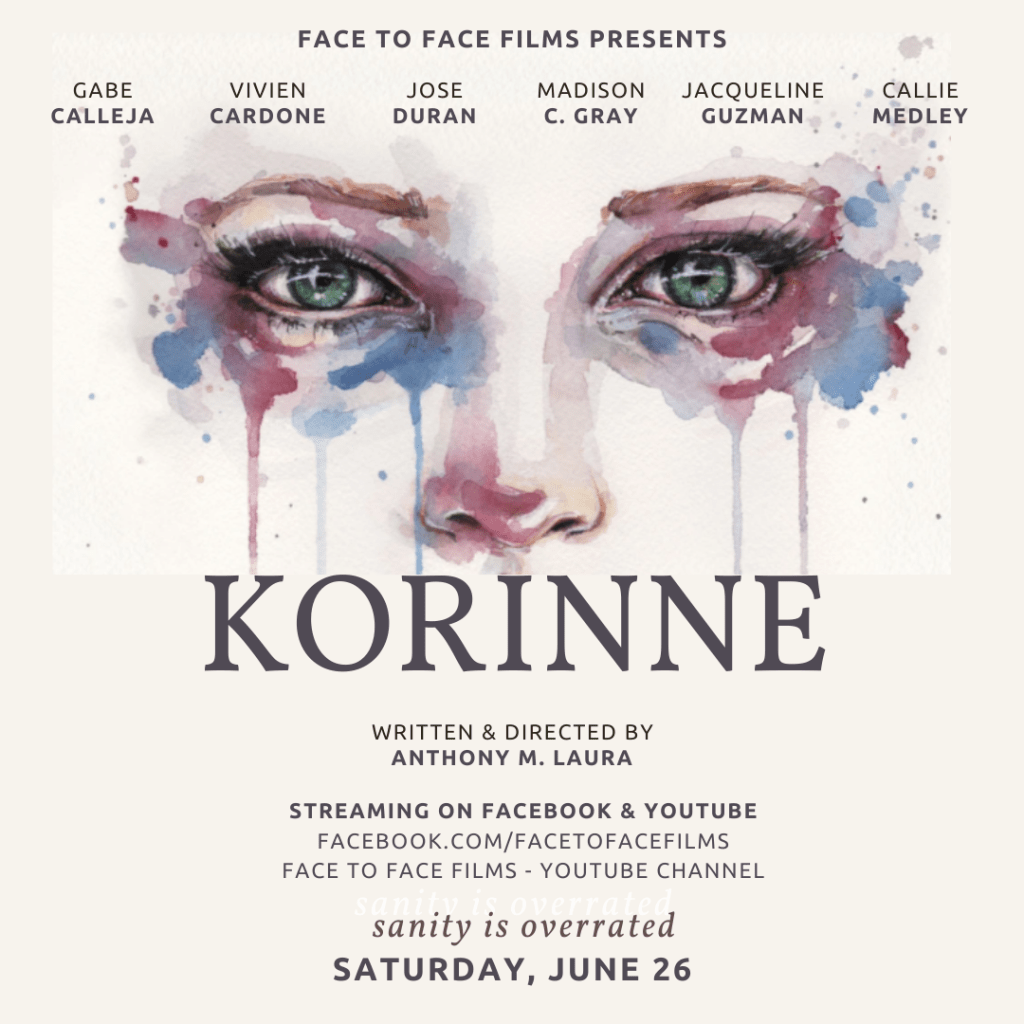
Korinne, a drama involving mental illness, written by Anthony Laura, featuring C Gabe Calleja, Vivien Cardone, Jose Duran, Madison C. Gray, Jacqueline Guzman, and Callie Medley, will air on YouTube, Saturday, June 26, at 2:00 p.m.
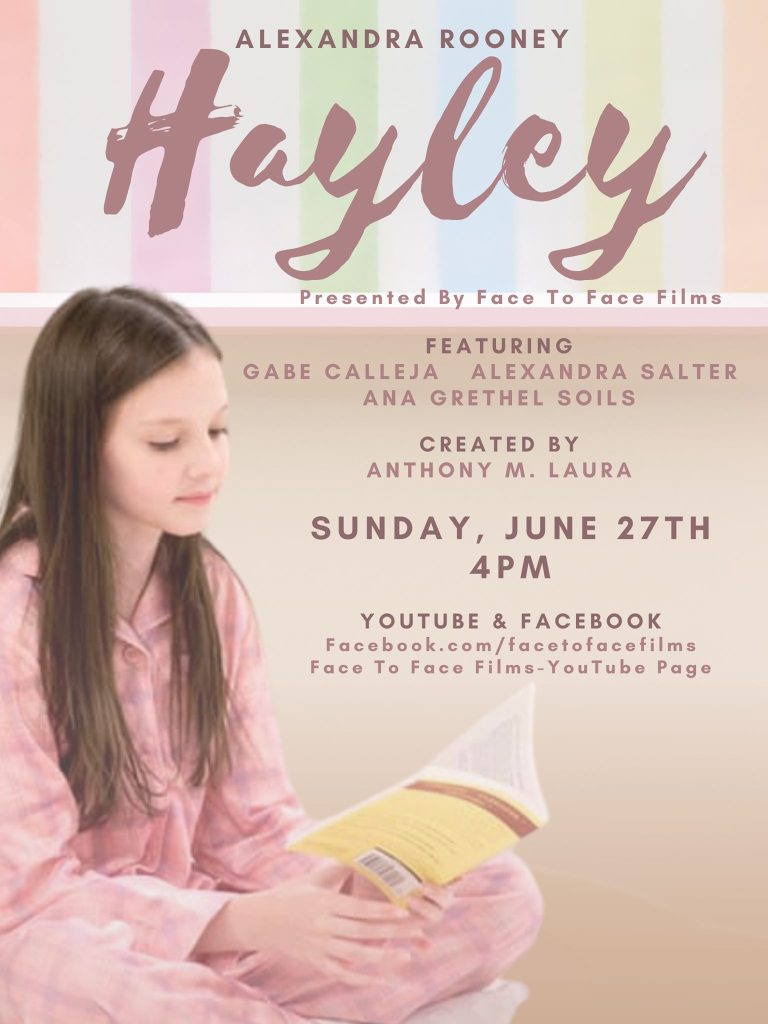
And closing the season will be another Anthony Laura work entitled Hayley, a one-person show, featuring Alexandra Rooney. This will air on Facebook on June 27, also at 2:00 p.m.
Visit Face to Face Films on YouTube to learn about Face to Face’s web-series, interviews, and other artistic endeavors.
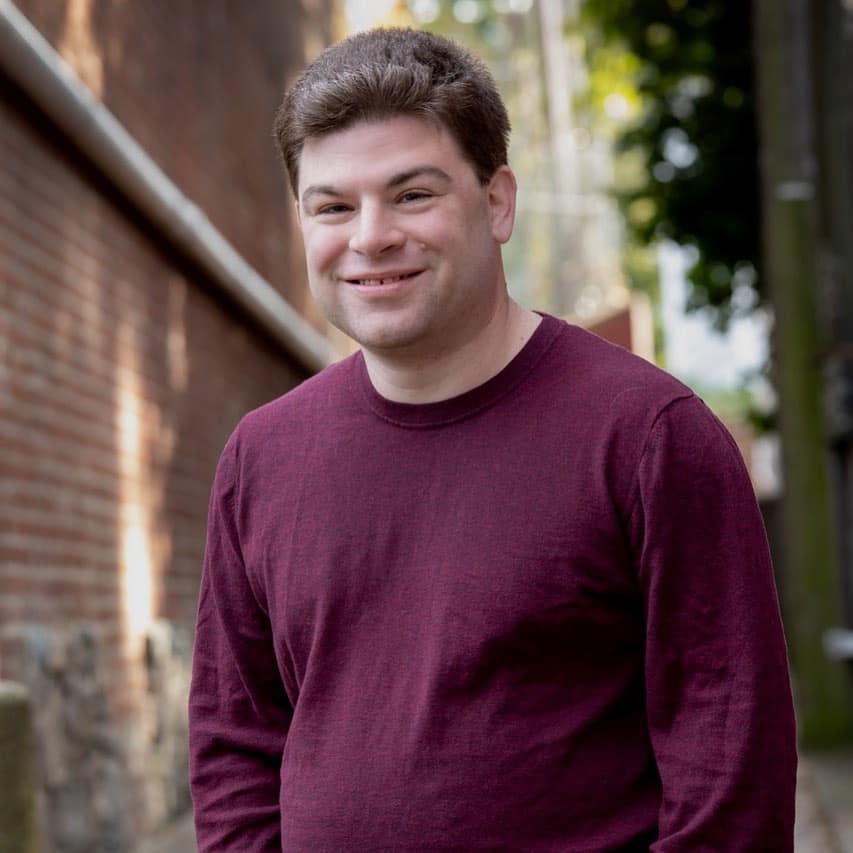
Ai spoke with playwright/director/producer, Anthony Laura on these two new works.
ANTHONY M. LAURA
What was your inspiration for remounting Korinne?
Similarly to “The Girl with the Red Hair” being the show that I am closest to as a playwright that I’ve written, “Korinne” represents the same feeling for me as a screenwriter. I wrote Korinne in 2013 and we made it into a film that I am so proud of. It’s a story that was always very close to me. I wrote it at a time when I was going through a major depression and thinking about suicide often. I was lacking hope in a lot of ways and I turned inward to create a relationship that made me feel hopeful. There is a love between Jane and Korinne that I continue to think about when I write current projects. What I love about the script is it continues to feel timeless. Everytime I open it up, or show it to someone, people seem to connect to the intimacy. Eight years later, I still feel the story is relevant and important and the only reason to remount is was for new people to experience Jane and Korinne’s story.
For Hayley, why did you decide to center a series around a younger version of a main character you have written?
Hayley Jones is my favorite character I have ever written. She’s a part of me and I love everything about her, from her warrior strength to her deep vulnerabilities and honesty. However, I wrote the Hayley character to be around the age of 27. About two years ago when we were workshopping the show, I decided to see what it would be like to add a younger version to the show. This led to meeting Alexandra Rooney, who has been a constant in the show and its development since 2019. Early on, I let Alexandra know that as she gets older, she will never be too old to play Hayley. The play will continue to grow with her. This led me to the idea of creating a web series following Hayley as she grows up from even before we meet her younger version in the play. It’s exciting to work with Lexie on how this character develops into someone who winds up slowly losing her sense of reality because of the trauma that happens to her. There are so many stories that happen before we hit page 1 of THE GIRL WITH THE RED HAIR and it’s really fun to work backwards.
Can you speak about the casting process for both shows?
First of all, both of these casts are absolutely stunning. Beginning with Korinne, Jacqueline Guzman and Calli Medley as Korinne and Jane have jumped in with such bravery and vulnerability that I get lost watching them. In rehearsal, their investment is full and it’s a hard show to go full out with. I’m in awe of them constantly. Vivien Cardone as Samantha and Jose Duran as Barry were the only people I thought about for the roles. Infact, I added scenes to the production to expand their relationship. The two of them are powerhouses. I’ve never seen work like this, both in their individual performances and in their work as a couple. It’s absolutely gorgeous to watch. Gabe Calleja plays Corbin and I’ve been given a lot of flack for the Corbin role in the past. Gabe came in and broke our heart with it. He is such a compassionate actor and lifted the role from the page. It’s a role where the consequences the character suffers is integral to the main characters growth and you need a confident actor to give themselves over to the storytelling that way. Gabe is always that actor. Finally, I’m so happy for the first time to be working with Madison C. Gray, who previously graced us as the company singer. As Maggie Kane, she brings an incredible energy and vitality that leaves a lasting impression.
For Hayley, Alexandra Rooney stepped right back into the role with such ease. She is one of the hardest workers I know. She is always there to see how she can better. It’s often remarkable she’s only 12. The places I’ve seen her grow in only two years of knowing her are astounding and she is absolutely hilarious and heartbreaking as Hayley. Gabe is doing double duty this month and joining as Hayley’s therapist, who he previously played in December. A relationship with a therapist and a young adult is a complex and compelling story to tell and Gabe is always interested in how to go deeper, how to provide support for Lexie and how to best tell the story. Lexie and Gabe have worked together a lot since last year and I love how much he looks out for her. Alexandra Salter, playing Elise Bell, recently joined our ensemble and I immediately wrote this role with her in mind. Alex (to not confuse with Ms. Rooney) has an incredibly raw quality to how she approaches her work. It’s mesmerizing to watch her moment to moment play with subtle differences that completely change the scene. It’s been such an honor working with her and I’m even more excited to continue that into next month when she plays Laura in THE GLASS MENAGERIE. Ana Solis also recently joined us and I wrote the role of Juliet with her in mind because I saw what she was capable of. The Juliet roles begins tying things into the universe of THE GIRL WITH THE RED HAIR and Ana has so much going on behind her eyes when she holds moments, you can’t look away. The whole cast is breathtaking.
What can we expect to see as the Hayley show develops?
We will start tying things even more to the show. We will bring in characters that are referenced in the show, as well as introducing new characters who are only part of this phase of Hayley’s life. This part of Hayley’s life is the time we begin forming bonds, the times that everything begins to matter a little more, so everything and every person she comes across will chart out who she’s going to be. The stories are endless and I can’t wait for you to see them!

Introducing Matt Frenzel
“I’ve been acting non-stop since high school. Theatre simply feels like it has always been a major part of my life. This is actually my first major role and show in Manhattan and and it has been a fantastic experience,” say Matt Frenzel, who just graduated from Queens College and embarks on a professional acting career in the same month.
Frenzel plays Jack-of-this-trade in celebrated play- and screenwriter, Rollin Jewett’s new work, THE BIG DREAM. This surreal piece follows an actor on the brink of a nervous breakdown whose life begins to circulate around him. Or is it his exaggeration of his life? Or is it all lies? Or is he a lie? or is he real?
A lot to unpack first time out of the gate. Ai spoke briefly with Matt after one of his few live rehearsals about this challenging role and the life of an artist.
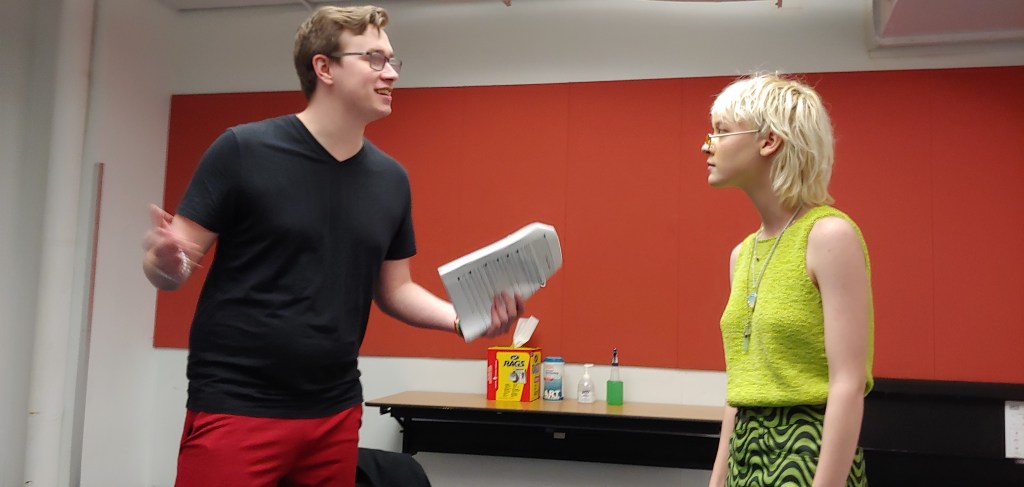
What are the challenges of doing an interactive play? And what are the challenges of doing one NOW?
While doing a play or musical, involving the audience very directly is always a fascinating dichotomy of intensely daunting and so extremely fun. The main challenge is, well, the audience doesn’t know how the show is supposed to go, so once you pull someone into this, you really have to be prepared for anything. I try to not think too hard about what they MIGHT do because I genuinely have no idea. I’ve always been pretty good at thinking on my feet so I generally enjoy the interactivity. The challenges NOW, however, are of course amplified because of social distancing and masks. We have to be extremely careful because, yes, we are interacting with our audience, but at the same time we have to remember that we are still very real people who are living through a very real pandemic and we have to make sure we are being safe.
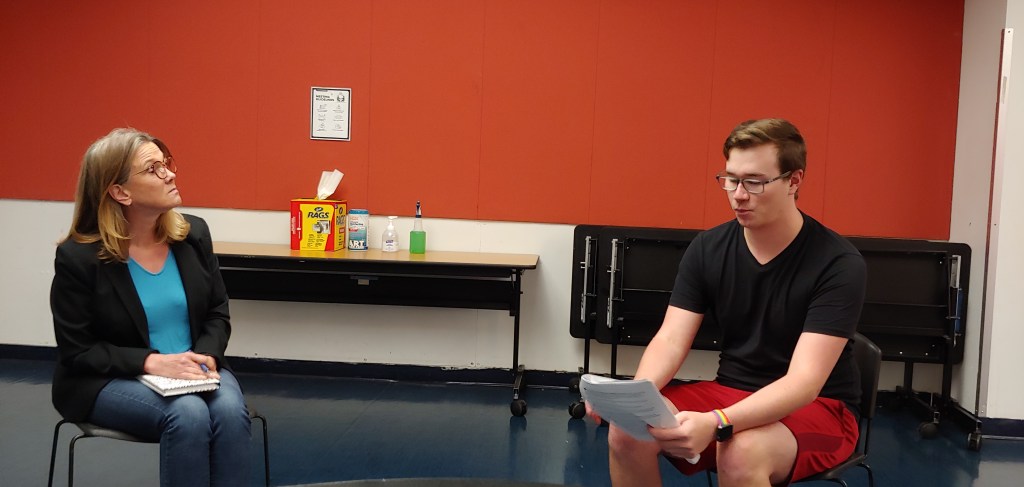
Elaborate on your feelings and concerns about returning to the live theater.
I am extremely excited to return to live theatre. It’s incredibly surreal. I feel so lucky to be a part of one of the first shows that people will be experiencing post-COVID. At the same time though, naturally we have to keep in mind COVID safety and health precautions. As much as we all love the theatre and it is a major part of our lives, the health and safety of our community and of our city are most important. But I am confident that all of the proper precautions are being taken and this will be a very safe experience.
What’s next for you?
As an actor who has mostly only done community theatre and high school theatre before this, I just hope more opportunities like this are next for me. This experience has been truly life changing and I would love to be able to build an actual career as an actor. It’s what I have to do. It’s who I am.
A film of Pandemic Proportions
Review by Lew Antoine
As we see the light at the end of the tunnel we start breathing a sigh of relief over the CoVid-19 pandemic. While not over, we start applying hope.
But what if that wasn’t what was to happen.
Roy Shellef’s film “Alone” takes us to the seventh-year anniversary of the pandemic – with no end in sight. Can we call this a horror film? Sure. Can we call it horrific? Definitely. Shellef, four languages, as many monologues, some creepy camera angles and effects plus some lonely guitar chords provides us with a cautionary tale of nightmarish proportions.
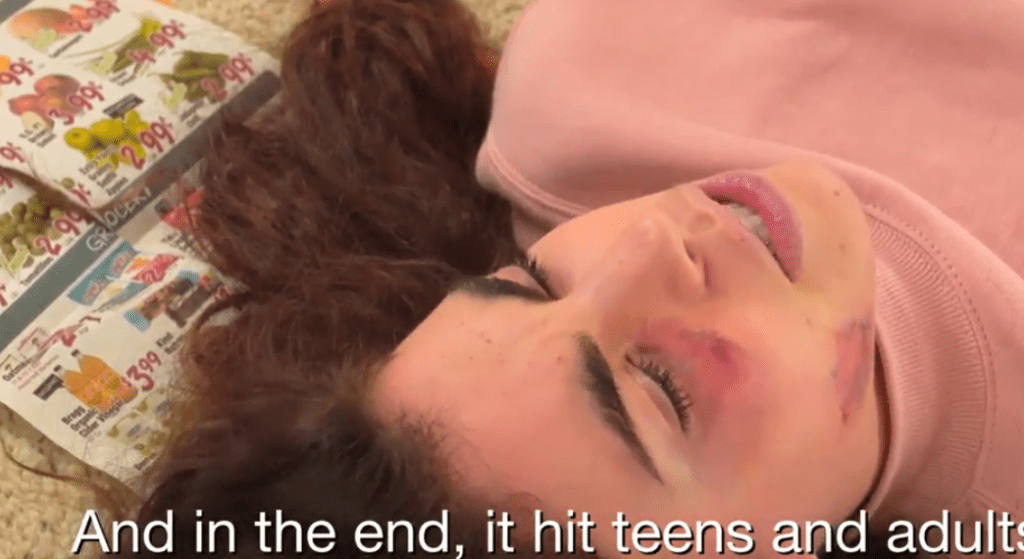
Make no mistake, there are no gory scenes, no eerie creatures, just four people alone on different parts of the world … thinking they are the only ones left. The simple dialogue serves to frighten more than any ghoul.
Joshua Wallace starts us off with command as an American – looking like a student – whose only friend is a recording devise allowing him to philosophize his terror; Eli Sundler perfectly sets us up to go around the world looking the part of a poet from a far-off land writing his final prose of the end of the world. Sundler gives us the feel of art dying; Chantal Casutt – particular devastating as a young french girl in the throughs of dying from this disease. Vacillating between madness and introspection the rash-ridden Casutt was a disconcerting harbinger of things to come for them all; Mariana Sanjuan, face dirty, sitting in front of a chalk board counting the days of loneliness, tells a story with the power one might feel when talking of any war; and Yijing Liz Song as a young woman who seems to be living in total terror. One might think that if she feels so alone why must she cower in the corner … what is she waiting for?
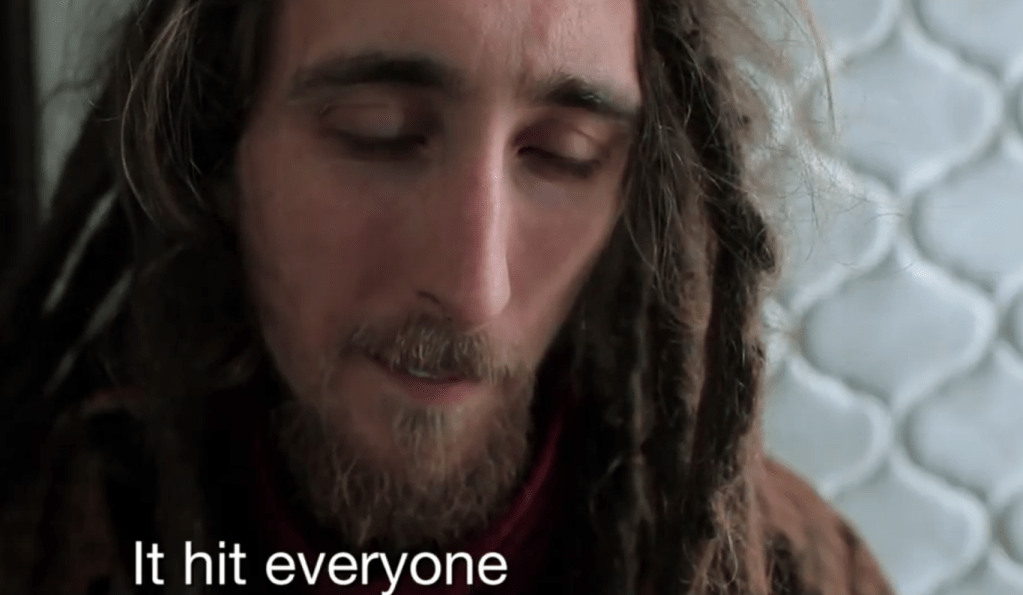
Each portrayed a different facet of loneliness. Interesting that there are five. Are these the stages of grief? If so, then Casutt might be acceptance and that would make the film even more terrifying.
Writer/Director/Producer/Cinematographer, Shellef seemed to hold the camera too close on his actors or cut away a bit too soon or revealed them in the middle of a sentence, making the film appropriately claustrophobic and morbid. Shellef kept it real and that made all the difference.
This really compelling work should be seen as the well-made film it is; as a cautionary tale; and as a chance to open a dialogue about what we are doing to ourselves and to each other.
Alone is currently touring the film festival circuit

“What kind of life do we want to live?”
“What kind of life do we want to live?”
Review by Brendan McCall
untitled: an exploration of grief
Created & performed by J. Bouey
(stream of live performance)
Part of La MaMa Moves! Festival, curated by Nicky Paraiso
12-23 May 2021
Fourteen months in. Have you ever paused and thought about what we have been through–from the impact of covid-19 on our health, professions, and communities, to the continued police brutality against Black and brown people; from misinformation and confusion over simple facts, to an insurrection against the nation´s Capitol in the name of the Big Lie. Sadly, stresses continue to plague our global society with alarming normalcy, from tighter voter restrictions to a new conflict between Israel-Palestine, from violence against Asian-Americans to the India´s staggering lack of resources to combat coronavirus.

How has all of this this affected our mental health? Our bodies? How do we move forward?
J. Bouey´s piece, untitled: an exploration of grief, invites viewers to participate in these questions, to reflect along with them during a performance which was live-streamed from the downstairs theater of La MaMa Experimental Theatre Club on Friday, 14 May, as part of their annual festival for dance, La MaMa Moves!, curated by Nicky Paraiso. Just as New York City begins opening up many businesses before we have even reached 50% vaccination rate, this year´s festival is a hybrid of dance films and streams for live performances.
The piece opens with J. seated, cross-legged, guiding the audience through a simple kind of guided meditation focused on breath. One advantage of this evening´s live-stream format is that the camera´s POV permitted us to close in on J.´s body, creating a far more intimate viewing experience than would be possible in the theater (although, at times, it was challenging to hear his soothing speaking voice, as he was not wearing a body mic).
After striking the edge of a meditation bowl, J. asks, “What kind of a life do we want to live?” As they answer in an elliptical, seemingly stream-of-conscious string of thoughts, J. simultaneously uses various props familiar to any dancer to massage their back, their legs, their neck. They emphasize the connective tissue of fascia as the individual body´s “first responders”, and encourages a metaphorical parallel to our collective body. The fascia connects all of our muscles with one another, as well as with the surface of our skin; just like our human nation, right? Aren´t we all connected?
The bulk of untitled: an exploration of grief is sharing time and space with J. It´s a bold act, having the performance be, essentially, J. stretching and listening to music and sharing some of their thoughts. However, by sustaining the boldness of this artistic choice for the duration of the piece reminds me of the “small dance” of Steve Paxton, or John Cage´s 4´33. Those pieces challenged what we think of as music and dance, but removing sound and movement from what we expect from the form. If there we witness J. “only” talking and resting, are they still “doing” something? Is this still a performance?
In untitled: an exploration of grief we witness J. Bouey take the time to rest, leading by example how each of us may prioritize or value rest, and to do it with purpose and intention. As things start to open up again, J. encourages each of us to take the time to explore not only what kind of life we want to live, but how we can live that life harmoniously, together.

The Naked Truth with Sean Stephens
Sean Stephens is an actor/singer/songwriter who hails from South Carolina. He peppers his vast litany of characters, comedy, and compositions with what he learned growing up in the south.

Sean is part of the revival of Queer musical comedy, CAMP MORNING WOOD, returning Off-Broadway, JUNE 4-20
AT ASYLUM THEATRE, 307 West 26thStreet. Conceived and directed by Marc Eardley, the critically acclaimed musical comedy features a book and lyrics by Jay Falzone, music by Trent Jeffords, Derrick Byars, Matt Gumley and Jeff Thomson with arrangements and orchestrations by Gumley and Jeffords. It also features nudity! https://campmorningwoodthemusical.com.
Camp Morning Wood tells the story of Randy, who – at a crossroads in his life, AND after a hellish 30th birthday – finds himself (thanks to a blown tire) at the front gate of a humble nudist camp. The camp itself is at a crossroads thanks to threats of closing by a tyrannical, right-wing Christian Senator. Randy is launched into a weekend adventure of titillating tunes, quirky campers, and soul-searching. Together they must find a solution to save the camp … and accept themselves. Randy and the campers bare it all – inside and out – in this wild cross between Rocky Horror and Wizard of Oz. Morning Wood takes “camp” to a new level.
Featured in the cast are Anthony Logan Cole, Thomas Delgado, Da’Merius Ford, Shelton Lindsay, Chris Ogren, Sean Stephens, and Brady Vigness. Premiering June 4 at Asylum Theater, 307 W 26th St, New York City. Evening and matinee performances and even late night showings include: June 4 @ 9:30; June 5 @ 11:00 p.m.; June 11 & 18 @ 9:30 p.m.; June 12 & 19 @ 2:00 & 5:00 p.m.; June 13 & 20 @ 2:00 p.m. Produced by Get Naked, LLC; General Management by Lyle Sterne, Anthony Logan Cole
Ai spoke with Sean before he put on his costume-er-make-up.
Is this the first time you’ve done a nude show? AND how does it feel to do a show like this?
I originated Derek in the last production so I’m excited to return in a new role. Honestly, the main focus is what you’re doing character wise. When you’re in the moment it doesn’t really even feel like you’re naked, you’re too focused on doing what you have to story and job wise.
OK, so we’re coming for the dicks and staying for the story… What’s the story of Camp Morning Wood?
It’s just an incredibly gay musical. It’s such a funny and out of left field story that I think it works. The absurdity is the point.
What’s one thing that makes this a show suitable for everyone? Or is there?
The resonating theme that we all want to be accepted for how we are. Baring it all (your heart) and being yourself is the most important thing you can do.

What’s next for you – clothed or not?
I’ll just be riding the re-opening wave. I’m looking forward to being able to make art after such a long break.


Emerging from plaything to person: QPAC presents Ibsen’s “A Doll’s House”
Article by Alice Greenwald, PhD.
What was once a stop-gap has grown into its own art-form. The Zoom-Play is now de rigeur among the theatre doers and goers and – while we’re patiently waiting for the vaccinated to outweigh the unvaccinated – we can rest assured the Zoom-Play is not going away.
The negative of it is that everything – good, bad, indifferent – can be recorded and displayed. That can make for countless hours of monotony. The really good part of it is that great works of the stage normally not shown for myriad unacceptable reasons can be shown.
Case in point: Henrik Ibsen’s A Doll’s House. This groundbreaking classic work is more timely today that during its premiere and in some ways even more daring.

Susan Agin and the Queensborough Performing Arts Center knew that and deftly produced a Zoom-Play presentation of it initially as a learning tool for its students and then made it available to all aficionados of fine drama. This alone shows their forward thinking and drive. They then handed the reigns over to Jay Michaels and a superior cast of professionals.
Ibsen’s seminal work tells the story of the Helmer family – Nora and Torvald – and those in their immediate stratosphere. As the 19th century comes to a close, we watch its ideologies begin to crumble – along with those of a subservient wife suddenly coming face-to-face both with her [actual] worth and how worthless she has really been. Her shock at learning the consequences of actions done in love and devotion to her husband send her through a maze of epiphanies that question her life and love. One might discuss how times have changed … very very slowly.
Director Jay Michaels is known for putting his own twist to the classics. His productions of Shakespeare’s canon and his contemporaries have won acclaim for inventiveness. Ironically, the wink that he normally applies is not part of his production of Ibsen’s masterpiece. Instead, director Michaels guides us through an intimate and deeply engrossing simplistically (but effectively) designed production allowing the material to breathe. Behind his excellent casting is a hint of period through virtual backgrounds and clever cutaways. This inspired departure from his wheelhouse delivered a definitive rendition of this play.
The cast supplies us with a sense of realism that delivers each punch with precision. Lydia Kalmen as Nora, the lady of the house, begins the play with a sense of naivety that is equal parts engrossing and heartbreaking. With every realization, we see her break and rebuild. Kalmen’s use wide-eyed innocence and lilting tone that so easily became resolve, was masterful as the three acts moved forward. She presented a litany of complex emotions worthy of tour-de-force. Paul Sheehan as Torvald, her husband, was a sea of gusto and bombast. In the wrong hands, the role could seem nefarious but Sheehan supplied the same level of innocence to his station as Kalmen allowing us to realize that all he was doing was living the privileged life he was supposed to live – allowing us the privilege of both fury and empathy toward the character. His flawless speech pattern allowed us to suspend electronic disbelief putting us in Victorian sensibilities and his powerful presence stepped through the camera. Their final exchange (the play’s true meat of the matter) was brilliant.
The other couple in this tale of emerging individualism is Rose Zisa and Pete Feliz as the widowed Mrs. Linde and the down-on-his-luck Krogstad. Choosing to tell her story in a symphony of side glances and pauses, Zisa provided brilliant commentary to Nora’s unwitting glee in being an elitist. Her desire to simply stand behind someone even though she was smarter than all around her should serve as a ponderous lesson. Zisa’s whispered tone gave us the feeling she felt she was always interrupting. Feliz knows what a “lean and hungry look” is and supplied us with some stunning confrontation scenes filled with it. Rumpled and looking a bit sweaty under his frock coat, Feliz’s exchanges with Nora over her indiscretion and how it looks no different that his own were to be savored. Krogstad is oft-called the villain of the play but here he a painful reality that we still face in this post-Trump era.
Dancing through the intimating and the comical, Vincent Ticali imbued freeloading family friend, Dr. Rank, with all the classic and classical nuisances making him a joyous addition and a mirror of a time gone-by and for good reason. Ticali cleverly used his camera making him seem larger (than life) and thus he served as the play’s “musical number.”
Peppering this soufflé were two servants – one a nanny to Nora’s children and the other a perfect Downton Abby style domestic. Donna White and Zara Zeidman as the nurse and maid, retrospectively, gave us fully realized characterizations of the underbelly of the class system of the time.
It will surely take an extra few minutes of scrolling to find stunning virtual experiences such as this on your computer but the search is well worth it. In the storm of viewing that is monopolized by Tiger King and endless Marvel movies, A Doll’s House produced by QPAC cuts through the noise to offer a powerful lesson handled with grace.
 Arts Independent