
Sometimes even when a show is clearly born out of a specific moment in time, a specific movement in the collective culture, the themes it touches on remain eternally relevant. Until Dark is such a piece. While clearly rooted in time in the midst of the Me Too movement, specifically dated as taking place in 2017, its discussions around yes sexual assault and consent but also past trauma and how it continues to impact our lives and how much it shapes our actions and how we take accountability for them is are bigger than one movement.

The script by Federica Borlenghi focuses on three sisters; Cass, Jackie, and Lisa. When one of Cass’ students from the yoga classes she teaches presses criminal charges against her following an incident, Jackie steps forward to act as her attorney. Most of the action takes place in the time leading up to Cass’ trial, an with all three sisters staying in Cass’ apartment, it becomes a breeding ground for tensions and unspoken resentments.
It’s a tightly written show with a fairly short run time that still manages to give a good idea of who these three people are and deliver a lot of information without it ever feeling rushed or cramped. Since much of the show is conversations between characters about past or off stage events, the script ran a risk of falling into telling too much and showing too little. Whether because of Borglenghi’s writing, her staging in her role as the show’s director, compelling performances by the cast, or a combination of the three, watching it never feels like it’s not showing you enough. The descriptions of specific events are appropriately evocative without needing to be overly detailed. The personalities and relationships of these sisters are clear and present.
As the youngest sister, Lisa, Luísa Galatti brings a frenetic energy that fits the youngest sibling role perfectly. She is caring and hopeful, almost naively so. Giorgia Valenti plays a Jackie who is so used to being the caregiver, the problem solver, and is feeling the weight of years of trying to handle everyone else’s problems. It’s clear that she cares, but it’s also easy to see her exasperation and exhaustion. Rounding out the cast is Maria Müller as Cass. Her performance is incredibly powerful, and she manages to capture a lot of complexity. All three shine in their respective roles.
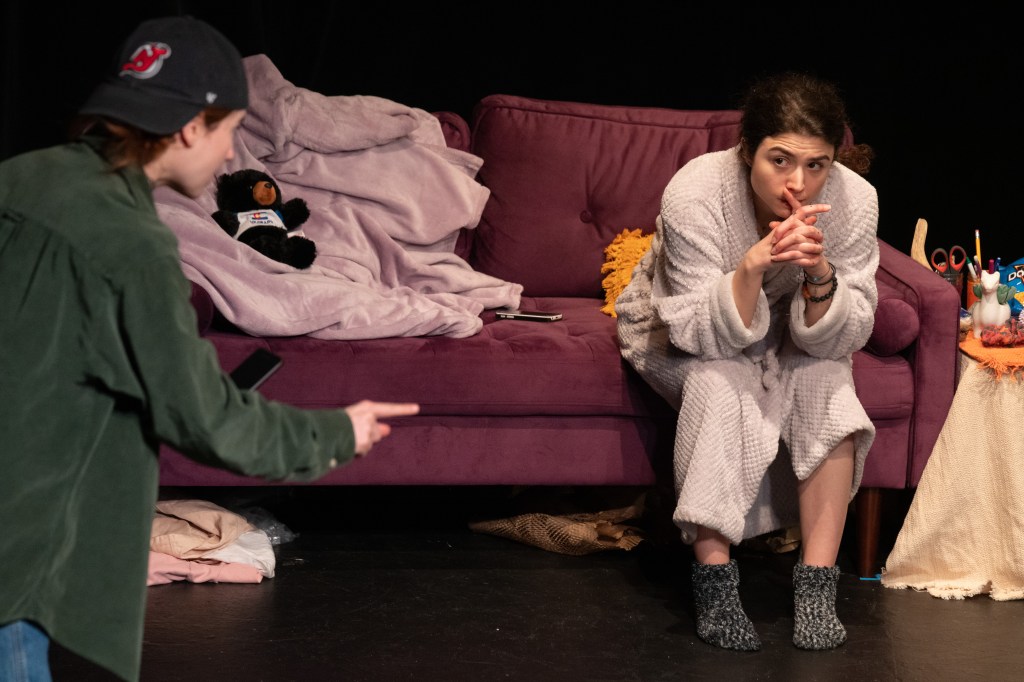
The show features set and props by Andrés López-Alicea. For a simple space, López-Alicea added a lot of detail to really create a detailed and fleshed out design that made for a lived-in world. The sound design by Stephanie L. Carlin was simple in that the show had simple needs when it came to diegetic sound, but her music composed for the show to underscore transitions and similar moments added a perfect amount of unease. Adrian Yuen’s lighting design was instrumental in helping shape the space and complimented the set perfectly. The whole design team (including costumes also by Borglenghi) did a great job creating a full and beautiful piece that filled but never felt too large for the venue.
A complex piece that handles difficult subject matter skillfully and delicately, talking about explanations for behavior without ever making excuses, Until Dark is a powerful show. And it manages to be on in a way that doesn’t lecture the audience or try and hit them over the head with a message. It simply presents three people amid a difficult situation without judgement. That sort of presentation is the best way to create a full picture of a complicated subject. For its compact run time, Until Dark manages to do that quite well.




 Arts Independent