
FIVE STAR chats with producers, Alice Camarota (AC) & Thoeger Hansen (TH) on the eve of the 80th Anniversary
Production of Jean-Paul Sartre’s existential classic
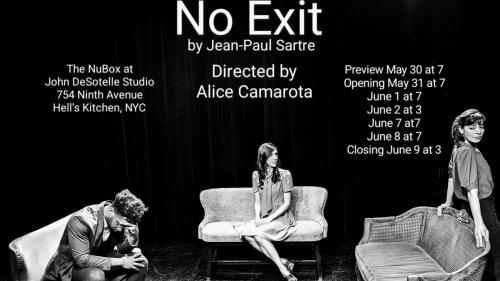
NO EXIT
The NuBox
John DeSotelle Studio754 Ninth Avenue, NYCReservations and further info:info@jaymichaelsarts.com
Special Preview: Thursday May 30 @ 7:00 pm
Opening: Friday May 31 @ 7:00 pm Saturday, June 1 @ 7:00 pm & Sunday, June 2, 3:00 pm Friday June 7 & Saturday, June 8 @ 7:00 pm Sunday June 9, 3:00 pm
Utilizing the Paul Bowles translation as well as elements from the original, director Alice Camarota transports us into Sartre’s version of Hell: A mysterious impenetrable room where individuals are trapped and forced to see themselves through the eyes of others. While — customarily — this is a depiction of the afterlife, Camarota’s scheme eerily opens us to the macabre parable of society seen through the lens of the social media avatar-engorged mirror.
“L’enfer, c’est les autres” or “Hell is other people”
The cast features Connor Wilson (Evil Dead, the Musical; Damn Yankees) as Garcin; Thoeger Hansen (E-Dreams) as Bellboy; Amie Margoles (Law & Order; House) as Inez; and Mandi Sagez (Cinderella 2020) as Estelle.
Five Star Arts Journals: What made you decide to do this play?
TH: When Alice and I met back in November to discuss co-producing, I had nothing more specific in mind than familiarity with and love for Waiting for Lefty by Clifford Odets, and Henrik Ibsen’s Hedda Gabler. Towards the end of our meeting, I asked what was at the top of her list of plays she dreams about directing, and without hesitation she answered, “Titus Andronicus.” Titus became my obsession for a week or so, until Alice talked some sense into me about how formidable a project it is and in particular the time needed to plan and execute it properly. With the goal of getting something on stage by late winter or spring, we pivoted. No Exit was a comparably viable option also at the top of her wish list.
AM: When I first read No Exit, I was already a fan of Camus, so Sartre’s play instantly spoke to me.
MS: When you get an e-mail from a director you’ve worked with multiple times that reads: “At this point you are my top pick for the role of Estelle and the only person I’m reaching out to, so if you want it, the part is yours.”…you say yes. I love working with Alice and trust her casting vision, so the decision was an easy one for me.
CW: I’d worked with Alice, the director, on a few projects before and she said she wanted to work with me on this, I jumped at the chance.
FSAJ: The initial message is that we are the sum of other people’s interpretations. Now, in the days of social media, avatars, and other “masks,” how has Sartre’s message stood up against the test of time?
AC: For me, the message of this show is that we create our own Hell and we create Hell for the people around us. This is more true now than ever when there are so many people physically and digitally around us that there is no escape.
TH: This is such a mind-bender to think about. Since the beginning of lockdowns in 2020, I have been obsessed with dystopian sci-fi and found myself reading or re-reading the relevant classics by Huxley, Orwell, Bradbury, et al and marveling at the predictive visions found in them. Sartre’s portrait of Hell is a different kind of future vision when it comes to anticipating the technologies of devices and social media. Incredibly dominant facets of our culture now require us to be camera-ready at all times, and to have our cameras ready to record whatever the thing is that’s about to happen. The part about always being in frame wholly devours the very idea of human fallibility and fragility. Yet every third moment of a normal person’s conscious life is a reminder of our humble limitations. And the impulse to press record, and have a device/lens in between ourselves and the thing happening live in front of us is, more than metaphorically, a deprivation of oneself from reality. In No Exit, all of the protagonists wrestle with aspects of it, but Estelle in particular embodies that notion of being unable to function without the comfort that someone or something can see her. She even says it. Humans’ simultaneous fear of and compulsion towards attention-seeking is part of why we are hooked on our devices and profiles. Sartre anticipated that as well as anyone.
AM: I think this play is still important, especially in this day and age of needing validation by the number of “likes” or “followers” one gets on social media. It hopefully reminds us that the need for so much reassurance is a cause for a lot of misery. One has to find the contentment in oneself and put aside what others think. We don’t know what they’re thinking anyway, and to quote Inez, “you don’t know what they want you to do anyway,” so you may as well do what moves you. I’m thrilled to be part of this group to help tell this story.
CW: I think it’s become more prevalent with the increase in “connectivity” and the explosion of social media. Now, more than ever, it seems we’re looking for an identity and are beholden to everyone else to tell us who and what we are. Before, when the play was written it was easier to get a more accurate opinion of who you were. We as human beings have always tried to put our best foot forward when meeting and interacting with others. After all, no one wants to air out their dirty laundry in public. But it was still you. Albeit a version of you that you created to make a good impression. Now with social media, every moment of our lives is doctored and tweaked, to paint us in the best light. And only the good parts of our lives. In order to exist in the echo chamber of whose life is better than who’s. But the principle is still the same now as it was then: We only exist as the image others conjure up in their minds about us and we are still trying to live up to that or chase this impossible standard instead of simply being what we are.
FSAJ: What is your creative process?
AC: I always go into the rehearsal room with an idea of how the show is going to look. I have a basic set design and basic blocking mapped out for the actors, but I like to give the actors room to explore their characters and play with each other. I want the process to be as collaborative as possible.
TH: My creative process as an actor is dry and studious. I elaborated on it in a recent interview about this production I did for Review Fix. Producing – at least the somewhat limited extent to which I’ve experienced it to-date – requires the type of creativity inherent in project management, since that’s basically what it is. That’s to say: the active-mindedness and curious-mindedness to not only devise the best possible solution for every challenge that arises, but to be able to anticipate those challenges – ideally before they make themselves apparent enough to immediately need attending to. It’s a different, probably less emotional and spiritual type of creativity than what’s available on the artistic side, and for that reason I enjoy it less overall. But I don’t hate it. It is a necessary part of life.
CW: For me, whenever I begin a project I read it a couple of times and I typically don’t make any choices or assumptions or make any notes about the character. And once I’ve a firm grasp on the story, only then do I start to play by allowing myself to create facts about the character. Like where he’s from, what he does, what his life is like according to the text and then I compile all this data and allow myself to let that go when rehearsing and see what comes up. And be open to whatever I happen to be feeling at the time informing what the character is feeling. I find it to be to least effortful on my part, I’m not trying to play an emotion or an action, if I’m tired, or grumpy or especially giddy that day, the character is too. And I think that the audience responds to seeing something real instead of an actor playing at something. I know I do. And that process doesn’t stop at rehearsal either. Even to the moment I’m on stage in performance I’m allowing myself to be influenced by what I’m feeling, the energy from my cast mates, the environment, so on. And I marry that with the actions of the text or other things we’ve cemented in rehearsal. If the character is meant to pick up something on a certain word, or shout at a certain point in the story, I will do all of those things but I never force myself to “feel” a certain way about it. Maybe I liked that another character touches me one night, maybe tomorrow I don’t. And that feels real to me and it keeps it fresh and enjoyable.
FSAJ: Do you feel an extra sense of responsibility in doing a piece so known; so historic?
AC: To be honest, I didn’t think about that when I picked this play. I have always loved this show and knew that I wanted to be able to tell this story when the opportunity came up.
TH: I subscribe to the notion that we stand on the shoulders of those who came before us. There may be many reasons why a certain play or other work of art becomes famous and time-honored. They often begin with the sheer effectiveness and relevance of the art. By doing our best to honor the play, we honor not just Jean-Paul Sartre, the person behind its vision, but everyone else who has worked on or appreciated the play since he created it, because they all have also contributed to its impact. We line up to humbly take our places in that procession.
MS: Every interpretation of a script will be unique to the actor/cast/director putting it on, so the responsibility I feel is the same as any other production – to honestly portray my character and to collaborate with the cast and director to create a cohesive story that resonates with audiences.
CW: Anytime you’re working on a play, especially one as revered as this one, you do feel a certain responsibility toward to source material and the character. But I usually try to stay in the mindset of “this is my shot at this story and as far as I’m concerned it’s never been done before” and that keeps pressure off of me for my own sanity and also allows me to not have to compare myself to previous iterations. But trust in the director and other actors goes a long way and makes it a lot easier to allow myself to still do my job while also not fretting too much over the reverence of the piece.
FSAJ: What is hell to you?
AC: For me, Hell is over stimulation without rest. I love to work hard and go hard, but I also need to take time just for myself. Without that, life can become Hell.
TH: Difficult to pin down. I’m a pretty patient person.
CW: Being trapped in a room full of Swifties during Super Bowl 58





 Arts Independent