
The Story of the Legendary Stormé, Hero of the Stonewall Uprising and So Much More, Is Beautifully Brought to Life at the ATA
“It was a rebellion,” Stormé declared. “It was an uprising…it wasn’t no damn riot.”
Carolyn M. Brown’s musical drama about the life of iconic 20th Century singer and drag performer, activist and protector Stormé Del DeLarverie is a must-see, and a reminder of everything that matters in the troubled times that we face here and now.
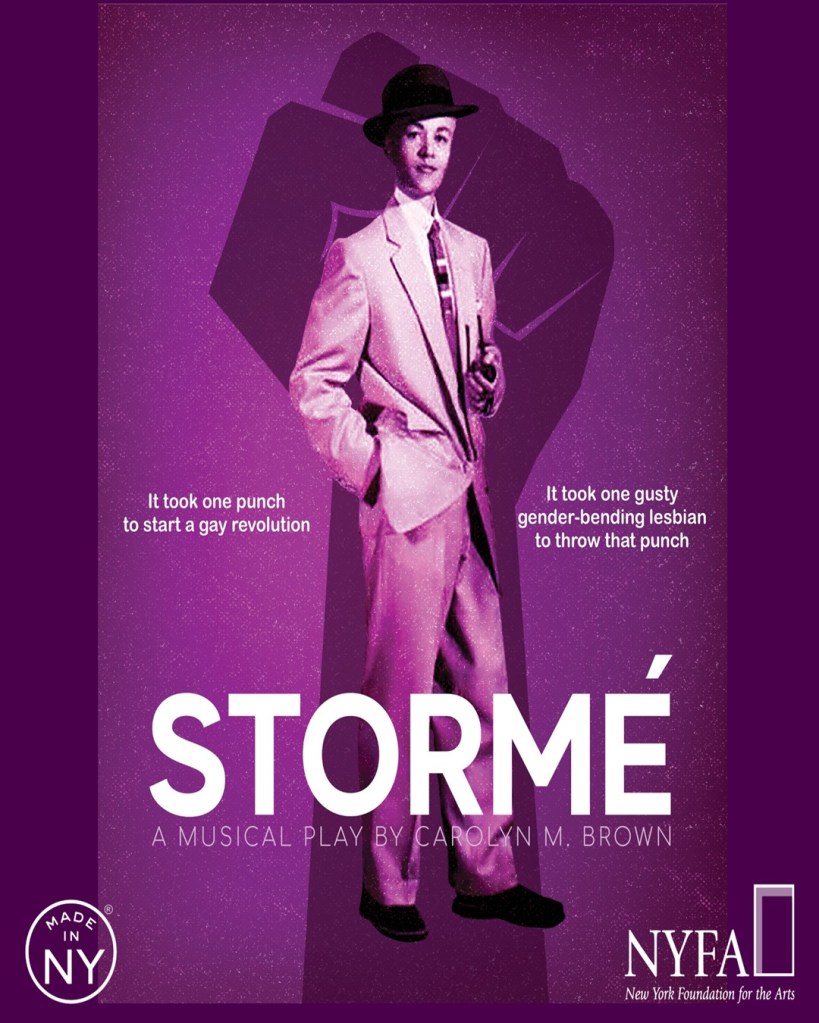
Stormé is portrayed magnificently by Yanece Cotto, who we first see at the Henrietta Hudson bar of the early 90s to tell colleagues (and us) the story of her journey. “I’m a bouncer, though I don’t like to be called that,” Stormé explains, appearing in full “sheriff” regalia. “No, I am a well-payed babysitter and protector of my people. I patrol these streets at night, on the lookout for any ugliness…I won’t have it. Not on my watch.”
Stormé was born in New Orleans in 1920, facing a life of abuse and rejection due to being a lesbian of mixed parentage. Undeterred, Stormé found her place in Chicago as the big band singer “Stormy Dale”, and later as a Drag King in Harlem with the Jewel Box Review (the intended short-term gig lasting 14 years). Her journey brought her to the love of her life, her beloved partner Diana Prasad (Asha Devi). Along the way she also befriended the legendary jazz composer Billy Strayhorn (Antonyio Artis), and the pioneering Drag Queen Billy Daye (Joshua Boyce). Sean Segerstrom, Aidan Martinez, Jenna Lucht, and Iain McLennan all deftly play multiple roles, depicting the heroes and villains and everything in-between that pass through Stormé’s life.
The play chronicles pivotal moments through the real-life adventures of the prolific performer, who as a Drag King in NYC was a target of cops who aggressively enforced the absurd laws against “cross-dressing” that were on the books in the era (likely as a quick way to boost their arrest records). Events climax at Stonewell in June 1969, when Stormé was seen to be on the first line of defense against the police persecution that plagued the now-historic home to LGBTQ+ performers and patrons.
It was shortly after that Stormé became devoted to fighting social injustice and defending the marginalized and oppressed, becoming “The Sheriff of Greenwich Village” (and as noted, fabulously looking the part).
“A change is gonna come,” proclaims Stormé. “People are tired of hiding in the shadows.”
As befitting a story about the lives of these incredible performers, Stormé is filled with rousing music rendered with panache by the cast. Cotto brings us the Gershwin classic “Man I Love,” in Stormé’s first Chicago audition; and the spectacular original song, “What’s a Show Without Ladies,” written by Christie Chiles Twillie and Nico Juber.
Boyce as Billy Daye gives us a stunning mini-concert, belting “St. Louis Blues,” and “Ain’t Nobody’s Business,” juxtaposed with a heartbreaking story about childhood abuse and rejection. Artis’s voice is stunning as his Billie Strayhorn delivers the moving “Something to Live For”, and later teams with Cotto on “Sweet Georgia Brown.” The three come together to deliver the emotional closing number, the legendary Joe Raposo’s “Being Green,” and both performers and audience are united; we’ve all been “green” at some point in our lives.
Stormé is an incredible theatrical experience and an excellent reminder of (or introduction to) an icon whose story needs to be told far and wide. It is a window into a history and a culture that perseveres even as hatred and ignorance rear their ugly heads once more; and it is also a celebration not to be missed.
Stormé is directed by Kevin Davis, with Musical Direction by Nicholas Sienkewicz. As part of the Icons Festival, it runs at the American Theatre of Actors through June 15, 2025.


 Arts Independent