
Article by guest writer, Dr. Mira Solis
As the Fresh Fruit Festival prepares to raise the curtain on its 2026 season, all eyes are on the Mainstage at The Wild Project. Opening the festival is a visceral new work that promises to be as messy as its title suggests: The Sloppy Abandon of Excavated Love.
For Dennis Bush — a playwright whose work has resonated from London to Johannesburg — this production marks a poignant return to a creative “home.” In this in-depth look, we explore the origins of the play, the weight of queer history, and the delicate balance between the “editor brain” and the raw pulse of independent theatre.
The Catalyst: A Journal from the 1980s
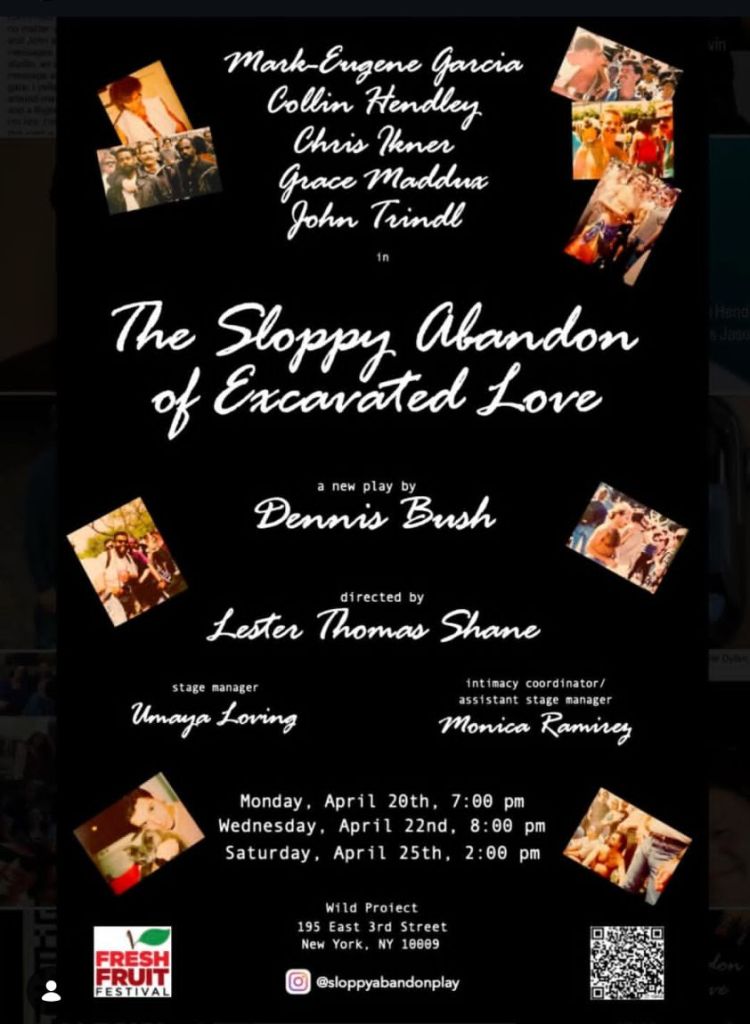
At the heart of the play is Marcus, a man who, prior to the first scene, has already been “absorbed” by a found journal from the 1980s. While some might see a diary as a mere window into the past, for Marcus, it is an excavation site.
Selecting the 1980s as the focal point was no accidental choice. It was an era defined by a “sloppy” and negligent government response to the AIDS crisis—a time when an entire generation of gay men was treated with contempt by the Reagan administration. By digging up these stories, Marcus isn’t just reading history; he is inviting a ghost into his modern-day relationships.
“As we excavate the layers of history and the layers of our relationships, sometimes we encounter love and sometimes it’s just a sloppy, emotional mess.”
The Friction of the Present
The play finds Marcus in the aftermath of a breakup with his ex-boyfriend, Jason, and navigating a strained living situation with his roommate (and former roommate-with-benefits), Kelvin. The journal acts as a magnifying glass for fractures that were already there.
While Kelvin and Jason blame the physical object of the journal for Marcus’s detachment, the play suggests a more complex power: the past has a unique ability to disrupt the present when honesty is in short supply.
The Anatomy of “Sloppy” Love
The title, The Sloppy Abandon of Excavated Love, serves as a visceral descriptor for the human condition. In the world of this play:
- Sex is sloppy: It is often used as a substitute for the terrifying work of honest communication.
- Politics are sloppy: Reflecting on the systemic failures of the 80s and 90s.
- Emotions are sloppy: The mess that occurs when people try to hang onto a version of a relationship that no longer exists.
Despite the “damage” and “flaws” of these characters, the narrative is ultimately an audacious and inspiring one. It isn’t a story about a descent into obsession; rather, it is about the return—the difficult journey of facing the things that broke us apart in order to move forward.
A Creative Home at The Wild Project
Staging the work at The Wild Project provides an essential layer of intimacy. The proximity of the audience to the actors transforms the play into a shared journey. This setting is particularly vital for a cast that the playwright describes as a “dream company”:
| Character | Actor | Defining Quality |
| Marcus | Chris Ikner | Set the bar from the first audition. |
| Kelvin | Mark-Eugene Garcia | A passionate supporter who threw himself into the role. |
| Aaron | John Trindl | A radiant mix of candor and curiosity. |
| Jason | Collin Hendley | Brought unexpected heart and good humor. |
| Sula | Grace Maddux | A force of nature who reimagined the character. |
Led by award-winning director Lester Thomas Shane, this ensemble is tasked with balancing “savage wit” with “emotional bombshells.”
The Consultant’s Craft: Writing vs. Editing
For a writer who also serves as a high-level script and dialogue consultant, the creative process is a disciplined split. The “writing brain” takes over from 10:00 pm to 3:00 am—a time for raw creation. The “editor brain” is reserved for the late morning, sharpening the dialogue that has allowed these stories to be produced in all 50 U.S. states and nearly every Canadian province.
This international resonance stems from a simple philosophy: Specificity leads to universality. Whether a director is in Laos or an actor is in Singapore, the core struggle to find meaningful connection remains a universal human language.
The State of the Indie Scene in 2026
As the play sets the tone for the Fresh Fruit Festival, it also serves as a reminder of the challenges facing independent creators. In a landscape where funding is scarce and support is hard-won, the playwright argues that artists are the “mirrors” society needs to see itself clearly.
The Sloppy Abandon of Excavated Love is more than a play; it is a bridge between the queer history of the 80s and the lived reality of 2026. It reminds us that while the excavation of the past is messy, it is the only way to find the truth buried beneath the surface.




 Arts Independent