
Home » Articles posted by jaymichaelsae
Author Archives: jaymichaelsae
The Archaeology of Intimacy: Excavating Love, History, and Modern Disconnect in Dennis Bush’s The Sloppy Abandon of Excavated Love.
Article by guest writer, Dr. Mira Solis
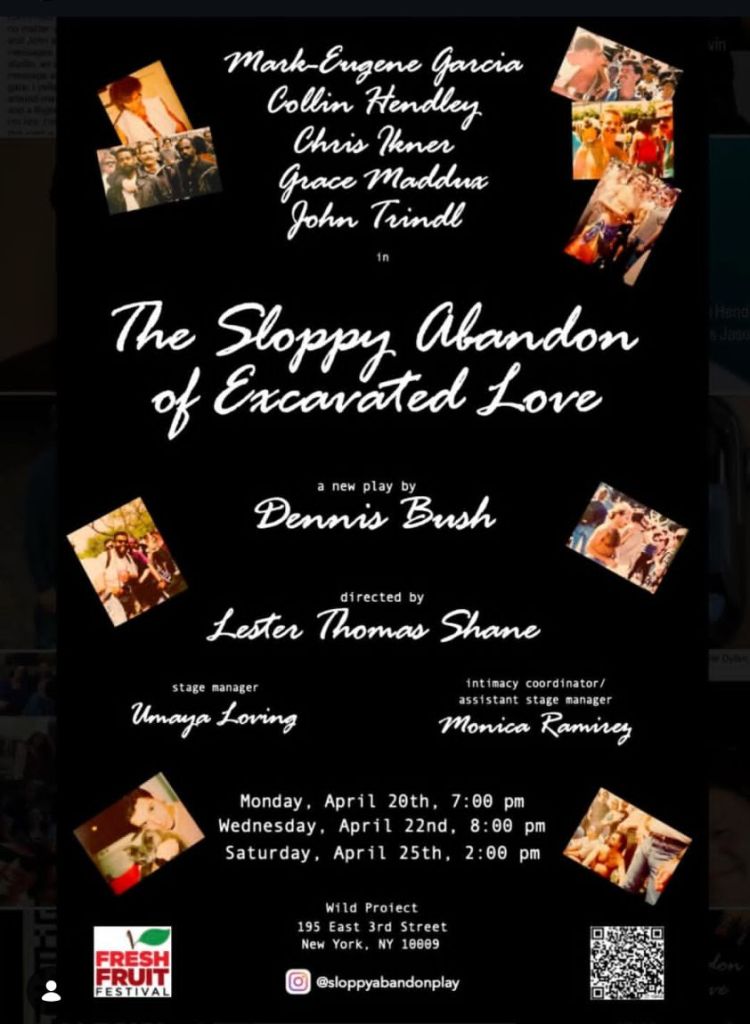
As the Fresh Fruit Festival prepares to raise the curtain on its 2026 season, all eyes are on the Mainstage at The Wild Project. Opening the festival is a visceral new work that promises to be as messy as its title suggests: The Sloppy Abandon of Excavated Love.
For Dennis Bush — a playwright whose work has resonated from London to Johannesburg — this production marks a poignant return to a creative “home.” In this in-depth look, we explore the origins of the play, the weight of queer history, and the delicate balance between the “editor brain” and the raw pulse of independent theatre.
The Catalyst: A Journal from the 1980s
At the heart of the play is Marcus, a man who, prior to the first scene, has already been “absorbed” by a found journal from the 1980s. While some might see a diary as a mere window into the past, for Marcus, it is an excavation site.
Selecting the 1980s as the focal point was no accidental choice. It was an era defined by a “sloppy” and negligent government response to the AIDS crisis—a time when an entire generation of gay men was treated with contempt by the Reagan administration. By digging up these stories, Marcus isn’t just reading history; he is inviting a ghost into his modern-day relationships.
“As we excavate the layers of history and the layers of our relationships, sometimes we encounter love and sometimes it’s just a sloppy, emotional mess.”
The Friction of the Present
The play finds Marcus in the aftermath of a breakup with his ex-boyfriend, Jason, and navigating a strained living situation with his roommate (and former roommate-with-benefits), Kelvin. The journal acts as a magnifying glass for fractures that were already there.
While Kelvin and Jason blame the physical object of the journal for Marcus’s detachment, the play suggests a more complex power: the past has a unique ability to disrupt the present when honesty is in short supply.
The Anatomy of “Sloppy” Love
The title, The Sloppy Abandon of Excavated Love, serves as a visceral descriptor for the human condition. In the world of this play:
- Sex is sloppy: It is often used as a substitute for the terrifying work of honest communication.
- Politics are sloppy: Reflecting on the systemic failures of the 80s and 90s.
- Emotions are sloppy: The mess that occurs when people try to hang onto a version of a relationship that no longer exists.
Despite the “damage” and “flaws” of these characters, the narrative is ultimately an audacious and inspiring one. It isn’t a story about a descent into obsession; rather, it is about the return—the difficult journey of facing the things that broke us apart in order to move forward.
A Creative Home at The Wild Project
Staging the work at The Wild Project provides an essential layer of intimacy. The proximity of the audience to the actors transforms the play into a shared journey. This setting is particularly vital for a cast that the playwright describes as a “dream company”:
| Character | Actor | Defining Quality |
| Marcus | Chris Ikner | Set the bar from the first audition. |
| Kelvin | Mark-Eugene Garcia | A passionate supporter who threw himself into the role. |
| Aaron | John Trindl | A radiant mix of candor and curiosity. |
| Jason | Collin Hendley | Brought unexpected heart and good humor. |
| Sula | Grace Maddux | A force of nature who reimagined the character. |
Led by award-winning director Lester Thomas Shane, this ensemble is tasked with balancing “savage wit” with “emotional bombshells.”
The Consultant’s Craft: Writing vs. Editing
For a writer who also serves as a high-level script and dialogue consultant, the creative process is a disciplined split. The “writing brain” takes over from 10:00 pm to 3:00 am—a time for raw creation. The “editor brain” is reserved for the late morning, sharpening the dialogue that has allowed these stories to be produced in all 50 U.S. states and nearly every Canadian province.
This international resonance stems from a simple philosophy: Specificity leads to universality. Whether a director is in Laos or an actor is in Singapore, the core struggle to find meaningful connection remains a universal human language.
The State of the Indie Scene in 2026
As the play sets the tone for the Fresh Fruit Festival, it also serves as a reminder of the challenges facing independent creators. In a landscape where funding is scarce and support is hard-won, the playwright argues that artists are the “mirrors” society needs to see itself clearly.
The Sloppy Abandon of Excavated Love is more than a play; it is a bridge between the queer history of the 80s and the lived reality of 2026. It reminds us that while the excavation of the past is messy, it is the only way to find the truth buried beneath the surface.
Tickets available at https://events.ticketleap.com/events/alloutarts

Jim Catapano reviews Anne L. Thompson-Scretching’s Home Is Sweet Sorrow: “A Masterful Conclusion to a Momentous Family Saga”
The War That Never Ends
Home Is Sweet Sorrow is a must-see and a devastatingly powerful third chapter in the Blood trilogy, which also includes the highly regarded A Lesson in Blood and A Long Way From Home. Anne L. Thompson-Scretching’s prolific pen and deft direction again triumph in a depiction of an American family wounded by war and the trials of the mid-20th Century.
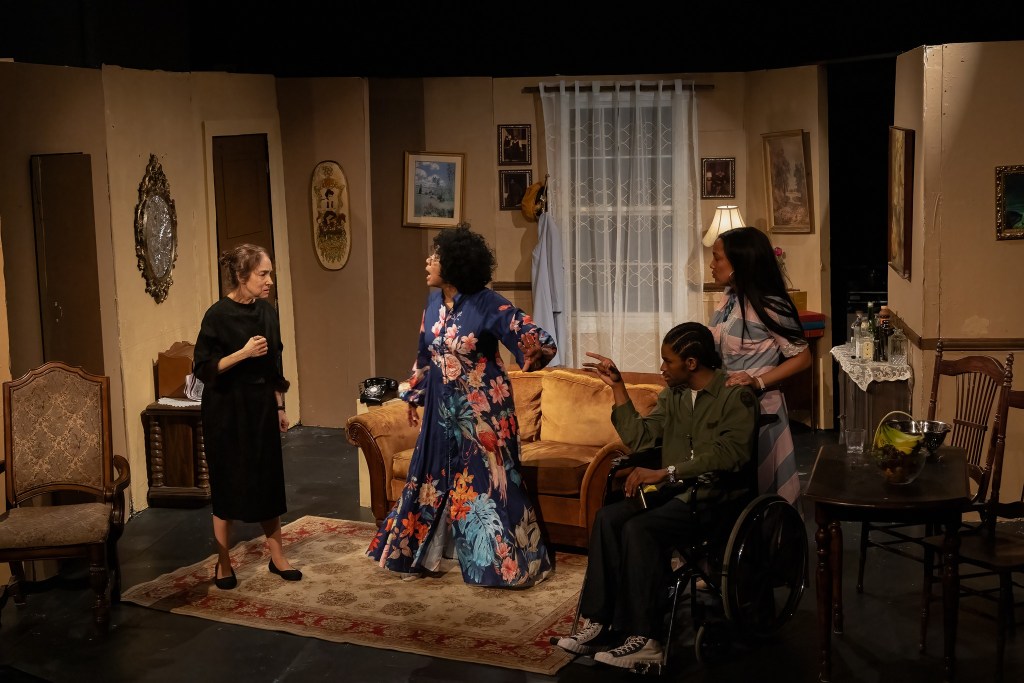
It is 1971, and PFC Willie Taylor (Laquan Hailey, reprising his role from A Long Way From Home) has come home from Vietnam. He is in a wheelchair, but his prognosis to walk again is good. Though he may soon regain his mobility, the damage to his mind is far less likely to ever be healed. He is a stranger to himself and to his family: mother Shanna (Gina McKinney), father Jacob (Kevin Leonard), and sister Luella (Joy Foster). Non-blood cousin Ceola Red Feather (Carrie Johnson) is the daughter of Oceola (the lead character of A Lesson in Blood); she has gone to school and now has medical training that she can help Willie with, and the two eventually begin the romantic relationship they were destined for. Rommell Sermons (Chester in A Long Way From Home) appears as Thomas Avery, a sergeant who visits to try to get Willie help for his PTSD.
That PTSD has shattered Willie’s personality and threatens his very sanity. After he arrives home (significantly not wearing his uniform), the mother he had missed so very much tries to help him navigate a tight hallway in his chair, and he snaps instantly and violently. He has developed a drinking problem—reaching for the bottle when the nightmares come (and they do, every time he closes his eyes), when the cars backfire like rifle shots, and when the flashbacks in his head threaten to consume him.
“I don’t know who I am or what I’ve done,” Willie despairs. “Them doctors, they only patched up the hole inside me and sent me on my merry way…sometimes when I wake up, I still feel like I’m dead. I can’t be the same person I was before I left here.”
Adding to his own trauma is that his friend and fellow PFC Jamie Lofton perished under suspicious circumstances in Vietnam. Jamie’s devastated mother Abigail (Elly-Anne Ehrman), aware of the secret that was her son’s burden, has come looking for answers from Willie, and a painful revelation adds even more horror to the already devastating effects of a war that no one wanted.
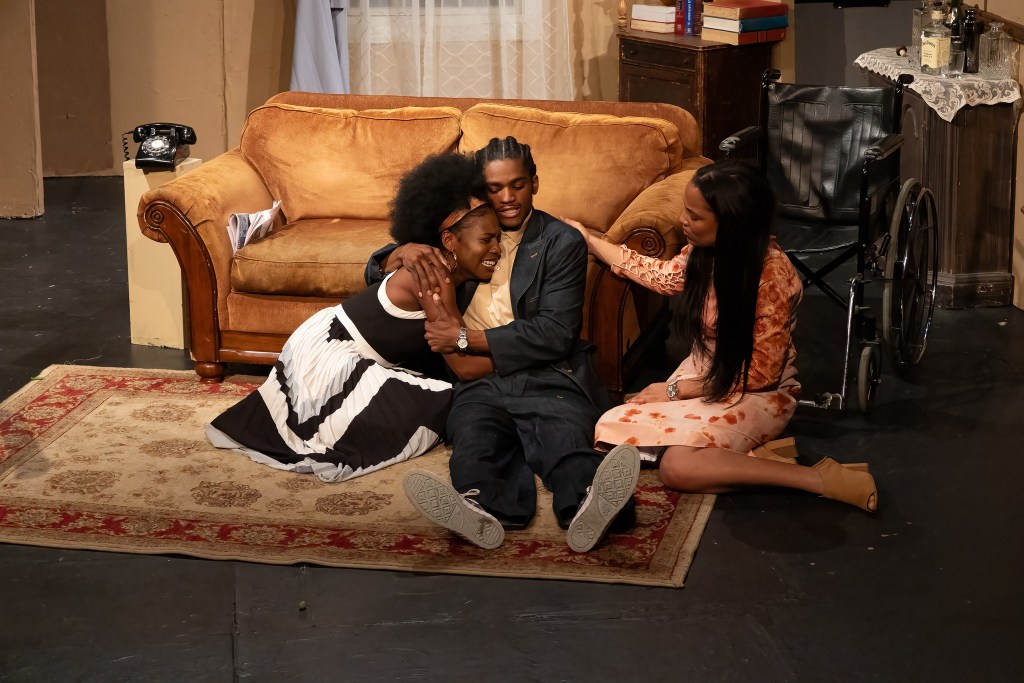
The relationships among the characters are so well-realized and so well-acted, anyone watching Home is Sweet Sorrow could almost feel like they truly are in the home of the Taylors in 1971. They share many a meal and many a drink, namecheck All in The Family and Ed Sullivan, and truly give the sense of having been through a great deal together. Each and every one of them feels like a real living and loving human being, and so their happiness and pain are felt viscerally. We find joy in their warmth and connection, thus making the moments when that connection is severed all the more painful to witness. Willie’s devotion to his Shanna is damaged by what he sees as her inability to grasp what he’s been through, and she is left terrified, forced to walk on eggshells in fear of the traumatized shell that her son has become. Shaina and Abigail, ostensibly friends, clash over their grief and their individual need to honor their sons, one who is gone physically and one emotionally. Jacob plays peacemaker and is anguished that any returns to normality are short-lived. Anne L. Thompson-Scretching’s powerful dialogue and skillful world-building are astonishing, as is her bravery in reminding us that resolutions and closure are not to be found in the brutal reality that Home Is Sweet Sorrow so poignantly depicts.
Layton Lamell, Patricia Fields and Sania Hyatt are Swings for Willie, Shanna, and Luella respectively.
Presented as part of the African American Playwrights Initiative, Home Is Sweet Sorrow is performed at the Sargent Theatre at The American Theatre of Actors through March 29, 2026.

THE BARD TAKES BROADWAY: SIXTH ANNUAL NEW YORK SHAKESPEARE AWARDS CELEBRATES RECORD-BREAKING 2025 SEASON
THE BARD TAKES BROADWAY: SIXTH ANNUAL NEW YORK SHAKESPEARE AWARDS CELEBRATES RECORD-BREAKING 2025 SEASON

The New York Shakespeare Awards has officially unveiled its list of winners for 2025, marking the sixth year of celebrating the most impactful contributions to the Bard’s legacy. The 2025 season represents a cultural “High Renaissance” for Shakespeare in Manhattan, defined by unprecedented commercial dominance on Broadway and a flourishing independent scene.
A BROADWAY JUGGERNAUT: SHAKESPEARE ON STAGE
The year 2025 will be remembered for the moment Shakespeare became Broadway’s most profitable leading man. The Shakespeare on Stage Award has been granted to the historic production of Othello, a production that redefined the financial and cultural ceiling of classical theater.
- The Power of the Production: Starring Denzel Washington and Jake Gyllenhaal, Othello became an absolute financial juggernaut. It shattered every standing box office record for a play in Broadway history, reaching a staggering $3.2 million single-week gross.
- A Masterclass in Producing: The production’s success was anchored by multi-time award-winning Broadway powerhouse Jim Kierstead. Kierstead has become the architect of modern Shakespearean commercial success, having also steered the 2024 hit Romeo + Juliet to similar acclaim. By bridging the gap between classical text and high-octane modern celebrity, Kierstead’s “industry-savvy” approach ensured Othello recouped its $9 million capitalization in a record nine weeks.
Complementing this Broadway surge was the Shakespeare in the Park production of Twelfth Night.
- Following the multi-million dollar renovation of the Delacorte Theater, the ensemble—featuring Lupita Nyong’o, Peter Dinklage, and Sandra Oh—was recognized as the year’s premier performing group, marking a triumphant return for the Public Theater.
LIFETIME ACHIEVEMENT: JAY MICHAELS
The 2025 Lifetime Achievement Award was presented to Jay Michaels, founder of Jay Michaels Global Communications (JMGC). Michaels is often referred to as the connective tissue for countless artists across the tri-state area.
- A Legacy of Influence: From his lwork in the 1990s with Genesis Rep to his recent launch of Channel Indie on ROKU and Independent Artists Movement TV, Michaels has spent decades championing independent theater and film.
- The Future of the Indie Scene: Michaels is on the teams of numerous theatre festivals happening this year. The 2026 revival of the Midtown International Theatre Festival; the inauguration of the Manifestival; the Mainstage of the Fresh Fruit Festival; the Below the Line Film Festival; and RiffRaffNYC’s New Works Festival, as well as his ongoing association with the landmark American Theatre of Actors, his tireless promotion of boutique artists have made him an indispensable titan of the industry.
- The Shakespeare Question: A leading proponent of the famed “Authorship Question,” Michaels has fostered discussions on stage and television examining the works of William Shakespeare from all angles.
2025 AWARD CATEGORIES AND WINNERS
Lifetime Achievement: Jay Michaels (JMGC)
Shakespeare On Stage: Othello (Produced by Jim Kierstead)
Shakespeare Performers: The Ensemble of Twelfth Night (The Public Theater)
Shakespeare on Film: Hamnet (Dir. Chloe Zhao; starring Jessie Buckley)
Scenic Design: Richard II (Arnulfo Maldonado / Red Bull Theater)
Shakespeare Adaptations: Nine Moons (Keith Hamilton Cobb / Blessed Unrest)
Shakespeare Music: “The Fate of Ophelia” (Taylor Swift)
Shakespeare Books: Kill Shakespeare: Romeo vs. Juliet (Anthony Del Col)
Solo Show: Conquering the Canon (Michael Hagins)
Videography: The Comedy of Errors (Shakespeare Sports Theatre)

ABOUT THE NEW YORK SHAKESPEARE AWARDS
Founded in 2020 by Shakespeare scholar Rodney Hakim, the New York Shakespeare Awards recognize excellence in the performance, study, and adaptation of William Shakespeare’s works within the New York metropolitan area. By honoring both legendary Broadway figures and emerging independent artists, the awards provide a comprehensive “Year in Review” of the city’s vibrant theatrical landscape. The awards are sponsored by one of the leading programs dedicated to the Bard, New York Shakespeare. Visit them on https://www.instagram.com/newyorkshakespeare/

American Theatre of Actors Announces 50th Anniversary Gala; Playwright LYLE KESSLER and TONY-winning actor, LEN CARIOU to Receive Lifetime Achievement Honors.
NEW YORK, NY — The American Theatre of Actors (ATA), a cornerstone of the New York theatrical landscape since 1976, is proud to announce ATA 50, a golden anniversary celebration and awards ceremony. The black-tie evening will honor five decades of artistic excellence and community impact, headlined by the presentation of the Lifetime Achievement Award to legendary playwright and director Lyle Kessler and TONY-winning actor, Len Cariou..

The gala will take place at the lavish Penn Club at 30 West 44th Street in New York City, beginning with a VIP Admission at 6:30 PM, followed by a formal dinner and the awards presentation at 7:30 PM.
The ceremony will also feature the Hell’s Kitchen Awards, acknowledging the gritty, vibrant excellence of the local artistic community that has called the ATA home for fifty years.
DETAILS:
Event Date: Tuesday April 7th
Tix levels: ($35 OFF through MARCH 15)
6:30pm VIP $325 ~ includes photoshoot and open bar hour + Dinner & Award
7:30pm General $290 ~ Dinner & Awards, only.
Address:
The Penn Club
30 W. 44th St.
Honoring Legends:
Lyle Kessler
Recognized for his monumental contributions to American letters and stage, Mr. Kessler is best known for his masterwork Orphans—which received two Tony nominations for its Broadway revival and has starred luminaries such as Al Pacino, Alec Baldwin, and Jesse Eisenberg—Kessler’s career spans the Actors Studio, the Sundance Screenwriter’s Lab, and prestigious foundations like Rockefeller and NYSCA.Kessler other works include The Watering Place (premiered on Broadway and starred Shirley Knight and William Devane); Perp, premiering at The Barrow Group in March 2019, directed by Lee Brock; House on Fire (2018) which premiered at Palm Beach Dramaworks, directed by Bill Hayes; and Robbers (1987) which has been performed at the Long Wharf Theatre in New Haven, Connecticut starring Judd Hirsch. Kessler’s play Orphans has been made into a film of the same name. Directed by Alan J. Pakula, the film version of Orphans starred Matthew Modine and Albert Finney. Beyond his creative output, the award celebrates his humanitarian work with The Imagination Workshop, the world’s longest-running arts and mental health program serving veterans with PTSD.
Len Cariou
Len is an internationally recognized, Tony Award-winning, Emmy-nominated actor whose career spans sixty-five years on regional stages, Broadway, off-Broadway, film and television. A member of the Theatre Hall of Fame, he is known best for his legendary performance as the title character in Sweeney Todd: The Demon Barber of Fleet Street. In 2024 he was honored with the John Willis Award for Lifetime Achievement in the Theatre by the Theatre World Awards. Cariou remains highly regarded for his extensive classical repertoire, including King Lear which he assayed twice. His one-man show Broadway and the Bard re-visited some of the best dramatic and musical elements of his robust career. Len became a beloved figure as Reagan over 14 seasons on CBS Blue Bloods. Last year, he distinguished himself once again off-Broadway in the role of Morrie Shwartz in the award-winning Seadog Theatre production of Tuesdays With Morrie, and in the role of Kozlowski in ATA’s acclaimed production of Zagłada. Look for him in the new year on MGM+ as Linus Bean in the new series American Classic, in which he co-stars with Kevin Kline, Jon Tenney and Laura Linney. Len is a Mets fan, an inveterate gin rummy player, and loves the game of golf. He is an adored and adoring father, husband and grandfather, a member of the Order of Manitoba, and an Officer of the Order of Canada.
The Jean Dalrymple Award — In a tradition established in 1985, Founder and Artistic Director James Jennings, alongside Vice President Jane Culley and Executive Director Jessica Jennings, will present the Jean Dalrymple Awards. Named for the “First Lady of City Center” and a founding member of the American Theatre Wing, the Dalrymple Awards honor exceptional talent at the Off-Off and Off-Broadway levels. Jean Dalrymple, who mentored James Jennings for over a decade, was a visionary producer who worked with icons ranging from Cary Grant (whom she famously discovered) to Orson Welles and Uta Hagen. Previous recipients of this flagship honor include Ginger Rogers, Patricia Neal, and Danny Aiello.
The ceremony inaugurates the Hell’s Kitchen Awards, acknowledging the gritty, vibrant excellence of the local artistic community that has called the ATA home for fifty years.
The American Theatre of Actors was founded in 1976 by James Jennings, who continues as its President and Artistic Director. It is a repertory theatre company whose purpose is to promote the development of new playwrights, directors, and actors and provide them a creative atmosphere in which to work without the pressures of commercial theatre.
Over 2000 new works have been presented and more than 12,000 actors have worked at A.T.A., including Dennis Quaid, Bruce Willis, Danny Aiello, Dan Lauria, Chazz Palminteri, Kevin O’Connor, William Fichtner, Edie Falco and Kathryn Hahn.
President: James Jennings
Vice President: Jane Culley
Exec Director: Jessica Jennings
Secretary: Joseph Krawczyk Treasurer: Jacqueline Pace
Board of Directors: Gil Ancowitz, Ted Baehr, Courtney Everette, Joseph Krawczyk, Suzanne McGrath, Terrence Fergus, McMillan Johnson
Honorary Board: Robert De Niro, Barbara Bel Geddes, James McManus, Peter Masterson, Vincent Sardi, Paul Sorvino, Joseph Stein, Madeline Thornton Sherwood, Andrew Stein


Music Among the Tumbleweeds: Jim Catapano reviews James Jennings’ New Dancing in the Meadow.
James Jennings’ New Dancing in the Meadow Brings Feel Good Vibes to the ATA
James Jennings, legendary Founder of the American Theatre of Actors, brings another rich character study to the Beckmann Theatre, along with “a little night music”. The setting of Dancing in the Meadow, his latest production, is the home of songwriter Hank Anderson (Rick Jordan) and his wife June (Ginger Kipps), during a New York snowstorm. Hank, now past retirement age but still wonderfully motivated to pursue his art, is working on new material. June, however, is not impressed with the snippets she hears Hank singing, and with his apparent inability to see any of his works in progress to completion.
“If I hear any more of that sh—t, I’m gonna get one of the kids over here to toss your a-ss out into the snowdrift,” snarks June. “Now just cut this crap.” (June’s language is delightfully colorful throughout the play.) Hank was once involved with the Whispering Tumbleweeds, a country band fronted by his old friend Marvin Swing (Ken Coughlin), and boasts of the song he got on their sixth album. But that was 40 years ago, and the two haven’t crossed paths since. June is troubled by what she sees as Hank’s delusions, and would rather he focus on shoveling the snow. But Hank feels sure that a reunion with Marvin is imminent.
“Hey, I got to get ready,” says Hank, “you never know when he might show up.”

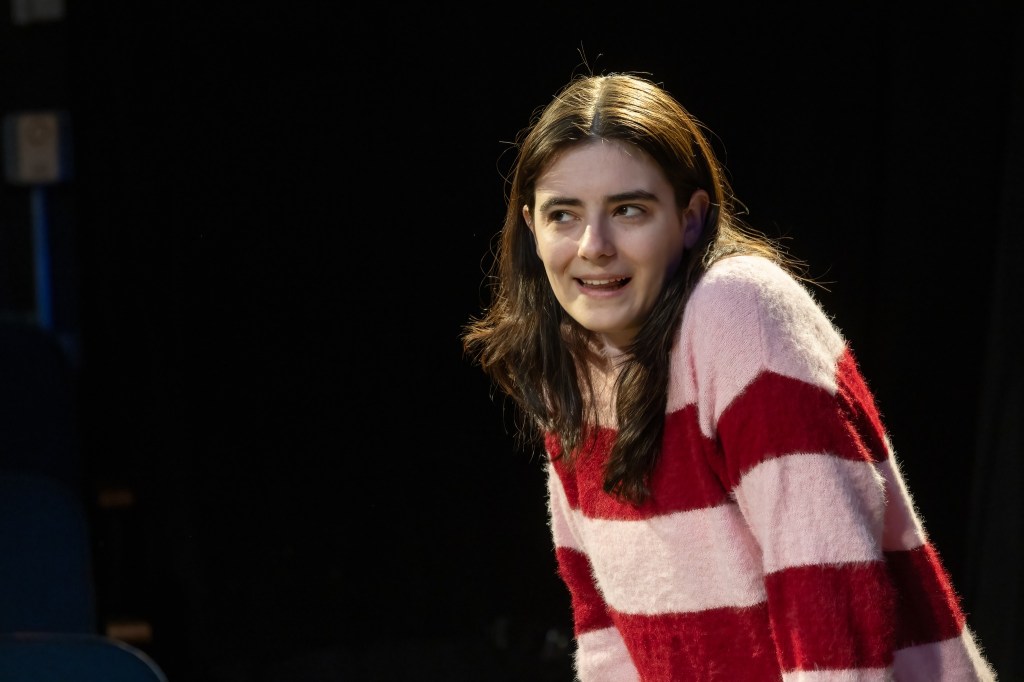
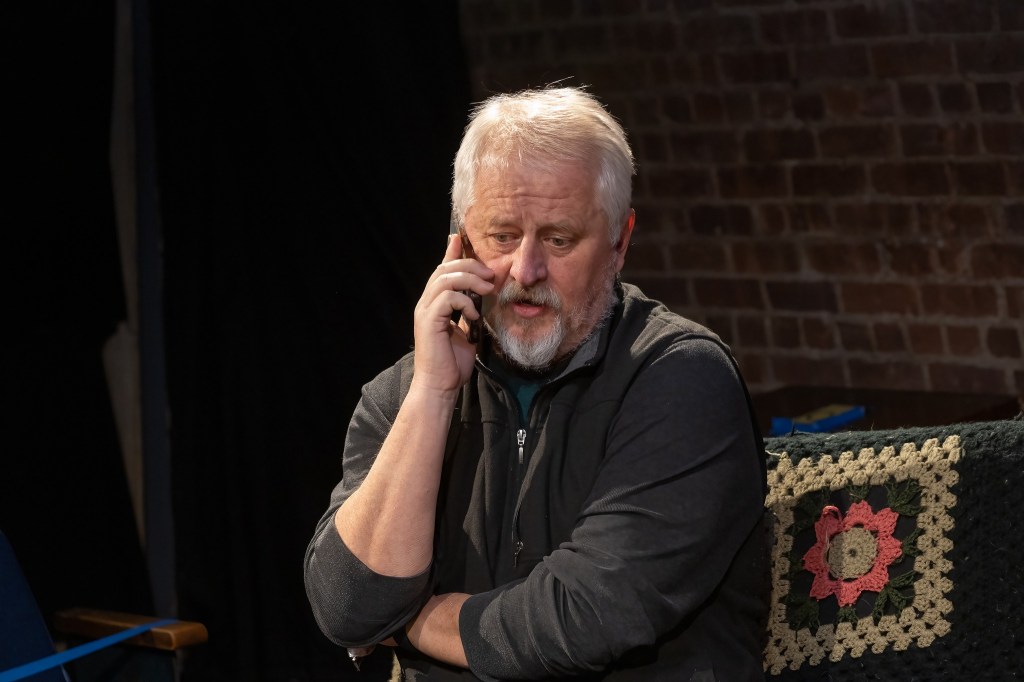
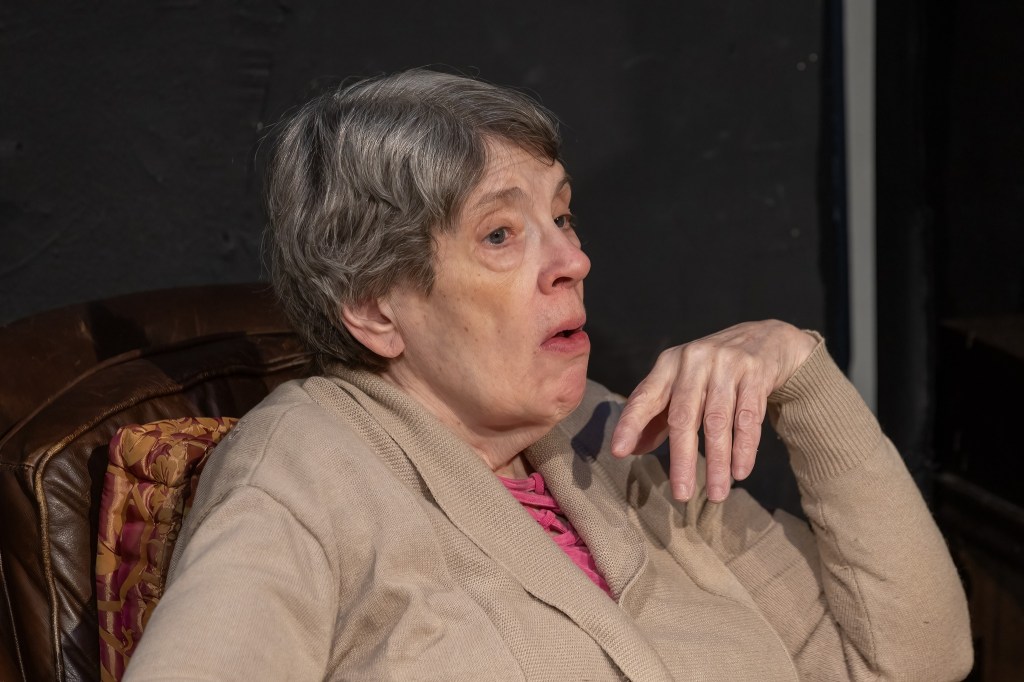
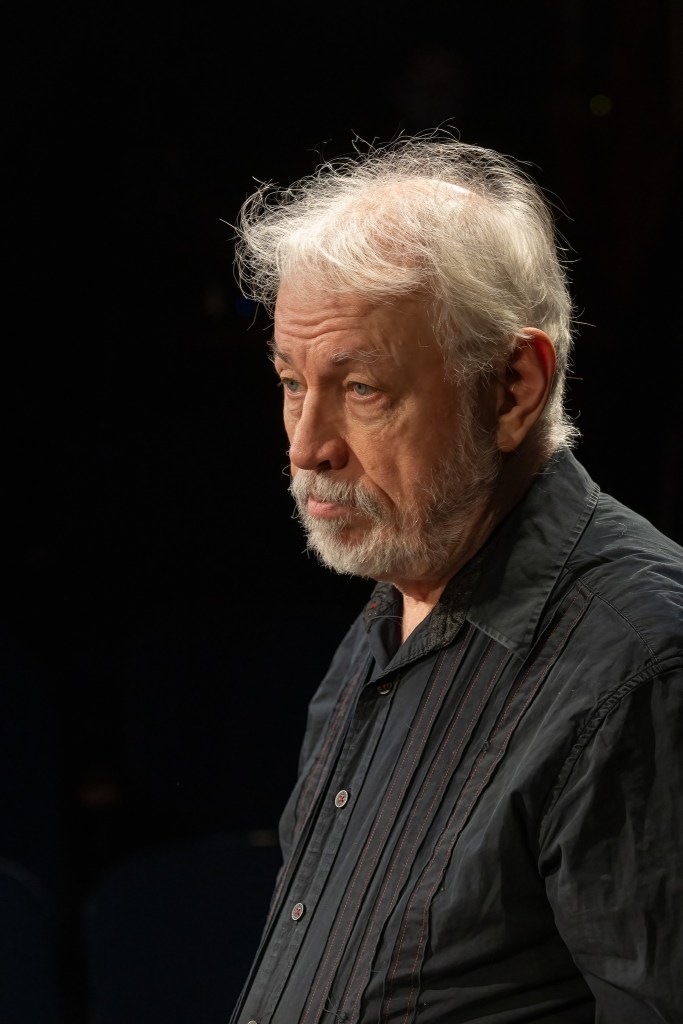
Their daughter Lucy (Chiara Aiello), an aspiring singer who just played The Bitter End, arrives to hear her dad’s old stories and her mom’s scoffing. But then, Marvin does indeed appear on their doorstep, resplendent in leather jacket and guitar-emblazoned scarf. He tunes Hank’s 12-string guitar and announces he is indeed here to make music, but wants it to involve more than one Anderson…
Dancing in the Meadow is a lovely piece that shows how the power of music can reunite old friends and connect generations. The interactions among the characters are genuine, moving, and fueled by Jennings’ trademark sparkling dialogue and wisdom about what makes people tick. The veteran cast sparkles in the first act of the production, and then return to the stage for a delightful surprise: Harmony in the Meadow, a concert with Aiello and Coughlin dueting as their characters. Coughlin’s excellent work on the 12-string and rich singing are accompanied by Aiello’s utterly gorgeous vocals, and we are treated to a set of some of the most beloved songs of the 1960s and beyond. Gems such as Joni Mitchell’s “Both Sides Now,” Simon and Garfunkel’s “The Boxer,” and the Righteous Brothers “You’ve Lost That Loving Feeling” are given marvelous readings by the duo, who I’d certainly love to see again in a concert setting. “Send in the Clowns” from the aforementioned A Little Night Music provides one of the most poignant moments, and “(I’ve Had) Time of My Life” from Dirty Dancing is the most uplifting. The half-play, half concert is one of the more joyous experiences you’ll have at the theatre this season, and another feather in the cap of James Jennings and the ATA.
Directed by James Jennings, Dancing in The Meadow runs at the American Theatre of Actors.

“Are We Friends, and Were We Ever?” asks Jim Catapano at YEARS TO DATE’s New York Premiere
Allen Barton’s Masterpiece Years to the Day Takes a Hard Look at Modern Relationships
“How the hell do you live your life unless you know who you are?”
Jeff (Jeff LeBeau) and Dan (Peter Zizzo) met each other and their later partners at the very beginning of college and have been “best friends” ever since…and yet they haven’t seen each other in person in six years. They finally meet over coffee, and it’s the precise anniversary of their last get-together in the flesh. They are in their mid-fifties, a time when a certain “rigidity” can set in for a person in terms of habits and point of view, accompanied by a “this is who I am, deal with it” attitude.
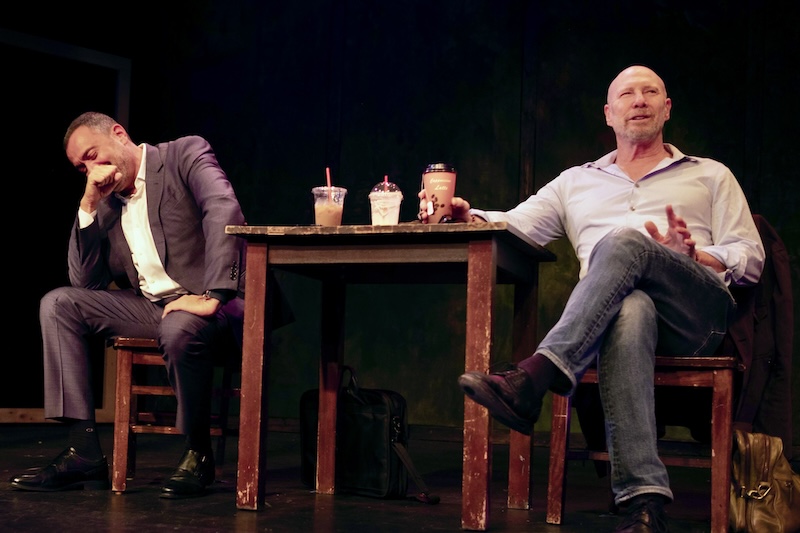
“You are the king of rudeness,” snarks Jeff as they settle in.
“You are the king of puerile, nanny-state intervention!” Dan claps back, but this “old buddy banter” is foreshadowing of the severe disconnection that is soon revealed. They discuss the “latest movie,” which Dan despises but Jeff saw twice; they debate about whether they’re middle-aged or old, and if “50 is the new 40” and how does that effect who they date.
But there’s a discomfort ever-present as the two try to slip into their old roles. The fiery Dan and the comparatively reserved Jeff come across like strangers that just happen to have known some of the same people and shared some experiences. We start to wonder immediately how these two came to be close, as their opposing energies and outlooks are brought to the table. Stunning revelations about each other’s lives come pouring out—important, life-changing, traumatic events that any close friend should have already known about. It’s clear that the notion of them having a deep connection is nonsense; their “friendship” is just a habit, and not one that they’ve cultivated in a healthy way. Jeff and Dan are on opposite sides of the political fence, but it’s never been a problem because Jeff used to downplay his beliefs; his refusal to take up the placating Avatar of old leads to a verbal explosion that nearly drives him out of the get-together. (The political climate is smartly kept vague and thus evergreen; we learn of an unnamed president that has somehow managed a third term, to Jeff’s delight and Dan’s horror.) Now that neither Jeff or Dan are “playing characters”, they find that the “actors” who brought them to life have little basis for a relationship. And yet somehow, their shared history and a genuine caring despite of all the differences just might be strong enough to lower the temperature and leave open the possibility of another meeting in the near future…maybe.
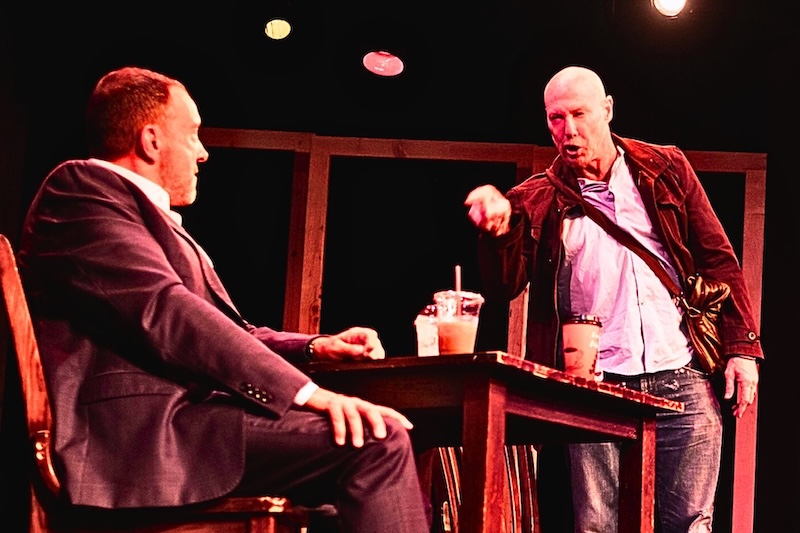
Written and directed by Barton and produced by Mia Christou, Years to The Day first premiered in 2013 to great acclaim and now makes its New York debut in a time when its themes are ever more relevant. Emmy winners LeBeau and Zizzo disappear deftly into their characters, delivering Barton’s musical, witty, rapid-fire dialogue with tremendous skill yet always appearing spontaneous in their interaction. Their body language, tense and awkward, is like another character in the play; seeing these two “buddies” barely look at each other for most of the meeting is chilling. Their unconvincing promise to “call Brenda” after a sad event for the unseen character stuns the audience; we all have a Brenda in our lives we’ve neglected. Seeing Jeff and Dan’s supposed closeness exposed as simply the product of having been in the same place at the same time is devastating as it certainly reflects reality for many in the modern world. In a time of social media false personas, fishing for “likes,” and a phone addiction that allows us to retreat at the first sign of boredom or discomfort, it becomes too easy to not even bother to cultivate a deep connection.
Hilarious, heartbreaking, and thought-provoking, Years to the Day is a must-see and a triumph for Barton, LeBeau, Zizzo and Christou.
“One thing exists at a time,” observes Dan throughout the play; it’s a simple yet astonishing declaration that will stay with you once you realize what it truly means, and the ark of Years to the Day reveals it powerfully.
Years to The Day is performed at the American Theatre of Actors through February 28, 2026.

International Industry Titans Announce NYC Power-Seminar
STOP “ACTING” AND START FIGHTING: International Industry Titans Announce NYC Power-Seminar
Tired of the “starving artist” trope? Ready to actually get on a set with a call sheet that has your name on it?
On Sunday, March 22, the game changes. For one afternoon only, Studios 353 in the heart of Manhattan becomes the “ring” for the most intensive, no-BS actor’s workshop of 2026. This isn’t your typical stuffy drama class; this is a high-octane career injection designed for the next generation of actors who are ready to dominate the global market.
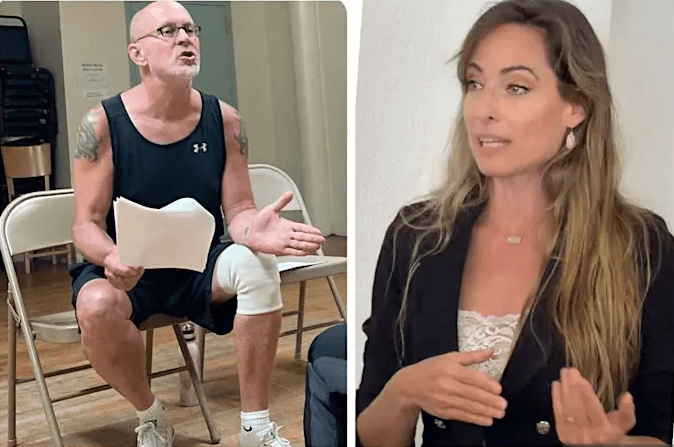
The Lineup: A Global Power Duo: Two industry heavy hitters are joining forces to give Tri-State actors the ultimate competitive edge.
THE AGENT: Jessica Polsky Alotto (Senior Agent, Dryblue Agency). Overseeing North American operations for one of the world’s premiere international agencies, Jessica’s clients are currently on your screens in Dune, Wednesday, Black Mirror, Mission Impossible, and The Gentlemen. She knows exactly what lands a self-tape in the “Yes” pile in London, Paris, and LA.
THE TRAINER: Robert Russell (Master Acting Coach & Industry Titan). With 30 years in the trenches as a Casting Director and Producer, Robert doesn’t “coach”—he trains. Known for his “tough-love” style, he conditions actors like fighters to find the raw, logical truth in every scene.
The Schedule: 4.5 Hours to Change Your Life
1:00 PM – 3:00 PM | The Global Rap Session: Jessica Polsky Alotto breaks down the “Cold Hard Truth” of 2026 casting. Learn how to land international representation, what’s actually happening in major casting offices right now, and how to get on the radar of an elite global roster.
3:00 PM – 3:15 PM | Recovery Break: Shake it off and prep for the ring.
3:15 PM – 5:30 PM | The Acting Dissertation: Robert Russell takes the floor to push you out of your comfort zone. Learn to strip away the “acting” and find the “heart” of the scene so creative teams have no choice but to cast you.“He’s the North Star guiding you through the leviathan that is Hollywood… the man is truly a part of history.” — Albert Reid, Student
Why This Matters for College-Age Actors:
The industry is shifting. Self-tapes are the new currency, and the market is global. If you are waiting for a “break,” you’re already behind. This seminar is about taking your career into your own hands with Discipline, Drive, and Determination.
The Essentials:
WHEN: Sunday, March 22, 2026
WHERE: Studios 353 (353 West 48th St, 2nd Floor, NYC)
DOORS: 12:45 PM (Don’t be late—unassigned seating!)
TICKETS: Starting at $108.55 via Eventbrite.
Don’t miss the chance to have your materials considered by an international agent and your craft sharpened by a master.
GET YOUR TICKETS HERE
Media & Support Contact: Jessica Polsky Coaching Studio jessicapolskycoachingstudio@gmail.com

Jessica PolskyThe Global Trailblazer
From Broadway stages to European primetime celebrity, Jessica Polsky Alotto has climbed every rung of the industry ladder. After a 20-year career as a major TV star in Italy, she moved behind the scenes as a Producer, Director, and Casting Professional. Now, as the Senior Agent for Dryblue Agency (DBA), she oversees North American operations for a premiere global roster of over 700 actors. With HQ in London and offices worldwide, Jessica is the ultimate bridge between New York talent and the international stage, specializing in turning local actors into global icons.
Robert RussellThe Industry Titan
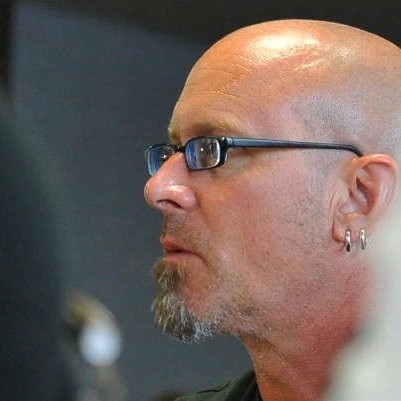
Robert Russell doesn’t just coach; he conditions. With 30 years at the highest levels of the industry,Robert has dominated the rooms that matter—serving as a high-level Casting Director and Producer for major TV networks, feature films, and iconic music videos. Born into an entertainment dynasty (including cousins Robin Antin, creator of The Pussycat Dolls, and Steve Antin, director of Burlesque), show business is his DNA. Today, he is sought after worldwide by A-list stars for his legendary “tough-love” training style, preparing actors to step into the audition ring like fighters ready to win.
| Contact: Jay Michaels Global Communications646-338-5472 // info@jaymichaelsarts.com |

It’s Mean to Be the King: Jim Catapano at RICHARD III (Atlas Shakespeare)
The Atlas Shakespeare Company Presents a Triumphant Retelling of Richard III
Following acclaimed productions of Henry VI Parts 1 and 2 and Henry VI Part III, the Atlas Shakespeare Company now completes the Bard’s first tetralogy with a riveting Richard III.
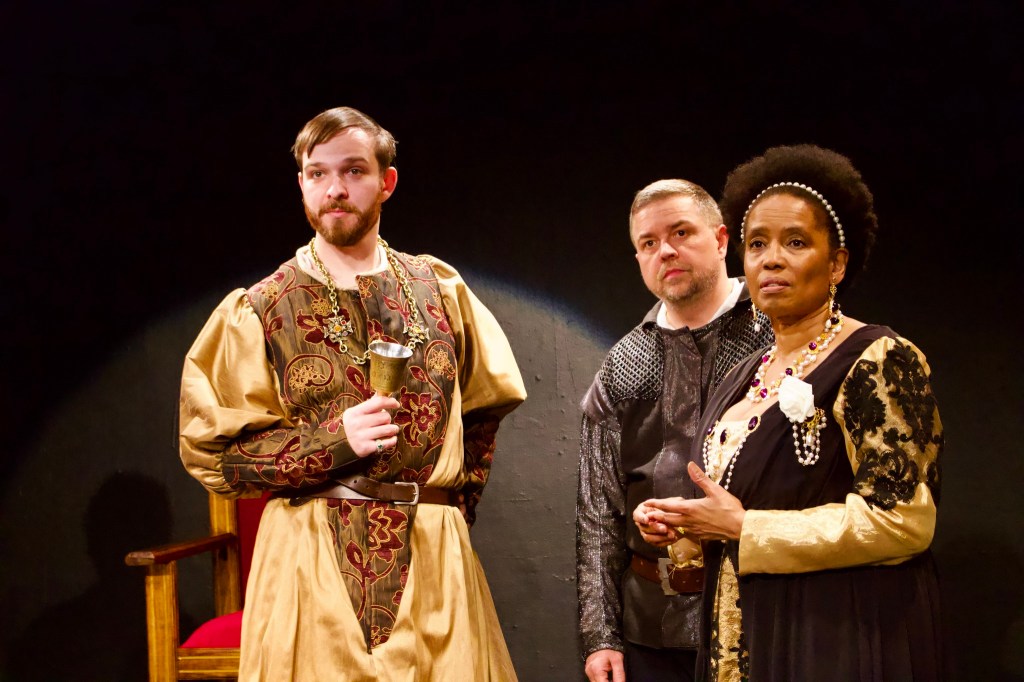
Following the long civil conflict in which the Yorks defeated the Lancasters, King Edward IV (Ethan Baker) sits atop the throne, depressed and ailing. His power-hungry brother Richard (Zachary C. Clark), the Duke of Gloucester, sees (and eventually seizes) an opportunity. Thus, he begins to systematically eliminate everyone who stands in his way, while wooing the widowed Lady Anne (Christa Souza) to his side. He imprisons his elder brother George (Yeshua Ellis), Duke of Clarence, in the infamous Tower, where he later also famously banishes his young nephews, Richard the Duke of York (also Souza) and Prince Edward (Charlotte Blacklock), to prevent any competition to the throne. The less-than-legitimate new King Richard’s reign of terror is finally threatened by Henry Tudor (Bradley Viktor), Earl of Richmond, who raises an army against the Machiavellian murderer.
The play completes the War of the Roses saga with a compelling story of betrayal and sociopathic serial killing that ends in a bloodbath. Along the way we watch the titular character go from scheming to murder to full-on madness, with lots of backstabbing along the way, most of it literal. We learn that a cask of wine is a great place for a murder victim. And what show would be complete without a game of “catch the severed head”?
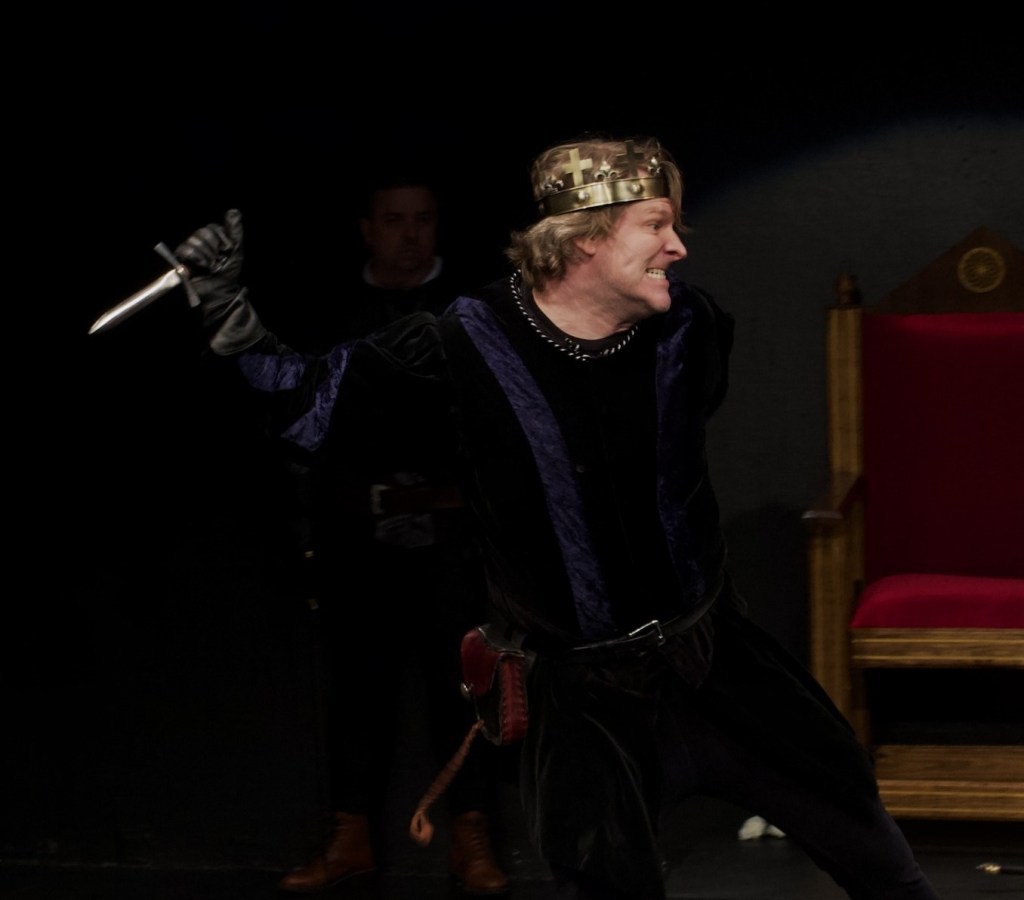
As the conniving cad of the title, Clark delivers a tour-de-force performance: charming, devious, funny and sly. He skillfully uses the audience as his “co-conspirators”, delivering asides and glances that make us feel part of the story.
“(Richard III) is very insecure in a lot of ways,” said director Adriana Alter in a talkback following a recent performance. “And very motivated by the need for external validation which he’s trying to get from the audience. We essentially become his imaginary friends. He’s trying to impress with how clever he is.” Clark is excellent at portraying Richard’s rollercoaster ride from the heights of power to the depths of slipping sanity. “He’s going to have to come face to face with the fact that he hates himself,” said Alter. “His coping mechanisms for keeping up, that pretense starts to melt away.”
Clark is joined by a sterling cast including Tonia E. Anderson as Cecily the Dutchess of York; Joscelyne Wilmouth as Queen Elizabeth; Nick Stevens as her brother Anthony (Lord Rivers); Matthew Tiemstra as Henry, the Duke of Buckingham; Quinlan Welch as Thomas Grey; Nicholas Grevera as William (Baron Hastings); Timm Coleman as Thomas Stanley; Chris Clark as Sir Richard Ratcliffe; and Gabe Girson as lawyer Sir William Catesby. (Baker, Blacklock, Sousa, Ellis, Viktor, and Welch each play two roles to round out the kingdom.)
The costumes—designed by Madeline Rostmeyer and coordinated by Nancy Nichols—are glorious in their elegance, and the sterling cast delivers Shakespeare’s iconic dialogue with a delighting deftness that captivates with every turn of phrase. Atlas’ mission statement is to present Shakespeare’s work as it was intended, and they do so here with a production that is true to the text and to the era it was initially performed, but still completely accessible to a 21st Century theatregoer.

Director Alter has presented a fantastic edition of the oft-performed classic, neatly trimmed and dynamically realized with all story beats intact. It is immensely engaging—from Richard’s first sinister speech, to the appearance of the ghosts of all his victims, to the incendiary final battle. That last sequence is astonishing, an edge-in-your-seat experience delivered with dance-like precision by the cast under the expert guidance of fight choreographer Leighton Schlanger.
This explosive conclusion to the saga is a positive triumph for Alter and Producer and Founder Alexander Nero. It’s a must-see for this “Winter of Discontent” or for any season.
Trade your kingdom for a horse and go see Richard III at the Wild Project through March 1, 2026. Learn more at atlasshakespearecompany.com/.


Jim Catapano examines A Legend Restored with the ATA production of Kenthedo Robinson‘s The Lewis & Clark Expedition: The Story of York
Kenthedo Robinson‘s The Lewis & Clark Expedition: The Story of York Returns a Hero to His Rightful Place in American History
“If a man can become a slave, a slave can become a man.”
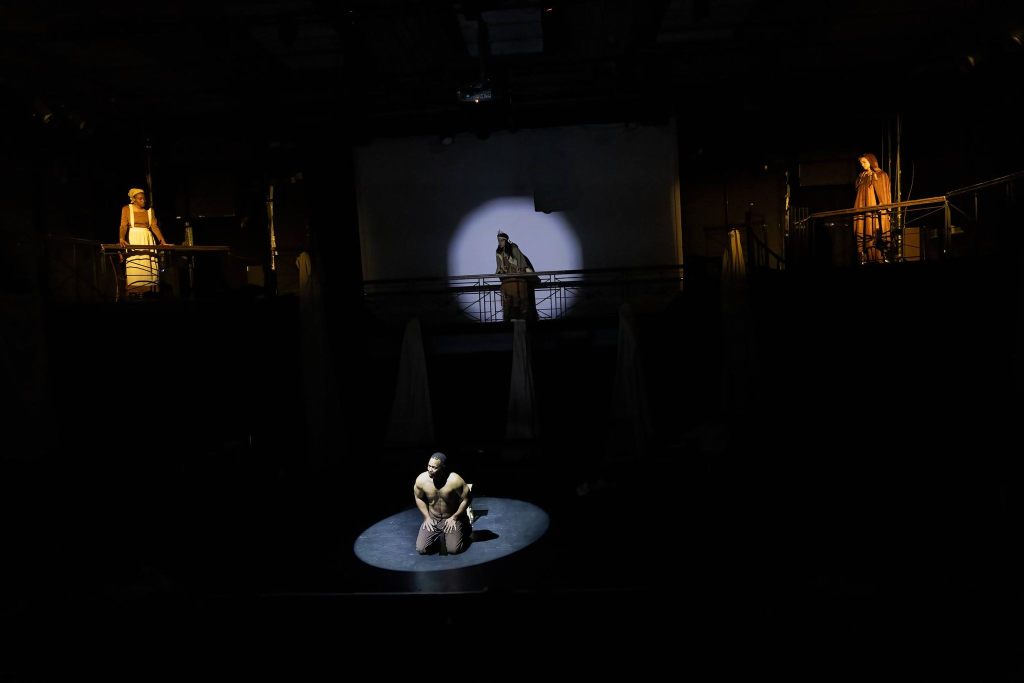
In 1804, a country in its infancy was determined to explore the uncharted land that would soon be part of its territory. The treacherous and dangerous journey was famously undertaken by Meriwether Lewis and William Clark, but few know of the man who accompanied them and was utterly essential to the success of the quest: York, an African-American enslaved by Clark.
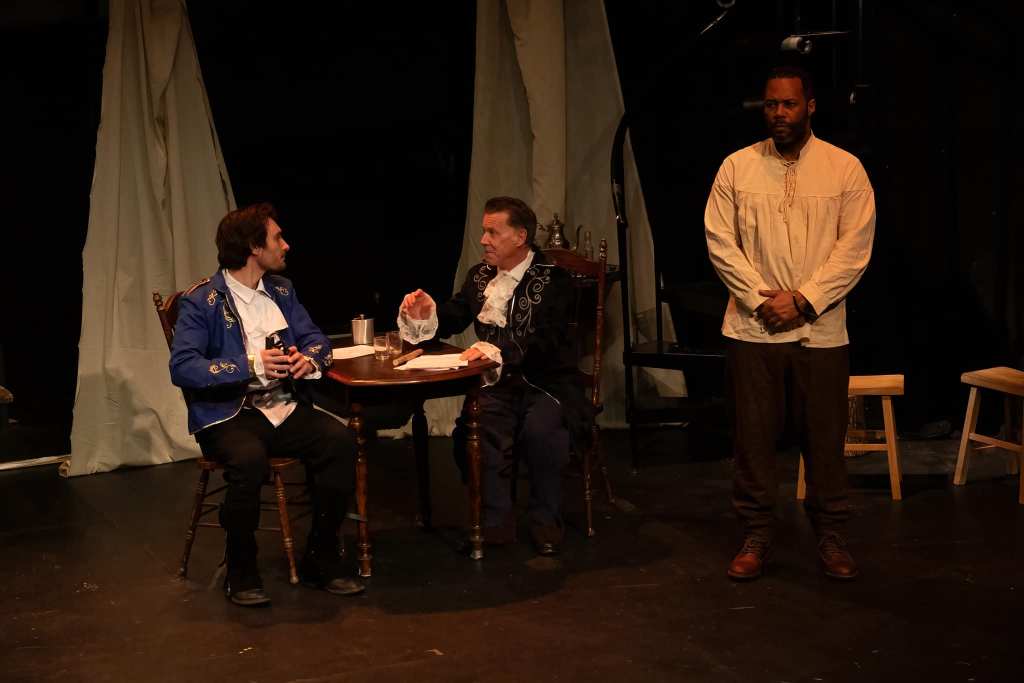
York is portrayed with astonishing power and authenticity by Rommell Sermons, who we see discussing his being chosen for the expedition with his wife Reeva (Marsha St. Julien; portrayed later in the run by Zsay Moore). Reeva is deeply unhappy with the idea of York going into certain danger with his white oppressors. Though York is loyal to Clark (Nicholas Dodge) because “Clark is loyal to him”, Reeva is much more skeptical about the nature of the relationship, a foreshadowing that will lead to a devastating revelation at the end of the play. Indeed, Clark seems somewhat benevolent, especially in contrast to Lewis (Travis Bergmann). Lewis here is seen to be a raging bigot, seething with contempt for York and threatening him with the whip at every opportunity (despite not having the “authority” to do so), something his “master” Clark has never done. Lewis is out for fortune and glory while Clark purports to be more nobly motivated by the chance to grow and unite the young country.
“I hate you because you exist!” screams Lewis at York, forever paranoid that the slaves and the indigenous people they are about to displace will rise up against their oppressors. Though Clark appears to respect and even care for York, he still refers to him as property and refuses to agree to give him his freedom, only mumbling that he will “revisit” the notion upon their return. It becomes clear that Clark is only good to York because he needs him.

And York is indeed crucial to the treacherous journey, his intelligence, skills and strength proving indispensable. The indigenous tribes encountered are fascinated by York, having never seen a person of African descent before, astonished that his dark “paint” doesn’t wipe off. After a tense face-off with Chief Cameawaite (Kevin Leonard), it is shown that his very presence provides essential assistance to the expedition in their dealings with the Native Americans they encounter. The indigenous peoples are portrayed by a talented cast including Sebastian Arteta (Chief Anapae), James Oliver (Chief Tall Crow), LeeSandra Moore (Sonomo/Stage Manager) and Ms. D (Highshee/Assistant Stage Manager). As the journey continues, events are cleverly linked by Clark’s correspondence with his back-home brother John (Alex Silverman).
York saves the day at every turn, becoming an icon to the native tribes but taken for granted by his own team, who still see him as property. He cares for a very ill Clark; he looks after Sacagawea (Natasha Sahs), an indigenous teenager who assists the expedition and travels with them all the way to the Pacific Ocean; and even saves his nemesis Lewis from a bear attack, in a sequence that is fantastically realized through excellent choreography and sound design (Lighting/Sound Liam Riordan).
Lewis’ utter lack of gratitude and his doubling down on his profound hatred is a chilling reminder of the depths of white supremacy that are still in evidence over 200 years later.
York’s spiritual encounter with the One From The Mountain Top (Jimena Rosas) gives him agency, self-worth, and a sense of purpose that will prove crucial upon his return from the journey, as the play concludes in a sequence of horrifying but powerfully depicted events that reveal the fates of Lewis and Reeva, and destroy any notion of Clark being a good man—sometimes evil and bigotry is more subtle than that displayed by the raging Lewis (a fact that those watching in 2026 need to stay aware of). This is where the production is at its most moving, as York refuses to be dominated and oppressed any longer; his self-actualization as he rises from the horror around him creates a triumphant resolution.
Written and directed by Kenthedo Robinson (with assistant direction by Andre Minkins), The Lewis & Clark Expedition: The Story of York sets history right, putting the man who was known as “The Bear God” back into the narrative, pulled from the obscurity where the history books had unfairly but predictably relegated him. The three leads, and the always exceptional Leonard and Sahs, are a wonder to watch, abetted deftly by a supporting cast that gels beautifully and is clearly moved by the important story they’re here to tell.
“It is better to walk into freedom.”
The Lewis & Clark Expedition: The Story of York runs at the John Collum Theatre at the American Theatre of Actors through February 22. It is presented as part of the African American Playwrights Initiative at the ATA.
PHOTOS BY DAN LANE WILLIAMS

New Theatrical Production Company, Diamond Mesh Inc., Announces “The Manifestival:” A New Frontier for NYC Independent Theater
In a world increasingly defined by digital isolation and existential questioning, a new theatrical force is rising to reclaim the stage. Diamond Mesh Inc.Theatrical Productions, led by producers Matt Bader and Faith Pasch, is proud to announce the inaugural Manifestival, a new works festival running from July 16th to August 9th in New York City.

The Search for Connection
Diamond Mesh is more than a production company; it is a response to the modern human condition. Launching with a provocative philosophical inquiry, the company’s mission centers on the “why” behind our collective loneliness.
“You did not stumble upon these questions. You found them. Just like you found this,” says the company’s statement. “We are Diamond Mesh. We have been looking for you too.”
The Manifestival: A Call for Submissions
The Manifestival is currently seeking digital submissions of new, 60–75 minute plays designed for intimate, character-driven production. Designed to strip theater down to its rawest, most impactful form, the festival emphasizes storytelling over spectacle.
Submission Guidelines & Opportunities:
- The Format: Scripts must feature a cast of five actors or fewer.
- The Aesthetic: Adaptable to minimal design (sparse set: one table, two chairs).
- The Series:
–The Signature Series: a Group of productions having a limited three performances during the festival.
–One Night Only Series: A high-impact, single-evening performance.
The MODEL: In a rare move for the NYC festival circuit, selected productions keep 100% of their ticket sales, providing a sustainable platform for playwrights & creators. Playwrights are encouraged to submit their work via the Official Manifestival Submission Form. Slots are assigned on a first-come, first-served basis.
Meet the Founding Executive Producers:
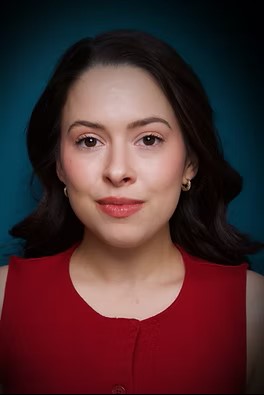
Faith Pasch — A New York City-based powerhouse, Pasch is an actress, singer, and producer with credits ranging from the I Was a Teenage She-Devil UK Premier to the Disney Cruise Line. A champion for marginalized voices, Pasch recently founded Faith Pasch Productions and co-founded Fate Productions, a company dedicated to highlighting female and non-binary voices in the cabaret circuit.
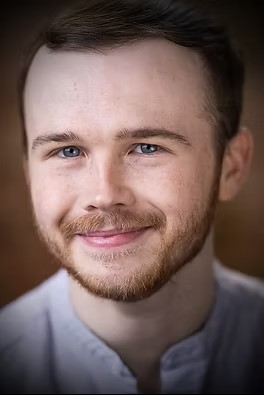
Matt Bader — A versatile actor, writer, and producer hailing from Milford, CT, Bader brings a wealth of international experience to Diamond Mesh. His past producing credits include The Silly William Gambit at the Edinburgh Fringe Festival. As a performer, he is known for his work in The Mystery of Edwin Drood (Connecticut Repertory Theater), the series The Startup, and his ongoing work with The Dinner Detective.
Join the Movement
- Website: diamondmeshinc.com
- Instagram: @diamondmeshinc
- Email: Mattbader@diamondmeshinc.com | Faithpasch@diamondmeshinc.com
 Arts Independent