
Home » Articles posted by jaymichaelsae (Page 12)
Author Archives: jaymichaelsae
Jim Catapano warns us of Tragedies of the Past, Warnings for the Future
Anne L. Thompson-Scretching’s A Lesson in Blood Returns to the ATA at a Pivotal
Moment in Time
The saying “Those who cannot remember the past are condemned to repeat it,” as
attributed to philosopher George Santayana, is oft quoted for a reason.
A Lesson in Blood, from the powerful pen of the prolific Anne L. Thompson-Scretching,
premiered at the ATA in 2011 and won best play at the Jean Dalrymple Awards. It’s the
first play in the Blood Trilogy, which also comprises A Long Way from Home and Home
Is Sweet Sorrow. In 2025, this work is more important than ever in its exploration of
racism and the exposing of those who cling to the absurd notion of white supremacy. It
is observed that people of color are “allowed” to go about their lives so as long as they
“stay in their place,” and the Klan is always lurking in the shadows, waiting to pounce at
the slightest hint of rebellion—real or imagined. Authority figures justify their prejudice
through their twisting of the words of the Bible, insisting it is the will of God that white
people are superior, and that people of different races must never mix.
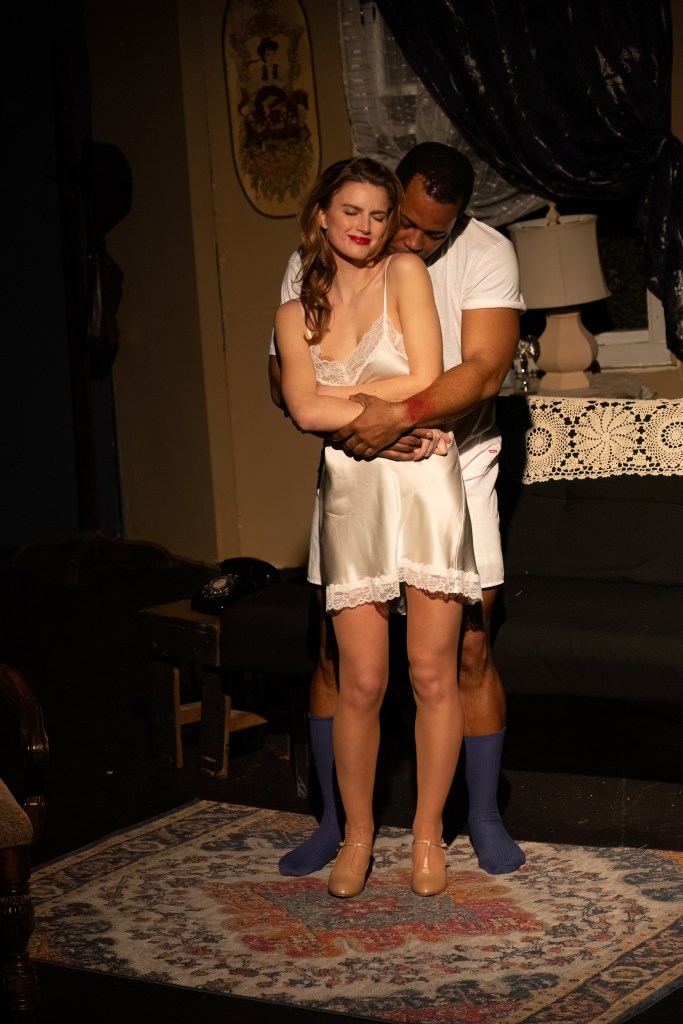
This puts Osceola Red Feather (Rommell Sermons) in a dangerous situation. A
Cherokee Indian man of color, he is living in the Jim Crow-era Georgia of the 1940s with
his “Aunt Lucy” Dix (Joy Foster) and his brother Calvin (Kevin Leonard). Osceola had
been secretly seeing Aggie Peters (Serena Profaci), the white daughter of repellent
Klansman Nathan (David Ezell). Aggie returns to the south, and to Osceola, after seven
years, with devastating revelations that will have consequences for him and everyone
else—including Johnny Ray Dobbs (Ronan Schwarz), the town’s sheriff who also
desires Aggie.
When we first see Johnny Ray, he appears amiable enough, visiting with Aunt Lucy and
partaking in her chicken dinner. It’s explained that he and Osceola were friends in
childhood who still go fishing together. But as circumstances unfold, the darkness within
him becomes all-too evident. When Osceola’s current partner Clara Henderson
(Natasha Sahs) learns of Aggie’s relationship with him, she threatens to expose the
situation, putting everyone in danger and setting events in motion towards violence and
tragedy. There is a grisly murder, and its circumstances and perpetrator are a mystery,
but the supremacists in power are quick—and perhaps even thrilled—to put the blame
on a person of color.
As the town reels from this horror, Johnny Ray abuses his authority by getting Osceola
dismissed from his job with Noah Cohen (Alan Hasnas), a Jewish lawyer. Cohen
reluctantly complies but remains an ally to Osceola, and tries to overcome his fears to
combat the racism around him, haunted by memories of his own family’s deaths in the
Holocaust. Aunt Lucy and Calvin stand by Osceola, even as tensions rise among them
and they look to answers in the traditions of mysticism they grew up with. Lucy is aware
that Osceola and Calvin are the last of the line and will do anything to protect
them—from prejudice, and from themselves.
A Lesson in Blood is beautifully directed by Tippi, who has steered many of Thompson-
Stretching’s productions. Expert lighting and sound design by Joe Coppola and Liam
Rordan respectively complement a fantastic set, that of Lucy’s old house, which takes
us right back to the Georgian summer of 1946. The writing pulls no punches in exposing
the racism of the era—a racism that we know very well was never fully extinguished.
The scene of Nathan asking Lucy for water, but insisting she pour it in his hand because
he won’t drink from her glass, is nearly as chilling as the moments of violence and
spoken hatred that surround it.
The cast is unified in its expert realization of the text; one fully believes in the history
among the characters and the desperation and injustice of the moment they find
themselves in. In a time when prejudice and ignorance threaten to overwhelm once
again, A Lesson in Blood is a crucial work that is not to be missed.
A Lesson in Blood is performed at the American Theatre of Actors through March 30,
2025.

Jim Catapano views the creative view from “Over the Shoulder”
Mark Solomon Shares His Expertise on Telling Stories and the Art of Skillful Editing
“The way I see the world is through stories,” says Mark Solomon. “It’s the water I swim in.”

Renowned Film editor Solomon has over 30 years’ experience in engaging audiences. And he did exactly that for an enthralled crowd at a Talkback, Signing, and Live Podcast at the Drama Book Shop in Midtown Manhattan, regaling us with tales of the craft as detailed in his new book, Over the Shoulder: A Freelancer’s Guide to Telling Stories and Editing Films. (The following are highlights from both the Talk and the Q&A portions of the event, facilitated by The Drama Book Show! Podcast hosts Mark Eugene-Garcia and David Rigano)
Solomon first became enchanted by the art of storytelling through cinema at 18 years old, when he saw the classic film Harold and Maude, the May-December romance story that he found “beautiful and life-affirming”. “When I left the theater that night I felt like I was floating on air,” he says. “So exhilarated and uplifted. I decided right then—this is my path.”
But after several semesters at Syracuse University where he was pursuing a bachelor’s degree in film and theatre, it was time for his final project, and Solomon found himself “choked with fear.” “I had a passion for films and filmmaking, but I had no idea what to make a film about…what story did I want to tell? I was desperate, and I berated myself for not knowing.”
It’s a struggle that all passionate creators can relate to. The intense pressure, anxiety, and dread in the time leading up to graduation resulted in what Solomon calls a “toxic psychosis that I was lucky to survive.”
Solomon found his way back following a Eureka! moment prompted by his experience of Japanese theater, where the actors do not begin until they are certain the audience is giving the stage their full attention and focus. “Through the course of the evening the actors take control of the breathing rhythm,” he notes, “and guide the audience through the climax of the play.”
Something about this concept stayed with him and spurred him on, and he was able to return to his academic and artistic journey. “My brain slowly recovered…I remember walking around my suburban neighborhood with a single plea migrating through my body: Give Me Life.” He didn’t know yet what his story was going to be, but he knew for certain he wanted another chance to find it.
While studying more about the rough state of the world and exploring ways to make it better, Solomon grew as a person, which fueled his artistic aspirations. The activist that he says left the greatest impression on him was Daniel Berrigan, the Jesuit Priest famous for speaking out against the Vietnam War and openly opposing huge institutions like the US government and military. Solomon was inspired by his “shining moral clarity and the courage to live by his convictions…I found his talk galvanizing.”
Kerrigan encouraged Solomon to volunteer at the local nonprofit peace council, and Solomon learned a critical lesson. “A single voice has power.” And this has been the impetus for his storytelling journey ever since.
“Learn what story matters,” he says. “Tell that story in the most compelling way, to make people feel something emotional…learn how to reach people.”
This call-to-action leads Solomon and his editing team, on every creative endeavor, to create the version of a narrative that will create the strongest impact on the audience. “I ask (of a scene), what’s in and what’s out? Of the pieces that are available, what do you choose to keep with you and what do you leave behind?” For Solomon, it comes down to discernment, fueled by the knowledge that people look for patterns; the human mind sees two things and decides for itself how they’re related to each other, and the craft of successful storytelling depends on recognizing that truth. Solomon cites “The Kuleshov Effect,” a film editing technique that uses a sequence of visuals to infer meaning and evoke an emotional response. Returning to Japanese storytelling, another influential technique is Jo-ha-kyū, which instructs that all actions or efforts should begin slowly, accelerate, and then end suddenly or quickly. (Solomon notes an example of Jo-ha-kyū in his own Chicken Run, specifically the memorable “pie machine” sequence.)
Building masterfully on his extensive experiences and influences, Solomon has gone on to be the person behind the prodigious editing of such animated films as the aforementioned Chicken Run; Sgt. Stubby: An American Hero; The Tale of Despereaux; and Frankenweenie, which was nominated for an Eddie Award in 2013. He was also part of the team behind the legendary movies Shrek and Space Jam.
Solomon gives his insight on how to persevere and succeed in an industry where there is so much content and competition, at a time when art is presented by hundreds of thousands of creators on multiple platforms.
“Declare victory and move on,” advises Solomon when a project doesn’t achieve the level of success one had hoped for. “Call it a success, and learn what you can from it.” The good news about our times is that there is always a chance for art to be re-envisioned, re-launched, or re-released.
As very much someone who wants to give back and share his insight and experiences with aspiring artists, Solomon has taught his craft to students at film schools and universities. Over the Shoulder is a way of passing that knowledge to an even wider audience.
“I’d started teaching at a film school in Boston and in London…and every term, there would be one student who would sort of be really sparked by what I was talking about,” he explains. “I knew that they would follow and pursue a career as an editor, and I wanted to give them something to help. When you finish film school it’s hard to see how to navigate the world outside…So I thought that I would try to share what I learned.”
He recalls that when he first started out as an apprentice, he pledged to his editors and instructors to one day mentor newcomers himself as well. “I promised when it’s my turn, I’ll pass all that I’ve learned to the next generation. So this book is a part of keeping that promise.”

Learn more about Mark at MarkSolomon.net. Over the Shoulder is available at 7pinespublishing.com.

Jim Catapano reviews the creation & connection in AMT’s Upside Down
A Rousing New Musical at AMT Imagines Life and Love in a Very Different Timeline

It’s another day in our matriarchal society. The legendary New York Jets are working towards their seventh Super Bowl win. Teachers are the heroes, and command the salary they deserve. A gay woman (Ashanti J’aria) is the president of the United States, and her partner (Kira Sarai Helper) is a general in the women-led military. Over 90 percent of the population identifies as gay, while marginalized straight people are fighting to exist and be heard. (The TV series “Straight Eye for the Gay Guy” is one attempt at mainstream recognition). The heterosexual community dreams to be accepted for who they are and to not be judged on who they love. But over on FUX news, “conservative” pundit Lou Smalls (Josh Powell) casts aspersion on the “breeders” (the straight community) while his purple shirt-wearing shadower Pastor Jake (Jake Foster) nods along, claiming that the Bible forbids “a man to lay down with a woman”.
Enter theatre book writer Jake Tanner (Mike Ferlita) and musician and lyricist Robert Lyons (Matthew Liu). The two gay creators are desperate for a Broadway hit, and joining forces with producer Robin Bird (Kelli Maguire) and agent Maggie Burns (Gina Milo), are commissioned to tackle a long-held taboo. They are to create the first heterosexual musical—and the theme will be (gasp!) straights in the military. Can you imagine, men and women on stage—together?! Welcome to Upside Down.
Jake and Robert’s journey to accomplish their momentous task starts with them going undercover at a straight bar. Robert is comically and ostentatiously dressed as straight icon Elvis, while Jake meets straight Tennessee torch singer Tammy (Brogan Nelson, who sings a spirited “Tennessee Rag” and “Midtown Boy”). Jake asks for Tammy to be his beard while he poses as hetero, and in turn Tammy asks him to help her get rid of her rich stalker, creepy mama’s boy Eugene (Patrick Brady, who sings the hilarious “Without Mom.”)
Struggling to write music about straight relationships, Robert composes a love song to his Alexa device (“My Female Ideal”). “You only speak when spoken to!” he croons to it. Meanwhile the “engaged” Jake and Tammy encounter bigotry when they go to a bakery and are rejected—the place won’t make wedding cakes for straight couples. As Jake learns more about the plight of the heterosexual community, and spends more time with the magnetic Tammy, he begins to feel things he didn’t expect. And as the musical gets closer to opening night, the powers-that-be get wind of the “offensive” content, and threaten to shut it down…
Upside Down is a positive triumph from Al Tapper (Book) and Tony Sportiello (Lyrics). It combines old-school Broadway flair with modern wit and sensibility, and is a joyful adventure from the first note to the coda. It holds a mirror to our society at a crucial time, and makes us stop and think about the absurdity of exclusion, while being endlessly ebullient and entertaining throughout. The ensemble’s singing and dancing is chef’s kiss, and all in the company get turns to show their stuff. Shining moments abound from Lauren Gemelli (Rachel/Mandy), Stephanie Maloney (Waitress), Stanley Martin (Ross/Roger), and Bernie Baldassaro (Midtown Boy). The group numbers are nothing short of astonishing (including an incredible tap-dancing sequence), and the tunes are collectively catchy and memorable. You’ll want to come right back for another evening in the Upside Down—and probably wish you could live there.
Upside Down is directed and choreographed by Taavon Gamble, with musical direction by David Wolfson. It runs at the AMT Theater through April 5, 2025.

Knock Knock, Whodunnit? Jim Catapano finds fun at CLUE
The MCT’s Imagining of Clue delights at the BACCA Arts Center
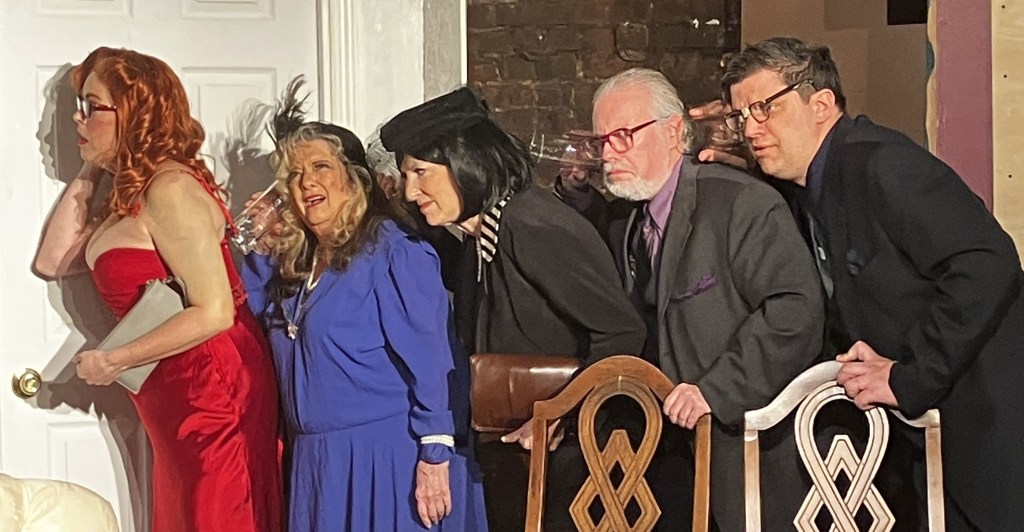
It is the early 1950s, a time when everyone is suspicious of everyone else. By invitation, several of society’s supposed finest gather at the mansion of Mr. Boddy (Mark John Santaromita) on a stormy night. They are familiar archetypes with political influence, all known for the occasion by the special pseudonyms bestowed on them by their mysterious host: Colonel Mustard (Joe Hoffman), Mrs. White (Pamela Seiderman), Mrs. Peacock (Elizabeth DeGennaro), Mr. Green (Ed Cress), Professor Plum (Gary Tifeld) and Miss Scarlet (Meredith Lynn Spencer). The guests are greeted by the very shady butler Wadsworth (Dan Bellusci) and the very French maid Yvette (Heather Legnosky). After clenched-teeth pleasantries, cocktails, and shark’s fin soup (Mrs. Peacock’s favorite, as the cook is creepily aware of), Mr. Boddy appears and reveals he is blackmailing them all, and then hands them their “gifts”; potential murder weapons for one of them to use to kill Wadsworth to protect their secrets before he contacts the authorities. The lights go out, and the fun begins as the bodies pile up and the suspects grow more desperate and frantic.
Sandy Rustin’s stage play Clue, based on the 1985 cult classic film based on the classic board game, is revisited through a wonderful new production by the Modern Classics Theatre of Long Island. It is directed with great panache by Matt Stashin, with clever set design by John Emro and Rian Romeo. A set of moving doors create the illusion of a vast mansion, and they are used to great effect as the characters peer in and out of them, race through them, and shudder at what horrors might be found behind them. High-energy chase music accompanies the characters rushing from room to room between scenes as the sets are swiftly and skillfully swapped—the scene changes are almost as entertaining as the show itself. This is a very physical production; the actors throw themselves bodily into every sequence as they deftly handle the complex wordplay, which is delivered rapid-fire; the audience is still laughing at the previous joke when another one comes hurtling at them.
In addition to the always witty and often hysterical dialogue, there are wonderful sight gags: the actual board game of Clue is used as a map to the mansion; one of the murder victims (James Brautigam) resets the scenery and gets back into position dead on the floor, in full view of the audience; a chandelier falls in super-slow motion as its victim recoils and screams equally slowly; the suspects prop up the dead bodies Weekend at Bernie’s-style to fool a prying police officer. Sound is also a big part of the fun: the ominous doorbell; the barking guard dogs outside; the incredibly loud dinner gong of the cook (Karen Santaromita) which traumatizes everyone, and Mrs. Peacock’s blood-curdling, sound barrier-breaking screams. Karen Santaromita’s double duty as a cheery but ill-fated singing telegram provides one of the show’s funniest moments as the murders accelerate. “Three bodies in three minutes!” marvels one suspect. “That’s our best record!”
Clue boasts a cast of 11 and a character count of 15—in this incarnation, every murder victim humorously gets to be reincarnated as a police officer.
The actors of the ensemble are all perfectly cast, and hilarious in their distrust and barely concealed contempt for each other as they desperately try to avoid suspicion and/or death. Late in the play when Wadsworth breathlessly recounts and acts out the events of the entire evening, Bellusci’s performance is astonishing. And true to the source material, multiple dénouements are explored, as every character gets a chance to have done it. “But it really happened like this…”
Clue is performed at the BACCA Arts Center through Sunday March 16.
Jim Catapano reviews a dying gasp of a senator’s soul with Michael Hagins’ “The Senator Speaks”
Michael Hagins’ Powerful New Play The Senator Speaks Examines the Human Consequences of Playing Politics
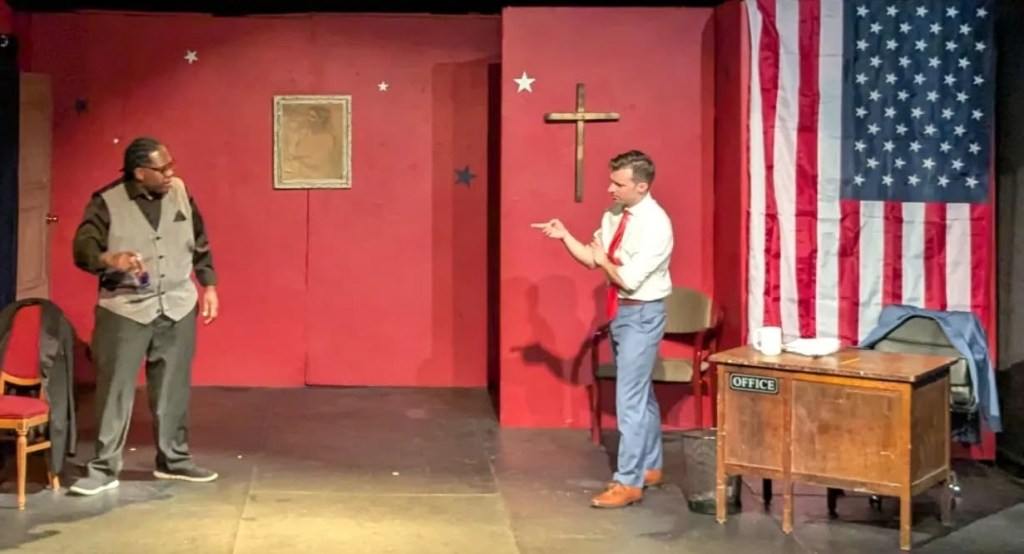
“We are all mired in dark times,” proclaims Conservative Republican Senator Calvin Shepherd (Michael J. Whitten). “At a time when the hard left is helping to ruin this country. Liberty is under assault…we are going to arm up and fight back.” Shepherd is spending the morning at home, surrounded by portraits of Reagan, Bush I, a large cross, and an even larger American Flag. He is practicing the Keynote speech he is scheduled to deliver to the National Rifle Association.
“It’s just rhetoric,” he admits to his religious, reserved wife Martha (Mary Sheridan). “I don’t believe any of it.”

Unsure of his own talking points, Shepherd keeps running to his desk to double-check his prepared script; he humorously has trouble saying the word “statistician.” But these are the least of his issues; his liberal activist, liberal arts-studying daughter Corinne (Olivia Whicheloe) is home from college, and they’re destined for another shouting match, which Martha wearily prepares to referee. (The relationship between father and daughter is exemplified by Corinne having thrown red paint on him during one of her many protest outings.)
Adding exponentially to the tension is the presence of Danny Johns (Xavier Rodney/Michael Hagins at Friday performances). Political Machiavelli Danny is essentially Shepherd’s Chief of Staff, and the devil on his shoulder, pulling the strings to advance Shepherd’s career and reap for himself the resulting rewards. (He also boasts that he’s the guy that makes potential “problems” go away for anyone who does what he wants.)
As events unfold, we learn that Shepherd’s voting history—the details of which he often struggles to recall—is coming back to haunt him. His rejection of background checks has put a gun in the hands of a young man who is now an active school shooter, just a few miles away, and ironically, mere hours before Shepherd is to go before the NRA. To the Shepherds’ horror, their young niece Jamie is one of the students trapped inside. Danny reveals that he’d been aware that the gunman was a potential threat to the community for some time, and he had strategically swept the information under the rug. But even now, this “incident” is all a mere inconvenience, and one that can be spun for political gain. “You can be America’s rock,” he later implores Shepherd. “The senator who overcame tragedy to bring this country to a stronger future.”
Amid an agonizing tug-of-war between Danny and the Shepherd family for the soul of the Senator, Corinne reveals that something terrible had recently happened to her at college. It’s indeed a crime against her, but one that she will receive no justice or recompense for—as a result of her father’s earlier political decisions. A further family revelation drives home the hypocrisy at the heart of Shepherd’s very being. Thus, at the urging of Danny and for the sake of some perks hidden in big wordy bills, Shepherd has essentially sold out his own family, to tragic consequences.
Brilliantly written and directed with no punches pulled by Michael Hagins, The Senator Speaks comes at a pivotal moment in history, when the chasm between congressman and constituent has never been greater. Hagins exposes the rot at the center of the politician’s heart; Shepherd is both callous and clueless, and this characterization is far from hyperbole in the turbulent early days of 2025. Corinne refers to Danny as “Rasputin,” and she is not far off; the kingmaker is not only a puppet master, but also so powerful in the political sphere as to be seemingly invincible. A disgusted Corinne asks him what he believes in. “Money,” he replies cooly. Shepherd is caught between Danny and his pleading family in a gripping and heartbreaking battle that singlehandedly sums up all that is wrong with American society.
The actors perfectly embody their roles, to the extent that the audience feels they are eavesdropping on a real family’s despair and disintegration. Rodney/Hagins’ Danny is a supervillain oozing with evil—but chillingly, he’s also completely realistic. The same is true for Whitten’s corrupted Shepherd, a man so consumed with his career and so brainwashed by his puppeteer that he can barely discern right from wrong anymore. Whicheloe’s assertive, fed-up Corinne is at turns defiant and heartbreaking—as is Sheridan’s disillusioned Martha, whose wavering admiration of her husband gives way to complete contempt. Whicheloe and Sheridan are compelling as their characters come to terms with the reality that their father/husband is not a person they can ever again stand with or depend on.
The Senator Speaks is a must-see production in an era when the creative voice is needed more than ever to speak to the troubles of our times, and to be our companion as we navigate the turbulent seas ahead of us.

The Senator Speaks is part of the African American Playwrights Initiative at the ATA. It is playing through March 8 at the Sargent Theater at the American Theatre of Actors.

Jim Catapano serves up a Double Serving of Strindberg from the ATA
The Stronger and Playing with Fire Perfectly Complement Each Other at the ATA
August Strindberg was a true renaissance man of late 19th Century Sweden—a prolific playwright, painter, novelist and poet. His plays are lauded examples of both naturalism and surrealism; he was quoted as saying, “I want to turn everything upside down to see what lies beneath.” The 10-minute monologue The Stronger and the farcical Playing with Fire are a fine sampling of his work and his worldview.
The semi-autobiographical The Stronger, written in 1889,features one actor in a brief but powerfully intense scene. Jennifer Patino triumphs in a solo performance as actress Madam X. There is another character, Amelia, AKA Mademoiselle Y. She is also an actress, and a rival to Mme X both on the stage and behind the scenes. Amelia has no dialogue, and though often portrayed by a second actor in productions of the piece, is here represented only by an empty chair.
Mme X, brandishing a basket of gifts for her “little piggies” (her children Liza and Henry), runs into Amelia, who is seated alone at an empty café.
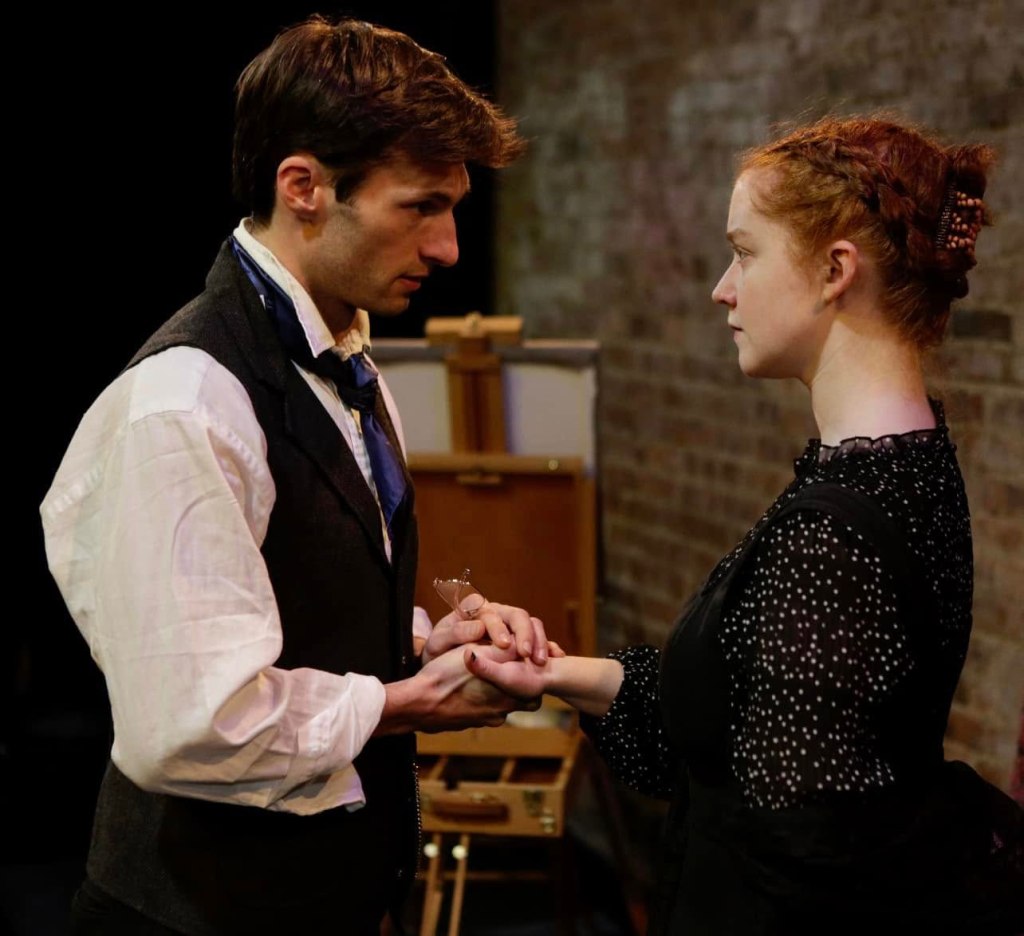
“Good evening, sitting here on Christmas Eve like a poor old maid!” chides Mme X. “It worries me to see you this way,” she tut-tuts with fake sincerity and genuine condescension. She admonishes Amelia for giving up on her marriage, and threateningly waves around the pop gun she bought Henry. She then launches into a diatribe that escalates quickly, the main topic being Mme X’s own husband Bob, whom we learn Amelia is all-too “familiar” with. “You ought to have such a husband,” she says, twisting the knife and foreshadowing a revelation. Patino is riveting as she raises the temperature slowly and believably through her deft physicality and expert performance of the difficult monologue. In just over ten minutes she tears down her unseen rival who—in the audience’s imagining—heartbreakingly takes it all in, in stunned, defeated silence. “Thank you for teaching my husband how to be a good lover,” is a finishing blow far more deadly than any gunshot.
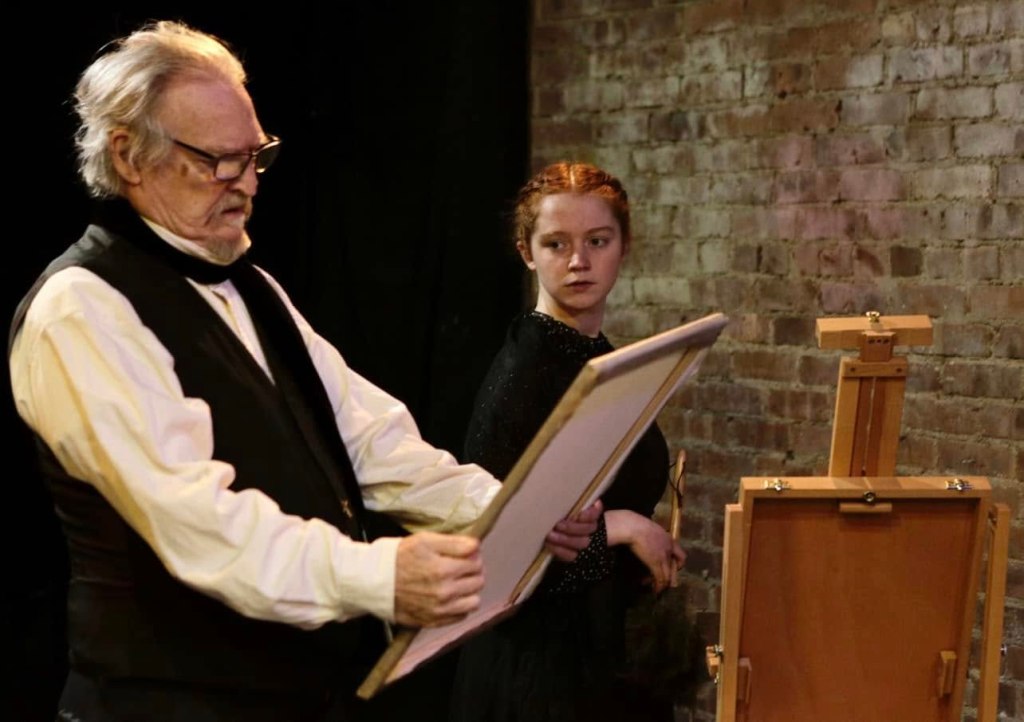
Playing with Fire is an unusually comedic turn from Strindberg, crafted in 1893, and also drawn from his own life experiences. Max Branciforte is Knut, a painter, and husband to the regal Kerstin (Annie Unger). The couple are entertaining visitors at the summer home owned by Knut’s parents (Amy Losi and Edmund McCarthy). The guests are young demure cousin Adele (Carolyn Best) and mutual friend Axel (Jessie Allen Hitner)—a jacket-, tie- and white tennis shoe-wearing writer who arrived in the middle of the night. The morning of the get-together begins cordially, but tensions rise when the true relationships among the characters—and what they truly think of each other—are slowly brought to the surface. Knut insists profusely that he is not jealous of the charismatic Axel; Adele is constantly cleaning, to the ire of Kerstin. “It’s her way of criticizing me and showing me up!” she observes. Knut is living off his parents’ allowance, while ungratefully dismissing them as “Philistines”. “You haven’t worked a day in your life,” fires back his mother. “And your father wasn’t a Philistine when he built this house for a scoundrel like you!” And circumstances (delightfully) escalate from there. It’s revealed that Knut is having an affair with Adele, who Knut’s father would love to make his own mistress. Adele is enamored with Axel—but confirming Knut’s suspicions, the charming writer is revealed to also be the true object of Kerstin’s desire. The reveal of the latter’s limerence sparks an unexpected response from Knut; he finds the competition is actually reigniting his dormant interest in his own marriage. Thus enfolds a hilarious, quotable tale of impropriety among the upper-class. Playing with Fire is the perfect main course after the appetizer of The Stronger; a love triangle storyteeming with sparkling discourse, it is presented with relish by a cast that is clearly enjoying the witty dialogue and delicious material.
The Stronger and Playing with Fire are stylishly directed by Sean Szak Prasso. There will be an encore performance at the American Theatre of Actors on March 2nd, 2025.
AMT Theater announces opening of UPSIDE DOWN, a new musical — Opening March 8 @ 7:00 p.m. at AMT Theater
AMT Theater announces the new opening of UPSIDE DOWN, a new musical — Opening March 8 @ 7:00 p.m. at AMT Theater, 354 West 45th Street, New York City TICKETS here.

According to a recent Gallup poll, 92.4 percent of the U.S population identifies as straight while the rest considers themselves as part of the LGBTIQA+ community.
Turn that number around, and you have the world of Upside Down.
It’s a world where straights are in the minority, women rule the military, and the Jets constantly win the Super Bowl. This is a world where the majority is gay.
In this topsy-turvy world, two songwriters are creating a new musical — innovative, unique, ground-breaking Broadway musical … about straight people!
The President is outraged! The military is put on red alert! News outlets are all ablaze over this unprecedented event.
Will they succeed? Is the world ready for a [wait for it] …a man and woman falling in love …ON STAGE?
The world of UPSIDE DOWN will put you in the zone … The Twilight Zone.
Upside Down has music and lyrics by Al Tapper, book by Tony Sportiello, directed by Taavon Gamble and music direction by David Wolfson. The cast includes Bernie Baldassaro, Patrick Brady, Mike Ferlita, Jake Foster, Lauren Gemelli, Kira Sarai Helper, Ashanti J’Aria, Matthew Liu, Kelli Maguire, Stephanie Maloney, Stanley Martin, Gina Milo, Brogan Nelson and Josh Powell.
Upside Down will open March 8th and run through April 5th at AMT Theater, 354 West 45th Street. For more information, contact amttheater.org
“What we are doing tech-wise with Upside Down is more ambitious than any show we’ve ever done.says Artistic Director Tony Sportiello. “The set alone is going to be a marvel. You’re going to go from a bar to The White House to an apartment to a television studio all in a flash.

AMT: The MISSION
AMT Theater aims to entertain, educate and inspire people through the arts. AMT Theater shall provide audiences the opportunity to attend and participate in quality presentations of the finest theatrical works available. We are dedicated to enhancing quality of life through art, events and workshops. AMT will create opportunities for hands-on learning experiences in all aspects of theater production and management to adults and children in order to foster and develop their talents. AMT will strive to be an organization which is diverse, inclusive and a leader in our field.
BOARD OF DIRECTORS: Co-Chairs: Tamara Flannagan & Tony Sportiello; Secretary: Joan Pelzer; Treasurer: Sharon Osowski; Members: Zoë Reeve, Joanne Schmidt, Al Tapper, Eve Tapper, Lynne Tapper
| In just its third year, AMT Theater is the West 42nd Street 2024 Winner for Best Venue. Upside Down is its fifth production, following An Unbalanced Mind, On The Right Track, Bettinger’s Luggage and David the Musical |

Joshua Crone and Thoeger Hansen: Bridging Divides Through Theatre
Article by Anya Kai
Joshua Crone and Thoeger Hansen are a dynamic force in the world of theatre, bringing a unique blend of playwrighting, directing, producing, and acting to their projects. Their latest collaboration, “A House Divided,” explores the complexities of family dynamics amidst the backdrop of a politically and socially fractured America.
Joshua Crone: From Playwright to Theatre Builder
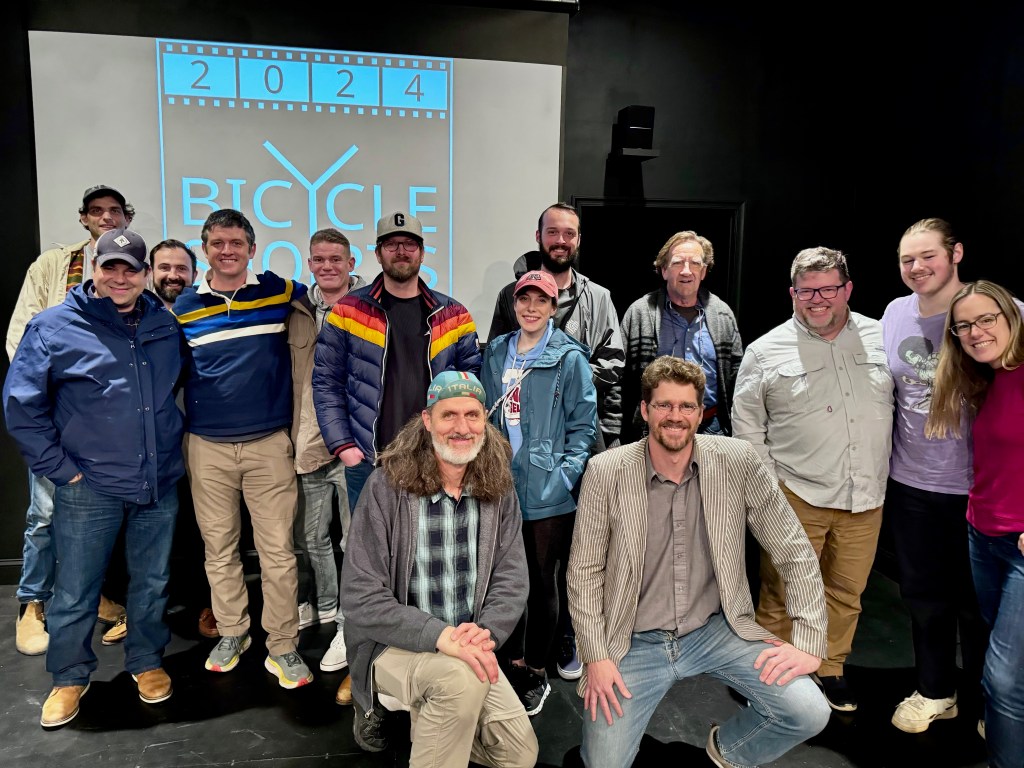
Joshua Crone’s journey in theatre began with a decisive choice at the age of 20: to be a playwright. However, Crone wasn’t content with simply submitting scripts and waiting for opportunities. He took control of his artistic destiny, learning to direct, produce, build sets and venues, and even make movies. This DIY spirit led him to establish Yellow Bicycle Theater, a black box space in Philadelphia. Named after the bicycle he used to park outside his apartment to make room for rehearsals and film shoots, Yellow Bicycle has become a hub for innovative theatre. Crone’s vision extends beyond Philadelphia, aiming to connect with the New York theatre scene, bringing shows like Thoeger’s “No Exit” and Megan Medley’s “Without God As My Lover” to the city and now taking his own work, “A House Divided” and “Ashes Ashes,” in the opposite direction.
Thoeger Hansen: From Actor to Director, Finding Focus in Grassroots Theatre
Thoeger Hansen brings a wealth of experience to “A House Divided,” having worked as a producer for several years and an actor for many more. Directing at this level represents a new chapter in his artistic journey, and he expresses excitement about working with Crone’s compelling script. Hansen’s path to theatre wasn’t always straightforward. He spent years navigating the challenges of the commercial/VO/print world before finding his true calling in grassroots New York theatre in 2019. This return to his roots, reminiscent of his early experiences with school plays and video production, reignited his passion. Hansen describes himself as a “gym rat” in the theatre world, finding joy in the daily grind of memorizing lines, practicing, and collaborating in the rehearsal process. This dedication and focus have been instrumental in his growth as an artist.
“A House Divided”: A Thanksgiving Play for a Divided America
“A House Divided” is a Thanksgiving play with a timely and resonant message. While Crone emphasizes that the play’s core themes are best articulated by its playwright, Hansen offers his perspective: the enduring power of human connection, particularly within families, even amidst deep political and social divisions.
Crone explains that the play was written in the tumultuous period leading up to the 2020 election and following the loss of his sister to cancer. Inspired by childhood Thanksgiving plays with his sister and their later adult disagreements, he wanted to create a play about a family gathering despite their differences. Set in 2021, a year marked by intense national division, the play fearlessly tackles a range of hot-button issues: mandates, Black Lives Matter, gender ideology, election integrity, and Trumpism. Crone’s goal was to present a balanced portrayal, avoiding straw-man arguments and ensuring that each character, with their flaws and finer qualities, has something at stake in these deeply personal debates.
The Power of Theatre to Bridge Divides
Both Crone and Hansen hope that audiences will be entertained by the play. Hansen expresses a desire for audiences to recognize the futility of the divisions that hinder human connection. Crone’s more playful hope is that any post-show arguments sparked by the play will ultimately lead to reconciliation.
They both believe that the recent election has little impact on the play’s relevance. Hansen points out that the play is set in the recent past and that the issues it explores would remain relevant regardless of the 2024 election outcome. Crone succinctly states that the play’s themes of division and conflict would persist regardless of which side prevails.
Looking Ahead: “Unicycle” and “Ashes Ashes”
Crone’s upcoming projects include “Unicycle,” a festival of solo shows at Yellow Bicycle Theater during Philly Theatre Week, featuring several shows from New York. He is also preparing for the New York premiere of his Hiroshima play, “Ashes Ashes,” at the American Theatre of Actors. This production, originally planned for the 75th anniversary of the bombing but delayed due to COVID, will coincide with the 80th anniversary in August. Hansen may also be involved in “Ashes Ashes” later in the year and is exploring other potential projects. For now, however, his focus remains firmly on “A House Divided.”
Joshua Crone and Thoeger Hansen represent a powerful force in contemporary theatre, creating works that not only entertain but also challenge audiences to confront the complexities of our time. Their commitment to exploring difficult topics with nuance and empathy makes their work both timely and essential.

“This is NOT A Drill” New Musical to Hold Private Industry Reading in NYC on Theatre Row
“This is NOT A Drill” New Musical to Hold Industry Reading in New York City
BY INVITATION ONLY event to be held on Theatre Row
BASED ON ACTUAL EVENTS

After numerous workshops and development, “This is NOT A Drill,” a new musical by Holly Doubet, is set to hold an exclusive by-invitation-only industry reading in New York City this March on Theatre Row.
This poignant work, inspired by a true event, has already garnered significant attention, including the prestigious 2021 Donald Fowler Theatre Arts Memorial Grant.
Following its acclaimed premiere in Dallas in 2021, “This is NOT A Drill” is taking the next step with this industry reading. The musical explores the lives of diverse characters who experience shock and panic upon receiving an emergency alert: “BALLISTIC MISSILE THREAT INBOUND TO HAWAII. SEEK IMMEDIATE SHELTER. THIS IS NOT A DRILL.”
Forced to confront their own mortality, they discover what truly matters. The show promises a suspenseful, yet warmhearted and funny journey, exploring love, relationships, and human nature under unimaginable circumstances. Doubet’s score is filled with undeniable emotion and soaring melodies.
The event will be the end of March on Theatre Row. Industry can contact Jay Michaels for further details.
“This is NOT A Drill” is based on a true event experienced by its conceptor, Holly Doubet. The musical follows the intertwined stories of individuals grappling with the reality of a potential missile threat. It’s a compelling exploration of human connection and the choices we make when faced with the unthinkable.
The production boasts an impressive team of talent:
- Director: Luis Salgado
- Grammy-Winning Musical Director: Paul Bogaev
- Grammy-Winning Guitarist: Jim “Kimo” West
- Broadway “Hamilton” Lead: Marc delaCruz
- Consulting Producer: Jack Lane
- Casting: Holly Buczek, Scott Wojcik – Wojcik Casting Team
- General Management: Evan Bernadin Productions/Hillel Friedman
- Attorney: Thomas Distler

Holly Doubet is a graduate of the Royal Academy of Music in London and holds a double major in classical piano and voice from a California university. Her diverse musical background spans from studio singing and songwriting to leading her own band and working as a backup singer in Los Angeles and Las Vegas. Doubet also served as a songwriter for the beloved children’s television show “Barney and Friends” and has achieved commercial success in the pop music world, including a CableAce Award nomination. “This is NOT A Drill” marks her exciting foray into musical theater.

From “Tonight Show” Writer to Funerals with Punchlines: Brad Dickson’s “Lovely Idiots” Comes to NYC
Get ready for a funeral unlike any you’ve attended before. Playwright Brad Dickson, Emmy Award-winning former staff writer for “The Tonight Show,” is bringing his uproarious play, “Lovely Idiots,” to New York City for an industry presentation. Known for his sharp wit and comedic timing, Dickson invites audiences to a memorial service brimming with laughter, proving that even death can be darn funny.

Dickson’s diverse background shines through in his work. From writing jokes for late-night television to penning humor columns in the days of thriving newspapers, his comedic voice has resonated across various mediums. His essays have graced the pages of prestigious publications like the Los Angeles Times and America Magazine, and he’s even co-authored two books published by Simon & Schuster. This breadth of experience clearly informs his playwriting, bringing a seasoned understanding of comedy to the stage.
“Lovely Idiots” centers around a group of New York actors and producers who gather to mourn the passing of a once-famous theatrical icon. But this isn’t your typical somber affair. Dickson’s play promises a comedic exploration of the theater world, its personalities, and perhaps even the absurdity of life itself. The premise alone hints at the kind of witty observations and character-driven humor that Dickson is known for.
This isn’t Dickson’s first foray into the theater world. His plays have been produced in numerous venues across the United States and Canada, demonstrating his commitment to the stage. “Lovely Idiots” marks another exciting chapter in his playwriting career, offering New York audiences a taste of his unique comedic perspective.
The industry presentation of “Lovely Idiots” will take place on Thursday, April 3rd, at 2:00 PM and 6:00 PM at Open Jar Studios, located at 1601 Broadway, New York City. Those interested in attending this unique theatrical experience can contact 646-338-5472 or [email address removed] for further details and to RSVP. Don’t miss this opportunity to witness the comedic genius of Brad Dickson and experience a funeral that’s sure to leave you in stitches.