
Home » Articles posted by jaymichaelsae (Page 14)
Author Archives: jaymichaelsae
“The Butterfly Soars” says Jim Catapano
Monarch: A Mexican-American Musical Makes a Poignant and Timely Entry Into Public Consciousness
The Monarch Butterfly is known for its autumnal instinctive migration between the Northern United States and Mexico, during which it travels thousands of miles. The butterfly is also the embodiment of change and transformation, and thus the perfect symbol for the journey of Luis, the hero of Monarch: A Mexican-American Musical.

The handyman is a “Luis of All Trades,” beloved by the community. But, he is also an undocumented immigrant, making him a target in turbulent times. Officer Castelo of ICE makes it his life’s obsession to pursue Luis, echoing the arc of the iconic Inspector Javert of Les Misérables. Luis is forced to seek sanctuary in a local church where he relates the story of his life. We are introduced to his daughter Ana (who sings “Dreamer”), who came to America as an infant and is now 20 when circumstances grow grim for the dreamer family; and his beloved wife Amanda, who passed before Luis had left Mexico but is still a powerful presence in his life. The titular Monarch (The Nagual, meaning Spirit or Shaman) is the narrator, relating the story of the butterfly’s journey while Luis’ story unfolds in song. “The Monarch, the most amazing creature, my darling,” he croons. “That’s what you are.”
In a time when the fate of the undocumented Dreamer is in considerable danger, Monarch reminds us that these are human beings who are only looking for a better life, as is the story of all who came to America since it was founded centuries ago; our ancestors were all once Luis.
As crafted by Alfonso Molina (music, lyrics and book) and Mayu Molina Lehmann (lyrics and book), the score runs the gamut of musical styles, from the Leonard Bernstein-recalling piano Overture to the operatic tones of the solo numbers, to the classic Broadway of the rousing ensemble pieces. The lyrics are direct and necessarily unsubtle in depicting the points-of-view of Luis’ hopeful family, as well as the “only following the law” Castelo. The production is a testament to the power of words and music to tell the story of the human experience, in a desperate time when we need creative activist voices more than ever.
Monarch boasts a cast of 13 and a total of 51 musical pieces over two acts, as presented at the Los Angeles Theatre Center in December 2023. An abridged reading was performed at Open Jar Studios in NYC in November 2024.

ALL-OUT ARTS honors NYC Councilman Erik Bottcher and Communications Professor Jay Michaels
Now in its 23rd year of presentation, All Out Arts is proud to announce the 2024 Fresh Fruit Festival Award WINNERS for Outstanding Productions in Playwrighting, Directing, Performances, and Technical Achievement.
Monday, December 2: Reception: 6:15 p.m. and Event: 7:00 p.m. at The Wild Project – 195 East 3rd St [btwn Ave. A and B]. The full list of winners can be found HERE and Tickets can be secured HERE. Seating is limited so you must reserve/purchase your seats in advance.
Edge Media called us “the most inclusive expression of LGBT arts ever held in the City of New York.” We present work that is fresh, exciting and insightful. Performers of all racial, religious, and ethnic backgrounds, sexuality, and gender orientations fill our stages. African-, Caribbean-, Chinese-, East Indian-,Filipino-, Hispanic-, Japanese-, Korean-, Native-, and even un-hyphenated Americans are among groups represented in our 20+ years of festivals.
HARRY WIEDER AWARD FOR COMMUNITY SERVICE
An individual or group that has worked extensively for Arts and LGBTQ Community. It is named in honor of Harry Wieder, a founding Fresh Fruit Board member and advocate for LGBTQ and disabled New Yorkers.

Erik Bottcher is a dedicated public servant and activist who has devoted his life to progressive causes and to the betterment of the community the loves.
In 2021, he was elected to represent New York City Council District 3, which includes the neighborhoods of the West Village, Chelsea, Hell’s Kitchen, Times Square, Hudson Square, Flatiron, and the Garment District. He sees his mission as simple yet vital: making New York City a better place to live.
Growing up in a small town in the Adirondack Mountains as the only gay person he knew, Erik’s personal struggles with depression sparked in him a lifelong dedication to helping the most marginalized members of our society. His career in public service began in 2009 as the LGBTQ & HIV/AIDS Community Liaison in the City Council’s community outreach unit, where he organized grassroots campaigns on issues including hate crimes, transgender rights, housing for people with HIV/AIDS, and marriage equality.
Erik then served as the statewide LGBTQ Community Liaison in the governor’s office, where he helped organize the fight for marriage equality in New York State, working with activists from Buffalo to Montauk in an unprecedented grassroots campaign to garner support for the Marriage Equality Act. New York State made history as the largest state to legalize same sex marriage.
From 2015 to 2021, Erik served as Chief of Staff to his predecessor, Council Member Corey Johnson. In this role he gained an encyclopedic knowledge of every block of Council District 3 while providing constituent services to tens of thousands of residents and working alongside tenant associations, block associations, community boards, PTAs, parks groups and others to make our community a better place to live.
Erik has established a citywide reputation as one of the most active and effective members of the New York City Council, leading on critical issues such as the crises of mental health, housing, sanitation, sustainability, and more. He is working to reverse decades of failed policies and disinvestment in mental healthcare, authoring and passing landmark legislation that requires family homeless shelters to provide on-site mental health services, requiring the Department of Education to provide suicide prevention resources to students, fighting for adequate inpatient psychiatric treatment capacity, and more.
Recognizing the importance of clean and healthy neighborhoods, Erik has been at the forefront of sanitation improvement efforts in the city, leading the way on reforms such as the containerization of garbage, reduced usage of single-use plastics, increased corner basket service, and other initiatives to enhance the city’s cleanliness.
Few elected officials have been more vocal than Erik about the affordable housing crisis that poses an existential threat to New York City. With the lowest rental apartment vacancy rate since 1968 and the highest levels of homelessness since the Great Depression, Erik believes that an abundance of housing is needed to bring down housing costs. He has worked with his local community boards to create a pipeline of thousands of affordable housing units in Council District 3.
Environmental sustainability is also a key priority for Erik. He has funded the planting of hundreds of new street trees in Council District 3. His legislation creating the Urban Forest Master Plan aims to increase the tree canopy coverage to 30% by 2030. He has championed universal curbside composting, reduced renovated parks and playgrounds, [remove space here]waged war against single-use plastics, and promoted cycling as a form of transportation by creating new protected bike lanes on Tenth Avenue and Lower Sixth Avenue.
Erik is Co-Chair of the Council’s Manhattan Delegation and the LGBTQIA+ Caucus. He serves on the following City Council committees: Mental Health, Disabilities, and Addition; Public Housing; Small Business; Technology; Economic Development; Civil Service and Labor; Contracts; Higher Education; and Immigration.
PASSION FRUIT AWARD
To a person or organization in the arts “whose passion has led them to a life’s work that serves our community and enlarges our world.” Award Reads: “Serving the Community & Enlarging Our World.”

Jay Michaels began his career during the original off-off Broadway and underground movements in New York City and has become one of indie theatre and films’ most visible personalities.
Beginning as a special events assistant at the New York Daily News and PBS, he moved on to positions including promotional staff for The Joyce Theater’s Drama Desk Award-winning American Theater series; national tour manager for Cats, Edwin Drood, and Les Miserables; a television media buying associate; senior event marketing executive for international galas and fundraisers including speechwriting for the Weissler, Nederlander and Shubert organizations, James Earl Jones, Jon Stewart, Vera Wang, Mayors Lindsay and Dinkins; and Hillary Clinton to name a few. Michaels also managed promotional events for Broadway shows, Guys & Dolls (1992) Damn Yankees (1994), Vagina Monologues (2005) and Beginnings (2018) as well as Audra McDonald at Broadway’s Town Hall (2019). As a general manager, Michaels ran the events for Genesis Repertory Ensemble, Inc., The Jan Hus Playhouse, The Chelsea Opera Theater, The Mazer Theater in the Lower East Side, Queens’ Greek Cultural Center, and Brooklyn’s Block Arts Center. Michaels is a recipient of the Jean Dalrymple Award; the Robin H. Miller Award; the Federation’s Marketing STAR Award; the Performing Arts Society Award; an honorary board member of Pace University; a Directing Fellow with former Pearl Theater Company; and Fearcon‘s Film Festival‘s HOST Award two years in a row.
As a stage and film producer, Michaels has helmed productions as some of New York most respected theatres and worked with Daryl Roth, Jim Kierstead, Ken Davenport, Bill Oberst, Jr., David Canary, and Tovah Feldshuh. Michaels served as on-air film and classic TV commentator for Sun Television Studios; Octane Media; and currently, star of ACW-TV’s Jay Watch. He is also host of Under the Influence and In the PassionPit podcasts and the Classic Cinema Challenge. And also host of on-air events for the Boston Sci-Fi Film Festival’s channel.
Michaels serves as a professor of communications for over 20 years at several universities including Fordham, Kingsborough, Yeshiva, Staten Island, Berkley, and DeVry. He has a Masters in Communications and Public Relations and Certification from The Hollywood Film Institute.
His boutique PR firm, Jay Michaels Global Communications, services a vast array of independent international talent and their projects including some of New York’s most prominent indie stage companies and all of the NYC theatre festivals: the Midtown International, the Fringe, Planet Connections, the Downtown Urban Arts, NYTheatreFest, and his favorites: Spotlight-On and — of course — the Fresh Fruit Festival.
The Fresh Fruit SPIRIT Award will also be featured at the event and awarded to
When a Faggot Finds a Flower – A fable about a boy who’s sick of his bent wrist, and what he stands to lose by straightening it out. -by Jude Cramer, directed by Lucy Harrington
“The spirit of pride and survival, of history and progress, of a freedom and creativity that allows for respect and equality for all people.” Everything and anything in the arts that gets us closer to that world is: the Fresh Fruit Spirit“

High Praise from Jim Catapano for SKYSCRAPER
The Skyscraper Rises Again
The 1960s Broadway Musical Is Gloriously Revived for the First Time.
The determined and spirited Georgina Allerton has two goals—to make her antique shop a success, and to save her Rutherford B. Hayes-era Manhattan brownstone from getting bulldozed in favor of the titular modern marvel. But she’s also a hopeless romantic, and her forays into flights of fancy threaten to impede her success in the real world, in a time when women had to fight to be seen and heard.
Skyscraper is the creation of legends James Van Heusen (music), Sammy Cahn (lyrics), and Peter Stone (book), based on the play Dream Girl by Elmer Rice. Today it is reborn, in its first-ever revival, as a vibrant production that blows welcome fresh air and a dose of cheer into uncertain modern times.
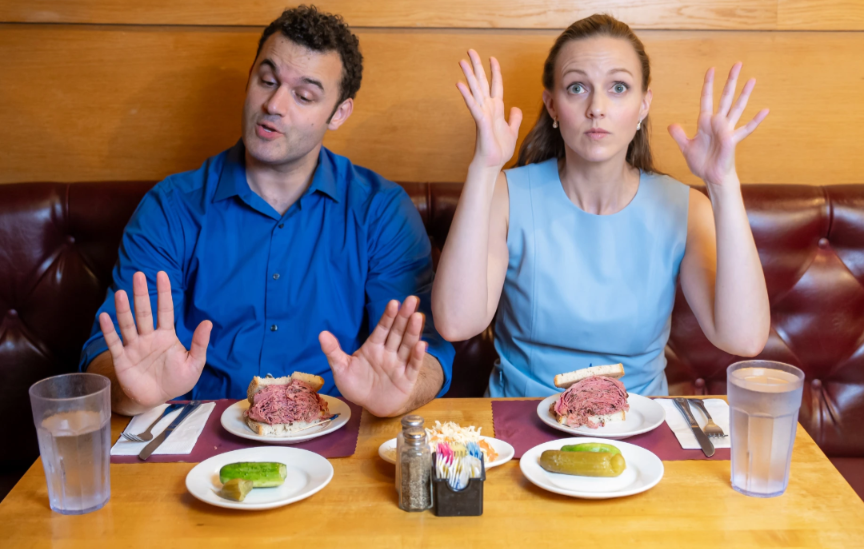
In the role originated by Julie Harris in 1965, Rachel Lauren James shines as Georgina, anchoring the show with a magnetic central performance. The shop owner fights/flirts with contractor Tim Bushman (Travis Murad Leland), who is competing with his brother Bert (Jeff Raab) to see which of the two can persuade Georgina to sell her property to make way for their towering behemoth (and its fittingly garish, pimply design). Tim, who has been spying on Georgina with a telescope (making him “a peeping Tim” as it is noted), takes a genuine liking to her, even as he conspires to cajole her for the sake of business.
Georgina also must battle the common, dismissive perception of her, which is either as “that stupid woman next door” or “the girl with the sensational legs and thighs.” Complicating things further is Georgina’s own vivid imagination, which propels her at inopportune moments to disappear into a dreamworld where she is romanced by her assistant Roger (Brian C. Veith.) “Everyone daydreams, it’s part of the human condition!” protests Georgina, oblivious to how much it is interfering with her life
(“Occasional Flights of Fancy”). The dream sequences are delightful as Georgina conjures up moments and dialogue from Gone with The Wind, and forays into Parisian-style passion.
Katryna Marttala excels as Stanley, tough-talking head of the construction crew, who leads them in singing “Local Four Oh Three.” Adding comic flair are Sydney Michele Castiglione as Georgina’s pestering but well-meaning mother, Shea Pender as her “can’t-be-bothered” father, and Abby Scalici as her “still-single” sister Charlotte.
As crafted by the masters, the songs are expectedly joyful and memorable, and the dance sequences beautifully crafted by director and choreographer Avital Asuleen, and guided by ensemble member Katherine Winter as Dance Captain. (Among the stunning sequences is a winning tap dance number.) “Haute Couture” is a particularly fun set piece, with the guys and gals singing the praises of 60s fashion and flair in their thick NYC accents.
The song and dance sequences, combined with the witty book, perfectly recreate the playful fun of early 60s Broadway while being an overall love letter to the theater and to New York City. The costumes by Michael O’ Herron are suitably bright, from the orange hats of the building construction workers, to the red, pink and green coats, shirts, and dresses of the ensemble at large. The inventive set design by Hannah Tarr beautifully brings it all together.
This newly built Skyscraper is a triumph for the actors and creative team, and it makes for the perfect, refreshing theatrical escape of the season.

Skyscraper is presented at Urban Stages through November 17, 2024.

Jim Catapano explores the 21st Century Dating Scene with his review of “He’s Different”
Love Will Find You
He’s Different Takes a Witty and Insightful Look at Contemporary Dating
“It was just a party…a normal Halloween party, smack in the middle of Bushwick, when everything changed.”
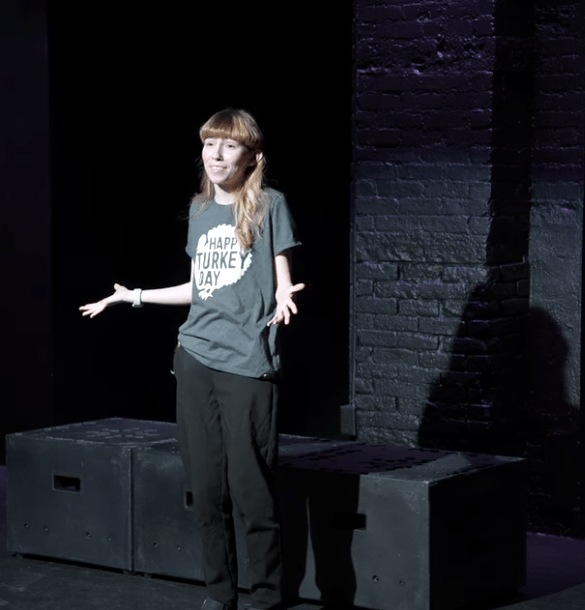
So proclaims Liv, a contemporary dancer, who toasts the holiday with her roommate Naomi as the intriguing tale of He’s Different unfolds.
The two friends watch the costumed revelers, scoping for someone worth flirting with like they’re picking lobsters from a tank. (Their choices this evening include Scooby-Doo and Jeffrey Dahmer.)
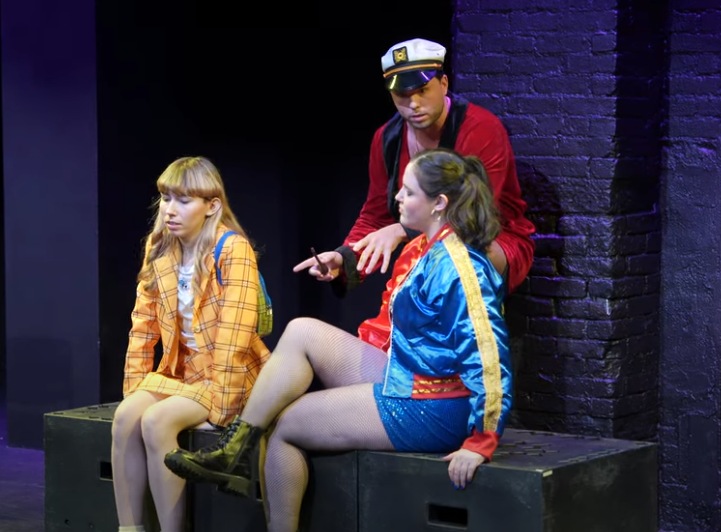
“I haven’t had sex in six months!” laments a frustrated Naomi. She is overheard and approached by Hugh, resplendent in a boat captain’s hat, silk red robe, and conspicuously zero pants—the walking example of everything the women don’t want.
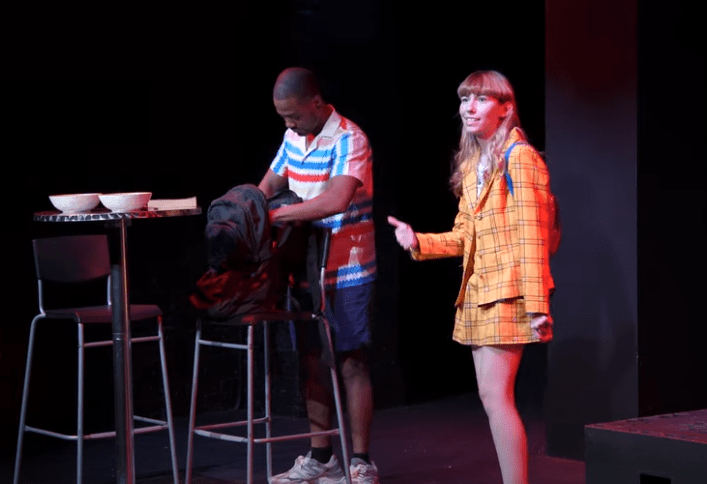
Liv is also single and adrift, noting that “most men are trash.” She’s holding out for someone suitably enlightened, feminist—and dare we say, woke. “All these guys are cute, but most of them probably don’t know the difference between Greta Thunberg and Greta Gerwig,” she observes. She points out a new arrival to the party, Travis, as a likely example. “How do I know that he wouldn’t skip our wedding for a football game?”
But then she spies a “Trans Lives Matter” sticker on his water bottle, and it piques her interest. “I got this from a cute little store in Brooklyn, owned by a trans activist,” Travis explains. “They make cute little merch like this to fund gender reassignment surgery for homeless teens.” The cynical Liv wonders if this is just the latest pickup line, but Travis keeps passing her tests, impressing in every way imaginable (Exhibits A-C: He works at a Senior Center, loves the aforementioned Greta Gerwig, and finishes Lynn’s sentences).
Liv is all-in: she grows not only intrigued, but smitten in a way she never thought possible, as her weary skepticism morphs into teenager-like infatuation. “What if he doesn’t text me back?” she whines, followed by a squealed, triumphant “HE TEXTED ME!” when he actually does, under the wary gaze of Naomi. And so the mystery begins—is this guy the real thing or the ultimate poser? Is this “smart and sweet” persona a disguise, no more real than the other costumes at the party? The question sets off a gripping journey, with a very amusing twist, and in the end, a poignant message about where real love can be found.
He’s Different is an insightful treatise on relationships in the here and now—taking a microscope to our desires, insecurities, turn-ons and offs, green flags and dealbreakers. It does so with a sharp, knowing wit that will keep you laughing and nodding in recognition. The sight of the previously grounded and Bechdel-test passing Liv melting into limerent obsession tells a truth about the malleability of the human psyche that is undeniable, and well worth exploring. The actors bring the story to life deftly, creating recognizable archetypes with warmth and humor. It all comes together to make He’s Different an enjoyable and satisfying experience.
He’s Different is written by Arianna Wellmoney. It was showcased at the Chain Theatre in the summer of 2024, as directed by Bradly Valenzuela, with Wellmoney as Liv, Kiamba Doyling as Travis, Megan Catalina as Naomi, and James Nash as Hugh.

Cleats, Chords, and Connections: Jim Catapano reviews 2 by Ken Couglin
Ken Coughlin’s New Plays Are Love Letters to Two Legendary Pastimes
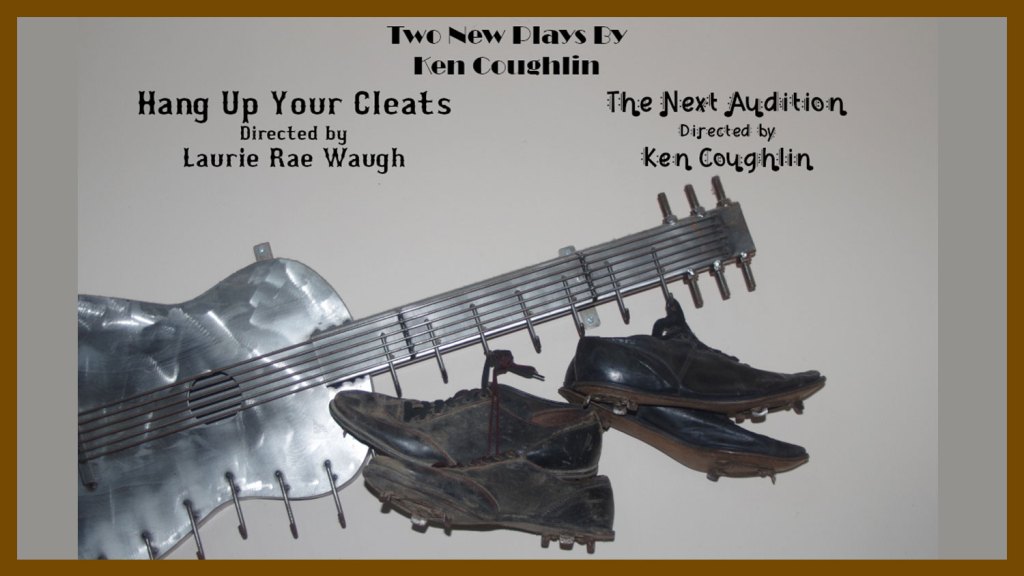
The award-winning Ken Coughlin has turned his attention to two of the most cherished pursuits of modern times: Baseball and Music. Hang Up Your Cleats, directed by Laurie Rae Waugh, and The Next Audition, directed by Coughlin, are performed together at the American Theatre of Actors, and truly fit like a glove. They are an insightful look at two of the passions that define modern culture, and how they inspire and connect people from all walks of life. Both plays are realized by a cast that brings a fitting charm and warmth to Coughlin’s resonant words.
Hang Up Your Cleats follows its characters over the course of over 20 years, beginning in 1931 during the prohibition era. The setting is a Speakeasy in a town with a popular baseball team at its center. The team’s star hitter, Otto Grafton (Kevin Ford), is in a 27-week slump, which he responds to by slumping into the bar to nurse his wounds. He tells the bar’s owner, Bart (Phil Oetiker), a devoted fan, that he is going to quit. The kindly Bart talks him into giving it one more go, promising that he will hang up Otto’s cleats behind the bar as a tribute when he eventually does retire (and giving the play’s title a second, more positive meaning).
This leads to a series of emotional vignettes over the course of the next two decades, segueing to the sounds of many different renditions of “Take Me Out to The Ballgame.” Bart’s son, Bart Jr. (Brian Michael O’ Neill) takes over the bar, Prohibition ends, and soon, the cleats above the bar multiply—a makeshift Wall of Fame for the town’s ballplayers, both famous and under-the-radar. We meet Cliff Samson (Dennis Mullikin), a kid who has just been cut from the local team. Soon we see that Bart Jr. has not only inherited his dad’s bar, but his compassion and love of the game as well—he urges Cliff not to give up.
In the spring of 1943, the bar is host to ballplayers Luke (Daniel Dennehy), Jim (Jacob Ward), and Benny (Luc Mitchell). The trio announce to Bart that they are not reporting to spring training, and due to the year, we immediately know why. Moved by their sacrifice, Bart hangs up their cleats in honor of the men. After the war ends, Women’s Baseball players Shirley (Julianne Lorndale) and Nadine (Sonia Halle) come into Bart’s to lament the end of their league, considered superfluous when all the male stars returned from overseas. Bart gives them both a place on the cleat wall, and starts a relationship with Shirley. Now partners in life and in business, the two meet Calvin Briggs (Will Allen). Calvin is a ballplayer from the Negro Leagues whose team has disbanded. Bart and Shirley welcome and honor him, rebuking former ballplayer Sam (also played by Oetiker) for his bigotry when he encounters Calvin.
The kind heart and compassion of Bart Jr., beautifully portrayed by O’Neill, is at the center of the play, coupled with the magical ability of baseball to bring people together. Bart’s bar becomes the “Cheers” of the town, and as the story progresses into the 1950s, all the characters come together as a kind of family—including Eloise (Aileen Bergin) and Martha (Valerie O’ Hara), sister and mom of one of the ballplayers. The group is united by their support of each other in hard times, shared history, and their devotion to the National Pastime. It all comes together to make Hang Up Your Cleats a moving tribute to human resilience and connection.
The topic shifts to music with The Next Audition. It’s the story of gigging lifelong guitarist Ken (Coughlin), as relayed and debated by Tom (Thomas J. Kane) and Val (Valerie O’Hara). The play is cleverly staged In Ken’s workshop, where he wordlessly tinkers with five guitars in the background while Tom and Val regale us with stories of his misadventures on the local concert circuit over the years—the gig on the boardwalk that lasted one night; the residency at the Italian restaurant that made it to a miraculous three weeks.
“Who wants to hear a bad, loud version of ‘Good Golly Miss Molly’ while they’re trying to enjoy their Risotto alle coste?” scoffs Tom.
Ken is seemingly oblivious to their conversation as he meditatively works on his collection. As opposed to the cynical Tom, Val is generally encouraging of Ken’s goals.
“You never get more unless you demand it,” she proclaims, suggesting that Tom is a dream-destroyer.
“Well maybe he should have spent more time getting the gigs that paid more,” he snarks back, suggesting that each failed endeavor only causes Ken to slide into despair. “He’s just going to get hurt again.”
Tom and Val are our guides to Ken’s journey from one project to the next, including a chaotic turn in one of the infamous Beatles Tribute bands. We hear the stories of Ken battling egos, creative differences, and frequent rejections, and ending up with little money or recognition to show for it. Though Ken never says a word, he’s clearly wondering if he’s wasting his time too by trying again and again. The dénouement, with Ken alone, is poignant, but fittingly, he performs a beautiful song, signaling that the show must go on. The funny and poignant play is a moving and familiar story for all of us in the entertainment business who have been constantly knocked down and always gotten up again.
Hang Up Your Cleats and The Next Audition are performed together at the Sargent Theatre at the American Theatre of Actors through November 3, 2024.
Jim Catapano, ZORA, and The Harlem Renaissance
The Life of a Literary Legend
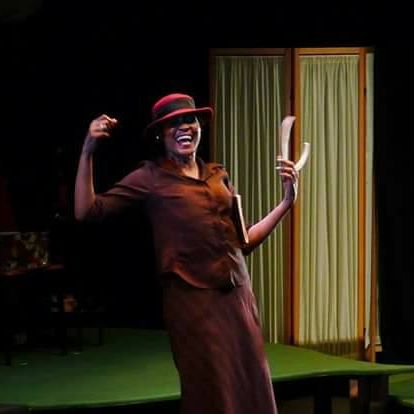
Actor Antonia Badón and Director Greg Freelon join forces to bring us the triumphant Zora!, a new staging of Laurence Holder’s play, realized as a one-woman show. It’s a love letter to not only the brilliant author, folklorist and anthropologist Zora Neale Hurston, but to a pivotal, landmark time in history.
Badón is astonishing as Hurston, “A Genius of the South” as novelist Alice Walker’s epitaph proclaimed. She embodies the author at various stages of her life, growing from a young hopeful to an accomplished elder with stunning realism, changing body language and the pitch of her voice dramatically to fit the time period. Hurston adventures from her home of Eatonville Florida, the first incorporated all-black town in America, winning a scholarship to Barnard college and launching herself into becoming a prominent force in the Harlem Renaissance. The most popular of her novels, Their Eyes Were Watching God, is published in 1937, and her essays, short stories and plays made her an essential voice in the black community of the time and well beyond.
In between (and often during) Badón’s monologues, a film projection of scenes from the early 20th century accompanies Zora’s story. Vivid images of New York City, and of the great icons of the era (such as Langston Hughes, James Van Der Zee, and Duke Ellington) flash by as we are treated to a soundtrack of the jazz classics of the age. The film interludes, while allowing us to delight in wistful time travel to another era, also allow Badón to change into one of her many fabulous outfits.
Armed with her powerful pen (and typewriter), Hurston’s voice holds tremendous power, brutal honesty, and necessary skepticism and criticism of the norms of the era. “I will jump up to support this democracy as soon as all those Jim Crow laws are gone,” she proclaims. “…But I am not selling out for no cheap, itchy suits!”
The most poignant sequence depicts Hurston as weary and ill in the late 1940s. She has written several acclaimed novels but with little money to show for it; she is now without a publisher but determined to raise her voice up and write again. After looking frail and spent she suddenly rises from her chair, stands up tall, and returns to her typewriter, stoic and strong once more, in a foreshadowing of her enduring legacy.
“Don’t worry about me,” she smiles.” Go down to your neighborhood bookstore. I’ll be there.”
Zora! is at the Sargent Theatre at the American Theater of Actors through Oct. 20, 2024.

Jim Catapano faces Demons in the Darkness
A Comedic Queer Horror Play Shines at The Days of the Dead Theater Festival
Riverside, California, 2010: Friends and co-workers Pablo (Sergio Caetano) and Owen (Hraban Luyat) are in a pickup truck by the woods. They are waiting for their gummies to kick in and for their dates to arrive. But they might as well be waiting for Godot—because due to a secret sabotage, the women are not going to show. And now the pair have their own complicated feelings for each other to confront—as well as, eventually, a very real monstrous entity lurking in the shadows (design by Coyote Caliente).

Goat Blood is the brainchild of Mark-Eugene Garcia, centering around the Latin folk tale of the chupacabra, a vampire-like creature said to have terrorized Puerto Rico in a series of livestock murders where the animals were found drained of blood. The story then worked its way across Latin America and the southern states in the late 90s. Owen tells a taco-devouring Pablo about the time he fell and broke his ankle on a hiking trail; immobile and scared, he warded off animal predators by warbling “God Bless The USA.” It is then that Pablo references the legend of the chupacabra. With the monster on their minds (and as we learn, lurking among the trees), the two continue to banter and philosophize, and begin to tentatively flirt. Owen mentions a game he played as a teen, where one “dude” runs his hand slowly up the other’s inner thigh, waiting for the other to get nervous and put a stop to it (or, not). Pablo incredulously dubs the game “Gay Chicken.”
“What, your high school friendships never had homo-erotic undertones?” counters Owen, before Pablo agrees to giving the game a go.
They are anxiously but playfully taking their first steps in exploring feelings that neither had wanted to admit to before. But before they can fully embrace the elephant in the room (or in this case, field), we come to realize that not only is the chupacabra in their midst, but that Pablo’s prior experience with it goes far beyond familiarity with the folklore. The creature makes its move, and we are now in a full-on horror story.
Suddenly, we flash back to 1998 and Pablo’s first encounter with the demon, which leads to a terrible tragedy that haunts Pablo to the present day. Gabriel Rosario appears here as the mysterious and intense Mr. Sanchez, who knows everything about the threat and allies with Pablo to try and combat it, using “fear as a weapon”. (Rosario also serves as Fight and Intimacy Director.) We cut backwards and forwards in time in a series of thrilling and dynamic sequences that roller coaster to a nightmare climax (but not without some more romantic exploration and soul-searching along the way).
The production is at turns atmospheric and creepy, insightful and witty. It is not only a gripping tale of terror, but also a relatable, astute look at the complexity of modern-day relationships in the queer community and beyond. The actors, as deftly directed by Rodrigo Ernesto Bolaños, throw themselves into the narrative and imbue their characters with a reality that plays beautifully alongside the old-school horror movie tropes—making them sparkle like the Twilight vampires that Owen jokingly alludes to. It all comes together to make Goat Blood an unmissable addition to The Days of the Dead Festival and to Frigid NY.
Goat Blood runs at Under St. Mark’s through Oct. 26, 2024.
Jim Catapano on how they died.
Anne L. Thompson-Scretching’s Poignant and Essential Reminder of a People Destroyed by Hate
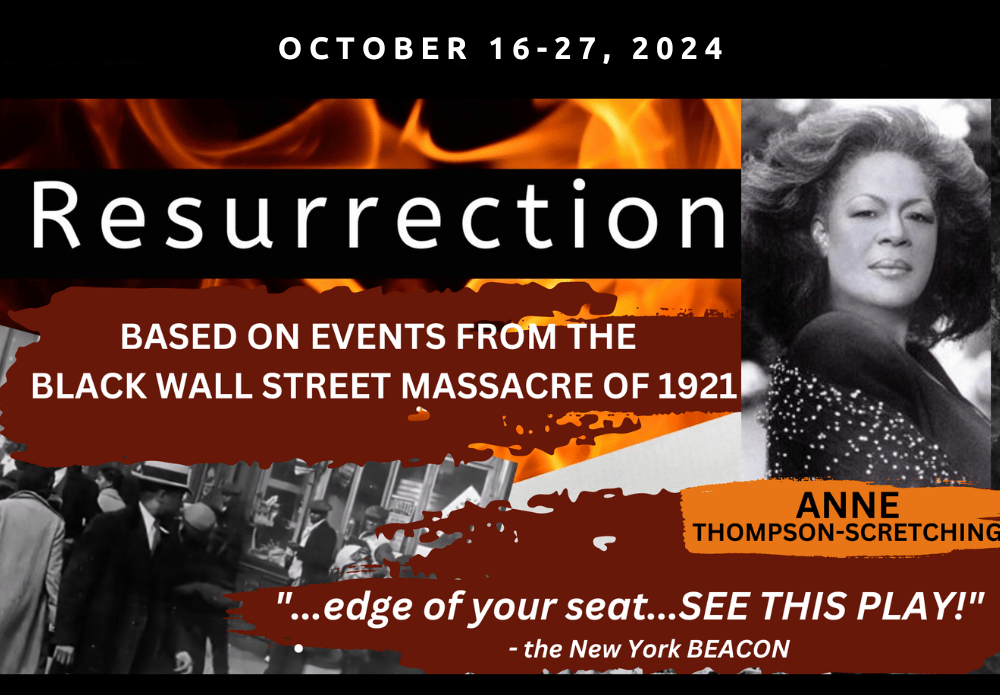
Everyone in the District of Greenwood in Tulsa Oklahoma is dead—brutally murdered by the Ku Klux Klan. The White Supremacists in the area took advantage of a lie to justify destroying the town and everyone in it. This is not fiction—this was the reality on the days of May 31st and June 1, 2021, in what came to be known as the Tulsa Race Massacre. It is widely considered to be the worst incident of racial violence in Unites States history. But this atrocity has been often relegated to a footnote in the decades that followed, out of shame; and to perpetuate the often-false narrative of progressive unity and equality in 20th Century America and beyond.
Anne L. Thompson-Scretching’s Resurrection is a fictional account based on the very real massacre, taking place during and after that horrific 48 hours of bloodshed. We meet the people of Greenwood in a limbo world after they have perished, furious that their lives have been extinguished over a lie, prejudice, and envy. A white woman’s claims of rape by a man of color were dismissed from court after her testimony held no merit—prompting the KKK to seek revenge by murdering everyone in the town. But the incident was merely an excuse to do what they always wanted—the supremacists of Tulsa were jealous of the prosperous district, which Booker T. Washington had nicknamed “Negro Wall Street.” As many of the white characters freely admit, they couldn’t tolerate the possibility of people of color doing better in life than they were.
In this afterlife we meet Alan (Courtney Everette), the town doctor who treated many of his white neighbors, only to be shot and killed by one of them; Bess (Sabyne Santiago), who was doused in gasoline and set on fire, her baby still in her arms—what happened next will stay with you forever. Kevin Leonard is charming and heartbreaking as the mash liquor salesman Pete, humiliated and slaughtered by one of his own customers, the revolting yet pathetic Blue (Travis Bergmann). Dave Hummel is Percy, an amiable townsman of mixed parentage brutally attacked by the Klansmen’s dogs in his own school. Ron (Moses Sesay) is the man falsely accused of rape simply because he happened to be in the wrong place at the wrong time; although charges were dismissed—or in truth, because they were—he is mutilated and hanged.
Each person in the doomed town gets an Aria to tell the harrowing story of what happened to them on those tragic two days. Thompson-Scretching makes sure that we remember that these were human beings with hopes and dreams, and the impact is appropriately devastating. We get to know and love these people over the course of the play, which makes their graphic, horrific murders all the more heartbreaking. No detail is spared, nor should it be. If we forget we repeat, an undeniable fact that looms ominously just a century later.
The cast’s performance is individually and collectively stunning, from Everette’s Alan, who also narrates from beginning to end; to Katie Trubetsky as Lula Noble, the desperate girl we meet in the closing moments, whose panicked false accusation brought death to an entire town. Santiago as Bess and Sesay as Ron will have you in tears as they describe how they died. Rommell Sermons is the cigar-puffing, stoic and steely lawyer Oliver Porter; Daniel Kornegay is the entrepreneur Marcus, furious that his dream to have a successful restaurant ended in getting shot to death. “Am I supposed to be thankful that I didn’t suffer?” he protests after hearing the stories of the others. Dan Brown is Carl, whose affair and ultimate rejection of elevator operator Lula was the catalyst for her heinous lie. Andrew Boszhardt is Alan’s murderer Ethan, whose jealous father basically ordered him to murder the town doctor; Harry Cooke is Poke, Blue’s associate who was in love with a woman of color; and Ashley Vigo is Bird in Flight, also known as Molly Brightwater, the Native-American teen who just wanted to be loved and seen. Boszhardt returns in Act II as Wille Poole, another companion of Blue who ends up dying and asking for help from the person of color he himself had just shot.
Every character gets a chance to tell their story, even the “villains.” Every actor shines, bringing so much emotion and anguish to their performances it’s as if they are guided by the spirits of the doomed people of a century ago. It is a triumph of Thompson-Scretching’s magnificent writing to incorporate such complexity and nuance to every single character—we get to know each and every one of them, and leave with the reminder that everyone we have met and will meet was someone’s child, parent, lover, friend; and that they all deserve to be seen and heard.
Resurrection is a masterpiece—a suitably uncomfortable, disturbing, heartbreaking, and rewarding watch; one that demands we face a reality that we simply must not turn away from. The play is must-see that goes a long way in reminding us that we have a lot of work to do and a lot of life to live, in honor of those who never got the chance.
Resurrection runs at the John Cullum Theatre at the American Theatre of Actors through Oct. 27, 2024.
Jim Catapano reviews the revival of “The Buffalo Hero”
Flying on Angel Wings
The Powerful, Poignant The Buffalo Hero of WWI: The Wayne Minor Story Is Revisited and Reimagined at the ATA
Playwright and Director Kenthedo Robinson’s masterwork telling the story of the African American Buffalo Soldiers of the Great War has had several acclaimed NY runs over the years. Its latest incarnation at the John Cullen theatre might well be the definitive version.

Alton Ray returns to his signature role of Private Wayne Minor of Kansas City, imbuing the doomed legend with dignity and depth. He is re-joined by Nicholas Dodge as the revolting, over-the-top but still true to reality Captain Blu. Zsay Moore and the returning Ms D. alternate as Mama Minor, the emotional heart of the show. Wayne and Mama exchange letters throughout, and thus we get to know her, building up to a heart-shattering moment of stoicism and strength late in the story. Sharrell Williams is the effervescent and aptly named Angelica, the Florence Nightingale figure by day and singer/dancer by night, who provides needed lightheartedness but also displays flashes of steel. She is Red Cross “adjacent”, as she is not allowed official membership due to her skin color. Angelica dispenses the protective Angel Wing necklaces that all the men hold tight. The two women symbolize warmth and hope in the face of horror, both in war and at home, where other battles await.
The mistreatment of the soldiers is portrayed even more sharply in this production, mirroring the suppression and degradation of people of color that has been perpetuated for centuries in civilian life. They get no training, no proper uniforms, no decent food; when the dismissive Blu finally acquiesces, he gives them out-of-date training manuals with pages torn out. The racist Blu is obsessed with delusions of grandeur and notions of glory, and freely admits that all he cares is about to ascending to the rank of major. He openly mourns the “social structures that are crumbling before my eyes” and the norms of yesteryear (i.e. white supremacy). Blu is the enemy for most of the story, until the men go to France and are faced with a new nightmare that they were deliberately sabotaged from being prepared for.
The differing personalities and approaches of the three soldiers are vivid in this production, deftly realized by the incredible actors. Ray’s Wayne is doing his best in a horrific situation, wanting to do right by his Mama, by his partner Belle and by the version of himself he aspires to be. He is dedicated to fighting for the America he wants to see emerge. “Deeds not words” is the mantra he upholds to his dying breath. Shatique E. Brown returns as the heartbreaking Rucker. Missing his family and humiliated by Blu, the sensitive Rucker’s monologue about the fate of his beloved daddy is utterly devastating. James Oliver provides intensity as the justifiably raging Seymoure, a Howard University graduate who lost his whole family in the Camp Logan tragedy of 1917. His conflicts with Blu are electrifyingly depicted. Christopher W. Clayton is their firm but compassionate leader Lieutenant Clark, and his devotion to the men is particularly moving in this rendition, as he is torn between getting them under control and putting their monster of a Captain in his place. A sequence where Blu goes too far by surprising the men with a tear gas attack as a “training” is harrowingly staged, and one can feel the anger and disgust across the entire theatre.
Blu’s treatment of the men has tragic consequences when the regiment finally ships out to France after a year of essentially no preparation. Minor’s climactic moment of fateful heroism in the face of everything collapsing around him is beautifully depicted and leaves very few dry eyes in the house. It’s a magnificent tribute to a man and a time that should never be forgotten. Because over a century later, many of the same battles are still being fought.

Jim Catapano and the Well-Mannered Wife Swap
A Stylish Adaptation of Shaw’s Slick Comedy Comes to the American Theatre of Actors
Way back in 1912, George Bernard Shaw, a master at depicting the complexity of human relationships and behavior, crafted Overruled, a farcical look at polygamy. Over a century later we get to examine this not-uncommon occurrence through modern eyes, and with the benefit of his evergreen legendary wit.
On paper, the circumstances of the story are akin to a screwball TV sitcom plot: a man and a woman meet on a boat trip and fall in love; they are each shocked to learn that the other is already married to someone else. Then, their respective spouses actually show up—also having fallen for each other. Fortunately, the brilliant writing of the iconic playwright, realized at the ATA by four exceptional actors, elevates the story to a more sophisticated level.
We first meet Mr. Lunn and Mrs. Juno, played by Sam Hardy and Natasha Sahs, fresh from their romantic voyage.
“Promise me you won’t be horrid,” she requests, standing on the precipice of infidelity.
“I’m not being horrid, I love you,” he declares. “Don’t be alarmed, I like wanting you.”
This declaration speaks to the heart of the matter as it unfolds; the adventure is too enjoyable to not pursue. The excitement of the situation is literally overruling any question of immorality. They flirt, they philosophize, they justify their actions and intentions; they circle the chairs of the hotel lobby they’re meeting in, sizing each other up as if in a choreographed dance, and trying to make sense of the inconvenient but inescapable feelings they have developed for each other. Suddenly the voices of their now less significant others are heard through the door, and we meet Mrs. Lunn and Mr. Juno (Kate Jergensen and Jonathan Beebe). This new team of Lunn and Juno is as smitten with each other as the first pair. Mr. Lunn, whose first name we have learned is Gregory (“which sounds like a powder”, he admits), and Mr. Juno (whose first name is oddly “Sibthorpe”), immediately go into alpha mode. Each of the men clearly wants the best of both worlds, but initially only for themselves.
“I’m her prospective husband,” says Sibthorpe to Gregory. “You’re only her actual one. I’m the anticipation: you’re the disappointment.” It’s the perfect “dis” and leads to an attempt at fisticuffs, which hysterically, neither is very good at.
Mrs. Juno is disappointed that her husband isn’t the proficient boxer he had professed to be. “You spoke with the greatest contempt of men who didn’t kick other men downstairs,” she notes.
“Well, I can’t kick Mr. Lunn downstairs,” Sibthorpe retorts. “We’re on the ground floor.”
As with all of Shaw’s works, the play is absolutely loaded with quotable lines like these that stay with you; the dialogue is either hilarious or makes a profound statement on the fickleness of humanity (and often, it’s both). The play neither justifies nor condemns the actions of its characters, simply allowing them to accept the situation as it is and embracing ambiguity; ultimately, everyone gets on board.
Overruled packs a lot of thought and humor into its 50-minute runtime and makes for the perfect Shavian appetitizer. The actors deliver it with relish, and are guided deftly by director John Benedetto.
Overruled runs at the American Theater of Actors through October 13, 2024.

