
Home » Uncategorized (Page 13)
Category Archives: Uncategorized

A Reading from the Book of Renovations: Jim Catapano reviews Ripple Effect’s RADIANT VERMIN
Philip Ridley’s Radiant Vermin is Dark, Devastating, and True to Our Times
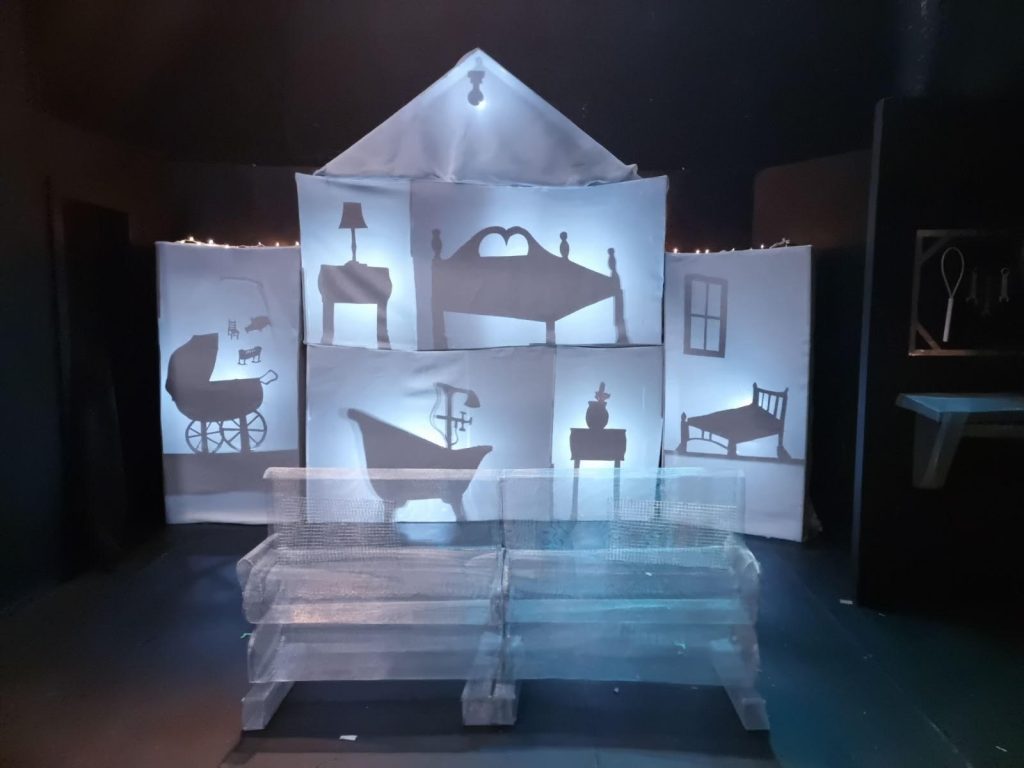
Ollie (Matt Braddak) and Jill (Mimi Brill) are an upbeat, upwardly mobile couple having their first child and looking into buying their first house. This brings them to the attention of the mysterious Miss Dee (Mejiah), who is brandishing a contract that holds the key to their dream home. In a visible red flag, the contract is a long, ancient-looking scroll. But the couple is determined to renovate their new abode into a virtual palace, and they fall under Miss Dee’s spell. Soon after, Ollie catches a hungry homeless person in the house and brutally murders them—and magically, one of the rooms of the house is instantly transformed into the very picture of what the couple have always envisioned.
Ollie and Jill realize that the key to this magic is the “sacrifice” of the homeless in the neighborhood, and begin an abominable murder spree, luring the less fortunate into their parlor with promises of food and a bath. With each murder, another room is instantly refurbished. They refer to the homeless they kill as their “renovators”, and thrill to the wonders of their paradisial home, all while their psyches begin to fracture at the horror of their actions. As events spiral into darkness the audience gets to play a part as well, as Ollie and Jill break the 4th Wall and address us directly, asking us to vote on and judge their choices and actions. It is a genius way of bringing the onlookers into the narrative and leaving us ruminating about the part we ourselves play in the ever-creeping social-economic inequality of the world today.
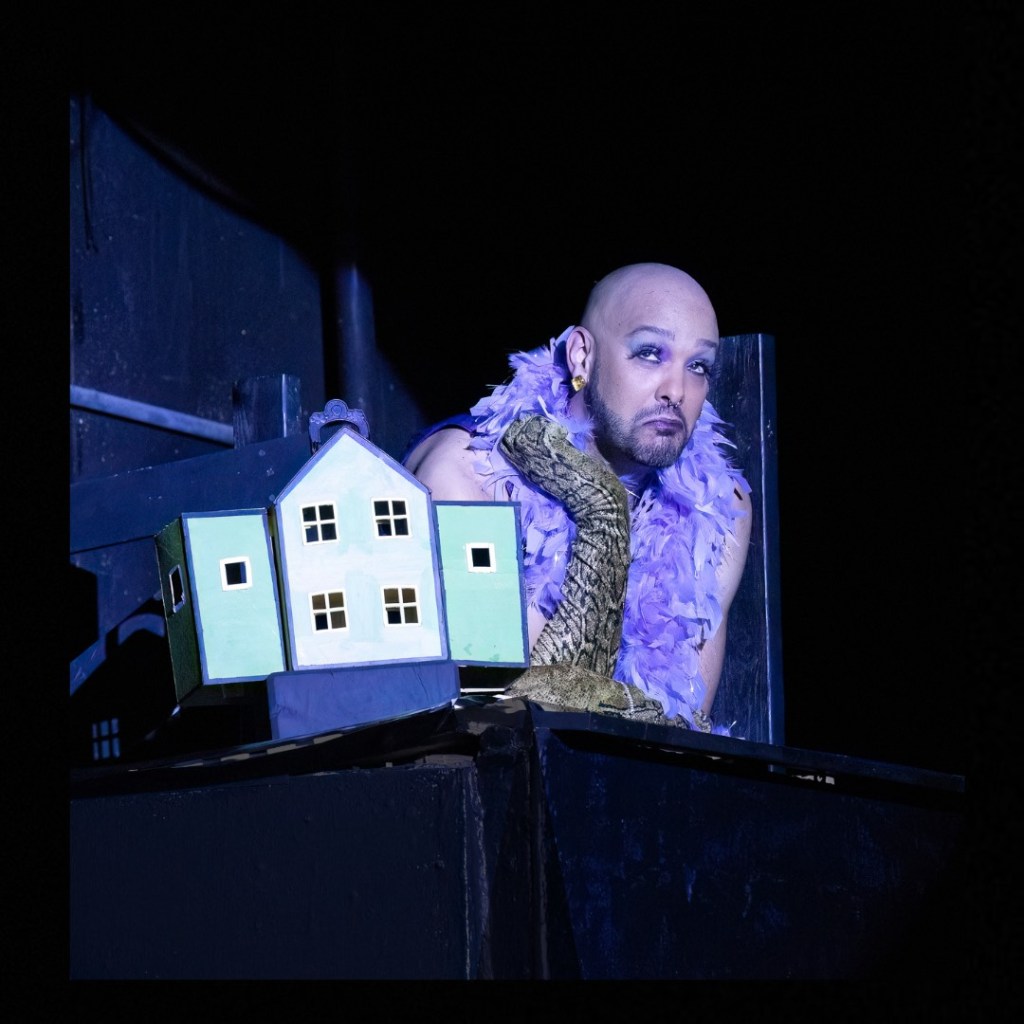
As events unfold, Miss Dee watches from the balcony from behind a dollhouse, symbolizing a God’s Eye View of events (or in this case, perhaps the opposite supernatural being). The effect is a brutal indictment of human greed, the current state of the housing market, and the willingness of the privileged to ride to success on the backs of the impoverished.
The three actors are individually and collectively astonishing. Mejiah does a star turn as the flamboyant Miss Dee, who is at times sensational and satanic, sunny and sinister. In the most heartbreaking moment of the play, Mejiah returns as another character—a kind, desperate young homeless man with a tragic family backstory—who gets caught in Ollie and Jill’s masterplan. When he realizes what is happening, he makes a shocking decision that will haunt anyone who witnesses it for a long time to come.
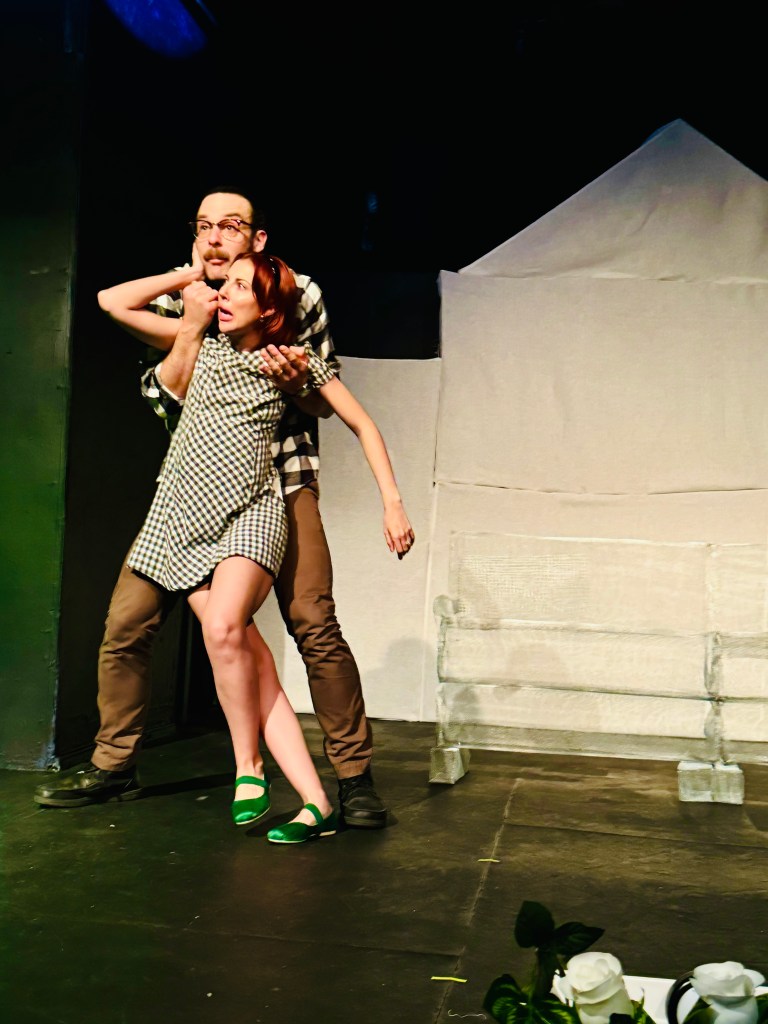
Braddak and Brill are magnificent together. The couple’s journey from murder to madness rivals the titular couple of Shakespeare’s Scottish play. In the most humorous scene, the couple invite their neighbors to a birthday garden party for their now one-year-old son Benjamin. In this sequence, Braddak and Brill play not only Ollie and Jill, but all of their guests, deftly changing demeanors, voices, and body language in a split-second and back again. Ollie and Jill are at their most paranoid here, triggered by words like “kill” and wondering if their neighbors are on to their heinous actions.
The play is powerfully directed by Kimberly Loren Eaton, who paints a vivid picture of the conquest of the privileged through clever use of shadowy backdrop images, jarring sound cues and well-timed lighting effects. Radiant Vermin is unique and powerful, and not to be missed.
Note: This production features gunshot sounds and flashing non-strobe bright lights.
Radiant Vermin is presented by Ripple Effect Artists, Inc. A portion of proceeds benefits The Bowery Mission.

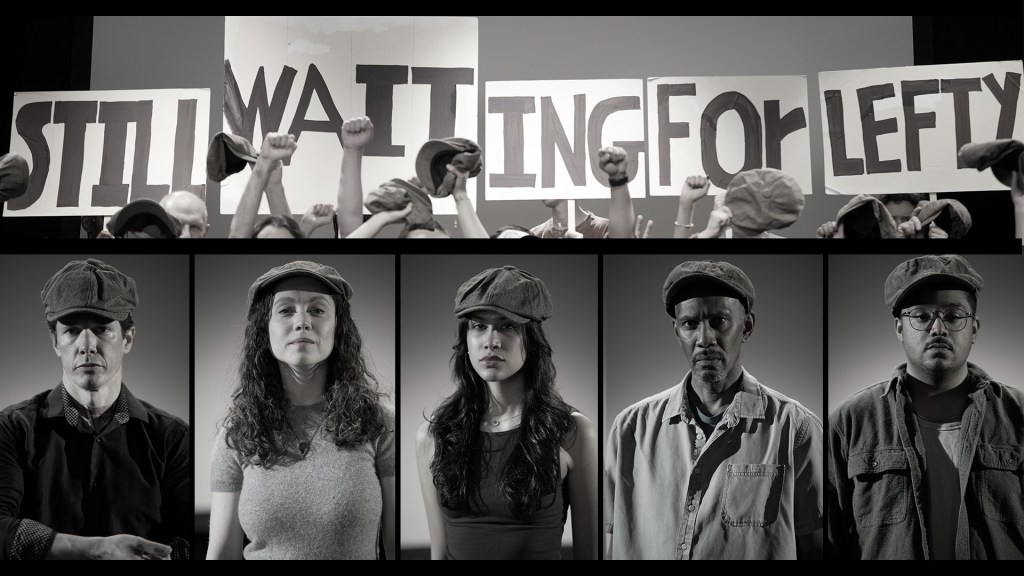
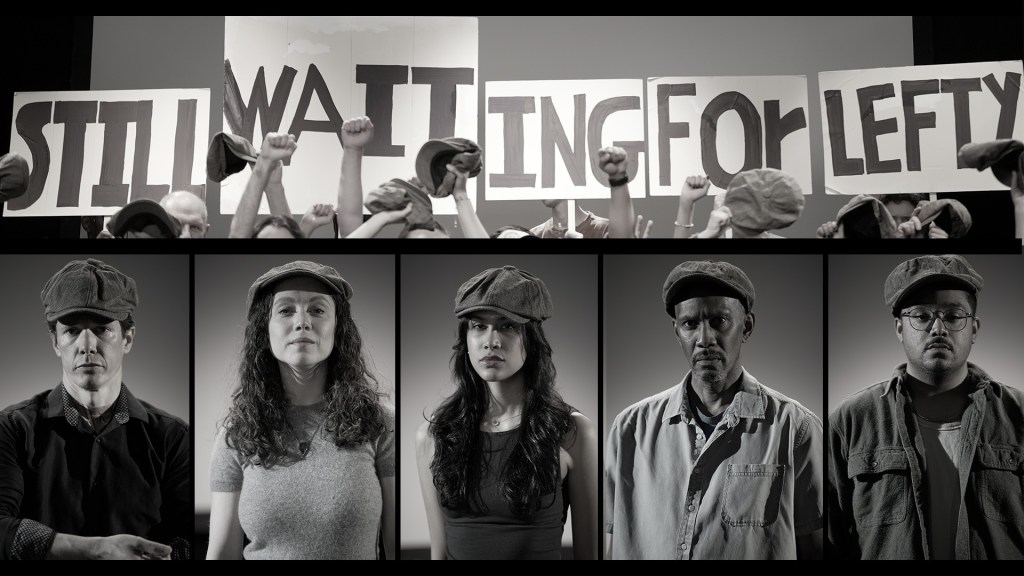
STILL WAITING FOR LEFTY: Luke Bond couldn’t wait!
Logophile Productions present…A New Play by Luke Bond
The Revolution Continues!
STILL WAITING FOR LEFTY Join us Independence Day WeekendJuly 4th @ 7:00 p.m; July 5th @ 7:00 p.m
July 6th @ 2:00 p.m. & 7:00 p.m. Teatro Latea — 107 Suffolk Street — NYC; TICKETS; Visit the WEBSITE for more info
“Waiting for Lefty” by Clifford Odets was produced in 1935 by The Group Theater and was heavily influenced by the 40-day cab drivers’ strike the previous year. Luke Bond’s play continues where Odets left off — showing us how little has changed. Set in the very recent past and the uncomfortably near future, “Still Waiting for Lefty” follows the lives of various warehouse workers for “New World Tech.” This all too familiar looking predominant and monstrous tech company with international influence continuously profits on the back of the working class. As workers of the world unite to battle for equitable wages and working conditions, they must overcome New World Tech’s sinister and underhanded tactics for resolving labor disputes, wherein workers’ integrity and solidarity will be tested.
A cast of dozens represents a “cast” of millions … of workers. Featured in the cast: Bill Blechingberg,* Ivan Goris, Laura Jones, Ron Brice, Tatiana Grey,* Len Nash, Greg Seel,* Majo Bermudez, Federico Mallet, Brian Cook, Tut Gregory, Ronald Barshop, Hannah Williams, Preston Johnson, Maria Christina Perry,* Maria J. Payares, Alan Gonzalez, Kamailyah Floyd, Emily Song Tyler, Alex Morrison, Luke Hodgeson, and Grant Williams. (*appearing courtesy of Actors Equity Association); Original Music by Zac Wood; Fight Choreography by Gabriel Rosario; Assistant Fight Choreography by Tristan Mesmer; Dance Choreography by Silvana Gonzalez; Life Jacket Ad by Bri Thomas; Program Artwork by Kevin Wadee; Photography by Ketak Dhiman. Written and Directed by Luke Bond
We spoke to Luke Bond about tackling the next level of this great classic.
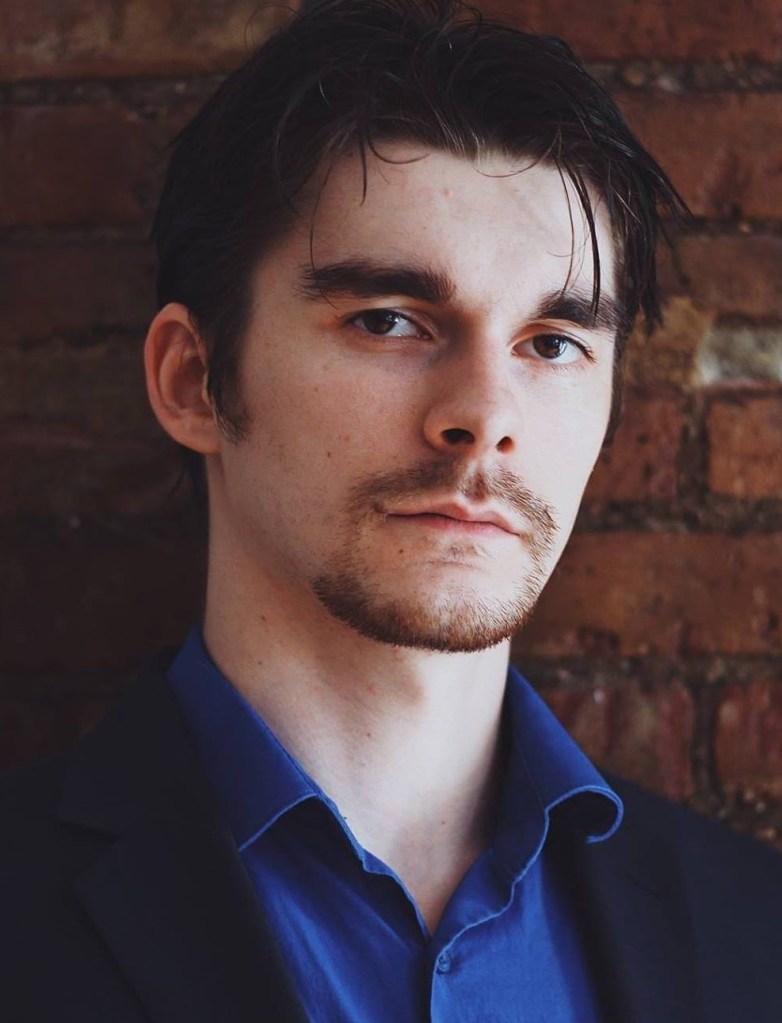
“I’ve been working as writer/director/editor in NYC for over a decade,” says Bond. “I’ve been doing films as of late. Bond rattled off a litany of award-winning motrion pictures under his command that are available on Amazon Prime among others. The diversity of topics allowed a fine segue into our questions:
What was the inspiration for this play?
“Inspiration” is a difficult term to quantify when it comes to producing a specific project. There are so many details as to why one project or script gets chosen over another, such as do I have the right people to bring onboard? Will I be able to amass the required resources? Will I have access to a venue? Will I survive the bankruptcy when its all over? Do I have an upcoming gig that can perhaps scratch the artistic itch instead? Do I have an upcoming gig that will help repay the bills once the show is done? Is this project susceptible to being canceled if disaster strikes? Ultimately, “inspiration” is for amateurs, and is not to be relied upon if one hopes to be able to create art at any level of consistency. On the more sentimental side, this is a story that has been on my mind for many years, and I’ve always wanted to do something that expresses my admiration for The Group Theater, and how their artistry defied all the practical expectations of their time.
How do you go about creating your characters … and did you utilize the original Odets play for your research?
Not only Odets’ original play, but his entire body of work, as well as the work of his contemporaries. There is a sly reference to almost every single one of Odets’ plays in this adaptation. The vernacular of the time is unique and lends itself to the language of the theater.
Powerful topic… never out of the news. Why now? Why did you want to premiere it now?
Again, the timing of a premiere for independent art is never dictated by the artists and always by the extenuating circumstances. I’m just happy it’s a weekend, as the majority of my plays have had runs exclusive to weekdays. While I hope the play has an immediate relevancy, I hope even more it has a universal relevancy to the working class throughout the course of history, and the fate of the working class to come.
You run during Independence Day weekend… very clever. Does that help the message?
I think it is nothing more than a cheeky coincidence. The theater going audience of NYC are not partial to Independence Day regardless, as I think most are aware of the multiple layers of irony in celebrating Independence Day; most of us don’t feel particularly independent, and even historically the day only applied to 20% of the population when it was first inaugurated.
What’s next for you?
I will be repaying the money required to fund this project for the next three years – I would not expect anything anytime soon! Our world changes so quickly, looking three years ahead feels futile and foolish.
“Teatro Latea” is located two blocks from the J/F/M Train stop at Delancey/Essex Street. There is a sign on top of the entrance that reads “The Clemente.” Once in the foyer, enter through the double doors on the left, and the theater is located on the second floor. Bathrooms are located on the third floor. Please be advised there is no elevator. The show runs two hours and ten minutes, which includes a 15 minute intermission. Tickets are $15 if purchased in advance (which includes all service fees), and are $20 if purchased at the door. Ticket purchases at the door can only be made with cash or venmo.

Tony Award winner, FRANK WOOD and KELLEY CURRAN of HBO’s The Gilded Age star in THE MEETING: THE INTERPRETER, a new play written by Catherine Gropper and directed by BrIan Mertes.
Tony Award winner, FRANK WOOD and KELLEY CURRAN one of the stars of HBO’s The Gilded Age star in THE MEETING: THE INTERPRETER, a new play written by Catherine Gropper and directed by BrIan Mertes.
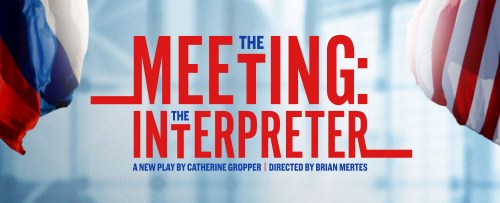
Previews begin Monday, JULY 29 with an opening set for Sunday, AUGUST 4 at Theater at St. Clements, 423 West 46th Street, New York City. GET TICKETS
Set against the backdrop of the infamous Trump Tower Meeting of 2016, the play tells the story of an international interpreter thrown up against government systems of congressional and senate interrogations, catapulting him into circumstances beyond his control. “This man could be everyman … one of us,” says playwright Catherine Gropper.
This play is about the loss of individuality and privacy is based on actual events (a chance meeting between the playwright and an actual government interpreter). This two-person play supports a cast of thousands thanks to Mertes’ production scheme including puppetry, film sequences, projections, and intricate lighting and sound.
Design team includes OBIE and Henry Hewes Award-winning lighting designer, producer, and organizer, Barbara Samuels; Broadway composer and sound designer Daniel Baker; OBIE Award-winning choreographer, Orlando Pabotoy international Puppeteer and Animator Julian Crouch (TONY nominated); video artist and theatre designer, Yana Biryukova (Hartford Stage, Yale Repertory, Irish Repertory Theatre as well as the Venice Biennale 2022); Set Designer Jim Findlay (his works have been presented in 50 countries); and international costume designer, Olivera Gajic (credits include Jedermann (Salzburg Festival, Austria); God’s Ear (VineyardTheatre); and the film, I am a Seagull). All of this is then folded back onto itself in real-time through the lens of international videographer Tatiana Stolporskaya, creating a synthesis between documentary and narrative filmmaking.
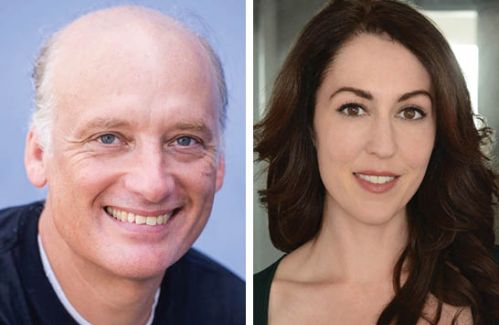
Frank Wood was first celebrated for his work on the Broadway production of Side Man, a performance that earned him both a Tony Award and a Drama League Award. His portrayal of Gene, a jazz musician grappling with personal and professional turmoil, highlighted his profound emotional depth and versatility. It’s a role that parallels the soul searching experience of The Interpreter in many profound ways. Wood has an impressive array of Broadway credits, including notable performances in The Great Society, Network, The Iceman Cometh, Clybourne Park, August: Osage County, Born Yesterday, and Hollywood Arms. Off-Broadway, he earned a Lucille Lortel nomination for Toros at Second Stage and has graced stages at Signature Theatre, Vineyard Theatre, Lincoln Center, Atlantic Theater Company, Manhattan Theatre Club, and Playwrights Horizons. His filmography includes roles in acclaimed films such as She Said, Joker, St. Vincent, Changeling, Dan in Real Life, Thirteen Days, In America, Down to You, and The Royal Tenenbaums. On TV, he appeared in series like Billions, The Blacklist, The Night Of, Mozart in the Jungle, The Newsroom, Girls, Flight of the Conchords, The Sopranos, and had a recurring role on Law & Order: SVU.
Kelley Curran can be seen, as Turner, in Julian Fellowes THE GILDED AGE for HBO. Prior to the intricate characters she will now tackle in The Meeting: The Interpreter, she appeared off-Broadway in Half-God of Rainfall at NYTW; at The Public Theater opposite Glenn Close in Mother of the Maid, and as Clytemnestra in Ellen McLaughlin’s world premiere of The Oresteia at The Shakespeare Theatre Company. Kelley has also appeared on Broadway in Present Laughter with Kevin Kline, and at The Signature Theatre, Classic Stage Company, Theatre For a New Audience, and LAByrinth Theatre Company, among others. She made her network television debut on NBC’s The Blacklist, and recently appeared on the CBS drama God Friended Me. In 2019 she made her feature film debut in The Man Who Killed Hitler and Then The Bigfoot. Kelley was nominated for a SAG Award, won The Callaway Award, Emery Battis Award, NTC Emerging Professional Award, and in 2016 was nominated for a Drama League Award alongside Lupita Nyong’o, Michelle Williams and Lin Manuel-Miranda. She has also been nominated for both a Princess Grace and Helen Hayes Award.

Hell is MORE people: Michael Hagin’s immersive interpretation of Sartre’s NO EXIT continues the 80th anniversary (interview: Matthew Tiemstra)
80 years ago… a play premiered in Paris that altered our perception of reality. Now, the C.A.G.E. Theatre Company under the direction of its artistic director, Michael Hagins, presents Matthew Tiemstra, Gigi Principe, Alaina Hammond & Charlotte Vaughn Raines in Jean-Paul Sartre’s existentialist masterpiece NO EXIT.
Translated from the original and adapted and directed for today’s reality by MICHAEL HAGINS, the production has a limited run of Fri., July 5 & Sat., July 6 @ 8:00 pm; Sun., July 7 @ 7:00 pm and Thurs., Fri., Sat., July 11, 12, 13 @ 8:00 pm at one of NYC’s edgiest theatres, The Theater Under St. Marks, 94 St Marks Place, NYC.
Arts journeyman, Michael Hagins, transports us into Sartre’s version of Hell: A mysterious impenetrable room where individuals are trapped and forced to see themselves through the eyes of others. In this interpretation, an immersive element is added to allow the audience to join in the claustrophobic atmosphere thus making hell more than “other people” it makes it ourselves.
Classically trained Matthew Tiemstra, celebrated for his portrayal of Hamlet, is part of the cast. We spoke with him about this masterpiece and what it takes to do it right.

What made you decide to do this play?
I knew the play by reputation. And I’ve worked with Michael quite a bit, mostly on Shakespeare. When Michael approached me to do the project, I was thrilled to dive into one of the most iconic portrayals of H-E-double hockey sticks. I knew it would be a lot of work, but saying no was never an option. Like the characters in the play, there was no way I was leaving.
Now, in the days of social media, avatars, and other “masks,” how has Sartre’s message stood up against the test of time?
I’ll push back on the premise of this question – if a play only has one message, then it’s not a play, it’s a TED talk. Sartre does a deft job at imagining how one could be thrust into a Hell that needs no medieval-style torture, and certainly social media is a Hell of our own creation, that much is undeniable. The masks in his play are flimsy – at the end of the day, there’s no hiding in Hell, whereas today’s masks are far more effective at hiding malicious behavior. To answer what Hell is in the modern world one has to answer what Hell is, in general. Hell is accountability – it’s punishment for those who have done wrong. Frankly, in our world, most truly evil people get away with their misdeeds. It’s why people cling to this concept, this idea of a post-mortem retribution, so that they can console themselves over the injustice in the world.
What is your creative process?
I love to be a sponge for information. I read all I can about previous productions, history behind the piece, and of course I take the script apart six ways till Sunday. Then I take all that noise and I stash that in a box. By the time our first rehearsal starts, I like to be as familiar with the play as I possibly can be. If I’m on the same page as the character, then the rest is easy- how do I feel about the people around me? The place? Once I set foot on stage, I want nothing in my brain other than the who, what, when, where, why, and how. The rest is safely accessible in my body.
Do you feel an extra sense of responsibility in doing a piece so known; so historic?
Oh yeah – As someone whose done a lot of Shakespeare, I love knowing that there never was before and never will be a performance like mine. That’s the fun of live theater, is that classic stories never truly die – they are reimagined again and again for new audiences, in new styles. I find it thrilling to continue a storied legacy. Joseph Garcin has been played by Omar Shariff, Raul Julia, Sir Alec Guinness, and now me. It’s hard not to feel responsibility when these are the shoes you’ve been tasked to fill.
What is Hell to you?
Hell is…. well, some people spring to mind, but I won’t be so crass as to mention their names in this public forum. They know who they are.


Jim Catapano reviews the first act of a Rebellion Fueled by Music and Laughter
Currently in workshop, Lour Yasin’s AREA D Is a Bright Candle in a Dark Time
The Story So Far: Israel is hosting Eurovision in Tel Aviv, and the theme of this year’s event is “Unity”. “I know some of you aren’t happy with our chosen finalists,” says Versace-wearing, fake sincerity-oozing Sheila Rich, the Israeli broadcaster. “But we assure you that this was a step in the right direction, to a more inclusive country free of conflict.”
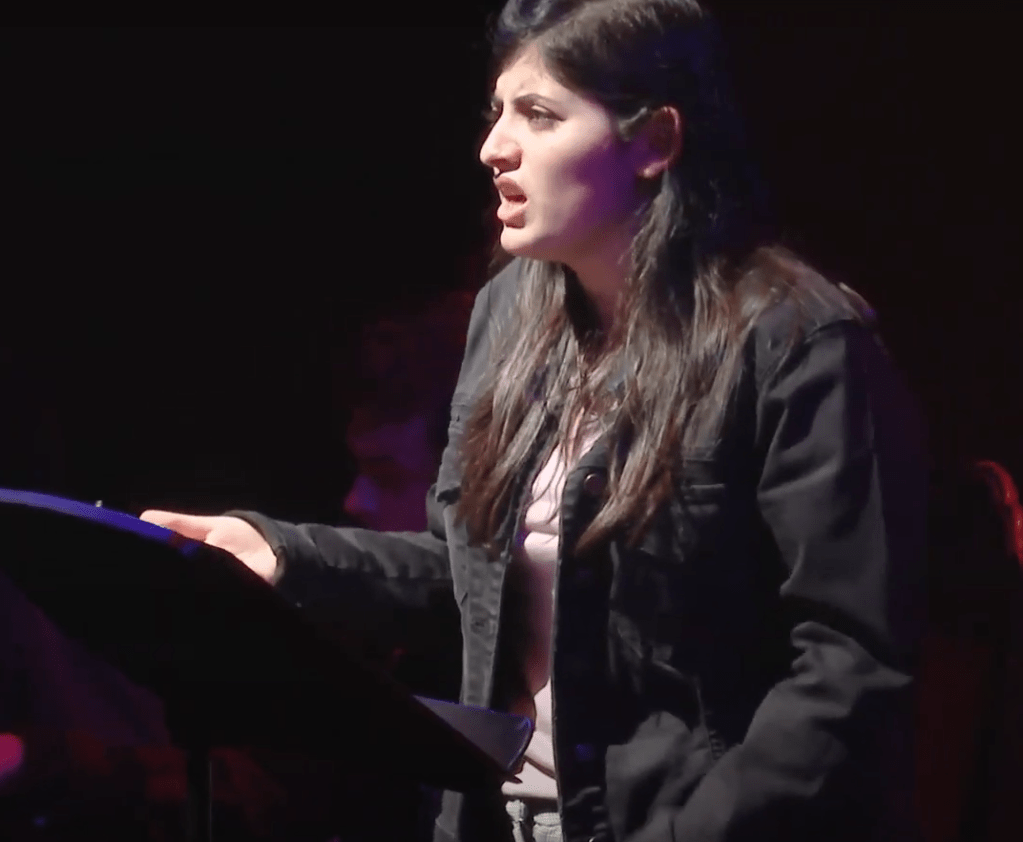
The crowd bellows their distinct disapproval. The reason for their condemnation is that the group chosen to represent Israel is AREA D, a rock band made up of young Palestinian musicians. They are Rami Zein of the West Bank (Keys), Dessa Rashid of West Jerusalem (Bass), Samir Total of Haifa (Drums), and Athena Jamil of East Jerusalem (Guitar). The quartet was, as they acknowledge, “thrown together” just three months before by a music teacher as part of a school assignment, and they are now on one of the biggest stages in the world—representing a country that mostly doesn’t want to support them. But they are defiant in the face of this. Rather than perform the song that was expressly chosen for them, they launch into a power-punk anthem of revolt against the system of oppression they have been trapped in all their lives.
“You count your money and swim in the millions,” they sing, heads held high, pointing at the crowd. “Benefitting off of shooting civilians; Cause you’re a teenage war profiteer; You make everyone live in fear.” This act of insurgence, of course, gets the plug pulled on them immediately.
We then shift into “How-Did-We-Get-Here” mode, to a flashback of the new group getting stopped at a checkpoint—an ominous scene of barbed wire, teenage soldiers, and AK-47s. Despite their unified plight, the band members are seen barely tolerating each other; they argue (in the song “You Think You Have It Worse”) over which of them is taking the hardest knocks.
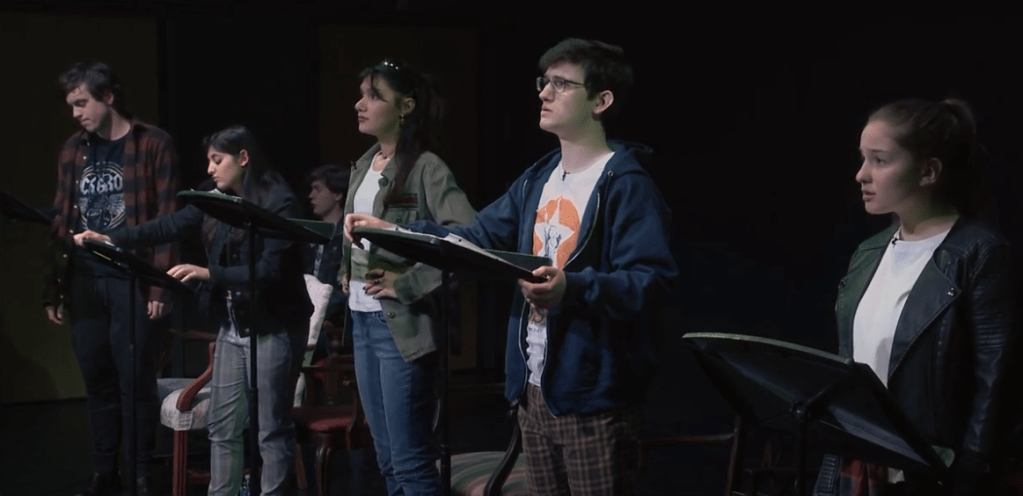
The band is arrested by Sheila Rich’s teenage daughter Sarah, former beauty pageant contestant and their own classmate, who has joined the local military. Sarah is an American from NYC, who hilariously switches her accent from British Estuary to French to Cockney for no apparent reason. The group chastises her for joining their oppressors, who they see as co-opting the name of God for their own purposes.
“We do weaponize religion,” concedes Sarah, “but it’s such a smart political tactic.”
At Sarah’s behest the band films her performing TikTok videos, which constitute her own pretentious EuroVision audition. But to Sarah’s disgust it is eventually AREA D who are chosen, and told to perform a propaganda-infused song, “Unity”, that purports to champion inclusivity over conflict.
“It’s not a conflict, it’s a f-ing apartheid!” screams Dessa, leading into the rousing concluding song of Act 1, “Apartheid Anthem.”
AREA D is work in progress, but its first act already constitutes a Grand Slam for Lour Yasin, who wrote the book, lyrics, music, directs (with assistant Sari Klainberg), and stars as Athena in the initial readings. The songs soar and glisten with humor and heart and create excitement for the next Act. It’s a moving tribute to the real people that our now facing a most desperate situation, and a testament to the power of creation and connection in creating a glimmer of hope to hang on to.
A Reading of Act 1 of AREA D at the ’62 Center for Theatre and Dance is available at https://www.youtube.com/watch?v=wRT9H0QiU-w
Hell (and Heaven Too) is Other People: Jim Catapano reviews NO EXIT
Hell (and Heaven Too) is Other People
Alice Camarota Delivers a Gripping Modern Take on a Classic Work
Jean-Paul Sartre would be pleased to know his iconic No Exit still resonates—whether he’s looking down upon the earth, or looking up at it as he likely anticipated.
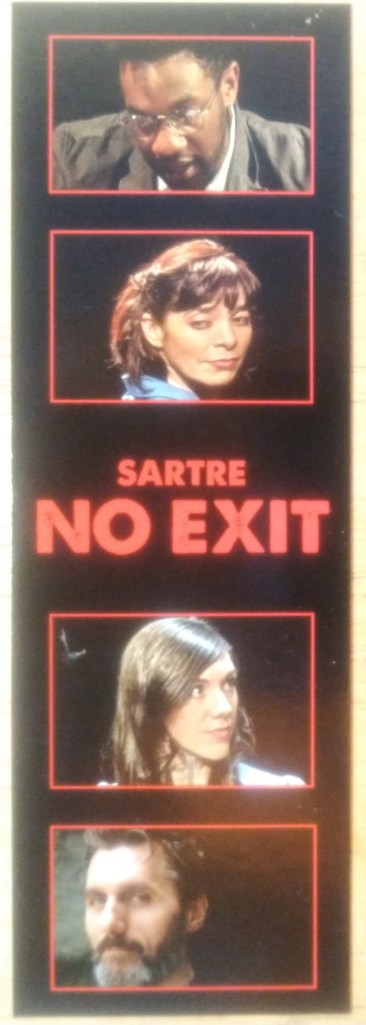
Upon arriving in his room in Hell after a particularly violent death, Joseph Garcin (Connor Wilson) asks the imposing Valet (Thoeger Hanson) where the implements of torture are. “Where are the thumbscrews, the whips, the racks?” The Valet looks at him puzzled. There are none, just three comfy couches that Monty Python’s Spanish Inquisition might consider wielding. “It’s hideous,” declares Garcin, who goes on to declare that he is well aware of why he has been condemned to Hell and has nothing to hide. But just when he’s feeling the Hades version of comfortable, Garcin learns that his deluxe afterlife apartment comes with roommates. Inez Serrano (Amie Margoles) arrives to join him, wearing a demon-red dress and ready to rock Garcin’s Netherworld. Inez “mistakes” Garcin for her Torturer, and things go downhill from there (yes, even in Hell that’s possible).
Joining the party next is Estelle Rigault (Mandi Sagez), a person so uptight and above-it-all that the bug residing inside her bum has made the journey to the Abyss completely intact. (She would have made a perfect first-class passenger on the Titanic, and hopefully been late for the lifeboats.) Unlike Garcin, she purports to have no idea why she’s in Hell and dismisses it as a likely mistake (much to the amusement of the snarky realist Inez). Estelle immediately claims one of the couches as her own, making sure it matches with her prim dress. She notes that her funeral on earth isn’t even over yet. “The wind is blowing my sister’s veil around,” she observes. “She’s trying her best to cry.” The willfully blind Estelle decides to refer to their current state as not dead, but “absent”. Inez, by contrast, is fully aware of why she’s where she is; she even relishes in her own cruelty. “I need to see other people suffer to exist at all,” she notes as she regales the others with the horror movie that was her life on earth. Garcin’s story is nearly as disturbing, as is his nonchalance about it all.
The trio swap stories of how they perished, then go on to defend their previous existence and come to terms with their current lack thereof. They wonder why they were put together in this room, having nothing in common but the fact that they barely tolerate each other. The personalities of the stoic, unapologetic Garcin, the stuck-up, selfish Estelle, and the manipulative, fiery Inez create a bubbling cauldron of tension as they come to realize they’re trapped in each other’s company for good, and that Inez was correct all along—they are, in fact, each other’s instruments of torture. Following this revelation, they struggle for a way to make a best of an impossible situation, going from contempt to flirtation to a form of love and respect—even if it’s a forced, pale imitation of the real thing.
The actors made a feast of the delicious material, providing a stark contrast of attitudes and sensibilities. Sagez has a wonderful Kristin Wiig-like energy that serves her character well; Wilson is a commanding presence as his character tries to fulfill the “Only Sane Person in the Room” trope; Hansen is perfectly cast as the polite but uncomforting Valet; and Margoles is delightfully incendiary, the spark that sets many metaphorical fires.
The production is directed pitch-perfectly by Director Alice Camarota and Assistant Director Thoeger Hansen.
No Exit is a production of The NuBox; it is produced by Camarota and Hansen.
From Near-Death to Affirmed Life—in His Own Words: Jim Catapano reviews 45 Scenes of Bad Sickness
45 Scenes of Bad Sickness Chronicles a Writer’s Harrowing Journey Through COVID
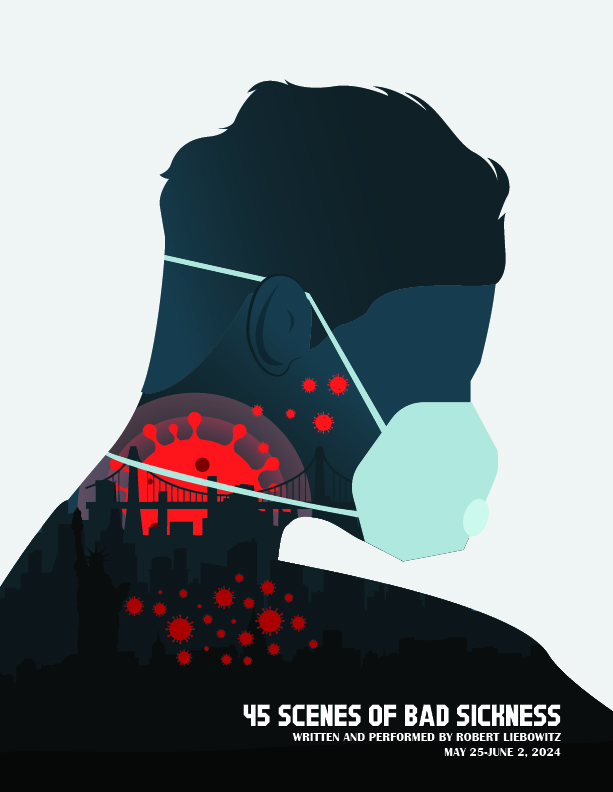
“I was looking forward to the next adventure. Instead, the next adventure found me.”
In the Summer of 2022, acclaimed playwright Robert Liebowitz began feeling distinctly unwell. “It started with a pain under my ribs,” he explains. “I didn’t think anything of it.” Within days he was in the ICU, fighting for his life.
45 Scenes of Bad Sickness is Liebowitz’ chronicle of the 3 months he spent in COVID hell; and he plays himself, literally reliving the entire traumatic experience on the stage every night. He is engaging, funny, heartbreaking, and endearing as he chronicles his living nightmare. He contracts pneumonia; his kidneys cease to function; and his legs atrophy to the point that he will have to learn to walk again—provided he ever makes it out of the hospital. He desperately longs to take a shower in his own home. His white hair and beard grow to the point where he thinks he looks like Moses. As things get ever grimmer it gets harder to fight—and yet he does, eventually getting all the way back both physically and mentally. The scenes where he takes his first unassisted steps in months, followed by his return home—60 pounds lighter and forever changed—are incredibly heartwarming and life-affirming.
Composer Stephen Cornine provides poignant musical accompaniment throughout. The scene number, from 1 through 45, appears on a pad at the front of his piano, and the actors take turns flipping the numbers and announcing the theme/first line of the next scene. Each opening line is then repeated by Liebowitz, as he enters the next phase of his battle and recovery.
The actors (including Jessica Kate Jordan, Charles Meckley, Monica Mist, Masaya Okubo, Kirstin Wolf, and Ronnie Zeidel in his theater debut) take turns playing different roles. Depending on the day/scene they are doctors, nurses, specialists, physical therapists, and Liebowitz’ visiting loved ones. They even get opportunities to sing, and beautifully so. Wolf, an ebullient Soprano, opens and closes the show with a duet and solo piece at the piano with Cornine.
Many true-to-life characters cameo throughout. Meckley is his son Andrew, who reminds him to cooperate with his healers. Jordan is a specialist from the south who appears for a hot minute to tell Liebowitz why she thinks he’s managed to stay alive when so many haven’t. Mist is his devoted girlfriend Lauren who is finally allowed to visit after many weeks, bringing love and snacks. Meckley and Zeidel are a comedic double-act as they give Liebowitz the most annoying sponge bath ever administered.
Liebowitz himself is astonishing. It cannot be easy to literally play out the most horrific period of his life over and over, and yet he does, with dignity, humor, and a philosophical point of view that is well worth taking on board for everyone who dares to stare down the abyss and live to tell about it.
45 Scenes of Bad Sickness is directed with gusto by Joanna Newman and runs at The Little Church through June 2 2024.
Three’s Dysfunctional Company: Jim Catapano reviews ATA’s “Crazy Love”
Crazy Love Looks at Relationships from the Farcical Side
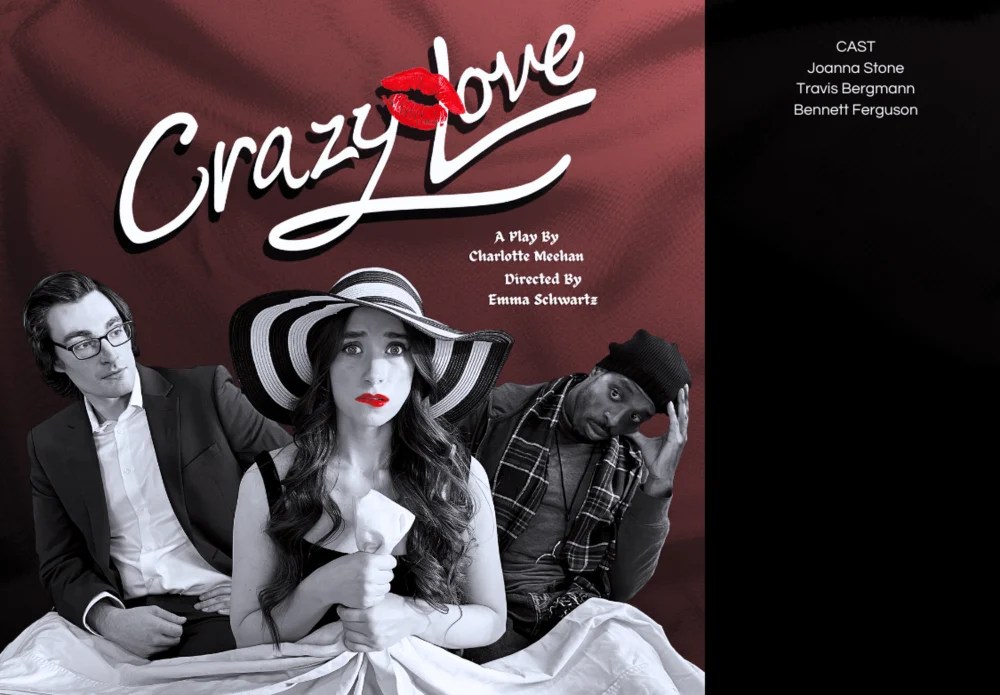
Celine (Joanna Stone) is a wild card in the deck of life, a bouncy irrepressible spirit who yells all of her wants and desires as if daring the universe not to listen. She is married to the slightly uptight Tom (Travis Bermann), a working man and a weekend philosopher who sees it as his responsibility in life to provide for Celine. But Celine does not see fidelity as part of the contract, and strikes up a situationship with Augustus (Bennett Ferguson), who gives her all the excitement and passion that she perceives Tom incapable of.
After Tom confronts the pair and condemns the love triangle he didn’t sign up for, he and Augustus unexpectedly bond over lengthy weed-smoking sessions, discussing life, the universe and everything Celine. Soon even their burgeoning bromance begins to slide beyond the platonic. They grow closer as they find themselves deciding together how to best care for the runaway train heading towards a brick wall that is the woman they both love.
Despite the hilarious antics, there’s a relatable reality under the surface. Between the jokes lies a familiar, genuine desperation that befalls many living in the modern world of chaos and insecurity. All three of our heroes just want to be understood and seen, to be loved and looked after, and to belong somewhere.
The actors all shine, giving energetic performances that shoot out of the gate to 60 mph and stay there. Stone’s flair for physical comedy is astonishing, and Bermann and Ferguson’s comic befuddlement is priceless. Despite the raucous comedic tone of the piece, they never fall into caricature, maintaining the reality and humanity of their characters throughout. Playwright Charlotte Meehan keeps things upbeat and witty with dialogue that is not only hysterical and sparkling, but filled with truth.
Crazy Love is stylishly directed by Emma Schwartz, with lighting by Zachary Dulny and sets by Gabriella Bonifacio. It runs at the American Theater of Actors through June 2, 2024.

Five Minutes with David Gutierrez
Five Minutes with David Gutierrez
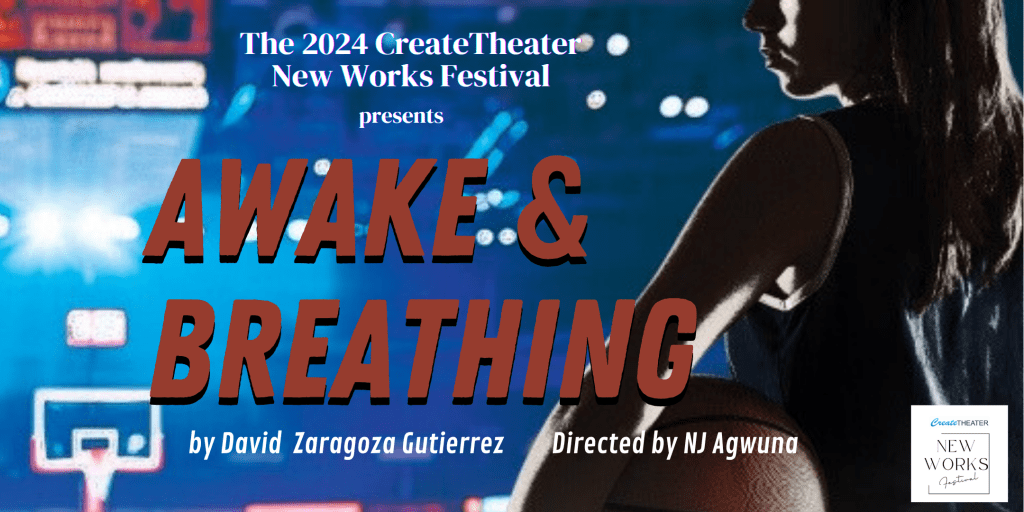
Award-winning playwright, David Zaragoza Gutierrez (Retraction, Wandering Blvd., Red Roses All Over Me) returns to New York with another compelling drama. AWAKE and BREATHING.
This INVITATION-ONLY industry reading marks the popular scribe’s return to New York theatre. With three shows at Cameo Studios, 307 West 43rd Street (Wednesday, June 5 @ 4:00 p.m. Studio B; Thursday, June 6 @ 1:00 p.m. – Cameo A; Saturday, June 8 @ 6 p.m. – Cameo B). The detail-oriented playwright is hoping for constructive feedback and enough encouragement to take this powerhouse play to the next level.
It concerns senior starter Stephanie Giacomo — on the day of the NCAA Women’s College Basketball National Championship game — reflecting on her past relationship with her ex-boyfriend Michael, her friendship with her teammate, Tanya, and the triumphs and tragedies in her life. Bouncing from past to present and back the past again (like a basketbacll) Awake and Breathing scores points for depicting love, heartbreak, hope, acceptance … and finding your way “home.”
The Staged Reading Presentation is directed by NJ Agwuna (assoc/asst. dir.) Broadway/Nat’l — MOULIN ROUGE; Helen Hayes Theatre — CLYDE’S by Lynn Nottage) and featuring Cecilia Trippiedi and J. Antonio Rodriguez, both from the Hadestown National Tour; and Daria Redus from the Spongebob National Tour.
We got the ball — or more likely — a few minutes with the playwright — to ask some questions.

What made you become a playwright?
I’ve always been interested in writing stories in general. When I was about 11 or 12 years old, I did write a couple of plays. But they were written on notebook paper and only about two or three pages long! But I’ve always been interested in writing stories, novels, plays, screenplays, and tv scripts.
What was your creative process like on this?
This one was a little bit different from my other writing projects. “Awake and Breathing” is based on an unfinished novel I tried to write when I was around 20 or 21 years old, which was back in 2002 or 2003. I wrote a detailed outline, wrote several pages, typed and handwritten, but never finished. But I actually came across some of those notes and pages in a box when I was going through my storage space a few months ago. Over the past twenty years, I had come back to the idea now and again and a few years ago I wrote and rewrote a screenplay treatment that was a few pages long. Then in late 2022, I decided to take that idea and instead of turning it into a screenplay, I decided to turn it into a stage play. I spent a few weeks writing what I call a S.T.O.S.–Summary Treatment Outline Scriptment—that ended up being about 15 to 20 pages long and about 5,000 to 6,000 words. After that, I started writing the first drafts of “Awake and Breathing.” Cate Cammarata is the dramaturg that helped me develop the story and script over the past year and a half.
Your plays delve into interesting subjects almost like an “expose.” Is that your mission? To uncover truth like this?
That may have been partly an intention of my previous play “Retraction”, but with “Awake and Breathing”, my intent was to explore the themes of love, acceptance, hope, and finding your way “home”–home being a place where you are happy.
What have you learned about the play and your work once the actors began interpreting it?
Having put “Awake and Breathing” through several readings over the past 12 months, in person and by Zoom, one thing that continues to fascinate me, in a great way, is how so many different actors take away very different meanings and experiences from your work. It’s really amazing.
What’s next?
Hopefully we get a good response from the invited audience at this industry reading. As for specifically what’s next, I’ll have to consult with Cate Cammarata. Stay tuned!
Love, Revenge, and Redemption on Both Sides of the Veil: Jim Catapano reviews “The Secrets We Keep”
The Secrets We Keep Examines Powerful, Painful Themes in Astounding Fashion
Slavic Folklore arrives in the present day to take on the tragedies of the past, and it’s unforgettable.
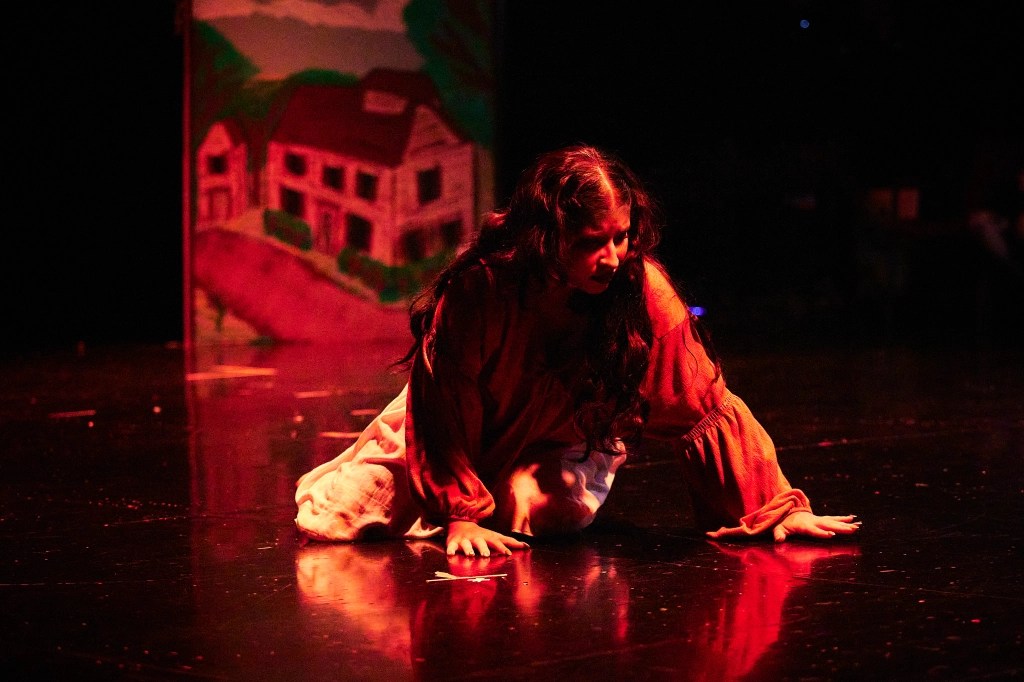
The Secrets We Keep is a musical fairytale, grounded in grim reality. A modern-day town in the Slavic region is haunted by the Rusalki (“Slavic mermaids”), beautiful nymph-like woman who reside in the waters among the forest trees. They were all once humans, and are now in an after-death existence of willful luring and killing (all while angelically singing). We meet Luba (Lynn Pineda), the newest Rusalka, who as a young Jewish Polish girl was beaten and drowned at the end of the second World War. She lives in eternal pain, grieving the violent loss of her life and of her great love, Bronislawa (Presley Zisk). “In the Night, I Am Alone,” she laments in song, as her Rusalki sisters dance menacingly around her, their feral manner clashing with their fairy-like appearance.
Luba’s confidant in the group is Dobra (Erin Yoffee), the second-youngest Rusaka. Luba and Dobra have the distinction of not having deliberately chosen to become Rusalki, unlike their peers. This coupled with their relatively recent arrival in the afterlife have allowed them to retain some semblance of humanity and conscience, while the others exist merely to woo and then destroy (as depicted in “Come to Me”).
Into this dark world arrive Kat (Megan Audette) and her partner Liesa (Sarah Reid Vinyard). Kat has come to see the land of her ancestors, many of whom perished in the Holocaust. The friendly, good-hearted Kat stumbles upon the Rusalki, and is saved from death at their hands by Luba, who is still trying to hold on to her own humanity. Kat sweetly offers Luba human snacks and friendship, and they quickly bond.
But a shocking twist regarding Kat’s ancestry threatens to extinguish Luba’s human heart for good and plunge her fully into the darkness under the lake. And “Trinity Week”—the time when the Rusalki are at their most powerful and dangerous—is looming. As Kat seeks to learn more from first the local library and then from a woman who lived through the war, Liesa finds herself in great danger from the Rusalki. Like Kat before her, she is also saved by Luba at first—but this time, recent revelations have threatened to make Luba the most vicious Rusalki of all.
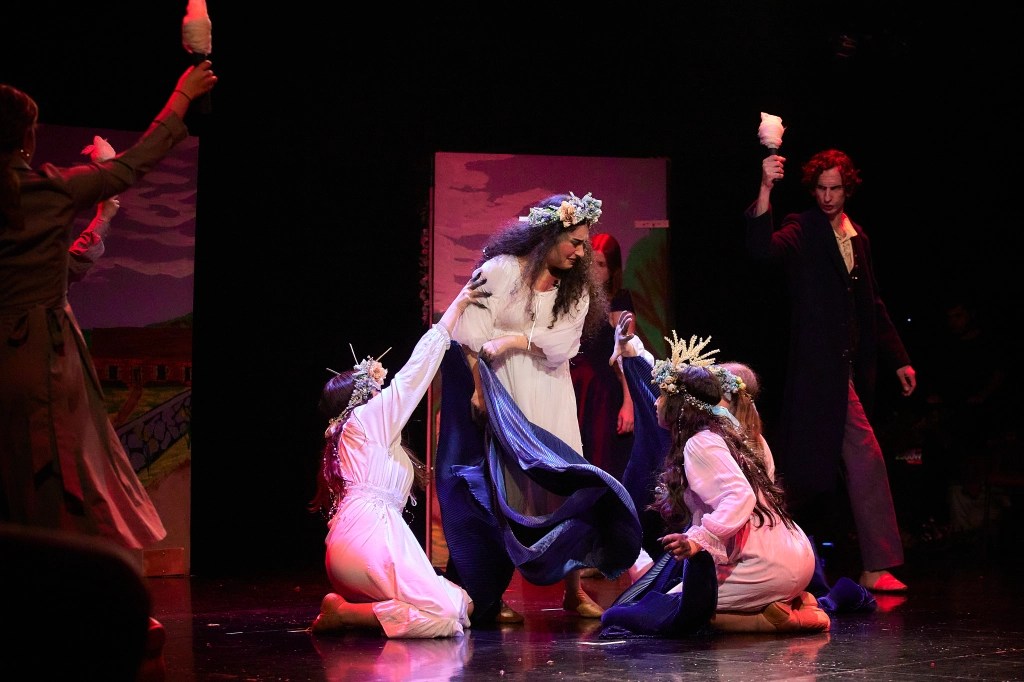
Luba’s plight is an intensely moving one, as she tries to choose between vengeance and redemption, and slowly begins to realize that perhaps the best revenge is to seek none at all.
The musical is beautifully realized; the Rusalki are elegant in their white robes while their crimson-colored hands remain a stark reminder of their bloodlust. Their gorgeous songs and spirited dancing contrast the viciousness of their hunger and hatred. The powerful themes depicted—the horror of genocide, he subjugation and defiling of women, the cyclical human patterns of fear, hatred, destruction and vengeance—are brought to a life in a new context that is undeniably thought-provoking. It creates a powerful story that, while based on myth, tackles head-on the all too real horrors of the past in a time when many choose to forget—and threaten to repeat.
The Secrets We Keep is written and directed by Danielle Wirsansky, with music by Frank Sanchez and choreography by Elizabeth Kessler.
 Arts Independent