
Home » Uncategorized (Page 16)
Category Archives: Uncategorized

Et Alia Theater to present Until Dark by Federica Borlenghi, Off-Broadway
Et Alia Theater is proud to present Until Dark by Federica Borlenghi, a new play that reflects consent and the intricacies of sisterhood, while testing its ties and boundaries.
When Cass is accused of a heinous crime, her sister Jackie – a promising criminal defense attorney – decides to take over the case. But when Lisa, their othersister, shows up in town for solidarity, she realizes there is more to theallegations than what she was told.
Thursday, February 15 · 7:00 pm EST; Friday, February 16 @ 7:00pm; Saturday, February, 17 @ 7:00pm; Sunday, February 18 @ 7:00pm; Thursday, February 22 @ 7:00pm; Friday, February 23 @ 7:00pm; Saturday, February, 24 @ 7:00pm; Sunday, February 25 @ 3:00 pm; Thursday, February 29 · 7:00pm; Friday, March 1 @ 7:00pm; Saturday, March 2 @ 7:00pm; Sunday, February 3 @ 3:00 pm
Out of the Box Theatrics, 154 Christopher Street #1E New York City

Cast features
Maria Müller as Cass; Giorgia Valenti as Jackie; and Luísa Galatti as Lisa (Covi Loveridge Brannan and Ana Moioli, alternates)
Production written and directed by Federica Borlenghi
(winner, Et Alia Theater Lab, 2023)
Produced by Et Alia Theater
Co-Produced by Mo Shah & Kavita Shah
Dramaturg: Covi Loveridge Brannan
Stage Manager: Skye Pallo Ross
Set & Properties Designer: Andrés López-Alicea
Lighting Designer: Adrian Yuen
Costume Designer: Federica Borlenghi
Graphic Designer: Marieli Pereira
Founded by international women in New York, Et Alia Theater champions multicultural, women-centered storytelling in the performing arts and fosters a community of mutual support. By providing performance programs and artistic opportunities that welcome, support, and showcase international women artists in New York, Et Alia offers an empathetic creative space for people adapting to a new social environment.
Men Behaving (Slightly) Badly: Jim Catapano looks at Two Gentlemen of Verona at the ATA

Shakespeare’s Early Romcom Comes to the ATA
Before Romeo and Juliet created havoc in Verona, William Shakespeare used it as the point of origin for a play about boys, girls, romance and duplicity. One of the Bard’s earliest works (written between 1590 and 1594 to be imprecise), The Two Gentleman of Verona is given a fresh coat of 21st-century paint at the American Theatre of Actors. Performed in modern dress but extremely faithful to the text, this re-imagining features a talented cast of dynamic actors who clearly relish every 16th century word.
Verona pals Proteus (Luke Hodgson) and Valentine (Brandon P. Raines) travel to Milan, where they find themselves in a love triangle with Silvia (Cameron Park-Miller), the daughter of the Duke (Martin Riofrio). However, Proteus is already partnered in Verona with Julia (Natasha Sahs). The assertive Silvia falls for Valentine and plans to elope with him, but Proteus betrays them to her objecting father. The Duke banishes Valentine to the forest, where he runs into another group of exiles and charms his way into becoming their leader. With the help of her women-in-waiting Lucetta (Kate Jergensen), Julia disguises herself as a pageboy and comes to Milan to find Proteus. Our heroes reunite and reconcile, but not before amusing shenanigans ensue.
Zachary Fretag steals the show as Launce, Proteus’ servant. He bounces around the stage in extremely loud pants, talks to his converse Chucks, his cane, and his dog Crab (represented by a stuffed toy in a picnic basket). He doesn’t speak Shakespeare’s lines so much as completely embody them. Brandon P. Raines is effervescent as Valentine, providing a “Niles Crane” energy that serves the source material beautifully. Blaize Adler-Ivanbrook is energetic and goofy as Speed, Valentine’s servant whose pants rival Launce’s in their gaudiness. Natasha Sahs is charming in her springtime dress as Julia, and amusing and convincing in her baseball cap and pants in her disguise as Sebastian the Pageboy.
All the actors use movement to great effect, making deft use of the small stage and its surrounding doors, and performing with physical and verbal gusto. Their chemistry with each other is electric, and their love of the material and the joy of performing it together is evident throughout the five acts of the play.
The play is a wonderful depiction of young people finding their way from betrayal and jealousy to love and friendship, and learning these lessons in the colorful way that Shakespeare was so genius at presenting.
The Two Gentlemen of Verona is directed by John Debenedetto. It runs at the American Theatre of Actors through Dec 22.
Jim Catapano is at the ATA with The Buffalo Hero of World War I: The Wayne Miner Story
Deeds Not Words
Kenthedo Robinson’s Stirring The Buffalo Hero of World War I: The Wayne Miner Story returns to the ATA
The “Great” War is a story of heroes—some well-known, but many unsung.
The Buffalo Hero of World War I is the true tale of one of the latter. Private Wayne Miner (played with power and dignity by Alton Ray) is a man dedicated to the cause that has stirred him to take arms with the Buffalo Soldier regiment when the U.S enters World War I in 1918. Except, as a person of color, he finds that in war (as in society), the road for him has deliberately been made much rockier.

Miner vows to defend democracy and be a hero to his wife and family despite the oppressive circumstances. “I’m not fighting for Lincoln,” he declares when it’s suggested his service is in return for his freedom. “I’m fighting for me, my family, and for the America that I want America to be.”
Miner finds comfort in the letters to his beloved Mamma Miner (Ms. D. in a moving performance). The men are also aided by Angelica (a warm and funny Monique Berkley), a Florence Nightingale figure who is not “officially” part of the Red Cross, but trying to help where she can.
Along with his bunkmates, Seymoure (Bilal Walker) and Rucker (Kevin Leonard), Miner finds that there is a battle to fight in the barracks that must be won before they ever see combat in France. The young men are denied the training, supplies, and guidance they need to survive and thrive, due to the blatant racism pervading the Armed Forces (and society as a whole). They don’t even get decent meals, heat, or proper boots. The head of the unit, Captain Quincy Blu (played with super-villain energy by Nicholas Dodge), is a loudmouthed racist—in both words and deeds—who has unveiled contempt for the men under him, and is only concerned with his own reputation and aspirations to glory. Their go-between is the tough but compassionate Lieutenant Clark (Rommell Sermons), who deals with the conundrum of trying to keep his men in line and boost their morale, while their spirits are being crushed by his own superior officer.
The anxious Rucker does what he’s told for the good of his beloved family; Seymoure rages against the situation and against “Blu” (as he refuses to refer to the officer by rank). The two men are harassed and humiliated by Blu in scenes depicted and described to brutal effect. Over the course of the play we truly get to know these people, which makes the denouement ever more poignant as we remember that these were lives that were really lived over 100 years ago.
When the men finally find themselves in France close to the combat, they are severely compromised by the lack of training that was deliberately denied them. Things come to a head between the group and Blu, in harrowing scenes of emotional and physical violence echoed and multiplied by the sound of artillery just outside the window.
The disparate personalities on display are brought to life vividly by the actors, who embody these historic figures with deftness and power. The two-tiered set is used cleverly, and coupled with excellent fight choreography, the music of the era and the disturbing sounds of war, the effect of being in a warzone in 1918 is palpable.
Wayne Miner was killed mere hours before the Armistice ending the war was put into effect, and may have been the very last to die for the Great War. He had volunteered to take artillery to the front when no one else would, knowing all too well what his chances of survival would be. He would often quote the Buffalo Soldier credo, “Deeds Not Words”, and his sacrifice shows he lived and died by this pledge.
The Buffalo Hero of World War 1: The Wayne Miner Story is written and directed by Kenthedo Robinson.
Guest Writer, DAVID SABELLA, reviews Manhattan School of Music’s A MIDSUMMER NIGHT’S DREAM
They Manhattan School of Music graduate opera theatre program presented the Benjamin Britten’s Opera, a Midsummer Nights Dream this past weekend, November 16-19, with varying degrees of success.
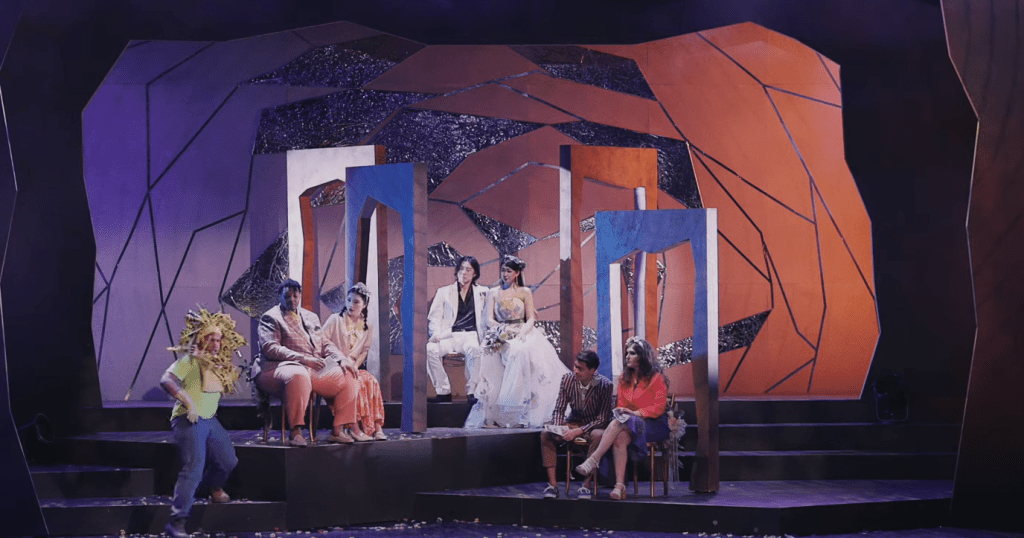
To be sure, Britten’s intricate (and nearly atonal music) is no small feat for the most experienced of singers and orchestras. Here, MSM shined. All of the singers were well prepared by their own personal teachers, (listed in the back of the program) as well as guided by the able hand of conductor George Manahan.
Even at this early stage of their careers, some singers showed great potential with both golden hued voices and silvery stage presence.
Of particular note at this performance, Nov 16 (the opera is double cast), was Haolun Zhang (Oberon) and Sofia Gotch-Caruana (Tytania), whose voices were well suited to their roles, and each other.
Benjamin R. Sokol (Nick Bottom) proved a very entertaining “Bottom“ with both a booming voice, and comical delivery. And Gregory Gropper (Starveling) was a stand out among the merry men of Pyramus and Thisbe, with an agile stage presence, channeling the physical comedy of a young Steve Martin.
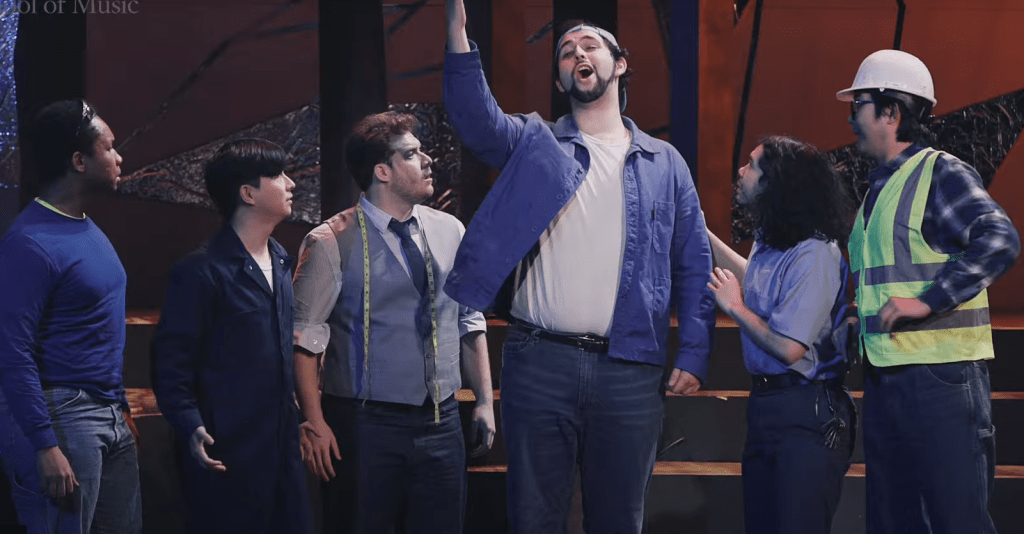
Indeed, the entire cast sang well and handled this music with a finesse beyond their years. However, even that finesse could not fully compensate for other problems within the creative environment. The scenic design (Abbey Wiker) was serviceable enough, giving a sense of changes and distance covered within the woodland throughout the evening. And, the lighting design (Paige Seber) managed to set the overall mystical mood of the evening.
Starting at the downbeat, Oberon enters with his chest fully exposed in a costume that can only be described as a cross between something worn for Mardi Gras, and leatherwear one might see at The Eagle. The choice to have the singer’s chest fully exposed was baffling and gratuitous. One could only guess that the purpose here was to assure the audience that the Countertenor singing the role was in fact, a male person. The costume suggested no regality or finery one might associate with the “king of the fairies,” and in fact, only served to distract from this young singer’s remarkable voice.
Equally questionable was the pink cotton candy bomb worn by Tytania, which also proved completely distracting to this reviewer. Tytania’s fairies were then equally burdened with contrasting “brown sacks of wool” that neither moved well or flattered the body.
Scene two proved even more confusing with each character within the opera looking as if they had brought their own costumes from home. Anachronisms persisted! Some singers seemed to be dressed in modern day clothing, and others seem to harken back to the 1950s, giving the opera no sense of time nor place.
It is not this writer’s intention to call out a young costume designer for their shortcomings, (at least I assume that this was a young costume designer, and not someone hired by the school for this purpose) but it must be noted that since the Manhattan school of music promotes itself as a “graduate opera theater” program, then, perhaps, a little bit more attention to the “Theatre“ part of it might be warranted, especially when offering such challenging repertoire as Benjamin Britten’s A Midsummer Nights Dream.
Whether it is an issue of budget/funding, or artistic resource. This production would have been much better served with greater care to all elements of a scenic and costume design.
Singers, great!
Creative team, not so much.
As in shakespeare’s enchanted forest, one must enter at one’s own risk.

Styrmir Elí has gathered a team of international visionary artists taking theatre AND film to the next level.
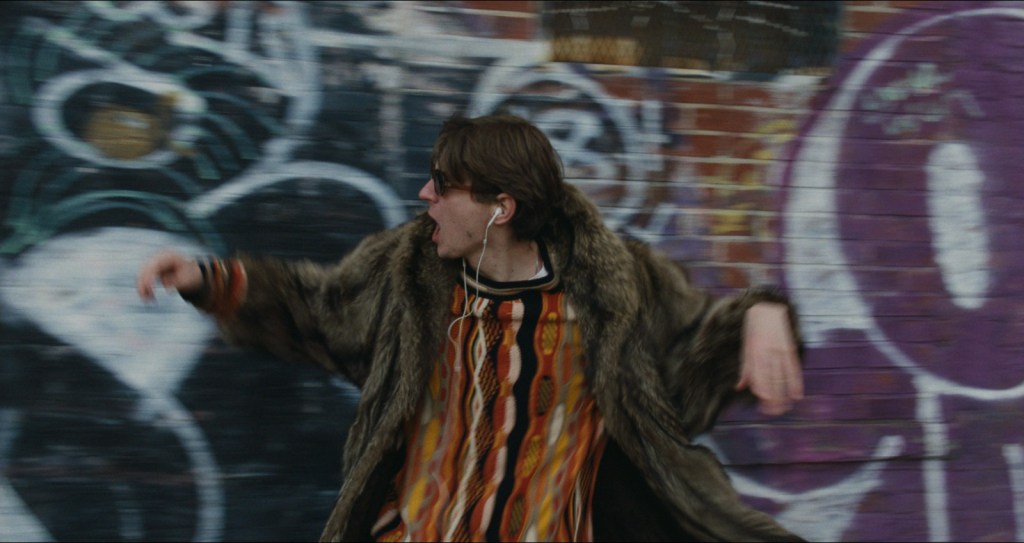
Untitled, 1970, is the ultimate in immersive theatre. This multimedia theatrical play involves improvision with actual script; live theatre with planned, prepared, and produced television programs mixed into the story; and – the most stunning element – the play is set in a New York apartment so the play is being done IN A NEW YORK APARTMENT!
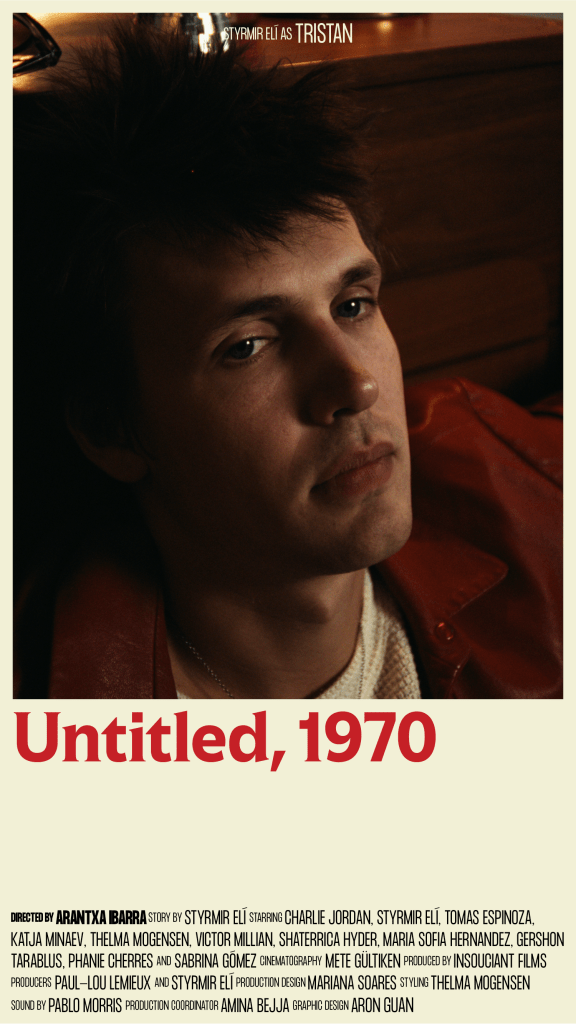
Even the story is a parable of the innovation as we meet Joey & Tristan as they arrive in New York and attempt to navigate friendship and the perplexities of life in their new surroundings.
UNTITLED 1970 at 28 Locust St, Brooklyn, New York 11206 DIRECTIONS
Sat. Dec 9 @ 8:00 pm
Mon. Dec 11 @ 8:00 pm
Tue. Dec 12 @ 8:00 pm
Wed. Dec 13 @ 8:00 pm
Thu. Dec 14 @ 8:00 pm
Fri. Dec 15 @ 8:00 pm
Sat. Dec 16 @ 8:00 pm
Tickets start at $35. Reserve you seat in the living room HERE
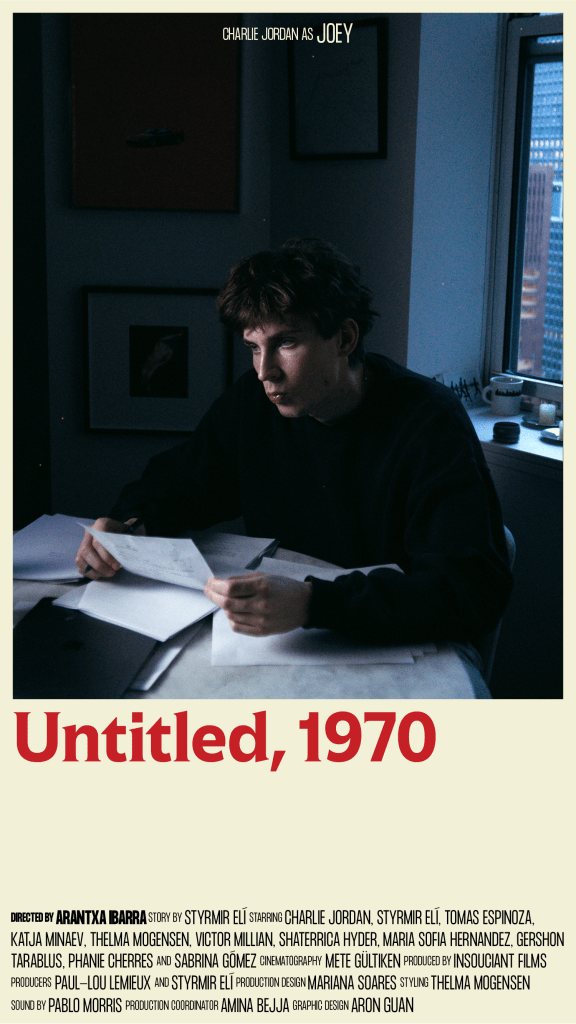
The cast includes: Charlie Jordan, Styrmir Elí, Katja Minaev, Tomas Espinoza, Thelma Mogensen, Victor Millan, Phanie Cherres, ShaTerrica Hyder, Gershon Tarablus, Maria Sofia Hernandez, and Sabrina Gomez
Director: Arantxa Ibarra
Story: Styrmir Elí
Cinematography: Mete Gultiken
Executiveproducer: Paul-Lou Lemieux
Producer: Styrmir Elí
Productioncoordinator: Amina Bejja
1stAD: Clem Collin
Styling: Thelma Mogensen
Productiondesign: Mariana Soares
Sound: Pablo Morris
READ all about creator Stymir Eli in ArtsIndependent.com
MERGING THE WORLDS OFTHEATRE AND CINEMA
Untitled, 1970 is an experimental, intimate, bold expression of what it is be to be young and alive in a big city. The performance will take place in an apartment in Brooklyn, New York, with a very limited audience capacity. Half the performance is live in front of the audience while the other half is filmed, cut and presented in video format on the living room TV. So the story will flow from stage to screen and screen to stage. The idea is to create the environment for the audience that they are in the cinematic universe they see on screen. If you would like to donate you can do so HERE.
An Afterlife with a Price: Jim Catapano reviews “Price in Purgatory”
Drew Pisara’s Price in Purgatory Takes Us on a Witty Existential Journey
Up next, a “Laughter Life” for a Film Legend.
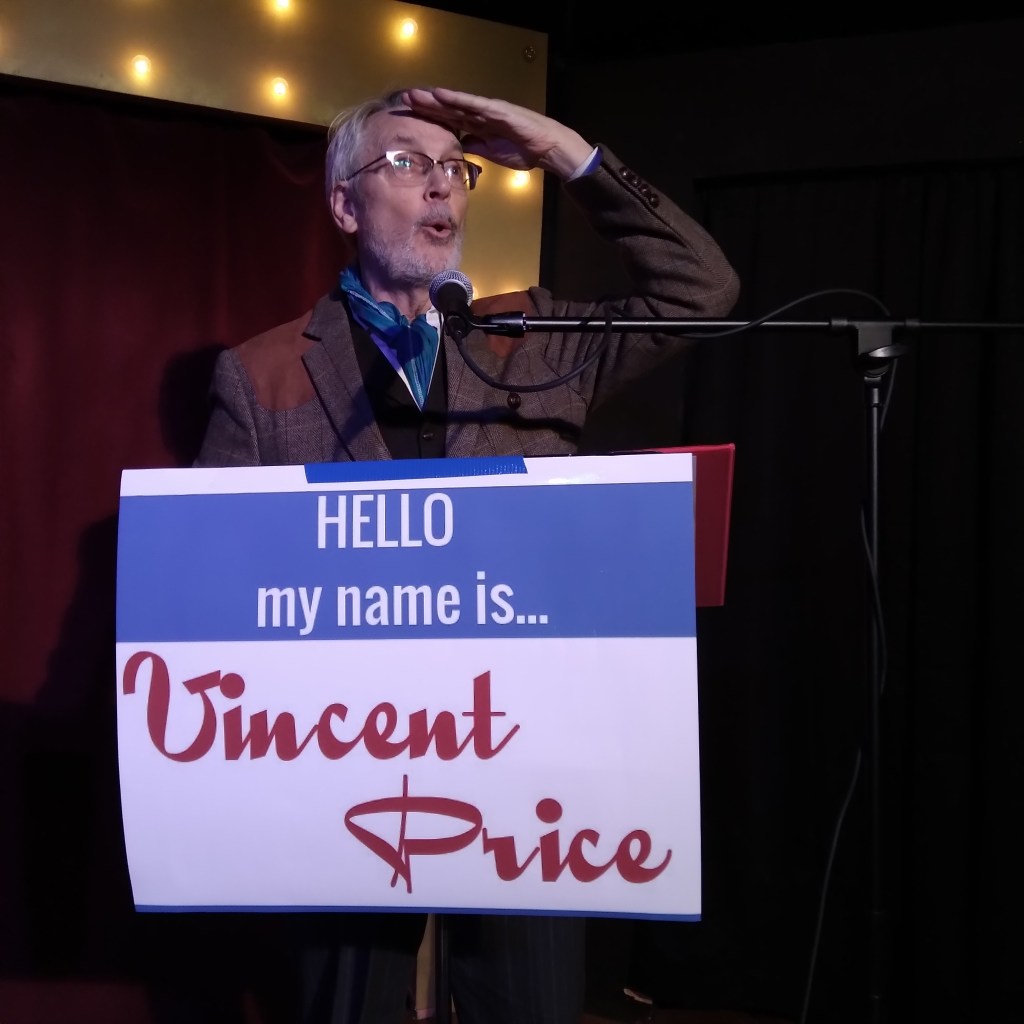
Presented (and recorded) by All Out Arts in the form of a live radio play, Price in Purgatory sees the titular icon of both the camp and the macabre, Vincent Price (Mike Pinney), in the infamous limbo world. Finding himself standing at a podium, he meets God themselves (Sai Cameron Gatrall, in his New York theater debut). Price is said to have entered Hell upon his departure from our world, but the Mormon community has arranged to have his case re-opened solely due to his performance as Mormonism founder Joseph Smith in the biopic, Brigham Young.
The “re-trial” explores Price’s life via a trip through the seven deadly sins, all of which he is clearly guilty of, with no remorse on display. Price, an inspired choice of subject, is arrogant and flamboyant as he defends (or rather, celebrates) his own existence with delightfully smirky self-satisfaction. He is presented here as a man so hilariously vain that he probably thinks the song is about him, but it’s done so in a tongue-in-cheek, reverent manner that shows true affection for the hero of horror.
Price is soon joined by his spirit guide, a youthful version of himself (Jmar Reid). After Price “Envies” his younger form, the two switch bodies/actors (“a painful process that culminates in the ripping off a moustache” explains a disembodied voice). They argue, banter, and in a brilliant and hilarious sequence, become ever more exasperated as they repeatedly say the exact same words in unison. “It’s weird to hear yourself think in stereo!” the Prices observe.
With sinful “Pride”, Price continuously namedrops his films and sidesteps into anecdotes about his career triumphs, including his narration on Michael Jackson’s Thriller. “It allowed a whole new generation to fall in love—with ME!” Price/Reid boasts hilariously. He later begins to perform the song but is forced to stop for legal reasons. “Copyright laws don’t stop in the afterlife!” explains the Spirit Guide.
Casting a child actor as God is a stroke of genius, and Gatrall gives a winning performance as the sardonic, sharp-tongued deity who’s literally seen it all (including Price’s films). “I am many things…smug included!” he proclaims in a moment of ultimate self-awareness.
Pinney and Reid are charming, engaging, and killingly funny as the dueling Vincents. The play is both hysterically funny and intensely thought-provoking as it debates what makes a person either worthy of heaven, better off in hell, and the purpose of existence on both sides of the veil.
“Everyone needs a little Nietzsche,” says a philosophical Price. “That which does not kill us makes us stronger.’ I’m still trying to figure out how to apply that one, despite being dead.” Price in Purgatory is written by Drew Pisarra and directed by Douglas Wagner (who also provides an appropriately spooky audio score). Costumes are by Adanne Spencer-Johnson. It is produced as part of the RadioPLAY Series as part of the Fresh Fruit Festiva
Season of the Witch: Jim Catapano reviews Gillian Britt’s Powerful Thought-Provoking Play at the Chain
The Beholden is the second production of the Trapezoid Theatre Company and provides a punch-in-the-air moment for feminist action and the power of sisterhood as it delivers a punch in a mouth to the patriarchy.
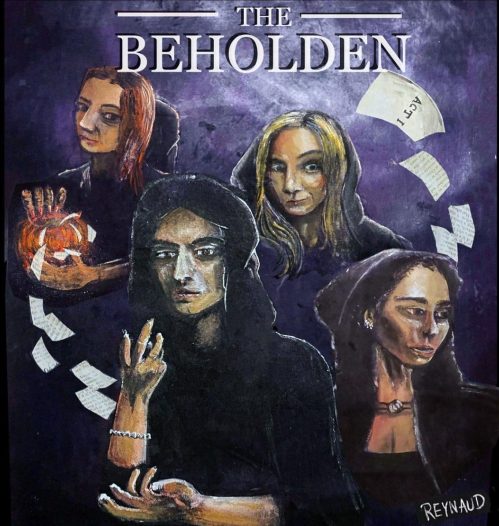
Sally (Shelby Sweet), a driven college senior, prepares her magnum opus for production at her university, a modern spin on the Salem Witch Trials. Her writing comes deep from her own experience and also shines a harsh light on centuries of patriarchal repression and misogynistic abuse. In Sally’s story, these dark forces get their comeuppance from the sisterhood of “witches,” rising up at last after an eternity of dismissal and destruction. But as she readies her personal statement for the stage, those same power-abusers and misogynists threaten to silence her voice and score another point for male dominance.
Britt presents the tale in a clever, riveting play-within-a-play format. Sally and her “sisters” both on and offstage —Samantha (Lucy Buchanan), Abbie, and Liz—rehearse scenes from the play, deal with backstage drama and note nitpicking, and vent their frustrations over bottles of wine. They also do battle with the slimy, sabotaging University liaison Dr. Samael (David Cagan) and Samantha’s violent-tempered boyfriend John (Henry Sirota). Jim Grant delivers consistent laughs as Adam, playing Sally’s “monster” in her production. Sam B. Wylde provides a calming presence as Professor Bast, countering the toxicity and gaslighting of John and Dr. Samael.
The direction and production design by Lauren McAuliffe deftly delivers the material in a powerful manner, aided by perfect lighting effects by Conor McAuliffe. The cast goes through an incredible amount of costume changes as they go from rehearsals, to girls’ nights, to a Halloween Party that changes everything, and finally to a climactic opening night. (The excellent multi-costume design is by Cynthia Johnson.)
Best friends Sally and Samantha are nearly pulled apart by the very forces they are trying to combat with their combined creativity. John keeps Samantha under his thumb as Sally desperately fights to pull that thumb away and free her (leading to a clever moment of irony later in the play). It is revealed just how personal Sally’s writing is, as what’s happening to Samantha happened to her as well.
Sweet delivers many powerful moving moments as she fights fiercely to protect her voice and her relationships.
“I didn’t fight back,” says Sally to Samantha. “I never fought back. And now you and everyone else makes fun of me for writing plays about women who do.”
Abbie witnesses a terrible incident of relationship violence, and finds her own eye-witness account dismissed by not only the person meant to help, but by the wronged person themselves. It’s a harrowing moment that hits home and is (rightfully) not easily forgotten. Events draw to a suspenseful, intense conclusion as Sally’s play opens, and we are on the edge of our seats waiting to see if her creative voice will be snuffed out or rise triumphant.
Britt’s script is a knock out of the park, delivered passionately by the entire cast, and each character is presented with remarkable consistency and depth. The Beholden is a compelling production, with a message that needs to be heard more than ever in a time when those who seek to silence and oppress are rallying for another try.
The Beholden is produced by Nicholas Kennedy and Gillian Britt.
Katherine Alice – Katy – White appears with … herself
Hi, My Name is…
Limited Run:
WEDNESDAY, November 8 @ 4:00 PM
FRIDAY, November 10 @ 6:30 PM
SUNDAY, November 12 @ 1:00 PM
Teatro LATEA, 107 Suffolk Street, New York City
Ticket available HERE
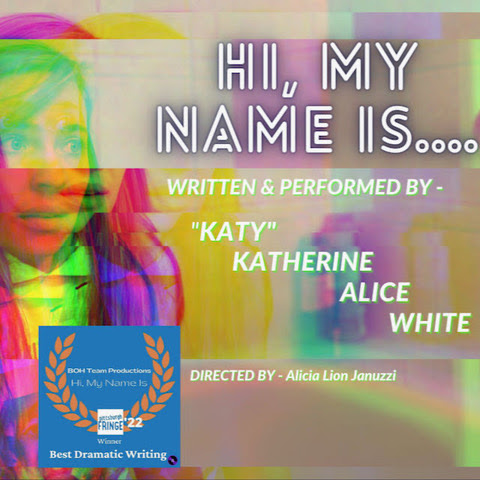
“Who am I anyway … am I my resume … That is a picture of a person I don’t know.” This lyric was first uttered nearly a half century ago in A Chorus Line and – since then – the exploitation of one’s inner self or even one’s “other” self has been fodder for numerous plays and films. Katherine White takes this to a new and innovative level in her one-woman exploration: “Hi My Name Is…” a featured event at the New York Theatre Festival at Teatro LATEA, 107 Suffolk Street,New York City in November. Ticket available HERE
Written and starring Kay White, “Hi, My Name Is….” features Ms. White engaged in a spirited “self-talk” – the kind we all have – elaborating on what it means to be truly ourselves – especially when we may not know who we really are! This schizophrenic story-telling journey allows us to meet Katherine – and Katy – who take the audience on a deeply moving ride culminating with her/them inviting the audience to VOTE on who will be in charge. As each tries to sway the audience, they unwittingly reveal themess inside us all.
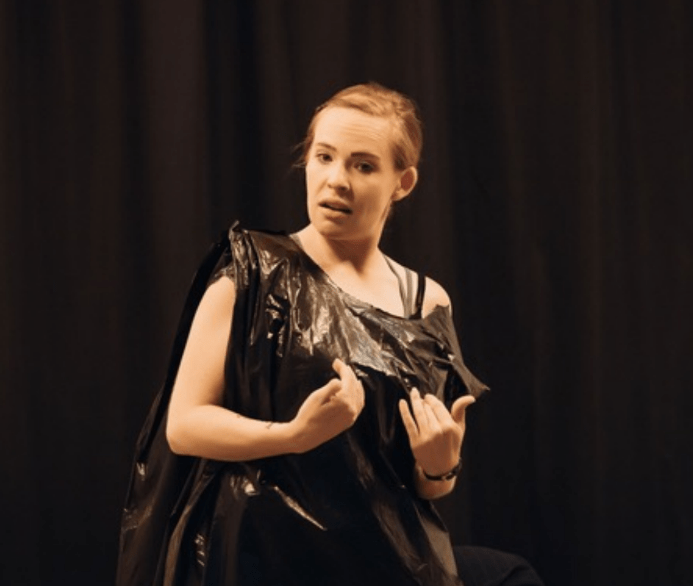
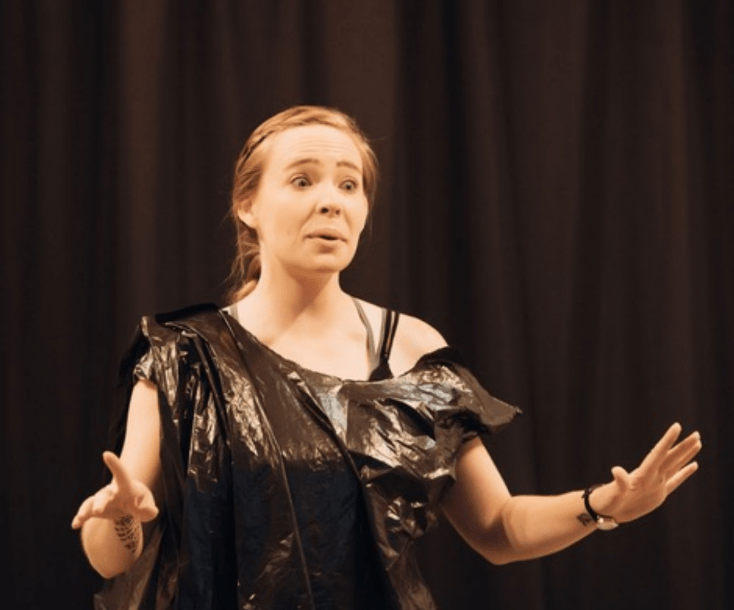
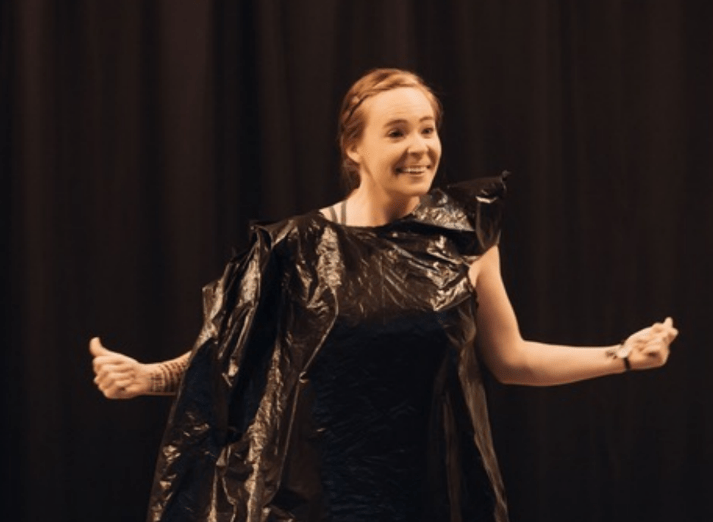
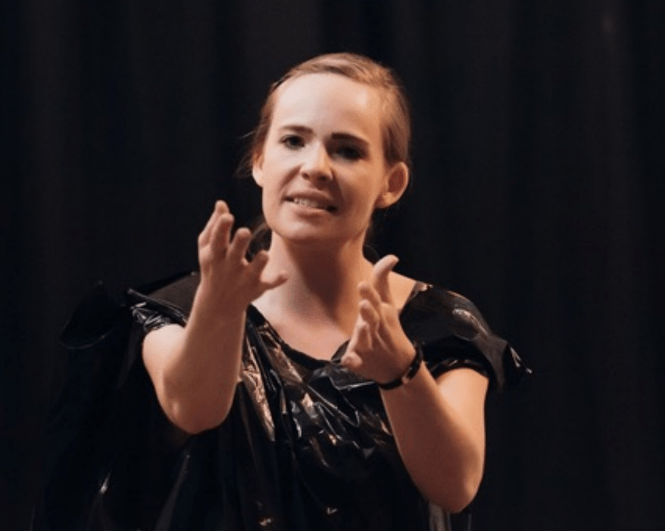
While this may seem shocking, this engrossing play shows us – on stage – what we do every day – in life.
This production is directed by Alicia Lion Januzzi
“Hi, My Name Is….” toured the country garnering accolades and awards and now comes to New York where it in development for the UnitedSolo Festival on stage as well as a possible cinematic bow.

For Styrmir Elí … it’s getting “REAL”
Styrmir Elí Interview by Jen Bush
Untitled 1970 is unlike anything you’ve ever seen before. It’s a cerebral hybrid production that takes place on a stage and on a screen. Talk about “all the world’s a stage… ”, Everyone will be getting a front row seat to this compelling show because the intended venue is YOUR living room! Yes, this unique entertainment experience will take place in people’s homes. We had the thrill of speaking with the writer and co-director Styrmir Eli to learn more about this exhilarating show.

Mr. Eli gives us a comprehensive description of the show. Untitled, 1970 is a multimedia theatre piece that sprung to life early this year. It is led by an international team of young creatives from the film and theatre world in New York.
The performance will all take place in an apartment, not in an actual theatre space, where half the performance will be on stage, while the other half will be on video. So, the story will flow from stage to screen, and from screen to stage.
This experimental, creative endeavor is a narration of friendship and the perplexities of life.
The inspiration for this work of art came from Mr. Eli’s life as well as a multitude of questions he pondered. “Well, I draw inspiration from many things in my personal life; observations, and real life scenarios.”
“The story is really built around a set of questions that I ask myself all the time, or opposing concepts rather. In recent years I have become fascinated with binary images. Good and bad. Light and dark. Positivity and negativity. 0 and 1. And how sometimes, it can be hard to tell what is what, that is, the world is full of paradoxes and sometimes one can become the other, based on perspective. And you cannot have one without the other. There is no good if there is no bad. And the frequency between these two opposing forces is, in my view, the beauty, and existence of life. As Einstein said, everything is relative.”
“We follow the story of Joey, and Tristan, two friends who live in the busy environment that is New York City. They are young, playful, smart, and curious, but approach life in very different ways. It is a story of contracting perplexities, and states of being.”
“Is it good or bad to be unbothered?”
“Then, in terms of the production, we’re playing with the concept of merging the worlds of theatre and cinema together. As a child, a young boy, I was fascinated with the world of cinema. It was my first love.”
“I grew up spending a lot of time at my grandmother’s dance & cultural studio in downtown Reykjavik, Iceland. There I would take acting lessons, dance and do other workshops. Then after class I would run to video rental across the street, grab a movie, and watch on my grandmother’s TV – who lived right above the studio. This was a standard routine through many years of my youth.”
“There is a certain intimacy in film that can be really tricky to conceive on stage, especially with a bigger audience. While in the theatre, there is presence, demand, and a level of realness that when done correctly, and fully, cinema cannot compete with.”
“That is why the idea sprung to merge these two worlds – and play with these two different mediums of storytelling – and possibly, hopefully, create a new sense, a different experience for the audience.”
Dreams and visions sometimes come with obstacles. Mr. Eli is facing some obstacles, but he is facing them with positivity and hope. “Honestly, budgeting, and logistics. It’s a complex piece we are putting together. And we are all newly graduated, young creatives, with no more than a few dollars to our names.”
“Nevertheless, we are a group of very ambitious, passionate, and hard-working individuals that really want to create something very special. And it actually works as a spice, a function of motive that wheels our creative endeavor forward. That’s the spirit of New York City.”
“So far we have been able to overcome any problems and obstacles that have come our way – and we just keep moving ahead.”
“Creatively, the process has flown and flowed quite freely. We’ve had no problem (at least so far) with putting the story together or building the characters that live within the world of our creation.”
“Today we are a few weeks from shooting the film part of the project, and then moving into rehearsals, so let’s hope we stay on the same path!”
This piece is much more than a suspension of reality. Mr. Eli would like the audience to walk away with some deep contemplations about existence. “The aim with this piece is to awake certain questions about what it means to be alive, what it means to be human, and to reflect on how we live our lives. What matters to us and how do we go on about our thoughts and emotions. What is my take on life? What is my perspective? What do I project into this world?

These are big questions.”
“All of us that are working on this piece have a different point of view on the story, and that’s exactly how it should be.”
This show could change the face of theatre as we know it! “Well, we’ll see about that. We are just excited to get our show up and running and hopefully create a meaningful experience for our audience.”
Next for Mr. Eli is seeing how far he can take this show. In theatres there are limited runs. With a show like this, the possibilities are limitless. It’s much easier to drop by someone’s home than to book a theatre. “Hopefully we will run our show for some time. I guess time will tell.”
This is an ambitious piece for newly graduated artists. If they are doing this now, imagine the amazing art they will put out into the world with more time and experience! Dust, mop, vacuum and open your home to these passionate artists! You don’t have to worry about parking or hanging around the stage door for an autograph. Your front door IS the stage door!
In a Time of Horror, Heroes and Hope Arise: Jim Catapano reviews VILNA
In a Time of Horror, Heroes and Hope Arise
Vilna: a Resistance Story Tells a True Tale of Jewish Freedom Fighters through Song
By Jim Catapano
The Green Room 42 at Yotel in Hell’s Kitchen gave a home to a concert reading of a true—but largely unexplored—story of hope and freedom; one whose time has finally come to be heard.
Vilna: a Resistance Story is a musical depicting the efforts of Jewish resistance fighters against the Nazis in Vilna, Lithuania during WWII. The Germans created “ghettos” in Vilna to confine the Jewish people in the summer of 1941, where they were forced to work and later massacred in mass murder operations. It was in the Vilna ghettos where the seeds of rebellion among the young bohemian crowd of the city were planted.

The score, with music and lyrics by Kevin Cloud, is based in modern pop and rock, with nods to the traditional sounds of Klezmer.
The real-life hero at the center of Vilna is Vitka Kempner. Only 19, she had sought refuge from the Nazis in Vilna in September 1939 when it was still a free city. She befriended local artists like the poet Abba Kovner (whom she later married), Hirsh Glick, and Abraham Sutskever.
The opening song, “Vilna My Vilna,” is a rousing tribute to their home as the bohemians show Vitka the still-vibrant town. “It’s a bright shining star turning darkness into light,” they sing.
Vitka, having seen and fled the horror of the Nazis in her own hometown, encourages the group to join the fight in the song “What do You Have to Lose”? When Vilna became occupied two years later, and 80,000 Jewish people were sent to the ghettos, Vitka and her new friends formed the United Partisan Organization. They faced not only the creeping devastation of the Third Reich, but also disapproval from their own elders and peers, who felt that their efforts would only put more of their people in danger. Most famously, local business owner Jakub Gens was appointed by the Nazis to be commander of the ghetto police, and his policy of “give the Nazis what they want, we have no choice” puts him in direct opposition to the resistance (“It’s what me must do to save our people!” he sings. “We will find another way,” the group counters.
The bohemians persevere, bonding and pushing forward with their collective voice and undeterred creativity as motivating factors, despite many setbacks and tragedies. They struggle with cramped living situations, lack of food and supplies, constant fear, and broken dreams. “The line between life and death is thin/it could be the end,” they sing as they desperately and dangerously smuggle supplies into the ghetto.
“I never thought I’d be the star of a tragedy,” laments aspiring songstress/actress Lyube Levitski.
The bohemians are portrayed by Tatiana Wechsler (as Vitka), Ben Fankhauser, Talia Suskauer, Samantha Massell (as the heroic and tragic Lyube), Oliver Prose, Dani Apple, and Eli Mayer.
The songs that bring their story to life are melodic and memorable, ranging from elegiac and melancholy to stirring and triumphant. “We will not go like sheep to the slaughter, they will not take our sons and our daughters,” they vow. “We are ready to die for our honor; we will stand and fight until our last breath.” The group keeps on going in the face of utter horror to ensure that their people and its culture will survive.
The book of Vilna is by Lisa Kenner Grissom, with additional story by Allison Cloud and additional music and lyrics by Greg LaFollette. The casting director is Andrea Grody.
Vilna: a Resistance Story will be back in NYC for an industry reading in Spring 2024.
 Arts Independent