Polite Nibbles
Review by Brendan McCall
The Fierce Urgency of Now
Radio play
Written by Doug DeVita
Directed by Dennis Corsi
Premiered on 29 March, as part of the Fresh Fruit Festival
We are now faced with the fact that tomorrow is today. We are confronted with the fierce urgency of now. In this unfolding conundrum of life and history, there “is” such a thing as being too late. This is no time for apathy or complacency. This is a time for vigorous and positive action.
–Dr. Martin Luther King, 28 August 1963
To name your work with a title referencing Dr. King’s famous speech from the March on Washington is bold, insinuating that this story will be impassioned and fervent. Especially when your play premieres the same day as the historic trial of former Minneapolis police officer Derek Chauvin for the murder of George Floyd in 2020. Doug DeVita´s The Fierce Urgency of Now is not about systemic racism, however. Kicking off a series of radio plays for the Fresh Fruit Festival, the piece is polite instead of political, and its edges never really cut.
The radio play–which began as a stage play, and is apparently being adapted into a screenplay–is described as a “fast-moving caustic comedy” exploring homophobia and ageism in the ad world. Ostensibly, this is true. To be sure, the energy of the dramatic writing aims for comparisons with Oscar Wilde or Noel Coward, where perhaps every other line prickles with barbed wit. But in DeVita´s play, the clever humor evinces a few smiles but oddly, given the subject matter, never erupts into scathing confrontational laughter. The teeth of this play nibbles, when it needs to bite.
Openly gay and perenially snarky Kyle (Matthew Jellison) is angry that he is being pulled off of a number of accounts at his New York advertising agency, and instead partnered with the older Dodo (Laura Crouch). The narrative arc of their relationship is conventional and predictable: you know that this odd couple will inevitably bond and help one another, each learning new things along the way. But while the facts of Kyle´s sexual identity and Dodo´s age arise throughout the play, the bulk of the dramatic action in The Fierce Urgency of Now is focused on completing some project deadlines over the Christmas holiday. What consequences do these two really suffer from this New York ad agency of the mind? What is at stake, if they do not complete their assignments in time over the winter? By the end of the piece, as Dodo joins Kyle on a significant and symbolic flight, we never really know.
Director Dennis Corsi harnesses clear and articulate vocal performances from each of the actors in DeVita´s play, and the use of sound and music during scene transitions helps to keep the hour-long piece moving.
Maybe I´m the wrong audience for this work, but experiencing this radio play as a bisexual male or a long time performance artist was disappointing. The Fierce Urgency of Now plays it safe, both in terms of content as well as form, and feels unintentionally akin to a magazine ad: glossy, hinting at politics and power, but ultimately remaining only on the surface.
The Caged Bird Sings
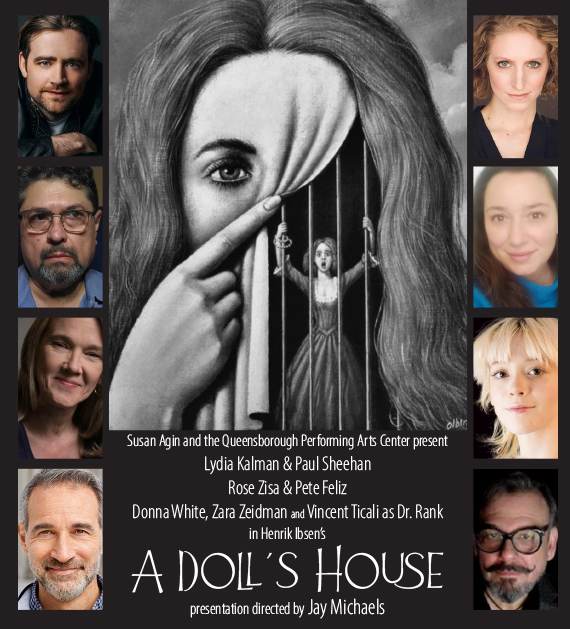
Susan Agin and the Queensborough Performing Arts Center will present Henrik Ibsen’s classic play, A DOLL’s HOUSE for an invited audience in April as part of an arts and education program.
Ibsen’s play still projects a substantial message – one of female empowerment, abuse, misogyny, and – as we look at it through the lens of post-Trump America – high crime and corruption.
Ms. Agin brought Jay Michaels aboard to direct the production. Michaels, a professor of communications and theater are various universities, is also known for his direction and production of much of Shakespeare’s canon felt right at home with Ibsen: “this play was banned in Germany because of its ending – highly unconventional for the time,” he said, “what exactly was too shocking?” he added. “I think anyone who has been raised in a very sheltered environment or a more conservative environment and had an epiphany moment or has not been free to be themselves because of certain views, will be able to relate to Nora,” chimed Lydia Kalman, who plays the focus of the piece … Nora.
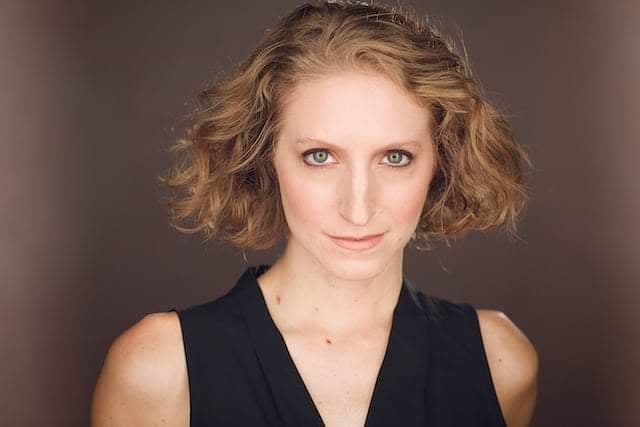
Kalman, a classically trained actor for both theater and film/TV, is credited with work Off and Off-Off Broadway, as well as several indie films. Kalman has been seen in heavy dramas, lighted-hearted comedies, Shakespeare, sketch comedy, and everything in between. She and co-star Paul Sheehan even shot an indie horror film – an historic one. Marcus Slabine’s The Dark Offerings was one of the first indie films to shoot during the pandemic adhering to all CDC guidelines and will be released later this year.
Lydia took a few minutes to share her thoughts on the production.
Is Doll’s House still groundbreaking today?
I think in some ways it is. For the majority of modern/western culture, it’s very normal for women to be independent and to lead independent lives. Though we are still fighting for equal pay for equal work and reproductive rights and so forth. But, for the most part we are allowed to lead our own independent lives. But there are still households in this country and around the world where women are expected to be the dutiful wife and mother and dedicate her life to such service. And for women who are not fulfilled by such a lifestyle, there is still that same struggle.
How has the role of Nora changed over the century since its writing?
I don’t think the role of Nora has changed too much over the century. I think audience members, women especially, will be routing for her to find her wings and fly. And I think anyone who has been raised in a very sheltered environment or a more conservative environment and had an epiphany moment or has not been free to be themselves because of certain views, will be able to relate to Nora.
Hiw important to offer-up the classics to colleges, universities, and other institutes of learning?
It’s very important to share classic works with college students and younger audiences. Classic works reflect the times they were written in, art imitates life imitates art. And just like studying history, it’s important to have a full picture of history so as not to repeat mistakes of the past. And…classics can still inspire and move hearts and make people laugh and cry and entertain!
What’s Next?
My next project is a recurring role on the first season of a new mystery series. I can’t give away any more details quite yet, sorry about that. But I’ll start filming at the end of April.
A Correspondence of Grief
A Correspondence of Grief
Review By Brendan McCall
Language Reversal: Move Past What We Know
Co-created by Aaron Landsman, Clarinda Mac Low, Ogemdi Ude, and Amrita Hepi
Virtual performance
Presented by Abrons Arts Center (New York, NY)
8 March 2021
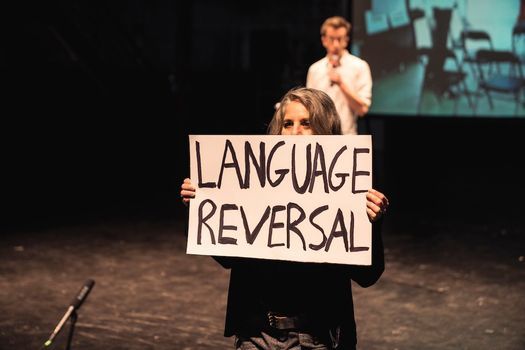
Can theater be an essay? Co-creator Aaron Landsman (Manhattan, New York) poses this question near the beginning of this second installment of the virtual performance Language Reversal: Move Past What We Know (Abrons Arts Center, New York). Even two weeks after witnessing it earlier this month, my mind keeps returning to images, moments, and phrases that these artists offered on 8 March 2021. Perhaps because its showing was approaching the one-year anniversary since lockdowns began sweeping the United States, a grim milestone of how all of our lives upended. Or maybe it was because, like the first installment of this project I saw last month, Language Reversal does so much with so little, its seemingly small economy supply sinking beneath my skin and penetrating my heart.
Translated in real-time to ASL for the hearing-impaired, Landsman reads excerpts from a series of emails with another one of the piece´s Co-creators, Ogemdi Ude (Brooklyn, New York). He asks questions from the beginning of the pandemic–what shall we do? What are we doing? How can we keep working together? After this revealing and slightly panicked prologue, we shift to Ude´s calming, vital presence, following her observations and feelings as she recounts how she spent part of last summer on a porch in Atlanta that feels almost mythic. As we listen to her sonorous voice, we see the silhouette of hands along a wall. Is it two pairs of hands dancing, or simply the appearance of four hands communicating with one another? Inquiries more than discovering answers seem important in Language Reversal. It’s a quest.
Ude remembers how, on the porch, news of the social upheaval sweeping the country would filter in and out. She and a friend talk about the coming apocalypse, and how to redirect grief. They also talk about how to choreograph, and the video games they like to play the most on their phones, for pleasure and for therapy. This is a memory, but also a letter from Ude to Co-creator Amrita Hepi (Melbourne, Australia).
If Ude is on the porch of grief, Hepi says at one point, then she is on the island. Her monologue is a kind of letter in reply to her long-distant friend, while we watch collages from some of her participatory dance projects. As a First Nations Australian artist, Hepi says she wants to making caring for one’s country a choreography unto itself. During this year of Covid-19, she doesn´t wish to avoid sadness, but neither does she want to search for the “drug of happiness.” Instead of being defined by struggle, why not focus, care, and to “have moments of incredible mediocrity.” Her piece ends with images from past works, often involving simple gestures such as hugs. Ordinary, perhaps, but for most of us this past year, utterly rare, magical, a memory.
After their visual and auditory correspondence of grief, Ude asked Co-creator Clarinda Mac Low to respond to the twenty-five work we had all just witnessed. Mac Low´s observations inspired me to remember moments within the work, as well, including ones she didn’t mention. It also left me reflecting upon how I have grieved this year, through my work, and out of it. Who have I entrusted my own grief with?
The friendship shared by Ogemdi Ude and Amrita Hepi is deep, and one which articulates some of their own relationships to grief, love, and how to focus during a time when everything has turned completely upside down. Language Reversal: Move Past What We Know shares just enough of their communication to provide permission for us to do the same with ourselves and the relationships in our own lives.
The Empty Space of the Telephone
The Empty Space of the Telephone
By Brendan McCall
Les Consultations Poétiques
Via Telephone
Theatre de la Ville (Paris)
This past Friday, shortly after 10 in the morning, my phone rang. Marie, a woman whose voice seemed to sparkle with her bright British accent, asked, “Are you ready for your poetic consultation today?”
One could speak endlessly about Paris, and the conversation would never exhaust its rich literature, dance, music, and theater. Like many cultural capitals around the world, this past year of the coronavirus pandemic has devastated the performing arts community here. At the time of this writing, all cultural venues that produce live dance, theater, cabaret, music (as well as cinemas and museums) have been shuttered since October. Notwithstanding some theaters being occupied by students in the past week in an attempt to pressure Prime Minister Macrón to reopen them (so far, the French government hasn’t budged), it appears that the theaters will continue to be closed until at least mid-April. Combined with daily curfews from six at night to six in the morning, the delightful din of the City of Light´s social scene feels muffled, muted by months of social distancing and isolation.
“How are you feeling today?” Marie asked.
One silver lining of this horrible year during covid is witnessing the many innovative ways performance artists have continued to create. And while many are creating live projects specifically to be seen on a computer screen, the Theatre de la Ville (Paris) has chosen to go old school. Spanning anywhere between 25-40 minutes, Les Consultations Poétiques is a free interactive experience between one actor and one audience member at a time through the telephone. Audience members can choose from twenty different languages, book a time, and then an actor calls you for this intimate and novel theatrical experience. (NOTE: if calling with a phone outside of France, your “poetic consultation” will come through WhatsApp).
“I´m tired, but I know that that´s not really an emotion,” I replied. “I guess the best word to describe how I’m feeling is….overwhelmed.”
Marie and I spoke for nearly thirty minutes, in a conversation that felt immediately intimate as well as welcoming–in other words, like attending a play or other live performance. We talked about some of the hardships over the past year during this pandemic, particularly the economic difficulties, and the loneliness. We compared responses to the pandemic by our country’s politicians. I mentioned how much I missed my daughter, and she encouraged me to move back to Europe full-time. Part of me was surprised at how quickly our “poetic consultation” got so deep and personal. But another part of me recalled hundreds of theatrical experiences from the past; how the theater is a space where each of us can be safely vulnerable, and affected by what unfolds onstage as well as between us in the audience. With Les Consultations Poétiques, Theatre de la Ville had taken that interactive nature of theater and stripped it down to its core, one actor to one audience member, mouth to ear.
“Based on our conversation,” Marie said, “I have a couple of poems I´m thinking of reading to you. Which would you like?”
Like most Americans, the one she suggested by Robert Frost was beloved to me, a poem no less dense for its brevity. However, seeking to take a road less traveled before the call was concluded, I opted for her suggestion of the one by Rudyard Kipling:
They shut the road through the woods
Seventy years ago.
Weather and rain have undone it again,
And now you would never know
There was once a road through the woods
Before they planted the trees…..
Peter Brook once famously remarked that if a man walks across any empty space, while being watched by at least one other person, that “this is all that is needed for an act of theatre to be engaged” (1). Arguably, the empty space Marie and I shared during Les Consultations Poétiques existed in the silences framing our voices. By listening to one another, who was performing and who was witnessing kept alternating. Or perhaps both of us simply connected, engaged in this brief exchange, a live theater moment created together.
(1) Peter Brook, The Empty Space. London: Penguin (1968, 2008), p. 11

Hell (and Redemption) is Other People, Car Pooling
Pooling to Paradise (filmed Zoom reading)
Written by Caytha Jentis
Directed by Alice Jankell
Review by Brendan McCall
Since No Exit premiered at the Theatre du Vieux-Colombier in 1944, folks around the world have been nodding their heads in agreement with playwright Jean-Paul Sartre´s most famous line, that “Hell is other people.” This line pops up in writer-producer Caytha Jentis´ comedy Pooling to Paradise, a filmed version of a Zoom reading of her latest play–only this time, instead of being trapped in a locked French drawing room for all of eternity, these four characters car-pool from Los Angeles to Paradise, Nevada, each finding a little bit of redemption along the way. It’s a charming premise, and for the most part Pooling to Paradise works.

Stressed out Jenny (played with spunk and sarcasm by Veronica Dang) is hurrying to get to catch her flight out of LAX to attend a “Mommy-blogger conference” in Las Vegas, her first time away from home and her kids (a theme Jentis has also explored with her series The Other F Word). However, her laid-back Uber driver Marc (Jersten Seraile, a warm, everyday Buddha) informs her that she has opted for a carpool. After picking up an aspiring actress Kara (the delightful and energetic Eulone Gooding) and then heartbroken casting agent Sean (played with ease and clarity by Stephen Reich), the car decides to drive to Paradise (literally and figuratively), hoping to escape each of their own personal hells.
Director Alice Jenkell, who worked with Jentis before on The Other F Word, elevates the piece to something more than a reading: title cards chronicling their geographic progress, an occasional score to augment a scene, and other techniques help experience the passage of time and space on their spontaneous odyssey through the desert. Gooding and Reich, in particular, seem utterly at ease on camera, consistently making this visual frame their own. My only critique would be the sound-quality of the actors´ voices, making it challenging to hear what they were saying from time to time, which I think is just a shortcoming of recording within our present medium of Zoom.
Unlike Sartre´s grim existential drama, Pooling to Paradise is upbeat, relatable, and humorous. In addition to French existentialist drama, Pooling to Paradise borrows elements of The Odd Couple (times two) and the psychedelics of Dennis Hopper´s Easy Rider. Like every good road-trip story, this is an odyssey, and each passenger experiences a “dramedic” epiphany before Marc parks their car in the desert. Jentis´ actors are well-cast, and each delivers Jentis´ script with commitment, timing, and solid emotional availability. At just over one hour in duration, Jentis´ reading seems to put on the brakes a bit abruptly at its conclusion. Hopefully, this Zoom film of Pooling to Paradise is just a pit stop, and her car-pool will hit the road again soon.

Uplifting This Body
This Body Shows Up (virtual showcase)
7 & 8 March 2021*
*(videos may be viewed online through 8 April 2021)
Review by Brendan McCall
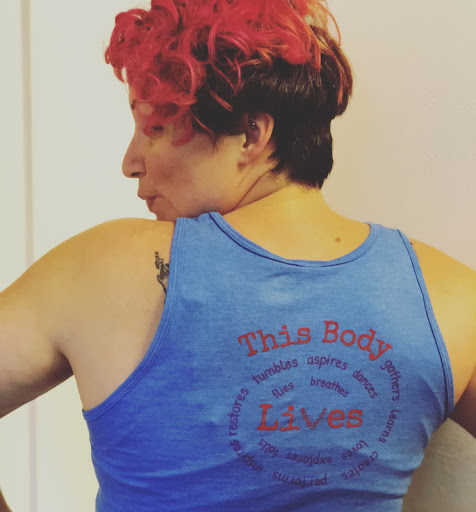
Truly, there is strength in numbers. Initiated by five performing artists based in New York–Nadia Hannan, Alessia Panti, Sara Roer, Diane Tomasi, and Marcie Yoselevsky–This Body is a dynamic and resilient expression of pooling creative resources, and of how a collective can uplift each individual.
This past weekend, the group presented This Body Shows Up, a showcase of short movement and dance films amplifying the work of queer/women/non-binary/BiPOC performing artists. Created during this past year of quarantine and social isolation during the global coronavirus pandemic, This Body Shows Up framed a delightfully diverse field of invention, ingenuity, and imagination.
Things Are Not Fine – how have you been? by guest artist Gabriel Bruno Eng Gonzalez is a kind of virtual collage of solo performance, lip-syncing, and multiple social media platforms. Constantly moving on one´s screen like a series of video-cards in continuous flux, the piece rides waves of gender-fluidity, with art, self-expression, and the internet serving as compasses.
Sara Roer´s emotionally eloquent Holding (me) refracts images of women isolated in multiple different interior spaces. Through editing, sometimes it appears that their partner could be touched through the wall through their gestures. The contrast between the sensual phrases of movement against the unforgiving walls of these apartments breaks one´s heart.
Abrupt silences and changing landscapes punctuate the unpredictability of Vanish, a solo created and performed by guest artist Maya Lam. Whether on a rooftop, in a park, or concealed in a bag, her surroundings feel oppressively empty, as if her dance is a forgotten scrap of imagination emerging from the environment.
Marcie Yoselevsky´s Capsule relishes line, form, shape. Five dancers in various squares athletically execute phrases to a percussive, repetitive rhythm, sometimes overlapping into unison, sometimes diverging into solos and duets. Through the accumulation of the work, one can see how the phrase is interpreted in various bodies, as well as notice the surroundings of each dancer–a living room, an attic, a studio.
Out of the Folds of Women, created and performed by guest artist Anabella Lenzu, immediately confronts the perception of the viewer. In addition to being shot in black/white, there is always an object occluding a clear view of her body in movement–a semi-transparent curtain, or a glass distorting her face.
When Philadelphia-based Sophiann Mahalia´s trio The Reclamation Dance Project begins, it is an immediate celebration of the fierceness of Black women. In vivid color and playful power, her dancers sensually move with authority in various outdoor locations in a piece that heralds so much more yet to come.
In some ways, Diane Tomasi´s Still is a coda to Roer´s Holding (me), as movement-passages are recycled and recontextualized. The soundscape is an ode to grief and resilience during the Covid-19 pandemic in New York City, particularly those uncertain early days: Tomasi combines ambulance sirens, the clanging of pots for first-responders, and news clips with her own phone calls with her friends and colleagues to rehearse, move, create.
Performance-based art-making can sometimes feel like crawling uphill, particularly within the horrific context of a series of policy failures in response to a global health crisis. The title of this showcase is purposeful, and perfectly appropriate. This Body Shows Up shines a light on artists who are multifaceted and multi-skilled. In addition to being choreographers and dancers, they are editors, composers, filmmakers. Perhaps some of them already possessed these skills during “the before times”, but the immediacy of these online pieces, the rawness and vulnerability contained within each of them, is palpable. Each piece is an urgent cry speaking through the screen and into the silence of our own still-quarantined bodies at home.
Altered States
EN: 2021
Hybrid performance (online live performance and films)
6 & 8 March 2021
Choreographed, Directed, and Produced by Yoshiko Sienkiewicz (Yokko)
Presented by Ren Gyo Soh
Review by Brendan McCall
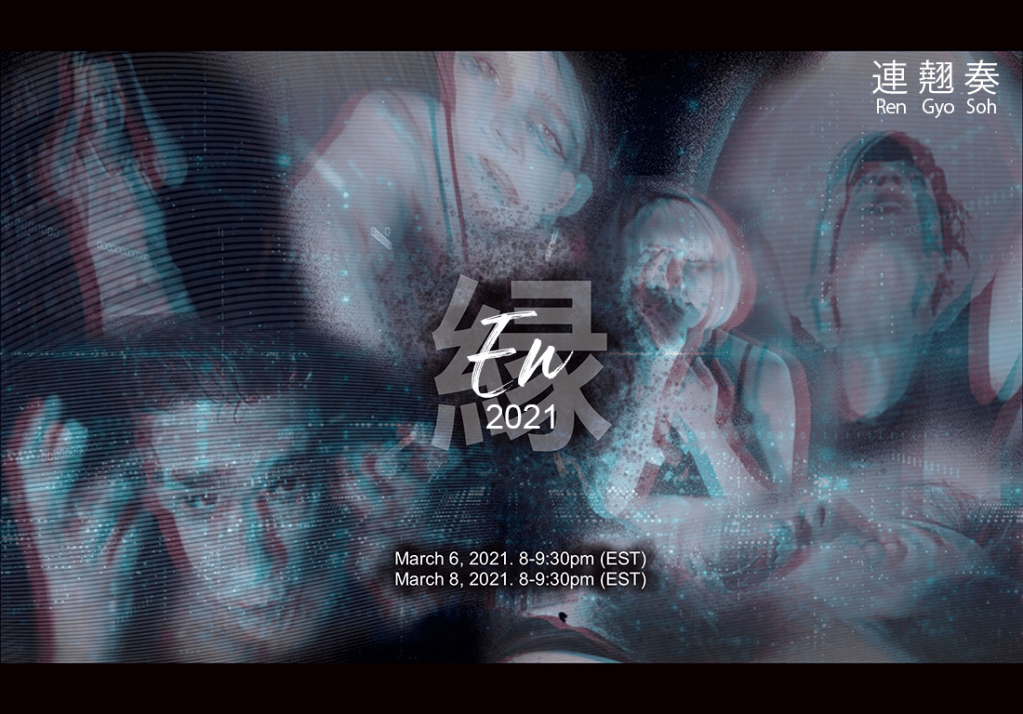
Before Ren Gyo Soh´s performance begins, the screen offers a definition of the Japanese word for En: a powerful connection between ourselves and another person, another object, a place. This connection could be brief or last a lifetime, could be intentional or occur by chance. With En: 2021, butoh artist Yoshiko Sienkiewicz (also known as Yokko) collaborates with six artists to create imaginary worlds which are potent, poetic, and occasionally nightmarish.
Yokko´s collaborators are multifaceted. In addition to performing, each has created their own short film, which weaves in and out of live episodes during the 80-minute experience of this abstract hybrid performance. An opening montage combining snapshots of New York City, people wearing masks, and fragments of news reporting of the past few months, contextualizes En: 2021 as emerging from our disorienting dystopian present. Initially, we see all six performers simultaneously in their squares, within various apartments and engaged in recognizable activities: exercising, reading in bed, playing an instrument. But once the ominous music begins, the everyday bleeds into the strange.
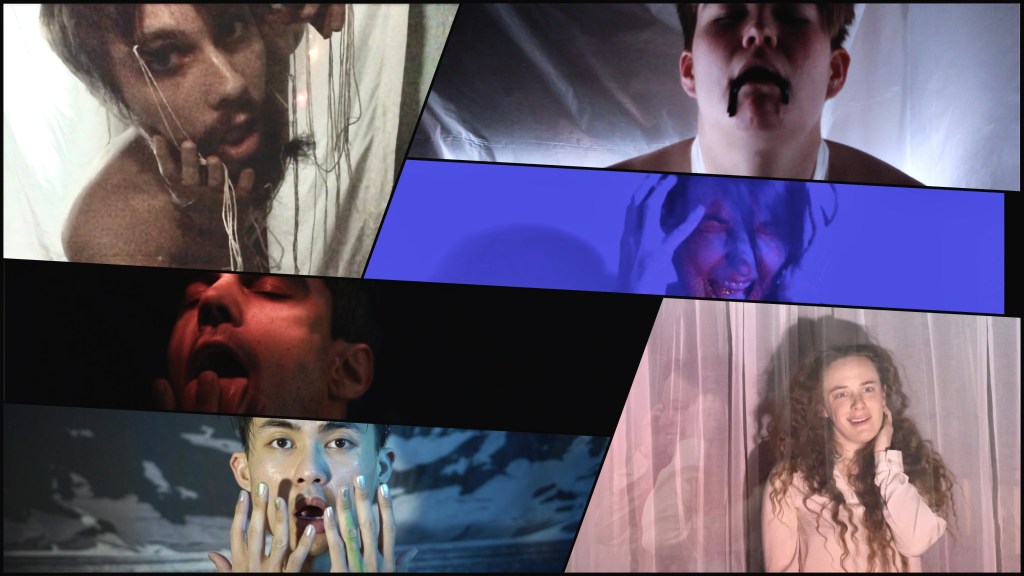
The various worlds that the members of Ren Gyo Soh create are vast and far-ranging. Technically, Yokko and her creative team brilliantly link the pre-recorded films with the live performance segments, supported in part by a luscious and haunting soundscape by Alyssa L. Jackson and Paul Michael Henry. Also, each of these six performers are masters of light, creating completely different moods and emotional atmospheres by saturating their screens in icy blue, infernal red, or using lights to birth fireflies or even stars.
There are multiple moments within En: 2021 which particularly struck me. At one point, the extreme motionlessness of Frankie Mulinix´s smiling face and gaze disturbed, as she gently moved her arms and hands in simple gestures. At another moment, Zak Ma´s hands and expressions seemed to ripple like the shifting surface of water struck by drops of rain. Annie McCoy once appeared like a ghost forged out of lightning, and then later moved under a projection of stars to a spoken poem. Miles Butler offered a sensitive and delicate ode to memory, incorporating interludes of family photographs and voice recordings with loved family members. Contorting himself within a business suit, Jorge Luna illustrated the cage of civilization on the purer animal state within each of us. And Rachelle Dart, within a space of silvery curtains, purges herself of a dark liquid substance in a dance which is both unnerving as well as cleansing.
Ostensibly, the performance language of En: 2021 is within the lineage of butoh. Gestures within the body twist, torsos convulse and arch, and faces silently howl or beg for peace. But perhaps it is because the performance is virtual, performed live yet screen to screen, that the depictions of desolation and horror seem to strike deeper. The impact of En: 2021, though brief, is a connection which resounds long after the screen returns to black.

Ai Lead Writer, BRENDAN McCALL
Brendan McCall is a writer and movement artist whose work with dance, theater, opera, and performance art has appeared in over 40 countries on 5 continents. Originally from California, he spent 18 years of his professional life in New York, and since 2008 has lived in Turkey, Australia, Norway, and France.
A member both of Actors Equity Association (USA) and the Norwegian Actors Union, Brendan has performed professionally in both languages in the United States, the United Kingdom, France, Norway, India, Russia, and Japan. Recent acting performances include Henrik Ibsen´s Svanhild (winner, 2014 Oslo Prize for Best Performance) at Teater Ibsen & Den Norske Opera (Norway), the Platonov International Arts Festival (Russia), and Theater X (Japan); and What a Glorious Day! at the 1st Ashirwad International Theater Festival (India), both directed by Lars Øyno. He has also performed professionally for Alexandra Beller, Maureen Fleming, David Gordon, Sin Cha Hong, Moisés Kaufman, Helena Lambert, Paul Langland, Mary Overlie, Stephen Petronio, Aki Sato, Keith Thompson, among others.
His theater direction has been produced internationally in the United States, Norway, Belgium, the Netherlands, France, Armenia, Turkey, Morocco, and Australia. Recent projects include #OccupyOpera, a new opera-in-progress composed by Kristin Norderval developed during multiple residencies at Den Norske Opera (Norway): Rabbit Hole (California, USA); As You Like It for the annual Shakespeare On The Plaza festival (New Mexico, USA); the Norwegian & Moroccan premieres of Open House, a site-specific play by Guggenheim Fellow Aaron Landsman (USA), presented by Nordic Black Theatre; and Visions of Kerouac, which he also wrote & produced, in association with Grusomhetens Teater (Norway).
As a producer, Brendan has represented a number of innovative independent artists around the world. Current collaborators include contemporary dance artists Haugen Productions & Kari Hoaas Productions (Norway) and danceTactics (USA). He was Director of Production for Tulsa Ballet (USA) in 2019, in charge of their collaboration with the Royal New Zealand Ballet, TBT´s European tour, as well as their world premiere by award-winning Broadway choreographer Andy Blankenbuehler; was the Producer for Grusomhetens Teater (2014-17), bringing the group to Japan, Turkey, and the USA for the first time; and served as Manager of the Cummins Theatre (Australia) from 2012-14, creating their playwright-in-residence program in partnership with Stages WA. He is currently a member of the Mary Overlie Legacy Project and a co-founder and co-director of the Allan Wayne Work Alliance.
As an educator, Brendan has taught a range of courses for conservatories and university programs (both Bachelor and Masters) since 1994. Previous long-term appointments include the Yale School of Drama, the New School for Drama, New York University, the Atlantic Theater Company Acting School, the American Academy of Dramatic Arts (United States); Danshôgskolan, Ballettakademien, Danscentrum, and Operalabb (Sweden), Bilkent University (Turkey), and The International Theater Academy Norway, where he served as Rektor (2008-10). Since 2019, he has taught movement and solo performance courses at Pace University in New York. His areas of expertise include Allan Wayne Work, the Jean Hamilton Floor Barre Technique, Mary Overlie´s Six Viewpoints, physical theater and ensemble training, and nurturing the creation of original performance-based work.
His award-winning articles have appeared in English, French, Norwegian, Russian, and Belarusian in publications such as Contemporary Theatre Review (UK), HowlRound, Contact Quarterly Dance Journal, Movement Research Performance Journal, Dance Magazine, Cultural Weekly (USA), pARTisan, ARCHE (Belarus), Regard Sur ĺ Est (France), and Klassekampen, Aftenposten, and The Nordic Page (Norway). He has presented at international conferences in Russia, England, and the United States on topics such as contemporary stagings of Samuel Beckett and Henrik Ibsen, to fundamental business practices into contemporary performing arts education.
BFA with Honors in Acting, New York University; MFA in Dance, Bennington College.
Coffee, Community, and Country
Welcome to the Conversation
Review by Brendan McCall
Language Reversal: Move Past What We Know
Organized by Aaron Landsman, Clarinda Mac Low, and Ogemdi Ude with Milan Vračar
Abrons Arts Center
1 February 2021 (virtual)
Two men, each in different countries on separate continents, communicate in real-time through Zoom. One is teaching the other how to make a distinct kind of coffee called sikterusa–a kind of bitter coffee one makes when you want your guests to go home. The ingredients are simple: tap water, a small cup, a lit candle, and patience.
As they wait for their water to heat, the two men begin to talk (mostly in English) about autocracy, and about what it is like to lose one’s country.
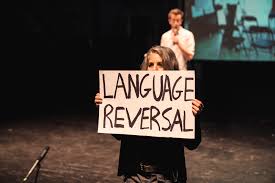
Language Reversal: Move Past What We Know (Abrons Arts Center) resists categorization. After settling in to this virtual performance while listening to Eastern European punk music, followed by a land-acknowledgement, the four collaborating artists introduce themselves, creating a real-time, interactive “bookend”. Ogemdi Ude (Brooklyn, US) takes the audience through a guided meditation, and after the succinct yet complex performance concludes, she prompts a rich dialogue with questions and observations about circling around what language we use to articulate the world we are currently experiencing, why it is often so inferior, and what (if anything) we can do to change it.
Experiencing Language Reversal is more than simply listening to a series of spontaneous conversations between writer, theater artist, community organizer Aaron Landsman (New York, US) and cultural producer Milan Vračar (Novi Sad, Serbia). Dramaturg and collaborator Clarinda Mac Low (New York, US) has approached these verbal recordings like a choreographer would phrases of movement, giving them shape and form into a kind of collage of sound. Sometimes the conversations dance like a duet, between these two minds; other times, multiple conversations occur simultaneously.
As the water slowly boils, the talk shifts into the difference between a “state of emergency” and “martial law”.
Visually, Language Reversal also features still and moving images from the two countries, making a clear link between the war in then-Yugoslavia in the late 1990s to the violent insurrection of the United States Capitol building on January 6th by supporters of the former President. Images of dragons also recur frequently–sometimes as a montage with NATO helicopters flying over the Danube River, and sometimes breathing fire on a lone warrior while the two try to recollect a joke from two years ago involving the winged creature. And yet, Language Reversal is not quite a narrative film nor a documentary.
We see footage of performers´ feet walking in a circle, backwards. We see maps of the region dissolve, merge, and shift. A dragon flies over a city.
Eventually, the candle has sufficiently warmed the water to make the coffee. The two men toast one another through their screens.
This piece struck a number of personal chords for me, notwithstanding the exceptional ingenuity and intelligence displayed by this dynamic creative team. I have visited Serbia a number of times since 2003, first as a performer for a dance festival in Novi Sad and later to visit my former father-in-law, who lives in Belgrade. When seeing the images of the destroyed bridges and buildings during the war, or listening to Milan Vračar describe hiding in basements to avoid the bombs or living without plumbing, reminds me of staying in homes whose walls were still cracked years after the cease-fire.
Abrons will present two more installments of the work this spring, the next being Ogemdi Ude will be in conversation with Amrita Hepi (Melbourne, Australia) on March 8th.

The Muyun Zhou Collection: Daddy Issues
Multi-Film Review by Lew Antoine
Film director and editor, Muyun Zhou, has made a name for herself serving up short films about familial relationships.
A pattern formed in two films – of which she directed and edited and one featuring her editing work alone.
The two standouts concern modern children dealing with their fathers. In To Be A Father, (written, directed and edited by Ms. Zhou) we meet young go-getting career woman played with all the bells and staccato whistles of an executive by Wanyoo Zhang making an uncomfortable visit to her father. One can see in the regal showing by Weiwei Meng, that she inherited the “headstrong” from him.
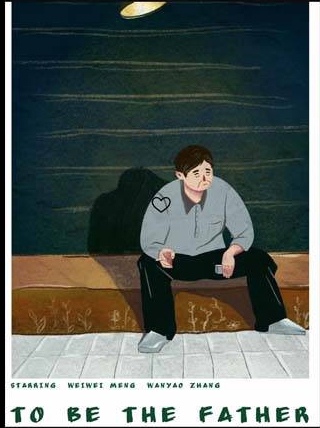
The film opens with dad paying a graveside visit to his wife. In something as simple as his posture, we see great grief and great power. A perfect juxtaposition occurred thanks to his dippy grin when he sees his daughter’s number on the phone and the conversation about her impending visit. One get the impression there was tension between them. One also gets the impression that both regret that tension. One also gets the impression that they both have no idea how to fix it. Zhou offers up some simple yet deeply moving imagery that – while only touching on the situation at hand – perfectly exemplifies it. The father in a frilly apron preparing far too much food; the daughter not taking her face out of her phone; lack of eye contact; small criticisms about onions prompting father to pick them off the food. Real exposition is released by chit-chat and through the deft lens of Zhou engrossing us in a heartbreaking reconciliation being attempted. A simple shot of an ashtray and the addition of an extra chair on the patio; dad explain a dream, daughter watching him walk down a staircase, and a whispered ending salutation, were all we needed to hold back tears.
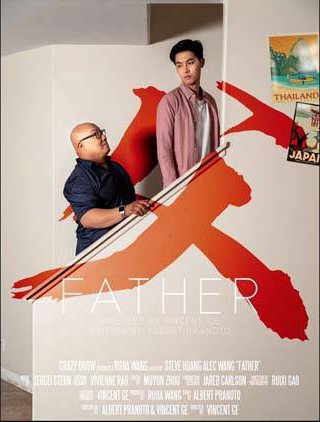
The second, called Father – for which served exclusively as editor is a parable about a gay son and his father. Again, lots of tension and no exposition. Again, a mother passed away and a father trying his – albeit inept – best. Again, no deep discussion about sexuality, no preachy dialogue. Frankly, no actual admission that his son is gay. Simply a father trying his best to raise his child. This short film centered around a trip proposed by the son to go with a friend and how the father handles it. This film should be part of every LGBTQ film festival as what a caring parent should look like. In this case, it is in the clever rapid close-ups and cutaways and interesting eye-contact shots that offer insight into the relationship. The ending again offered up a caring connection between generations.
Both films offered no huge great panoramic moments; no soaring anything. Just the simple, deeply moving family dynamic done brilliantly by a young filmmaker and editor.
It would be a shame to not mention Zhou’s The Hole. This comedic O. Henry-style short film brings us to a common 9-to-5 style office and features a junior accountant with a secret. A barren full or red herrings lead us to a final scene that is both uproarious and unexpected. Here, again, clever cuts and close-up lead us quickly into this mystery with a gasp-inducing ending.
Muyun Zhou offers up no nonsense, deeply moving and engrossing works in a styles streamlined way. The film community should be watching her star rise.
Latest Posts
-
Jim Catapano reviews Anne L. Thompson-Scretching’s Home Is Sweet Sorrow: “A Masterful Conclusion to a Momentous Family Saga”
The War That Never Ends Home Is Sweet Sorrow is a must-see and a devastatingly powerful third chapter in the Blood trilogy, which also includes…
-

THE BARD TAKES BROADWAY: SIXTH ANNUAL NEW YORK SHAKESPEARE AWARDS CELEBRATES RECORD-BREAKING 2025 SEASON
THE BARD TAKES BROADWAY: SIXTH ANNUAL NEW YORK SHAKESPEARE AWARDS CELEBRATES RECORD-BREAKING 2025 SEASON The New York Shakespeare Awards has officially unveiled its list of…
-

American Theatre of Actors Announces 50th Anniversary Gala; Playwright LYLE KESSLER and TONY-winning actor, LEN CARIOU to Receive Lifetime Achievement Honors.
NEW YORK, NY — The American Theatre of Actors (ATA), a cornerstone of the New York theatrical landscape since 1976, is proud to announce ATA 50, a…
-

Music Among the Tumbleweeds: Jim Catapano reviews James Jennings’ New Dancing in the Meadow.
James Jennings’ New Dancing in the Meadow Brings Feel Good Vibes to the ATA James Jennings, legendary Founder of the American Theatre of Actors, brings…
 Arts Independent