
Phil Paradis and the End of the World … as we know it.
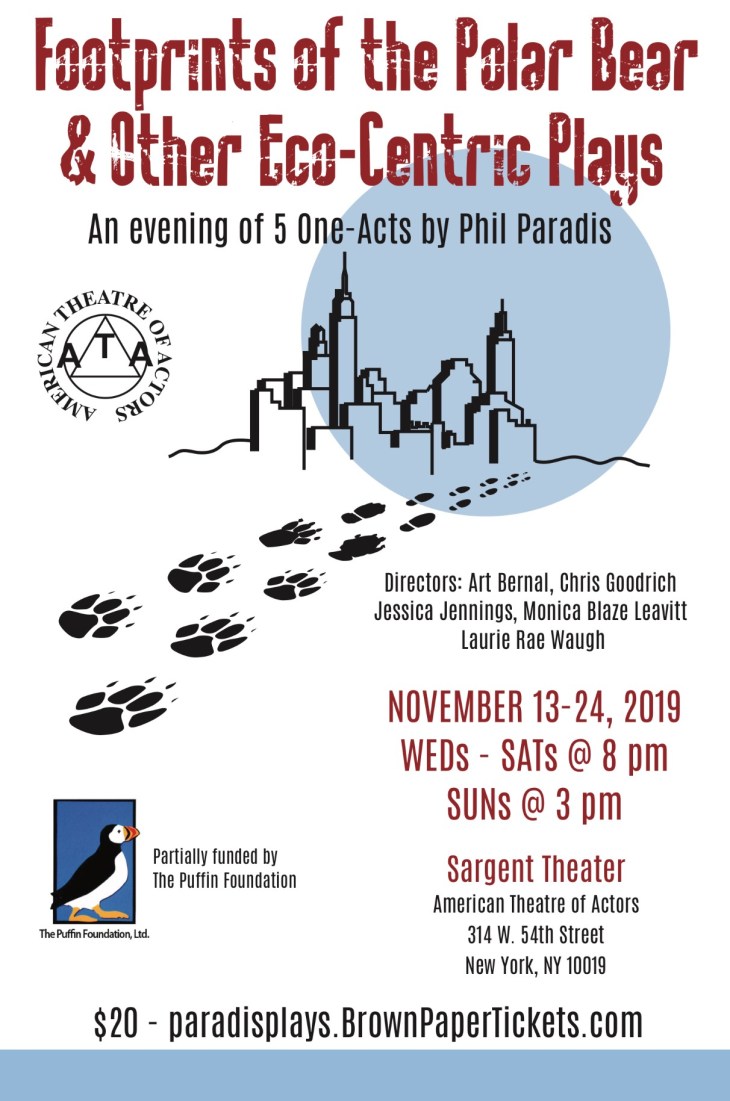
“Footprints of the Polar Bear and Other Eco-Centric Plays” is a festival of one-act plays by acclaimed playwright, Phil Paradis that will run at the legendary American Theatre of Actors, 314 West 54th Street, Fourth Floor. The limited run will be November 13-16 and November 20-23 at 8:00 p.m. with matinees on November 17 & 24 at 3:00 p.m. Tickets are $20 and will be on sale on or before November 1. The event is co-produced by stage and film director, Laurie Rae Waugh
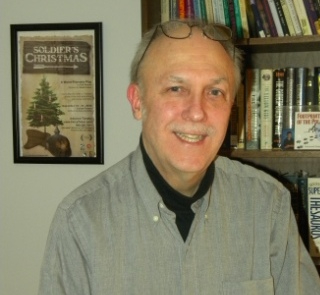 Phil Paradis – a playwright, poet, and professor – compiled a group of works from what’s in the news and on the minds of millions these days–global warming, climate change, environmental degradation.
Footprints …” is a royal flush of clever plays that might make you recycle your thoughts on the climate and the planet.
We wanted to get some thoughts from Mr. Paradis while we still have a biosphere!
Tell us about yourself as an artist
I wrote and published poems for many years — about twenty-five years. During that period, the first ten years I didn’t publish much at all. Then I began having poems appear in periodicals, including Poetry and The American Scholar and College English, and then came three poetry collections: Tornado Alley, From Gobbler’s Knob, and Something of Ourselves. Also during that time I wrote some fiction, nonfiction, and screenplays, and then gradually shifted to one act plays. I’ve been working on plays now for twenty-six or twenty-seven years. The first ten years writing plays I had nothing produced. My luck changed in 2004-5 when I met Athol Fugard in Cincinnati and he encouraged me to write a play with African American characters. I did. Some people got very upset at me. Some thought I was insane to attempt it. But readings of the drama were so well received that I found a director and producer and it was my first produced play.
What was the inspiration to write plays about climate change?
I was inspired by Stephen Crane who had written about homeless men in New York City in 1894. About 2007, I interviewed some homeless men who lived under a bridge in Cincinnati and turned out the men were vets and one in particular a Vietnam vet who was obsessed with global warming and environmental degradation. Ever since reading Thoreau’s Walden, I have been pro-environment but I was fascinated by this destitute man who cared so much. I put my full length play on hold and wrote this one act in 2007 that became Footprints of the Polar Bear. We had a public stage reading of Footprints and Soldiers Christmas in December that year and both were well received. Directed by Arnie Shayne, Footprints went on the win the grand prize for the 2008 Cincinnati Directors Competition and was produced again by Arnie and the Blue Chip Players in 2008. I wrote several short plays for a change as a break from the full-length dramas I had been working on and by 2016 when my futuristic satire Natural Rarities Up for Bid was presented at John Chatterton’s Midtown International Festival, I realized that I had five one acts that focused on global warming, climate change, environmental degradation, and eco-centric concerns. Around that time I met Jessica Jennings and she expressed interest in the plays.
What’s harder… writing a full length or getting the message across in a short play?
I strive to do my best on the short forms too, but full-lengths demand more of my time, and require more research and sustained attention, generally more work as you might expect.
What next for you?
My solo play about The Red Badge of Courage author “Evening With Stephen Crane” is being performed at the Stephen Crane House November 16-17 in Asbury Park, New Jersey, hosted by the Asbury Park Historical Society and The Friends of Stephen Crane. I have completed three full length dramas Soldier’s Christmas, When New York Was Young, and North Country Holiday that I’d like to see staged. And I have a full-length environmental drama in progress, along with a screenplay on the life of Stephen Crane.

Mary Elizabeth Micari: Life in C-Sharp
The Lady in Black 2
Written and performed by Mary Elizabeth Micari
Reviewed by Robert Viagas
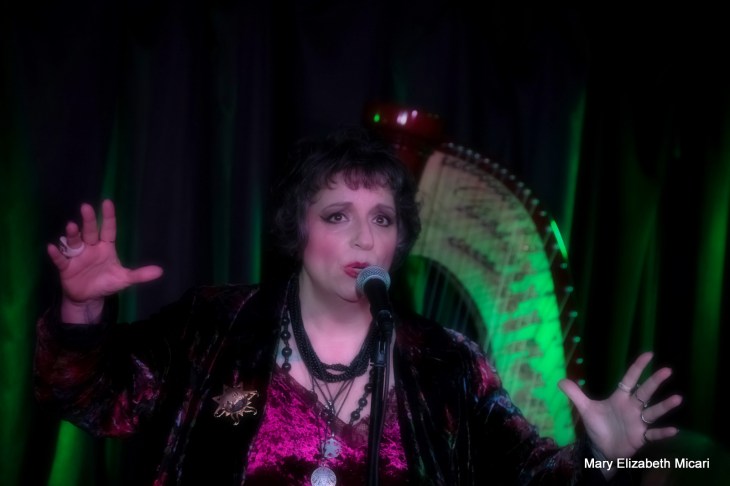
The 1990s were a period of upheaval in the life of performance artist Mary Elizabeth Micari. Her marriage was breaking up and she was discovering her true inner self as a Wiccan—a witch. Helping her through this life crisis were two things: the alt-rock songs of disconnection and angst she heard on the radio, including songs by Alanis Morrissette, Tori Amos, Phil Collins and other nineties mainstays—and her diary.
Micari has combined those two supports into The Lady in Black 2, a cabaret show-cum-confessional that premiered Oct. 26 at Pangea in New York City. She relates breathless (and sometimes breathy) accounts of learning how to cast spells, visiting an upscale witch store on the West Side, watching her marriage erode, and conquering her first Witches Ball, all read directly from the red-bookmarked text of her actual diary. In between these autobiographical sketches, Micari closes her eyes, leans back her head, spreads her fingers on upraised hands, and growls her way through Amos’ “Hey Jupiter,” or Elton John’s “The One,” or Sting’s “Sister Moon.”
 When switching gears in this, her Halloween-timed bildungsroman, Micari cares enough to warn the audience, “Things get a little more serious, guys, buckle up.”
In The Lady in Black 2 Micari confides in the audience like a friend, with stories that are sometimes deep emo, sometime joyful. MAC Award winning musical director Tracy Stark, makes her three-piece band somehow sound like all the most interesting musicians of that musically complex decade.
Seen previously at Pangea in I’m SOOOO High: Rev. Mary’s Reefer Revue, Micari gets down to brass tacks in this latest installment of her autobiographical musical odyssey.
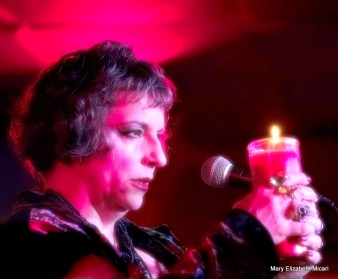 The Lady in Black 2 played a single performance Oct. 26, 2019 at Pangea, the cabaret club at 178 Second Avenue in Manhattan.
All photos by Dan Lane Williams.
http://www.dlwphotographynyc.com/
Robert Viagas and Shelter in Place
Shelter in Place written and directed by Raphael Perahia
Reviewed by Robert Viagas
A quiet, peaceful, relaxing art class turns into an emotional free-for-all in Raphael Perahia’s new comic drama, Shelter in Place, being presented by the Playful Substance program as part of the Off-Off-Broadway FringeBYOV Festival.
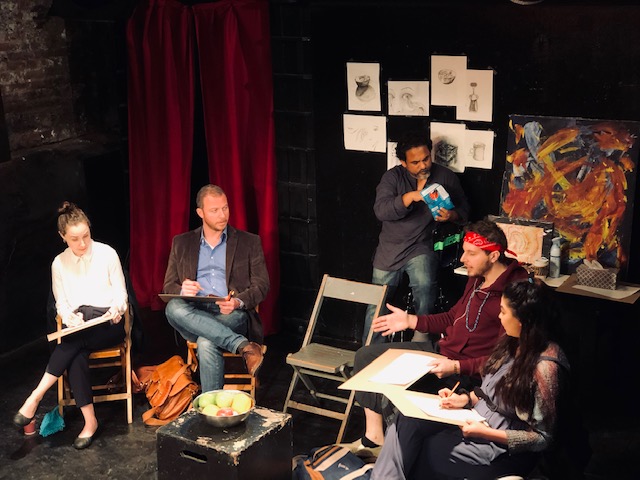
Performed at the 41-seat Under St. Mark’s theatre in the East Village, Shelter in Place shows what happens when the adult students’ carefully composed social masks fall away during an emergency. The school building is on fire and they’ve been advised by the FDNY not to flee, but to “shelter in place” (giving the play its title) at the risk of their lives. The fire is one thing, but what they really need is shelter from one another.
We meet Robert (Dan Kellmer), an macho businessman always ready to litigate personal slights; Jennifer (Megan Greener) a wife deeply conflicted about her marriage; Zeek (Brandon Fox), a funny stoner who gets all his life advice from a New Jersey “shaman” named Victor; Ithaca (Nicole Amaral), a kleptomaniac with parent issues; and, finally, their instructor Jahoose (Rahoul Roy), an art-lover who seems conciliatory and sweet-tempered, but who hides a well of aggression.
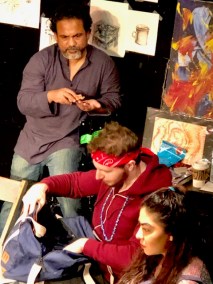 In the panic of the fire, their defenses come down and their true selves are revealed. All manage to survive, but then they have to return to class the following week and find a way to face each other now that all their careful secrets are out in the open. It’s an interesting inquiry into the artificial personas people try to project, and the dangers of having them stripped away.
Writing (and directing) in realistic style, Perahia uses the intended subject of their sketches, a bowl of the fruit at the center of the stage, as they eye of this storm. In general, none of his characters are as sympathetic as they should be for the amount of time we spend with them. Fox’s Zeek is sweetly comic for the most part, and his spacy non-sequiturs provide a lot of the humor in the play. Roy is complex and convincing as the art teacher. But once we absorb each character’s “issue,” they have a tendency to grate. Act I, which includes the fire scene, is clearly the stronger of the two acts, and the play as a whole needs to be brought to a more satisfying conclusion.
This is a greatly expanded and fleshed-out version of a one-act play presented earlier this year as part of Theater for the New City’s Dream Up Festival. One more rewrite should do it.
Shelter in Place is playing a limited run through Nov. 2 at Under St. Marks Off-Off-Broadway.
A satisfying Richard
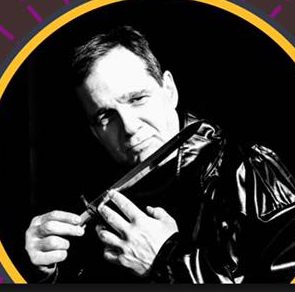
Richard III directed by James Jennings at the American Theatre of Actors
Review by Andre Vauthey
Well-mastered truthful simplicity is the best description of the last production by James Jennings of Richard III that I had the chance to see at the American Theater of Actors. That comes without much surprise for this veteran of Shakespeare and classical plays, whose 5th production of Richard III flows with ease from beginning till the end, three and half hours down the road.
Characters come on and off the stage at a good rhythm, keeping the ball flying without it ever touching the floor. The stage is really simple, with one small bench and two stools, and its mezzanine is well-used, allowing some additional perspectives in time and space, having the actors at times running from behind the audience. Especially at the end, when the battles is at its peak, the stage seems to be just a small
point of pause between the opposing sides before jumping back in the fight left and right from the audience.
James’ choices to have the characters wear up-to-date costumes feels very natural without being modernized, keeping the theme of the play very grounded. Most of the lords are in business suits,
Richard himself is in a leather jacket and the queens and the gentlewomen are in dresses that can pass for quite timeless. The only little critique I could add to this would be a wish that the actors, most of whom played lords in suits, would have embraced this even more fully.
The swords and the rest of the props stayed quite authentic to the play, adding a certain authenticity, which I highly appreciated.
The cast is well-mixed and as range of different techniques, which gives us a diverse flavor of lords and ladyships with a wide range of interpretations. The acting per/se is kept mostly very simple. No
over-acting here, which is of course very nice but maybe too safe.
In general, I believe this is my take on this piece: as much as I appreciate the well-maneuvered
production, its simplicity and its pursuit for truthfulness, I wonder if it was too safe and whether some risks or stronger choices could have been taken.
The role of Richard III is a challenge well-met by Alan Hasnas. The ease with the text and the stage from the start, to the different colors he brought to the character, made his performance enjoyable to watch. The only critique I could have here would be that I missed a certain a flavor of uncertainty and vulnerability from him as well as a better character arc from the beginning, to his fall into
madness.
In general, all the actors’ performances seem to follow the same line of honesty and ease with the text. An interesting performance to be noted, is that of Buckingham (played by Jake Minter), whose acting and physicality brought a nice energy to the stage.
Although no special sound or light effects can be noted here, real drums are used twice and their function and timing are perfect.
All together, I definitely enjoyed this production and am looking forward to future ones, perhaps even with a few more surprises and skips of the heart.

Cat Parker is creating a monster
Currently in fundraising and in pre-production after a wildly successful reading, Articulate Theatre Company’s production of Doctor Frankenstein gears up for a limited run in November. [Watch the trailer]
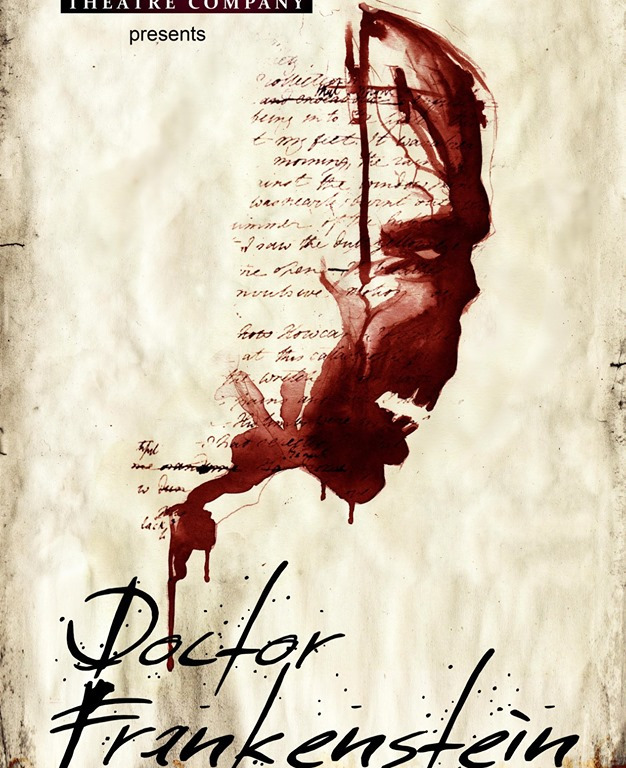
But that’s not all.
Articulate is thrilled to have George Allison’s new play inaugurate their residency at the historic West End Theatre.
But that’s not all.
Articulate joins Prospect Theater Company, The Bang Group, and Hunger & Thirst as one of the resident companies of West End Theatre’s “Consortium,” located on the second floor of the historic Church of St. Paul and St. Andrew (263 W 86th St, New York City). “We are very excited to have a home base from which to continue our work and to have the chance to share energy with the other wonderful companies that call this space home,” said Brittney Venable, Articulate’s managing director. “The stunning architecture is a perfect location for our next production, Doctor Frankenstein, by George Allison.”
But that’s not all.
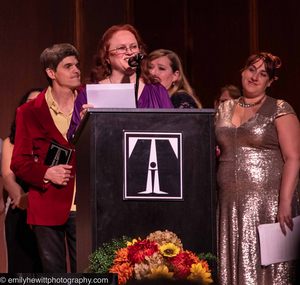
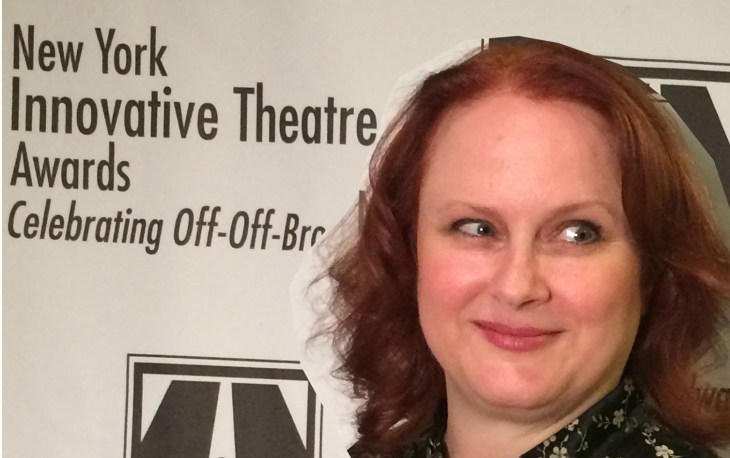
Cat Parker, Articulate’s founding artistic director, was recently made a part of the new leadership of New York Innovative Theatre Foundation. She joins Ariel Estrada, Producing Artistic Director of Leviathan Lab Projects; Jazmyn Arroyo, Co-Founding Artistic Director of Step 1 Theatre Project; and Akia Squiteri, Artistic Director of Rising Sun Performance Company as Directors of the organization. “It is a terrific honor,” said Parker, “I look forward to working with my new partners to support the Indie theatre community by continuing to provide a setting that recognizes the amazing work that we all do, and by advocating for the artistic and social needs of all our artists” she concluded.
Something tells me … there’s more to come.
 Articulate Theatre Company is an ensemble driven company who thrive on being storytellers. Our simple mantra is ‘good stories, told well.’ Guided by the three definitions of articulate, -clarity, structure and connectivity- we are committed to challenging and connecting audiences and artist with clearly structured work that is intelligent, thought-provoking and visually striking. Storytelling is the heart of theatre. And the stories we like to tell involve myth, magic and the mundane: Mythical creatures bringing new perspective to our mundane lives, or typical people doing epic things. Gods, faeries, artists, plumbers, teachers, heroes, villains, accountants, florists – when these elements combine, we see our reality in a new way. Learn more and get tickets at http://bit.ly/ArticulateDF
Before the monster is loose, we wanted to speak with Ms. Parker about all things new and exciting.
How does this [Doctor Frankenstein] fit in to the mission of ATC?
Articulate’s mission is “myth, magic and the mundane.” This play is an excellent example of how good plays use a mythical story to relate to all of us in our daily lives. Mary Shelley’s story of a mad scientist hell-bent of breaking the laws of god and man is so much a part of the zeitgeist that you can say “Frankenstein” anywhere in the world and people will have a reaction to it. The story has been translated, transcribed, adapted, converted to film, plays, comic books, even video games! You’d be hard pressed to find a story more “mythic” than that of Victor Frankenstein and his “creature.” And yet, what is it is all a lie? What if the story millions of people have enjoyed over the years, actually resulted in one man’s erasure from the world? Many of us have experienced someone saying something untrue about us, and in the world of social media, that untruth can spread like wildfire and create it’s own reality, scarring us in the process. I don’t know anyone who has created a monster in their NYC studio apartment, but I do know people who have been hurt by rumors and lies. Many of us can identify with Victor Frankenstein’s frustration at the warping of his reality. The heart of this story is the meeting between the mythic tale of “Frankenstein” and the mundane reality of a person’s life destroyed by casual untruths.
Are you a fan of the genre?
Kind of depends on what genre you mean! I am not a big fan of blood & guts style horror films, but I looooove psychological thrillers. Our “Doctor Frankenstein” definitely fits the latter category. There’s blood and guts, to be sure, but the plot really hinges on the reality behind the madness. And of course, some plot turns you won’t see coming!
Living author … Pros? Cons?
Hah! Well, in this case the living author actually lives with me, so I’ll have to be careful about how I answer this one! Speaking generally, I see this as just a different set of challenges. Dead authors don’t weigh in on every little thing you do, but they also aren’t there to challenge me as an artist. A living author, especially one that lives in your house, definitely ramps up the “challenge” factor! The ‘cons’ of it are what a fellow director in the same situation calls “the 24-hour design meeting.” It’s hard to switch off the discussion, and art (and artists) need quiet time to let ideas percolate. But there are so many ‘pros’ to the working with a playwright that is in the trenches with you. To have them at rehearsals, listening, interpreting, really helps the process to flow, and to make sure that the message I’m putting on a stage is the one they wanted when they wrote it on the page.
What is your creative process as a director and do you find wearing the producer hat as an obstacle or benefit?
Oh boy, that’s two very dense questions to answer. The easy answer to the second question is “yes.” Being a producer/director has it’s good and bad moments. The weakness of being both is that it can undermine the needed tension between the job of the director and the producer – directors need to fight for the story, at all costs; producers need to fight for the story…at a certain cost. lol Sometimes my producer hat can suffocate a good idea, if it’s not held in check. And sometimes my director hat can get away with doing something that was not as critical as once believed. As for my process – oy, well, the basics are reading and re-reading the script, then research, and then back to the script. It’s tempting in a play with historical foundations to try to put that history on the stage, but the bottom line is I’m here to tell George Allison’s story – not Mary Shelley’s, not James Whale’s, not Kenneth Branagh’s; not even Mel Brooks’ version. So, going back to the script is essential.
What do you want the audience to take-away from this show?
I want them to leave with questions and conversation! The play has several little turns to it, and I think there’s room for interpretation of Victor’s plight and the actions he takes to solve it. I would like them to consider that stories have multiple sides. The world we live in now is filled with one-liners, sound bytes, memes and propaganda – which makes the world seem very black and white. But if there’s any one truth in the world, it’s that there is no one truth. We all “knew” how horrible the Wicked Witch of the West was until Gregory Maguire spun Oz on it’s axis and told us the story from another angle. Like Elphable, Victor Frankenstein deserves to have his version of the story heard – and we’re giving him that chance.
What’s next?
Oh, how I wish I could tell you, but I’m sworn to secrecy until November 4th! Here’s a hint though: it involves a place based on the author of “A Confederacy of Dunces.” Keep watch on the Articulate website to hear the details!
Ditko was his own worst [super] villain.
Ditko
Written & Directed by Lenny Schwartz
Reviewed by Robert Viagas
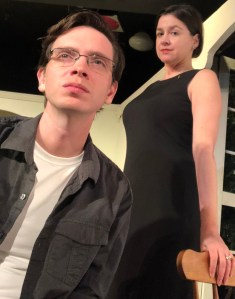
Comic book fans who revere auteurs the likes of Stan Lee and Jack Kirby will be fascinated with Ditko, Lenny Schwartz’s new drama that charts the rise and fall of master illustrator Steve Ditko (1927-2018), co-creator of comics icons The Amazing Spider-Man and Doctor Strange, but who spent his long career in the considerable shadow of Lee, his boss and collaborator at Marvel Comics.
As played with charismatic gusto by Geoff White, the play’s ostensible villain Lee is presented as a whirlwind of mad energy and humor. The scalawag act is very appealing. Unfortunately, Ditko, the supposed main character, is played by Derek Laurendeau as a colossal pill. Lee’s refusal to give him co-creator credit on Spider-Man and other comics irks sourpuss Ditko to no end, and he spends most of the play’s 90 minutes complaining bitterly about it—even when Lee writes an open letter acknowledging Ditko’s work. Because a single word isn’t sufficiently enthusiastic, the ever-scowling Ditko rips it up.
Overlong philosophical dialogue scenes with Ditko’s spiritual mentor, Objectivist author Ayn Rand (Anne Bowman), do little to make Ditko more sympathetic. Though he emotes mightily and reveals enough backstory about the twists and turns in his career to satisfy the fans, the minute his partner/nemesis Lee enters the stage, Ditko sure enough falls right back into Lee’s shade.
Playwright Schwartz deserves credit for nimbly covering huge swaths of time and biography by smoothly changing verb tenses and allowing characters to narrate sections of their own lives. Presented the same week as ComicCon in New York City, Ditko playwright Schwartz wants to rescue a great American pop artist from falling into obscurity, but he picked one with a classically tragical flaw: he, not Lee, was his own worst enemy.
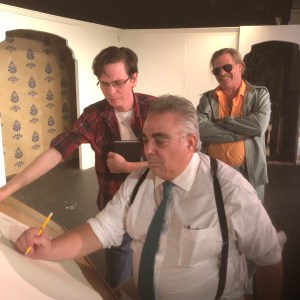 Also featuring performances by Samantha Acampora, Dave Almeida, Anne Bowman, Mindy Britto, Jonah Coppolelli, Timothy DeLisle, Chris Ferreira, Emily Lamarre, Nicholas Tvaroha and Bob Wiacek, Ditko played a limited run through Oct. 2 at Theaterlab in the Hell’s Kitchen section of Manhattan.
Viagas and the Renaissance Man
Henslowe! Or, A Lamentable Complaint
Written and performed by Alexander D[CQ, no period] Carney
Reviewed by Robert Viagas
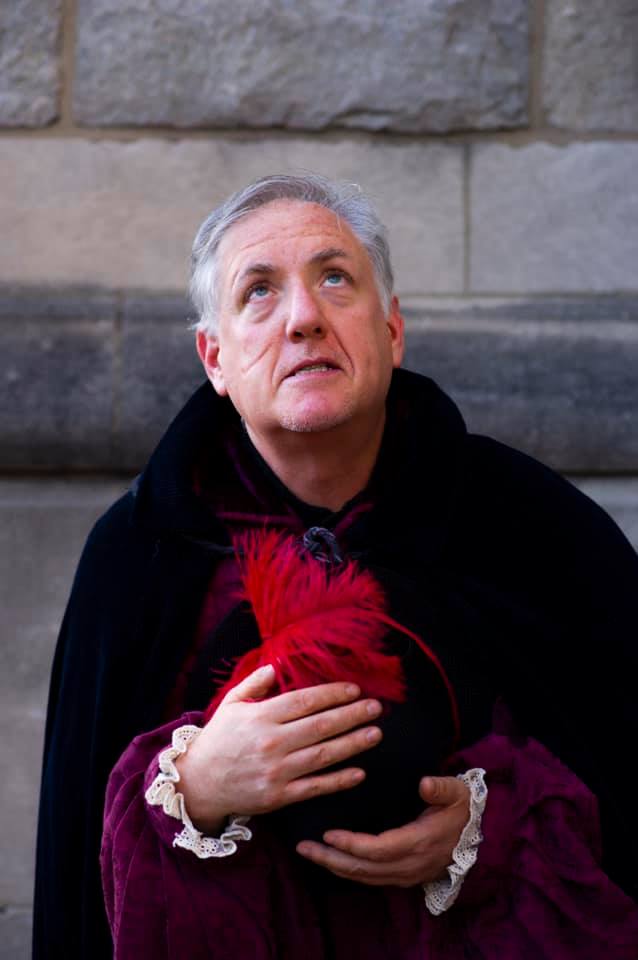
A minor personage who had a major effect on the life of William Shakespeare is ushered out of the shadows of history into the spotlight in Henslowe! Or, A Lamentable Complaint. Alexander D Carney’s solo play introduces Phillip Henslowe, the man who built London’s Rose Playhouse where Shakespeare’s plays were first mounted, and who claims vaingloriously to have discovered the budding Bard.
Author/star Carney spends most of the 75-minute monologue describing his loves (especially good writing and full houses) and his hates (actors who don’t pay back his generous loans). He erupts with frustration at the fact that the “upstart” Shakespeare will be remembered forever, but he, Henslowe, who createsd the financial underpinning of Shakespeare’s success, will only be remembered, if he is remembered at all, as a minor supporting character. Carney wants to change that.
Carney, who states in a program note that he’s been working on the play for twelve years, tries to give his meandering and sometimes repetitive narrative some shape by having Henslowe rehearse what is essentially a 16th century backers’ audition, in which he pleads to an imagined audience of moneyed gentry for the shillings and pounds he needs, not only to mount his “greatest discovery”—Christopher Marlowe’s The Jew of Malta—but to give the dilapidated but beloved Rose Theatre itself a desperately needed refurbishment. Henslowe! is based in part on the manager’s original financial ledger, which chronicled all the people he lent money to, including many of the leading literary lights of the times—and the many did and never paid him back. The tattered ledger, which he nicknames A Lamentable Complaint, lends its sobriquet to the play’s subtitle.
Carney’s acting sometimes strains the limits of the super-intimate real-life Off-Off-Broadway venue Torn Page Theatre (located in the onetime home of late actors Rip Torn and Geraldine Page) in which he performs Henslowe! Carney often appears to be pushing his voice and gesture to the back of a balcony that isn’t there. But there is a moment where he asks whether the subject matter isn’t worth a dose of bombast. In that moment the actor and the character become one.
The dilapidated Rose Theatre itself, which the “ingrate” Shakespeare leaves behind for the greener pastures of Burbage’s Globe, is no mere building to Henslowe. The Rose is his most prized property (along with his bear-baiting pit and his brothel). With the loving way he speaks about it and to it, you can see that the Rose also is his obsession, his muse, his mistress—and, ultimately, his co-star in this play. Henslowe makes a case that he may lack the divine fire of a writer or actor, but even a hard-nosed businessman like himself can sometimes rise to the level of an artist by dint of his nurturing great writers and especially great plays. He argues passionately for metaphorically adding his initials to The Jew of Malta, Shakespeare’s Henry VI and other plays. With Henslowe!, Carney transforms a theatrical footnote into true tale of sound and fury.
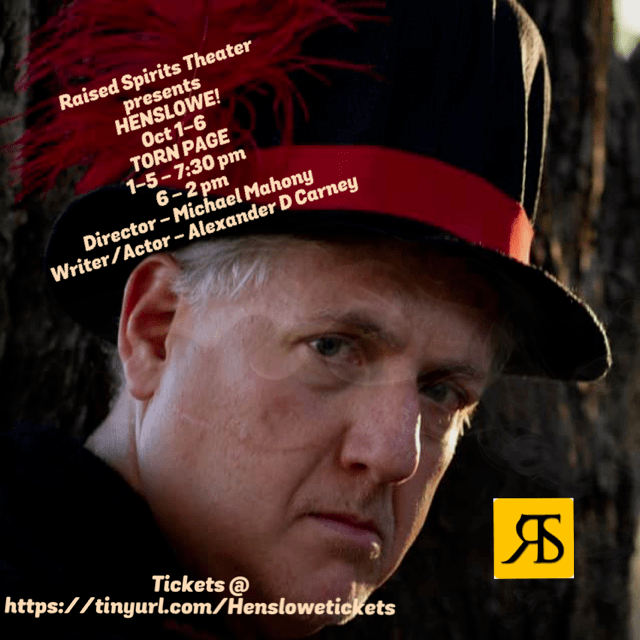
Presented by Raised Spirits Theater and directed by Michael Mahoney, Henslowe! is playing a limited run through Oct. 6 at the 25-seat Torn Page Theatre in the Chelsea section of Manhattan.
Carney on Henslowe: The Producer’s The Thing!

Alexander Carney’s new play, HENSLOWE! will have its world premiere at Torn Page – the historic home of Geraldine Page and Rip Torn – located at 435 West 22nd Street, NYC. Performing October 1 -5 at 7:30 p.m. and October 6 at 2:00 p.m. $20 suggested donation. Reservations at https://www.eventbrite.com/e/henslowe-tickets-69820114843?aff=ebdssbdestsearch
HENSLOWE! Tells the story of Phillip Henslowe, the Elizabethan entrepreneur who built the Rose Playhouse – where Shakespeare’s early plays were first performed.
Henslowe struggled to find meaning and recognition in life. Alexander Carney’s fascinating depiction of REAL life in the days of the great masters like Shakespeare, Jonson, Marlowe, and Kyd. Be prepared to rethink the renaissance. This remarkable in-depth portrait of a deeply driven man had an astonishing 14-year gestation filled with readings, workshops, and endless hours of research. One might say that Carney is as driven as Henslowe!
Mr. Carney also used Henslowe! as a major jumping off point of his theatre company, Raised Spirits Theater, which creates theater “by, for and with ALL sorts of people” with a focus on the classics. Thus far, RST staged Shakespeare’s Macbeth; a radio drama version of Coriolanus; and a workshop where A Midsummer Night’s Dream was explored. Now RST is producing its first original piece, HENSLOWE!
Donations to RST help open the door to the classics – new and rare – in ways not-yet-seen. Donations an be made at the following link: https://fundraising.fracturedatlas.org/raised-spirits-theater?fbclid=IwAR2ygZAHeScVZTHTgnfgYVav9cDg-QX-WK2bN1oa2koIqcTA1jeWC5vjBhg. Checks can be made payable to Raised Spirits Theater c/o Alexander D Carney and sent to 35-13 31st Avenue #2-2, New York, NY 11106 (Checks should be made payable to Fractured Atlas, with Raised Spirits Theater in the memo line.)
Ai wanted to check-in with the impresario, Mr. Carney, about the impresario, Mr. henslowe
Tell us about yourself as an artist
I’ve been involved in making live theater for my entire life. I graduated from NYC’s High School of the Performing Arts Drama Department, was at SUNY/Purchase in the Acting Conservatory, worked off-Broadway in rotating rep with such stars as Geraldine Page, F. Murray Abraham, Tovah Feldshuh, and Michael Moriarty. From there, I worked regional theater for a long time, with a special love for the classics. I’ve had the chance to play Macbeth, Caliban, Claudius, and Benedick; opportunities I’m very grateful for. I come most alive when working with material from the Elizabethan era. I’m not sure why that is but it’s always been that way. Perhaps it’s because my father was an actor and my earliest memories of him are him reading me Shakespeare in bed so I would sleep.
What drew you to Henslowe – the man that is
I was first drawn to the fact that he’s a cold man. I love that. He’s punctilious in his business dealings and in documenting his day to day life. That shows me he cared about what he was doing. As I got further into him through research, I found out what he loved. If you read his letters to his daughter and wife you realize how much this cold man who held the world accountable for what it owed him (in addition to being a playhouse owner he was a moneylender and brothel owner) loved these two people. You can feel the heat of his caring. I respect that. The contradiction of it makes for great theater.
What surprises did you encounter – in your research; in your writing ; in performing it?
What I said above about his coldness and warmth surprised me in the research. In the writing process I was continuously surprised by what came out on the page. That’s my favorite part of writing. In performing, I am amazed at how much feeling it takes to sustain this cold, hard man. I’ve fallen in love with him even more.
What are the challenges of starring in the play you wrote?
As in any one person piece, stamina. Perspective is an issue but I have a tremendous partner in my director, Michael Mahony whom I trust completely.
Why should we care about Philip Henslowe?
We’re all a mixed bag. We are all cold and hot. We love, hate —- and we ALL want to leave a legacy. That’s human. That’s what this play exposes in Phillip Henslowe, that need, that fear of being forgotten, that lives in all of us. The audience will understand this need because they feel it too.
What’s next for you?
Two days off. Then working on the website and publicity materials in anticipation of booking the tour. I am also writing a four hander that intrigues me; I’ve suspended work on that while HENSLOWE! Is in its birth process. I’m looking forward to getting back to it. Plus auditioning as much as I can; I’d love to do something where someone else was in charge.
Acting, Singing, Dancing, Scratching
 Starting From Scratch
by the members of the From Scratch company
Reviewed by Robert Viagas
A new multidisciplinary performing arts company calling itself From Scratch lifted off September 14 with a starburst of ambitious creativity. The inaugural gala showcase, titled Starting From Scratch, rolled out twenty-six original drama, dance, song and instrumental segments at the Ballet Arts Studio at Manhattan’s City Center.
Overseen by artistic director Robert Liebowitz, the twenty original company members performed the work of eight writers.
Among highlights:
- Gritty life among New York’s struggling class amid the dangers and discomforts of the public transportation system was turned into an exuberant ensemble dance in “The Subway at Night,” staged by company choreographer Albena Kervanbashieva.
- Kervanbashieva herself took to the boards to demonstrate From Scratch’s social consciousness with “Rhino, White Rhino,” in which a member of the endangered species fled from, then triumphed over, ruthless hunters.
- The generation gap was dramatized in Liebowitz’s playlet “Seven Scenes of Grande Grande Blah Blah Blah,” in which an older man (Jerry Lewkowitz) came into conflict withyoung woman (Weronika H. Wozniak) over coffee while a sardonic barista (Zack Rickert) headed toward a breakdown.
- “Queen of the Day,” a madrigal by D. Sanborn III, was sung and danced by Walter Dortch, Monique Romero, Jordan Davis and Samantha Randolph, as choreographed by Davis.
- Composer Tim Horace offered an elegy for the loss of a child in his instrumental “Murmurs of the Innocents.”
- Although the work of eight different composers were featured in the program, Starting From Scratch provided a special showcase for company musical director Stephen Cornine, who also served as composer, arranger, and pianist for the evening. Among his nine compositions s were the duet “Roses Bloom,” “Brand New,” and no fewer than three holiday tunes, “Christmas Coming Soon,” “On A Midwinter’s Day” and “Aftermas.”
For the record, other performers in the original multi-disciplinary multi-ethnic company include, Daniel Dunlow, Izzy Durakovic, Michael Durso, Charlotte Hagstrom, Helen Jiexin Cai, Valerie Johnson, Jordan McCallister, Teddy Montuori, Donna Morales, Alehia Renee, Michael Romeo Ruocco, Nana Tatebayaski.
Starting From Scratch played a single performance September 14 at the City Center in Manhattan. As for the future, the company is lining up a 2019-2020 season that includes Cornine’s Mirror Mirror, Liebowitz’s Last Night I Dreamed of Paul McCartney, and Martin Goldberg’s Tumble Blindly.
Robert Viagas says Yokko is EN-chanting
En – choreographed by Yoshiko Usami and company
Reviewed by Robert Viagas
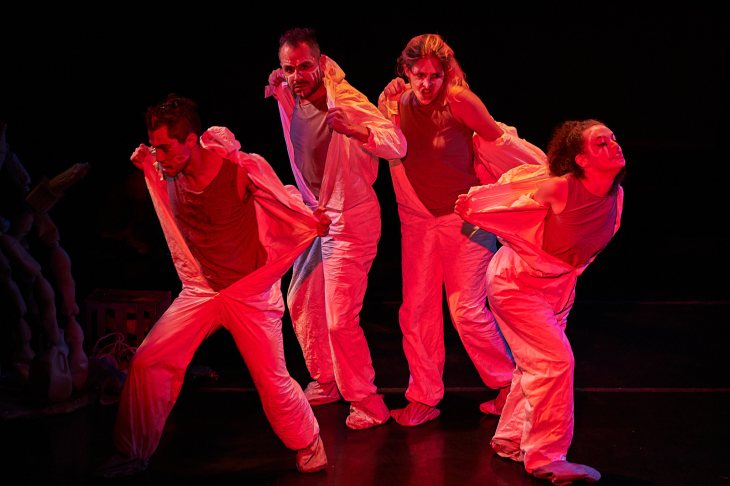 Deep emotional connections between people and nature, between people and the creatures of the earth, and between people and other people, are embodied in the Japanese concept of “en.” Japanese-American performance artist Yoshiko Usami (a.k.a. Yokko) explores those connections in her new Butoh-style dance/movement piece, also titled En.
Presented by the Ren Gyo Soh theatre group at the Triskelion Arts Center, Enshowcases Yokko and four other dancers beautifully imitating the movements of the natural world in more or less presentational ways, all expressed through the languid, deliberate movements of Butoh.
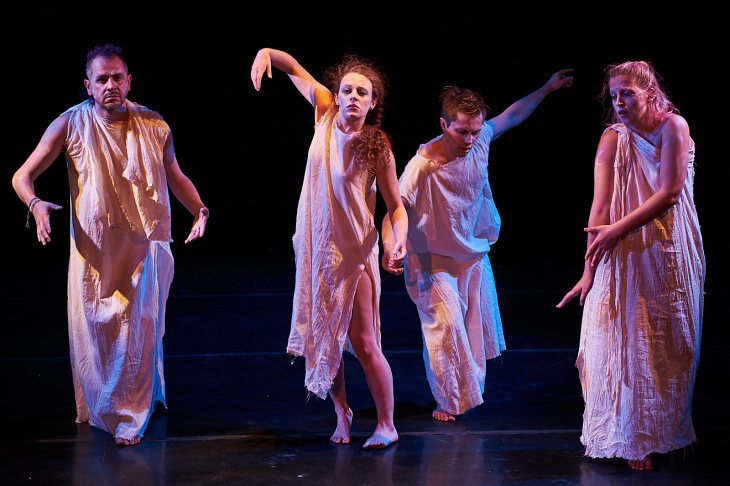 The opening segment is also one of the most successful and evocative. The five company members suggest the movements of tropical fish, feeding, chasing, exploring, mating. Costume designer Deepsikha Chatterjee adds a layer of environmental commentary by creating their fins and gills out of plastic bottles, egg cartons, product boxes and other detritus with which mankind has littered the ocean. He seems to ask, are these creatures enmeshed in the trash, or has the trash actually become part of them?
Though much of the rest of the performance is abstract, it seems to follow an arc from the ocean to the land, to the bustle of the human world. As a company they play on a beach like children in one of the more lighthearted moments, but also writhe with their heads trapped in cages in one of the darker segments.
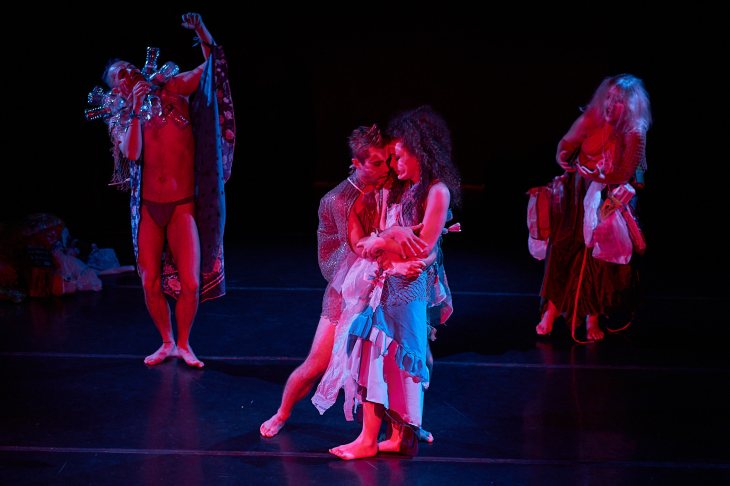 Each of the dancers take moments to shine in solo passages they choreographed themselves. Petite and fierce Annie McCoy is frequently highlighted, at one point struggling on her back like a turtle or chick hatching from an egg, and at another point recreating the quivering pangs of childbirth.
Miles Butler provides a transition from the sea to the beach in a remarkable sequence where he sheds his fins and staggers onto a beach, like Adam in Eden, only to be swept up into a kind of factory where he loses his individuality.
Efrén Olson-Sánchez and Laura Aristovulos evolve through a variety of roles including teeth-gnashing wild animals, ghosts, and beings who struggle clumsily to stand but then suddenly acquire fluid grace. The show benefits from the occasional majestic appearance of Yokko herself, covered in ethereal white makeup, like a spirit of the earth.
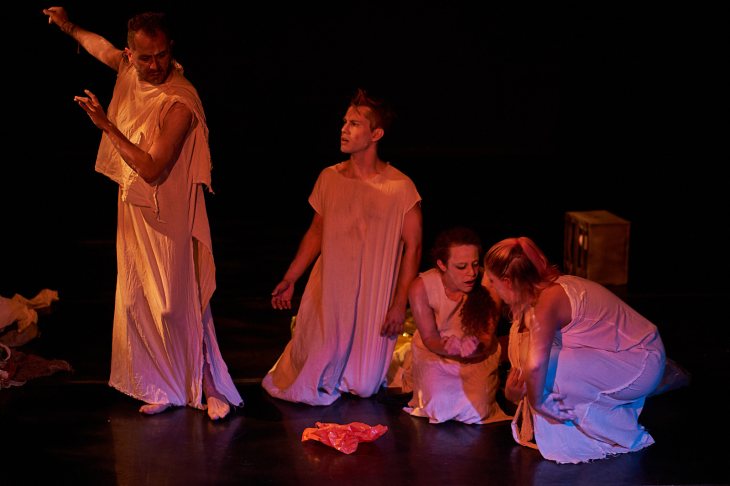 All of this is performed with the deliberate slowness of Butoh. The evening would benefit from an occasional andante or allegro passage to set off the rest.
Lighting designer Rachel Zimmerman creates dark recesses on the open stage from which the dancers gradually emerge and to which they gradually return. Sound designers Alyssa L. Jackson and Jorge Olivo help suggest the piece’s various physical environments through the sounds of water bubbling, rocks clattering, waves breaking, machinery clanking, airplanes zooming overhead, and occasional evocative music.
In the end, the company seems to return to the sea, gazing out over the audience, as if surveying both the beauty and ugliness what man has wrought.
En played a limited run September 13-15 at the Triskelion Arts, 106 Calyer Street, Brooklyn.
Latest Posts
-
Jim Catapano reviews Anne L. Thompson-Scretching’s Home Is Sweet Sorrow: “A Masterful Conclusion to a Momentous Family Saga”
The War That Never Ends Home Is Sweet Sorrow is a must-see and a devastatingly powerful third chapter in the Blood trilogy, which also includes…
-

THE BARD TAKES BROADWAY: SIXTH ANNUAL NEW YORK SHAKESPEARE AWARDS CELEBRATES RECORD-BREAKING 2025 SEASON
THE BARD TAKES BROADWAY: SIXTH ANNUAL NEW YORK SHAKESPEARE AWARDS CELEBRATES RECORD-BREAKING 2025 SEASON The New York Shakespeare Awards has officially unveiled its list of…
-

American Theatre of Actors Announces 50th Anniversary Gala; Playwright LYLE KESSLER and TONY-winning actor, LEN CARIOU to Receive Lifetime Achievement Honors.
NEW YORK, NY — The American Theatre of Actors (ATA), a cornerstone of the New York theatrical landscape since 1976, is proud to announce ATA 50, a…
-

Music Among the Tumbleweeds: Jim Catapano reviews James Jennings’ New Dancing in the Meadow.
James Jennings’ New Dancing in the Meadow Brings Feel Good Vibes to the ATA James Jennings, legendary Founder of the American Theatre of Actors, brings…
 Arts Independent