

ELEGIES FOR ANGELS, PUNKS AND RAGING QUEENS benefitting Broadway Cares/Equity Fights AIDS, presented December 1
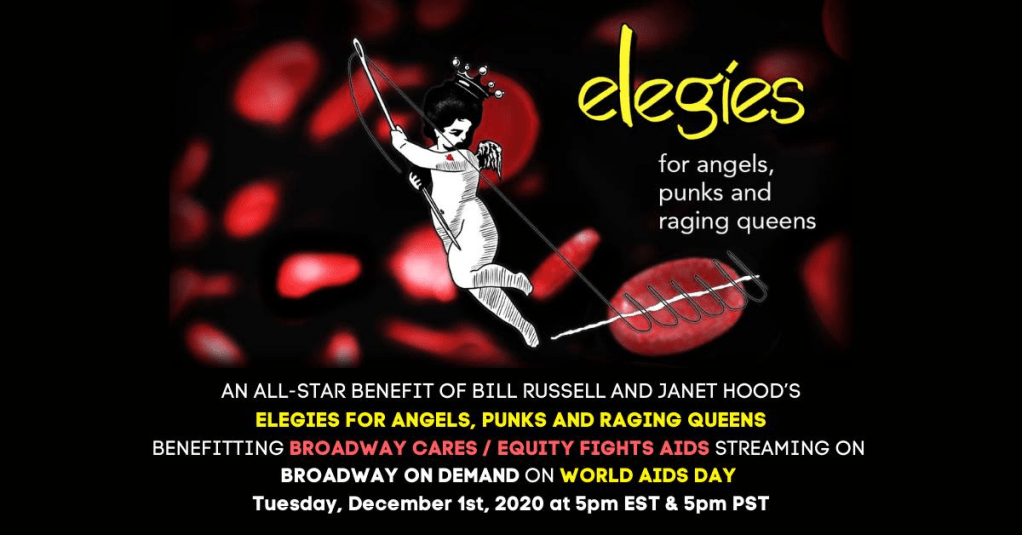
More Broadway, television and film stars have been added to the celebrated series of songs and monologues Elegies for Angels, Punks and Raging Queens, set to stream on World AIDS Day – Tuesday, December 1, 2020. The virtual production, featuring 51 performers, will benefit Broadway Cares/Equity Fights AIDS.
Elegies for Angels, Punks and Raging Queens honors the lives lost to AIDS through free-verse monologues with a blues, jazz and rock score.
The newest additions to the stream include Paul Castree (Disaster!), Richard Chamberlain (TV’s The Thorn Birds), Charity Angél Dawson (Waitress), Fran Drescher (TV’s The Nanny), J. Harrison Ghee (Kinky Boots), Gideon Glick (To Kill a Mockingbird), Lisa Howard (It Shoulda Been You), James Monroe Iglehart (Aladdin), Cherry Jones (The Glass Menagerie), Francis Jue (Cambodian Rock Band, TV’s Madam Secretary), Vicki Lewis (Anastasia), Telly Leung (Aladdin), Stanley Wayne Mathis (Nice Work If You Can Get It), Eric William Morris (King Kong), Michael Notardonato (Romeo & Bernadette), Okieriete Onaodowan (Hamilton, TV’s Station 19), Kirsten Scott (Rock of Ages), Matthew Scott (An American in Paris), Michael James Scott (Aladdin), Evan Todd (Beautiful: The Carole King Musical), Mariand Torres (Wicked) and Michael Xavier (Sunset Boulevard).
There also will be special appearances by longtime Broadway Cares/Equity Fights AIDS friends Danny Burstein, Judith Light, Billy Porter (who’s also a member of the Broadway Cares Board of Trustees) and Michael Urie.
They join the previously announced lineup of Brooks Ashmanskas (The Prom), Laura Bell Bundy (Legally Blonde), Robin de Jesús (The Boys in the Band), Stephanie Gibson (Charlie and the Chocolate Factory), Lana Gordon (Chicago), Alan H. Green (Charlie and the Chocolate Factory), Lena Hall (Hedwig and the Angry Inch), Tony winner Jayne Houdyshell (The Music Man), Famke Janssen (X-Men), Jay Armstrong Johnson (The Phantom of the Opera), Joaquina Kalukango (Slave Play), Tari Kelly (Groundhog Day), Nathan Lane (The Producers), Norm Lewis (Once on This Island), Alyse Alan Louis (Amélie), Andrea Macasaet (Six the Musical), Kevin McHale (TV’s Glee), Varla Jean Merman (Chicago), Jessie Mueller (Carousel), Cynthia Nixon (Sex and the City), Royina Patel , Anthony Rapp (Rent), Krysta Rodriguez (Spring Awakening), SiriusXM host Seth Rudetsky , JK Simmons (Whiplash, TV’s Law & Order), Robin Lord Taylor (TV’s Gotham), Alysha Umphress (On the Town), Anna Uzele (Six the Musical) and Marisha Wallace (West End’s Dreamgirls).
Watch the free stream at broadwaycares.org/elegies beginning at 5 pm Eastern on World AIDS Day, December 1. The stream also will premiere at 5 pm and 8 pm Eastern on Broadway on Demand. The show will be available through Saturday, December 5.
Created in the face of one pandemic and revived in another, Elegies for Angels, Punks and Raging Queens features a book and lyrics by Bill Russell and music by Janet Hood . It premiered in 1989 as the AIDS crisis ravaged the country. Each monologue is written from the perspective of a character who died from AIDS. The songs represent the feelings of friends and family members dealing with the loss. It’s a show where “joy and hope and love seeps from its every pore,” as one reviewed noted. This stirring piece of theater history, shared this year on World AIDS Day, takes on new meaning amid the coronavirus pandemic.
The streaming of Elegies for Angels, Punks and Raging Queens is being directed by Bill Russell and Justin Ross Cohen and produced by Jim Kierstead and Broadway Virtual, Jim Head, Sainty & Eric Nelsen, Rusty & Molly Reid, The Worx Productions LTD, Linda Karn, Daniel Mitura/Jill Steinberg, Ann Moore/Jane Furse, and Justin Ross Cohen, in association with The Abingdon Theatre Company (Chad Austin, Artistic Director).
The stream is free and donations will be accepted for Broadway Cares/Equity Fights AIDS at broadwaycares.org/elegies2020. Every dollar donated will help those across the country affected by HIV/AIDS, COVID-19 and other critical illnesses receive healthy meals, lifesaving medication, emergency financial assistance, housing, counseling and more. The donations also support and champion organizations focused on social justice and anti-racism.
Center of GRAVITY
Return with us to the wondrous days of Famous Monsters, the science vs. fiction of Omni and Starlog, the satirical humor of Mad Magazine, and the brilliant short stories of the legendary pulp magazines.
Gravity City Digital Magazine — a stunning amalgam of these great periodicals will burst upon the genre by Halloween!
Filled with Mad Magazine lampoon-style ads and spoof gadgets and products, the magazine — aside from its humor — serves as a platform for emerging authors of science fiction, fantasy, and Horror, as well as illuminating interviews and articles about new films, books, and other genre events.
Gravity City is a media partner with Phoenix FearCon Online. FearCon will run until December 31. Gravity City will provide coverage of the film festival’s events. Gravity City is also offering Issues 1 & 2 (now out of print) to all ticket buyers of Phoenix FearCon (https://phoenixfearcon.festivee.com/)
Joining Artie Cabrera and editorial collaborator Christopher J. Valin is Margarita Mendoza, a veteran of marketing and advertising, and Jay Michaels, a prominent personality in the genre community as well as producer and host of In the PassionPit, an ongoing podcast, and video program that spotlights indie artists and their creations — just like Artie and Gravity City — as well as appearances at PhantasmCon, Boston Sci-Fi, and others.
Margarita Mendoza has already begun spearheading a far-reaching marketing campaign and soliciting [real] advertising while Jay Michaels is the communications director.


The Third Issue of Gravity City Digital Magazine is currently in production and it features exclusive interviews with Star Trek: Discovery writers Bo Yeon Kim and Erika Lippoldt, as well as television writer Larry Brody (The Six Million Dollar Man, Hawaii 5–0, Automan, Todd McFarlane’s Spawn animated series (HBO) conducted and written by Christopher J. Valin.
Also — Gravity City Digital Magazine is more than a magazine and an adjoining website. It endeavors to act as a compendium for the Gravity City fictional universe it’s based on. Readers and fans have dubbed Gravity City as Star Wars meets the best of ’70s crime dramas.
Synopsis: “In the far reaches of space, the celestial body known as Nebuna is the home to a metropolis with a bad attitude and an expansive wasteland filled with legends and mystery. The tales you are about to read will give you an unflinching ride through the crime-infested gutters and corruption of GRAVITY CITY and the wondrous world that lies beyond city limits,” expounds Artie Cabrera, founder, and publisher of the magazine and creator of the universe and website.
“Gravity City is filled with dark stories, Noir stories, science fiction stories, gumshoe stories, war stories, alien stories, and smuggler stories. In this city, imagination is bursting at the seams, the sky’s the limit and the tales to tell here are numerous and filled with variety.” — an Amazon review.
A series of Gravity City novels written by Artie Cabrera and Christopher J. Valin will be released sometime in 2021.
Ai had a chance to chat with Artie about his far-flung creation.
Tell us about you as an artist?
I was fortunate to have grown up in the era that I did and with a family who were so vastly different from one another that we basically had a wealth of music, movies, and literature lying around the house. I witnessed the golden age of Spielberg and Lucas, Kenner, Hasbro, and Mattel toys, sugary, neon-dyed cereal, and Saturday Morning Cartoons in real time. There wasn’t any shortage of inspiration for me because we were a three-generation home, so I had access to a myriad of content spanning back to the 40s and 50s. A lot of it I consumed by sneaking off into the bathroom with magazines or books I perceived to be off-limits to me – i.e. Playboy, Robert Crumb and Ralph Bakshi pictures, LIFE magazine, National Geographic, and various lifestyle or Pulp periodicals. Sometimes I feel like I was raised by the strangest menagerie of characters. I owe most of my earliest impressions to Tony Montana, Bruce Lee, Prince, and G.I. Joe. All that brought me here to this point today, and is essentially the well that I draw from for Gravity City.
Why a Magazine and Book Series?
The magazine was a happy accident and a way to promote the various elements and the Gravity City novels. Initially, I think it was only intended to be a twenty-five page compendium to go with our website or Facebook group. But I eventually had different plans, and I lost many nights staying awake brainstorming ideas and concepts for what I wanted the magazine to look like and represent. With a magazine, I felt like we could do so much more and just go wild. We’re not where I want to be aesthetically-speaking yet but the ideas are there, and they’ll continuously evolve.
How do you find artists and writers?
I wish the process was a lot simpler and fluid, but I’ll spend days sifting through artist-based sites, like Artstation, Adobe’s Behance, sometimes Pinterest. Sometimes I’ll see something on Facebook and set it aside. When I find something I think is suitable for the magazine—in that I mean, if the imagery is telling me a story or is so striking that it leaps off the page, and is within the tone of our magazine—I’ll reach out to the artist and ask them if the image is available to be featured. Most of them are gracious and are generous with their work and will give us their blessings.
Were you an avid Sci-Fi reader when you were younger?
As I mentioned earlier, there was an abundance of reading and visual materials in our home. Sadly, reading wasn’t what I gravitated to as much as I did when it came to visuals and music. Out of the three, music won out and I became an active musician for roughly twenty-five years. It wasn’t really until 2010 where I changed course and put my focus on writing. Even then, I still feel a stronger tug towards the visual realm. That hasn’t changed.
What makes Gravity City different or special?
Gravity City was born out of my need to approach science fiction in a way that was palatable for me. That’s not me saying that I attempted to fix science fiction or that science fiction was lacking in any shape or form. God knows that I’m not qualified to revise any genre. I’m quite envious of writers who are disciplined enough to sit down, be prolific, and write multiple books in a year. I’m not sure if that is part of my genetic makeup. But what I saw happening was that the hard science trend was permeating science fiction mainstream literature and there was a focal shift towards machine learning, artificial intelligence, time travel, and how potatoes grew on Mars. I guess it gained enough traction that it felt like storytellers were suddenly more conscious and inclined to be super-accurate and grounded in their stories than just going at it all willy-nilly. Which is all fine by me, but I don’t always need to know how the sausage is made. I can suspend my belief with most entertainment because I’m there to be entertained and not to read a thesis on time dilation or quantum theory. I don’t have a shot in competing in that arena. And I sure as hell am not going to write something that is going to hold a candle against someone who actually knows what they’re talking about and have studied a subject their entire career. So, I ran in the other direction, to the ridiculous and quirky side of things.
I naturally asked myself all the necessary questions to get me going and writing science fiction. What did I like? What do I want to see? What will I tolerate writing for the next ten years? I came to the conclusion that I was a fan of Martin Scorsese and Brian De Palma films and space opera. I knew more about mob movies than I did science fiction, but I loved space opera, and so out of that, Gravity City was born. I gave it the tagline – Star Wars meets Taxi Driver because people like taglines, apparently. They’re easier to digest, I suppose.
Now, if you’re thinking cyberpunk or Blade Runner, it’s not really that, either. I think of it in terms of taking all the classic, gritty police, crime, and urban dramas and applying them to sci-fi. I will venture and say that it is an aspect I don’t often find in science fiction these days. Maybe I’m just not looking hard enough.
Who is your audience?
Hopefully, fans of science fiction and humor. I tend to get along with smartasses and goofballs, so maybe that’s our audience, I’m not sure. On a personal level, I don’t know where I’d be today if I couldn’t laugh my way out of tough spots, so I’d love to share a laugh with like-minded people who can embrace the silliness of life. If we can provide them with a good time with our magazine, that’s all I can ask for.
What’s your ultimate goal?
I think most artists’ goals are to see their creations come to life one way or another and see how others respond or are affected by their work. Personally, I’d love to hold a Gravity City action figure in my hand, maybe write a script and see our characters in motion on the big screen. But overall, it’s just to really deliver big, quality work that will resonate with the sci-fi community.
What’s next?
Issue 3 of the Gravity City magazine will be out before Christmas, and 2021 will see more of Gravity City in three novels that I have written with my collaborator Christopher Valin. Then maybe we’ll finally get those action figures.
Visit https://www.gravitycitynews.com/ for more details
Stage Artists to Screen: Madcap Mystery Mansion
Review by Evan Meena
So imagine if the Three Stooges got really stoned with HP Lovecraft and Maurice Sendak and then asked Sam Raimi to film the whole thing?
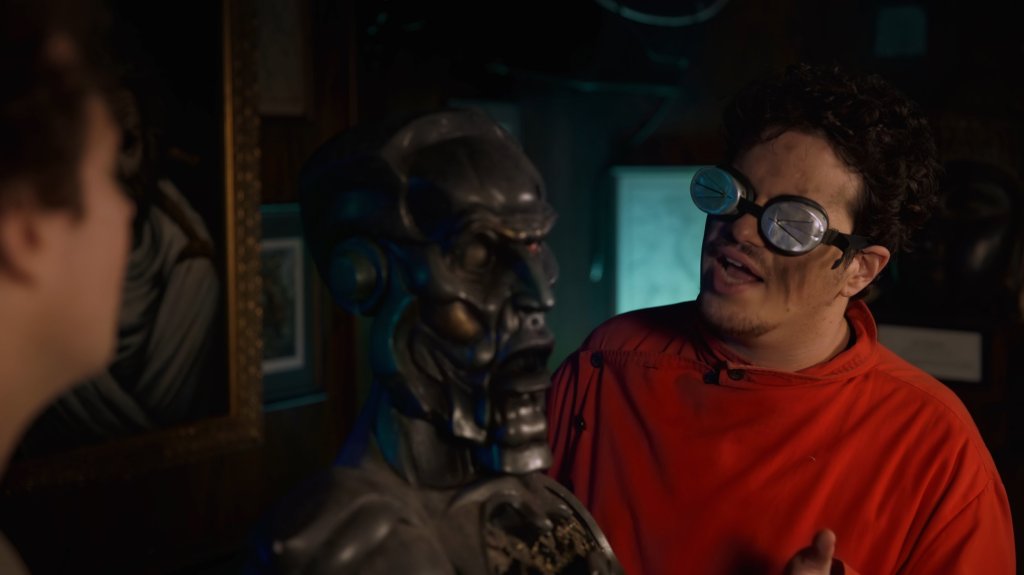
Mystery Mansion, the brainchild of three stand-up comics (and horror film lovers), Mike Handelman, Isaiah Mueller, and Hunter West, is now alive and screaming online on YouTube and on the Phoenix FearCon Film Festival site.
The premise is simple and familiar, an ancient portal leading to an unimaginable underworld of chaos and darkness must be guarded. Of course, and by some logic that seems to be prevalent in so many comedic horror movies, this portal is placed in a haunted house and guarded by three idiots.
Before you switch channels exclaiming that you’ve seen it all before, Mystery Mansion distinctifies itself with clever writing, top-notch special effects depicting an ’80s feel, and, dare I say it, some very good acting.
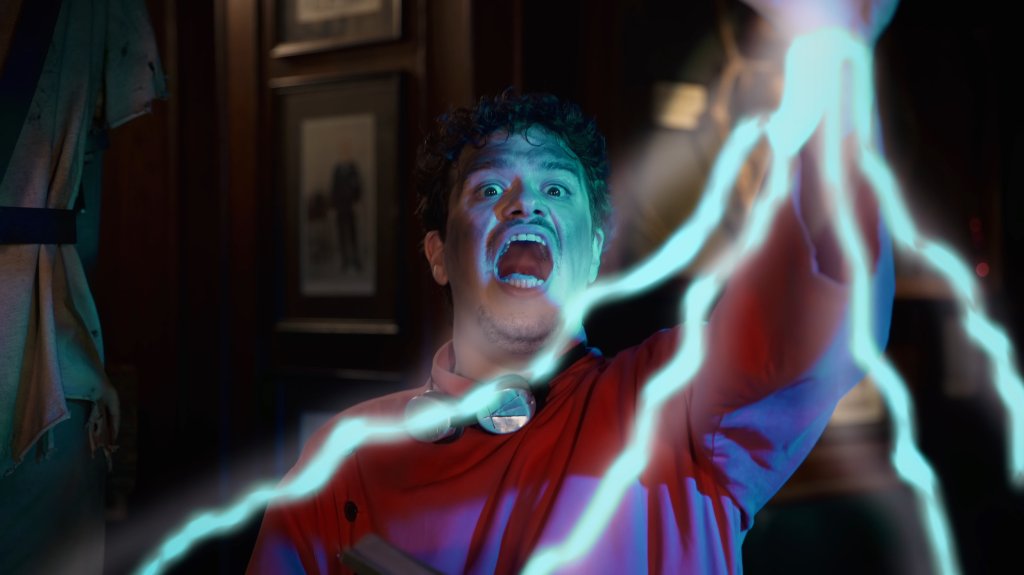
Mike Handelman, the “Moe” of these stooges, affects an old Hollywood actor twang in his voice that’s a perfect counterpoint to his ever frustrated countenance. Handelman is like that pair of symbols in a marching band whose presence always comes with immense high energy and fun;
Hunter West, seemingly the “Curly” of the three, it’s surely the punching bag in this as the original Curly was. What makes us laugh (a lot) is that he’s the punching bag of every kind of demon that happens to mansion. It’s not easy being a straight man to a demonic feline, an ancient hell beast, and his own eye, but West does this beautifully.
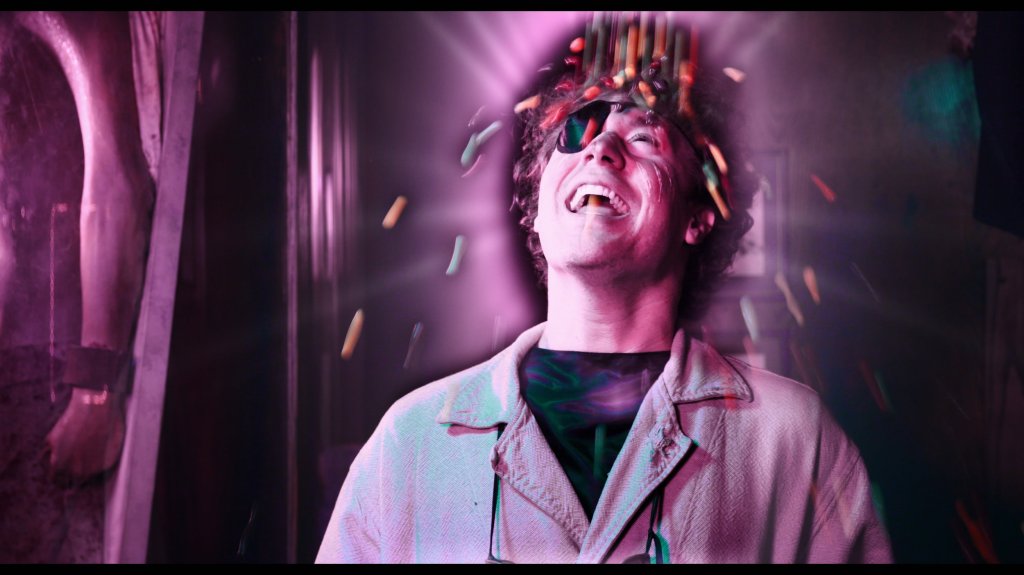
The third character, Isaiah Mueller, while seemingly the “Larry”, becomes the Moe quite quickly. It is his performance — a fine mixture of slapstick comedy and old-fashioned horror movie acting — holds the three loonies — and the plot — together. He glides between straightman and comic with ease and gives us enough mugging to the camera to keep us part of the gag. He also peppers his performance with just enough maturity to give the 30+ minute sitcom a foundation stopping it from just being funny.
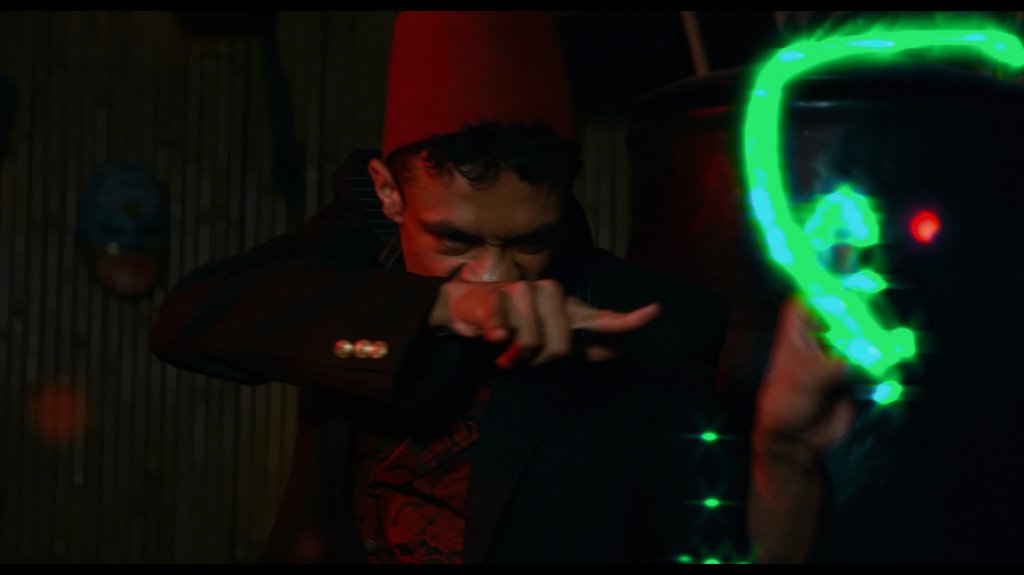
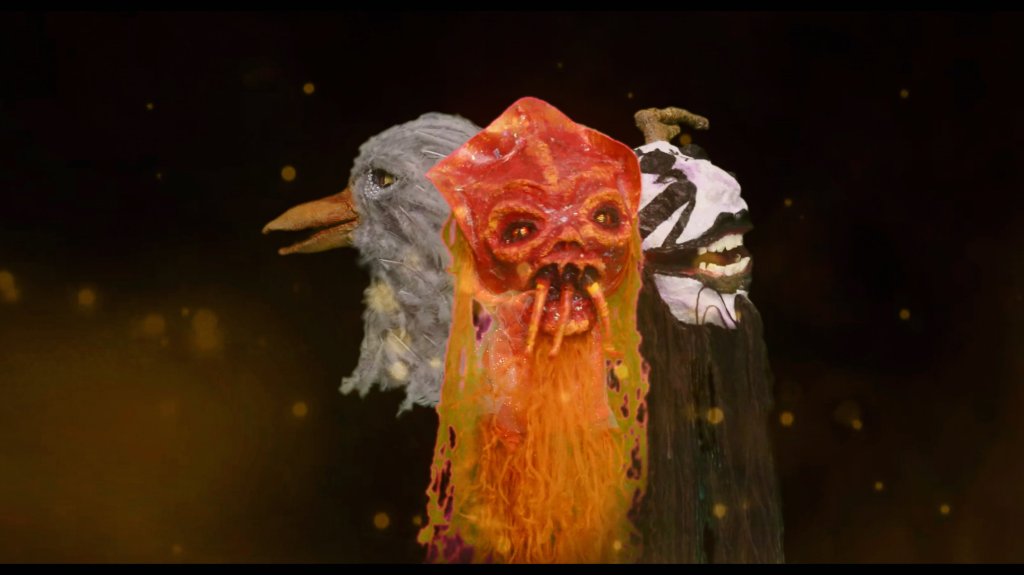
The 80s style special effects are also a cut-above. The Jim Henson-from-Hell puppetry provided by Rocco George were equal parts Saturday morning cartoon and Weird Science; and the high production values via special effects and well-made set pieces by Dylan Mars Greenberg gave us Land of the Lost marinated in Beetlejuice.
Lumped into brief blackout sketches, Mystery Mansion capitalized on the 21st century attention span by handing us a full episode before any of us even know it’s happening. Commercially speaking, it opens the door for them to be part of larger events, as well as being an excellent sitcom pilot when combining all the episodes into a little over 30 minute event.
If one has to be critical in any manner, director Joe Whelski would be well-advised to pick-up the pace of the show. Boasting stand-up comedy cred, the three stars played it like a stand-up routine: a little slower than normal, allowing for the audience to get the joke. Not necessary considering everything. If they can increase their speed by just a little bit then they would be perfectly timed in a perfectly funny send up of the genre.
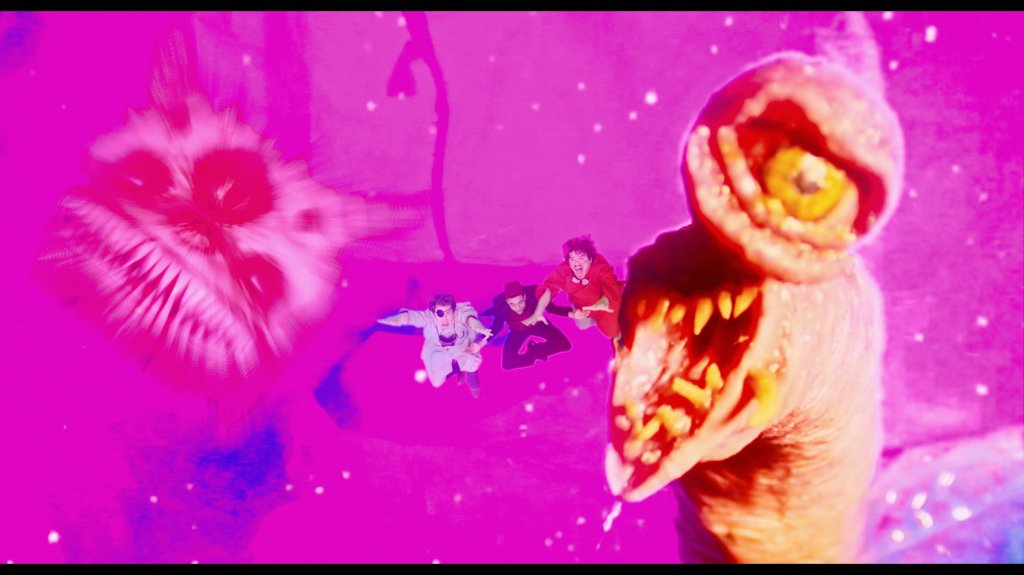
Toward the end, their trip to the shadow realm, for instance, is worth the price of admission alone.
Kudos to the team of Handelman, Mueller, and West, and here’s hoping there are many more outings in which they must protect the Mystery Mansion from the forces of frightfully funny.
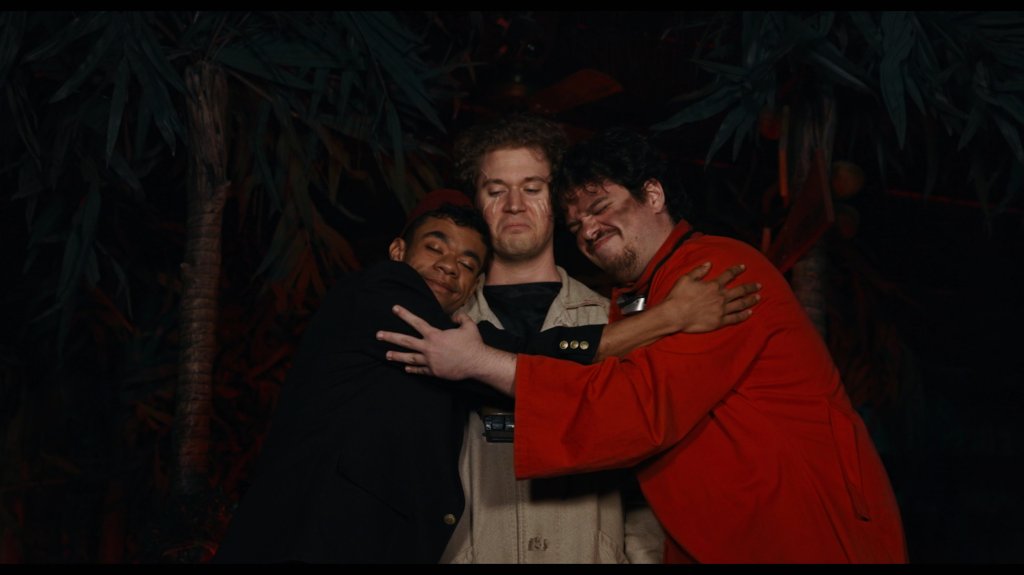
Episodes 1 & 2 are currently running on YouTube ands on the Phoenix FearCon Film Festival site.
https://www.mysterymansionshow.com/
Nine NYC-Based Theatre Companies Join Forces to Present “It Can’t Happen Here” October 28, 2020Based on the Sinclair Lewis NovelAbout the Rise of Fascism in America
Playful Substance joins
National Yiddish Theatre Folksbiene, Israeli Artists Project, Kairos Italy Theater, New Heritage Theatre Group/Impact Repertory Theatre, New York Classical Theatre, Pan Asian Repertory Theatre, Repertorio Español, and Turkish American Repertory Theater & Entertainment
A historic reading of Sinclair Lewis’ 1936 classic “It Can’t Happen Here,” adapted for the stage by John C. Moffitt and Sinclair Lewis; unprecedented collaboration in Yiddish, English, Spanish, Italian, Turkish and Hebrew. Viewable at 1 PM at https://nytf.org/live and only available until November 1.
Initiated and hosted by National Yiddish Theatre Folksbiene, nine prestigious theatre companies will come together on Wednesday, October 28 to present an unprecedented virtual play reading – in Yiddish, English, Spanish, Italian, Turkish and Hebrew – of “It Can’t Happen Here”, a dramatization of the 1935 novel by Sinclair Lewis imagining the rise of fascism in America. More than 60 actors with Israeli Artists Project, Kairos Italy Theater, National Yiddish Theatre Folksbiene, New Heritage Theatre Group/Impact Repertory Theatre, New York Classical Theatre, Pan Asian Repertory Theatre, Playful Substance, Repertorio Español and Turkish American Repertory Theater & Entertainment will participate in this one-time event.
Adapted for the stage by John C. Moffitt and Sinclair Lewis in 1936, “It Can’t Happen Here” was presented simultaneously by 21 theater companies under the auspices of the Works Progress Administration (WPA) Federal Theater Project as fascism was on the rise in Europe. The work chronicles the rise of a demagogue who is elected President of the United States after fomenting fear and promising sweeping economic and social reforms while promoting a return to patriotism and “traditional” values.
The organizations are presenting the multi-lingual reading of this landmark play to bring attention to the need for greater support of the theater industry, which has been impacted in a dramatic way during the COVID-19 pandemic (and on the heels of the announcement that Broadway will not raise its curtain again until after May 2021). “It Can’t Happen Here” is a benefit, through permission from Theatre Authority, Inc. for the nine participating theater companies.
The reading will take place on Wednesday, October 28 at 1:00 PM Eastern Time, and then only be available for viewing until Sunday, November 1 at 1:00 PM Eastern Time. The event will be presented on National Yiddish Theatre Folksbiene’s website at https://nytf.org/live.
“We got hold of the script for ‘It Can’t Happen Here’ about a year ago, already knowing of its history with the Yiddish WPA theater. We had been planning to present a staged reading of this play before the pandemic struck,” said Motl Didner, Associate Director of the National Yiddish Theatre Folksbiene. “The idea to present this in several languages with many other theater companies came out of a conversation that we had with our friends at New Heritage Theatre Group / IMPACT Repertory Theatre about the need for a new Works Progress Administration to help artists and cultural organizations get through these times when we have seen the devastation of our entire industry. We are all in this together.”
“A powerful necessary voice from the 30s talking about today. It did happen in Italy, it can’t happen here?,” said Laura Caparrotti, President and Artistic Director of Kairos Italy Theater.
“The creation, history and significance of the 1930’s Works Progress Administration (WPA) Federal Theater Project, established during the great depression under President Franklin D. Roosevelt, placed a spotlight on the importance of the role of arts and culture in the United States,” said Voza Rivers, Executive Producer, and Jamal Joseph, Senior Artistic Director, at the New Heritage Theatre Group/ Impact Repertory Theatre. “Not only did the Federal Theatre Project program employ tens of thousands of workers in theater, music. arts, etc., it also supported racial integration of black and white Americans. Significant theatrical presentations were produced and presented. Because of the challenging times we are now living in today, COVID-19, systemic racism, and civil unrest, we applaud the National Yiddish Theater Folksbiene for selecting the 1936 play ‘It Can’t Happen Here’ by John C. Moffitt and Sinclair Lewis. A play that brings to light a message for today that “it can happen again” if our country and citizens can’t find a way of living together peacefully and in harmony. New Heritage Theatre Group believes that the positive power of theater, music, and art can break down any and all barriers of misunderstanding.”
“Since our inception in 1977, Pan Asian Rep has promoted stories seldom told and voices seldom heard. Our productions have focused on stories of probing social justice issues, making ‘It Can’t Happen Here’ a project that aligns directly with Pan Asian’s values. We are thrilled to join this roster of change-makers in the American Theater to tell this timely tale,” said Tisa Chang, Artistic Producing Director at Pan Asian Repertory Theater.
“The authoritarian playbook is neat, trim and oh so effective. It takes hold so quickly, so quietly, using predictable, repeatable steps that make it easy to just follow along. Stories can be disruptive. That’s part of their power,” said Bree O’Connor, Artistic Director at Playful Substance. “It may be disheartening to hear how familiar It Can’t Happen Here sounds to our 2020 ears, but what a gift it is to have voices from 1936 reach out to disrupt THIS moment. To disrupt us.”
“We are all in this thing together for sure. We want to move forward as a human race not backwards. We see a lot of similarities between now and then and we need to act smarter and be better and fix our mistakes. I am so happy to be a part of a multicultural, multinational project with my friends,” added Ayse Eldek Richardson, Turkish American Repertory Theater & Entertainment’s founder.
The event is part of National Yiddish Theatre Folksbiene’s ongoing virtual programming, Folksbiene! LIVE, an online celebration of Yiddish culture, featuring live-streamed theater, American Jewish performers, concerts, lectures, talks, and other events. Programming provides inspirational and entertaining experiences as cultural and arts venues across the country and the world remain closed amid the coronavirus pandemic.
All Folksbiene! LIVE programs are presented at 1:00 PM. Stay in the loop and get reminders about new episodes by subscribing to Folksbiene’s newsletter, and catch up on past episodes on-demand, at nytf.org/live.
Prior to the presentation, Casa Italiana Zerilli-Marimò at New York University will hold a virtual discussion (in English) between Laura Caparrotti, Artistic Director at Kairos Italy Theater, and Motl Didner, Associate Artistic Director at National Yiddish Theatre Folksbiene, on Thursday, October 22 at 5:00 PM. The event is free, and will be aired on Casa Italiana Zerilli-Marimò’s Facebook page and website.
The special event features more than five dozen actors affiliated with participating theatrical organizations. You can view the full list of participants and directors on Folksbiene’s website here and at www.nytf.org/itcanthappenhere.
About the National Yiddish Theatre Folksbiene
Now entering its 106th season, Tony Award-nominated and Drama Desk Award-winning National Yiddish Theatre Folksbiene (NYTF) is the longest consecutively producing theatre in the U.S. and the world’s oldest continuously operating Yiddish theatre company. NYTF, which presented the award-winning Fiddler on the Roof in Yiddish, directed by Joel Grey, to sold-out audiences before it moved to Off-Broadway uptown, is in residence at the Museum of Jewish Heritage – A Living Memorial to the Holocaust. Under the leadership of Artistic Director Zalmen Mlotek and Executive Director Dominick Balletta, NYTF is dedicated to creating a living legacy through the arts, connecting generations, and bridging communities. NYTF aims to bring history to life by reviving and restoring lost and forgotten work, commissioning new work, and adapting pre-existing work for the 21st Century. Serving a diverse audience comprised of performing arts patrons, cultural enthusiasts, Yiddish-language aficionados, and the general public, the company presents plays, musicals, concerts, lectures, interactive educational workshops, and community-building activities in English and Yiddish, with English and Russian supertitles accompanying performances. NYTF provides access to a century-old cultural legacy and inspires the imaginations of the next generation to contribute to this valuable body of work. Learn more at www.nytf.org.

About Playful Substance
Playful Substance is a New York based theater company dedicated to fostering new works through our Writers Groups, developmental workshops, community events and fully staged productions. We believe that lifelong artist development, work-life balance, and the vitality of an inclusive creative space are integral to the artist’s practice. “Playful Substance” is the mission; substantive work approached with joy, cooperation, sensitivity and humor. We all deserve to be seen. We also have the responsibility to see. www.playfulsubstance.com
About the Museum of Jewish Heritage – A Living Memorial to the Holocaust
The Museum of Jewish Heritage – A Living Memorial to the Holocaust is New York’s contribution to the global responsibility to never forget. The Museum is committed to the crucial mission of educating diverse visitors about Jewish life before, during, and after the Holocaust. The third-largest Holocaust museum in the world and the second largest in North America, the Museum of Jewish Heritage anchors the southernmost tip of Manhattan, completing the cultural and educational landscape it shares with the Statue of Liberty and Ellis Island.
The Museum of Jewish Heritage maintains a collection of more than 40,000 artifacts, photographs, documentary films, and survivor testimonies and contains classrooms, a 375-seat theater (Edmond J. Safra Hall), special exhibition galleries, a resource center for educators, and a memorial art installation, Garden of Stones, designed by internationally acclaimed sculptor Andy Goldsworthy. The Museum is the home of the National Yiddish Theatre Folksbiene.
Currently on view is the acclaimed exhibition Auschwitz. Not long ago. Not far away. This is the most comprehensive exhibition dedicated to the history of Auschwitz and its role in the Holocaust ever presented in North America, bringing together more than 700 original objects and 400 photographs from over 20 institutions and museums around the world. Also on view are Ordinary Treasures: Highlights from the Museum of Jewish Heritage Collection and Rendering Witness: Holocaust-Era Art as Testimony.
The Museum receives general operating support from the New York City Department of Cultural Affairs and New York State Council on the Arts. The Museum has reopened to the public with timed ticketing and limited capacity. For more information on health and safety measures, visit mjhnyc.org.
About the Israeli Artists Project
The Israeli Artists Project is a NYC based organization that promotes and presents Israeli theater, music and art. www.israeliartistsproject.org
About the Kairos Italy Theater
Kairos Italy Theater is internationally recognized as the Italian Theater Company in New York. KIT’s mission is to spread Italian Culture and to create an Italian/International Culture Network in the United States (and abroad). KIT produces plays, events, lectures, and workshops. KIT is the co-creator of In Scena! Italian Theater Festival NY, that takes place in all five New York City boroughs and of OnStage!, the first American Theater Festival in Italy. KIT is the Theater Company in residence at Casa Italiana Zerilli-Marimo’ at NYU. www.kitheater.com
About New Heritage Theatre Group/Impact Repertory Theatre
New Heritage Theatre Group (NHTG) is celebrating its 56th anniversary and is the oldest Black nonprofit theater company in New York (est. 1964). NHTG’s original mission was to present entertaining, informative, educational and first-class productions at affordable prices and preserve and institutionalize classic works by established and emerging black playwrights, authors, and artists of color. Our mission has expanded from local to global, placing an additional emphasis on international issues that impact on people of color. In 1997, playwright/director Jamal Joseph joined as Executive Artistic Director. In the same year Rivers, Joseph, Joyce Joseph, and Alice Arlen, created a NHTG youth division IMPACT Repertory Theatre a creative development leadership training program for young people that encourages members to create and marry activism with their artistic works. It combines a performing arts program, with training in the creative arts (spoken word, musical theater, dance, poetry, and songwriting) and youth leadership development, through the concept of “art-ivism”—using art and activism to change the world. www.newheritagetheatre.org and www.impactreptheatre.org
About New York Classical Theatre
New York Classical Theatre’s mission is to create and reinvigorate audiences by presenting free performances in open public spaces. Since 2000, we have produced over 40 interpretations, translations, and adaptations of timeless masterpieces for more than 250,000 people. By producing at no direct cost to our audiences, we engage neighbors from all walks of life. We activate beautiful, accessible places including: Central Park at West 103rd Street, Castle Clinton National Monument, Carl Schurz Park, Brooklyn Bridge Park, and the Tata Innovation Center on Roosevelt Island. NY Classical offers audiences the opportunity to enjoy professional classical theatre together as a community. www.nyclassical.org
About Pan Asian Repertory Theatre
Pan Asian Repertory Theatre is the most veteran pioneer, award-winning Asian American theatre company on the East Coast. Founded by Tisa Chang and core artists in 1977 with the vision that Asian American artists can equally contribute to the excellence of American Theater with stories seldom told to promote social justice and access. Our live theatre will return with CAMBODIA AGONISTES in 2021. www.panasianrep.org
About Repertorio Español
Founded in 1968 by stage director René Buch and the late producer Gilberto Zaldívar, and joined by Robert Weber Federico in 1971, who now serves as Executive Producer, REPERTORIO has presented an unparalleled body of theater that promotes and divulges the rich heritage of Hispanic theater. Spanish masters like Calderón, Lope de Vega and García Lorca, renowned playwrights from Latin America and the growing body of American writers who capture the Latino experience in the U.S.—from New York City to Portland, and in Los Angeles, Washington DC, Texas, Denver and Chicago—are all at home in REPERTORIO’s programming. Also, the company has presented acclaimed translations of plays by Edward Albee, Shakespeare, Tennessee Williams, Gian Carlo Menotti, Eduardo De Filippo and Noel Coward.
The Company presents a rotating repertory of 13 different plays, musicals and dance concerts with over 300 performances every year. Its productions are seen by over 50,000 people annually at its home, the historic Gramercy Arts Theatre and on tour. Every year, approximately 20,000 students are introduced to the heritage of Spanish language theatre through its education program, ¡DIGNIDAD! www.repertorio.nyc
About Turkish American Repertory Theater & Entertainment
Turkish American Repertory Theater & Entertainment—TARTE—is a unique performance institution established by Ayse Eldek-Richardson in May of 2010. The productions explore aspects of Turkish identity that may be unfamiliar or unknown to many in the United States. Turkish culture developed over many centuries and each work we produce has its own related signature and design reflecting a past or current aspect of that cultural development. We hope to broaden the perception of what Turkish culture is.
While the company’s primary emphasis is on performing Turkish classics and original works by Turkish and American writers, plays and musical submissions with Turkish or Middle-Eastern themes are considered from American and international writers as well so as to present a repertoire of quality works to a wide range of Western audiences.
Turkish American Repertory Theater & Entertainment works on producing original plays, cabarets, and musicals by TARTE’s honorary writers and multi-ethnic writers group. TARTE also organizes educational workshops called “Drama Club” aimed at younger members every year. www.tarteusa.com
The BLAME Game
Review by Lew Antonie
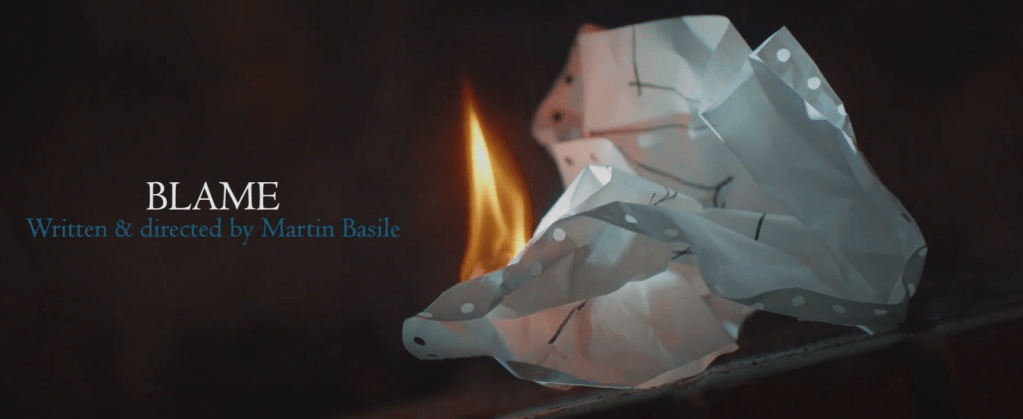
Martin Basile has smacked us in the face with a film having very little dialogue and just a lot of walking around.
BLAME takes a concept you might find in a grade school project and turned it into a startling commentary about what shapes the tener of our world.
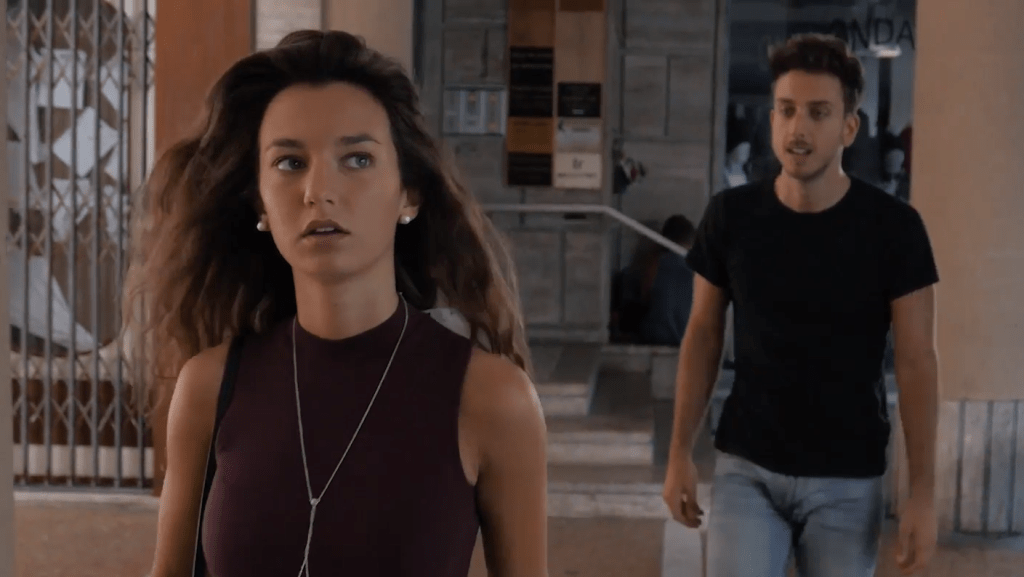
Marie Solimena stars as a young girl oppressed by her alcoholic father. This is all done through Marie’s stunning use of facial expression and body language. We see, not how her father ends up shaping the world around them, but how Marie’s reactions do. Without giving away the highly simplistic but truly imaginative plot point, we were handed a parable of how one person’s misery can truly erode an entire world. Again, without giving away the ending, the simplest move brought this reviewer to tears.
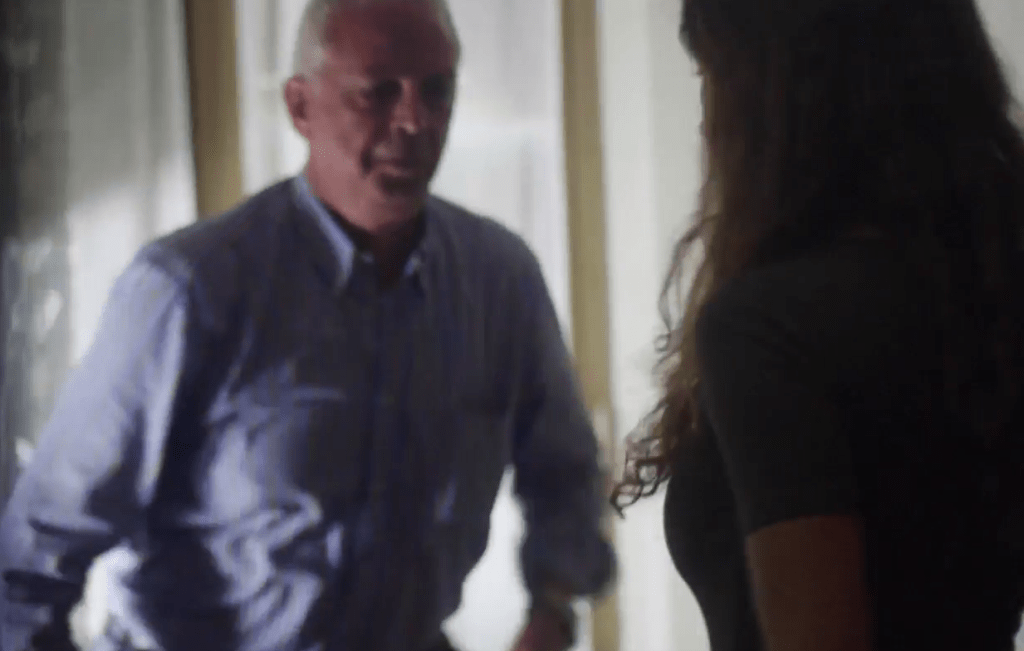
Strong characteriszation and transitions supplied by Basile and Solimena (her masterful inner dialogue sets us up for all that followed) as well as Hugo Santoro, Guiliana Sanchini, and Silvia Magnolo. The ensemble, which included Christian Mangione, Alberto Bologna, and Amedeo Pagella all delivered the message with subtle power.
One can imagine what Martin Basile could do with a bigger budget and more time.

Andrés Gallardo Bustillo gets Dystopian
July 4 marked the formal launch of an ongoing fundraising effort to bring One Empire, Under God, the new full-length drama by writer/producer Anthony J. Piccione – to the stage in 2021, with an announcement forthcoming for a staged reading this Fall, in advance of a full production. Monthly donations are now being accepted at www.patreon.com/oneempireundergod
Set in the far-distant future, One Empire, Under God tells the story of how an emotionally disturbed young man – with the help of virtual media technology – is able to rise to political power by inciting an uprising against America’s openly atheist president, and subverting democratic and military rule throughout Western civilization, paving the way for him and his descendants to rule for generations to come. Every step toward a more perfect union is followed by an enormous reactionary backlash. That historical trend remains very much alive in the future, as seen in this provocative critique of nationalism, imperialism, and religious extremism.
The production will be directed by Andrés Gallardo Bustillo, Associate Artistic Director of The Phoenix Theatre in Philadelphia, where he was the associate director and choreographer on their productions of The Tempest and The Glass Menagerie. He also has directing credits that include productions at the Davenport Theatre and the American Theatre of Actors. He met Piccione when he served as assistant director of Piccione’s full-length drama A Therapy Session with Myself as well as an actor in his short drama, What I Left Behind. Bustillo’s acting credits include West Side Story, (Indio) Peter/Wendy, (Peter Pan) & My Magical Chivita, (The Man) and he is the founder of Cumbres Musical, a pre-professional theatre program in Colombia.
Ai grabbed Andres for a few moments in-between fundraising
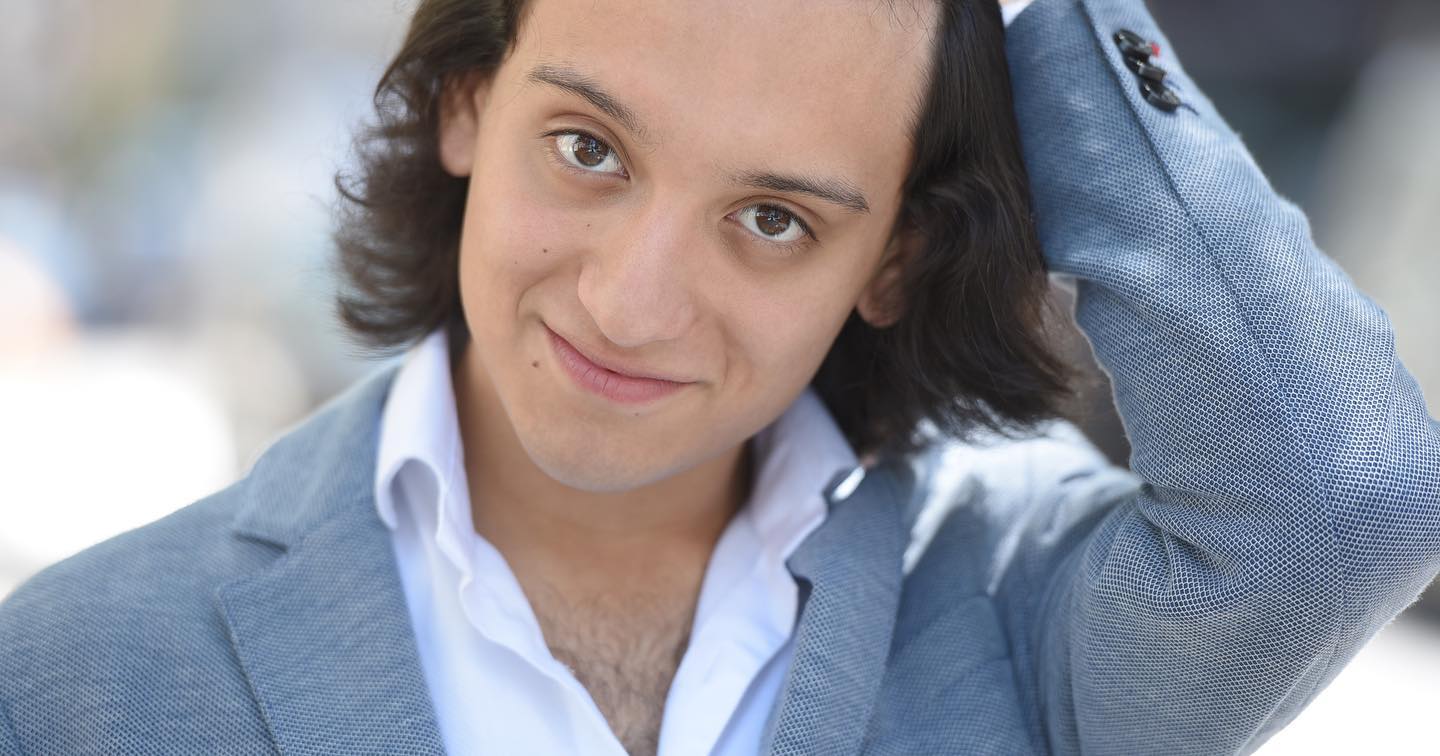
 We hear the word “dystopian” a great deal. What’s a dystopian future to you and how can we change that?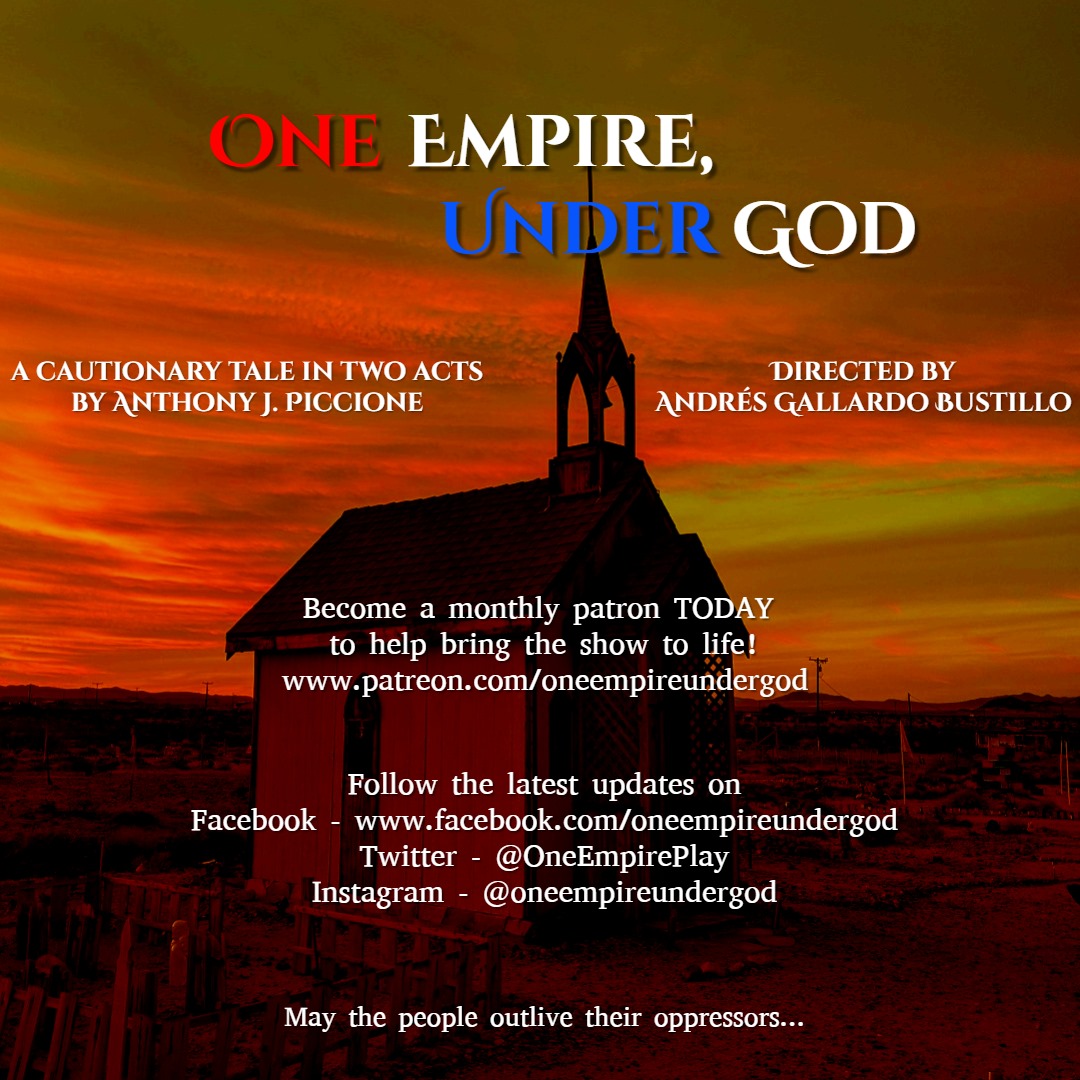
To learn more about One Empire, Under God, visit www.anthonyjpiccione.com/oneempireundergod, and follow along on Facebook and Instagram @oneempireundergod and Twitter @OneEmpirePlay.
Jelani Alladin and Claudia Acosta are having a SWELL time.
Refracted Theatre Company’s audio-immersive theatrical experience, The Swell, is currently running on multiple platforms.
With The Swell, RTC has transformed the space around us. Each Act of The Swell will feature plays in which the action can only happen by way of the dialogue or the soundscape. “The Swell” is a sound-dive into a play, where sound effects, music and dialogue take you deeper into the world. As a means of transcending space, RTC invites listeners to createg the “set” in their own homes. A location has been assigned at which to enjoy their play or an activity to do while enjoying their play. The audience has full reign over the depth of their submersion, deciding when, or if, to come up for air.
The Swell can be found on www.refractedco.com; Spotify; Apple Podcasts; Breaker; Castbox; Google Podcasts; Overcast; Pocket Casts; RadioPublic.
Part of this first episode or ACT, is the radio play, The Legend of Jim Gunderson and How I Wound Up In Your Ear, written by Dylan Guerra; directed by Graham Miller with sound design by Emma Wilk, featuring David Shih (“Hunters”, Amazon; “Billions”, Showtime; “City on a Hill”, Showtime) , Jelani Alladin (Frozen, Broadway; Public Works’ Musical Adaptation of Hercules, The Public Theater; “The Walking Dead: The World Beyond”, AMC), and Claudia Acosta (Seven Spots in The Sun, Rattlestick Playwright’s Theater; Architecture of Becoming, WP Theater; Don Cristóbal Billy Club Man, HERE Arts Center).

Jelani Alladin, who debuted on Broadway as Kristoff in Frozen (2018), said this about The Swell: “With every change in medium, there is a slight change to the approach. A great friend once said about Voice-Over work, “perform in the space you’re in.” In the Swell, we are inside the listeners ears, so everything about the performance becomes aural. Even the characters thought processes must be heard; that was the most fun in creating this experience.”

Bilingual actor/producer/director/writer/teaching artist, Claudia Acosta talked of her creative process: “I never know till I show up first read. I look for connections within writing to understand story, observe the actors and remain open to them through a screen, process what the director is wanting to HEAR and learn to adapt to new stage…in this case the mic with an audience I’ll never see.”
The creative process became a learning process for her as well. “Focusing on my voice to create within limitations of space and no physical presence of other actors was an exciting challenge, but this biggest reward was feeling the freedom of working outside my ethnicity. Didn’t have to think about being a Latinx character. Didn’t have to think how my body took shape on a stage. Never felt that liberation before on any stage in my 20 years performing.”
For details go to: www.refractedco.com.
Rattlestick presents a powerful theatre festival … on film.
“Through My Eyes” Tells Four Immigrant Women’s Stories of Reflection and Revolution Amid the Covid Era
Article by Alex Simmons
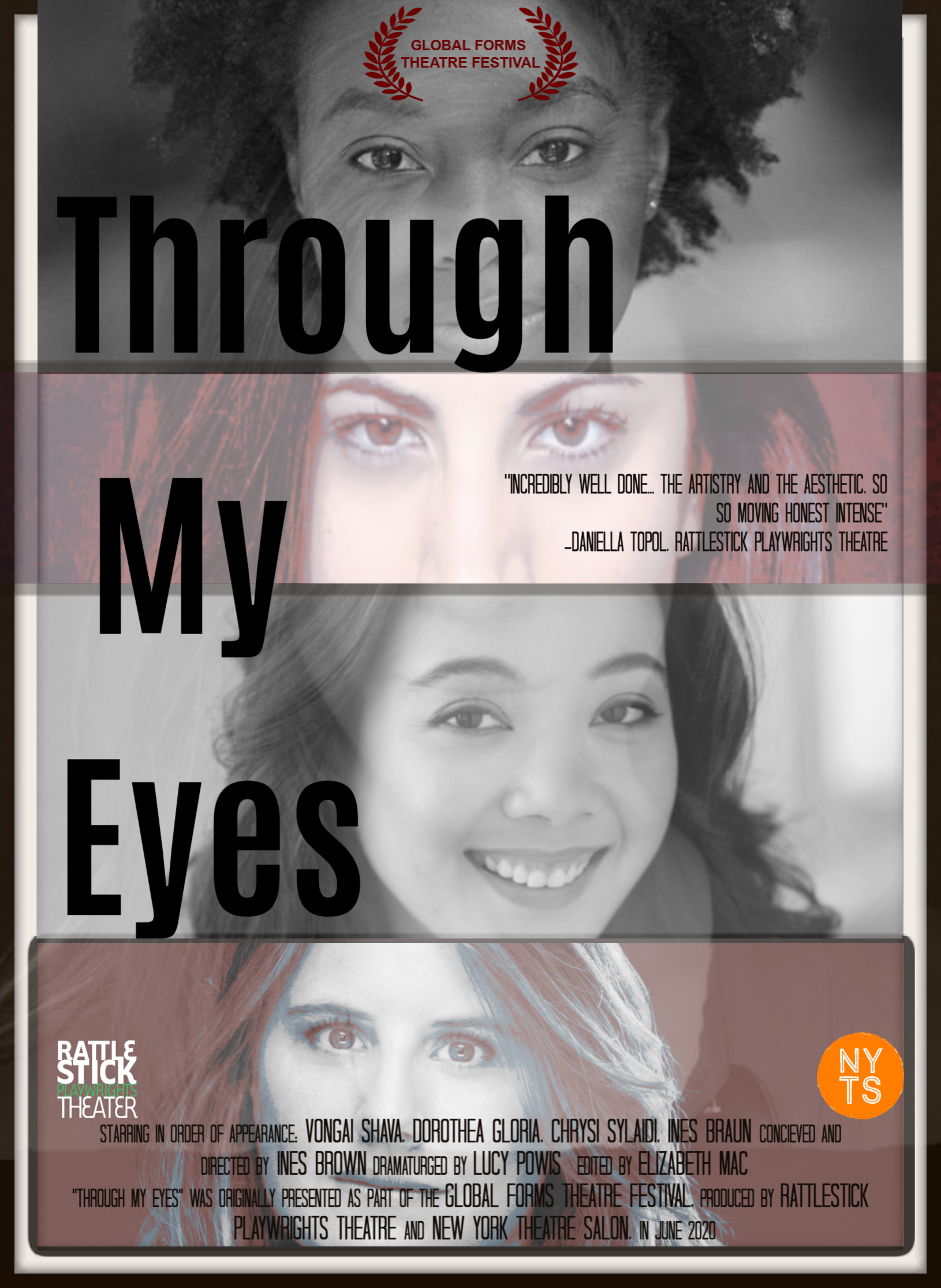
Obie Award-winning Off-Off-Broadway company Rattlestick Playwrights Theater, along with and New York Theatre Salon, proudly presented Through My Eyes for their Global Forms Theater Festival, a festival committed to international and immigrant theater artists, Through My Eyes was conceived by Ines Braun and presents four solo monologues by four women performers. Each piece is the performer’s autobiographical account of lockdowns and social distancing and the emotions and introspection that comes with it.
Vongai Shava’s Quarantine Is takes an unfiltered look at the actresses’ experience in self isolation in the wake of the pandemic, civil unrest over the death of George Floyd, and anti-immigration rhetoric from the Commander in Chief. Where, by Dorothea Gloria, recounts the performer’s escape from poverty and violence in the Philippines’ capital city of Manila. Chrysi Sylaidi infuses longing and powerlessness into Distance, a pensive speech about human contact, and the devastating feelings evoked when absent. In The Silence, Ines Braun reflects on the namesake’s association with loneliness, separation, and childhood memories of Argentina.
Each monologue is presented as voiceover with mood setting footage, performance footage of the actress, and quick editing between. The simple production values allowed the words and experiences of these four very different artists to take center stage. Despite their differences, these women all hone in on the same feelings from different perspectives. Through My Eyes gives an intimate look at the experience of artists amid a global health crisis and social upheaval, compounded with the shades of otherization felt by people of color and immigrants in the United States.
Rattlestick can be followed at @RattlestickNY on Facebook, Twitter and Instagram, and their eponymous Youtube channel. More information can be found at http://www.rattlestick.org.
This theater is a SAFE SPACE
Jay Michaels interviews Anthony Laura and Casey Hartnett
Many off-off and independent companies provide services. It’s part of being nonprofit but few keep the audience in mind as well. Many companies offer training, scholarships, internships, even housing to cast an crew on productions, but few are there when the show ends.
Face to Face Films inaugurates The Julia Initiative in honor of philanthropist, Julia Patanella, who passed away in 2004. The Initiative creates a “safe space” within Face to Face for cast, crew, and audience, who find themselves in situations of mental or physical harm.
When the world was business-as-usual maintaining a schedule of life, work, art was difficult. But now, that tribulation has been increased – in some case, almost unbearably. Producing partners, Anthony Laura and Casey Hartnett have created this initiative to help their actors, the crew, and even their patrons find a place to talk, to ask for help, and have a friendly hand and voice to assist them in getting it. A member of Face to Face is available to help find services to assist individuals in solving or at least alleviating the situation.
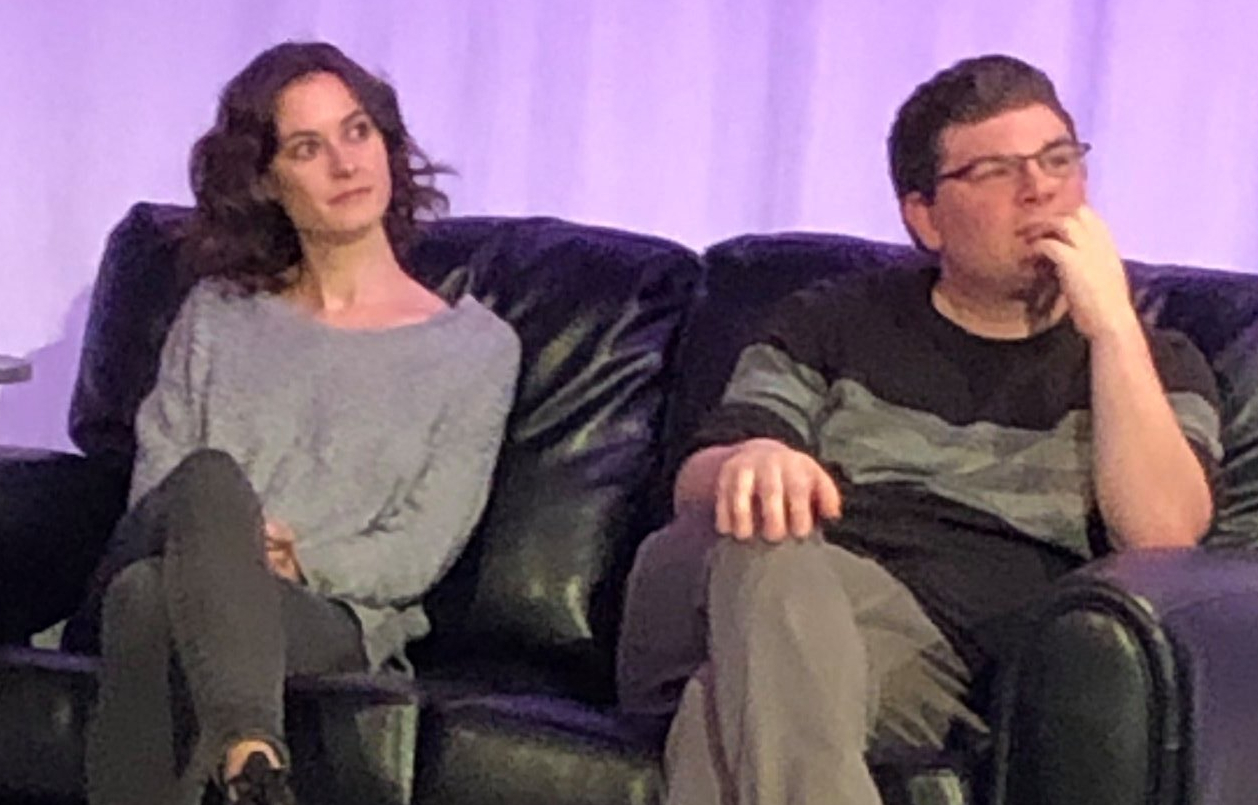 I sat down with Casey and Anthony about the initiative and what made them want to open their hearts this wide and go that extra mile.
This is a wonderful thing you’re doing. What brought you to create this initiative?
CASEY: A lot of our work, stage and film productions, tells stories dealing with mental illness. Our company members are all such strong advocates for mental health, so we only felt it appropriate to give audiences and followers of our work a space to feel like they can safely reach out to us if they feel inspired to talk about their own mental health. From there we can direct them to appropriate resources and programs.
ANTHONY: We wanted to create our initiative to provide a safe space for people who interact with our company and productions. It was important for us to find a way to give resources to people who may be suffering and may not know where to look. By comprising a list of phone numbers, websites and individual recommendations, our company can point people in the direction of hope for whatever they’re struggling through. It’s important to note that this isn’t only for depression or anxiety, but other illnesses and situations that can lead to mental health decline, such as domestic violence, sexual assault and bullying.
If it’s not too personal to ask… was there anything in your life that made you decide to undertake such a program?
ANTHONY: I suffered with depression and anxiety from a very young age, and though I had a very supportive family, sometimes the help I needed wasn’t easy to find. I would find myself coming across road blocks of websites that were inaccurate or phone numbers no longer in service. I wanted to help provide a clearer path of resources. The Julia Initiative is named after my Aunt Julia who was a nurse and someone who was always willing to lend a hand. She was one of the many women who raised me growing up and helped support me creatively and personally with my development as an artist and a person. She taught me that a life spent serving others and helping others is the only way to live a successful life. She passed away in 2004. The initiative is named after her and dedicated to her memory.
CASEY: Mental illness is so common, I’ve certainly had some sort of relationship with it and have seen friends and family suffering and working through their own mental illnesses, so I think it’s something that affects so many people but is still so stigmatized to share and talk about. So we want to open the conversation and allow people to talk about it safely.
Have you thought about how this could blossom? How do you see this project growing?
CASEY: Hopefully the initiative will grow as the company grows and as we expand on our body of work being produced, reaching more people. I think over time it will give a greater meaning to our company of Face to Face Films and help solidify others’ understanding of who we are as artists and creators and what we believe in.
ANTHONY: Casey and I hope, as our company grows, our initiative continues to grow to eventually be able to employ therapists and maybe even our own hotline with trained professionals who can provide assistance. Overall, we would love for the initiative to not only help people in the United States but all over the world who are suffering.
This IS a strong undertaking… Do you have any major concerns regarding it?
CASEY: I suppose, I just hope that we can successfully help guide those who need some direction of where to go for help and resources. People who feel very alone in working through their mental illness.
ANTHONY: I don’t currently have any concerns. I’m very excited to see it start up!
How can someone reach you? And what do they need to employ your services?
CASEY: We will have an email address set up where they can email us and someone will reply with either resources or programs that they can look into. We are here to listen to their stories if they feel like sharing and need a place to vent and then guide them from there.
ANTHONY: People can reach us on Instagram @facetofacefilms and DM us. Or by e-mailing us at facetofacefilms2020@gmail.com. All responses can take up to 48 hours to return which is why we urge anyone suffering and needing immediate assistance to call a hotline or 911.
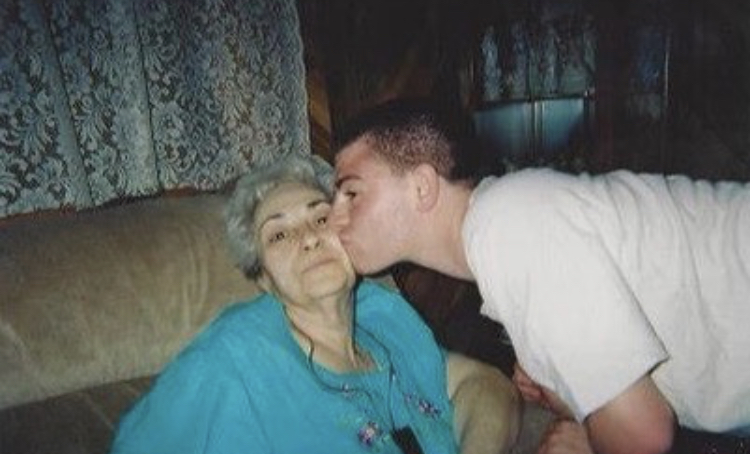
Artistic Director ANTHONY LAURA with his aunt JULIA PATANELLA

Part IV: A MURDER MOST FOUL, SOLVED
 In this final chapter, Robert “Hercule” Liebowitz boards the Times Square Express and proves that Monsieur de Broadway was killed in the drawing room with a line of credit.
The Bible says that money is the root of all evil. But ‘Mad’ Magazine said that the lack of money was the root of all evil.
Probably a bit of both.
Michael Jackson set the world on fire. Armed with a handful of videos, a commercial for Pepsi, and an other-worldly performance at the Grammys, he changed the way the world perceived music. No doubt, the Beatles changed the way we lived; but after the original MJ was finished–with his trio of ‘Off The Wall’ (1979), ‘Thriller’ (1982), and ‘Bad’ (1987), it was no longer the exclusive property of the counter-culture. It became another cog in the machine of capitalism.
Theater could not counter. Marlon Brando had last performed ‘Streetcar…’ in 1948, never to return to the stage the rest of his life. No one of his caliber and magnetism had replaced him, except maybe Laurence Olivier, and he was across the pond.. The theater has always been the medium of the playwright, but it is always served as the victory parade for the performers. The theater, in that sense, had lost one generation of theater-doers because it was no longer cool to do so. Soon, that would morph into two generations.
Theater of the late 1980s were soon viewed by half-filled houses. There are no shortage of examples. In 1989, on a lark (it seemed), Jack Nicholson, apparently in need of a paycheck, made the wretched movie ‘Batman’, and this celluloid embarrassment was soon breaking box office records. Other studios and stars followed suit; an entire cottage industry of adult movie-making for children soon appeared…where it remains to this day.
Neil Simon’s last great work–the outstanding “Lost in Yonkers’–hit the boards in 1993, where he was commanding a salary of $65,000 per week plus 6% of the gross. That, however, was his last hurrah, and he was soon put out to pasture. August Wilson died at a tragically young age. So did the author of ‘Rent’; Jonathan Larson died in 1996, unbelievably the night before the first preview..Sam Shepard lost his way and got involved in movie-making, of all things. Actors–too numerous to mention–made the trek right from Tisch to Hollywood, bypassing Broadway altogether.


Even successes became a prime suspect in the Murder of Broadway. Mel Brooks created a staged version of his movie ‘The Producers’, and it became, ironically, a legitimate smash hit. Then, the (real) producers got a bit piggish, inventing something called ‘Premium Seating’–a device where they could charge even higher ticket prices in the orchestra by cordoning off the very few first rows. It was met without resistance the first time around, in 2001, but fell on its collective face in 2007, when Brooks attempted a similar stunt with ‘Young Frankenstein’.
Why? Why should something that is so vital to the public be so damned expensive?
The Murderers of Broadway were now becoming a traditional, familiar hit team of usual suspects. Finally, who should appear but the Grand Daddy, the ‘Mocha Motivz’ (Yiddish for ‘Boss of the Night’)…the Grim Reaper.
That crazy little thing called the Internet. The proverbial final nail in the coffin.
People happily retreated from the physical world into a world all of their making. Talents like letter-writing fell by the wayside, much as making horsewhips had done at the turn of the last century. By now, Mtv had mushroomed into a cornucopia of reality shows, home shopping networks, cable shows on every subject under the sun, Netflix, Hulu, Amazon, dozens of sights for pornography, you name it. These days (not Covid days, but the days right before), this is how the art world is defined. Why brave 16 degree, or 116 degree weather, to hope for a morsel of art, when one could simply select from a most impressive menu on how to pass their time? The harder path to choose is to go to the theater…alas, the folks of this city and country (except tourists) have resigned themselves to choosing the path of less resistance.
 In ‘Murder on the Orient Express’, one of the better mysteries by the great Agatha Christie, a very bad man is murdered on a train The train it occurs on is stuck in a snowdrift, and no one is going anywhere. The headstrong Belgian detective Hercule Poirot performs the task at hand in his usual stellar fashion. He determines that there was not just one murderer…that everyone had a hand in it. But since a very bad man had been killed, Mr. Poirot had bestowed onto the culprits some unexpected mercy, and lets them go.
The Murder of Broadway, it turned out, met a similar fate. Money, greed, lack of talent, competition, apathy–nothing was immune. So the answer to the question of who killed Broadway was: All Of The Above.
But the victim wasn’t A Very Bad Man. The victim was A Very Good Thing. Of Someone Dear… to our hearts.
Perhaps a good thing will rise from the wreckage of this virus. Sometimes, just sometimes behind every problem is an opportunity. Perhaps, when our Time Out Chair has been put back in the closet, a more meaningful, less expensive, important brand of theater will emerge, with story-telling about subjects that matter, which will remind us how to live our lives.. One can only hope.
David Mamet, in his brilliant play 1988 play ‘Speed-the-Plow’: “Hope; it’s what keeps us alive.’

Latest Posts
-
“Is It Better to Rule in Hell?” Jim finds out at the ATA with Anne L. Thompson-Scretching’s “The Fall From Grace”
Anne L. Thompson-Scretching’s The Fall from Grace Explores Paradise—and Innocence—Lost “I am coming, mortal… enjoy this strange light that illuminates your world. It cannot protect…
-

The Rhythm of Survival: Andy Teirstein on Scoring BROKE and Honoring a Vanished New York
Before Hell’s Kitchen became synonymous with luxury high-rises, it housed St. Clare’s—a haven that was chronically underfunded, defiantly kindhearted, and open to anyone the rest…
-

Jim Catapano learns “Don’t Die with Your Music Inside You” from The Laros Theatre Company’s My Ghosts
The Laros Theatre Company’s My Ghosts Provides a Fine Haunt at The Manifestival It’s not easy to create when your inner critics are Christopher (Kit)…
-

Jim attends Sad Stories of the Death of Kings: Richard II kicks off the Classical Initiative at the ATA
Director James Jennings has gifted American Theatre of Actors aficionados with another successful Shakespeare production at the John Cullum Theatre with this season’s Richard II.…
 Arts Independent