

The Lions of 21st Century Live Art


Jay Michaels,
the host of Terror Talk on Terror TV
conducted the interview
Naya James, Lucia (“Lu”) Bellini, and Trenton Clark are the pride of lions that make up THREE-HEADED LION PRODUCTIONS. Amassing decades of experience between them, Bellini, James, and Clark (sounds like a law firm, no?) have appeared, directed, produced, and studied with some of the leading names in independent art: Wednesday Repertory Company (where Trent is a resident director), Anjali Productions, an independent film production company (Naya is an owner), Theater 54, The Paradise Factory, The Algonquin, Richmond Shepard Theater, NY Madness, Planet Connection Festivities (where Lu is an award-winner), HERE Arts Center, Abrons Arts Center, Hudson Warehouse, Papermill Theater, New World Stages Hollywood, and La Mama Experimental Theatre.
Makes sense that they would join forces to create their own theatrical hub.
The team opens their first production at another laudable festival: Theatre for the New City’s Dream-Up Festival.
 Combining all their talents and tastes, Abdication! Is a blend of Retro TV, cutting edge “downtown” art, timely topics, brilliant writing, directing, and acting, and some gallows humor thrown-in. Abdication! is three fantasy based tales on what happens when we [willingly] give up our identity. Imagine Orwell’s 1984 spiced with Handmaid’s Tale and Black Mirror.
I took the reins of interviewing the Lions due to my devotion to all things macabre.
OK, let’s start with intros… tell us about yourselves as artists.
NAYA JAMES: First and foremost, I regard myself as a storyteller. There are many different ways to tell a story of course—my main mediums are writing and acting, others do it through technical design or directing, etc. But I feel that any valuable narrative art has to service the story above all. Because it is the story that brings people together, lets them experience something as one and create a shared energy space. To me, that is what we in film and theater should always be striving for and what I aim to do as an artist.
LU BELLINI: I started out as a ballet dancer when I was about 3 years old and I remember being so fascinated from that very young age by my teachers and choreographers creating and guiding us all. I would be so proud of being part of the group of people coming into the theatre from the backstage door. It’s like all of a sudden, I knew something mysterious and magical that nobody else could know about. I would ask my mother: “can I please pretty please put up my own dancing recital?” Of course not. I was 6. Maybe 7. Still no. Shortly after I got bit by the acting bug, and it still itches today. But that was not quite enough to fill that “let’s-come up with new ideas make a show tell some jokes and use music to recreate a feeling a situation a though” hole in my heart. It started to fill up when by accident I ended up co-directing for Bad Babies Films. I did research and read books and studied and practiced and I am of course still doing that today. So I would say that myself as an artist is that part of me that searches and listens out for new pieces of information every chance I get to add to my little baggage of knowledge, to then put to practice and experiment, make it my own when I can. Practice, practice, practice. I am not the kind of artist that think I was simply born with a miraculous talent and that I should just go out and spread my amazing gift into the world (you would be surprised by how much I hear stuff like that or along those lines). And plus, why not? I love reading and talking about theatre, and film, and directing techniques, and acting techniques, I find it truly interesting. And if I have to be responsible for a group of 15, 20, or however many people, I owe it to them to be as prepared as I can be. Same goes if I am acting in something, you’re not alone and what you do and what you bring to the table touches so many other people that might not even be in the room in that moment.
TRENTON CLARK: I started doing theatre when I was in high school. A friend of mine had seen the audition posting for the upcoming spring musical–that year wasAnything Goes–and maybe she thought I would be really good, or perhaps she just wanted to get me to stop humming and singing my way around campus. Either way she marched with me over to the call board and practically put my name down for me. And that was that. I was cast as ensemble and got my first real dose of theatre. Despite spending much of my time in the Musical Theatre world, I really found my passion for the arts in the acting studio. I loved studying the text. I quickly adopted my mother’s father’s appreciation for Shakespeare; I’ve even carted his aging, hardback copies of the Bard’s works across the country with me–three times. I moved to New York to study the craft at the American Musical and Dramatic Academy. I graduated. I worked professionally in regional theaters and tap danced (something I had never done before going to school in NY) my way across Asia in a production of 42nd Street. I was told I should try TV, so I moved to Los Angeles. It was during my time on the west coast that I really began exploring and pushing the limits of my creativty; I did a movie musical, I worked on a green screen project. I’ve grown to love those elements of storytelling that really push the imagination.
What’s your creative process and how do you make the fantasy elements real?
NAYA JAMES: My creative process as a writer is to just try to participate in life as much as possible. To notice the things happening around me. People and the environment are connected in many significant ways that you might miss if you’re not paying attention—so I just try to pay attention, to observe people and situations. From doing this, stories and ideas tend to arise organically. In everything I create, I try to ground it in the reality of the human experience as much as possible. Regarding fantasy, it doesn’t matter if you’re a character in middle earth in the beginning of days, or a character living on Mars hundreds of years from now—your fundamental human emotions and need for love, community, connection and security will always be the same. So as long as characters feel and exhibit truthful behavior, it doesn’t matter how fantastical the imaginary setting is.
LU BELLINI: Any fantasy element can easily become real if you treat it as such. If you think about it, any reality can be a fantasy for someone else and vice versa. I find it a matter of being able and willing to put yourself in the required proverbial shoes. It can’t harm if you’re stuck with the imagination and curiosity of a small child. First step of the process: having a good relationship with the script (and the playwright). I must love it and believe in it and it has to make sense for me, for my sensibility, humor, etc. I am not fit to direct or act in anything under the sun. With time I found that some things are better fit than others (like most people I am sure). As a director I usually then start to compile visual and musical references for myself and for the rest of team I am working with so we can all start “seeing” the show slowly emerging from the fog. I keep an open mind and more often than not things change quite a bit from those first concepts. Better ideas and/or more effective ways of telling the story might come from anywhere at any time. Not to mention the world of logistics and staying on time/budget which will try your imagination and general process really good. Reason why I find it crucial to have a team you trust and that you feel comfortable with around you. It is sometimes in time of trouble that true imagination and collaboration happen and shine.
TRENTON CLARK: I always start with the text. I’ve learned over the years that you can study and study and study a script, and there are always more surprises. It’s amazing what information can be pulled from the writer’s chosen words. After learning the script inside and out, the next thing has always been to play; make that weird choic–in the moment. It may not be the best choice but it’ll teach you something, about the material, or about yourself, often both. Fantasy comes alive when you’re uninhibited and unfiltered. The courage to take that risk and do the uncomfortable often results in the most amazing discoveries. In that state of constant discovery, the fantasy is kept alive for me.

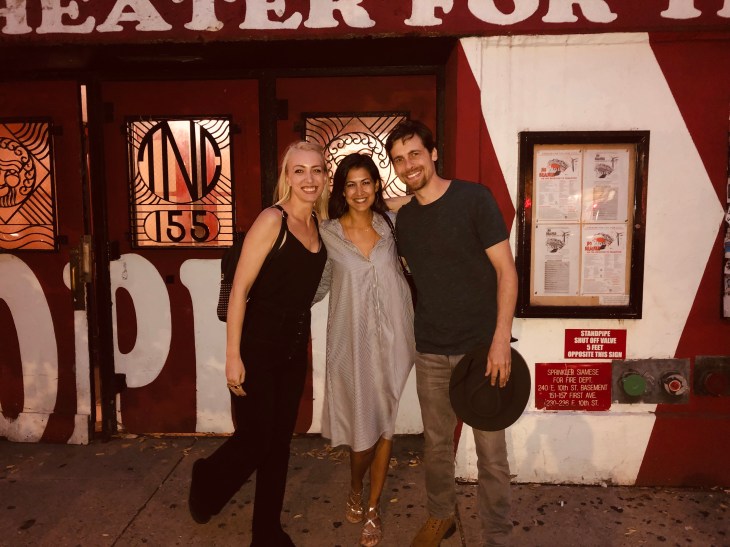
From left to right Naya James (playwright/producer/actor), Lucia Bellini (director/producer), Trenton Clark (producer/actor)
How do you inject humor without losing the message?
LU BELLINI: I don’t think comedy and humor would cause any message to be lost. If anything, I believe it might help getting people to listen or to even get the message across without even realizing there a was a message in the first place.
NAYA JAMES: A lot of times humor is the message. For example, “laughter through tears” can be seen as the quintessential human behavior—we are complex emotional individuals, and our ability to find humor and nuance in grim or challenging situations has historically been one of our best coping mechanisms.
TRENTON CLARK: Well, never try to be funny. Again, going to the script will almost always show you where the humor lies. And humor is complicated; it isn’t just slapstick, it isn’t just punchlines, it’s ironies and tragedies and so much more. Then there’s the humor that comes with discomfort. I stick with the message and commit to my choices and the humor flows from things naturally.
I’ve always felt that anything fantasy, sci-fi and horror are cautionary tales. What’s your opinion?
LU BELLINI: I agree. Even if they don’t intent to be. They tap into those big “as ifs” and “what if that happened IRL” and “what would I do if” and they get the conversation going and your wheels turning. “what if” can be a very powerful question.
NAYA JAMES: I believe it depends on what exactly you’re attempting to caution people against. Pieces in the fantasy, sci-fi or horror genres can absolutely serve as warnings to people of potential or future danger. But in other stories, a more utopian or aspirational alternative can be presented. In these instances, they can have the opposite effect, encouraging people not to proceed with caution but rather to barrel full steam ahead. And sometimes there’s a special hybrid, cautionary tale and heartwarming Utopia story all at once—which is why a movie like Avatar was so popular!
TRENTON CLARK: So much of human storytelling is cautionary. Warnings of creatures to be feared, stalking in the dark have always been whispered across the campfire. Zombies, one of my favorite creature-villains, are arguably the most utilized characterizations of our fear throughout modernity. Representative of illness, disease, contagion, and death, Zombies teach us to be cautious of infections and new “miracle cures”, the depths of the jungle and crowded public places, and perhaps most of all ourselves and the horrors we are capable of. StarTrek teaches us that no matter how advanced our society may become, we are still human and prone to err.
What next?
NAYA JAMES: To continue working with my fabulous collaborators. To develop this show to its ultimate creative vision, and hopefully find it a more permanent home. After that, more plays, films, and multimedia. As my production partner says, I am a “bottomless pit of ideas.” So just getting those ideas to fruition in attempt to connect relevant stories to as many people as we can.
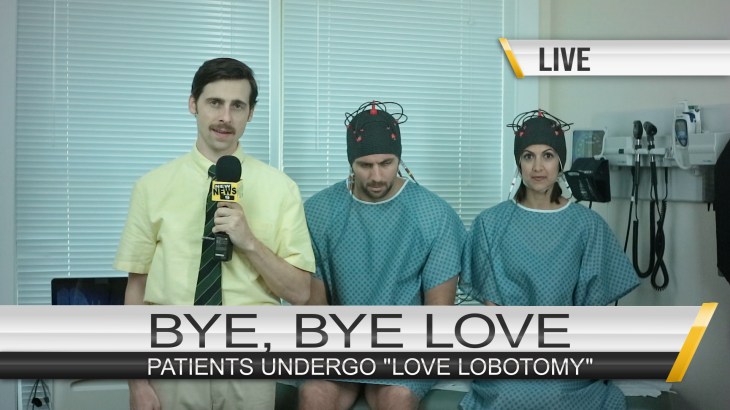
Abdication! explodes with live action and video sequences (From left to right: Trenton Clark as Rick Rarey, Mike Ivers as Joe and Naya James as Mara in the video segment for the episode Love Lobotomy)
LU BELLINI: I am looking forward to seeing Abdication! finally on stage and how to improve it from there. I also can’t wait to start working on Naya’s new full-length play, and who knows… maybe jump on stage, myself, for a bit?
TRENTON CLARK: I write, I direct, I act. Abdication! will continue to see development and I see a lot more beyond that on the horizon.
André Vauthey, a doctor turned actor, had a truly unique story to tell.
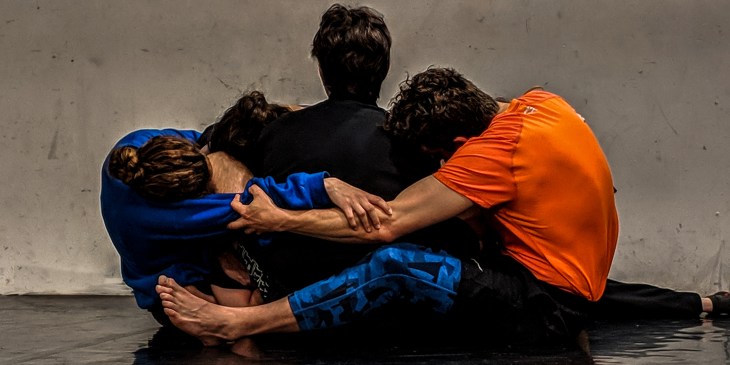
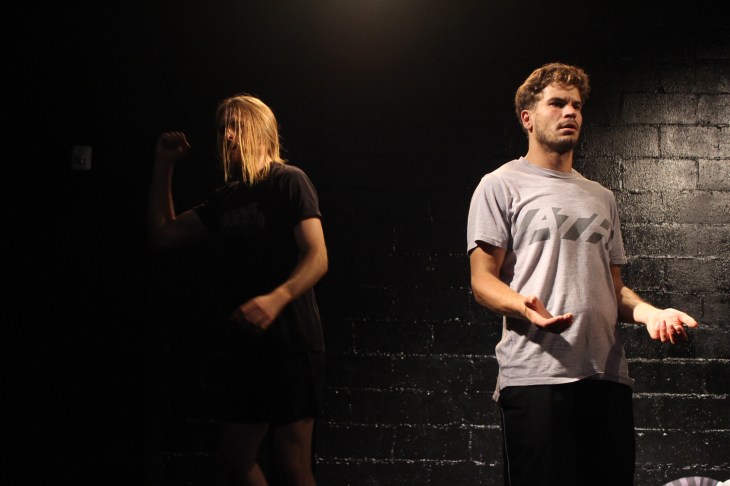
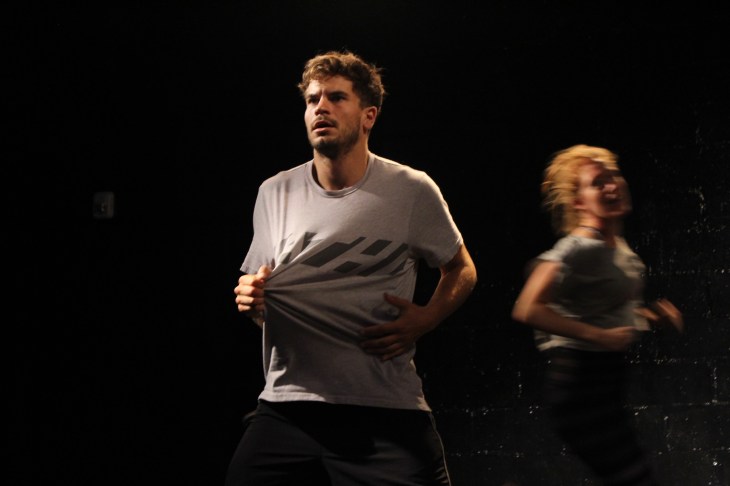
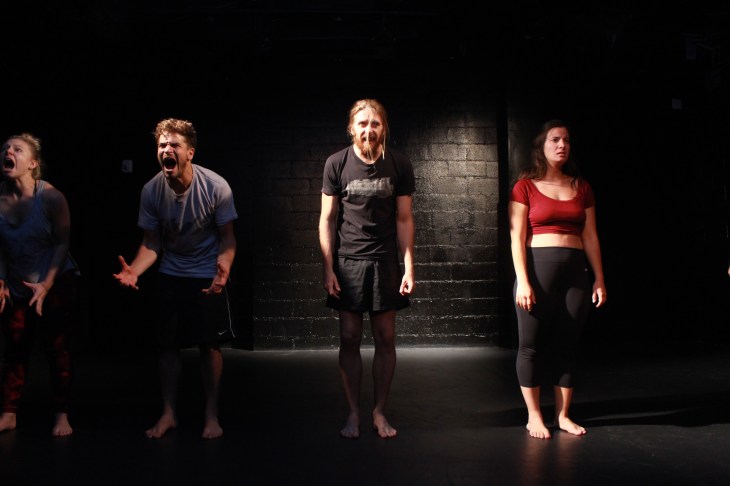
The How: What We Do, part of the 3B Development Series, currently running at IRT Theatre 154 Christopher St. NYC #3B (third floor), is a daring and engrossing movement piece developed by the artists in the rehearsal process and explored through improvisation.
What We Do runs the gamut of attention, attraction, separation, and oneness. It is a fluid
kinetic representation of what it means to part of a whole or wholly apart. Joshua Crone reviewed it in OuterStage saying it is was compelling, organically choreographed and deeply moving.
The mesmerizing experience runs through this week, closing on August 2nd before the next performance piece moves in. Directed by Polina Ionina; William Hand, Shay Wisniewski, André Vauthey, and Rosalee DeHuff are featured.
 André Vauthey, a doctor turned actor, had a truly unique story to tell.
“I am a young Swiss doctor-turned-actor who moved to the states about two and half years ago. My parents are polish and I was born and grew up in the French part of Switzerland before moving to the German part to study med school. After graduating and working as a doctor, I realized that even though I was doing a very meaningful work, I wasn’t living in harmony with myself, mostly due to the amount of administrative work in comparison to the actual patient’s time. I decided to quit the hospital to take time to myself and make sure I was where I wanted to be and it wasn’t just a consequence of my past decisions. As I wandered in my inner self, I remembered that as a kid I used to love acting and would even force my older brother to perform in front of our parents. So I decided to give it a try. I went to the pinewood studios in London for an acting workshop and loved it. Back in Switzerland I started acting in some films but felt like I need more guidance and decided to move to NYC to study at the Lee Strasberg’s Theater and Film Institute. When I first moved here, I thought it would be just to complete a one year program at my acting school and go back to Europe to work as an actor. But I fell in love with both the city and the school and decided to complete their entire two year conservatory program and stay here. I would say I learned as much about the craft of acting as I have learned about myself. This has been an incredible journey and my state of mind has changed forever. By knowing myself better, I am now so much more expressive and open to this world and to the art. It is a wonderful feeling.
That is an amazing story! What made you want to come to America and thus, New York?
Well there are different reasons. First of all, I lived in NYC with my parents when I was 1 year old for a year and always saw those pictures without remembering any of it. So something in me was attracted by it. Secondly, I was/am always attracted by the energy and the chaos of this city. I felt like something truthful, expressive, raw must exist there. I remembered when I first moved here, I was quite disappointed. Everything seemed too normal. But slowly and gently, the spirit of NYC and Brooklyn came to me and I love it. Finally, the opportunities here are different than in Switzerland. I love Europe and want to do projects there too, but it’s a very different way of seeing the work. Both are great, just different.
Tell us about this presentation, how does movement in it tell the story?
This presentation and this ensemble is another blessing that just came to me. As I started studying acting I realized that I was what I was convinced I wasn’t: quite intellectual. It took me a whole year to realize that. During the second year, I gently and slowly started to drop from my head to my body and my acting changed a lot. One thing that helped me a lot with that was movement exploration. I started to go to Butoh, Gaga, 5 rhythms, ecstatic dance and that changed my acting and my life. I became way more expressive and in touch with my body and as all this was happening and found on backstage an audition for a movement piece and felt like everything was aligned. I performed with the ensemble for the first time about three months ago and again now. For me, movement and body language is the key of truthfulness. The body doesn’t and can’t lie. There aren’t any words to support you, to support you at moments you don’t feel it. There aren’t any escapes. It’s just you, your feelings, and your body to express it. No lies, no deviations, no intellectualization, pure truthful emotions and the journey told this way is incredible. The audience response to it is wonderful. It talks to people straight to the core. And everyone feels it in their own truth which is the best answer any artist can get. A friend of mine was so touched by our piece, she felt moved but as well felt compelled to put that energy in motion and start her own journey. It’s wonderful when the audience is not only entertained during the show but when something in them shifts and brings them to change things afterwards. More pragmatically, this presentation explores the self in regard to oneself, to others, the self alone, the self in group, the self-facing itself, and the self being part of the whole. We had the opportunity to bring our personal movements in it as well as explore the movement of others and explore the creation of common movements. It is so interesting and thrilling to be able to explore so much with our body and soul. Working as an actor presents many challenges. Working in another country far from friends and family presents challenges as well. Working as an actor in another country… well you get it. I feel very lucky and humble because I am actually performing quite often and doing beautiful work with wonderful people.
What are/were some difficulties in working here?
At the beginning the hardest part was to get a balance in life. As an actor, you are your own boss and make your own schedule, so it’s easy to procrastinate or to feel overwhelmed. But you learn and grow. Now I feel like I have a nice balance between work from home, work on projects and nature and friends. The hardest part now I guess is for me to get people to see my work, to get an agent, I guess to “break through” as people say it. There are so many actors, so many plays being performed, that it is hard to get an agent or manager’s attention, which is understandable. But I am very positive and feel like I am exactly where I am supposed to be and things will come along when they do.
What’s in store for us from you here?
Well I just came back from an international tour as the lead and am now in this show. As soon as we close, I start rehearsing for two other plays: Cocaine and Dreams and Nightmares. As well as for a short [film] that is being shot in two weeks. I am myself writing and exploring a play about what it means to be an artist and so, to some extent, to be a human being.
FOR FURTHER INFO: http://irttheater.org/3b-development-series/what-we-do/
Ai Spotlight: Arts Veteran Laurie Rae Waugh
Independent theater has many heroes but even more unsung ones. The splintered nature of the independent theater scene makes it difficult to truly celebrate some of its more prolific artists. The myriad theaters, companies, and even festivals, make knowing who is making a difference very difficult. You could be seeing a show on a block in Manhattan and still not be aware of all the others shows on that block. Even festivals. Go see a show with a friend in it and look in the playbill – how many people do you know in the same festival but never knew they were there!
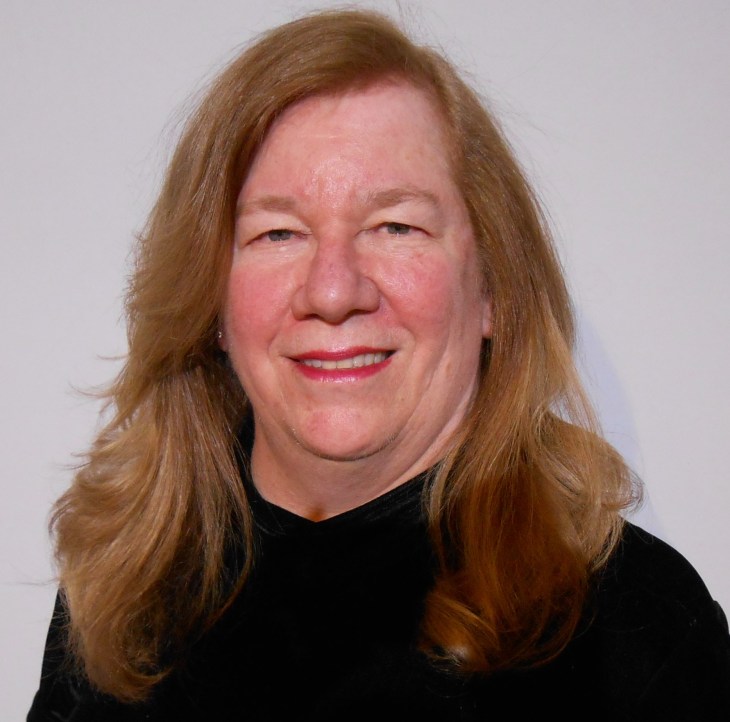
Laurie Rae Waugh has been a power-players in NYC for near 40 years, but her humble nature and desire to simply do good work has made her one of New York’s best kept secrets.
Well, not everywhere. She is a repertory director at a theater that has been around as long as she has: the American Theatre of Actors. Representing the works of many playwrights including Jame Crafford, Irving Greenfield, Shirley Beth Newbery, and the late Steve Silver, Laurie’s signature soft-touch has given their plays a sensitivity that is engaging yet organic.
Whether it was out of humility or desire to not age herself, Ms. Waugh – in interview – “accidentally” left out the dates of her first works, but her entrance was easy to figure as she stage-managed a moment in history. Before Broadway Cares/Equity Fights Aids, she ran the show at The Ballroom in 1987 for STAMP OUT AIDS – dedicated to Michael Bennett.
Share with us your firsts.
There have been several firsts on the acting front. My first time in an acting role in NYC came about when the late playwright, Steve Silver expanded his one-act play “The Watchtower” and turned it into a full length play. Steve wrote a character specifically for me to play. The character was his wife’s older sister, Molly McCann. I reprised the role of Molly in the film version he developed and that was also a first for me on film. Steve later wrote a one act play called “The Tiger of Greenwich Village” and he asked me to play the leading role. Steve said that he had complete faith in me to pull it off and with the help of Ken Coughlin as the director I was able to do just that.
I first got into directing through the TSI/Playtime Series where I directed 3 one-act plays. One of the plays “Rage, Inc.” by Le Wilhelm happened to be part of a group of plays that I went to see some friends in. I mentioned to the man sitting next to me that I would have to leave the theatre before the play started because I didn’t want to see how someone else staged it as I was currently in rehearsal for my vision of the same play. The funny thing was that I got to meet Mr. Wilhelm that evening and we discussed his play in depth. My next first was working with EndTime Productions for 2 years on their Vignettes for the Apocalypse and Naked Holidays NYC Series. This was a different concept for me for several reasons. We sat thru a day of auditions and then a day of call backs. We put our cast list together and had to hope that you got the cast you wanted because other directors wanted the same actors. My next first was responding to an advertisement in Backstage for directors. The ad was placed by Mr. James Jennings of the American Theatre of Actors. I had a meeting with Mr. Jennings and was given the opportunity to read many one-act plays until I found the one that I liked. The play was called “Trailer Trash Deluxe” by Laurie Allen.
My first taste of producing happened when I started a Theatre Company with two partners called Legacy Stage Ensemble. LSE was dedicated to bridging the artistic and cultural gap between experiences, training and concerns of different generations. Its productions, both original and revival, tackled topics about personal crisis and social bias. Our two productions were “The Acting Lesson” by Wesley St. John and “The Gray List” by Allan Provost. We lasted for two seasons before my two partners careers went in other directions.
When I moved to NYC in 1980 I got my first Stage Managing job for the show “Notes from The Underground” by Fyodor Dostoyevsky. I staged managed 21 shows in my first 7 years. The most notable one was STAMP OUT AIDS a one-night only show at The Ballroom on 7/4/87 dedicated to Michael Bennett. This was before Broadway Cares/Equity Fights Aids.
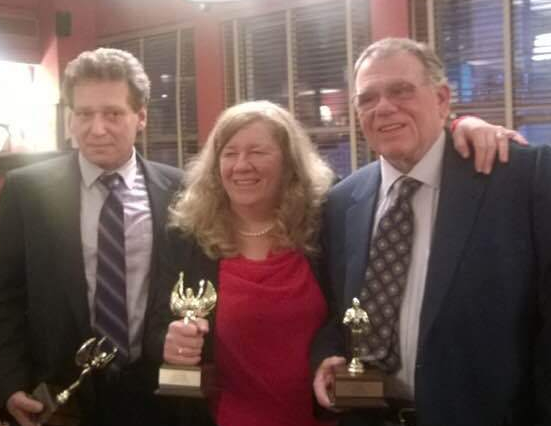
Waugh (center) is flanked by old buddies: The last Steve Silver (left) and character actor, Thomas J. Kane. All winners of the Jean Dalrymple Award – off-off Broadway’s first honor.
Family is an importation factor to Ms. Waugh. Thus, she aims her director’s baton at works with a family foundation. She has mastered stage conversation so her family plays look like real families chatting.
What kind of plays are you drawn to?
I select plays that call to me. It might be the subject matter, the way in which it is written or just the dialogue that has me see a vision in my mind’s eye. Most of the plays I direct are dramas. The themes are mostly about family conflict. I have worked with a couple of playwrights on multiple projects and have gotten insights from them about why they wrote the play in the first place. The great thing is that they continue to hand me meaningful scripts to direct.
It’s that same light touch that has allowed her to take a strong place in the line-up of directors ion NYC. What was once a male-dominated industry, she stood her ground and kept getting the world to listen.
What’s it like being a woman in the arts in the (now) 21st century….and how have things changed?
When I first started doing theatre in NYC back in 1980 almost all the director’s I worked were men. I believe I only worked with one woman director. As a woman, it takes time, perseverance and the right play to stand out in a crowded indie theatre scene. It takes the help of social media, word of mouth, and publicity to put your project on top and to make you stand out from the rest. For me personally, I hired a publicist several years ago and he has been able to get my projects in the press, mostly online, and recently I participated on podcasts.
Entering the world of film, she teamed with Steve Silver some years ago to create “The Watchtower” an award-winning independent film that has since seen great acclaim and distribution. As she took many thespian-friends of the stage with her, the transition was relativity smooth.


Film or theatre……differences? If you had a choice?
The first part is an easy answer, theatre. Theatre is live, has a pulse, and anything can happen on stage. From forgetting lines to missing cues to enter or exit the stage. Props not being set in the right place, and having an actor bring props onto the stage for the next scene. With film, you get to have several takes until the final product looks the way you want it to look. You also have the benefit of utilizing different camera angles and lighting to forever capture the right moment. Theatre will always be my first love. I love to learn new things and improve upon the skills I possess. For this reason I have a desire to learn more about film production.
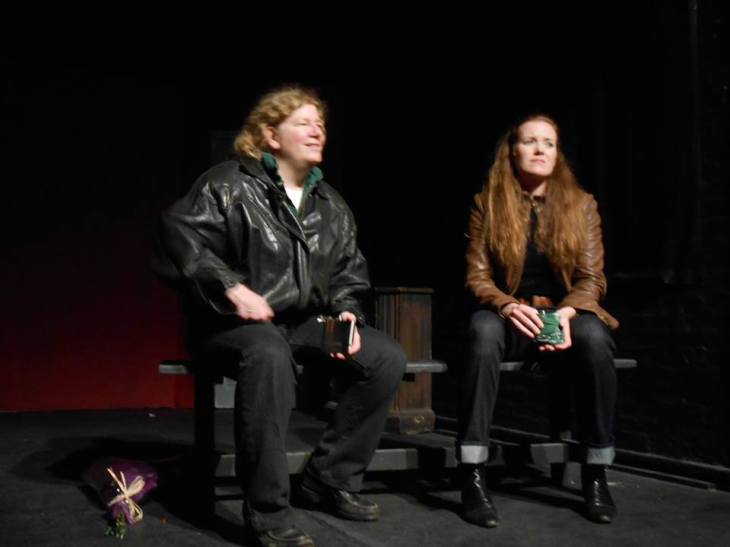
Laurie Waugh on stage in a Steve Silver play
Stanislavsky-styled, she creates a cohesive situation among her casts/crews so that they feel respected and the process-fluid. One might say she creates a family to play a family.
What is your creative process?
My creative process evolves and changes from project to project and from cast to cast. I usually allow the actors freedom to explore their characters through the dialogue and movement around the stage. With my current project, we are spending time on some of the stage direction that the playwright has written into the script. Sometimes we have to stop and start a section a few times to make it feel fluid and realistic. I also share parts of my life with the actors so they can see a human side of how I see the character and my vision for the play.
There are about four or so spaces in New York left from the great indie theater movement that started in the late 50s. LaMama stands at the forefront with The Medicine Show still thriving, but – standing like a beacon in midtown – is the American Theatre of Actors. This is Laurie’s “home.”
Why ATA?
Easy question as well. Mr. James Jennings has encouraged me from the beginning to be my best. He allows me to pick my own projects and he has seen every play I have directed. The environment Mr. Jennings created at ATA is very welcoming and nurturing and provides you with the ability to hone your craft. ATA is conveniently located at 314 W 54th St. in Manhattan. The ATA building contains three theatres and ample rehearsal space that we are able to utilize for everything from auditions to rehearsals and on to opening night of the show. I also get to work with very committed and talented people.
Money-driven societies always have the renegades that simply want to “do the work.”
WHY DO YOU DO IT?????
For the love of it of course. I enjoy taking a play from the written word to a piece of entertainment. Putting my spin on the production and hoping the playwright enjoys what they see. I believe it’s all about being true to the words of the playwright. I truly care about the writer’s opinion in my productions because without them I wouldn’t be directing.
And when you love it … you keep doing it.
What’s Next?
I have three more projects in the pipeline. In November of 2019 I will be directing a one-act in a series of One Acts. The play is called “Footprints of the Polar Bear” by Phil Paradis. Early 2020, I plan to be acting in a play called “After the Lynching” by James Crafford. In spring 2020 I will be directing another play written by one of my favorite playwrights Mr. Irving Greenfield. The play is called “What do we do about Walter?”
LAURIE RAE WAUGH’S CURRENT PROJECT:
The wit of playwright Shirley Beth Newbery coupled with the steady hand of director Laurie Rae Waugh will make even the saddest occasion a joy in AFTER THE WAKE, running Wednesday – Sundays, August 7 – 18 at the Serene Sargent Theatre – part of the American Theatre of Actors complex of art-houses. Wednesday – Saturday at 8:00 p.m. and matinees on Sunday at 3:00 p.m. Tickets $20 at the door.
American Theatre of Actors is located at 314 W. 54th Street
New York City, 212.581.3044
Universal Themes that are all in our heads.
 The play, directed by Lester Thomas Shane, premiered last week at the 2019 Fresh Fruit Festival and ran for four performances. Cooper Koch, a Pace University Theater alumnus, played Kyle, the lead character. Austin Larkin, who hails from North Carolina, played Second Actor, portraying Kevin, Greg, John and several other parts. Both actors have worked steadily commercially and in a variety of New York, regional, and experimental venues.
Dan Woods loves theater and writes about technology at www.EarlyAdopter.com and in other publications.
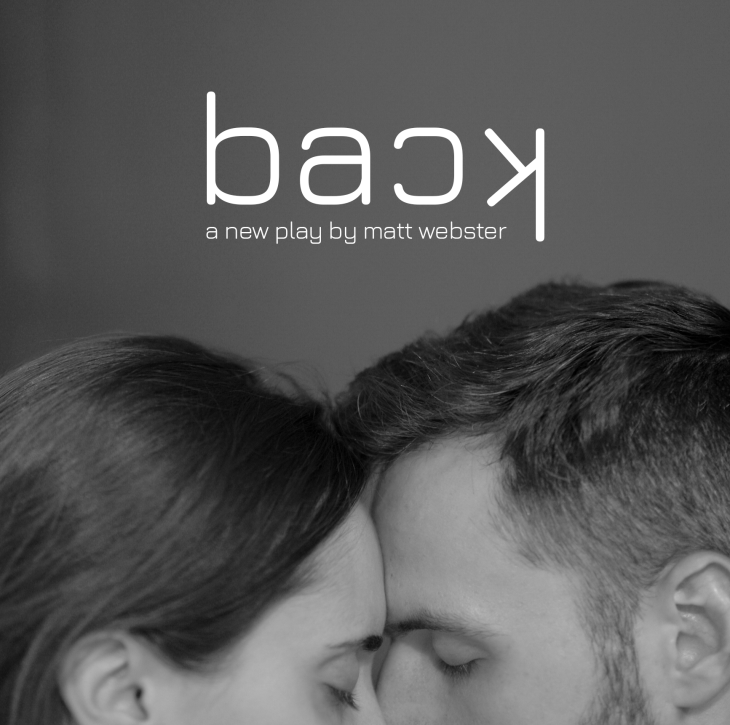
Matt Webster goes forth with BACK
A featured event in Ken Davenport’s inaugural Rave Theater Festival is BACK, a new play written by and featuring Matt Webster with Terra Mackintosh and directed by David Perlow
This 90-minute drama will perform on Saturday 8/10 @ 2:15pm; Tuesday 8/13 @ 8:45pm; Friday 8/16 @ 7pm; Sunday 8/18 @ 4pm; Friday 8/23 @ 9:15pm with tickets being available at http://www.BackThePlay.com (further info at @BackThePlay)
Leah travels to New York City to reconnect with her best friend Derek. Their undeniable chemistry and inherent trust would otherwise make these two a perfect match, if it weren’t for something in the past keeping them apart. Leah tells Derek about an incredible opportunity: a chance to go back in time and change the course of their lives. But there are rules about altering the past that could have devastating effects on the present. Will they risk everything in search of a second chance at life?
 Playwright/Performer Matt Webster recently performed on Broadway at the Hudson Theatre in DGF Toasts: Stephen Schwartz. In addition to singing in the show, Matt contributed the vocal arrangements.
So that makes him a Broadway actor and arranger.
Matt has been seen onstage as Glad Hand in the Broadway Tour of West Side Story and won BroadwayWorld’s Best Actor Award for his portrayal of Johnny Pope in A Hatful of Rain.
So that makes him an acclaimed Broadway actor and arranger.
Matt can also be seen on screen in various feature films, commercials, web-series, and short films.
So that makes him an acclaimed Broadway actor, film artist, and arranger.
As a writer, Matt’s first musical, Kingdom Come, won Best Musical at the Downtown Urban Theatre Festival in NYC. Since winning the festival, Kingdom Come has been featured at the New York Theatre Barn and the Secret Theatre in Long Island City. Kingdom Come made its regional premier at Concordia University in St. Paul, Minnesota. His second original musical, Propaganda! The Musical was produced at the Pearl Theatre on 42nd St. as part of the New York Musical Theatre Festival. It won several awards, including: Best Featured Actress and Best Choreography. It had its regional premier in Orlando, Florida at the Winter Park Playhouse in 2017. Propaganda! The Musical made its international debut at the Gaetnerplatz Theatre in Munich, Germany in July of 2018. This summer, Propaganda! The Musical will be released as a one of a kind, fully produced, podcast musical, featuring a full sound design, complete orchestra, and a cast filled with Broadway stars. Matt’s children’s show, a fast-paced, four-actor version of Cinderella, featuring songs from the Great American Songbook, premiered in March 2017 in Washington, DC with the American Pops Orchestra. He is currently writing several projects including: a new adaptation of Shakespeare’s Much Ado About Nothing featuring chart topping country hits; a film called “Super,” about the opioid epidemic in Ohio; and a new play called Jay and the Contest. He received his BFA in Acting from West Virginia University where he was named the outstanding graduate from the College of Creative Arts. Matt is a founding member of the Magic Forest Theatre Company – a traveling children’s theatre that performs at pre-schools and daycares across the NY Metro area. Matt won the 2016 Johnny Mercer Award for Songwriting and currently works as assistant to Broadway’s Andrew Lippa.
Well, that makes him an acclaimed Broadway actor, musical writer and arranger, film artist, with a diverse portfolio of projects befitting innumerable demographics.
Not too shabby.
So we wanted to chat with Matt about BACK. This foray into fantasy and realistic romance is a featured piece at Broadway producer, Ken Davenport’s inaugural festival in NYC.
Tell us about yourself as an artist?
Dandelion: A New Musical Grows in NYC

Over at the last of the classy supper clubs, Feinstein’s/54 Below, a Dandelion is growing. This Dandelion will blossom for one night only bringing a new musical to the place where musicals grow best. August 14 at 9:30 p.m. a heartbreaking musical called DANDELION premieres.
The soil behind Dandelion is the story of high school senior, Jane, and her mother, Delilah, and how the two are forced to confront guilt, responsibility, and sacrifice. Jane must decide between attending college or remain at home to fare for her mother who is withering under a desperate battle with mental illness and drug addiction. opioid addiction.
The female-driven Dandelion features music and lyrics by Colleen Francis and Bill Zeffiro, book and direction by Jessica Francis Fichter and Sean Riehm, and has been developed in collaboration with Hailee Beltzhoover. Musical Director, Nevada Lozano guides artists Hailee Beltzhoover, Lillie Ricciardi, Allison Siko, Brenden MacDonald, Brianne Wylie, and Miranda Luze.
Tickets and information are available at www.54Below.com. Tickets on the day of performance after 4:00 are only available by calling (646) 476-3551.
A thru-line of many of this months Five Star Arts articles centers on the creative process. So we grabbed the creatives on how they got that way.
Tell us about yourself.
Director Jessica Francis Fichter: I grew up in Columbia, South Carolina and was always a self proclaimed theatre nerd. I think I feel in love during a school production of Really Rosie when I was five years old- I played a bluebird (and no that is not a real role). After graduating from Winthrop University with a degree in theatre education, I taught theatre in both middle and high school public schools for 8 years in addition to acting as the artistic director of a theatre company in SC before moving to the city to pursue my MFA in directing. I am a mother of 2 small children, 8 years old and 4 years old, and have been navigating the NYC theatre world for 2 years. I recently directed The Eleventh Hour at Townstages, and Assistant directed Shadows: A Dance Musical at the Connelly Theater.
Colleen Francis (Musics/Lyrics): I am a singer-songwriter based out of Dallas, TX. My main experience is with pop and country artists, however, when my sister brought the idea of the Dandelion to me, I jumped at it. I was always into musical theater growing up, and enjoy songs that can cross over to pop/rock charts, namely Rent, Spring Awakening, Dear Evan Hansen, Waitress. I am very excited to bring my experience writing in the pop world to musical theater. Tell us about this play … why did you choose to work on this?
Tell us about this play … your inspirations? Your “plan?”
Director Jessica Francis Fichter: This musical is a story that is close to my heart for many reasons. At its core it’s a story of a young woman finding her own way- forging her own path despite obstacles far beyond what a seventeen year old should be faced with. But as we all know, what should be and what is do not always align. This positive, high school female-driven story of strength is begging to be told and I am grateful to have the chance to tell it. And on a personal note, this is a story of someone I know and love, and the truth of her struggle may be what another family needs to find their way through the labyrinth of mental health and drug addiction. It’s also a story of responsibility and family and what we owe ourselves versus what we owe those closest to us. They are not questions that can be answered in 2 hours but they are certainly worth asking- and I honestly can’t tell you if everyone will agree with Jane’s decision in the end but maybe that is the point.
Colleen Francis (Musics/Lyrics): In college, I had my first brush with the correlation between mental health and drug addiction. Seeing a long-term friend of mine cross into a period of amphetamine-induced psychosis was very difficult to cope with. I was caught between the role of caretaker and instigator. At the time, I didn’t really understand how mental health and drug addiction can be so closely tied, or how they can have profound effects on close relationships. In our musical, we hope to touch on the difficulties of coping with family members who suffer from these conditions.
What is your “creative process”?
Director Jessica Francis Fichter: Working with my sister who is a singer/songwriter in Dallas has been challenging, involving many trips back and forth and late night conversations but it has also been extremely fun to share our creative talents with each other. We are excited to finally have actors in the room, because each individual brings their own perspective and thoughts to the piece and nothing can replace the creative energy of a room full of excited actors collaborating on your work!
Colleen Francis (Musics/Lyrics): I spent a lot of time putting myself back in that place – thinking about the pain and anxiety that it provoked in me – thinking about the struggles that my friend was going through. It honestly puts me in a very emotional place. Throughout the process, inspiration and recovery were two words that kept coming back. I wanted the music to touch on the darkness but maintain the aspect of hope.
Who do you feel is your “audience?”
Colleen Francis (Musics/Lyrics): Anyone who has a friend or family member who has struggled with mental health or addiction… so everyone. The music is certainly more youthful, and younger audiences may connect with it more easily, because of the coming of age aspect.
What’s next?
Director Jessica Francis Fichter: We are hoping to find a lead producer who is excited about the story we are telling and the right fit for the Dandelion team. We are thrilled to follow this journey in whatever direction it takes us. For me personally, I am working on a female driven devising piece called If Women Rose Rooted and finishing my MFA at the Actor’s Studio Drama School.
Colleen Francis (Musics/Lyrics): After this showcase, we’d love to get it on its feet. We need to workshop out the book and the overall flow. We’re taking each step as it comes. It’s a long process, and we want to do what’s best for the whole project.
For further info, visit www.dandelionmusical.com.
The Mime Talks-the-Talk
Bill Bowers-All Over the Map-Review by Jen Bush
 Once upon a time, there was a mime. That would be a great alternate title to Bill Bower’s show because he is, indeed, a storytelling mime. Within moments of seeing his show though, it’s pretty evident that this artist’s talents go way beyond miming and storytelling. Bill Bowers is a multitalented performer who can act and can ease in and out of male and female accents to accent-utate a story.
Out of the gate, the show was strong. Bill Bowers jumped right into the first story. There was no exchange of pleasantries and no exposition. There was just narrative and good narrative at that. Chairs were widely utilized as props and some audio-visual material served as enhancements to some of the stories.
If you are expecting to see 60 minutes of mime, you’ll be disappointed. That’s not what this evening was about. Your craving for mime, if you have one, will be satiated on a small but tender scale with a beautiful moonlight mime sequence that will tug at your heartstrings.
You’ll be regaled with tales of talented rabbits, nudists, the Amish, The Happy Hooker and more. If you feel the tales are too outlandish to be true, the ending of the show will provide definitive proof that they are absolutely true and very outlandish.
We think of mimes as mysterious elusive people, but Bill Bowers was transparent, genuine and wore his heart on his sleeve. Each story he told held consistent interest and had clever endings. There was plenty of energy, humor, passion and exuberance to go around. If you find yourself trapped in an invisible box, get out for one night to see this wonderful show.
William Considine and The Greeks
Women’s Mysteries
Review by S. A. Holland
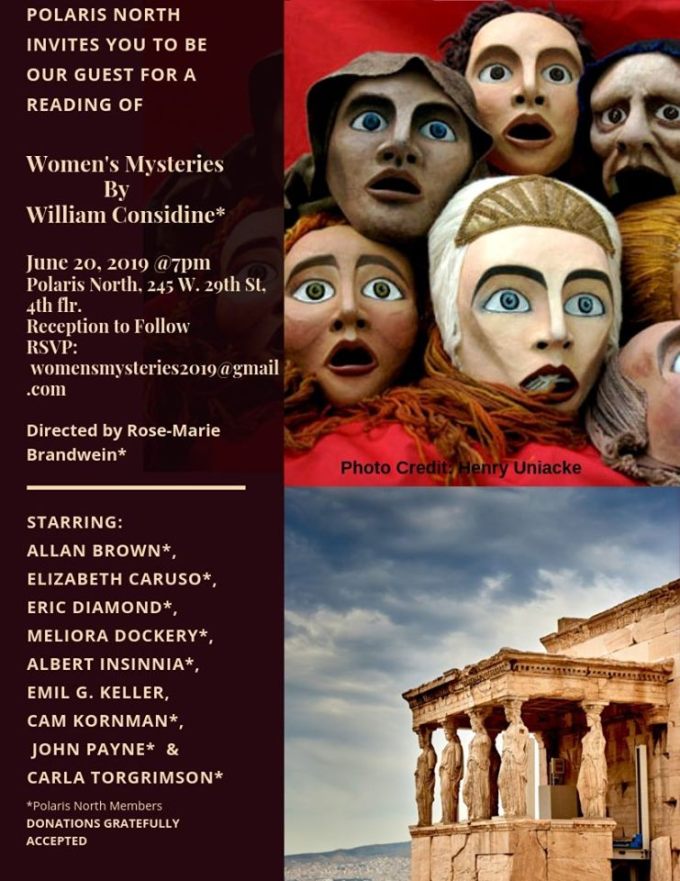
When I first heard that William Considine was going to have a reading of his play, Women’s Mysteries I was more than a little intrigued.
As a classics aficionado, with a long-standing interest in ancient Greek religion, I wondered how he would be able to pull it off, given that, to this day, the Eleusinian Mysteries remain enveloped by an impenetrable shroud of secrecy that all initiates, ever, adhered to rigorously. My other reaction was a minor twinge of jealousy, as the displacement of chthonic matriarchal goddesses, has been a topic of active research for me for the past year or so. However, eventually I found out that this project has been in gestation in the writer’s mind and on paper for almost three decades. William Considine also wrote The Furies, a trilogy of verse plays, published by The Operating System, 2017, as well as the contemporary play about family dynamics, Moral Support, which was produced this year at the Medicine Show Theatre.
Prior to attending the reading, given at Polaris North, I had been advised by William Considine to revisit Plutarch’s story of Solon, the Athenian lawgiver. And indeed, that was how William Considine solves the problem of writing about the unknowable Eleusinian Mysteries – he focuses on an historical figure – Solon – who had contact with the cult initiates. He does not pretend to reconstruct or confabulate the ceremonial rites for twenty-first century eyes. Instead, he ingeniously structures scenes around the Mysteries while incorporating only certain known elements: such as the sacrifice of pigs, the execution of men who were foolish enough to stray into the sacred precincts, and the use of a barley and mint drink, the kykeon, which may or may not have included an hallucinogenic drug. Rather than risk potentially inaccurate speculation about the Mysteries, he instead shows the female characters attempting to re-establish the rites after a twenty year hiatus.
Women’s Mysteries, was performed at a staged reading Thursday night, June 20th, 2019, 7 pm, at Polaris North, 245 West 29th Street, New York, N.Y. The reading was expertly directed by Rose-Marie Brandwein, and the cast was composed of Polaris North members, most of whom took on multiple roles in the production.
Very little has come down to us about what actually occurred at these rites at Eleusis – the initiates, after days of purification and preparation, would make their way from Athens to the sanctuary building, or Telestarion, on foot, a 14 mile journey from Athens undertaken both in the spring (Lesser Mysteries) and the fall (Greater Mysteries). The initiates, who came from all classes, (even slaves), were sworn to secrecy, and nothing of what was shown in the sacred precincts is known to us. References to the experience were deemed both forbidden and unspeakable. The participants in these profound spiritual experiences , which had two stages of initiation, myesis and epopteia, seemed to have emerged from their experiences with a profound sense of personal connection to the goddesses, and henceforth lacked a fear of death. The religious experience was transformational – eventually, men were allowed to take part in the Mysteries. Socrates, Plato, and Augustus were all initiates. Despite intensive efforts to reconstruct these rites, we have only an outline and informed scholarly speculation.
As noted above, the focus of the play is on Solon. Solon lived in Archaic Greece around the time of Hesiod, a time, as the playwright puts it, which was “prior to the classical period. It’s a poor, primitive world.” Not only was this world primitive, but there were temporary restraining ordinances: talk of war was verboten, punishable by penalty of death. And yet Solon, following the dictates of the oracle of Apollo, a comparatively “new” god whose oracle at Delphi he pledged to protect, yet simultaneously viewed with deep skepticism, managed to find a way around this restriction. In the play, he risks death, pretending to be mad so that he will not be penalized, and recites an incendiary poem entitled Salamis, designed to foment war between the Athenians and Megarions.
For those who are unfamiliar with Solon, or need a quick refresher, he was an Athenian statesman, lawgiver, and poet. His life’s work prepared ancient Greece for democracy. As portrayed in Women’s Mysteries, he is boundlessly curious, eager to make money, and wants to rectify disparities between the wealthy and the poor. (Prior to his reforms, those who owed money could literally be taken off and enslaved for their debts.) He successfully restructured debt in Athenian society, and moreover was able to accomplish this in a way that the economy of Athens did not crash and burn.
According to the director, Rose-Marie Brandwein, the actors in the play all have backgrounds in Shakespearean productions, which explains the ease and aplomb with which they handled this verse play. Many of them undertook several roles, although Eric Diamond (Pisistratus), John Payne (Solon), and Carla Torgrimson (Chorus) all had solo parts. Cam Kornman was extraordinarily enthusiastic and commanding in each of her roles, as Basilinna, Python, and the Chorus.
In staging the reading, the director incorporated certain understated elements that made it simple yet extremely effective: the men, the war-fomenters, wore dark clothing, and the women wore white or light clothing, to emphasize their purity and devotion to spirituality. No masks were used in the production, which is just as well, since the actors were reading from the scripts, and the costumes were limited to wreaths and scarves for the Oracle of Pythian Apollo and the female worshippers of the Double Goddess.
As Considine writes of Demeter, goddess and mother in mourning for her daughter, Persephone, brutally abducted by Hades:
“Only Hecate, stirrer of witches, heard
A startled cry from the girl pulled to hell…
Persephone, a child, was stranded
In eternal darkness, at the side of death.”
The poetry of the play is by turns beautiful, stark, and evocative, particularly in the scenes that depict the worshippers trying to revive the cult at Eleusis, and it is in these scenes that William Considine manages to evoke the cadence and gravitas of ancient poetic funeral inscriptions found on steles at the sites of Eleusis and Delphi. There are also moments of humor and absurdity, and at times the character of Solon displays a sort of meta-consciousness about his situation and that of his companions and/or detractors. This made the reading absorbing to watch, especially in the moments when the language and acting attained a solemnity that allowed the audience an immersive experience in the ancient world of the play.
To my knowledge, there is no extant play, ancient or modern, that depicts Solon. An account of the Eleusinian Mysteries is recorded in a chapter of Apuleius’ The Golden Ass, and there are numerous scholarly books that painstakingly aggregate and analyze what is known about the cult, from the literary fragments, relics, and archeological remains throughout the ancient world, such as Carl Kerenyi’s Eleusis or the works of Walter Burkert. This makes William Considine’s play a novel and interesting experiment that tries to convey a sense of what was a profound religious experience for many in the ancient world, one which endured for well over two thousand years.
This is not to say that there are no issues with the play in its current form.
While the attempts of the women to revive the Eleusinian Mysteries contains some of the most moving parts of the play, its focus is nonetheless on Solon, specifically his transformation from itinerant poet and trader to an Odysseus-like schemer who devises an elaborate ruse to make war on the Megarions in order to reclaim Salamis for Athens, despite the stringent prohibitions against war talk in Athens. The transition from dreamy poet to war-monger needs somewhat more delineation, because we are never shown anything, other than Solon’s desire to follow the oracle of Apollo, that would impel him to risk his life to abet a war. We lack an understanding of the elements of his personality which would allow for the radical turnaround from ardent wandering poet to deceitful determined warrior. Further exploration by the playwright would be beneficial.
Leaving aside the character development of Solon, the women in this play are portrayed as resolute, dedicated to serving the Double Goddess, diligently working to revive the cult of the Mysteries after the too-long hiatus brought on by the disruptions of an exhausting war. They are so focused on this mission, that they tend to be mostly archetypal. The cult of the mother Goddess is disparaged by the men, as well as by the female Python, Oracle of Apollo:
“I won’t do the snake dance again.
I’m clean of the snake. It’s a goddess rite,
As old as the women’s mysteries.
It’s a lie to people of clear mind.”
Despite the machinations and maneuvers of Solon, the last word is given to a woman, in the persona of the goddess Persephone, daughter of Demeter and Queen of the Underworld. The ending is oracular and devastating. I would love to see a full scale production of this play – the verse flowed well from scene to scene, alternating smoothly between lyricism, discourse, and action and the subject matter is well-handled and inherently fascinating.
Guest reviewer, S. A. Holland lives in the Hudson Valley. She studied ancient Greek language, literature and history while at Princeton. During her time there she was the producer of Euripides’ “The Bacchae,” in ancient Greek. She worked in publishing for several years as an editor, and then began to work in the computer industry as a consultant and technical writer. Currently she writes poetry in Filip Marinovich’s writing group “Motley College” at Page Poetry Parlor in Chelsea and regularly keeps up with scholarly works on ancient Greek religion, in addition to running her own business full-time.

Robert Viagas and Two Crazy Broke Asians
The American Dream: a Story of Two Crazy Broke Asians
By Yanzi Ding, Grace Shih, Kui-Fang Tseng and Maya Avisar
Reviewed by Robert Viagas
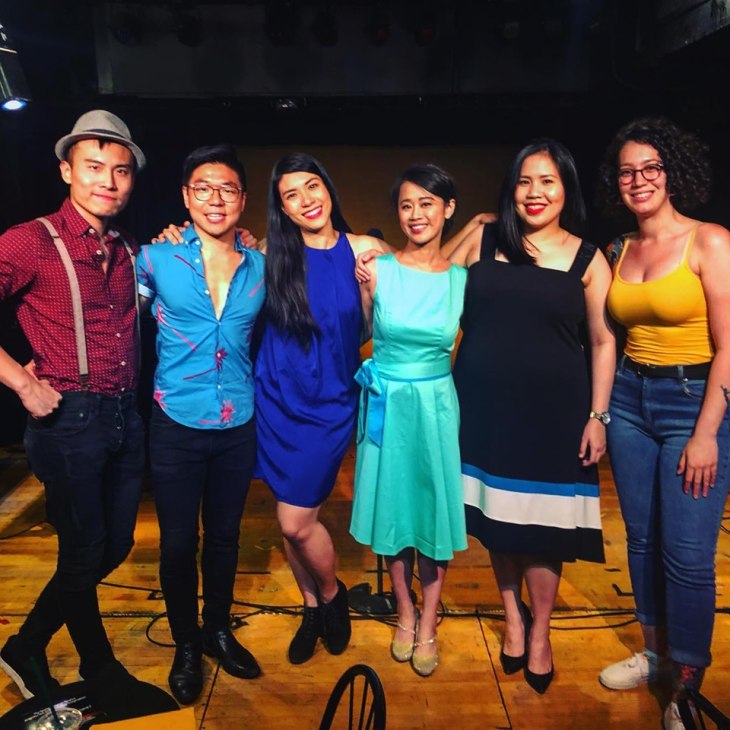
It’s a timeless New York story, celebrated on stage in Wonderful Town and told countless times before and since: penniless newcomers arrive in the big city, looking for love, fortune and fame. Hearts are broken, dreams are dashed—but new dreams take their place and love is found in the least likely of places.
The twist in the latest incarnation, the 50-minute musical cabaret show The American Dream: a Story of Two Crazy Broke Asians, is that the newcomers are East Asian: Grace Shih and Yanzi Ding. They present their wry romantic story as the flipside of the hit movie comedy Crazy Rich Asians
Shih arrived first and knows the ways of the city a little better. She acts as a big sister and confidante to Ding, an ingenue who steps off the plane in a Miss Saigon-like pursuit of an American boy she met back home. Ding gets a tough lesson in the ways of love in New York, but eventually learns to love the city, and her “sister” on their own terms.
American Dream features pre-existing songs, many with new lyrics, mostly from Broadway shows and musical films. One of the funnier conceits of the show is that Ding has learned English from Disney musicals and speaks extremely well—as long as she’s saying something from one of the Mouse House classics.
As the highlight of this show, Ding lends her lovely soprano to “Part of His World” from The Little Mermaid, does her own sprightly vegetarian take on “Happy Working Song” from Enchanted, and breaks hearts with “Another Suitcase, Another Hall” from Evita.
Among Shih’s contributions include sturdy versions of “I Get a Kick Out of You” from Anything Goes and “Simple Little Things” from 110 in the Shade. The two women cement their friendship with “For Good” from Wicked.
Leo Chang appears as a heartthrob interest for Grace, and adds his leading man stamp to “Almost Like Being in Love” from Brigadoon. Diversely inspired musical accompaniment is supplied by Ming-Hsueh (Mitch) Lin on the piano.
Directed by Kui-Fang Tseng, produced by Maya Avisar and supported by the Alliance of Alien Artists, The American Dream: a Story of Two Crazy Broke Asians played a single scheduled performance at The Duplex cabaret in Greenwich Village.
Standing with Jazmyn & Janelle is Step 1
No celebration of indie artists would be complete without raving the inexhaustible energy and engaging talents of Jazmyn Arroyo & Janelle Zapata Castellano, the brains, the muscle, the wit, and so much behind Step1 Theatre Project. Step1 Theatre Project is an NYC-based indie theatre company whose mission is to present professional works presented by underrepresented artists while providing accessible support to members of the local indie theatre community.
Their next piece is a deception in a deception: A noir mystery that looks like a Frank Miller comic book but packs a devastating conclusion: Mahogany Brown and the Case of the Disappearing Kid.

Janelle & Jazmyn make youth outreach a major facet of Step1
Step1 has made a commitment toward creating new, innovative ways of supporting fellow artists. They seek to be a company of #ArtistsSupportingArtists–to foster growth and inspire the next generation of theatre makers; to encourage them to present their projects fearlessly, regardless of financial and social barriers. With every artist support initiative and every story Step 1 tells, they encourage all who have a vision to start and keep moving forward, one step at a time. Well, hooray, ladies, A.i. is here to support you.
We were sworn to secrecy over the twists and turns in their current show so we took this opportunity to hear what NYC arts look like from their vantage point.
Tell us about your journey as producer/directors in New York
Janelle:
 It has been a journey! It has not been easy because we don’t come from a background where art is ever an option. We both are very similar where we have family that moved here from Puerto Rico, and worked very hard for their children to have it easier than they did. My parents always told me they worked hard so I can do anything that I wanted. Being the first generation that is more established, and has the space to follow their dreams and passions as opposed to being concerned about survival can only be described as a gift. We are very aware our lives are a product of generations of hard work, and that informs everything we do. This is the reason we choose to produce work, and create platforms for people like us, the people who do not have the traditional story. The amazing thing about this ‘not traditional’ story is that it is not only the two of us who share it, but there are so many others who have grown up in a space where art is not centered in their lives, but they found art and realized that that is what they were made for, that it is essential to their lives and the way they experience and communicate with the world. We want to celebrate those differences, and highlight how these experiences actually make us the same.
Jazmyn:
 It’s hard to follow up Janelle’s answer, but it’s worth reiterating that our awareness and appreciation of those who came before us really does inform everything we do. I had big dreams as a kid, but things surrounding me taught me that life was about survival. It took me some time to accept that I am allowed to think beyond survival, that I can grant myself permission to create. However in high school and college, even though I was constantly surrounded by other people of color, I personally did not see myself represented much in the work we were being taught. That was another thing I had to work through–not simply accept the lack of representation and giving myself permission to create platforms for the works we needed to see through those formative years. When it comes to producing in New York, I’ve found this strange, often unspoken assumption that legitimate, professional theatre exists only in Off Broadway and Broadway spaces. We’re here to show folks that diverse voices can be presented and shine on a small stage, maintain their magic and legitimacy, and hopefully get their work one step closer to those larger, aspirational spaces.
Tell us how you formed Step1?
Janelle:
Jazmyn came to me one day with an idea. I had no clue how much this idea would come to change and shape my life. Let’s make art. Let’s tell the stories we always wanted to see. Let’s connect to the people that have not traditionally been connected to. Let’s celebrate artists, and center them and their experiences and their needs. Since then we have been trying to figure out how to create an experience for our artists and audiences where everyone can connect to one another. We truth think of theatre as a community, and building this community is what is most important to us.
Jazmyn:
Summer of 2015 I had what I called my “quarter-life crisis”, working at my hourly job that had no room for growth and nagging feelings of inadequacy. I knew I wanted to start a theatre company, but I felt too young, too inexperienced, that I would get it going “someday”. When I verbalized this to a friend, he asked me, why not just start the company now? Once I realized I didn’t actually have an answer for that, I allowed myself to honestly entertain the idea of founding a company. That night I opened a notebook and wrote out pages and pages of ideas, and I called Janelle right away asking if she was down to take the risk and just go for it. Our hope is that other artists can feel this experience, too–if they feel underprepared or inadequate in any way, every journey starts with that first step. Step1 Theatre Project aims to be an accessible space for underrepresented indie artists to “get started”, so if you feel that drive in you, just start!
Obviously, you wear many hats. How’s the juggling going? Difficult? fun? necessary? desired? etc…
Janelle:
We work really hard to support one another. Sometimes one of us has more time, ability, or just brain space to help the other when they are overwhelmed. We really work hard to be transparent with each other and with everyone we work with so they know they can be transparent with us. No one is perfect and if we are honest with each other in that way, we can hold each other up. When we work with artists, we try to check and give them avenues to let us know how they are feeling at any point in the process. Everyone wants to work hard and do a good job, and in this business it is often that you take on a lot and have to be supported. We try hard to support one another and everyone on our team.
Jazmyn:
I think about this a lot! At first I assumed that it was part of the territory of being an indie theatre producer, but what I have found is that folks are often forced to wear many hats, whether they want to or not. For our first season our titles were “Co-Directors of Everything” because we had to do it all on our own! Season one we operated on the grace of unpaid volunteers because they believed in us, they loved the work, and wanted to be a part of it. We have gradually been able to elevate our productions, pay our team members, and hopefully we will soon be able to start hiring more admin team members! Growth of the team means we don’t have to spread ourselves so thin so we can be of better service to our artists. (Shout out to Ashley Rogers and Benjamin-Ernest Abraham, without their hard work I’m not sure I would have gotten through these past couple of months with my sanity intact!)
As an artist, and a woman, how has “reality” of working in New York differed from your original expectations?
Janelle:
I had very few expectations coming in. I knew that I had no choice, I had to be in theatre. I often get asked by young people about doing theatre in New York and I tell them that they should only do it if they can’t ever see themselves being happy doing anything else. Sometimes it is surprising how small the community really is. You come in expecting the biggest theatre community in the world, but it is much smaller than many expect. I feel lucky every day to get to do what I do, but I have only ever expected it to be difficult, and boy was I right!
Jazmyn:
I’m not sure I had any specific expectations going in. My driving force was the desire to be in service of indie/early career artists, especially those who have been disadvantaged in some way. The reality I found was, it’s much more difficult than I originally thought to find viable funding opportunities when you are a very small company with a small budget. It seems like most grant opportunities are reserved for more established companies, so it’s been tricky navigating the catch-22 of needing to increase spending in order to be eligible for more funding. (Shout out to groups like A.R.T./New York and the League of Independent Theatre for offering real support to small companies like ours!) As a woman, well—maybe this is a cop-out answer but I’m just happy to be existing in this community as a woman of color in a leadership position! That’s what I want to see more of.
What are future plans?
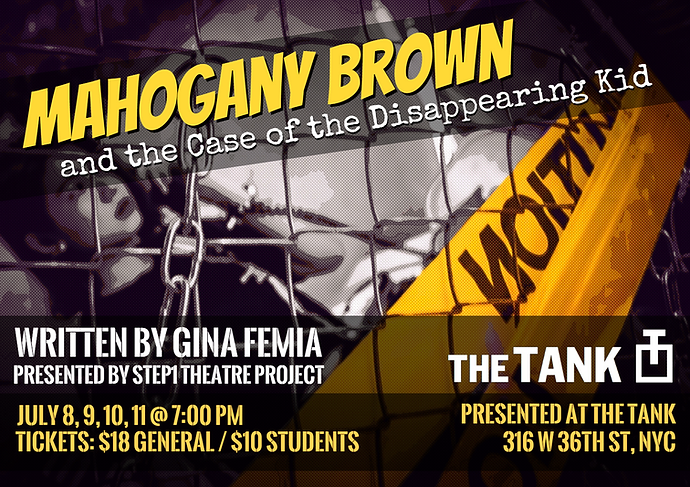
Growth! We are really in transition and are growing as a theatre company. Fundraising, adding to our team, and learning about the ins and outs of really establishing the organization is really at the forefront of our minds right now. Our reading series, where we give playwrights with work early in development a space, actors, and an audience of other theatre artists to develop their work in an open, loving, relaxed environment has been a great way to connect and service our community. Our upcoming show, Mahogany Brown and the Case of the Disappearing Kid by Gina Femia is absolutely the most ambitious work we have ever done, and showing what we can really do without the restrictions of being a ‘young company’ has been an amazing experience. I cannot wait to continue to grow, to continue to service artists and to connect more people to art and our community!
Jazmyn:
What Janelle said: growth, growth, growth. Even if it’s incremental, every level-up for us means we can be of better service to the artists who find and work with us. Right now, we provide free public cold readings for early draft / developing works, then we elevate those pieces further by producing ticketed staged readings with design elements, and next we are looking to elevate those works even further with full productions. We also offer free workshops, and with more resources we can offer higher quality (free!) resources that artists need for their own development. Step1’s tagline is Artists Supporting Artists, we want to be those supportive artists, and we want to create spaces where artists show up to support one another as a community. Committing myself to this effort has been the most rewarding decision of my life.
Latest Posts
-
Jim Catapano reviews Anne L. Thompson-Scretching’s Home Is Sweet Sorrow: “A Masterful Conclusion to a Momentous Family Saga”
The War That Never Ends Home Is Sweet Sorrow is a must-see and a devastatingly powerful third chapter in the Blood trilogy, which also includes…
-

THE BARD TAKES BROADWAY: SIXTH ANNUAL NEW YORK SHAKESPEARE AWARDS CELEBRATES RECORD-BREAKING 2025 SEASON
THE BARD TAKES BROADWAY: SIXTH ANNUAL NEW YORK SHAKESPEARE AWARDS CELEBRATES RECORD-BREAKING 2025 SEASON The New York Shakespeare Awards has officially unveiled its list of…
-

American Theatre of Actors Announces 50th Anniversary Gala; Playwright LYLE KESSLER and TONY-winning actor, LEN CARIOU to Receive Lifetime Achievement Honors.
NEW YORK, NY — The American Theatre of Actors (ATA), a cornerstone of the New York theatrical landscape since 1976, is proud to announce ATA 50, a…
-

Music Among the Tumbleweeds: Jim Catapano reviews James Jennings’ New Dancing in the Meadow.
James Jennings’ New Dancing in the Meadow Brings Feel Good Vibes to the ATA James Jennings, legendary Founder of the American Theatre of Actors, brings…
 Arts Independent