

Star Power and Seasoned Talent: The Cast Bringing Richard Vetere’s “ZAGŁADA” to the ATA Stage
Richard Vetere’s new psychological crime thriller, ZAGŁADA, is set for its New York City premiere at the American Theatre of Actors (ATA), supported by a powerhouse team of Broadway veterans, acclaimed character actors, and an experienced director. The production, running from October 16 to November 2, features the formidable talent of Tony Award winner Len Cariou, leading an electrifying cast to confront a chilling piece of history.
The play, which centers on the arrest of an elderly Maspeth resident—a former kapo in a Nazi concentration camp—demands a cast with the gravitas and skill to navigate the story’s dense layers of historical trauma, moral ambiguity, and high-stakes confrontation.

The Headliner: Len Cariou as Jerzy Kozlowski
Leading the cast is the internationally recognized, Tony Award-winning, and Emmy-nominated Broadway icon, Len Cariou.
Cariou is perhaps best known for his legendary, Tony-winning performance as the title character in Stephen Sondheim’s Sweeney Todd: The Demon Barber of Fleet Street. His extensive, 65-year career spans regional stages, Broadway, off-Broadway, film, and television, earning him membership in the Theatre Hall of Fame. A master of the classical repertoire, he has twice assayed the title role in King Lear.
While his stage career is monumental—recently honored with the 2024 John Willis Award for Lifetime Achievement in the Theatre—Cariou is also a beloved figure on television. For 14 seasons, he played the patriarch ‘Pop’ Reagan on CBS’s hit show Blue Bloods. His recent work includes the award-winning off-Broadway role of Morrie Shwartz in Tuesdays With Morrie.
In ZAGŁADA, Cariou takes on the central and challenging role of Jerzy Kozlowski, the 90-year-old former kapo arrested for shooting a journalist. His casting ensures the character, though morally dark, will be portrayed with a depth and humanity that forces the audience to grapple with the play’s central questions of justice and self-preservation.
The Electrifying Supporting Cast
The veteran performers joining Cariou are charged with portraying the three New Yorkers who must confront Kozlowski and his past: Danielle Hooper (the journalist), NYPD Officer Frank Napoli, and Homeland Security Officer Sonia Sokolow.
Jes Washington
A New York actress, writer, and singer, Jes Washington brings a compelling resume of stage and screen work. A Lifetime Member of the Actors Studio, her dedication to in-depth character work is clear. Her stage credits include off-Broadway productions such as Coping Mechanism and White Woman, Black Boy, and her acclaimed international one-woman show Who Will Sing for Lena. Washington is also known for her television appearances on HBO’s The Gilded Age and CBS’s The Equalizer. Her involvement in workshops directed by figures like Estelle Parsons and Steve Broadnax III further speaks to her commitment to developing challenging new work.
Salvatore Inzerillo
Salvatore Inzerillo is a respected New York-based actor, director, and artistic director, with deep roots in the city’s theatre scene. A member of both LAByrinth Theater Company and The Actors Studio, Inzerillo has worked extensively at The Public Theater and developed over a hundred new plays with leading American playwrights. His stage credits include originating roles in early works by Stephen Adly Guirgis, all directed by Philip Seymour Hoffman, such as In Arabia We’d All Be Kings and Jesus Hopped the ‘A’ Train. He also appeared in The Iceman Cometh with Nathan Lane and Brian Dennehy at BAM. On screen, he is recognizable from roles in Boardwalk Empire, The Deuce, and various Law & Order franchises. Inzerillo’s history with gritty, character-driven material makes him an ideal fit for this psychological thriller.
The Creative Vision: Director Maja Wampuszyc
Guiding the production is director Maja Wampuszyc, who has a close working relationship with playwright Richard Vetere, having directed the development process of ZAGŁADA at the PDW at The Actors Studio.
Wampuszyc is an accomplished actress herself, known for her appearances on Broadway in Irena’s Vow, as well as off-Broadway and regional productions. Her film and TV credits include The Immigrant (with Marion Cotillard), Mona Lisa Smile, The Knick, and Madam Secretary. As a director, her work is recognized for its bold approach, having previously helmed productions in Krakow, Poland, and throughout the U.S. Her deep familiarity with the script and Vetere’s writing ensures an interpretation that is both true to the playwright’s intent and dramatically compelling.
The Creative Home: The American Theatre of Actors (ATA)
The production is staged at the American Theatre of Actors, a venue founded in 1976 by James Jennings. The ATA continues its mission of spotlighting socially and historically resonant works, having produced over 1,000 original plays and served as an artistic home for figures like Dennis Quaid, Edie Falco, and Chazz Palminteri early in their careers. The ATA’s legacy provides the perfect institutional support for a drama that grapples with weighty historical and moral questions.

John Stillwaggon & Carolyn Dellinger celebrate the works of BERNARD J. TAYLOR with a special private showing of TENNESSEE WILLIAMS: PORTRAIT OF A GAY ICON
John Stillwaggon & Carolyn Dellinger celebrate the works of BERNARD J. TAYLOR with a special private showing of TENNESSEE WILLIAMS: PORTRAIT OF A GAY ICON plus other presentations. This event is dedicated to the EMERGENCY FUND OF SAVE THE CHILDREN (All donations go to Save the Children) and the 50th anniversary of the AMERICAN THEATRE OF ACTORS, the host venue of the original New York production. Doors open at Noon; Program begins at 12:30 p.m. on Monday, November 3, 2025 at the Jerry Orbach Theatre, 210 West 50th Street on Broadway, New York City.

This event is produced by JAY MICHAELS GLOBAL COMMUNICATIONS, LLC (Contact Jay Michaels at info@jaymichaelsarts.com for further info or to RSVP)
Tennessee Williams: Portrait of a Gay Icon an exploration of playwright Tennessee Williams’ “private” life.
After acclaimed national performances, Bernard J. Taylor’s play made its NYC debut to sold-out showings at the historic American Theatre of Actors before garnering the same kudos in the United Kingdom.
Join us for one last showing tributing playwright Taylor and raising funds for the Emergency Fund of the
Save the Children Foundation.
PLOT: Williams is chatting with “old friends” in his home and becomes increasingly inebriated during the course of the visit. The author launches into myriad diatribes about life, love — or the lack and abuse of it, his viciously cruel father, his sister — who received the brunt of that cruelty, and his work in the theatre — or more likely — his work with actors.
Mr. Stillwaggon and Ms. Delinger appear courtesy of The Theatre Authority

Playwright Bernard J. Taylor had more than 100 worldwide productions of his plays and musicals in more than a dozen countries. His early works were chronicled in the Encyclopedia of Film and Stage Music. In 2013, he was made an Honorary Fellow by the Victoria College of Music and Drama for “services to music and the performing arts.” Recent years have been the most prolific. Six productions of his stage works in San Antonio won eleven awards at the 2015, 2016 and 2017 ATAC awards (San Antonio’s version of New York’s Tony Awards).

Jim Catapano notes that the Prince Clowns so the Bat Can Fly: Joshuah Patriarco’s Brilliant Merging of Shakespeare and Batman Rises at the ATA.
“I am vengeance.
I am the night.
I am…HAMLET!”
Thus proclaims the “Prince of Arkham” (Joshuah Patriarco) as he prepares to avenge his father’s murder at the hands of his “Penguin”-like Uncle Claudius (Thomas Annunziata), who wears his stolen crown over a top hat and brandishes an umbrella. The ghost of the slain king (also Annunziata) prowls the night, with a bat cowl over his skull face, looking for revenge. Hamlet is alerted to the presence of his father’s spirit by his faithful sidekick, the yellow-caped Horatio (Jett Hernandez), and the trench-coated “commissioner” (Joe DeAngelo).

The ghost reveals the truth to Hamlet. But before the prince takes up his cowl for good, he dons clown makeup and a purple coat, in order to make both friends and foes think he’s mad as he plots the downfall of Claudius and his complicit mother Gertrude (Elizabeth Dimon), who slinks about in a latex catsuit and is counting on those other 8 lives.
Hamlet: The Clown Prince, a production of the Epiphany Shakespeare Company,is the astonishingly clever, superbly entertaining brainchild of Joshuah Patriarco. In a tour-de-force, he gives a magnificent performance as the title character, who has the personality of both Batman and the Joker, as well as directing the production and adapting the Shakespeare classic to blend perfectly into the DC Universe. The text and story of Hamlet is all here, from “To Be or Not to Be” to “The Rest is Silence”, but is here joined by “Why So Serious?” “Have You Ever Danced with The Devil…” and “Let’s Get Nuts!”. The quotes are taken from across the Batman Movie and TV Universe and skillfully added to the Bard’s text (almost as if they were always intended to be). And Horatio/Robin does indeed exclaim “Holy___!” with hilarious frequency. His “bring the house” down moment is when he yells, “Holy Nostalgia!” at the site of the late jester Yorick’s skull. And Frozencrantz is quick with the “ice” puns famously delivered by Arnold Schwarzenegger in Batman and Robin.
Hamlet’s duality works beautifully with the notion of the Dark Night and his greatest adversary being two sides of the same coin (and speaking of which, Two-Face appears in the role of Laertes (John Schmitz). The Riddler is also present, fittingly in the persona of the wordplay-loving Polonius (David Bunde). DeAngelo returns as the amusingly named “Frozencrantz” (Mr. Freeze as you might have guessed). Laura Ruth is the orange-haired, top hat wearing Guildenstern (Mad Hatter).
Hamlet’s transformation into a Joker-like figure disturbs the whole kingdom, but none more than his lover Ophelia (in an incredible performance by Epiphany co-founder Samantha Mileski). Ophelia is traumatized by the behavior of her “Puddin’” but remains devoted to him; after he kills her father Polonius she cracks entirely, becoming Harley Quinn in both demeanor and dress.
The soundtrack features Danny Elfman’s stirring 1989 score for the first Tim Burton Batman film, as well as the theme to the 60’s Batman TV show, and even Seal’s haunting “Kiss from a Rose” from Batman Forever. In addition, the tortured Ophelia sings a heartbreaking, appropo “I Started a Joke,” by the Bee Gees. And then there are the fight scenes. Bat-Hamlet and Horatio-Robin take care of the villains in a scene right out of the Adam West series, and the climactic swordfight of the Dark Prince/Knight with Laertes/Two-Face is magnificently realized. Special shoutout to Fight Choreographer Erin Hebert for crafting these stunning sequences.
Overall, the mashup of the deeply serious Hamlet and the grim world of Batman works much better than anyone might have expected; even the addition of elements from the campier versions of the Caped Crusader fit amazingly into the narrative. A smart, winning concept elevated by great performances, it all makes for a can’t-miss masterpiece that will delight both Batman Buffs and Shakespeare Students.
Goodnight, Sweet Bat!
Hamlet: The Clown Prince is performed at the American Theater of Actors through Sept 28 2025.

Jim Catapano at Blood Orange: A Masterful Study of Hurt, Love, and Loss
Et Atalia Theater Presents Abigail Duclos’ Stunning Experimental New Play
How do adolescents survive when all the grown-ups have disappeared? Blood Orange is like a domestic Lord of The Flies, but the abandonment and isolation on display cuts much deeper. The teenagers here aren’t just separated from their parental figures; they have been utterly failed by them.

Maria Müller is astonishing as Faye, a North Carolina high schooler whose father died violently a few weeks before the story begins. Faye’s stepmother has retreated to her bedroom, devastated, and extremely physically and emotionally unwell. The suddenly alone Faye brings over her school friend Eden for company; the lonely outcast Eden is happy for the attention but disturbed by Faye’s manic dark humor, a symptom of the trauma she’s been through. Faye keeps begging the appalled Eden to physically assault her (perhaps deep down to “see if she can still feel,” as Nine Inch Nails suggested).
Eden’s unease fades as her attraction strengthens. The two begin to connect on a deeper level, but the situation is disturbed by the arrival of Faye’s friend Georgia, who is the polar opposite of Eden; loud, assertive and hyper-sexual, she strides in and dominates proceedings, flirting with Faye and gazing with disdain upon Eden.
Now without a father and essentially without a mother, Faye feels abandoned by God as well. She devises her own deity out of a dead animal she found on the road and placed in a paper bag in a refrigerator, below her stash of frozen dinners. The creature is so mangled they can’t even tell what kind of animal it was (they decide on probably bunny), but Faye and later Eden are entranced by its appearance and even its stench of decay. They suddenly find a tangerine in the bag with the animal and declare it to be a miracle. The grounded Georgia is of course disgusted and condemns the horrific turn of events; she is also clearly threatened by Faye and Eden’s growing bond, which is now being solidified by Eden’s joining Faye’s new religion. Georgia is a Regina George in “Mean Girls”-type but is realized in three dimensions by Giorgia Valenti. The sassy, cynical Georgia can’t hide her insecurity and jealousy; it’s clear that her insults towards Eden are coming from that place. (The cast rotates throughout the run; Müller alternates as Georgia when Luisa Galatti appears as Faye.)
Ana Moioli charms as the awkward, innocent, appropriately named Eden, searching for connection and for an escape from her abusive father. She shows Faye the beloved stuffed animal her father tried to destroy, which foreshadows a climactic moment with Georgia and the “deity” later in the play. Faye prays to her roadkill god to bring her father back; Eden prays for it to make her own father go away. The two become one over their despair, dancing (literally) around their attraction to each other as they chant and pray to their new savior. It is a striking sequence, enthralling and horrifying at the same time, and speaks to the heart of the matter: these are young women who have been abandoned, abused, and cast adrift, and desperately looking for hope, love, and something to believe in.
One of the play’s most surprising moments is the sudden appearance of Faye’s stepmother Mariah in the flesh. If you have not consulted the playbill beforehand it would be understandable to expect her to remain an unseen character, represented only by the sound of footsteps making floorboards creak. But Doreen Oliver arrives to pull at our heartstrings, the loving mother weakened by illness and grief, desperately trying to regain her strength and faculties to make a simple tomato soup dinner for her daughter. It is a glimmer of hope for Faye, but a brief one; Mariah heartbreakingly collapses back into her desperate state, suddenly unable to even recognize Faye. The tomato soup is spilled onto the floor, a puddle of dark red, again foreshadowing the darkness to come. When Georgia returns to put the situation to an end, events spiral to a horrific conclusion that is deeply unsettling—but also excellently staged and acted.
The production is brought to life with powerful direction by Vernice Miller, and meticulously choreographed by associate director Amelia Rose Estrada, with an exceptional scenic design by Ningning Yang. The sound design by Laura Perreira and lighting by Hayley Garcia Parnell contribute so much that they can almost be considered other characters in the play. The compelling group of actors, whose chemistry is electric, stay completely in character even through the many scene changes, keeping the audience immersed in the world of the play. Duclos and the actors have combined to bring us real people that we get to deeply feel for as we hang on their every word and action.
Blood Orange is an absolute triumph for Duclos and the cast, a masterful work that will stay with you long after the lights in Faye’s apartment go out.
The production of Blood Orange is supported by the Romanian Cultural Institute. It runs through Sept. 17, 2025.


Jim Catapano attends A Majestic Production in Celebration of 50 Great Years
King Lear Rises Again to Mark the Golden Anniversary of The American Theatre of Actors
As the curtain opens on its 50th year, the ATA has turned to a signature piece to mark the very special occasion. King Lear, itself enjoying its 420th anniversary, returns to the John Cullen stage after a great run last year, and featuring faces familiar and new.

Alan Hasnas reprises the role of the titular tragic monarch in this energetic rendering, directed with panache by ATA president and founder James Jennings. In a special presentation after the show, Hasnas noted he is celebrating his own anniversary, having debuted at the ATA in the role of Claudius in a production of Hamlet 20 years ago.

Amber Brookes returns as the icy, scheming Regan, oozing malevolence in every scene, such as when she puts her cigarette out on the ill-fated Earl of Gloucester (a heartstring-pulling Tom Corciari in his ATA debut). Dramaturge Jane Culley is grand in her reprise of Regan’s sister Goneril, who tops her sibling’s villainy by tampering with Regan’s ubiquitous goblet. Sam Hardy, who recently excelled as Henry V, brings his powerhouse voice and presence to Edgar. Jake Minter returns to bring a powerful intensity in the role of the villainous Edmund, a part he also played in a recent film adaptation. Dustin Pazar shines, a dashing figure in the pivotal role of Kent. Karolina Larion takes on the role of Cordelia, whose actions at the top of the play start a chain reaction leading to her father’s descent into madness and despair. Larion’s expressive face and performance beautifully portray the punished daughter’s sadness and her later resolve to make things right and attempt to rescue her betrayed father. Sam Cruz is a dynamic Fool, providing the levity to balance out the dark events. However, he is not the only source of mirth—moments of humor are drawn from the text through clever interpretations of the dialogue by the actors, while never betraying the solemnity of the piece. The ensemble’s love of the play is palpable, and they work as a collective to bring it alive with astonishing skill.
The entire production is an incredibly engaging, high-energy rendering of the classic material; completely unabridged, the three-plus hours of King Lear are continuously riveting as well as moving. The space of the elegant John Cullen theatre is fully utilized, from its balcony to its stairs to its wings. The Fool hovers on the balcony watching events unfold; the increasingly mad Lear strides past the audience to command center stage; Edgar leads his blinded father down the winding staircases. Backdrops showing castle grounds and interiors, the sea, the hovel, an eclipse, and the famous thunderstorm provide a dynamic sense of place and time. The swordfights are beautifully coordinated and executed, and the relationships among the characters well realized, leading to the unforgettable, heartbreaking climax that will break your heart no matter how well you know the story. It’s another terrific success for the ATA, and the perfect way to start its milestone year.
The performance of King Lear on September 14th was followed by a rousing celebration of a half-century of the American Theatre of Actors, and of all who have honed their craft there.

King Lear runs at the ATA through September 21, 2025.

Kevin Davis’ Uplifting Musical Story of Hope in Troubled Times, reviewed by Jim Catapano
Kevin Davis’s Rousing One in A Million Gets an Exciting Sneak Preview atDon’t Tell Mama
In a recent interview with Kelly Wright on America’s Hope, composer, playwright and musician Kevin Davis was asked about his wish for America. He responded that he wanted it to be a place where we can “talk to each other…help each other again. ‘We the people’ has to be all of us.”

In a time when the promise of a United States for everyone, and the teachings of Jesus, have both been co-opted and corrupted by evil forces, this desire for a better future fuels Davis’ heartfelt, faith-based One in a Million. The production, known for its evergreen message of hope and humanity, has been workshopped and performed many times in the last several years, earning a nomination for Best Musical, Off-Off Broadway by BroadwayWorld. The latest incarnation of the ever-evolving show was previewed in Cabaret form to an enraptured sold-out house at the legendary Don’t Tell Mama on August 22, 2025.
The musical sees Wanda and her sister Suzy of Anytown USA invite their church friends (and Wanda’s “archenemy” Priscilla) to their annual Christmas party. The group collectively takes a sharp turn from angelic to avarice, as they decide to combine all their money on a life-changing lottery ticket that could bring them $999 million. When this longshot actually happens, the winnings become a poison that threatens to destroy not only their relationships, but their very souls. In 2025 One in a Million holds a mirror on what’s happening to our country in a time when oligarchic greed and fear of the “other” has turned the American dream into a nightmare.
The dynamic songs in the preview comment on this collapse into selfishness and greed, and advocate for spirituality and community, as Suzy takes a moral stand against events. “Who are you fooling when you lie to yourself? Too much of anything will ruin you,” the lyrics warn as the chorus insists “Give me money.”

The show also poignantly touches on the inhuman horrors that immigrants are facing today, with families being pulled apart by people who claim to be Christians yet ignore the words of Jesus entirely. Matthew 25:40 is quoted as a reminder: “Whatever you did for one of the least of these brothers and sisters of mine, you did for me.”
The preview was narrated by Jenna Lucht as Little Red (complete with riding hood), with songs performed by a diverse cast singing in wonderfully varied musical styles, from jazz to soul to salsa. Dancer Jillian Marzziotti performed an electrifying sequence to a latin beat. The talented ensemble also included Valerie Chamberlain, Karev Vigo, Jayandra Chiluwal, and Ray John.


Davis, who recently directed Stormé at the American Theatre of Actors, joined members of his acclaimed Jazz Catz band on stage on clarinet and saxophone to accompany the performers, giving a dynamic sample of the memorable songs in the production.
“What’s going to happen to all of our friends from Anytown USA?” asked Little Red, ending the show on a cliffhanger. “What’s going to happen to a nation torn apart? And people who act in hate in the name of God?”
“How do you show god’s love? You love your neighbor. Everybody here is your neighbor,” Davis reminded us towards the end of the preview. “Everybody in America is your neighbor. And we are sick and tired of this gospel being corrupted by hate. These folks here come from every background…and I love each and every one of them, because they’re my neighbor. And that’s the message of this show.”
Fingers crossed the characters will return to the stage soon to continue the story, and that they—and the country—will return to the light.
Davis’ Jazz Catz will be performing at Don’t Tell Mama on October 8.

“A Marine Walks Up to the Pearly Gates” at Yellow Bicycle Theatre: Josh Crone’s 250-Year Journey of the Corps
The Philadelphia Fringe Festival is set to host a powerful and thought-provoking new play by Joshua Crone, a Marine Corps veteran and the founder of Yellow Bicycle Theatre. Titled A Marine Walks Up to the Pearly Gates, the show is an ambitious exploration of the U.S. Marine Corps’ 250-year history, told from the surreal perspective of fallen Marines arriving at the gates of Heaven. The production will run from September 11 to September 27, 2025, at the Yellow Bicycle Theater in Center City.

Written and directed by Joshua Crone, a former Marine who served in the mid-90s, the play is a deeply personal project. Crone’s diverse background, which includes time as a carpenter, programmer, fisherman, and translator, informs his unique artistic vision. He founded Yellow Bicycle Theater in 2022, transforming an abandoned escape room into an edgy, experimental space for theater and film. Crone’s mission as a playwright is to “explore difficult questions by giving abstract problems human dimensions,” all while ensuring the audience is entertained.
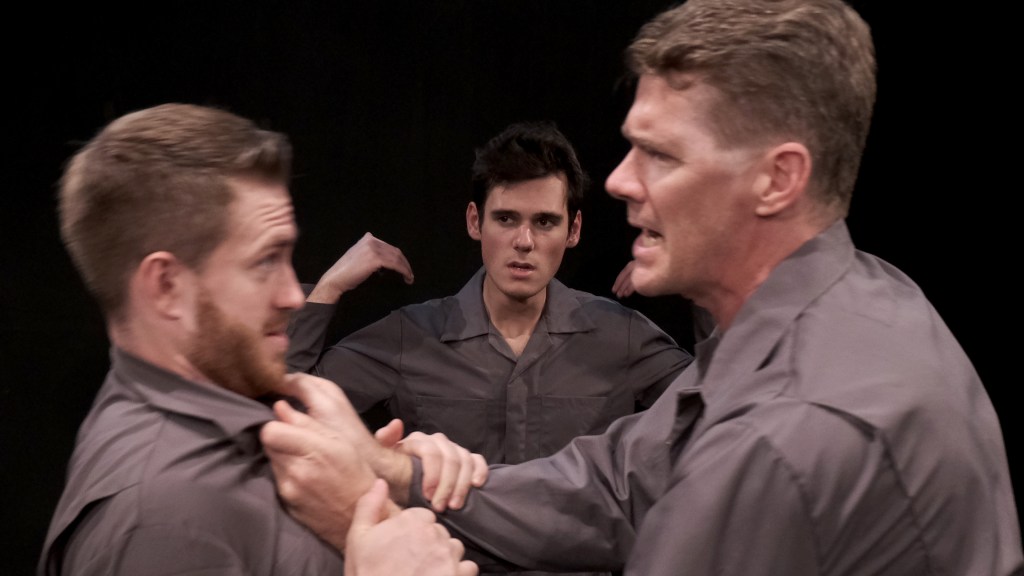
The impetus for A Marine Walks Up to the Pearly Gates is the upcoming 250th birthday of the Marine Corps on November 10, 2025. The play delves into both the heroic contributions of the Corps and its more controversial aspects, such as racial segregation. From the American Revolution to the wars in Iraq and Afghanistan, the audience will witness the ghostly parade of Marines who, in their afterlife, must confront their past and their service.
Crone’s play is designed to be a “rowdy, poignant yarn filled with gallows humor,” drawing inspiration from the running cadences Marines sing. The central premise, “Hell is other Marines,” is a twist on Jean-Paul Sartre’s famous line, presenting a purgatory where Marines from different eras give each other a hard time. Through a series of flashbacks, the audience will follow each of the eight characters on an “archetypal soldier’s journey,” from recruitment and training to combat and death. A unique technical element is the use of video projections to create animated shadows of unseen figures, a solution born out of a technical problem that evolved into a trippy, immersive effect.

The play is also filled with “Easter eggs” for those with a military background. Crone incorporates details from his own service, such as moves from the hand-to-hand combat system known as Line Training. He also references historical events that are part of every Marine’s “knowledge,” including the original order of the Continental Congress that founded the Corps. Crone cites authors like Jason Bohm (Washington’s Marines), Chester Nez (Code Talker), and Allan R. Millett (Semper Fidelis) as sources that gave him a “new appreciation for Marine Corps tradition.”
For the audience, Crone’s ideal takeaway is not just a deeper understanding of military history, but the simple catharsis of laughter and emotional engagement. The play is an homage to his fellow “jarheads,” written to share the feeling of pride in a long and storied tradition. The play is intended for mature audiences, with an age rating of 18+ due to violent content, adult language, and fog/smoke effects.
Following its run at the Philly Fringe, the play may be heading to a new audience. There is a potential plan to secure a venue in Washington, D.C. for Veterans Day Weekend, possibly at the Army Museum.


Et Alia Theater presents a limited engagement of Blood Orange, a horror play by Abigail Duclos
“One of the most intense plays you will see this season!”

Et Alia Theater presents a limited engagement of Blood Orange, a horror play by Abigail Duclos, at The Jeffrey & Paula Gural Theatre of A.R.T./New York, 502 West 53rd Street, New York City, ADA accessible. Previews begin: 11 September (Invitation Only); Opening: 13 September; Closing: 27 September TICKETS

Performed in Repertory: September 11, 13, 14, 19, 21, 22, 27: Luísa Galatti as Faye, Ana Moioli as Eden, Maria Müller as Georgia
September 12, 15, 18, 20, 25 and 26: Maria Müller as Faye, Ana Moioli as Eden, Giorgia Valenti as Georgia
Doreen Oliver as Mariah for all showings

Blood Orange, by Abigail Duclos and produced by Et Alia Theater, tells the story of Faye, a teenage girl who — feeling abandoned by God and her mother in the wake of her father’s violent death — turns to a nightmarish roadkill creature for salvation. Faye then draws her awkward friend, Eden, into a strange religion filled with prayer, blood, and budding love.
The play delves deeply into grief and depicts it as an ugly, intricate, and biting experience, examining the complexities of modern teenage girlhood and sexuality. The play asks, “how do young women navigate a culture that hypersexualizes them while demonizing their desires?” “What happens when the hunt for pleasure intertwines with pain?”

Production Directed by Vernice Miller with Amelia Estrada as Associate Director/Choreographer; Scenic and Property Design by Ningning Yang; Costumes Designed & Associate Props Design by Whitney Fabre; Sound Designed by Laura Pereira; Lighting Designed by Hayley Garcia Parnell; Fight and Intimacy Direction by Leana Gardella.
For Et Alia Theater: Production and Box Office Management by Covi Loveridge Brannan; Stage Management by Isabel Criado; Deck Management by Thais Fernandes.
The play runs about 90 minutes with no intermission.
CONTENT WARNING: explicit scenes of violence and of self harm.
Production design support provided by the Edith Lutyens and Norman Bel Geddes Design Enhancement Fund, a program of the Alliance of Resident Theatres/New York (A.R.T./NY).
Established in 1972 by an innovative collective, A.R.T./New York has matured into an indispensable cornerstone for over 475 theatres and more than 150 individual producers and artists throughout all five boroughs of New York City and across the state. As the singular membership organization dedicated to encompassing New York’s entire not-for-profit theatre sector, A.R.T./New York’s reach extends from playwriting collectives and developmental labs to producing organizations and pioneering independent artists. A.R.T./NY continues to serve the field through four essential service areas — Funding, Space, Professional Development and Advocacy — in order to help theatremakers put their creative ideas on stage.

ATA kicks off the 50th Season with the revival of their acclaimed production of Shakespeare’sKING LEAR. September 10 – 21 with a special 50th Season Kick-off Event, Sunday, September 14 after the performance. Refreshments will be served.
King Lear begins as the Earl of Gloucester introduces his illegitimate son, Edmund, to the Earl of Kent. Lear, King of Britain, enters with his court. Now that he is an old man, Lear has decided to divide his kingdom between his three daughters. The division will depend on the quality of each princess’ declarations of love for her father before the court. Goneril, Duchess of Albany, and Regan, Duchess of Cornwall, both speak enthusiastically and earn their father’s praise. But Cordelia, the youngest, says nothing because she cannot voice her deep love for Lear. Misunderstanding his daughter, Lear disowns and banishes her from the kingdom. He also banishes the Earl of Kent, who had taken Cordelia’s side against the King.

Despairing for his daughters, and deeply regretting rejecting Cordelia, Lear goes mad at the height of a great storm. He and the Fool run wild on the heath until Gloucester takes them into a hut for shelter. He then seeks the aid of Kent to get them away to the coast, where Cordelia has landed with a French army to fight for her father against her sisters and their husbands.
In this family drama, greed is a driving force and remorse comes too late.
Alan Hasnas returns to the title role Featured in the cast is Josh Bartosch, Amber Brookes, Tom Ciorciari, Sam Cruz, Jane Culley*, Oliver Figueroa, Adonis Guzman, Sam Hardy, Karolina Larion, Emery Lawrence, Paul Maurizio, Jake Minter, Dustin Pazar, Alex Silverman, and Reese Villiger.*Ms. Culley appears courtesy of Actors Equity Association

The American Theatre of Actors was founded in 1976 by James Jennings, who continues as its President and Artistic Director. It is a repertory theatre company consisting of 50 actors, 15 playwrights and 8 directors. Its purpose is to promote the development of new playwrights, directors and actors and provide them a creative atmosphere in which to work without the pressures of commercial theatre.The plays deal with the social and ethical problems of contemporary society. Over 1,000 new works have been presented and more than 11,000 actors have worked at A.T.A., including Dennis Quaid, Bruce Willis, Danny Aiello, Dan Lauria, Chazz Palminteri, Kevin O’Connor, William Fichtner, Edie Falco and Kathryn Hahn.
CONTACT: info@jaymichaelsarts.com or 646-338-5472

Jim Catapano view Two Tales of Taking Action
The Seacoast of Chile and Birds in the Meadow Bow at the ATA
A Double-Header of new intriguing plays always makes for a great experience at the American Theatre of Actors. And when one is both written and directed by Founder, Artistic Director and President James Jennings, it’s an extra-special experience.

Birds In the Meadow presents a unique situation relevant to our times. Cross-country adventurers Joan (Julie Zimmermann) and her husband Jack (Phil Oetiker) have parked their camper in a trailer park, where Joan rages against the injustices she is seeing in the world, chiefly the widespread physical and emotional abuse of women, such as in Latin America, where “men believe they have control over women’s bodies” to the point of femicide. The camper floor is strewn with crumpled newspapers (Joan is a relative luddite with no computer and only a flip phone, complicating her crusade). Joan has a habit of throwing those crumpled newspapers at Jack, who seems unimpressed with her “hackles up” crusading and dismissive of the notion that she, or anyone, can make a difference.

“Our whole society is breaking down, but I’m not a lawyer,” she says. “Maybe some of the damn lawyers should step up and do their damn jobs.” Joan devises a plan to go from city to city in their camper to talk to the respective governors about replacing all the legal do-nothings. “Whistling in the wind,” dismisses Jack, but Joan refuses to back down. “We’re independents,” she reminds him. “They can’t win without us!”
The situation is complicated by an ominous red note on the camper door which appears to threaten their ability to remain in the park. Wanda (Jiening Zhu), a park representative, arrives at the camper to clear up the situation, but not before getting a humorous earful from Jack and another from Joan. “Is she like that all the time?” Wanda asks Jack after Joan has stormed off. But Wanda notes that the dire state of the world is something worth “getting worked up” about, and soon the passionate Joan sees an opportunity to recruit another person to her cause. Will Joan, Jack, Wanda and their dog Thunder—unseen on the porch but very much a character—join forces and save the world? Expertly written and directed, with a cast that makes their characters come alive with realness and wit, Birds in the Meadow is a gem that, while it entertains, provides a glimmer of hope for troubled times in reminding us of the good that a single person can accomplish.
The opener, Meny Beriro’s Sea Coast of Chile, presents another woman taking action—but this time to rescue her own life. Bella (Leslie Fleming-Mitchell) is a widow who lost her husband in a tragic accident and was driven to attempt suicide a year before the events of the play. She is now gathering with lifelong friends Catherine (Laura Tewksbury), Ed (Michael Donaldson), and Adam (Ken Coughlin), all in their 60s. The other three continue to be worried about Bella, who arrives at their get-together to announce she’s “dying” —not physically, but emotionally. With her suitcase in tow, she reveals that she plans to fly to Chile that very day to start a new life. Catherine and Ed are supportive, but Adam is against it to the point of exploding into emotional outbursts. He practically demands that Bella stay put, chiefly for the sake of her children, who he threatens to contact. “Her kids deserve to know, not read about it in a letter after she disappears!” he argues. But his words and body language betray that there are feelings that the closed-off Adam has been suppressing for decades, and it’s time for the truth to be revealed.
Directed by Ginger Kipps, The Seacoast of Chile is poignant, funny and relatable; the actors truly feel like life-long friends who have experienced both joy and heartbreak together. Bella’s desire to run away and start a new life resonates for anyone who feels trapped and lonely, as does Adam’s unrequited (or is it?) love for his childhood pal. Experienced together, the two plays are a rousing, optimistic look at people kickstarting their lives post-middle age, and finding love, adventure, and an opportunity to make a difference.
Latest Posts
-

Jim Catapano reviews Anne L. Thompson-Scretching’s Home Is Sweet Sorrow: “A Masterful Conclusion to a Momentous Family Saga”
The War That Never Ends Home Is Sweet Sorrow is a must-see and a devastatingly powerful third chapter in the Blood trilogy, which also includes…
-

THE BARD TAKES BROADWAY: SIXTH ANNUAL NEW YORK SHAKESPEARE AWARDS CELEBRATES RECORD-BREAKING 2025 SEASON
THE BARD TAKES BROADWAY: SIXTH ANNUAL NEW YORK SHAKESPEARE AWARDS CELEBRATES RECORD-BREAKING 2025 SEASON The New York Shakespeare Awards has officially unveiled its list of…
-

American Theatre of Actors Announces 50th Anniversary Gala; Playwright LYLE KESSLER and TONY-winning actor, LEN CARIOU to Receive Lifetime Achievement Honors.
NEW YORK, NY — The American Theatre of Actors (ATA), a cornerstone of the New York theatrical landscape since 1976, is proud to announce ATA 50, a…
-

Music Among the Tumbleweeds: Jim Catapano reviews James Jennings’ New Dancing in the Meadow.
James Jennings’ New Dancing in the Meadow Brings Feel Good Vibes to the ATA James Jennings, legendary Founder of the American Theatre of Actors, brings…
 Arts Independent