

Too Much Dressing
The Bare Truth
By H.G Brown, directed by Laurie Rae Waugh
Reviewed by Robert Viagas
The new Off-Off-Broadway comedy The Bare Truth tries to wring two-plus hours of sitcom-style comedy out of a pair of Florida grandparents who announce to their excessively shocked adult children that they have become nudists.
The wanly funny show, having its world premiere at the American Theatre of Actors, lacks the courage of its naked ambition in several ways. For instance, there is no actual nudity—not even when the main characters are offstage. The grandpa (Ken Coughlin) appears at one point in swim trunks, and the grandma (Francesca Devito) appears in a low-cut caftan, but that’s about it. The needed scene where the children react in comic horror at their parents’ bare skin is simply not present.
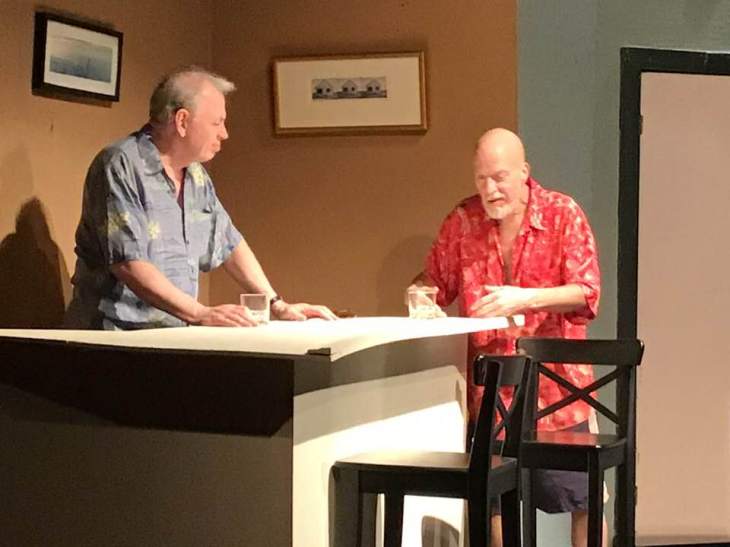 Instead, the characters sit around Coughlin’s set (he’s also the lighting and sound designer) and argue about the more interesting things happening offstage. A doubly unnecessary scene at the top of Act II recaps everything that we heard had happened in Act I.
As a pair of wacky (and fully dressed) nudist neighbors, Mike Durell and Amy Losi add some liveliness to the proceedings. But Johnny Blaze Leavitt and Autumn Mirassou are just a pair of pills as the main characters’ uptight offspring. The role of comic foil has a long and honorable history. They could have done much more with their roles, and author H.G. Brown should have given them more to work with. But the script, which feels like it was written for a 1960s TV series like “Love American Style,” doesn’t afford them much of an opportunity. Is casual naturism still considered this big of a deal?
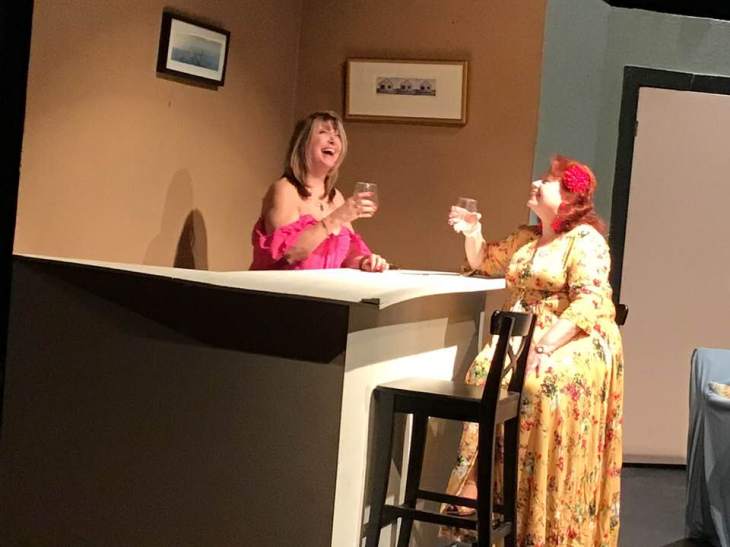 The Bare Truth, which also features performances by Rooki Tiwari and Manny Rey, played at the American Theatre of Actors complex at 314 West 54thStreet through February 3.
Family Secrets
Till We Meet Again
By Glory Kadigan
Reviewed by Robert Viagas
The new Off-Off-Broadway drama Till We Meet Again starts out like a pleasant family comedy with a crusty grandpa and a sweet and dotty grandma taking care of a precocious and wisecracking granddaughter. But somewhere along the way that mask slips off. Deeply buried secrets rise to the surface, unexpected connections between characters appear, violence erupts, and the cute-as-a-button little girl turns out to have the strongest backbone and the keenest understanding of humanity of them all.
 Directed with a sure hand by Tony-winning actress Tonya Pinkins (who does not appear in the play), Till We Meet Again is structured around a series of school papers being written by the granddaughter (a multi dexterous Mehret Marsh) who is studying World War II at school. She interviews her grandparents as part of her research, and those interviews awaken ghosts of the past, including one literal one. A long-ago misunderstanding and a misplaced sense of duty may have thrown a switch that sent the grandfather’s entire life careening down the wrong track—or perhaps it was the right track after all. Visiting the road not taken is always a tricky proposition.
There are many layers to the character of the grandmother, and June Ballinger plays them all: funny, flirtatious and earnest, but underneath determined and even dangerous. David L. Carson must play the grandfather as a man slipping into dementia—or is he? Are his memories of a lost love (Gina LeMoine) hallucinations? Agonizing memories? Or actual hauntings?
Jumping continually in time and space on a nearly bare playing space, this production could easily have become a muddle without Pinkins’ smart staging. She’s made a strong choice with this play, which asks what price is paid when we do what duty requires at the cost of what our heart desires. It’s a big question.
Till We Meet Again, which also features performances by Mary Monahan and Perri Yaniv, is scheduled to play at the 14thStreet Y through January 26, but deserves a life beyond this production.
Robert Viagas on Choir Boy
Choir Boy
By Tarell Alvin McCraney
Reviewed by Robert Viagas

It turns out that all-male, all-white prep schools, such as the one revealed in all its awfulness last fall during the Supreme Court confirmation hearings for Brett Kavanaugh, have no corner on the market for bullying, violence and illicit sex. Choir Boy, the new Broadway drama with music, goes behind the ivy-covered walls to explore what happens when a gay student at the all-black Charles Drew Prep School for Boys tries to confront homophobic hostility among members of the school’s championship choir after he is appointed their student leader.
Choir Boyis not technically a musical, but is nevertheless drenched in music. In between the confrontations, the young men give lush, close-harmony, a capella performances of several gospel classics, notably “His Eye Is on the Sparrow,” plus pop hits “Boys To Men,” “Autumn Leaves,” and “Love Ballad.” These songs are used to reflect and comment upon the action of the play as the young gay man, Pharus Jonathan Young (the angel-voiced Jeremy Pope) comes into conflict with his straight rival and antagonist Bobby Marrow (the smoldering J. Quinton Johnson), who also happens to be the nephew of the beleaguered headmaster (Tony Award winner Chuck Cooper).
The school’s traditions of honor and achievement are old and a source of intense pride. All the teenaged students aspire to grow up to be “Drew Men.” One of the unwritten Drew taboos is “snitching” on a fellow student, and the strain between this tradition and Bobby’s survival eventually lead to an epic clash.
However the road to get there takes several interesting twists and detours. Tarell Alvin McCraney’s script deals not only with the issue of bullying, homophobia, and sexual repression; it looks at black history and the world beyond Drew’s walls where these young men will someday have to make their way. The conflict between Pharus and Bobby is fought on the concert stage and in the classroom as well as in the locker room. Pharus also has no small ego and it irritates his classmates that his obvious talent seems to support it.
Pharus and Bobby disagree over whether the spirituals they sing were purely religious in nature or if they contained coded nuts-and-bolts directions on how to escape slavery and journey to freedom. The underlying question is whether their slave forbears used purely spiritual means to transcend their slavery or if they took concrete steps to win their freedom. The difference adds another stick of dynamite to the coming explosion.
Presented on Broadway by Manhattan Theatre Club, Choir Boy was previously produced Off-Broadway by MTC in 2013. Directed by Tripp Cullman, Choir Boy plays a limited run through Feb. 24 at the Samuel L. Friedman Theatre.
Robert Viagas at The Prom
The Prom
Book by Bob Martin and Chad Beguelin, music by Matthew Sklar, lyrics by Chad Beguelin. Directed and choreographed by Casey Nicholaw.
Reviewed by Robert Viagas
Some of the funniest musical comedies of the 21stcentury have featured Broadway making fun of itself. Think of The Producers or the under-appreciated Something Rotten.
The Promis a glistening new addition to that list.
The show ostensibly tells the story of a teen-age lesbian who throws her conservative Indiana town into a tizzy when she announces that she plans to escort a fellow non-fellow as her date to the senior prom. An earnest Footloose-like musical could have been made from such a story. But the creators take the welcome extra step of sending a quintet of extravagantly flamboyant Broadway stars, proudly self-described as “New York liberals,” quivering with indignation and hungry for publicity, down to what they imagine to be a moral backwater in a quest to bring them goodness and light.
A terrible—and terribly funny—time is had by all, as they proceed to use their self-righteous crusade to make things incalculably worse for the young woman.
Act I sets up the premise and introduces the characters: Brooks Ashmanskas has the role of his career as an over-the-top hambone actor. Tony-winner Beth Leavel (The Drowsy Chaperone) plays a Lupone-like diva. Angie Schworer (The Producers) plays a longtime member of the cast of Broadway’s Chicagowho perpetually understudies the role of Roxie. Christopher Sieber (Spamalot) is a “between jobs” actor who can’t escape his onetime featured role on an embarrassing sitcom. Josh Lamon bustles about as their sidekick press agent.
Intermission gives you a chance to catch your breath before an Act II that consists of a barrage of bravura eleven o’clock numbers by Sklar & Beguelin (Elf, The Wedding Singer), notably “Zazz,” a Bob Fosse tribute from Schworer; “Love Thy Neighbor,” an athletic dance number for Sieber and the wildly talented chorus; “The Lady’s Improving,” a tour de force for Leavel; and the king of them all, “Barry Is Going to the Prom,” a barn-burner of a wish fulfillment song for Ashmanskas.
Scenery chomping by these theatrical T-Rexes makes Caitlin Kinnunen seem a little drab by comparison as the gay girl at the center of the whirlwind, but she busts out from time to time, especially on her Godiva truffle of an I-Want number, “I Just Want to Dance With You,” a duet with Isabelle McCalla, as her love interest.
Thanks to librettists Beguelin and Martin everybody has a lovely little story arc. And it’s not only the townspeople who learn lessons about tolerance. The Broadway people learn too, even though it costs Leavel’s character her treasured house in the Hamptons.
A lot of the show’s humor comes from inside-baseball jokes about Broadway, including references to Stephen Sondheim Lin-Manuel Miranda, Wicked, et al. But the show also takes a serious moment for “We Look to You,” in which the school principal (Michael Potts) quietly explains why people love the theatre so much.
Director/choreographer Nicholaw’s credits include some of the biggest hits of the past decade, including The Book of Mormon, Disney’s Aladdin, and Monty Python’s Spamalot. With The Prom, he hits another home run. One-tenth of all Broadway theatres are currently occupied with his shows.
The Prom is playing at the Longacre Theatre on Broadway.
The Inner Mind Out … On Stage
A Therapy Session With Myself – review by Rebecca Benedict
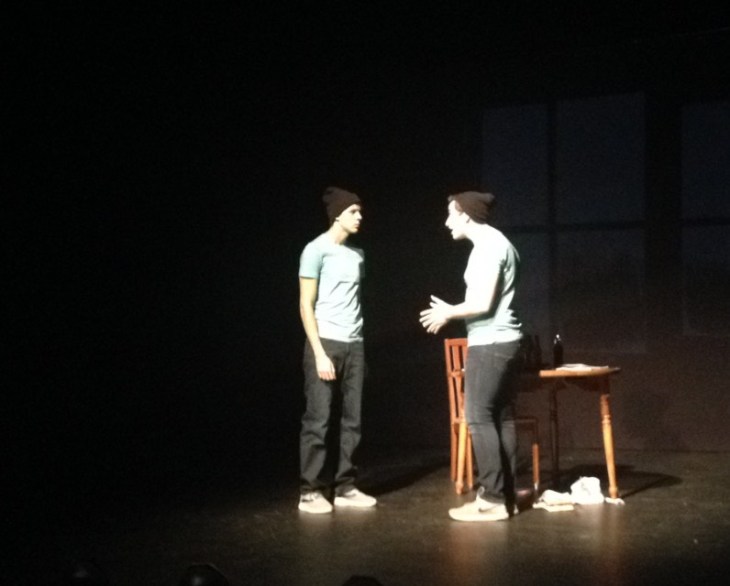
A trip inside of some ones mind is not an easy trip, it is not somewhere that is readily shared or given in its entirety because of its vastness and its confusing twists and turns, we are often only able to share in small snippets that are cultivated and released.
On the eve of January 15th I was granted access to the mind of Anthony J Piccione the creator of “A Therapy Session With Myself” and so many of the wheels that turn it.
The Main Character Alex has Asperger Syndrome and anxiety and is trying hard to figure out how to change his intense patterning, connect with other people and give his life some direction. Throughout the journey we are presented the inner workings of Alex’s mind with three Alex’s, the one who is in the memories, the one who is stuck in his head living in the real world and the one who is the embodiment of Alex’s consciousness.
We are spun round and round with Ideas and thoughts that wont leave and memories that fuel these cycles of self torture and fear in an extremely relatable experience.
 It is hard to sit through Alex’s doubt and fear and confusion and the repetition of the self arguing with the self, because it is hard to actually visit ones own inertia without taking a trip to the depths of someone else’s, yet it is also necessary.
Through out the show I found myself wanting to hug Alex, shake him into knowing his worth and frustrated by the circles he spun. This was a very brave and abstract show. I enjoyed the skillful and vulnerable crafting of such truth and emotion and the end of our experience its undeniable how absolutely harsh human-ing can be. With mental illness and Asperger’s aside we all have visited a piece of the very human mania that is presented in “A Therapy Session With Myself”. Anthony J Piccione connected to the tough parts of the human experience for us all and it was thought provoking.
I left asking myself questions about my own worth and looking at my own circles I spin and knowing for sure I am not alone.
[Photos by Anthony J. Piccione]
COMMON GROUND: Learning from reading
 Granville Burgess, the author behind the new musical COMMON GROUND about a meeting between Abraham Lincoln and Frederick Douglass has created a by-invitation-only industry event, Monday, January 21 at 7;00 p.m. at Ripley Greer Studios, opening the possibility of this new look at history, in time when we really need it, might go on to a commercial run.
Before the first member of the audience has arrived, the feedback is already powerful. The reading has since given way to new thoughts and understanding by the actors on thew world we will in and what our part of it is.
GRANVILLE WYCHE BURGESS: I’ve learned the excitement of giving young actors who are not yet in the Union an opportunity to share their talent with the professional community. This workshop will be a launching pad for several of these actors and I am proud to have provided the material and the opportunity for them. I am also grateful that the themes of this musical resonate so deeply with the company, as they have expressed to me personally and to all of us in our sharing time at the end of each day’s rehearsal. I know that through the years having done this COMMON GROUND workshop will be an important moment in their lives both personally and professionally and that is very gratifying.
As a writer, I have continued to develop a keener sense of how to make the necessary cuts in exposition and repetition that lead us into the heart of a scene more quickly. I have definitely grown in my ability to quickly decide what needs to go without unduly hanging on to those words which I have spent so many hours crafting. I have seldom argued over proposed cuts but have focused on them and then made my decision without ego, without focusing on me, but focusing solely on what is best for the show. When writing about history, my tendency is to try to get as much history in the material as possible, but I have learned to not worry about the history but instead to focus on the emotional storyline.
Ali Coopersmith – Abraham Lincoln
The workshop process has been interesting in the amount of input we have in the process. I’ve really learned to question everything and take an active role in the material which I hope to bring to future projects. In terms of activism, Common Ground has reminded me of the power that lies in telling uncomfortable truths. We get to be a part of the change that we want to see in the world, as Rajendra always says.
Mario Claudio – Frederick Douglass
I have learned that the core demands of black people during the time of the civil war took a while to fully operate. That the struggle is still going on, from unjust killing of unarmed black men to illegal child trafficking from poor African countries under the guise of adoption. I’ve learned so much about the struggle of my ancestors, and how most American schools don’t fully go into the injustices of how slavery and the struggle to abolish it. I feel I have grown, not only in my craft but understanding the interconnectivity that if one person in this country is struggling we are all struggling. If one person is unjustly murdered, than we can all be unjustly murdered based solely on their color of skin. We need true works that don’t sugarcoat or fetishize true struggle just for the sake of entertainment.
Victoria Sasso – Mary Todd Lincoln
One of the great gifts we are given as actors is the ability to inspire social change through our work. I have learned that, often times, the most difficult stories to tell are the most important for people to hear. My hope is that audiences who see this piece will be able to celebrate the strides we have made because of individuals like Frederick Douglass, while also recognizing how far we still have to go.
Teisha Duncan – Anna Douglass
“From this process, I have learned that…
An actor is twice defeated when they show up knowing more about what they don’t have to offer than what they do have to offer. Therefore showing up with an open spirit and the knowledge of both makes you doubly prepared to bear witness to your own growth and potential for greatness! ”
Maurio Brown – Reverend Grimes
This workshop has been an amazing experience not only for me as an actor but as a person of African decent. Rajendra our director has challenged us to be truthful and tell our ancestors stories. I have learned so much history from this experience and I am so excited about how this show will change people’s perception of this era in history.
Ethan Ness – Seward + Ensemble
Common Ground has been such a challenging but rewarding process. I would say that I’ve learned that in history–as in the present day–there are no easy answers, and there are no flawless human beings. But we always have the choice to focus on that which unites us, rather than the things that separate us. To me, that’s the whole idea behind ‘Common Ground.’
Sam Oz Stone – Stanton + Ensemble
Laughter, Love and Music are the universal language. Walls can and will be broken down when people of all color and creed can accept this as their truth.
Tommy T. Walker – Chase + Ensemble
This entire experience has been completely eye opening. I’ve learned about the processes the others take in order to allow themselves to be ready for a performance. Rajendra was brilliant when working with the different actors and putting them into the real life situations that these characters had to endure in history. For myself, thanks to my cast mates, Rajendra, Caren, Stan and Granville I have a growing confidence in myself, and as long as I keep working towards the theater as a goal, anything is possible.
Akeil Davis – Lewis, Young Douglass + Ensemble
This workshop taught me the impact of Fredrick Douglass’ life and gave me a new found appreciation for his legacy. Personally, I learned to allow myself a new level of vulnerability which I’d steered away from prior to this experience. Common Ground taught me that Broadway is a mindset not the locations between 34th street and Lincoln center.

Robert Viagas and Cher
The Cher Show
Book by Rick Elice. Songs by various composers.
Reviewed by Robert Viagas
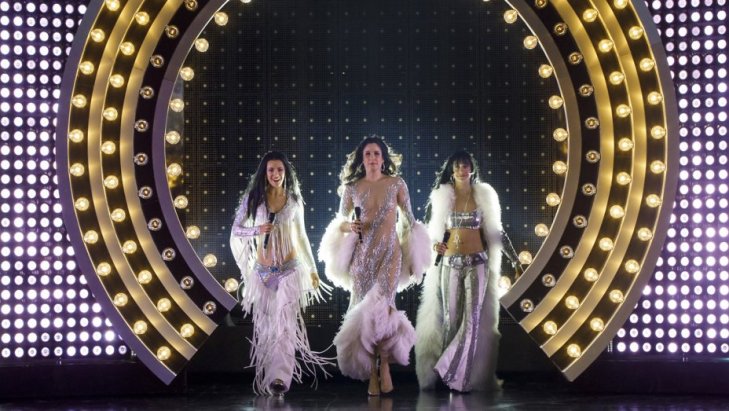
The pop goddess known as Cher (real name Cherilyn Sarkisian) has made only a single in-person appearance on Broadway, in the 1982 drama Come Back to the 5 & Dime Jimmy Dean, Jimmy Dean. And yet her passionate fan base overlaps extensively with that of Broadway musicals, likely because of her swagger, her panache, her endurance, her talent, and her pure star quality—all of which are very theatrical.
No wonder, then, that her new musical biography, unambiguously titled The Cher Show, seems so comfortable on Broadway. Rick Elice, co-librettist of one of the most successful jukebox/star biographies ever, Jersey Boys, weaves all of the above qualities around Cher’s songbook, which has covered five decades of pop hits. These have included “I Got You Babe,” “The Beat Goes On,” “Gypsies, Tramps and Thieves,” and “Believe.”
These and two dozen more numbers are performed all are in part by three actresses playing Cher at different points of her life: the youthful “Babe” (Micaela Diamond), the mid-career “Lady” (Teal Wicks), and the worldly-wise elder “Star” (Dee Roscioli, subbing for Stephanie Block at the performance caught). Roscioli is the strongest of the three, followed by the sweetly appealing Diamond, who gives a strong sense of the brightly talented but still innocent Cher of the early days.
Elice’s biographical libretto goes out of its way to be generous to Cher’s discoverer, booster, partner, husband and ex, the late Sonny Bono (Jarrod Spector), who is given credit for his rocket-fuel influence on Cher’s career along with blame for the control-freak workaholism that eventually doomed their relationship.
While this production lacks Jersey Boys’ dramatic complexity, it does a more than respectable job of exploring its subject’s heart, which is what the fans want to see, and why they sang along, clapped along (on “Dark Lady”), and cheered.
The Cher Show plays at the Neil Simon Theatre on Broadway.
Attachments area
Robert Viagas and King Kong
King Kong
Written by Jack Thorne, songs by Eddie Perfect, other music by Marius de Vries.
Reviewed by Robert Viagas

There has been talk of bringing the Australian musical spectacular King Kong to Broadway since 2010.
Now, through a possibly unprecedented combined effort of the Shubert Organization, the Nederlander Organization, Jujamcyn, the Ambassador Theatre Group and two dozen other above-the-title producers, the extravaganza (based on the classic 1933 film) is finally pounding its chest and bellowing at the Broadway Theatre. But not as primally as it needs to. ’Tis political correctness that kills this beast.
As in Oz, the star of the show is the colossal animatronic marionette/robot playing the title character, a two-story monster gorilla who is hunted and captured from the wild in Act I and hubristically brought to Manhattan to be exhibited to the public in Act II. But a force of nature like Kong can’t be kept in chains for long. By the end, Kong makes his epic climb up the Empire State Building where his final fate awaits him.
This unique creation deserves a detailed description. Twenty feet tall, he dominates the stage both with his overwhelming physical presence and, significantly, with his acting. Yes, his acting. He is operated by seven black-clad puppeteers who scurry around him, skillfully manipulating his body and limbs with their hands and with long ropes that act exactly like puppet strings. After a while your mind subtracts the puppeteers and you see only Kong. In addition, his mouth, eyes and facial muscles are operated by computer-run servos. Kong’s face is so large that wherever you sit in the theatre you can see his remarkably expressive facial expressions in the equivalent of a movie closeup. Alternately terrifying and heartbreaking, the expression of his emotions as he deals with these strange little human creature are the best part of King Kong.
This epic monster will undoubtedly go down in Broadway history. For many, the chance to experience it will be worth the ticket price.
Humanizing this force of nature is an amazing feat, but often undercuts the drama. To make the story more contemporary and politically correct, the creators monkeyed around with the characters, making the leading lady Ann Darrow (Christiani Pitts) more of a driver of the story. But that means she has to take more of the blame for her “betrayal” of Kong, who becomes less of a threat, and more like a moody boyfriend. Making him more human actually diminishes his stature. Kong the Mighty spends most of Act II moping.
To make Ann’s role bigger, librettist Jack Thorne and songwriter Eddie Perfect had to make the other characters smaller. Filmmaker Carl Denham (Eric William Morris) is now just a creepy con man and ship captain Englehorn has almost nothing to do.
Perfect’s score doesn’t always live up to the grandeur of the central character (who doesn’t sing, thankfully), but he does provide Pitts with several satisfying power ballads, including a wow of an eleven o’clock number, “The Wonder,” delivered as she stands alone at the pinnacle of the Empire State.
King Kong plays at the Broadway Theatre in Manhattan.
“Long Rail’s” Journey North
After a successful run in the New York International Fringe Festival, C.A.G.E. Theatre Company is proud to encore The Long Rail North, written by award-winning playwright, Michael Hagins, and directed by Planet Connections’ former Artistic Director, Brock H. Hill. The riveting play about a Black Union soldier and a young White Southern girl, will be at the Soho Playhouse, for a special three-performance run.
The Long Rail North opens Friday, December 28th at 7 pm, and runs on Saturday, December 29th at 7 pm and closes Sunday, December 30th at 3 pm at the Soho Playhouse, 15 Vandam Street.
The Long Rail North is the story of Private Thomas Morgan, a Black Union soldier, who must escape via train with a young Southern White girl named Molly Barnes that he rescued from a plantation fire of a nearby Civil War battle. Exhausted with limited resources and even fewer allies, Thomas continues traveling north in the near-empty boxcar, hoping to get Molly to safety despite her ignorant and preconceived opinions of him and his race, all while both Union and Confederate forces pursue them. He will do whatever he can to protect her…at all costs.
Playwright Michael Hagins shares his journey with this gripping play.
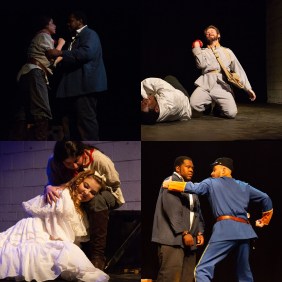
I started writing The Long Rail North when I was 15 years old. I had a love for the Civil War and its history, and for the brave Black soldiers who risked their lives to save others. When I finished, it only had 3 characters (Thomas, Molly and Vickers) and was roughly 20 minutes long. It took me a long time to find it again and fill the holes and do the edits I needed to feel good about it. I think I picked it up again way back in 2003, and even then I didn’t have a computer at home so I’d spend a lot of time in computer labs writing and editing.
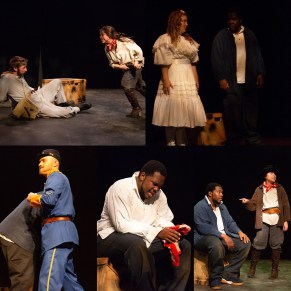
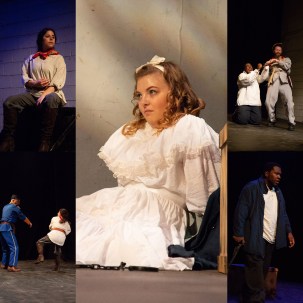 The first time I put the show up, it ended up having 3 performances in a now-defunct festival for 8 people. TOTAL – as in across the 3 shows. The shows took place during a snowstorm, and yet the actors always showed up and always did the show. I felt so bad that I couldn’t give them a more full house, and I remain so thankful to them that they stuck it out with me. When I submitted it to Planet Connections Theatre Festivity, I felt like it was a near-finished product. I say that because none of my work is ever truly done. Even this play…maybe I missed something. Maybe there’s more I could create. And luckily, I’ve always had an amazing cast and crew to keep encouraging me to create more and to be happy with the work I’ve been able to provide for them.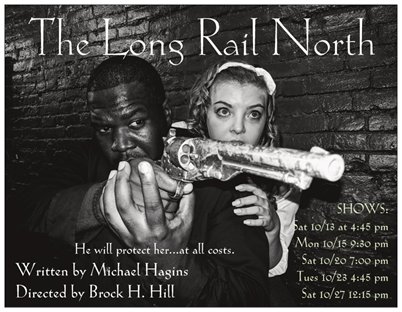

Mario Lantigua and family drama
Pink Arts Peace Productions, Inc. presents the revival of the compelling play by Mario Lantigua, Two Faces One Mirror. Workshopped in 2013, Mario Lantigua’s powerful drama will be revived at the landmark American Theater of Actors, 314 W 54th Street New York City, for a limited run, December 28 – 30. Tickets available at: https://www.eventbrite.com/o/pink-arts-peace-productions-inc-18255837545
Lantigua also directs his play – about the journey of a young single mother and her blind-to-reality daughter. “This play serves as a parable of love and sacrifice,” says Lantigua, regarding his play.
We spoke with Mr. Lantigua about his work.

What is YOUR message as a writer – what do you hope to contribute to the independent theatre scene?
My message as a writer is to never put the pen down, and to keep telling your story. Even though I still consider myself a student in the world of theatre and film, I never stop writing. The stories that I tell are a part of the lives of so many people who may not otherwise be heard. We write for ourselves and for all of those around us.
What was the inspiration for this project?
My inspiration for this story comes from the girls and women I grew up with in the Bronx. While their stories are unique, they also have so much in common. Sacrifice, love, navigating family expectations. I think there’s something really special about this particular production, with Sunflower Duran playing the lead role, who herself has lived as a young Dominican mother from the Bronx. It’s a classic tale.
What’s your creative process like?
I actually started writing this play for a class I took in 1995. It’s hard for me explain my creative process, but I just keep writing what I see and feel.
What makes this different or special from the first run?
This run of 2 Faces One Mirror is being produced by Pink Arts Peace Productions Inc. (PAPI), with an outstanding cast and crew. I had no idea what I was doing during the first run of the play. I was doing everything myself, from writing the play to managing the stage, and many of the cast were acting for the first time. With the backing off PAPI, I can focus on directing, while the experienced talent can focus on what they do best.
What did you learn/are learning about yourself through this process?
I am learning to trust myself more, and to also trust a team. As I learned through experience, you can’t do everything yourself. You need a team behind you.
What are your ultimate goals for this production or your company for the future?
My goal is to take this production on the road. PAPI and the cast is filled with Bronx natives who have actually lived through the experiences of 2 Faces One Mirror. Our stories are incredibly important. I would especially love to see 2 Faces One Mirror in Hollywood, as a theatre production and also as a film production.
What’s next?
People say the sky is the limit, but I want the whole universe. My team and I won’t stop till till we get it. In addition to a film version of 2 Faces One Mirror, I’m working on a documentary with the working title ‘Freeing Manuel Lugo’. It’s about gangs, corruption, and the prison system in the Bronx. Our stories must be heard.

Latest Posts
-

Jim Catapano reviews Anne L. Thompson-Scretching’s Home Is Sweet Sorrow: “A Masterful Conclusion to a Momentous Family Saga”
The War That Never Ends Home Is Sweet Sorrow is a must-see and a devastatingly powerful third chapter in the Blood trilogy, which also includes…
-

THE BARD TAKES BROADWAY: SIXTH ANNUAL NEW YORK SHAKESPEARE AWARDS CELEBRATES RECORD-BREAKING 2025 SEASON
THE BARD TAKES BROADWAY: SIXTH ANNUAL NEW YORK SHAKESPEARE AWARDS CELEBRATES RECORD-BREAKING 2025 SEASON The New York Shakespeare Awards has officially unveiled its list of…
-

American Theatre of Actors Announces 50th Anniversary Gala; Playwright LYLE KESSLER and TONY-winning actor, LEN CARIOU to Receive Lifetime Achievement Honors.
NEW YORK, NY — The American Theatre of Actors (ATA), a cornerstone of the New York theatrical landscape since 1976, is proud to announce ATA 50, a…
-

Music Among the Tumbleweeds: Jim Catapano reviews James Jennings’ New Dancing in the Meadow.
James Jennings’ New Dancing in the Meadow Brings Feel Good Vibes to the ATA James Jennings, legendary Founder of the American Theatre of Actors, brings…
 Arts Independent