

AMT Theater announces opening of UPSIDE DOWN, a new musical — Opening March 8 @ 7:00 p.m. at AMT Theater
AMT Theater announces the new opening of UPSIDE DOWN, a new musical — Opening March 8 @ 7:00 p.m. at AMT Theater, 354 West 45th Street, New York City TICKETS here.

According to a recent Gallup poll, 92.4 percent of the U.S population identifies as straight while the rest considers themselves as part of the LGBTIQA+ community.
Turn that number around, and you have the world of Upside Down.
It’s a world where straights are in the minority, women rule the military, and the Jets constantly win the Super Bowl. This is a world where the majority is gay.
In this topsy-turvy world, two songwriters are creating a new musical — innovative, unique, ground-breaking Broadway musical … about straight people!
The President is outraged! The military is put on red alert! News outlets are all ablaze over this unprecedented event.
Will they succeed? Is the world ready for a [wait for it] …a man and woman falling in love …ON STAGE?
The world of UPSIDE DOWN will put you in the zone … The Twilight Zone.
Upside Down has music and lyrics by Al Tapper, book by Tony Sportiello, directed by Taavon Gamble and music direction by David Wolfson. The cast includes Bernie Baldassaro, Patrick Brady, Mike Ferlita, Jake Foster, Lauren Gemelli, Kira Sarai Helper, Ashanti J’Aria, Matthew Liu, Kelli Maguire, Stephanie Maloney, Stanley Martin, Gina Milo, Brogan Nelson and Josh Powell.
Upside Down will open March 8th and run through April 5th at AMT Theater, 354 West 45th Street. For more information, contact amttheater.org
“What we are doing tech-wise with Upside Down is more ambitious than any show we’ve ever done.says Artistic Director Tony Sportiello. “The set alone is going to be a marvel. You’re going to go from a bar to The White House to an apartment to a television studio all in a flash.
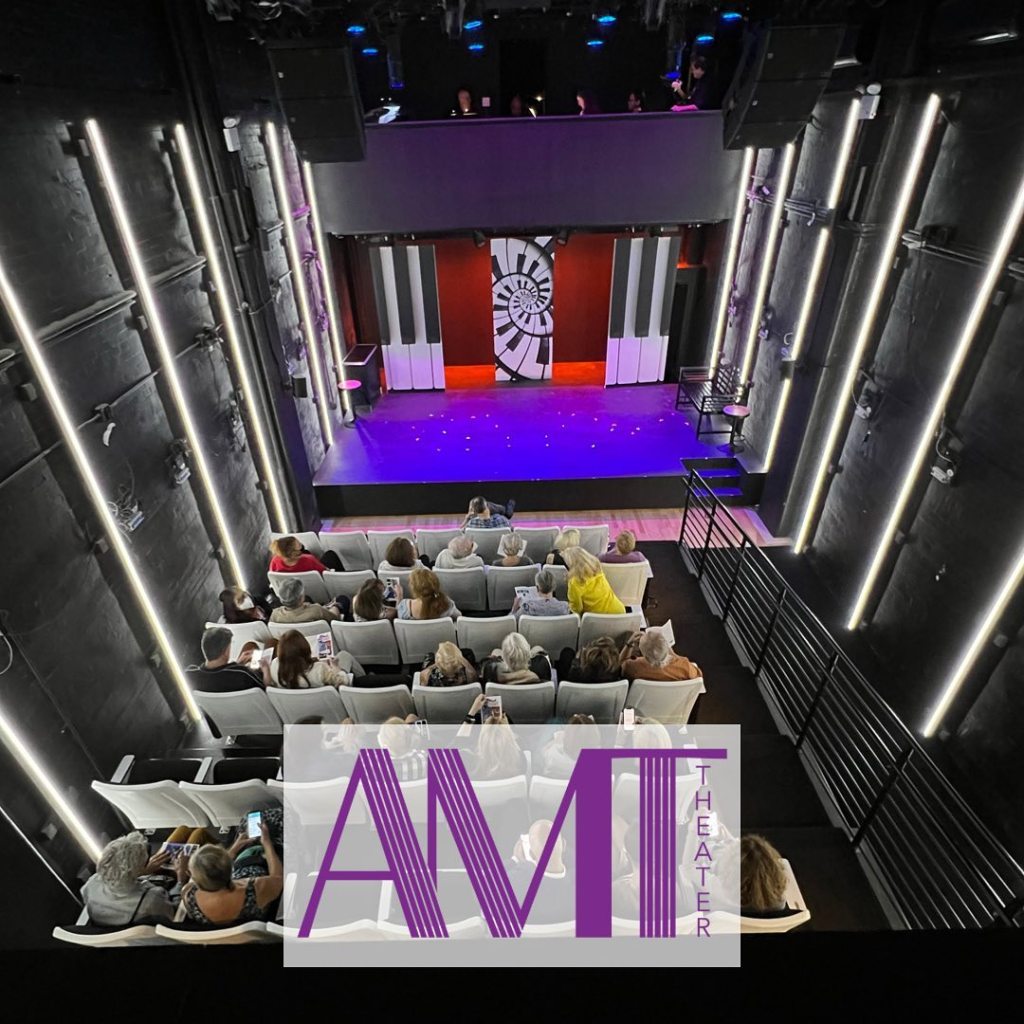
AMT: The MISSION
AMT Theater aims to entertain, educate and inspire people through the arts. AMT Theater shall provide audiences the opportunity to attend and participate in quality presentations of the finest theatrical works available. We are dedicated to enhancing quality of life through art, events and workshops. AMT will create opportunities for hands-on learning experiences in all aspects of theater production and management to adults and children in order to foster and develop their talents. AMT will strive to be an organization which is diverse, inclusive and a leader in our field.
BOARD OF DIRECTORS: Co-Chairs: Tamara Flannagan & Tony Sportiello; Secretary: Joan Pelzer; Treasurer: Sharon Osowski; Members: Zoë Reeve, Joanne Schmidt, Al Tapper, Eve Tapper, Lynne Tapper
| In just its third year, AMT Theater is the West 42nd Street 2024 Winner for Best Venue. Upside Down is its fifth production, following An Unbalanced Mind, On The Right Track, Bettinger’s Luggage and David the Musical |

Joshua Crone and Thoeger Hansen: Bridging Divides Through Theatre
Article by Anya Kai
Joshua Crone and Thoeger Hansen are a dynamic force in the world of theatre, bringing a unique blend of playwrighting, directing, producing, and acting to their projects. Their latest collaboration, “A House Divided,” explores the complexities of family dynamics amidst the backdrop of a politically and socially fractured America.
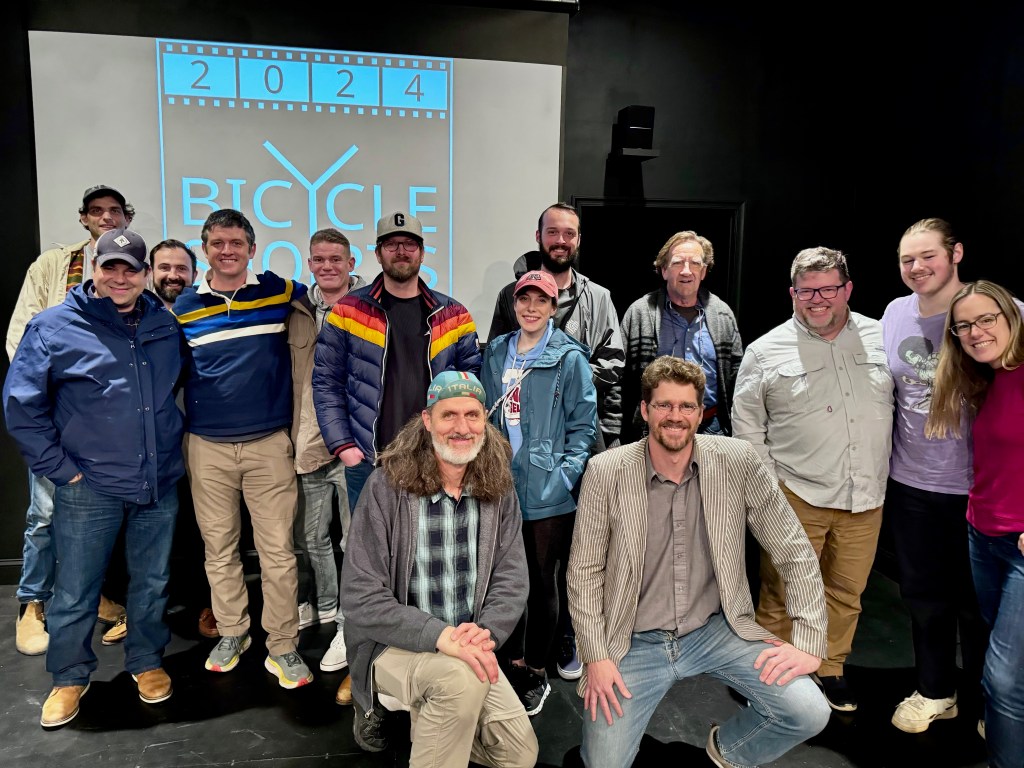
Joshua Crone: From Playwright to Theatre Builder
Joshua Crone’s journey in theatre began with a decisive choice at the age of 20: to be a playwright. However, Crone wasn’t content with simply submitting scripts and waiting for opportunities. He took control of his artistic destiny, learning to direct, produce, build sets and venues, and even make movies. This DIY spirit led him to establish Yellow Bicycle Theater, a black box space in Philadelphia. Named after the bicycle he used to park outside his apartment to make room for rehearsals and film shoots, Yellow Bicycle has become a hub for innovative theatre. Crone’s vision extends beyond Philadelphia, aiming to connect with the New York theatre scene, bringing shows like Thoeger’s “No Exit” and Megan Medley’s “Without God As My Lover” to the city and now taking his own work, “A House Divided” and “Ashes Ashes,” in the opposite direction.
Thoeger Hansen: From Actor to Director, Finding Focus in Grassroots Theatre
Thoeger Hansen brings a wealth of experience to “A House Divided,” having worked as a producer for several years and an actor for many more. Directing at this level represents a new chapter in his artistic journey, and he expresses excitement about working with Crone’s compelling script. Hansen’s path to theatre wasn’t always straightforward. He spent years navigating the challenges of the commercial/VO/print world before finding his true calling in grassroots New York theatre in 2019. This return to his roots, reminiscent of his early experiences with school plays and video production, reignited his passion. Hansen describes himself as a “gym rat” in the theatre world, finding joy in the daily grind of memorizing lines, practicing, and collaborating in the rehearsal process. This dedication and focus have been instrumental in his growth as an artist.
“A House Divided”: A Thanksgiving Play for a Divided America
“A House Divided” is a Thanksgiving play with a timely and resonant message. While Crone emphasizes that the play’s core themes are best articulated by its playwright, Hansen offers his perspective: the enduring power of human connection, particularly within families, even amidst deep political and social divisions.
Crone explains that the play was written in the tumultuous period leading up to the 2020 election and following the loss of his sister to cancer. Inspired by childhood Thanksgiving plays with his sister and their later adult disagreements, he wanted to create a play about a family gathering despite their differences. Set in 2021, a year marked by intense national division, the play fearlessly tackles a range of hot-button issues: mandates, Black Lives Matter, gender ideology, election integrity, and Trumpism. Crone’s goal was to present a balanced portrayal, avoiding straw-man arguments and ensuring that each character, with their flaws and finer qualities, has something at stake in these deeply personal debates.
The Power of Theatre to Bridge Divides
Both Crone and Hansen hope that audiences will be entertained by the play. Hansen expresses a desire for audiences to recognize the futility of the divisions that hinder human connection. Crone’s more playful hope is that any post-show arguments sparked by the play will ultimately lead to reconciliation.
They both believe that the recent election has little impact on the play’s relevance. Hansen points out that the play is set in the recent past and that the issues it explores would remain relevant regardless of the 2024 election outcome. Crone succinctly states that the play’s themes of division and conflict would persist regardless of which side prevails.
Looking Ahead: “Unicycle” and “Ashes Ashes”
Crone’s upcoming projects include “Unicycle,” a festival of solo shows at Yellow Bicycle Theater during Philly Theatre Week, featuring several shows from New York. He is also preparing for the New York premiere of his Hiroshima play, “Ashes Ashes,” at the American Theatre of Actors. This production, originally planned for the 75th anniversary of the bombing but delayed due to COVID, will coincide with the 80th anniversary in August. Hansen may also be involved in “Ashes Ashes” later in the year and is exploring other potential projects. For now, however, his focus remains firmly on “A House Divided.”
Joshua Crone and Thoeger Hansen represent a powerful force in contemporary theatre, creating works that not only entertain but also challenge audiences to confront the complexities of our time. Their commitment to exploring difficult topics with nuance and empathy makes their work both timely and essential.

“This is NOT A Drill” New Musical to Hold Private Industry Reading in NYC on Theatre Row
“This is NOT A Drill” New Musical to Hold Industry Reading in New York City
BY INVITATION ONLY event to be held on Theatre Row
BASED ON ACTUAL EVENTS

After numerous workshops and development, “This is NOT A Drill,” a new musical by Holly Doubet, is set to hold an exclusive by-invitation-only industry reading in New York City this March on Theatre Row.
This poignant work, inspired by a true event, has already garnered significant attention, including the prestigious 2021 Donald Fowler Theatre Arts Memorial Grant.
Following its acclaimed premiere in Dallas in 2021, “This is NOT A Drill” is taking the next step with this industry reading. The musical explores the lives of diverse characters who experience shock and panic upon receiving an emergency alert: “BALLISTIC MISSILE THREAT INBOUND TO HAWAII. SEEK IMMEDIATE SHELTER. THIS IS NOT A DRILL.”
Forced to confront their own mortality, they discover what truly matters. The show promises a suspenseful, yet warmhearted and funny journey, exploring love, relationships, and human nature under unimaginable circumstances. Doubet’s score is filled with undeniable emotion and soaring melodies.
The event will be the end of March on Theatre Row. Industry can contact Jay Michaels for further details.
“This is NOT A Drill” is based on a true event experienced by its conceptor, Holly Doubet. The musical follows the intertwined stories of individuals grappling with the reality of a potential missile threat. It’s a compelling exploration of human connection and the choices we make when faced with the unthinkable.
The production boasts an impressive team of talent:
- Director: Luis Salgado
- Grammy-Winning Musical Director: Paul Bogaev
- Grammy-Winning Guitarist: Jim “Kimo” West
- Broadway “Hamilton” Lead: Marc delaCruz
- Consulting Producer: Jack Lane
- Casting: Holly Buczek, Scott Wojcik – Wojcik Casting Team
- General Management: Evan Bernadin Productions/Hillel Friedman
- Attorney: Thomas Distler
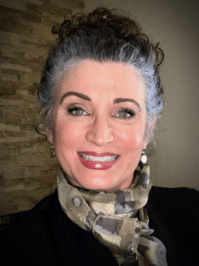
Holly Doubet is a graduate of the Royal Academy of Music in London and holds a double major in classical piano and voice from a California university. Her diverse musical background spans from studio singing and songwriting to leading her own band and working as a backup singer in Los Angeles and Las Vegas. Doubet also served as a songwriter for the beloved children’s television show “Barney and Friends” and has achieved commercial success in the pop music world, including a CableAce Award nomination. “This is NOT A Drill” marks her exciting foray into musical theater.

From “Tonight Show” Writer to Funerals with Punchlines: Brad Dickson’s “Lovely Idiots” Comes to NYC
Get ready for a funeral unlike any you’ve attended before. Playwright Brad Dickson, Emmy Award-winning former staff writer for “The Tonight Show,” is bringing his uproarious play, “Lovely Idiots,” to New York City for an industry presentation. Known for his sharp wit and comedic timing, Dickson invites audiences to a memorial service brimming with laughter, proving that even death can be darn funny.
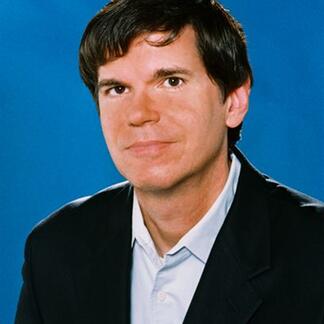
Dickson’s diverse background shines through in his work. From writing jokes for late-night television to penning humor columns in the days of thriving newspapers, his comedic voice has resonated across various mediums. His essays have graced the pages of prestigious publications like the Los Angeles Times and America Magazine, and he’s even co-authored two books published by Simon & Schuster. This breadth of experience clearly informs his playwriting, bringing a seasoned understanding of comedy to the stage.
“Lovely Idiots” centers around a group of New York actors and producers who gather to mourn the passing of a once-famous theatrical icon. But this isn’t your typical somber affair. Dickson’s play promises a comedic exploration of the theater world, its personalities, and perhaps even the absurdity of life itself. The premise alone hints at the kind of witty observations and character-driven humor that Dickson is known for.
This isn’t Dickson’s first foray into the theater world. His plays have been produced in numerous venues across the United States and Canada, demonstrating his commitment to the stage. “Lovely Idiots” marks another exciting chapter in his playwriting career, offering New York audiences a taste of his unique comedic perspective.
The industry presentation of “Lovely Idiots” will take place on Thursday, April 3rd, at 2:00 PM and 6:00 PM at Open Jar Studios, located at 1601 Broadway, New York City. Those interested in attending this unique theatrical experience can contact 646-338-5472 or [email address removed] for further details and to RSVP. Don’t miss this opportunity to witness the comedic genius of Brad Dickson and experience a funeral that’s sure to leave you in stitches.


Jim Catapano reviews (beyond) Doomsday Scrolling: A Timely Tale of Feminist Resistance
(beyond) Doomsday Scrolling Raises a Collective Voice Against Patriarchal Atrocities Past and Present
“One of the convenient afflictions of power is a lack of imaginative extension. For many men it begins in early childhood, with almost exclusively being read and given stories with male protagonists.” – Rebecca Solnit
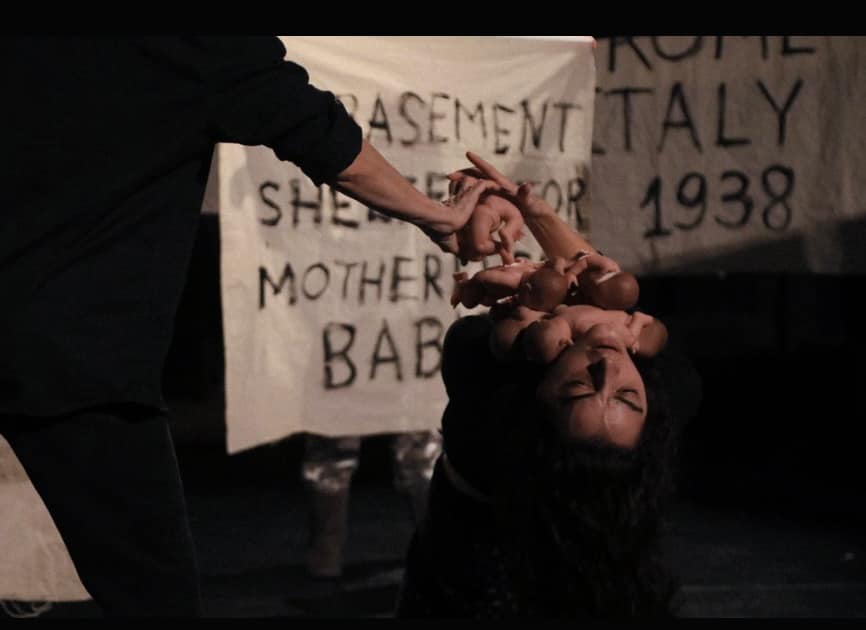
AnomalousCo’s (beyond) Doomsday Scrolling is a production of protest against the male-led oppressive, destructive course of human history which continues to this very moment, told through the stories of women who were there. It was first realized in 2022, and now returns for a run at the American Theatre of Actors. In the early, frightening days of 2025, its re-imagining is not a moment too soon.
The play is the ever-evolving creation of an ensemble—AnomalousCo is a women-led collective of predominately queer-identifying feminist artists and performers. All the actors are descendants of people who lived through these events; they are literally portraying their ancestors. The actors developed their individual characters themselves, drawing on the stories and experiences of their own families. The reality that the historic horrors they depict are also happening to and around them, here and now, lends a palpable emotional poignancy. You can see it in the actors’ eyes, feel it in their voices. Their work is a unified cry of resistance against the horrors of war and subjugation, caused by a system perpetually run by men.
(beyond) Doomsday Scrolling imagines women from different times and places, taking sanctuary in a theater to escape the horrors they have all faced. We meet refugees of violent conflict and disaster from all over the world; from the Warsaw uprising of 1944 to the 2022 invasion of Ukraine, and right up to the current day horrors of the Altadena fires. It is a tense scene—a siren sound mixes with the pleading cries of a baby; news reports, read matter-of-factly, are heard throughout, depicting tragic historical events from the last two centuries. These reports heartbreakingly intertwine with news from just days ago, in the aftermath of the repressive actions of the new US administration, and the ongoing horrors of Gaza. Quotations from women writers, including Rebecca Solnit (as noted above) Evgeniya Byelorusets and Naomi Klein, appear on a screen to bear witness, and to warn.
Speaking in their native tongues, the women try to communicate; they compare weapons and pass around a bottle of rum. A Red Cross volunteer comes to the “rescue”. The women open his box of supplies only to find that it’s useless: it’s filled with burlesque-type outfits, glittering dresses and feather boas. Through it all the women argue, they bond, they sing (notably a beautiful “Bella Ciao,” an Italian resistance folk piece); they try to escape in sleep, in long stretches of ominous silence. United by their experiences, they ultimately rise above their language barriers and cultural differences to come together in solidarity and understanding.
The initial incarnation of the show debuted shortly after the Russian Invasion of Ukraine, and is as crucial and relevant as ever in the cloud of chaos and uncertainty that is the here and now. Sheets line the walls, and ultimately the women’s clotheslines, listing the historic, patriarchy-caused catastrophes that caused them to flee. They all note the year, and ultimately, about half of them say 2025. The mantra of “it couldn’t happen here” is proven painfully incorrect; and history repeats, and repeats.
It’s noted that shortly before this production, the Doomsday Clock was moved from 90 seconds to 89. As (beyond) Doomsday Scrolling powerfully demonstrates,art—and the voices of women everywhere, from across time and distance—play a large part in slowing that second hand.
The performers/creators are: Alina Mihailevschi (Moldova), Claudia Godi (Italy), Diana Zhdanova (Russia), Jeremy Goren (US), Kikki Lau (China), Lesya Verba (Ukraine), Merve Atabek (Turkey), Simona DeFeo (Italy), Tia Cassmira (US), Wilemina Olivia-Garcia (Cuba), Weronika Wozniak (Poland), Ylfa Edelstein (Iceland).
(beyond) Doomsday Scrolling is directed brilliantly by Kathryn Mederos Syssoyeva, with Dramaturgy by Rhiannon Ling. It runs at the American Theatre of Actors through February 9, 2025.
Content warning: Presence of gun prop, partial nudity, siren sound.

Two Deep Cuts from a Legendary Playwright: Jim Catapano reviews Anton Chekhov
Two Deep Cuts from a Legendary Playwright
Chekhov’s Witty One-Act Character Studies Are Showcased at the ATA
The coupling of A Tragedian In Spite of Himself and The Anniversary is a delicious sampler of the work of the iconic Anton Chekhov, suited for both aficionados and newcomers. It’s another triumph for the American Theatre of Actors as it begins its 49th season.

A Tragedian… is a two-hander written in 1889, where “Chekhov’s Gun” gets an immediate namecheck. Ivan Ivanovitch Tolkachov (Devon Lawler) asks to borrow said revolver from his friend Alexey Alexeyevitch Murashkin (Harry Cooke). “If you don’t lend me a revolver than somebody else will!” he shouts. When Alexey admits he cannot detect what exactly is wrong with his friend’s life, Ivan proceeds to tell him…in incredible detail. Lawler is riveting as he delivers a long, frantic, impassioned monologue, raging against the perceived injustices of his existence. “Nobody has any sympathy for me, and everyone seems to think that all is as it should be!” he seethes—the final insult to him is his peers’ ignorance of his plight. It’s a complex stream-of-consciousness piece that Two Deep Cuts from a Legendary Playwright
Chekhov’s Witty One-Act Character Studies Are Showcased at the ATA
The coupling of A Tragedian In Spite of Himself and The Anniversary is a delicious sampler of the work of the iconic Anton Chekhov, suited for both aficionados and newcomers. It’s another triumph for the American Theatre of Actors as it begins its 49th season.
A Tragedian… is a two-hander written in 1889, where “Chekhov’s Gun” gets an immediate namecheck. Ivan Ivanovitch Tolkachov (Devon Lawler) asks to borrow said revolver from his friend Alexey Alexeyevitch Murashkin (Harry Cooke). “If you don’t lend me a revolver than somebody else will!” he shouts. When Alexey admits he cannot detect what exactly is wrong with his friend’s life, Ivan proceeds to tell him…in incredible detail. Lawler is riveting as he delivers a long, frantic, impassioned monologue, raging against the perceived injustices of his existence. “Nobody has any sympathy for me, and everyone seems to think that all is as it should be!” he seethes—the final insult to him is his peers’ ignorance of his plight. It’s a complex stream-of-consciousness piece that Lawler performs with astonishing energy and tremendous skill. (His “fed-up-ness” will have you nodding in solidarity.) Through it all Cooke’s Alexa listens with apparent sympathy, but then shockingly makes a request of Ivan that indicates he didn’t take in a word that his friend said, thus proving Ivan right. This sends the teetering Ivan over the edge, and chaos inevitably—and fittingly—reigns.
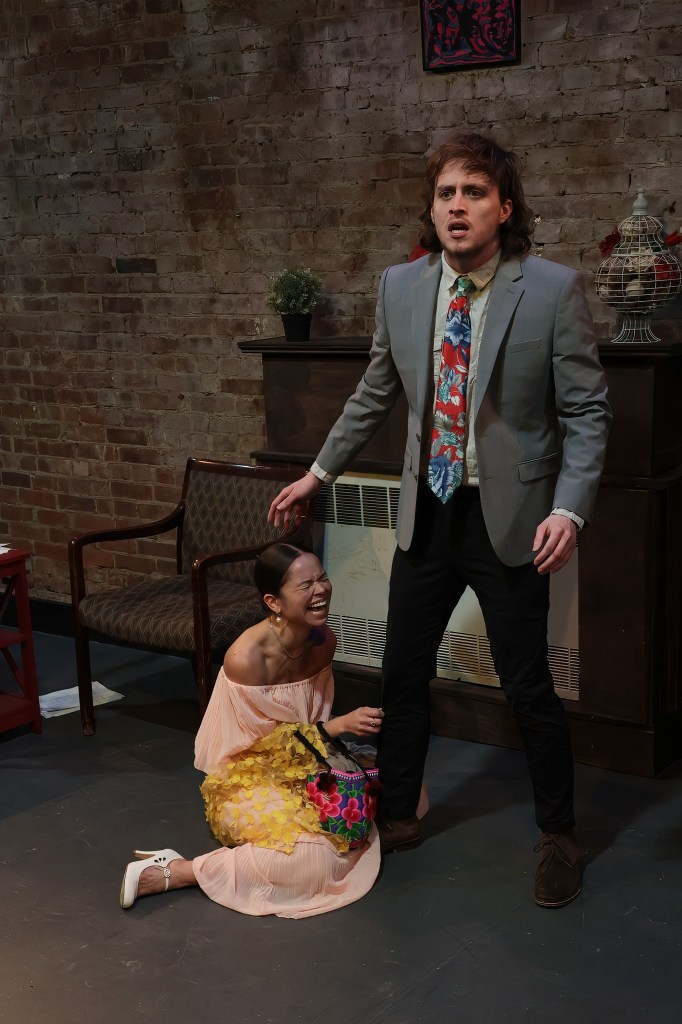
In The Anniversary, Anton takes on corporate life, and it’s striking to see how the piece—also from 1889—resonates in 2025. A farcical story set at a private bank, it concerns one Andrey Shipuchin (Jonathan Beebe), the company’s chairman, as he gathers his colleagues and shareholders to celebrate the institution’s 15th anniversary. Unfortunately for Shipuchin and all involved, events quickly go comedically south. Harry Cooke returns as the frustrated clerk Kusma, lamenting the chairman’s empty promises even as he prepares to craft his boss’ speech for the occasion. Natasha Sahs is hilarious as Andrey’s obnoxious wife Tatiana, who cannot stop talking about things that are not remotely relevant to anyone else. Kate Jergensen’s Natasha arrives to very humorously ruin the vibe even further, demanding that the bank pay her husband’s salary even though there’s no evidence that he ever worked there.
The actors collectively shine, providing a masterclass in realizing Chekhov’s classic and clever material, resulting in a can’t-miss dual production that demonstrates how words written long ago still resonate in the early 21st century.
A Tragedian In Spite of Himself and The Anniversary are directed by John DeBenedetto. They run at the American Theatre of Actors through February 2, 2025.

Holly Doubet: A Musical Legacy in the Making with a musical lineage that spans generations,
Holly Doubet is poised to make her mark on the Broadway stage with THIS IS NOT A DRILL.
A graduate of the Royal Academy of Music in London and a double major in classical piano and voice from a California university, HOLLY DOUBET boasts a diverse musical background. Her career has encompassed a wide range of experiences, from working as a studio singer and songwriter to leading her own band and serving as a backup singer in both Los Angeles and Las Vegas.
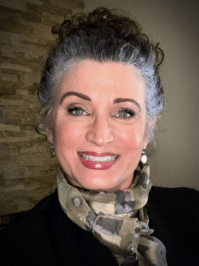
Doubet’s creative talents extend beyond performance. She served as the songwriter for the beloved children’s television show “Barney and Friends” in Dallas, contributing to its enduring popularity. Her songwriting prowess has also garnered recognition in the pop music world, with several of her songs achieving commercial success, including one that earned a CableAce Award nomination.
Drawing upon her rich musical heritage, Doubet has now turned her focus to musical theater. Her debut musical, “This is NOT A Drill,” a poignant and powerful work inspired by a true event, has captivated the attention of industry luminaries on both coasts.
In a significant milestone, “This is NOT A Drill” was unanimously selected to receive the prestigious Donald Fowler Theatre Arts Memorial Grant in May 2021. This esteemed recognition further solidifies Doubet’s position as a rising star in the musical theater world.
“This is NOT A Drill” — after its highly acclaimed premiere in Dallas in 2021, Doubet sets her sights on Broadway, she is currently in development for an industry reading in New York. Details to follow when solidified.

Searching for Hope in a State of Decay: Jim Catapano reviews Black & White City Blues
Richard Vetere’s Powerful Black & White City Blues Opens the American Theatre of Actors’ 49th Season

It begins with a tragedy and gets ever sadder from there. 32-Year-Old Little Guy (Joseph Monseur), his younger brother John John (Sam Cruz), and their friend Bobby (Jake Minter) are high on heroin and high on a rooftop, deliriously plotting a drug deal that they think we take them to even loftier places. But this euphoria is a smack-fueled illusion, and reality strikes abruptly and violently. Now Little Guy is without a sibling and consumed with a guilt that competes with his addiction to destroy him.
Black & White City Blues depicts the Williamsburg Brooklyn of 1971, where the streets are mean and bleak. Weary Detective Lucy Cortez (Anita Moreno) is suddenly working solo after her partner had decided he’d seen enough despair and retired to Florida. As she investigates what happened to John John, she is shadowed by Village Voice reporter Burke (Wasim Azeez), who sees a great story; Burke becomes so obsessed with making a name for himself through the tragic circumstances that he dooms himself to becoming just another part of them.

Little Guy longs for the existence that he saw depicted on TV in his childhood, where everyone was happy and any problems were solved in 30 minutes. “No one is lonely on TV,” is a mantra repeated through the play. This of course is a lie, as potent and damaging as the heroin he can’t kick. He alternates between trying to get clean (becoming one of the “straights”) and wondering if it might be better to succumb. The people he associates with are all living harrowing existences, while actively trying to make money off of them. Delilah (Amber Brookes, who also directs) is the addicted, broken prostitute haunted by memories of her toxic father; Bernice (Gary E. Vincent) is a barfly trying to find glimmers of joy and self-actualization amidst the dread. Piranha (Riyadh Rollins) is the most powerful and dangerous person in the neighborhood, a pimp and a drug dealer who the others try to stay on the good side of. Bobby and Delilah, in particular, are enablers on Little Guy’s road to destruction; he’s literally of more use to them as a junkie. But even as Little Guy searches for a way out, he continues to be literally haunted by John John, who even in death holds a devastating secret that just may lead to Little Guy’s breaking point.
As the only person actively trying to save Little Guy, Kevin Leonard is poignant as Mr. Wellman, a former addict now counseling him and helping him get clean. Wellman also has drug-related tragedy in his past, and like Little Guy, the guilt is always with him, affording no rest or peace.
We really get a sense of the world closing in on Little Guy and his doomed community, as any sign of hope is quickly cast aside by the false promise that heroin keeps dangling in front of them.
Though Little Guy is the focus, every character gets an aria, a moment in the spotlight to tell their story, and the cast collectively astonishes in bringing the heartbreaking tale to life. The actors give a brutally realistic depiction of addiction and withdrawal, while being utterly compelling and truly sympathetic to the very end.
The production is stylishly directed by Brookes and makes excellent use of the space to depict a city of ruins occupied by desperate people. (Of particular note is the clever use of a backlit door depicting the silhouettes of first sex, and then suicide.)

Brookes’ team includes Dustin Pazar as Assistant Director/Production Manager, and Jake Smith providing Lighting Design.
Black & White City Blues is an incredibly moving, impactful, and astute observation of the frailty of human existence that is not to be missed, and will stay with you long after the lights go out.
Note: This play portrays violence, scenes of intimacy, and drug use and paraphernalia.
Black & White City Blues runs at the American Theatre of Actors through January 19, 2025.

Brad Dickson’s LOVELY IDIOTS comes to NY
You’re invited to a funeral!
Playwright BRAD DICKSON in association with Jay Michaels Global Communications llc bring to New York an industry presentation of Dickson’s uproarious play.

A group of New York actors and producers gather for the funeral of a faded theatrical acting icon. Who ever knew that death could be so darn funny?
LOVELY IDIOTS will be presented Thursday, April 3 @ 2:00 and 6:00 p.m. at Open Jar Studios, 1601 Broadway, New York City. Contact 646-338-5472 or info@jaymichaelsarts.com for further details or to RSVP
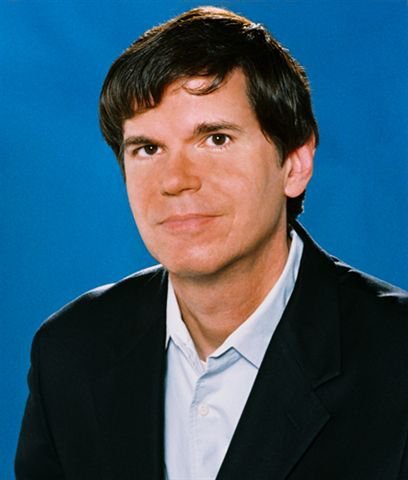
EMMY Award-winner, Brad Dickson is a former staff writer for The Tonight Show. He was a newspaper humor columnist back when newspapers were a thing. His essays have appeared in the Los Angeles Times, Los Angeles Times Magazine and America Magazine. He’s the co-author of two books that were published by Simon & Schuster. His plays have been produced at numerous theaters in New York City and throughout the rest of the country as well as in Canada.
Jim Catapano reviews a Letter-Perfect Power Play
Frank Cossa’s Witty Character Study Bows at the ATA
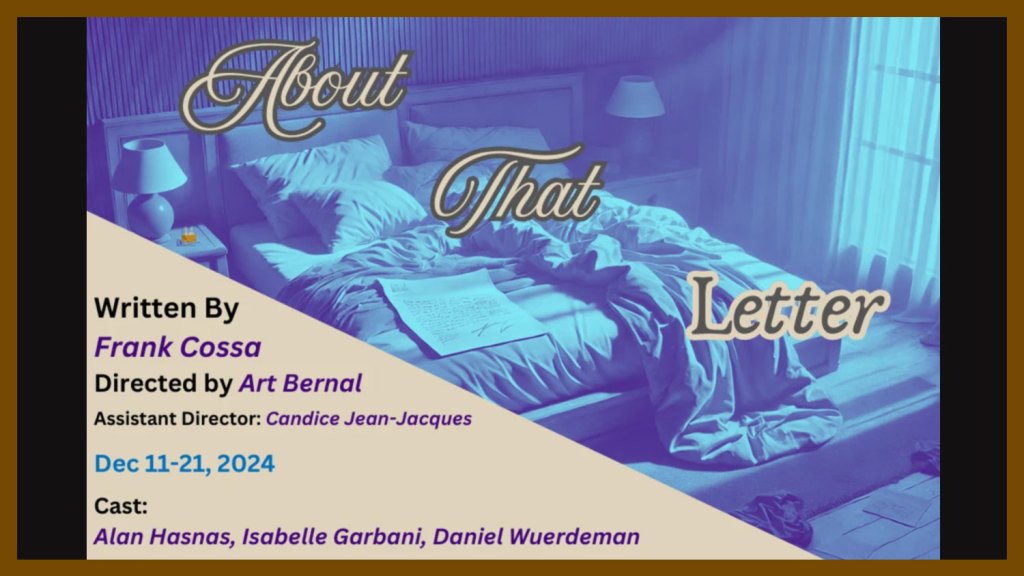
While sipping an adult beverage at a professional conference, Doctor Emma Vanderlyn (Isabelle Garbani) meets a charming man who she describes as “oddly cute, in a cutely odd kind of way.” However, to her horror the man turns out to be her arch-nemesis, tenured professor Pete Brasso (Alan Hasnas). Years earlier, Brasso had single-handedly brought to a near-halt the academic career of Emma’s husband, Josh Sperling (Dan Wuerdeman). Brasso had sent a letter to the editor of The Art Review, pointing out a serious factual error in Sperling’s article in the journal regarding the artist Whistler. This action led to Sperling’s credentials being questioned, culminating in the rejection of his own tenure. The incident, in her estimation, “ruined her life”— and she’s ready for revenge, but in a very unusual manner.
Thus begins About That Letter, a sharp and engaging one-act by Bronx-born Frank Cossa. To the sounds of the Pomp and Circumstance Graduation March, we flash back to Emma and Josh learning of Brasso’s letter; Josh is in despair—admitting Brasso is right, and correctly predicting the dire consequences of it. Emma seethes that the triumphant life path she had sought through her husband’s success is about to be denied her; she is almost Lady Macbeth-like in her rage. She scoffs at Josh’s suggestion that it will end up ok: “I don’t want OK, I want pretty damn good!”
Returning to the present, things have taken an unexpected turn—after copious drinks, Emma has “slept with the enemy.” Wearing the fluffy white robes of the hotel they are staying in, they bask in the afterglow the next morning, until Emma reveals her motives and gives us a clearer picture of the calculating, success-obsessed person underneath the professional charm and decorum.
“I wanted to know what it felt like to have sex with a man I detest,” she proclaims unapologetically. (There’s a slang term for that, but I won’t repeat it here.) Still reveling in the satisfaction of this, she gleefully assassinates his character, dismissing him as a poser and a hypocrite who rambles on meaninglessly (“A Rebel Without a Pause” is one of her more memorable dismissals). And circumstances only escalate from there…
The three actors bring Cossa’s compelling story beautifully to life, delivering his insightful and humorous observations with relish. It’s a terrific study of human interaction and dysfunction, and how the desperate desire to be somebody leads to some shocking life choices.
About That Letter is directed by Art Bernal with co-direction by Candice Jean-Jacques. It is presented at the Beckman Theatre at the American Theatre of Actors through December 21, 2024.
Latest Posts
-

Jim Catapano reviews Anne L. Thompson-Scretching’s Home Is Sweet Sorrow: “A Masterful Conclusion to a Momentous Family Saga”
The War That Never Ends Home Is Sweet Sorrow is a must-see and a devastatingly powerful third chapter in the Blood trilogy, which also includes…
-

THE BARD TAKES BROADWAY: SIXTH ANNUAL NEW YORK SHAKESPEARE AWARDS CELEBRATES RECORD-BREAKING 2025 SEASON
THE BARD TAKES BROADWAY: SIXTH ANNUAL NEW YORK SHAKESPEARE AWARDS CELEBRATES RECORD-BREAKING 2025 SEASON The New York Shakespeare Awards has officially unveiled its list of…
-

American Theatre of Actors Announces 50th Anniversary Gala; Playwright LYLE KESSLER and TONY-winning actor, LEN CARIOU to Receive Lifetime Achievement Honors.
NEW YORK, NY — The American Theatre of Actors (ATA), a cornerstone of the New York theatrical landscape since 1976, is proud to announce ATA 50, a…
-

Music Among the Tumbleweeds: Jim Catapano reviews James Jennings’ New Dancing in the Meadow.
James Jennings’ New Dancing in the Meadow Brings Feel Good Vibes to the ATA James Jennings, legendary Founder of the American Theatre of Actors, brings…
 Arts Independent