
Home » Posts tagged 'book-review'
Tag Archives: book-review

History is NOW: Jim Catapano views ZAGŁADA
Richard Vetere Brings t His Gripping Zaglada and the Great Len Cariou to the ATA Stage
“How do you judge human behavior when human life is judged to be worthless?”
Zaglada is a polish word meaning “annihilation, or extermination.” The astonishingplay that takes this nameexplores the moral dilemma faced by human beings in the horrific, life-and-death situation that this describes. What would you do to save yourself, or the person you love most? And how far would you go to render justice, even decades later? Should a person in the last days of their life face punishment for the crimes of a near century ago—crimes that to some eyes, they were forced to commit?
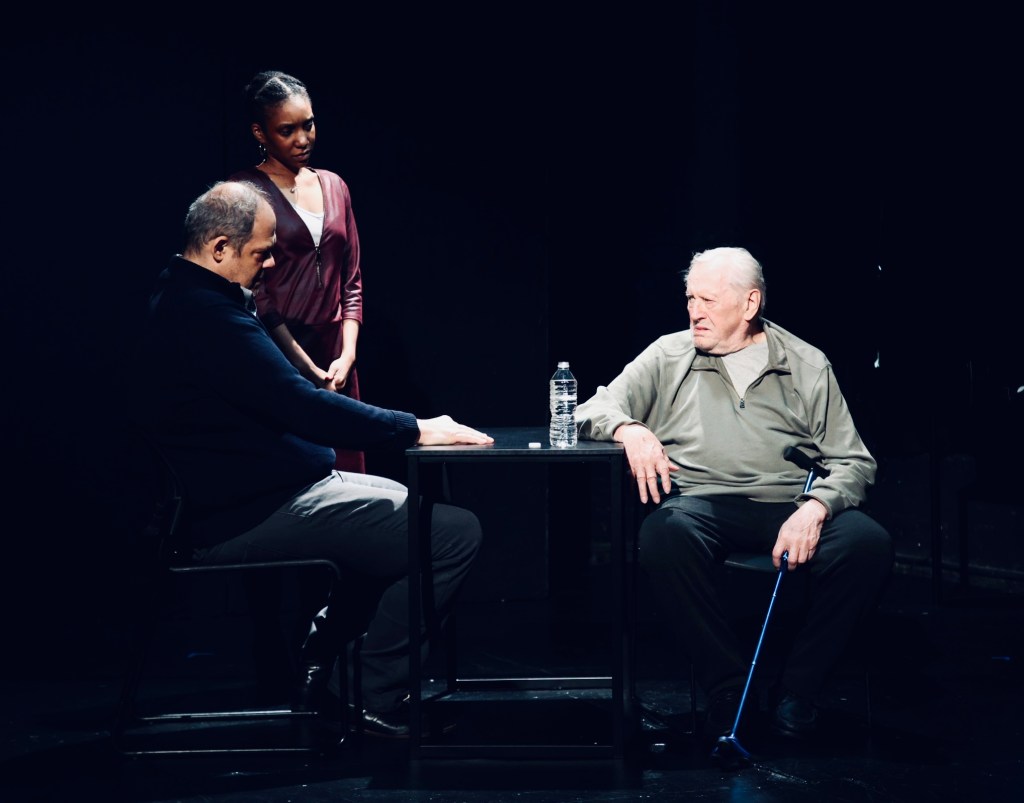
The Marvelous Len Cariou, a 65-year veteran of the stage and a Tony winner renowned for his performance as Sweeney Todd, isJerzy Kozlowski. He is a 93-year-old Polish Queens resident who has been arrested for shooting at Danielle Hooper (Jes Washington), a woman of color and a journalist. Danielle has discovered that Kozlowski was a kapo in a Buchenwald concentration camp in World War II, a prisoner who became an enforcer in the camp in exchange for his own life…and more. The arresting officer Frank Napoli (Salvatore Inzerillo) finds himself in an unexpected conflict with Sonia Sakalow (Maja Wampuszyc), a Homeland Security Officer who is hellbent on finally bringing Kozlowski to justice.
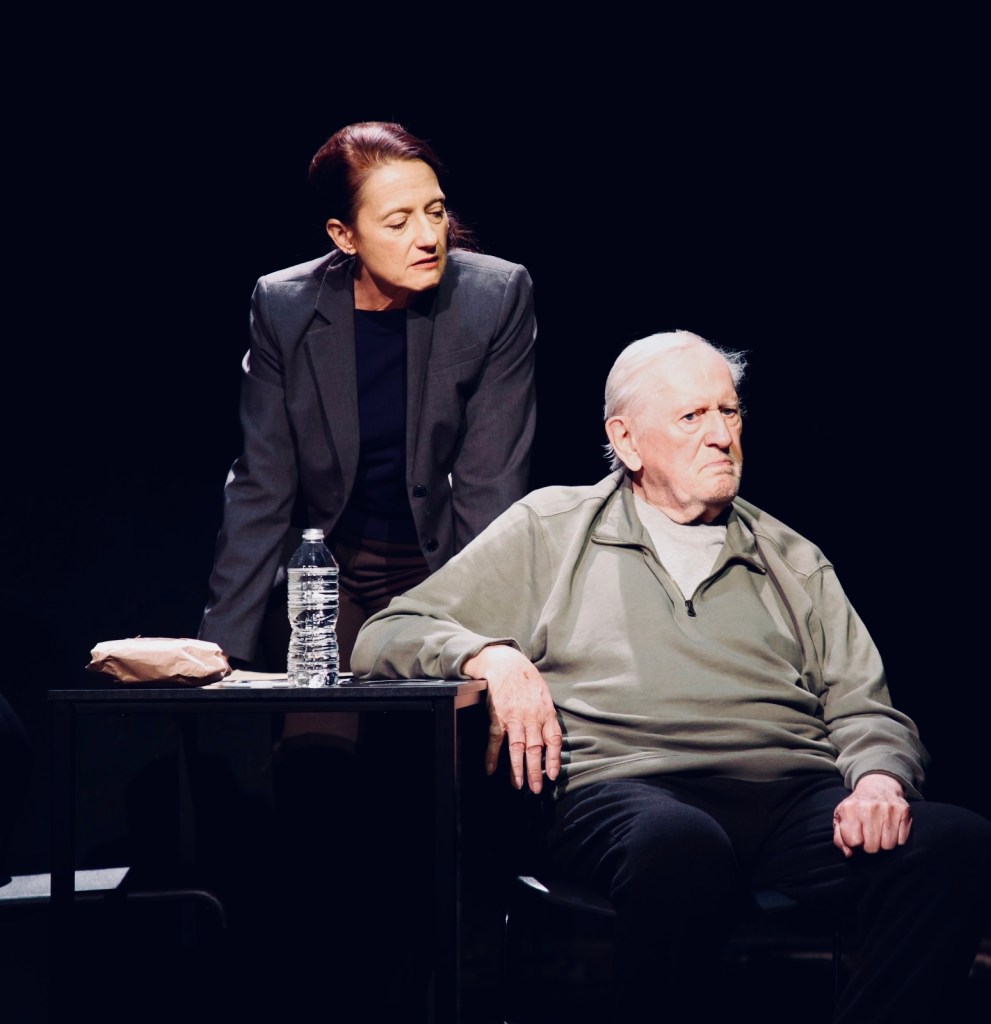
Powerfully directed by Wampuszyc, Zaglada is a fiction based on a very real reality—a history that is in danger of being forgotten, which creates the very real possibility that it will be repeated.
Napoli takes pity on the dying Kozlowski, giving him his pills and making sure he’s comfortable. He appears to be on the side of “moving on” from history.
“We spend most of our time worrying about things, dealing with things that happened when we weren’t even here,” he says to Hooper.
“Like Kozlowski?” she asks.
“Like Christopher Columbus, like Confederate statues, like reparations for slaves,” he replies, adding that his family wasn’t even in the country when the events transpired.
“That is the usual argument,” she notes. “But it is history, isn’t it?”
“Yours, maybe,” he dismisses, “not mine.”
Hooper, who is writing a book getting a PHD in International Human Rights, sees a parallel between the atrocities of the War and the persecution of African Americans, and seeks to make the world see it as well.
“The economy of this country was built on slavery,” reminds Hooper. “Now whether they were here or not, your people certainly benefited by the time they got here. Slavery was also a crime against humanity if you ask me, and there’s no statutory limit on that.”
Wampuszyc also sees no statute of limitations on Kozlowski’s actions in the latter days of WWII. She looks upon the old man with contempt and hatred that feels unusually personal, and is determined to see him be extradited and tried. Napoli is not on board; he sees Kozlowski as having been coerced into his actions.
“An elderly man, forced to work for the SS in a war that nobody thinks about anymore, needs to be punished?” Napoli protests.
“I am well aware that he did not volunteer to be a kapo at Buchenwald,” Wampuszyc retorts, dismissing that aspect as irrelevant. “…He is guilty, those are the facts.”
“I’m not sure that I would survive in a camp,” acknowledged Napoli. “But I know one thing…I would do all I could to survive.”
“You don’t know what you would do, nobody does,” says Wampuszyc. “Not until you are there, and it is real.”
The legendary Cariou is a wonder to behold; the experiences of a near-century are all in his eyes. You can literally see him putting himself back in 1945 as he gazes into the middle distance in agony. His fellow actors are also remarkable in their intensity, each suffering from their own form of PTSD that manifests in their passionate resolve and in the haunted, pained expressions on their weary faces. As circumstances unfold there are revelations that paint a vivid picture of why these particular people have found themselves battling in a small police station in 2018; every moment is riveting as more and more comes to the surface to create deeper shades of gray.
Zaglada is a masterpiece that is a must-see from both a creative standpoint and due to its undeniable relevancy in a time when humanity is at a moral crossroads and is already beginning to repeat the atrocities of the past.
Zaglada is performed at the American Theater of Actors through November 2.

The Bees Still Can’t Help Themselves! says Jim Catapano
Douglas Carter Beane’s 90s Classic As Bees In Honey Drown Gets a Masterful Revival
“Once, I saw a bee drown in honey, and I understood,” is a famous quote attributed to the 20th Century Greek writer Nikos Kazantzakis. He recognized the danger of wanting too much, the trap that is set for us by our own unquenchable desires. Douglas Carter Beane took this fact of life and fashioned As Bees In Honey Drown, an astute and incredibly witty play that takes a brutal look at the fame game and how seduction can lead us down a dark path, and eventually destroy us. The Modern Classics Theatre Company has brought this masterwork roaring into the (new) 20s with panache and a sterling cast.
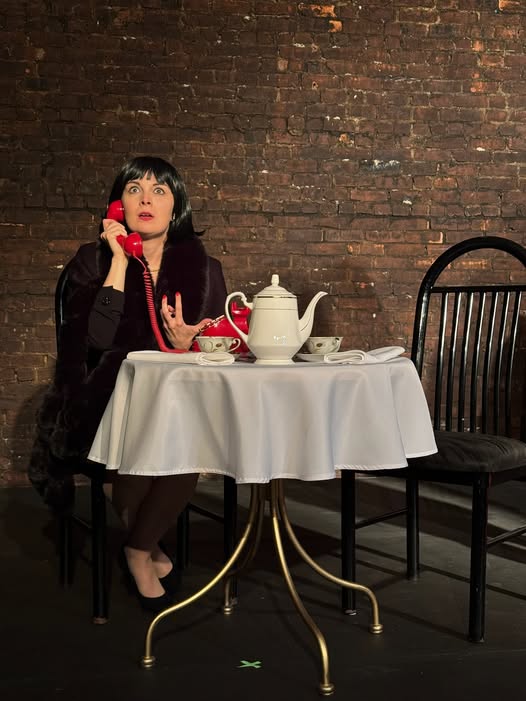
New York City con artist Alexa Vere de Vere (Christina O’ Shea), the villain of As Bees in Honey Drown, recognizes the power of the “honey” that is fame and fortune, and makes a living out of exploiting those who hunger for it. Alexa is a force of nature, a narcissistic socialite in designer dresses who sports an Uma Thurman Pulp Fiction-style black bob and an air of being the most important person at the party. She claims a thousand connections and drops a name at every opportunity, in an exotic, unplaceable accent rivaling that of Kathleen Turner (as she freely points out). As her story unfolds we learn that she is both Frankenstein, and the monster. The latest bee in her honey pot, Evan Wyler (Peter Konsevich), is a writer on the cusp of fame. At a magazine photoshoot for his upcoming book he is convinced by the photographer to pose without a shirt, and this gets Alexa’s attention, outing him as a person desperate for success. She seduces her prey with promises of fortune and glory—convincing him that she is the one who can take him to the top. They dine, they banter, they party, and he foots the bills. She even gets the openly gay Evan to fall for her: Just when it seems like Alexa’s pretentious phoniness is getting too obvious, she “humanizes” herself with a tragic backstory that’s really too “bad” to be true, but reels Evan in anyway. “I love you,” he proclaims at her weepy suggestion that she is unlovable. Before long he is down thousands of dollars, alone, still not famous, and desperate to get revenge—or so he says. Does he hate Alexa, or is he still infatuated?
O’Shea gives a powerhouse performance as the conniving Alexa. She is at turns over-the-top, hilarious, irresistible, and even at times almost sympathetic, and it all comes together brilliantly. When Evan finds artist Mike (Kevin Russo), Alexa’s overall-clad ex-partner and the focus of her tallest tale, we see in a flashback that he was the first victim of her crime spree. (She even chillingly calls him “lamb” before their falling out, just as she would later dub Evan.) As with Anakin Skywalker/Darth Vader, this compelling prequel shows us how the “Alexa” persona came to be, down to the accent and the bizarre surname, and O’Shea is remarkable portraying the ordinary girl behind the curtain who slowly morphs into the supervillain.

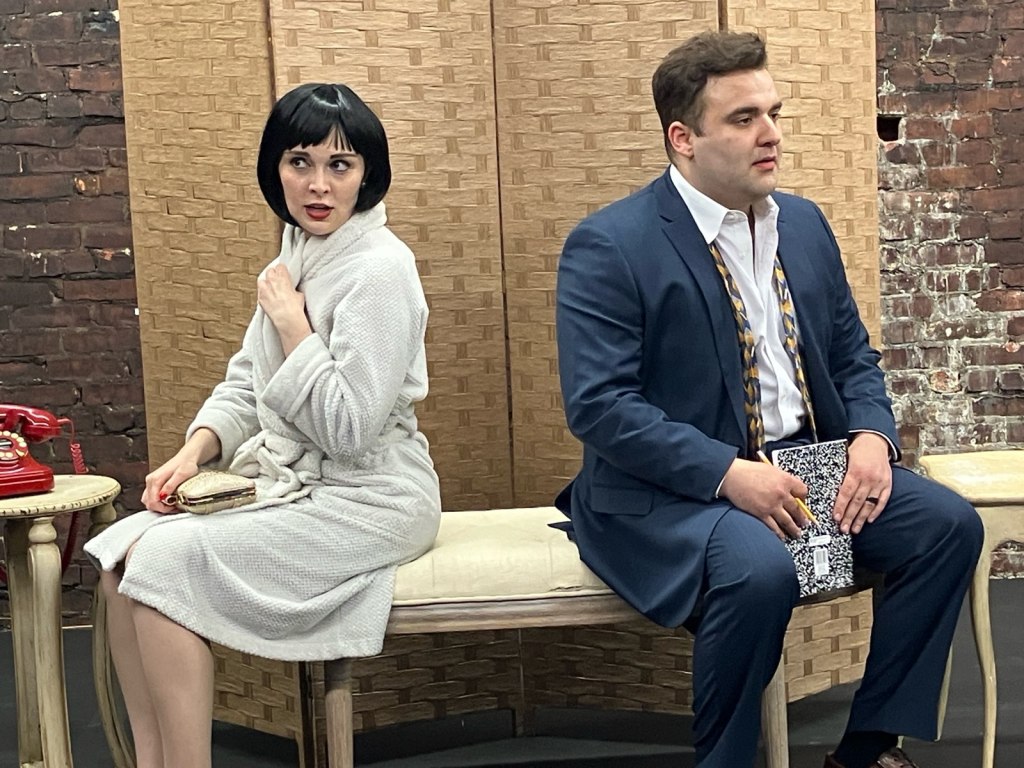
Konsevich is sympathetic and very funny as the befuddled, relatable Evan. Brian DiRaimondo, Julie Lorson, and Ronni Schweitzer round out the cast wonderfully in multiple roles, including several of the other bees caught in Alexa’s honey whom Evan calls on in his plan to get even. It all makes for an entertaining and faithful rendering of Keane’s clever classic, a cautionary tale that is all the more relevant in this modern age of Social Media, Influencers, and the “almost famous” who will do anything to get to the top of the search engine.
As Bees in Honey Drown is deftly directed by Tarmo Kirsimäe. It runs through June 1 at the Bacca Arts Center in Lindenhurst, Long Island. For more information, go to https://modernclassicsli.booktix.com/dept/main/e/Bees

Is That in the Script? asks Jim Catapano regarding Joseph P. Krawczyk’s Living the Play
Joseph P. Krawczyk’s Living the Play: A Dangerous Time for Women Is Timely, Clever, and Compelling
It is November 5, 2024. Crystal (Chelsea Clark), a New York Theatre actor, and her partner Jeremy (Nathan Cusson), a psychotherapist, are coming back to their apartment after voting for Kamala Harris on Election Day. Crystal awaits the outcome with tremendous trepidation while Jeremy just “que-sera-seras” and suggests they hope for the best. Crystal is also gearing up for her lead role in a make-or-break Off-Broadway production, a two-hander about a woman whose pregnancy and subsequent difficulties in getting proper reproductive care lead to tragedy. Jeremy’s apparent nonchalance (masking an anxious personality, as we soon learn) exasperates the passionate Crystal. She implores her reluctant partner to run lines with her. Jeremy, whose own acting career was brief and long ago, reads the lines initially in a disinterested monotone. But he has a didactic memory, and begins to get very familiar with a show that he’s not even in. The rehearsal of the tense dialogue between the couple in the play begins to mix with Crystal and Jeremy’s actual discourse and their real-life relationship difficulties, leading to the ominous mantra, “is that in the script?” (or, are we really saying these things to each other?). Soon neither they—or us—is certain where Crystal and Jeremy end and their characters begin.

The play-within-a-play technique, set against the backdrop of the real-life circumstances its audience finds itself in the United States of 2025, makes Living the Play a unique and powerful experience. We who are observing the couple know how the election of 2024 is going to end; how it’s going to affect Crystal; and how it threatens her rights as a woman. A revelation drives home that her character’s plight in the play could well be a foreshadowing of her own future, and Jeremy—whose “life is not at risk,” as she reminds him—seems incapable of the support and understanding she needs from a partner. Crystal had turned off the news for the remainder of November 5 after casting her vote, and it’s left to Jeremy to inform her of the outcome. She grabs a pillow and screams into it, and It’s a sad and chilling moment of recognition for those of us who wanted things to go another way. Jeremy continues to play the “it won’t be that bad” tune, ignorant of the fact that he is dismissing Crystal’s fear, and the clear and present danger that every woman is now in.
With this dark cloud over the future and their relationship, Crystal carries on with the play with Jeremy’s grudging assistance, the dialogue continuing to blur with their reality. When she brings out the real loaded gun she owns, mistaking it for the prop gun from the play, it drives home how close they are to living out the tragic circumstances of the show she’s so absorbed in.
The outcome of the election has consequences for the production itself too, as the understudy for Crystal’s scene partner, a transgender person, leaves for Canada. Jeremy is now the understudy for a role he doesn’t want, just one more defection away from being the lead. He desperately tries to get out of it and yet begins to paradoxically get more involved, his photographic memory causing an unexpected engagement with the material. He even questions the playwright’s choices, which draws further ire from his partner. We can feel the walls closing in as not only is Crystal’s career and relationship in danger, but so is her very future as a woman in America, as her rights to bodily autonomy and reproductive care begin to slip away, and the one person she wants to depend on can only shrug helplessly.
Clark and Cusson are astonishing in their roles—believable, relatable, and skillful in their juggling of their own characters’ voices with those of the characters of the play they are rehearsing. By showing how the suppression of rights impacts one person whom we’ve grown to care about, Krawczyk has driven the urgency of the situation home. His words are expertly brought to life by Clark and Cusson, under the deft guidance of Director Eddie Lew and Assistant Director Carrie Stribling. Just as Crystal is taking on injustice and fighting for her future through creativity, so is the team behind Living the Play showing us how art is one of our greatest weapons to wield against the tyranny of the times.
Living the Play: A Dangerous Time for Women is dedicated to Amber Thurman, Taysha Sobieski, Josseli Barnica, and Candi Miller, who lost their lives due to the denial of timely reproductive care.
The play runs at the American Theatre of Actors through May 18, 2025.

Knock Knock, Whodunnit? Jim Catapano finds fun at CLUE
The MCT’s Imagining of Clue delights at the BACCA Arts Center
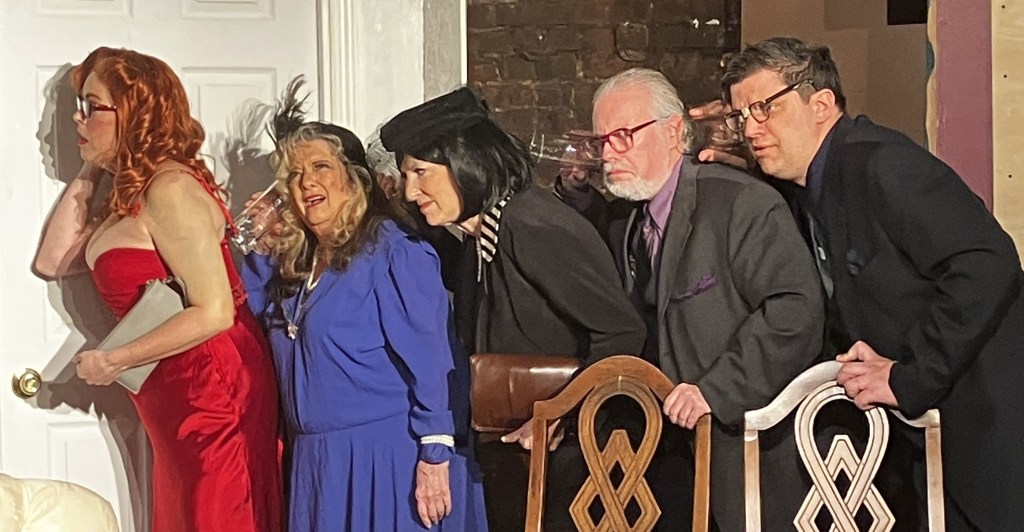
It is the early 1950s, a time when everyone is suspicious of everyone else. By invitation, several of society’s supposed finest gather at the mansion of Mr. Boddy (Mark John Santaromita) on a stormy night. They are familiar archetypes with political influence, all known for the occasion by the special pseudonyms bestowed on them by their mysterious host: Colonel Mustard (Joe Hoffman), Mrs. White (Pamela Seiderman), Mrs. Peacock (Elizabeth DeGennaro), Mr. Green (Ed Cress), Professor Plum (Gary Tifeld) and Miss Scarlet (Meredith Lynn Spencer). The guests are greeted by the very shady butler Wadsworth (Dan Bellusci) and the very French maid Yvette (Heather Legnosky). After clenched-teeth pleasantries, cocktails, and shark’s fin soup (Mrs. Peacock’s favorite, as the cook is creepily aware of), Mr. Boddy appears and reveals he is blackmailing them all, and then hands them their “gifts”; potential murder weapons for one of them to use to kill Wadsworth to protect their secrets before he contacts the authorities. The lights go out, and the fun begins as the bodies pile up and the suspects grow more desperate and frantic.
Sandy Rustin’s stage play Clue, based on the 1985 cult classic film based on the classic board game, is revisited through a wonderful new production by the Modern Classics Theatre of Long Island. It is directed with great panache by Matt Stashin, with clever set design by John Emro and Rian Romeo. A set of moving doors create the illusion of a vast mansion, and they are used to great effect as the characters peer in and out of them, race through them, and shudder at what horrors might be found behind them. High-energy chase music accompanies the characters rushing from room to room between scenes as the sets are swiftly and skillfully swapped—the scene changes are almost as entertaining as the show itself. This is a very physical production; the actors throw themselves bodily into every sequence as they deftly handle the complex wordplay, which is delivered rapid-fire; the audience is still laughing at the previous joke when another one comes hurtling at them.
In addition to the always witty and often hysterical dialogue, there are wonderful sight gags: the actual board game of Clue is used as a map to the mansion; one of the murder victims (James Brautigam) resets the scenery and gets back into position dead on the floor, in full view of the audience; a chandelier falls in super-slow motion as its victim recoils and screams equally slowly; the suspects prop up the dead bodies Weekend at Bernie’s-style to fool a prying police officer. Sound is also a big part of the fun: the ominous doorbell; the barking guard dogs outside; the incredibly loud dinner gong of the cook (Karen Santaromita) which traumatizes everyone, and Mrs. Peacock’s blood-curdling, sound barrier-breaking screams. Karen Santaromita’s double duty as a cheery but ill-fated singing telegram provides one of the show’s funniest moments as the murders accelerate. “Three bodies in three minutes!” marvels one suspect. “That’s our best record!”
Clue boasts a cast of 11 and a character count of 15—in this incarnation, every murder victim humorously gets to be reincarnated as a police officer.
The actors of the ensemble are all perfectly cast, and hilarious in their distrust and barely concealed contempt for each other as they desperately try to avoid suspicion and/or death. Late in the play when Wadsworth breathlessly recounts and acts out the events of the entire evening, Bellusci’s performance is astonishing. And true to the source material, multiple dénouements are explored, as every character gets a chance to have done it. “But it really happened like this…”
Clue is performed at the BACCA Arts Center through Sunday March 16.
Jim Catapano reviews a Letter-Perfect Power Play
Frank Cossa’s Witty Character Study Bows at the ATA
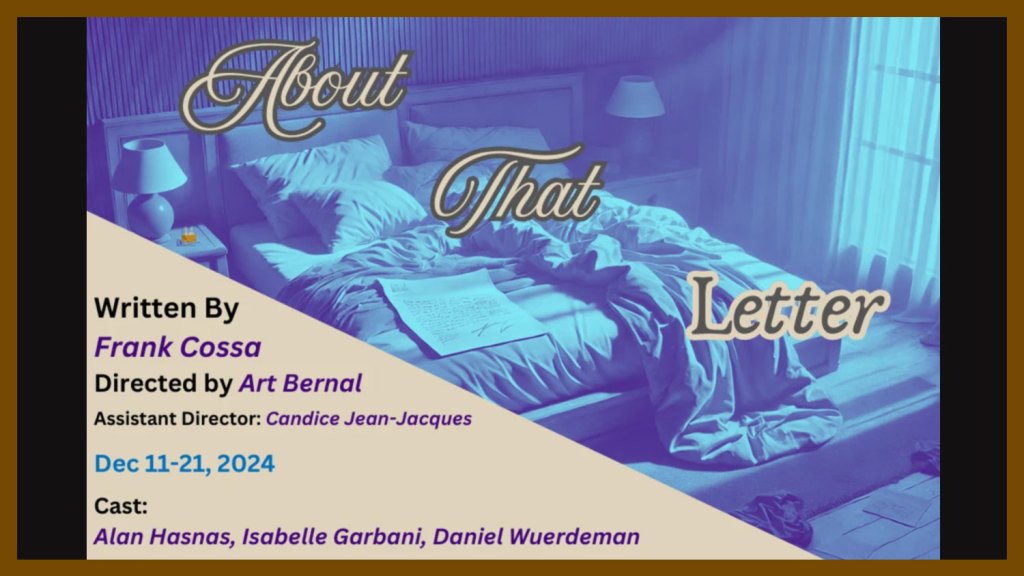
While sipping an adult beverage at a professional conference, Doctor Emma Vanderlyn (Isabelle Garbani) meets a charming man who she describes as “oddly cute, in a cutely odd kind of way.” However, to her horror the man turns out to be her arch-nemesis, tenured professor Pete Brasso (Alan Hasnas). Years earlier, Brasso had single-handedly brought to a near-halt the academic career of Emma’s husband, Josh Sperling (Dan Wuerdeman). Brasso had sent a letter to the editor of The Art Review, pointing out a serious factual error in Sperling’s article in the journal regarding the artist Whistler. This action led to Sperling’s credentials being questioned, culminating in the rejection of his own tenure. The incident, in her estimation, “ruined her life”— and she’s ready for revenge, but in a very unusual manner.
Thus begins About That Letter, a sharp and engaging one-act by Bronx-born Frank Cossa. To the sounds of the Pomp and Circumstance Graduation March, we flash back to Emma and Josh learning of Brasso’s letter; Josh is in despair—admitting Brasso is right, and correctly predicting the dire consequences of it. Emma seethes that the triumphant life path she had sought through her husband’s success is about to be denied her; she is almost Lady Macbeth-like in her rage. She scoffs at Josh’s suggestion that it will end up ok: “I don’t want OK, I want pretty damn good!”
Returning to the present, things have taken an unexpected turn—after copious drinks, Emma has “slept with the enemy.” Wearing the fluffy white robes of the hotel they are staying in, they bask in the afterglow the next morning, until Emma reveals her motives and gives us a clearer picture of the calculating, success-obsessed person underneath the professional charm and decorum.
“I wanted to know what it felt like to have sex with a man I detest,” she proclaims unapologetically. (There’s a slang term for that, but I won’t repeat it here.) Still reveling in the satisfaction of this, she gleefully assassinates his character, dismissing him as a poser and a hypocrite who rambles on meaninglessly (“A Rebel Without a Pause” is one of her more memorable dismissals). And circumstances only escalate from there…
The three actors bring Cossa’s compelling story beautifully to life, delivering his insightful and humorous observations with relish. It’s a terrific study of human interaction and dysfunction, and how the desperate desire to be somebody leads to some shocking life choices.
About That Letter is directed by Art Bernal with co-direction by Candice Jean-Jacques. It is presented at the Beckman Theatre at the American Theatre of Actors through December 21, 2024.

Jim Catapano is seeing double: two shows at the ATA
The Oddest of Couples: Meny Beriri Brings Two Witty and Insightful Character Studies to the ATA
Opposites may attract, but they also repel pretty quickly too, as Meny Beriri observes in his two new one-act pieces, Smoking Kills and SKU. They complement each other perfectly as each is a look at two sets of people struggling to get on the same page. Each pairing features one cynic, and one hopeless romantic; one cautious, and the other free-spirited; one level-headed, and the other obsessive; one grounded in reality, and the other in Hallmark movie-land. Both plays take place in a post-pandemic world, which informs the approaches to life of all the characters—it’s basically “Let’s Form a Connection” vs. “Leave Me Be.”

SKU: “We’ll always have Paris Baguette!”
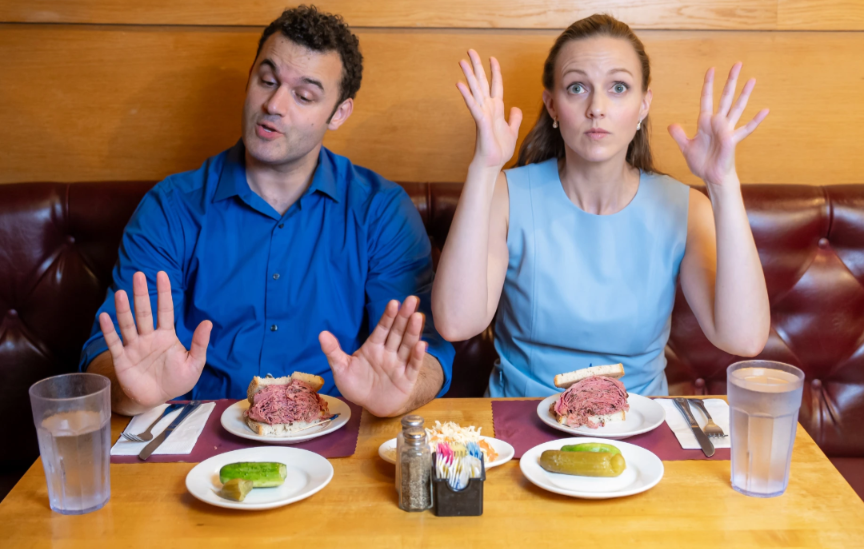
Alex (Gordon Rothman) and Melanie (Stacey Petricha) are fresh from their memorable date at the aforementioned bakery/café, and are now meeting at a restaurant to keep the fire burning over Indian food. Melanie is a retired nurse, and happy to be independent and free of responsibility. “We’re not heroes,” dismisses Melanie, who sees her nursing career as having been just a stressful gig. Alex, in contrast, is a high-school social studies teacher so in love with his job that he has convinced himself that every day is as meaningful as Dead Poets Society. He’s a passionate soul who fixates on something and won’t let it go; he’s an hour late to the second date, blaming it on his obsession over obtaining a certain stapler missing the SKU of the title. (It stands for “Stock Keeping Unit”, which stores use to identify products in their inventory.) He then goes on a tangent about Star Trek (The episode “The Doomsday Machine,” to be appropriately specific), and his quest to discover the identity of the actor who walked in front of Kirk in one pivotal scene. Melanie is life-loving as well, but in a fiercely independent way. She doesn’t see constant companionship as the key to happiness—to her, it’s by and large an obstacle.
“You still need other people,” argues Alex. “But you can’t depend on them for happiness!” Melanie fires back.
She stays polite, but her demeanor begins to indicate that the Paris Baguette encounter should maybe have been a one-and-done. Alex, however, has decided after one date and a half that Melanie is his soul mate.
“You think we share a soul?” she scoffs. “From what I remember, that’s not how reincarnation works!” But Alex is unrelenting—he announces he wants to travel the world with the sudden love of his life, and Melanie recoils in horror; to her, that basically echoes the title of the very first episode of Star Trek: “The Cage”.
While perfectly depicting the clashing of their characters, the actors have tremendous chemistry and make the script sing. Petricha and Rothman are supported by Samiha Ahmed, the waitress who has a god’s eye-view of the quickly crumbling romance. Though things go south fast for Alex and Melanie’s connection, they do so humorously, and the theme of incompatibility lands while never feeling tragic or even at all downbeat; Alex lands on his passionate feet, in a very funny resolution.
Smoking Kills opens to the sounds of the Odd Couple theme, lampshading the relationship between the youthful and exuberant Emily (Julianne Lorndale) and her roommate/landlord, the older, warier Jane (Leia Martin).
An Oklahoma transplant, Emily returns to their NYC apartment gushing over her date with “Harold”, who took her to the exotic Avenue D and then on a romantic trip on the Staten Island Ferry. Emily compares it to Casablanca, which she recently discovered. Jean smells cigarettes on Emily—the extremely potent Marlboro Reds, to be exact—and is disgusted. Emily admits she smoked one of Harold’s ciggies in the heat of the moment, and still has the pack. Jean is triggered due to the 6-pack a day habit she once had as a teen, and warns Emily of the evils of the addiction, and of a lot of other dangers in life that Emily seems blissfully unaware of—such as the antibiotic filled Jumbo Shrimp she consumed at dinner. Jean invokes the “my house, my rules” clause, escalating the confrontation between the two, and leading to an explosive, violent-but-comical climax. As with SKU, a potentially traumatic conclusion is handled humorously, and again with the perfect final moment. Martin and Lorndale realize this modern-day Felix and Oscar beautifully, playing off each other with deftness and expertly serving the witty material.
These two delightful one-acts are a testament to Beriri’s ability to take the sad reality of the failed connections that plague life in the post-pandemic 2020s, and imbue them with a compassionate touch and knowing sense of humor that is refreshing, and somehow even healing.
SKU is directed by Meny Beriro; Smoking Kills is directed by Ginger Kipps. They are featured together at the American Theatre of Actors through December 8, 2024.

High Praise from Jim Catapano for SKYSCRAPER
The Skyscraper Rises Again
The 1960s Broadway Musical Is Gloriously Revived for the First Time.
The determined and spirited Georgina Allerton has two goals—to make her antique shop a success, and to save her Rutherford B. Hayes-era Manhattan brownstone from getting bulldozed in favor of the titular modern marvel. But she’s also a hopeless romantic, and her forays into flights of fancy threaten to impede her success in the real world, in a time when women had to fight to be seen and heard.
Skyscraper is the creation of legends James Van Heusen (music), Sammy Cahn (lyrics), and Peter Stone (book), based on the play Dream Girl by Elmer Rice. Today it is reborn, in its first-ever revival, as a vibrant production that blows welcome fresh air and a dose of cheer into uncertain modern times.
In the role originated by Julie Harris in 1965, Rachel Lauren James shines as Georgina, anchoring the show with a magnetic central performance. The shop owner fights/flirts with contractor Tim Bushman (Travis Murad Leland), who is competing with his brother Bert (Jeff Raab) to see which of the two can persuade Georgina to sell her property to make way for their towering behemoth (and its fittingly garish, pimply design). Tim, who has been spying on Georgina with a telescope (making him “a peeping Tim” as it is noted), takes a genuine liking to her, even as he conspires to cajole her for the sake of business.
Georgina also must battle the common, dismissive perception of her, which is either as “that stupid woman next door” or “the girl with the sensational legs and thighs.” Complicating things further is Georgina’s own vivid imagination, which propels her at inopportune moments to disappear into a dreamworld where she is romanced by her assistant Roger (Brian C. Veith.) “Everyone daydreams, it’s part of the human condition!” protests Georgina, oblivious to how much it is interfering with her life
(“Occasional Flights of Fancy”). The dream sequences are delightful as Georgina conjures up moments and dialogue from Gone with The Wind, and forays into Parisian-style passion.
Katryna Marttala excels as Stanley, tough-talking head of the construction crew, who leads them in singing “Local Four Oh Three.” Adding comic flair are Sydney Michele Castiglione as Georgina’s pestering but well-meaning mother, Shea Pender as her “can’t-be-bothered” father, and Abby Scalici as her “still-single” sister Charlotte.
As crafted by the masters, the songs are expectedly joyful and memorable, and the dance sequences beautifully crafted by director and choreographer Avital Asuleen, and guided by ensemble member Katherine Winter as Dance Captain. (Among the stunning sequences is a winning tap dance number.) “Haute Couture” is a particularly fun set piece, with the guys and gals singing the praises of 60s fashion and flair in their thick NYC accents.
The song and dance sequences, combined with the witty book, perfectly recreate the playful fun of early 60s Broadway while being an overall love letter to the theater and to New York City. The costumes by Michael O’ Herron are suitably bright, from the orange hats of the building construction workers, to the red, pink and green coats, shirts, and dresses of the ensemble at large. The inventive set design by Hannah Tarr beautifully brings it all together.
This newly built Skyscraper is a triumph for the actors and creative team, and it makes for the perfect, refreshing theatrical escape of the season.

Skyscraper is presented at Urban Stages through November 17, 2024.

Jim Catapano explores the 21st Century Dating Scene with his review of “He’s Different”
Love Will Find You
He’s Different Takes a Witty and Insightful Look at Contemporary Dating
“It was just a party…a normal Halloween party, smack in the middle of Bushwick, when everything changed.”
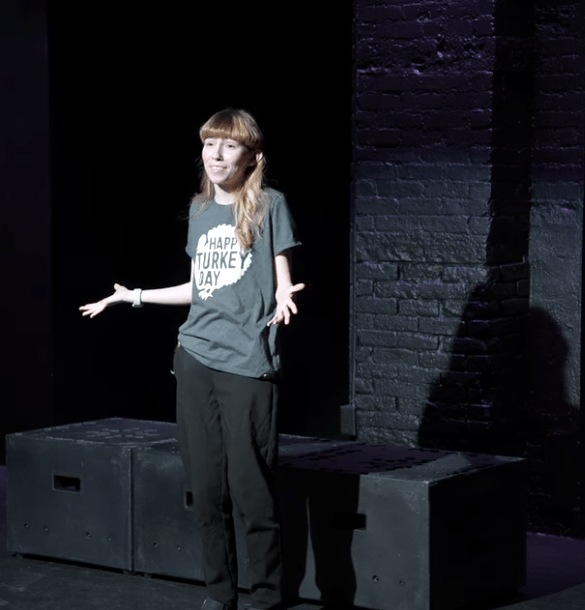
So proclaims Liv, a contemporary dancer, who toasts the holiday with her roommate Naomi as the intriguing tale of He’s Different unfolds.
The two friends watch the costumed revelers, scoping for someone worth flirting with like they’re picking lobsters from a tank. (Their choices this evening include Scooby-Doo and Jeffrey Dahmer.)
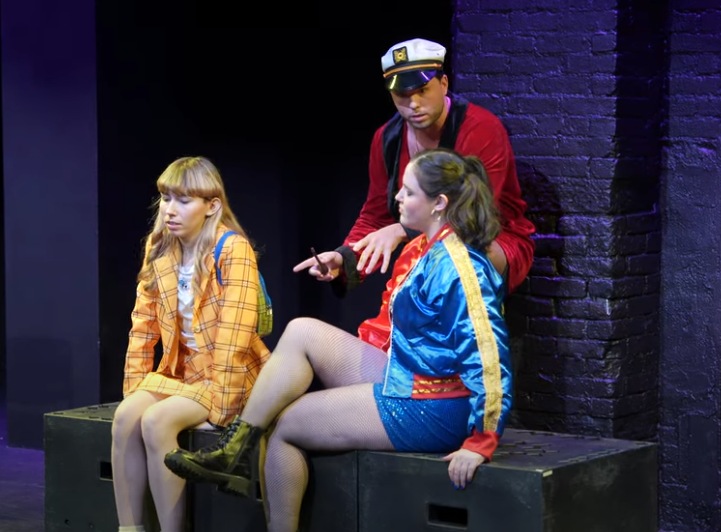
“I haven’t had sex in six months!” laments a frustrated Naomi. She is overheard and approached by Hugh, resplendent in a boat captain’s hat, silk red robe, and conspicuously zero pants—the walking example of everything the women don’t want.
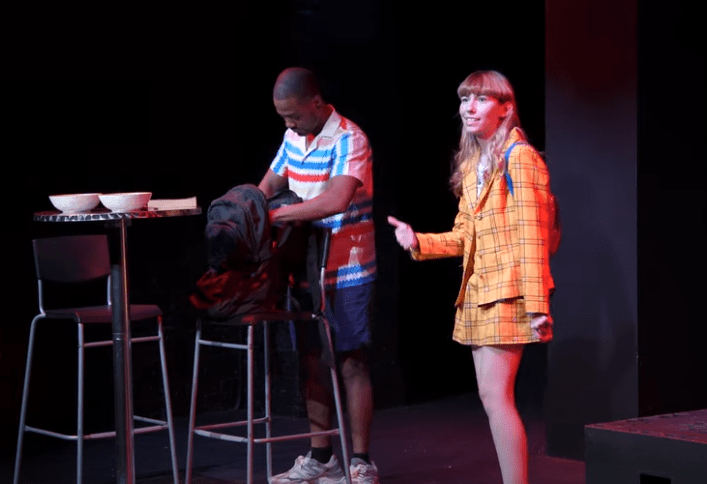
Liv is also single and adrift, noting that “most men are trash.” She’s holding out for someone suitably enlightened, feminist—and dare we say, woke. “All these guys are cute, but most of them probably don’t know the difference between Greta Thunberg and Greta Gerwig,” she observes. She points out a new arrival to the party, Travis, as a likely example. “How do I know that he wouldn’t skip our wedding for a football game?”
But then she spies a “Trans Lives Matter” sticker on his water bottle, and it piques her interest. “I got this from a cute little store in Brooklyn, owned by a trans activist,” Travis explains. “They make cute little merch like this to fund gender reassignment surgery for homeless teens.” The cynical Liv wonders if this is just the latest pickup line, but Travis keeps passing her tests, impressing in every way imaginable (Exhibits A-C: He works at a Senior Center, loves the aforementioned Greta Gerwig, and finishes Lynn’s sentences).
Liv is all-in: she grows not only intrigued, but smitten in a way she never thought possible, as her weary skepticism morphs into teenager-like infatuation. “What if he doesn’t text me back?” she whines, followed by a squealed, triumphant “HE TEXTED ME!” when he actually does, under the wary gaze of Naomi. And so the mystery begins—is this guy the real thing or the ultimate poser? Is this “smart and sweet” persona a disguise, no more real than the other costumes at the party? The question sets off a gripping journey, with a very amusing twist, and in the end, a poignant message about where real love can be found.
He’s Different is an insightful treatise on relationships in the here and now—taking a microscope to our desires, insecurities, turn-ons and offs, green flags and dealbreakers. It does so with a sharp, knowing wit that will keep you laughing and nodding in recognition. The sight of the previously grounded and Bechdel-test passing Liv melting into limerent obsession tells a truth about the malleability of the human psyche that is undeniable, and well worth exploring. The actors bring the story to life deftly, creating recognizable archetypes with warmth and humor. It all comes together to make He’s Different an enjoyable and satisfying experience.
He’s Different is written by Arianna Wellmoney. It was showcased at the Chain Theatre in the summer of 2024, as directed by Bradly Valenzuela, with Wellmoney as Liv, Kiamba Doyling as Travis, Megan Catalina as Naomi, and James Nash as Hugh.
Jim Catapano, ZORA, and The Harlem Renaissance
The Life of a Literary Legend
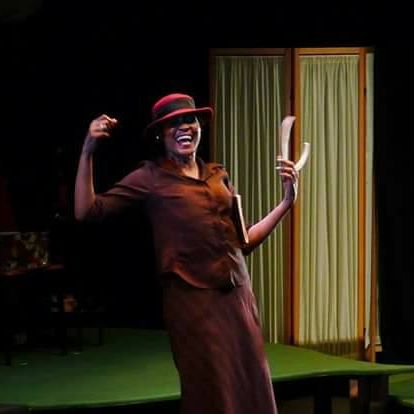
Actor Antonia Badón and Director Greg Freelon join forces to bring us the triumphant Zora!, a new staging of Laurence Holder’s play, realized as a one-woman show. It’s a love letter to not only the brilliant author, folklorist and anthropologist Zora Neale Hurston, but to a pivotal, landmark time in history.
Badón is astonishing as Hurston, “A Genius of the South” as novelist Alice Walker’s epitaph proclaimed. She embodies the author at various stages of her life, growing from a young hopeful to an accomplished elder with stunning realism, changing body language and the pitch of her voice dramatically to fit the time period. Hurston adventures from her home of Eatonville Florida, the first incorporated all-black town in America, winning a scholarship to Barnard college and launching herself into becoming a prominent force in the Harlem Renaissance. The most popular of her novels, Their Eyes Were Watching God, is published in 1937, and her essays, short stories and plays made her an essential voice in the black community of the time and well beyond.
In between (and often during) Badón’s monologues, a film projection of scenes from the early 20th century accompanies Zora’s story. Vivid images of New York City, and of the great icons of the era (such as Langston Hughes, James Van Der Zee, and Duke Ellington) flash by as we are treated to a soundtrack of the jazz classics of the age. The film interludes, while allowing us to delight in wistful time travel to another era, also allow Badón to change into one of her many fabulous outfits.
Armed with her powerful pen (and typewriter), Hurston’s voice holds tremendous power, brutal honesty, and necessary skepticism and criticism of the norms of the era. “I will jump up to support this democracy as soon as all those Jim Crow laws are gone,” she proclaims. “…But I am not selling out for no cheap, itchy suits!”
The most poignant sequence depicts Hurston as weary and ill in the late 1940s. She has written several acclaimed novels but with little money to show for it; she is now without a publisher but determined to raise her voice up and write again. After looking frail and spent she suddenly rises from her chair, stands up tall, and returns to her typewriter, stoic and strong once more, in a foreshadowing of her enduring legacy.
“Don’t worry about me,” she smiles.” Go down to your neighborhood bookstore. I’ll be there.”
Zora! is at the Sargent Theatre at the American Theater of Actors through Oct. 20, 2024.

Jim Catapano and the Well-Mannered Wife Swap
A Stylish Adaptation of Shaw’s Slick Comedy Comes to the American Theatre of Actors
Way back in 1912, George Bernard Shaw, a master at depicting the complexity of human relationships and behavior, crafted Overruled, a farcical look at polygamy. Over a century later we get to examine this not-uncommon occurrence through modern eyes, and with the benefit of his evergreen legendary wit.
On paper, the circumstances of the story are akin to a screwball TV sitcom plot: a man and a woman meet on a boat trip and fall in love; they are each shocked to learn that the other is already married to someone else. Then, their respective spouses actually show up—also having fallen for each other. Fortunately, the brilliant writing of the iconic playwright, realized at the ATA by four exceptional actors, elevates the story to a more sophisticated level.
We first meet Mr. Lunn and Mrs. Juno, played by Sam Hardy and Natasha Sahs, fresh from their romantic voyage.
“Promise me you won’t be horrid,” she requests, standing on the precipice of infidelity.
“I’m not being horrid, I love you,” he declares. “Don’t be alarmed, I like wanting you.”
This declaration speaks to the heart of the matter as it unfolds; the adventure is too enjoyable to not pursue. The excitement of the situation is literally overruling any question of immorality. They flirt, they philosophize, they justify their actions and intentions; they circle the chairs of the hotel lobby they’re meeting in, sizing each other up as if in a choreographed dance, and trying to make sense of the inconvenient but inescapable feelings they have developed for each other. Suddenly the voices of their now less significant others are heard through the door, and we meet Mrs. Lunn and Mr. Juno (Kate Jergensen and Jonathan Beebe). This new team of Lunn and Juno is as smitten with each other as the first pair. Mr. Lunn, whose first name we have learned is Gregory (“which sounds like a powder”, he admits), and Mr. Juno (whose first name is oddly “Sibthorpe”), immediately go into alpha mode. Each of the men clearly wants the best of both worlds, but initially only for themselves.
“I’m her prospective husband,” says Sibthorpe to Gregory. “You’re only her actual one. I’m the anticipation: you’re the disappointment.” It’s the perfect “dis” and leads to an attempt at fisticuffs, which hysterically, neither is very good at.
Mrs. Juno is disappointed that her husband isn’t the proficient boxer he had professed to be. “You spoke with the greatest contempt of men who didn’t kick other men downstairs,” she notes.
“Well, I can’t kick Mr. Lunn downstairs,” Sibthorpe retorts. “We’re on the ground floor.”
As with all of Shaw’s works, the play is absolutely loaded with quotable lines like these that stay with you; the dialogue is either hilarious or makes a profound statement on the fickleness of humanity (and often, it’s both). The play neither justifies nor condemns the actions of its characters, simply allowing them to accept the situation as it is and embracing ambiguity; ultimately, everyone gets on board.
Overruled packs a lot of thought and humor into its 50-minute runtime and makes for the perfect Shavian appetitizer. The actors deliver it with relish, and are guided deftly by director John Benedetto.
Overruled runs at the American Theater of Actors through October 13, 2024.
 Arts Independent