
Home » Posts tagged 'book-reviews'
Tag Archives: book-reviews
Is That in the Script? asks Jim Catapano regarding Joseph P. Krawczyk’s Living the Play
Joseph P. Krawczyk’s Living the Play: A Dangerous Time for Women Is Timely, Clever, and Compelling
It is November 5, 2024. Crystal (Chelsea Clark), a New York Theatre actor, and her partner Jeremy (Nathan Cusson), a psychotherapist, are coming back to their apartment after voting for Kamala Harris on Election Day. Crystal awaits the outcome with tremendous trepidation while Jeremy just “que-sera-seras” and suggests they hope for the best. Crystal is also gearing up for her lead role in a make-or-break Off-Broadway production, a two-hander about a woman whose pregnancy and subsequent difficulties in getting proper reproductive care lead to tragedy. Jeremy’s apparent nonchalance (masking an anxious personality, as we soon learn) exasperates the passionate Crystal. She implores her reluctant partner to run lines with her. Jeremy, whose own acting career was brief and long ago, reads the lines initially in a disinterested monotone. But he has a didactic memory, and begins to get very familiar with a show that he’s not even in. The rehearsal of the tense dialogue between the couple in the play begins to mix with Crystal and Jeremy’s actual discourse and their real-life relationship difficulties, leading to the ominous mantra, “is that in the script?” (or, are we really saying these things to each other?). Soon neither they—or us—is certain where Crystal and Jeremy end and their characters begin.

The play-within-a-play technique, set against the backdrop of the real-life circumstances its audience finds itself in the United States of 2025, makes Living the Play a unique and powerful experience. We who are observing the couple know how the election of 2024 is going to end; how it’s going to affect Crystal; and how it threatens her rights as a woman. A revelation drives home that her character’s plight in the play could well be a foreshadowing of her own future, and Jeremy—whose “life is not at risk,” as she reminds him—seems incapable of the support and understanding she needs from a partner. Crystal had turned off the news for the remainder of November 5 after casting her vote, and it’s left to Jeremy to inform her of the outcome. She grabs a pillow and screams into it, and It’s a sad and chilling moment of recognition for those of us who wanted things to go another way. Jeremy continues to play the “it won’t be that bad” tune, ignorant of the fact that he is dismissing Crystal’s fear, and the clear and present danger that every woman is now in.
With this dark cloud over the future and their relationship, Crystal carries on with the play with Jeremy’s grudging assistance, the dialogue continuing to blur with their reality. When she brings out the real loaded gun she owns, mistaking it for the prop gun from the play, it drives home how close they are to living out the tragic circumstances of the show she’s so absorbed in.
The outcome of the election has consequences for the production itself too, as the understudy for Crystal’s scene partner, a transgender person, leaves for Canada. Jeremy is now the understudy for a role he doesn’t want, just one more defection away from being the lead. He desperately tries to get out of it and yet begins to paradoxically get more involved, his photographic memory causing an unexpected engagement with the material. He even questions the playwright’s choices, which draws further ire from his partner. We can feel the walls closing in as not only is Crystal’s career and relationship in danger, but so is her very future as a woman in America, as her rights to bodily autonomy and reproductive care begin to slip away, and the one person she wants to depend on can only shrug helplessly.
Clark and Cusson are astonishing in their roles—believable, relatable, and skillful in their juggling of their own characters’ voices with those of the characters of the play they are rehearsing. By showing how the suppression of rights impacts one person whom we’ve grown to care about, Krawczyk has driven the urgency of the situation home. His words are expertly brought to life by Clark and Cusson, under the deft guidance of Director Eddie Lew and Assistant Director Carrie Stribling. Just as Crystal is taking on injustice and fighting for her future through creativity, so is the team behind Living the Play showing us how art is one of our greatest weapons to wield against the tyranny of the times.
Living the Play: A Dangerous Time for Women is dedicated to Amber Thurman, Taysha Sobieski, Josseli Barnica, and Candi Miller, who lost their lives due to the denial of timely reproductive care.
The play runs at the American Theatre of Actors through May 18, 2025.

Knock Knock, Whodunnit? Jim Catapano finds fun at CLUE
The MCT’s Imagining of Clue delights at the BACCA Arts Center
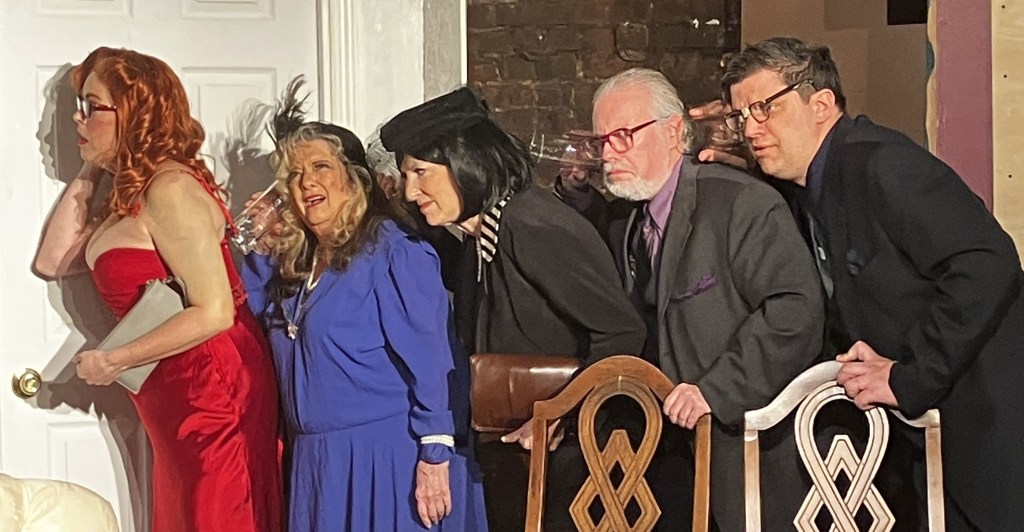
It is the early 1950s, a time when everyone is suspicious of everyone else. By invitation, several of society’s supposed finest gather at the mansion of Mr. Boddy (Mark John Santaromita) on a stormy night. They are familiar archetypes with political influence, all known for the occasion by the special pseudonyms bestowed on them by their mysterious host: Colonel Mustard (Joe Hoffman), Mrs. White (Pamela Seiderman), Mrs. Peacock (Elizabeth DeGennaro), Mr. Green (Ed Cress), Professor Plum (Gary Tifeld) and Miss Scarlet (Meredith Lynn Spencer). The guests are greeted by the very shady butler Wadsworth (Dan Bellusci) and the very French maid Yvette (Heather Legnosky). After clenched-teeth pleasantries, cocktails, and shark’s fin soup (Mrs. Peacock’s favorite, as the cook is creepily aware of), Mr. Boddy appears and reveals he is blackmailing them all, and then hands them their “gifts”; potential murder weapons for one of them to use to kill Wadsworth to protect their secrets before he contacts the authorities. The lights go out, and the fun begins as the bodies pile up and the suspects grow more desperate and frantic.
Sandy Rustin’s stage play Clue, based on the 1985 cult classic film based on the classic board game, is revisited through a wonderful new production by the Modern Classics Theatre of Long Island. It is directed with great panache by Matt Stashin, with clever set design by John Emro and Rian Romeo. A set of moving doors create the illusion of a vast mansion, and they are used to great effect as the characters peer in and out of them, race through them, and shudder at what horrors might be found behind them. High-energy chase music accompanies the characters rushing from room to room between scenes as the sets are swiftly and skillfully swapped—the scene changes are almost as entertaining as the show itself. This is a very physical production; the actors throw themselves bodily into every sequence as they deftly handle the complex wordplay, which is delivered rapid-fire; the audience is still laughing at the previous joke when another one comes hurtling at them.
In addition to the always witty and often hysterical dialogue, there are wonderful sight gags: the actual board game of Clue is used as a map to the mansion; one of the murder victims (James Brautigam) resets the scenery and gets back into position dead on the floor, in full view of the audience; a chandelier falls in super-slow motion as its victim recoils and screams equally slowly; the suspects prop up the dead bodies Weekend at Bernie’s-style to fool a prying police officer. Sound is also a big part of the fun: the ominous doorbell; the barking guard dogs outside; the incredibly loud dinner gong of the cook (Karen Santaromita) which traumatizes everyone, and Mrs. Peacock’s blood-curdling, sound barrier-breaking screams. Karen Santaromita’s double duty as a cheery but ill-fated singing telegram provides one of the show’s funniest moments as the murders accelerate. “Three bodies in three minutes!” marvels one suspect. “That’s our best record!”
Clue boasts a cast of 11 and a character count of 15—in this incarnation, every murder victim humorously gets to be reincarnated as a police officer.
The actors of the ensemble are all perfectly cast, and hilarious in their distrust and barely concealed contempt for each other as they desperately try to avoid suspicion and/or death. Late in the play when Wadsworth breathlessly recounts and acts out the events of the entire evening, Bellusci’s performance is astonishing. And true to the source material, multiple dénouements are explored, as every character gets a chance to have done it. “But it really happened like this…”
Clue is performed at the BACCA Arts Center through Sunday March 16.

Jim Catapano is seeing double: two shows at the ATA
The Oddest of Couples: Meny Beriri Brings Two Witty and Insightful Character Studies to the ATA
Opposites may attract, but they also repel pretty quickly too, as Meny Beriri observes in his two new one-act pieces, Smoking Kills and SKU. They complement each other perfectly as each is a look at two sets of people struggling to get on the same page. Each pairing features one cynic, and one hopeless romantic; one cautious, and the other free-spirited; one level-headed, and the other obsessive; one grounded in reality, and the other in Hallmark movie-land. Both plays take place in a post-pandemic world, which informs the approaches to life of all the characters—it’s basically “Let’s Form a Connection” vs. “Leave Me Be.”

SKU: “We’ll always have Paris Baguette!”
Alex (Gordon Rothman) and Melanie (Stacey Petricha) are fresh from their memorable date at the aforementioned bakery/café, and are now meeting at a restaurant to keep the fire burning over Indian food. Melanie is a retired nurse, and happy to be independent and free of responsibility. “We’re not heroes,” dismisses Melanie, who sees her nursing career as having been just a stressful gig. Alex, in contrast, is a high-school social studies teacher so in love with his job that he has convinced himself that every day is as meaningful as Dead Poets Society. He’s a passionate soul who fixates on something and won’t let it go; he’s an hour late to the second date, blaming it on his obsession over obtaining a certain stapler missing the SKU of the title. (It stands for “Stock Keeping Unit”, which stores use to identify products in their inventory.) He then goes on a tangent about Star Trek (The episode “The Doomsday Machine,” to be appropriately specific), and his quest to discover the identity of the actor who walked in front of Kirk in one pivotal scene. Melanie is life-loving as well, but in a fiercely independent way. She doesn’t see constant companionship as the key to happiness—to her, it’s by and large an obstacle.
“You still need other people,” argues Alex. “But you can’t depend on them for happiness!” Melanie fires back.
She stays polite, but her demeanor begins to indicate that the Paris Baguette encounter should maybe have been a one-and-done. Alex, however, has decided after one date and a half that Melanie is his soul mate.
“You think we share a soul?” she scoffs. “From what I remember, that’s not how reincarnation works!” But Alex is unrelenting—he announces he wants to travel the world with the sudden love of his life, and Melanie recoils in horror; to her, that basically echoes the title of the very first episode of Star Trek: “The Cage”.
While perfectly depicting the clashing of their characters, the actors have tremendous chemistry and make the script sing. Petricha and Rothman are supported by Samiha Ahmed, the waitress who has a god’s eye-view of the quickly crumbling romance. Though things go south fast for Alex and Melanie’s connection, they do so humorously, and the theme of incompatibility lands while never feeling tragic or even at all downbeat; Alex lands on his passionate feet, in a very funny resolution.
Smoking Kills opens to the sounds of the Odd Couple theme, lampshading the relationship between the youthful and exuberant Emily (Julianne Lorndale) and her roommate/landlord, the older, warier Jane (Leia Martin).
An Oklahoma transplant, Emily returns to their NYC apartment gushing over her date with “Harold”, who took her to the exotic Avenue D and then on a romantic trip on the Staten Island Ferry. Emily compares it to Casablanca, which she recently discovered. Jean smells cigarettes on Emily—the extremely potent Marlboro Reds, to be exact—and is disgusted. Emily admits she smoked one of Harold’s ciggies in the heat of the moment, and still has the pack. Jean is triggered due to the 6-pack a day habit she once had as a teen, and warns Emily of the evils of the addiction, and of a lot of other dangers in life that Emily seems blissfully unaware of—such as the antibiotic filled Jumbo Shrimp she consumed at dinner. Jean invokes the “my house, my rules” clause, escalating the confrontation between the two, and leading to an explosive, violent-but-comical climax. As with SKU, a potentially traumatic conclusion is handled humorously, and again with the perfect final moment. Martin and Lorndale realize this modern-day Felix and Oscar beautifully, playing off each other with deftness and expertly serving the witty material.
These two delightful one-acts are a testament to Beriri’s ability to take the sad reality of the failed connections that plague life in the post-pandemic 2020s, and imbue them with a compassionate touch and knowing sense of humor that is refreshing, and somehow even healing.
SKU is directed by Meny Beriro; Smoking Kills is directed by Ginger Kipps. They are featured together at the American Theatre of Actors through December 8, 2024.

Jim Catapano explores the 21st Century Dating Scene with his review of “He’s Different”
Love Will Find You
He’s Different Takes a Witty and Insightful Look at Contemporary Dating
“It was just a party…a normal Halloween party, smack in the middle of Bushwick, when everything changed.”
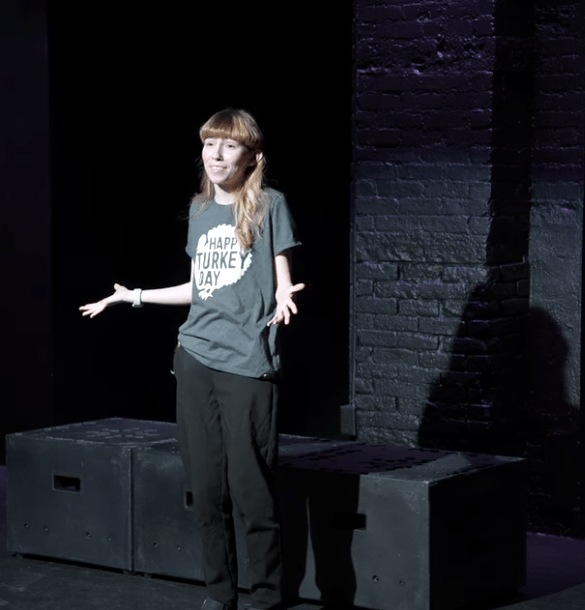
So proclaims Liv, a contemporary dancer, who toasts the holiday with her roommate Naomi as the intriguing tale of He’s Different unfolds.
The two friends watch the costumed revelers, scoping for someone worth flirting with like they’re picking lobsters from a tank. (Their choices this evening include Scooby-Doo and Jeffrey Dahmer.)
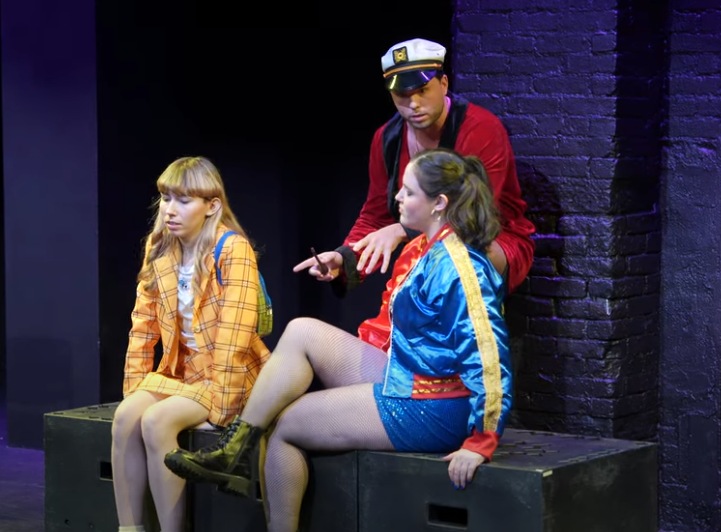
“I haven’t had sex in six months!” laments a frustrated Naomi. She is overheard and approached by Hugh, resplendent in a boat captain’s hat, silk red robe, and conspicuously zero pants—the walking example of everything the women don’t want.
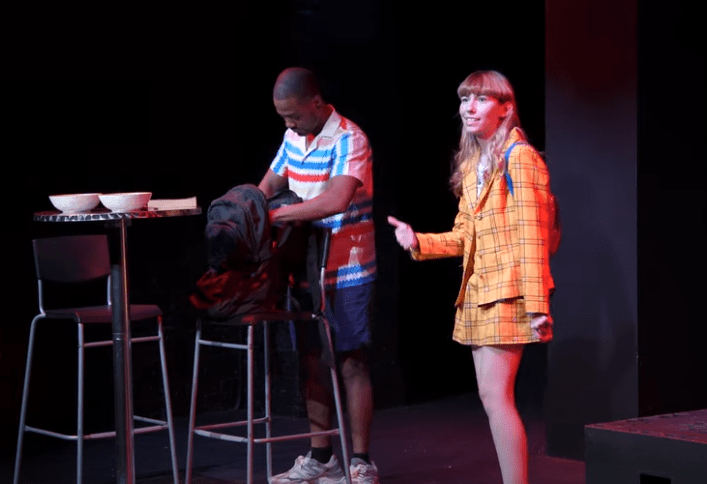
Liv is also single and adrift, noting that “most men are trash.” She’s holding out for someone suitably enlightened, feminist—and dare we say, woke. “All these guys are cute, but most of them probably don’t know the difference between Greta Thunberg and Greta Gerwig,” she observes. She points out a new arrival to the party, Travis, as a likely example. “How do I know that he wouldn’t skip our wedding for a football game?”
But then she spies a “Trans Lives Matter” sticker on his water bottle, and it piques her interest. “I got this from a cute little store in Brooklyn, owned by a trans activist,” Travis explains. “They make cute little merch like this to fund gender reassignment surgery for homeless teens.” The cynical Liv wonders if this is just the latest pickup line, but Travis keeps passing her tests, impressing in every way imaginable (Exhibits A-C: He works at a Senior Center, loves the aforementioned Greta Gerwig, and finishes Lynn’s sentences).
Liv is all-in: she grows not only intrigued, but smitten in a way she never thought possible, as her weary skepticism morphs into teenager-like infatuation. “What if he doesn’t text me back?” she whines, followed by a squealed, triumphant “HE TEXTED ME!” when he actually does, under the wary gaze of Naomi. And so the mystery begins—is this guy the real thing or the ultimate poser? Is this “smart and sweet” persona a disguise, no more real than the other costumes at the party? The question sets off a gripping journey, with a very amusing twist, and in the end, a poignant message about where real love can be found.
He’s Different is an insightful treatise on relationships in the here and now—taking a microscope to our desires, insecurities, turn-ons and offs, green flags and dealbreakers. It does so with a sharp, knowing wit that will keep you laughing and nodding in recognition. The sight of the previously grounded and Bechdel-test passing Liv melting into limerent obsession tells a truth about the malleability of the human psyche that is undeniable, and well worth exploring. The actors bring the story to life deftly, creating recognizable archetypes with warmth and humor. It all comes together to make He’s Different an enjoyable and satisfying experience.
He’s Different is written by Arianna Wellmoney. It was showcased at the Chain Theatre in the summer of 2024, as directed by Bradly Valenzuela, with Wellmoney as Liv, Kiamba Doyling as Travis, Megan Catalina as Naomi, and James Nash as Hugh.
 Arts Independent