
Home » Posts tagged 'books' (Page 3)
Tag Archives: books
Nothing Left but the Kindness of Strangers: A Jim Catapano Review
Bernard J. Taylor’s Tennessee Williams: Portrait of a Gay Icon Brings a Legend to Life at the ATA
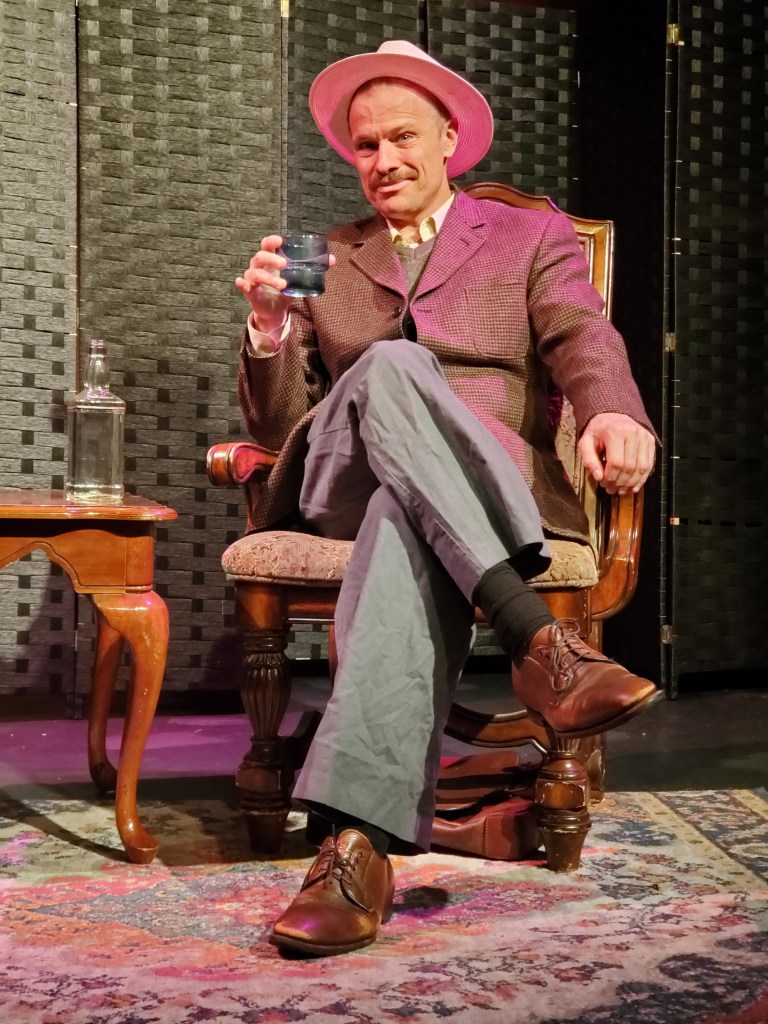
Tennessee Williams is alone on stage, and at this point, apparently alone in life. Seen on a lecture tour, he is surrounded by posters of his most famous works: A Streetcar Named Desire, The Glass Menagerie, Cat on a Hot Tin Roof; the face of his muse, Anna Magnani, stares out at us from a poster of The Rose Tattoo. Another wall is plastered with manuscript pages, relics of an era when creativity flowed. Pictures of his beloved sister Rose, his parents (one loving and one abusive), and his life partner Frank Merlo are on the table next to the chair from which he tells his story. They are all ghosts now—the only companion he has with him is a bottle of Vodka. He reminds himself to take “small sips”, but as his trauma comes to the surface these become heavy gulps. His laughter gives way to gasps of despair; he hugs the chair and sobs, imagining it to be Frank in his late partner’s last moments. He screams out Anna’s name in utter desperation for a companion for comforting and understanding than a liquor bottle.
John Stillwaggon as Williams is astonishing; one feels they are genuinely spending an evening with the legendary writer. Williams bares his soul, exorcises his demons and welcomes them back in again, and we feel we are witness to something extraordinary, as turns triumphant and tragic. The south of the mid-20th century comes to life in his words, and his disdain for the dreaded city of St. Louis is a hilarious running theme amidst the sadness.
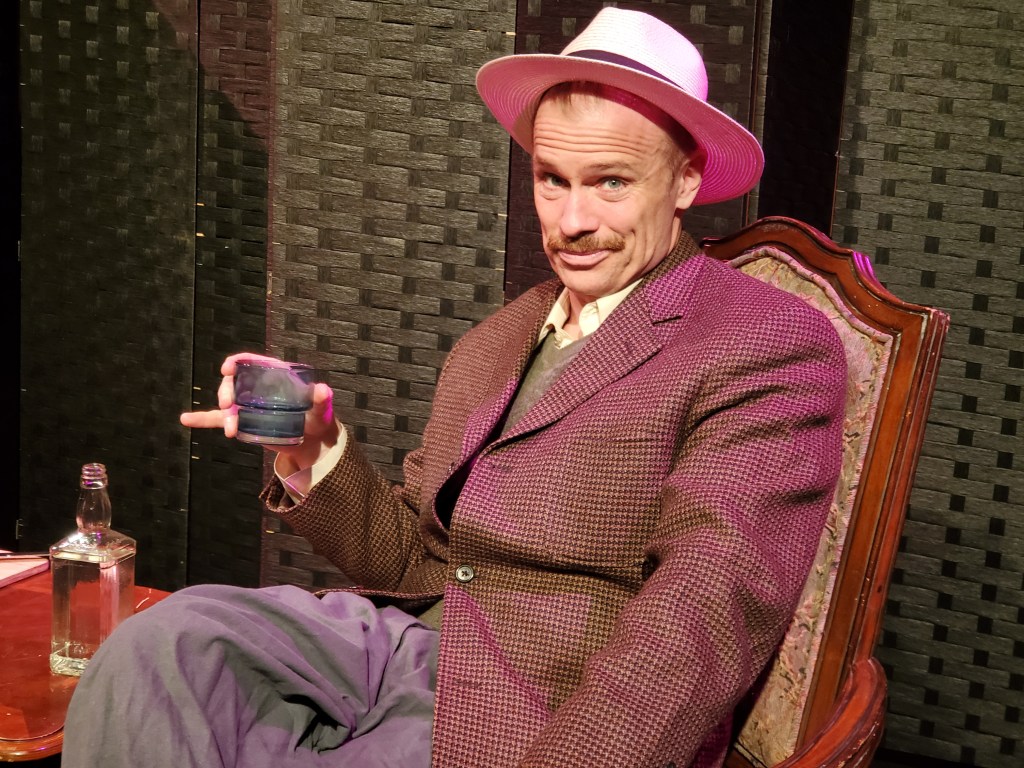
A gay man in a time and place where that was not treated kindly, Williams is portrayed by Stillwaggon as defiant, boisterous and charismatic, while simultaneously tragic and heartbreaking. He laments the fate of his beloved Rose, inspiration for Laura in The Glass Menagerie, and the victim of a lobotomy in a time when mental health was even more misunderstood than it is today. He mourns his beloved Frank and curses his vile father, who he says he only got along with “after he died.”
He gushes at the magnificence of the young Brando and rages against the critics—and at “the dying of the light,” noting that he’s once again “graverobbing” from other artists. “They say Dylan Thomas went to the White Horse Tavern…drank 18 shots of whiskey and dropped dead,” he remembers, glancing at the Vodka bottle and musing that he’s likely halfway there himself. It’s funny until you realize he likely wants to complete the journey.
The production is a must-see for the masterful performance of Stillwaggon, who recreates the swagger, wit, charm and pathos of Williams perfectly. It is directed deftly by Carolyn Dellinger, with a brisk pacing that complements Stillwaggon’s performance and Taylor’s writing expertly. It provides great insight into not only the story of one legendary artist, but the very notion of the highs and lows of fame, and the “having and losing” nature of life itself.
Tennessee Williams: Portrait of a Gay Icon, as part of the Icons Festival, runs at the American Theatre of Actors through June 15, 2025.

The Bees Still Can’t Help Themselves! says Jim Catapano
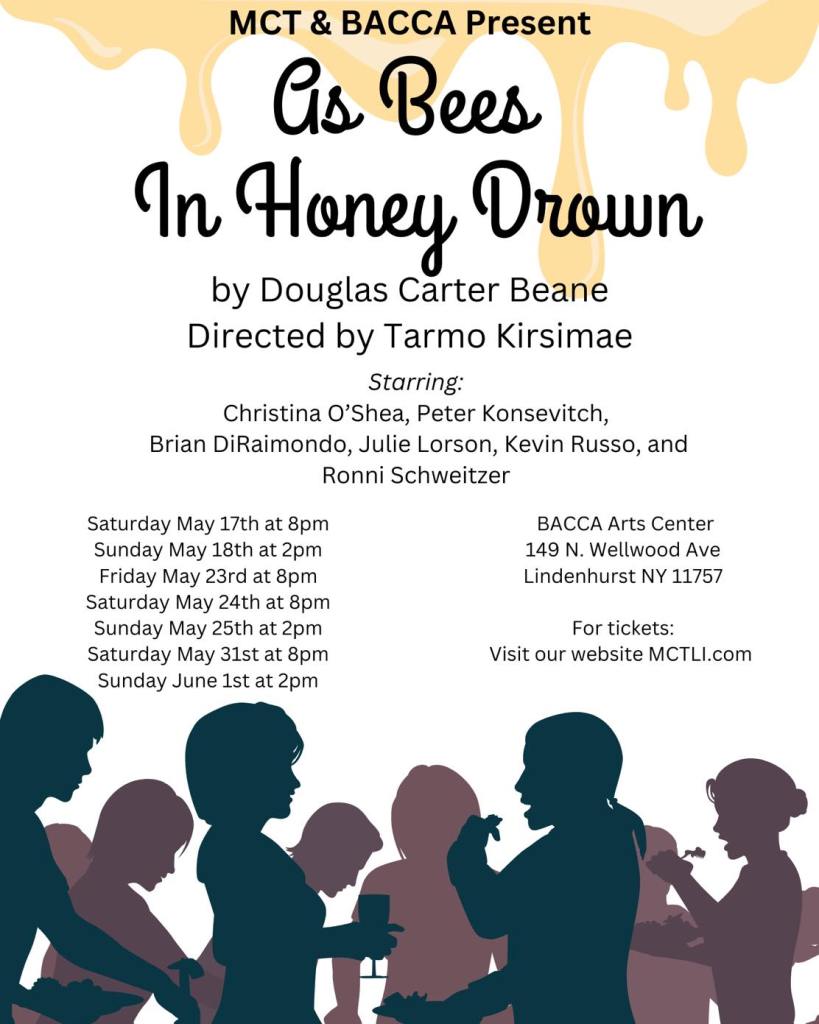
Douglas Carter Beane’s 90s Classic As Bees In Honey Drown Gets a Masterful Revival
“Once, I saw a bee drown in honey, and I understood,” is a famous quote attributed to the 20th Century Greek writer Nikos Kazantzakis. He recognized the danger of wanting too much, the trap that is set for us by our own unquenchable desires. Douglas Carter Beane took this fact of life and fashioned As Bees In Honey Drown, an astute and incredibly witty play that takes a brutal look at the fame game and how seduction can lead us down a dark path, and eventually destroy us. The Modern Classics Theatre Company has brought this masterwork roaring into the (new) 20s with panache and a sterling cast.
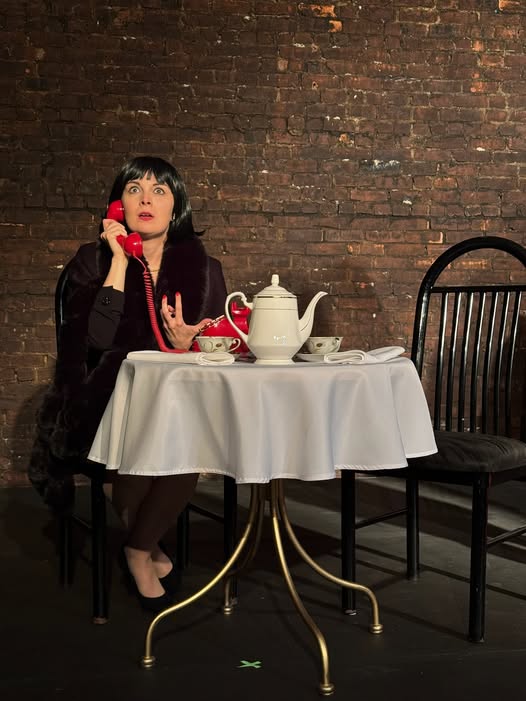
New York City con artist Alexa Vere de Vere (Christina O’ Shea), the villain of As Bees in Honey Drown, recognizes the power of the “honey” that is fame and fortune, and makes a living out of exploiting those who hunger for it. Alexa is a force of nature, a narcissistic socialite in designer dresses who sports an Uma Thurman Pulp Fiction-style black bob and an air of being the most important person at the party. She claims a thousand connections and drops a name at every opportunity, in an exotic, unplaceable accent rivaling that of Kathleen Turner (as she freely points out). As her story unfolds we learn that she is both Frankenstein, and the monster. The latest bee in her honey pot, Evan Wyler (Peter Konsevich), is a writer on the cusp of fame. At a magazine photoshoot for his upcoming book he is convinced by the photographer to pose without a shirt, and this gets Alexa’s attention, outing him as a person desperate for success. She seduces her prey with promises of fortune and glory—convincing him that she is the one who can take him to the top. They dine, they banter, they party, and he foots the bills. She even gets the openly gay Evan to fall for her: Just when it seems like Alexa’s pretentious phoniness is getting too obvious, she “humanizes” herself with a tragic backstory that’s really too “bad” to be true, but reels Evan in anyway. “I love you,” he proclaims at her weepy suggestion that she is unlovable. Before long he is down thousands of dollars, alone, still not famous, and desperate to get revenge—or so he says. Does he hate Alexa, or is he still infatuated?
O’Shea gives a powerhouse performance as the conniving Alexa. She is at turns over-the-top, hilarious, irresistible, and even at times almost sympathetic, and it all comes together brilliantly. When Evan finds artist Mike (Kevin Russo), Alexa’s overall-clad ex-partner and the focus of her tallest tale, we see in a flashback that he was the first victim of her crime spree. (She even chillingly calls him “lamb” before their falling out, just as she would later dub Evan.) As with Anakin Skywalker/Darth Vader, this compelling prequel shows us how the “Alexa” persona came to be, down to the accent and the bizarre surname, and O’Shea is remarkable portraying the ordinary girl behind the curtain who slowly morphs into the supervillain.
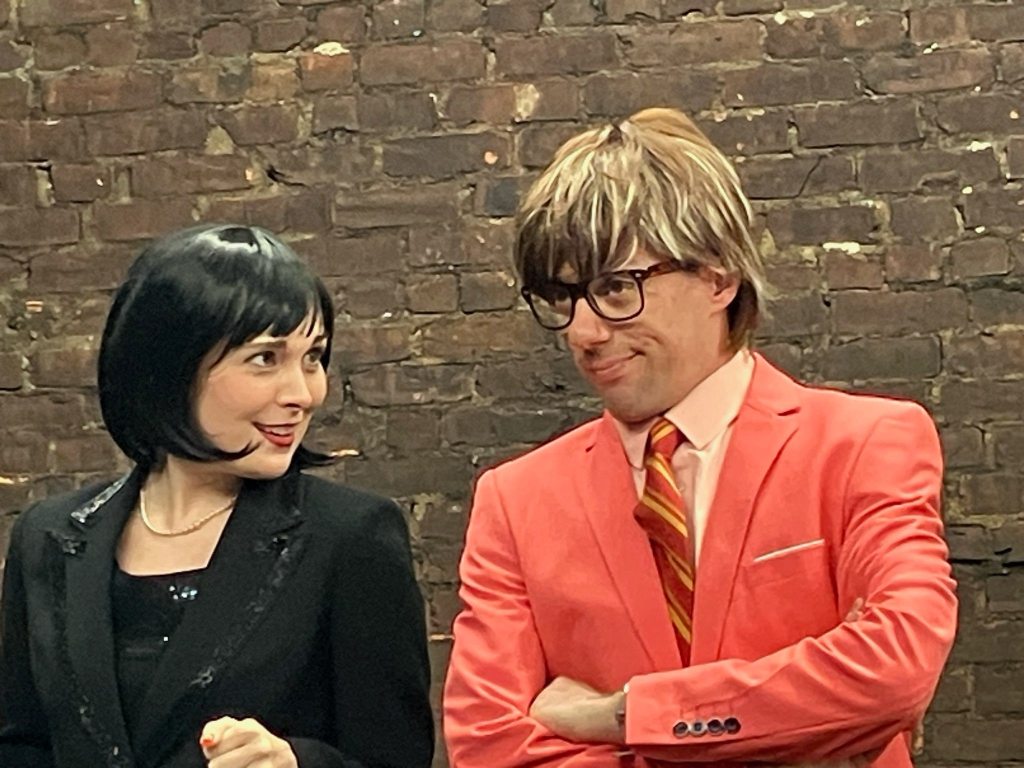
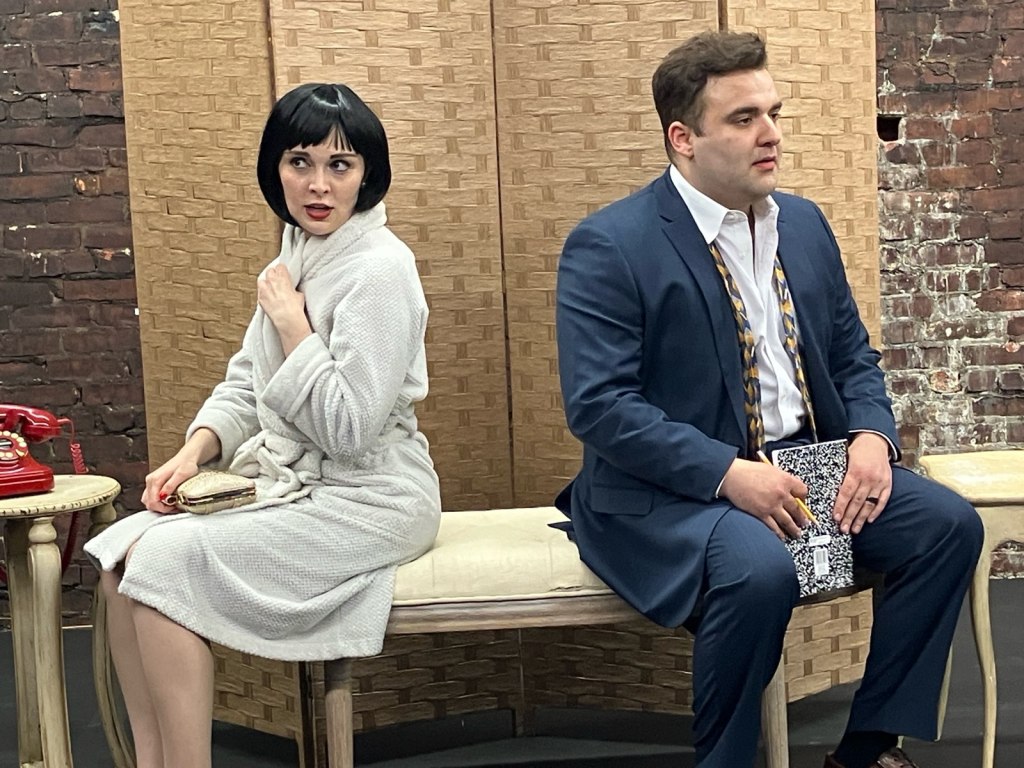
Konsevich is sympathetic and very funny as the befuddled, relatable Evan. Brian DiRaimondo, Julie Lorson, and Ronni Schweitzer round out the cast wonderfully in multiple roles, including several of the other bees caught in Alexa’s honey whom Evan calls on in his plan to get even. It all makes for an entertaining and faithful rendering of Keane’s clever classic, a cautionary tale that is all the more relevant in this modern age of Social Media, Influencers, and the “almost famous” who will do anything to get to the top of the search engine.
As Bees in Honey Drown is deftly directed by Tarmo Kirsimäe. It runs through June 1 at the Bacca Arts Center in Lindenhurst, Long Island. For more information, go to https://modernclassicsli.booktix.com/dept/main/e/Bees

The Wit and Wisdom of Felipe Luz as written by Jim Catapano
An Up-and-Coming Cabaret Star Looks at Life, Love, Lust, and Everything Else That Happens Under the Covers
“As tempting as it is, please refrain from opening your dating apps during this show,” requests Felipe Luz in a voiceover at the beginning of their show, dubbed “Men Are Trash and I’m a Raccoon.”
Luckily, Luz is too engaging for that to be a concern. They’re not performing in a one-person show; They are a one-person show.
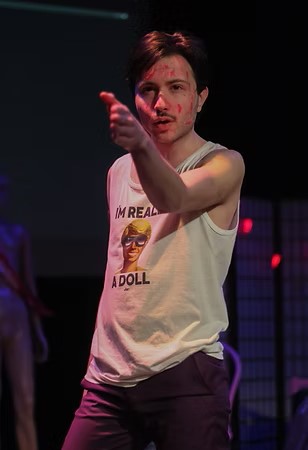
Luz is a Manhattanite who pursued an MFA in Acting at Ohio University (where they recently brought their show). They are a self-described “Brazilian multi-hyphenate and teaching artist” who believes “we should all live our lives as works of art.” And they are fulfilling this 100 percent in their ongoing theatrical journey, where they regale the crowd with persona life stories and lessons—with plenty of laughs along the way.
A stage is set with Japanese byōbu screens flanking a semi-dressed mannequin behind a makeup mirror and table, and a satin-sheeted bed. Luz emerges, a lighthouse beacon coming to rescue us from our denial of how modern life works (or doesn’t).
“How much will people put themselves into boxes only to get laid?” they observe. “Isn’t Grindr the LinkedIn of Sex”? And thus, the tone is set, and it’s lots of Truth and implied Dare. Luz proceeds to lay down the ground rules that must be followed if anyone wants their attention—no sex with idiots, no politics, no questions asked—while acknowledging that all those rules get dropped if Luz is feeling “super-horny.”
Luz’s honesty is refreshing and hilarious, and we laugh as they shine the spotlight back on us, urging us to consider our own motives in life and love. The show is filled with Luz’s astute observations and revelations; they admit they’ve always been a
“manic pixie dream boy,” who often exists solely as a “plot device” for people to learn about themselves before they move on to someone else (a stunning realization that surely hits home for many of us).
Lux is the kind of performer who holds your attention from beginning to end (an end that arrives too soon and leaves the audience wanting more). Their storytelling is rich and poignant, peppered with hilarity and familiarity, emotion and vulnerability. A relationship begins, addictions are addressed and conquered, feelings increase and diminish, restlessness and doubt creep in, and a wondering of what else is out there leads to growing apart and finally, a breakup.
“I’ll be forever grateful to you for showing me that I deserve love,” Luz says to their unseen former partner in a bittersweet, teary moment. Then the mood changes, as Luz, jumping excitedly on the bed, announces a plan to message all the boys they’ve ever dated and call them out— “just for the drama!”
Social media, and its impact on modern dating, gets a turn under Luz’ powerful microscope. In a nutshell, they observe that our addiction to checking on people from our past online means we can never truly turn the page and free ourselves, and our former objects of affection know this. “I’ll start dating someone else in two weeks, and they won’t even be that pretty, and you’ll wonder what’s wrong with you!” Luz proclaims to a past paramour (another shot to the heart).
It’s then that a true shot to the heart is delivered. “We’re always waiting for someone, so we don’t want to get too attached, because there might be someone better waiting around the next corner.” Luz knows themself—and us—very well.
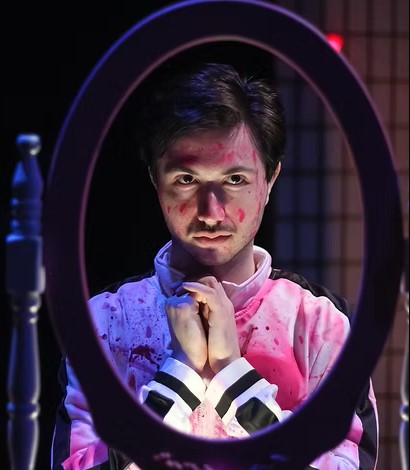
“Men Are Trash and I’m a Racoon” recently ran at Brooklyn’s The Rat, and further NYC shows are coming this year. Follow Felipe on Instagram at @letherebefelipeluz to see what they do next (and where you can see them do it!).
Is That in the Script? asks Jim Catapano regarding Joseph P. Krawczyk’s Living the Play
Joseph P. Krawczyk’s Living the Play: A Dangerous Time for Women Is Timely, Clever, and Compelling
It is November 5, 2024. Crystal (Chelsea Clark), a New York Theatre actor, and her partner Jeremy (Nathan Cusson), a psychotherapist, are coming back to their apartment after voting for Kamala Harris on Election Day. Crystal awaits the outcome with tremendous trepidation while Jeremy just “que-sera-seras” and suggests they hope for the best. Crystal is also gearing up for her lead role in a make-or-break Off-Broadway production, a two-hander about a woman whose pregnancy and subsequent difficulties in getting proper reproductive care lead to tragedy. Jeremy’s apparent nonchalance (masking an anxious personality, as we soon learn) exasperates the passionate Crystal. She implores her reluctant partner to run lines with her. Jeremy, whose own acting career was brief and long ago, reads the lines initially in a disinterested monotone. But he has a didactic memory, and begins to get very familiar with a show that he’s not even in. The rehearsal of the tense dialogue between the couple in the play begins to mix with Crystal and Jeremy’s actual discourse and their real-life relationship difficulties, leading to the ominous mantra, “is that in the script?” (or, are we really saying these things to each other?). Soon neither they—or us—is certain where Crystal and Jeremy end and their characters begin.

The play-within-a-play technique, set against the backdrop of the real-life circumstances its audience finds itself in the United States of 2025, makes Living the Play a unique and powerful experience. We who are observing the couple know how the election of 2024 is going to end; how it’s going to affect Crystal; and how it threatens her rights as a woman. A revelation drives home that her character’s plight in the play could well be a foreshadowing of her own future, and Jeremy—whose “life is not at risk,” as she reminds him—seems incapable of the support and understanding she needs from a partner. Crystal had turned off the news for the remainder of November 5 after casting her vote, and it’s left to Jeremy to inform her of the outcome. She grabs a pillow and screams into it, and It’s a sad and chilling moment of recognition for those of us who wanted things to go another way. Jeremy continues to play the “it won’t be that bad” tune, ignorant of the fact that he is dismissing Crystal’s fear, and the clear and present danger that every woman is now in.
With this dark cloud over the future and their relationship, Crystal carries on with the play with Jeremy’s grudging assistance, the dialogue continuing to blur with their reality. When she brings out the real loaded gun she owns, mistaking it for the prop gun from the play, it drives home how close they are to living out the tragic circumstances of the show she’s so absorbed in.
The outcome of the election has consequences for the production itself too, as the understudy for Crystal’s scene partner, a transgender person, leaves for Canada. Jeremy is now the understudy for a role he doesn’t want, just one more defection away from being the lead. He desperately tries to get out of it and yet begins to paradoxically get more involved, his photographic memory causing an unexpected engagement with the material. He even questions the playwright’s choices, which draws further ire from his partner. We can feel the walls closing in as not only is Crystal’s career and relationship in danger, but so is her very future as a woman in America, as her rights to bodily autonomy and reproductive care begin to slip away, and the one person she wants to depend on can only shrug helplessly.
Clark and Cusson are astonishing in their roles—believable, relatable, and skillful in their juggling of their own characters’ voices with those of the characters of the play they are rehearsing. By showing how the suppression of rights impacts one person whom we’ve grown to care about, Krawczyk has driven the urgency of the situation home. His words are expertly brought to life by Clark and Cusson, under the deft guidance of Director Eddie Lew and Assistant Director Carrie Stribling. Just as Crystal is taking on injustice and fighting for her future through creativity, so is the team behind Living the Play showing us how art is one of our greatest weapons to wield against the tyranny of the times.
Living the Play: A Dangerous Time for Women is dedicated to Amber Thurman, Taysha Sobieski, Josseli Barnica, and Candi Miller, who lost their lives due to the denial of timely reproductive care.
The play runs at the American Theatre of Actors through May 18, 2025.

REVIEW by JIM CATAPANO: A Fractured Family Searches for Connection
A House Divided Visits a Family in the Aftermath of the Events of 2016 and 2020
Thanksgiving Day, 2021. COVID lingers. The Trump Era is (temporarily) interrupted. The working-class Gebauer family of south Philadelphia reunites for their first in-person gathering in years, after their personal and political differences had driven them apart. Thus begins A House Divided: A Blue Collar Comedy on National Themes, a timely, powerful and very entertaining work by Joshua Crone.
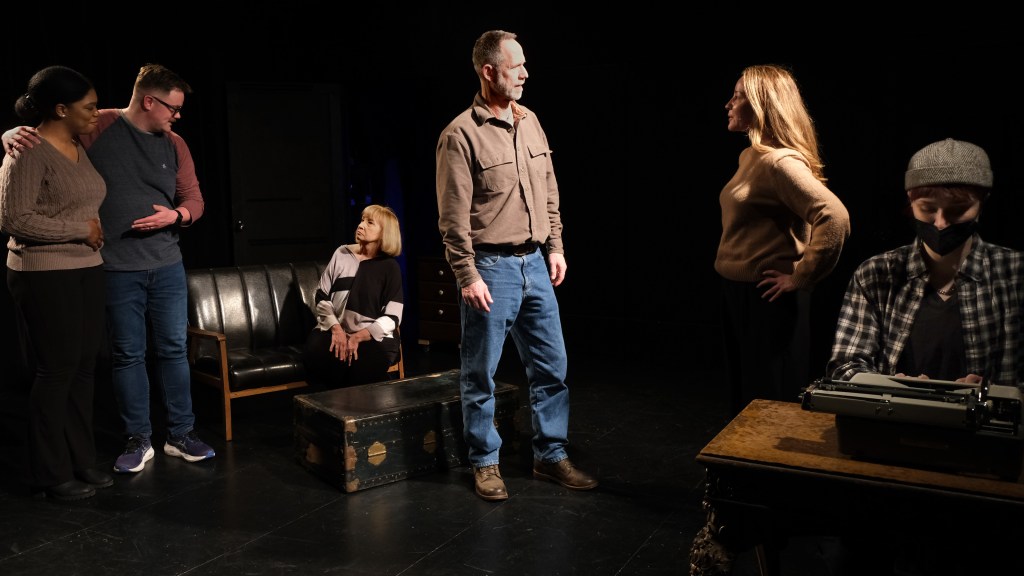
Jim (Mark Thomas McKenna) is a long-haul trucker and Trump supporter, separated from his liberal wife, schoolteacher Rosalie (Alyssa Simon), who is hosting for the holiday. “Granny” Alice (Jenny Martel) is initially not in attendance, and is only appearing via FaceTime, as Jim has refused to vaccinate and she doesn’t want to risk exposure. Adam McDowell is the Gebauer’s son Jimmy, a pastor, who has brought his devout girlfriend Grace (Kinah Britton), a woman of color, to the gathering. The couple has two related major life announcements to tell the family, but Jimmy is aware that they may not go over well, particularly with the “old-fashioned” (to put it mildly) Alice. Sammy (Hayley Pace) is the Gebauer’s other child, arriving with a Covid mask on—and a major life announcement of his own, which is unlikely to be welcomed by either Alice or Jim. All is revealed at the unseen dinner, and the family returns to the living room to deal with the aftermath, the chasm between them even wider than before.
Where the characters agree and disagree is handled very interestingly and realistically. Jimmy is the only character who tries to consistently put acceptance and understanding above all else, but struggles to maintain the role of peacekeeper. Jim is somewhat sympathetic to the Black Lives Matter movement, agreeing that police brutality and prejudice is a real thing, but he rolls his eyes at Rosalie’s having put a BLM flag in the window—suspecting it’s only there because Grace was coming. Rosalie later admits he’s right, but Grace is not impressed, and actually distances herself from the movement. Sammy and Alice agree on masks, but decidedly differ on Sammy’s revelation.
Hayley Pace gives a nuanced, sensitive performance as Sammy, who reveals to the family that he will seek gender-affirming surgery—despite being assigned female at birth, he’s a boy and always has been. The reactions of the other characters vary dramatically; Jim is aghast, verbally dismissive, and refuses to use Sammy’s pronouns (as foreshadowed earlier in the play when he can’t even remember to use his wife’s own preferred version of her name). The old-school religious Grace also condemns the notion, driving a wedge between her and Jimmy, who fully supports his sibling. Progressive Rosalie is also completely on Sammy’s side, but also very awkward and occasionally unhelpful—and Sammy calls her on that. The frustrated Rosalie later admits that as an ally she’s trying to do the right thing, but feels she keeps doing it the wrong way. Meanwhile the spark is still there between her and Jim, and they go from flirting to fighting in the blink of an eye—again, a very realistic take on the complexities of human relationships.
Crone’s writing crucially does not take sides—events play out and the audience is allowed to take it all in without being manipulated into any character’s corner. The effect is a blend of All in The Family and the notorious “Seven Fishes” episode of The Bear. Which is to say there is a lot of humor mixed in with the dysfunctional strife, making the story more true-to-life than it would have been if it were nothing but melodramatic angst and shouting. Early on there is a comedic sequence involving the charred turkey, which brings in a fireman (Will Maizel) after a funny phone mix-up with the operator (Tiffany Ray). There’s even two invisible (but adorable) energetic cats, Smokey and Bandit, unseen but very much heard.
The characters escape from the conflict by reminiscing about the good times back in the day, trying to recapture the bond among them. They take turns noodling meditatively at the electric piano at the front of the stage. Jim tunes out the fighting literally, by singing loudly as he works on fixing the fireplace, trying to reclaim his former role in the family. These interludes culminate in an unexpected, hilarious Broadway-style song (by Michael and Joshua Crone) from the entire cast that provides a catharsis, and gently pokes fun at the inherent weirdness of the musical trope of everyone knowing the same song and suddenly bursting into it.
The actors gel remarkably, giving the impression of relationships with a long, complex history. At the end of the play we see them all as human beings, and despite their very serious differences the connections and love are still there among them. A heartwarming sequence involving popcorn and family-favorite movie Convoy drives this home (and “warm fuzzies” abound). A House Divided successfully shows us the angst, heartache, and growing pains of the 2020s, but reminds us that warmth and sweetness can still follow.
A House Divided is directed by Thoeger Hansen and is a production of Night Cook Studio. It runs at The NuBox at John DeSotelle studio through March 30, 2025.

Knock Knock, Whodunnit? Jim Catapano finds fun at CLUE
The MCT’s Imagining of Clue delights at the BACCA Arts Center
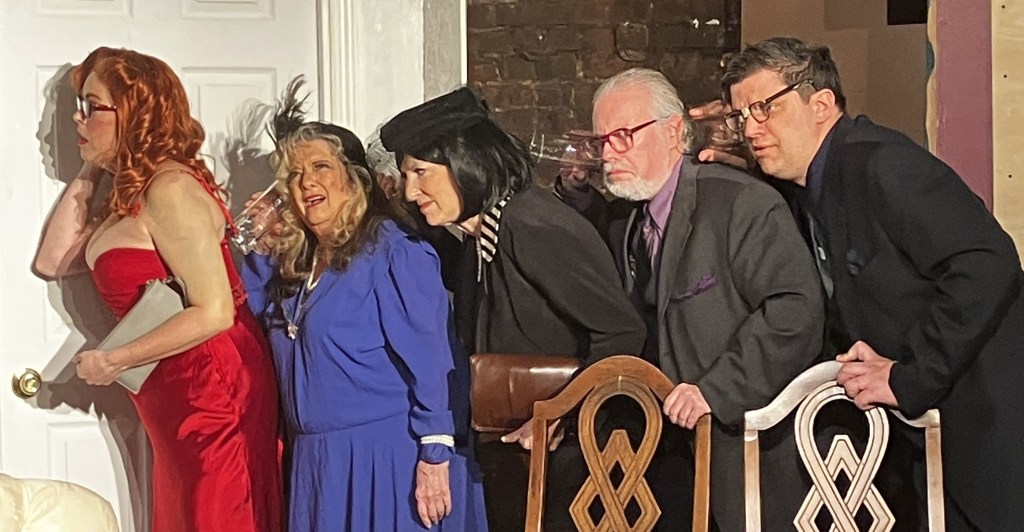
It is the early 1950s, a time when everyone is suspicious of everyone else. By invitation, several of society’s supposed finest gather at the mansion of Mr. Boddy (Mark John Santaromita) on a stormy night. They are familiar archetypes with political influence, all known for the occasion by the special pseudonyms bestowed on them by their mysterious host: Colonel Mustard (Joe Hoffman), Mrs. White (Pamela Seiderman), Mrs. Peacock (Elizabeth DeGennaro), Mr. Green (Ed Cress), Professor Plum (Gary Tifeld) and Miss Scarlet (Meredith Lynn Spencer). The guests are greeted by the very shady butler Wadsworth (Dan Bellusci) and the very French maid Yvette (Heather Legnosky). After clenched-teeth pleasantries, cocktails, and shark’s fin soup (Mrs. Peacock’s favorite, as the cook is creepily aware of), Mr. Boddy appears and reveals he is blackmailing them all, and then hands them their “gifts”; potential murder weapons for one of them to use to kill Wadsworth to protect their secrets before he contacts the authorities. The lights go out, and the fun begins as the bodies pile up and the suspects grow more desperate and frantic.
Sandy Rustin’s stage play Clue, based on the 1985 cult classic film based on the classic board game, is revisited through a wonderful new production by the Modern Classics Theatre of Long Island. It is directed with great panache by Matt Stashin, with clever set design by John Emro and Rian Romeo. A set of moving doors create the illusion of a vast mansion, and they are used to great effect as the characters peer in and out of them, race through them, and shudder at what horrors might be found behind them. High-energy chase music accompanies the characters rushing from room to room between scenes as the sets are swiftly and skillfully swapped—the scene changes are almost as entertaining as the show itself. This is a very physical production; the actors throw themselves bodily into every sequence as they deftly handle the complex wordplay, which is delivered rapid-fire; the audience is still laughing at the previous joke when another one comes hurtling at them.
In addition to the always witty and often hysterical dialogue, there are wonderful sight gags: the actual board game of Clue is used as a map to the mansion; one of the murder victims (James Brautigam) resets the scenery and gets back into position dead on the floor, in full view of the audience; a chandelier falls in super-slow motion as its victim recoils and screams equally slowly; the suspects prop up the dead bodies Weekend at Bernie’s-style to fool a prying police officer. Sound is also a big part of the fun: the ominous doorbell; the barking guard dogs outside; the incredibly loud dinner gong of the cook (Karen Santaromita) which traumatizes everyone, and Mrs. Peacock’s blood-curdling, sound barrier-breaking screams. Karen Santaromita’s double duty as a cheery but ill-fated singing telegram provides one of the show’s funniest moments as the murders accelerate. “Three bodies in three minutes!” marvels one suspect. “That’s our best record!”
Clue boasts a cast of 11 and a character count of 15—in this incarnation, every murder victim humorously gets to be reincarnated as a police officer.
The actors of the ensemble are all perfectly cast, and hilarious in their distrust and barely concealed contempt for each other as they desperately try to avoid suspicion and/or death. Late in the play when Wadsworth breathlessly recounts and acts out the events of the entire evening, Bellusci’s performance is astonishing. And true to the source material, multiple dénouements are explored, as every character gets a chance to have done it. “But it really happened like this…”
Clue is performed at the BACCA Arts Center through Sunday March 16.

From “Tonight Show” Writer to Funerals with Punchlines: Brad Dickson’s “Lovely Idiots” Comes to NYC
Get ready for a funeral unlike any you’ve attended before. Playwright Brad Dickson, Emmy Award-winning former staff writer for “The Tonight Show,” is bringing his uproarious play, “Lovely Idiots,” to New York City for an industry presentation. Known for his sharp wit and comedic timing, Dickson invites audiences to a memorial service brimming with laughter, proving that even death can be darn funny.

Dickson’s diverse background shines through in his work. From writing jokes for late-night television to penning humor columns in the days of thriving newspapers, his comedic voice has resonated across various mediums. His essays have graced the pages of prestigious publications like the Los Angeles Times and America Magazine, and he’s even co-authored two books published by Simon & Schuster. This breadth of experience clearly informs his playwriting, bringing a seasoned understanding of comedy to the stage.
“Lovely Idiots” centers around a group of New York actors and producers who gather to mourn the passing of a once-famous theatrical icon. But this isn’t your typical somber affair. Dickson’s play promises a comedic exploration of the theater world, its personalities, and perhaps even the absurdity of life itself. The premise alone hints at the kind of witty observations and character-driven humor that Dickson is known for.
This isn’t Dickson’s first foray into the theater world. His plays have been produced in numerous venues across the United States and Canada, demonstrating his commitment to the stage. “Lovely Idiots” marks another exciting chapter in his playwriting career, offering New York audiences a taste of his unique comedic perspective.
The industry presentation of “Lovely Idiots” will take place on Thursday, April 3rd, at 2:00 PM and 6:00 PM at Open Jar Studios, located at 1601 Broadway, New York City. Those interested in attending this unique theatrical experience can contact 646-338-5472 or [email address removed] for further details and to RSVP. Don’t miss this opportunity to witness the comedic genius of Brad Dickson and experience a funeral that’s sure to leave you in stitches.


Two Deep Cuts from a Legendary Playwright: Jim Catapano reviews Anton Chekhov
Two Deep Cuts from a Legendary Playwright
Chekhov’s Witty One-Act Character Studies Are Showcased at the ATA
The coupling of A Tragedian In Spite of Himself and The Anniversary is a delicious sampler of the work of the iconic Anton Chekhov, suited for both aficionados and newcomers. It’s another triumph for the American Theatre of Actors as it begins its 49th season.

A Tragedian… is a two-hander written in 1889, where “Chekhov’s Gun” gets an immediate namecheck. Ivan Ivanovitch Tolkachov (Devon Lawler) asks to borrow said revolver from his friend Alexey Alexeyevitch Murashkin (Harry Cooke). “If you don’t lend me a revolver than somebody else will!” he shouts. When Alexey admits he cannot detect what exactly is wrong with his friend’s life, Ivan proceeds to tell him…in incredible detail. Lawler is riveting as he delivers a long, frantic, impassioned monologue, raging against the perceived injustices of his existence. “Nobody has any sympathy for me, and everyone seems to think that all is as it should be!” he seethes—the final insult to him is his peers’ ignorance of his plight. It’s a complex stream-of-consciousness piece that Two Deep Cuts from a Legendary Playwright
Chekhov’s Witty One-Act Character Studies Are Showcased at the ATA
The coupling of A Tragedian In Spite of Himself and The Anniversary is a delicious sampler of the work of the iconic Anton Chekhov, suited for both aficionados and newcomers. It’s another triumph for the American Theatre of Actors as it begins its 49th season.
A Tragedian… is a two-hander written in 1889, where “Chekhov’s Gun” gets an immediate namecheck. Ivan Ivanovitch Tolkachov (Devon Lawler) asks to borrow said revolver from his friend Alexey Alexeyevitch Murashkin (Harry Cooke). “If you don’t lend me a revolver than somebody else will!” he shouts. When Alexey admits he cannot detect what exactly is wrong with his friend’s life, Ivan proceeds to tell him…in incredible detail. Lawler is riveting as he delivers a long, frantic, impassioned monologue, raging against the perceived injustices of his existence. “Nobody has any sympathy for me, and everyone seems to think that all is as it should be!” he seethes—the final insult to him is his peers’ ignorance of his plight. It’s a complex stream-of-consciousness piece that Lawler performs with astonishing energy and tremendous skill. (His “fed-up-ness” will have you nodding in solidarity.) Through it all Cooke’s Alexa listens with apparent sympathy, but then shockingly makes a request of Ivan that indicates he didn’t take in a word that his friend said, thus proving Ivan right. This sends the teetering Ivan over the edge, and chaos inevitably—and fittingly—reigns.
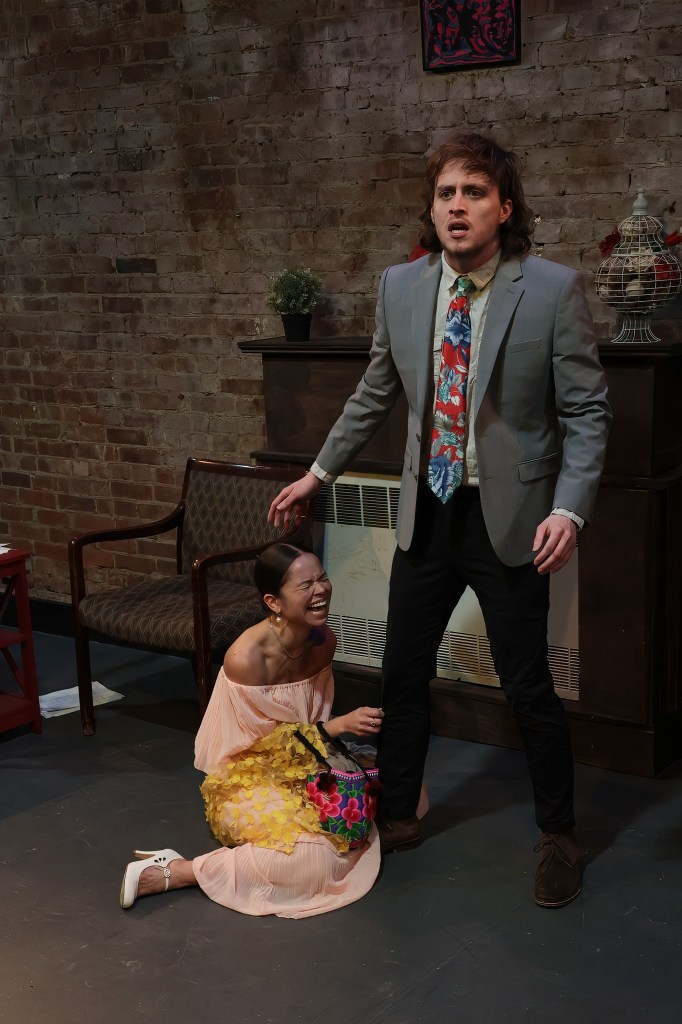
In The Anniversary, Anton takes on corporate life, and it’s striking to see how the piece—also from 1889—resonates in 2025. A farcical story set at a private bank, it concerns one Andrey Shipuchin (Jonathan Beebe), the company’s chairman, as he gathers his colleagues and shareholders to celebrate the institution’s 15th anniversary. Unfortunately for Shipuchin and all involved, events quickly go comedically south. Harry Cooke returns as the frustrated clerk Kusma, lamenting the chairman’s empty promises even as he prepares to craft his boss’ speech for the occasion. Natasha Sahs is hilarious as Andrey’s obnoxious wife Tatiana, who cannot stop talking about things that are not remotely relevant to anyone else. Kate Jergensen’s Natasha arrives to very humorously ruin the vibe even further, demanding that the bank pay her husband’s salary even though there’s no evidence that he ever worked there.
The actors collectively shine, providing a masterclass in realizing Chekhov’s classic and clever material, resulting in a can’t-miss dual production that demonstrates how words written long ago still resonate in the early 21st century.
A Tragedian In Spite of Himself and The Anniversary are directed by John DeBenedetto. They run at the American Theatre of Actors through February 2, 2025.
Jim Catapano reviews a Letter-Perfect Power Play
Frank Cossa’s Witty Character Study Bows at the ATA
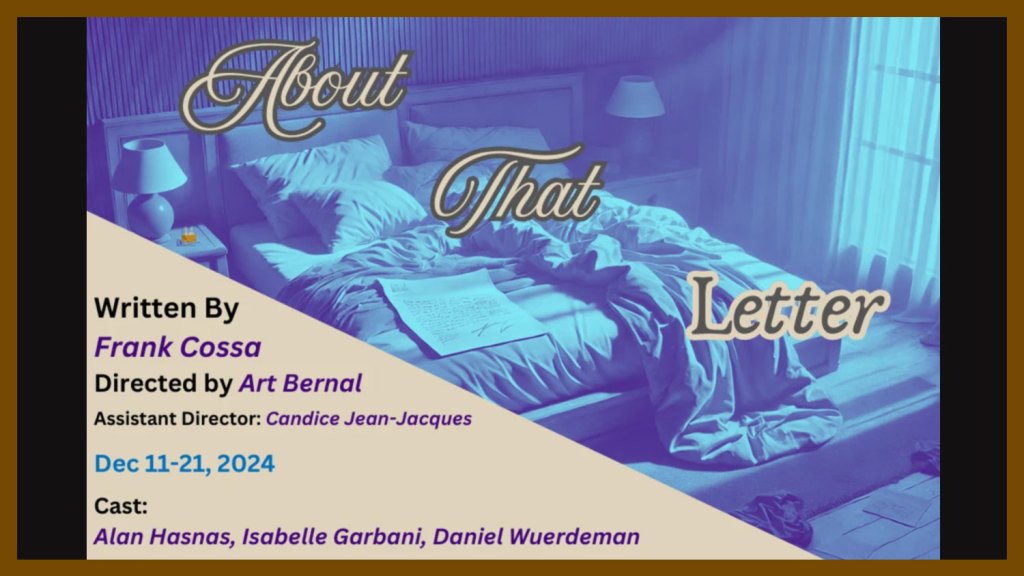
While sipping an adult beverage at a professional conference, Doctor Emma Vanderlyn (Isabelle Garbani) meets a charming man who she describes as “oddly cute, in a cutely odd kind of way.” However, to her horror the man turns out to be her arch-nemesis, tenured professor Pete Brasso (Alan Hasnas). Years earlier, Brasso had single-handedly brought to a near-halt the academic career of Emma’s husband, Josh Sperling (Dan Wuerdeman). Brasso had sent a letter to the editor of The Art Review, pointing out a serious factual error in Sperling’s article in the journal regarding the artist Whistler. This action led to Sperling’s credentials being questioned, culminating in the rejection of his own tenure. The incident, in her estimation, “ruined her life”— and she’s ready for revenge, but in a very unusual manner.
Thus begins About That Letter, a sharp and engaging one-act by Bronx-born Frank Cossa. To the sounds of the Pomp and Circumstance Graduation March, we flash back to Emma and Josh learning of Brasso’s letter; Josh is in despair—admitting Brasso is right, and correctly predicting the dire consequences of it. Emma seethes that the triumphant life path she had sought through her husband’s success is about to be denied her; she is almost Lady Macbeth-like in her rage. She scoffs at Josh’s suggestion that it will end up ok: “I don’t want OK, I want pretty damn good!”
Returning to the present, things have taken an unexpected turn—after copious drinks, Emma has “slept with the enemy.” Wearing the fluffy white robes of the hotel they are staying in, they bask in the afterglow the next morning, until Emma reveals her motives and gives us a clearer picture of the calculating, success-obsessed person underneath the professional charm and decorum.
“I wanted to know what it felt like to have sex with a man I detest,” she proclaims unapologetically. (There’s a slang term for that, but I won’t repeat it here.) Still reveling in the satisfaction of this, she gleefully assassinates his character, dismissing him as a poser and a hypocrite who rambles on meaninglessly (“A Rebel Without a Pause” is one of her more memorable dismissals). And circumstances only escalate from there…
The three actors bring Cossa’s compelling story beautifully to life, delivering his insightful and humorous observations with relish. It’s a terrific study of human interaction and dysfunction, and how the desperate desire to be somebody leads to some shocking life choices.
About That Letter is directed by Art Bernal with co-direction by Candice Jean-Jacques. It is presented at the Beckman Theatre at the American Theatre of Actors through December 21, 2024.

Jim Catapano is seeing double: two shows at the ATA
The Oddest of Couples: Meny Beriri Brings Two Witty and Insightful Character Studies to the ATA
Opposites may attract, but they also repel pretty quickly too, as Meny Beriri observes in his two new one-act pieces, Smoking Kills and SKU. They complement each other perfectly as each is a look at two sets of people struggling to get on the same page. Each pairing features one cynic, and one hopeless romantic; one cautious, and the other free-spirited; one level-headed, and the other obsessive; one grounded in reality, and the other in Hallmark movie-land. Both plays take place in a post-pandemic world, which informs the approaches to life of all the characters—it’s basically “Let’s Form a Connection” vs. “Leave Me Be.”

SKU: “We’ll always have Paris Baguette!”
Alex (Gordon Rothman) and Melanie (Stacey Petricha) are fresh from their memorable date at the aforementioned bakery/café, and are now meeting at a restaurant to keep the fire burning over Indian food. Melanie is a retired nurse, and happy to be independent and free of responsibility. “We’re not heroes,” dismisses Melanie, who sees her nursing career as having been just a stressful gig. Alex, in contrast, is a high-school social studies teacher so in love with his job that he has convinced himself that every day is as meaningful as Dead Poets Society. He’s a passionate soul who fixates on something and won’t let it go; he’s an hour late to the second date, blaming it on his obsession over obtaining a certain stapler missing the SKU of the title. (It stands for “Stock Keeping Unit”, which stores use to identify products in their inventory.) He then goes on a tangent about Star Trek (The episode “The Doomsday Machine,” to be appropriately specific), and his quest to discover the identity of the actor who walked in front of Kirk in one pivotal scene. Melanie is life-loving as well, but in a fiercely independent way. She doesn’t see constant companionship as the key to happiness—to her, it’s by and large an obstacle.
“You still need other people,” argues Alex. “But you can’t depend on them for happiness!” Melanie fires back.
She stays polite, but her demeanor begins to indicate that the Paris Baguette encounter should maybe have been a one-and-done. Alex, however, has decided after one date and a half that Melanie is his soul mate.
“You think we share a soul?” she scoffs. “From what I remember, that’s not how reincarnation works!” But Alex is unrelenting—he announces he wants to travel the world with the sudden love of his life, and Melanie recoils in horror; to her, that basically echoes the title of the very first episode of Star Trek: “The Cage”.
While perfectly depicting the clashing of their characters, the actors have tremendous chemistry and make the script sing. Petricha and Rothman are supported by Samiha Ahmed, the waitress who has a god’s eye-view of the quickly crumbling romance. Though things go south fast for Alex and Melanie’s connection, they do so humorously, and the theme of incompatibility lands while never feeling tragic or even at all downbeat; Alex lands on his passionate feet, in a very funny resolution.
Smoking Kills opens to the sounds of the Odd Couple theme, lampshading the relationship between the youthful and exuberant Emily (Julianne Lorndale) and her roommate/landlord, the older, warier Jane (Leia Martin).
An Oklahoma transplant, Emily returns to their NYC apartment gushing over her date with “Harold”, who took her to the exotic Avenue D and then on a romantic trip on the Staten Island Ferry. Emily compares it to Casablanca, which she recently discovered. Jean smells cigarettes on Emily—the extremely potent Marlboro Reds, to be exact—and is disgusted. Emily admits she smoked one of Harold’s ciggies in the heat of the moment, and still has the pack. Jean is triggered due to the 6-pack a day habit she once had as a teen, and warns Emily of the evils of the addiction, and of a lot of other dangers in life that Emily seems blissfully unaware of—such as the antibiotic filled Jumbo Shrimp she consumed at dinner. Jean invokes the “my house, my rules” clause, escalating the confrontation between the two, and leading to an explosive, violent-but-comical climax. As with SKU, a potentially traumatic conclusion is handled humorously, and again with the perfect final moment. Martin and Lorndale realize this modern-day Felix and Oscar beautifully, playing off each other with deftness and expertly serving the witty material.
These two delightful one-acts are a testament to Beriri’s ability to take the sad reality of the failed connections that plague life in the post-pandemic 2020s, and imbue them with a compassionate touch and knowing sense of humor that is refreshing, and somehow even healing.
SKU is directed by Meny Beriro; Smoking Kills is directed by Ginger Kipps. They are featured together at the American Theatre of Actors through December 8, 2024.
 Arts Independent