
Home » Posts tagged 'god'
Tag Archives: god

Jim Catapano views the creative view from “Over the Shoulder”
The Creative View from Over the Shoulder
Mark Solomon Shares His Expertise on Telling Stories and the Art of Skillful Editing
“The way I see the world is through stories,” says Mark Solomon. “It’s the water I swim in.”
Renowned Film editor Solomon has over 30 years’ experience in engaging audiences. And he did exactly that for an enthralled crowd at a Talkback, Signing, and Live Podcast at the Drama Book Shop in Midtown Manhattan, regaling us with tales of the craft as detailed in his new book, Over the Shoulder: A Freelancer’s Guide to Telling Stories and Editing Films. (The following are highlights from both the Talk and the Q&A portions of the event, facilitated by The Drama Book Show! Podcast hosts Mark Eugene-Garcia and David Rigano)

Solomon first became enchanted by the art of storytelling through cinema at 18 years old, when he saw the classic film Harold and Maude, the May-December romance story that he found “beautiful and life-affirming”. “When I left the theater that night I felt like I was floating on air,” he says. “So exhilarated and uplifted. I decided right then—this is my path.”
But after several semesters at Syracuse University where he was pursuing a bachelor’s degree in film and theatre, it was time for his final project, and Solomon found himself “choked with fear.” “I had a passion for films and filmmaking, but I had no idea what to make a film about…what story did I want to tell? I was desperate, and I berated myself for not knowing.”
It’s a struggle that all passionate creators can relate to. The intense pressure, anxiety, and dread in the time leading up to graduation resulted in what Solomon calls a “toxic psychosis that I was lucky to survive.”
Solomon found his way back following a Eureka! moment prompted by his experience of Japanese theater, where the actors do not begin until they are certain the audience is giving the stage their full attention and focus. “Through the course of the evening the actors take control of the breathing rhythm,” he notes, “and guide the audience through the climax of the play.”
Something about this concept stayed with him and spurred him on, and he was able to return to his academic and artistic journey. “My brain slowly recovered…I remember walking around my suburban neighborhood with a single plea migrating through my body: Give Me Life.” He didn’t know yet what his story was going to be, but he knew for certain he wanted another chance to find it.
While studying more about the rough state of the world and exploring ways to make it better, Solomon grew as a person, which fueled his artistic aspirations. The activist that he says left the greatest impression on him was Daniel Berrigan, the Jesuit Priest famous for speaking out against the Vietnam War and openly opposing huge institutions like the US government and military. Solomon was inspired by his “shining moral clarity and the courage to live by his convictions…I found his talk galvanizing.”
Kerrigan encouraged Solomon to volunteer at the local nonprofit peace council, and Solomon learned a critical lesson. “A single voice has power.” And this has been the impetus for his storytelling journey ever since.
“Learn what story matters,” he says. “Tell that story in the most compelling way, to make people feel something emotional…learn how to reach people.”
This call-to-action leads Solomon and his editing team, on every creative endeavor, to create the version of a narrative that will create the strongest impact on the audience. “I ask (of a scene), what’s in and what’s out? Of the pieces that are available, what do you choose to keep with you and what do you leave behind?” For Solomon, it comes down to discernment, fueled by the knowledge that people look for patterns; the human mind sees two things and decides for itself how they’re related to each other, and the craft of successful storytelling depends on recognizing that truth. Solomon cites “The Kuleshov Effect,” a film editing technique that uses a sequence of visuals to infer meaning and evoke an emotional response. Returning to Japanese storytelling, another influential technique is Jo-ha-kyū, which instructs that all actions or efforts should begin slowly, accelerate, and then end suddenly or quickly. (Solomon notes an example of Jo-ha-kyū in his own Chicken Run, specifically the memorable “pie machine” sequence.)
Building masterfully on his extensive experiences and influences, Solomon has gone on to be the person behind the prodigious editing of such animated films as the aforementioned Chicken Run; Sgt. Stubby: An American Hero; The Tale of Despereaux; and Frankenweenie, which was nominated for an Eddie Award in 2013. He was also part of the team behind the legendary movies Shrek and Space Jam.
Solomon gives his insight on how to persevere and succeed in an industry where there is so much content and competition, at a time when art is presented by hundreds of thousands of creators on multiple platforms.
“Declare victory and move on,” advises Solomon when a project doesn’t achieve the level of success one had hoped for. “Call it a success, and learn what you can from it.” The good news about our times is that there is always a chance for art to be re-envisioned, re-launched, or re-released.
As very much someone who wants to give back and share his insight and experiences with aspiring artists, Solomon has taught his craft to students at film schools and universities. Over the Shoulder is a way of passing that knowledge to an even wider audience.
“I’d started teaching at a film school in Boston and in London…and every term, there would be one student who would sort of be really sparked by what I was talking about,” he explains. “I knew that they would follow and pursue a career as an editor, and I wanted to give them something to help. When you finish film school it’s hard to see how to navigate the world outside…So I thought that I would try to share what I learned.”
He recalls that when he first started out as an apprentice, he pledged to his editors and instructors to one day mentor newcomers himself as well. “I promised when it’s my turn, I’ll pass all that I’ve learned to the next generation. So this book is a part of keeping that promise.”
Learn more about Mark at MarkSolomon.net. Over the Shoulder is available at 7pinespublishing.com. Learn more about the Drama Book Store at https://dramabookshop.com/

Jim Catapano views the creative view from “Over the Shoulder”
Mark Solomon Shares His Expertise on Telling Stories and the Art of Skillful Editing
“The way I see the world is through stories,” says Mark Solomon. “It’s the water I swim in.”

Renowned Film editor Solomon has over 30 years’ experience in engaging audiences. And he did exactly that for an enthralled crowd at a Talkback, Signing, and Live Podcast at the Drama Book Shop in Midtown Manhattan, regaling us with tales of the craft as detailed in his new book, Over the Shoulder: A Freelancer’s Guide to Telling Stories and Editing Films. (The following are highlights from both the Talk and the Q&A portions of the event, facilitated by The Drama Book Show! Podcast hosts Mark Eugene-Garcia and David Rigano)
Solomon first became enchanted by the art of storytelling through cinema at 18 years old, when he saw the classic film Harold and Maude, the May-December romance story that he found “beautiful and life-affirming”. “When I left the theater that night I felt like I was floating on air,” he says. “So exhilarated and uplifted. I decided right then—this is my path.”
But after several semesters at Syracuse University where he was pursuing a bachelor’s degree in film and theatre, it was time for his final project, and Solomon found himself “choked with fear.” “I had a passion for films and filmmaking, but I had no idea what to make a film about…what story did I want to tell? I was desperate, and I berated myself for not knowing.”
It’s a struggle that all passionate creators can relate to. The intense pressure, anxiety, and dread in the time leading up to graduation resulted in what Solomon calls a “toxic psychosis that I was lucky to survive.”
Solomon found his way back following a Eureka! moment prompted by his experience of Japanese theater, where the actors do not begin until they are certain the audience is giving the stage their full attention and focus. “Through the course of the evening the actors take control of the breathing rhythm,” he notes, “and guide the audience through the climax of the play.”
Something about this concept stayed with him and spurred him on, and he was able to return to his academic and artistic journey. “My brain slowly recovered…I remember walking around my suburban neighborhood with a single plea migrating through my body: Give Me Life.” He didn’t know yet what his story was going to be, but he knew for certain he wanted another chance to find it.
While studying more about the rough state of the world and exploring ways to make it better, Solomon grew as a person, which fueled his artistic aspirations. The activist that he says left the greatest impression on him was Daniel Berrigan, the Jesuit Priest famous for speaking out against the Vietnam War and openly opposing huge institutions like the US government and military. Solomon was inspired by his “shining moral clarity and the courage to live by his convictions…I found his talk galvanizing.”
Kerrigan encouraged Solomon to volunteer at the local nonprofit peace council, and Solomon learned a critical lesson. “A single voice has power.” And this has been the impetus for his storytelling journey ever since.
“Learn what story matters,” he says. “Tell that story in the most compelling way, to make people feel something emotional…learn how to reach people.”
This call-to-action leads Solomon and his editing team, on every creative endeavor, to create the version of a narrative that will create the strongest impact on the audience. “I ask (of a scene), what’s in and what’s out? Of the pieces that are available, what do you choose to keep with you and what do you leave behind?” For Solomon, it comes down to discernment, fueled by the knowledge that people look for patterns; the human mind sees two things and decides for itself how they’re related to each other, and the craft of successful storytelling depends on recognizing that truth. Solomon cites “The Kuleshov Effect,” a film editing technique that uses a sequence of visuals to infer meaning and evoke an emotional response. Returning to Japanese storytelling, another influential technique is Jo-ha-kyū, which instructs that all actions or efforts should begin slowly, accelerate, and then end suddenly or quickly. (Solomon notes an example of Jo-ha-kyū in his own Chicken Run, specifically the memorable “pie machine” sequence.)
Building masterfully on his extensive experiences and influences, Solomon has gone on to be the person behind the prodigious editing of such animated films as the aforementioned Chicken Run; Sgt. Stubby: An American Hero; The Tale of Despereaux; and Frankenweenie, which was nominated for an Eddie Award in 2013. He was also part of the team behind the legendary movies Shrek and Space Jam.
Solomon gives his insight on how to persevere and succeed in an industry where there is so much content and competition, at a time when art is presented by hundreds of thousands of creators on multiple platforms.
“Declare victory and move on,” advises Solomon when a project doesn’t achieve the level of success one had hoped for. “Call it a success, and learn what you can from it.” The good news about our times is that there is always a chance for art to be re-envisioned, re-launched, or re-released.
As very much someone who wants to give back and share his insight and experiences with aspiring artists, Solomon has taught his craft to students at film schools and universities. Over the Shoulder is a way of passing that knowledge to an even wider audience.
“I’d started teaching at a film school in Boston and in London…and every term, there would be one student who would sort of be really sparked by what I was talking about,” he explains. “I knew that they would follow and pursue a career as an editor, and I wanted to give them something to help. When you finish film school it’s hard to see how to navigate the world outside…So I thought that I would try to share what I learned.”
He recalls that when he first started out as an apprentice, he pledged to his editors and instructors to one day mentor newcomers himself as well. “I promised when it’s my turn, I’ll pass all that I’ve learned to the next generation. So this book is a part of keeping that promise.”

Learn more about Mark at MarkSolomon.net. Over the Shoulder is available at 7pinespublishing.com.

Jim Catapano reviews a dying gasp of a senator’s soul with Michael Hagins’ “The Senator Speaks”
Michael Hagins’ Powerful New Play The Senator Speaks Examines the Human Consequences of Playing Politics
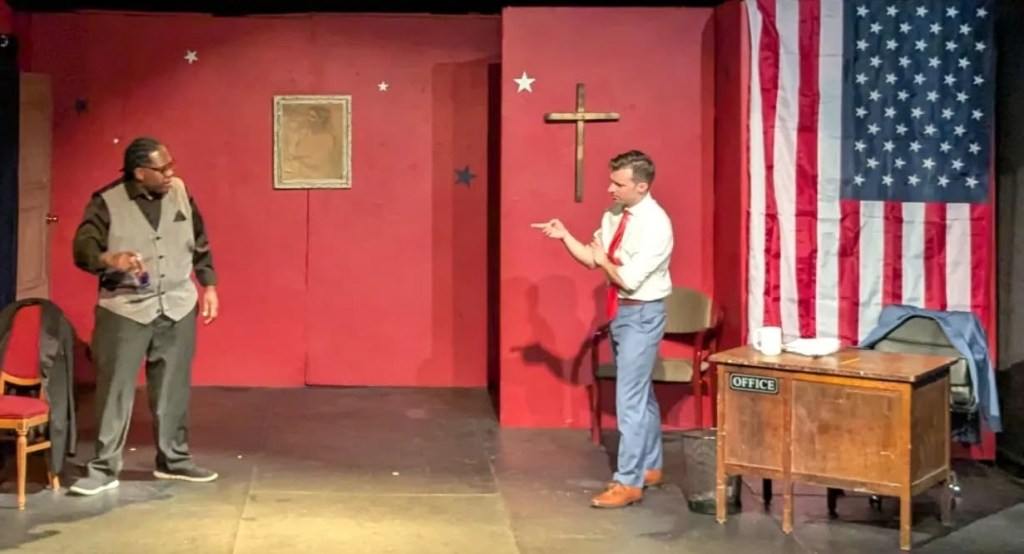
“We are all mired in dark times,” proclaims Conservative Republican Senator Calvin Shepherd (Michael J. Whitten). “At a time when the hard left is helping to ruin this country. Liberty is under assault…we are going to arm up and fight back.” Shepherd is spending the morning at home, surrounded by portraits of Reagan, Bush I, a large cross, and an even larger American Flag. He is practicing the Keynote speech he is scheduled to deliver to the National Rifle Association.
“It’s just rhetoric,” he admits to his religious, reserved wife Martha (Mary Sheridan). “I don’t believe any of it.”

Unsure of his own talking points, Shepherd keeps running to his desk to double-check his prepared script; he humorously has trouble saying the word “statistician.” But these are the least of his issues; his liberal activist, liberal arts-studying daughter Corinne (Olivia Whicheloe) is home from college, and they’re destined for another shouting match, which Martha wearily prepares to referee. (The relationship between father and daughter is exemplified by Corinne having thrown red paint on him during one of her many protest outings.)
Adding exponentially to the tension is the presence of Danny Johns (Xavier Rodney/Michael Hagins at Friday performances). Political Machiavelli Danny is essentially Shepherd’s Chief of Staff, and the devil on his shoulder, pulling the strings to advance Shepherd’s career and reap for himself the resulting rewards. (He also boasts that he’s the guy that makes potential “problems” go away for anyone who does what he wants.)
As events unfold, we learn that Shepherd’s voting history—the details of which he often struggles to recall—is coming back to haunt him. His rejection of background checks has put a gun in the hands of a young man who is now an active school shooter, just a few miles away, and ironically, mere hours before Shepherd is to go before the NRA. To the Shepherds’ horror, their young niece Jamie is one of the students trapped inside. Danny reveals that he’d been aware that the gunman was a potential threat to the community for some time, and he had strategically swept the information under the rug. But even now, this “incident” is all a mere inconvenience, and one that can be spun for political gain. “You can be America’s rock,” he later implores Shepherd. “The senator who overcame tragedy to bring this country to a stronger future.”
Amid an agonizing tug-of-war between Danny and the Shepherd family for the soul of the Senator, Corinne reveals that something terrible had recently happened to her at college. It’s indeed a crime against her, but one that she will receive no justice or recompense for—as a result of her father’s earlier political decisions. A further family revelation drives home the hypocrisy at the heart of Shepherd’s very being. Thus, at the urging of Danny and for the sake of some perks hidden in big wordy bills, Shepherd has essentially sold out his own family, to tragic consequences.
Brilliantly written and directed with no punches pulled by Michael Hagins, The Senator Speaks comes at a pivotal moment in history, when the chasm between congressman and constituent has never been greater. Hagins exposes the rot at the center of the politician’s heart; Shepherd is both callous and clueless, and this characterization is far from hyperbole in the turbulent early days of 2025. Corinne refers to Danny as “Rasputin,” and she is not far off; the kingmaker is not only a puppet master, but also so powerful in the political sphere as to be seemingly invincible. A disgusted Corinne asks him what he believes in. “Money,” he replies cooly. Shepherd is caught between Danny and his pleading family in a gripping and heartbreaking battle that singlehandedly sums up all that is wrong with American society.
The actors perfectly embody their roles, to the extent that the audience feels they are eavesdropping on a real family’s despair and disintegration. Rodney/Hagins’ Danny is a supervillain oozing with evil—but chillingly, he’s also completely realistic. The same is true for Whitten’s corrupted Shepherd, a man so consumed with his career and so brainwashed by his puppeteer that he can barely discern right from wrong anymore. Whicheloe’s assertive, fed-up Corinne is at turns defiant and heartbreaking—as is Sheridan’s disillusioned Martha, whose wavering admiration of her husband gives way to complete contempt. Whicheloe and Sheridan are compelling as their characters come to terms with the reality that their father/husband is not a person they can ever again stand with or depend on.
The Senator Speaks is a must-see production in an era when the creative voice is needed more than ever to speak to the troubles of our times, and to be our companion as we navigate the turbulent seas ahead of us.

The Senator Speaks is part of the African American Playwrights Initiative at the ATA. It is playing through March 8 at the Sargent Theater at the American Theatre of Actors.
 Arts Independent