
Home » Posts tagged 'history'
Tag Archives: history

It’s Mean to Be the King: Jim Catapano at RICHARD III (Atlas Shakespeare)
The Atlas Shakespeare Company Presents a Triumphant Retelling of Richard III
Following acclaimed productions of Henry VI Parts 1 and 2 and Henry VI Part III, the Atlas Shakespeare Company now completes the Bard’s first tetralogy with a riveting Richard III.
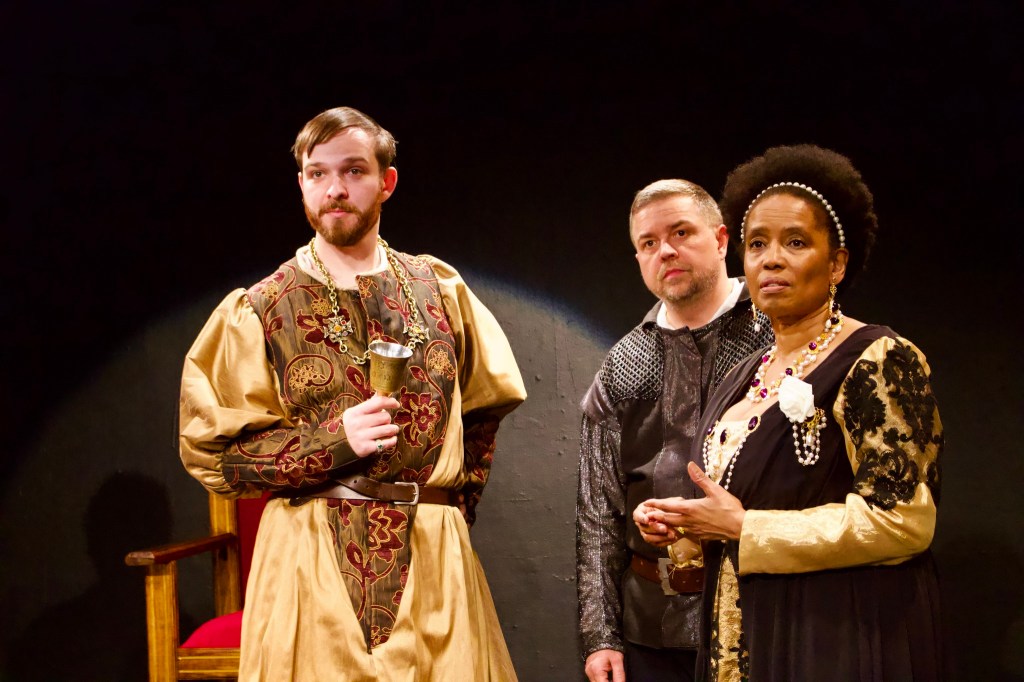
Following the long civil conflict in which the Yorks defeated the Lancasters, King Edward IV (Ethan Baker) sits atop the throne, depressed and ailing. His power-hungry brother Richard (Zachary C. Clark), the Duke of Gloucester, sees (and eventually seizes) an opportunity. Thus, he begins to systematically eliminate everyone who stands in his way, while wooing the widowed Lady Anne (Christa Souza) to his side. He imprisons his elder brother George (Yeshua Ellis), Duke of Clarence, in the infamous Tower, where he later also famously banishes his young nephews, Richard the Duke of York (also Souza) and Prince Edward (Charlotte Blacklock), to prevent any competition to the throne. The less-than-legitimate new King Richard’s reign of terror is finally threatened by Henry Tudor (Bradley Viktor), Earl of Richmond, who raises an army against the Machiavellian murderer.
The play completes the War of the Roses saga with a compelling story of betrayal and sociopathic serial killing that ends in a bloodbath. Along the way we watch the titular character go from scheming to murder to full-on madness, with lots of backstabbing along the way, most of it literal. We learn that a cask of wine is a great place for a murder victim. And what show would be complete without a game of “catch the severed head”?
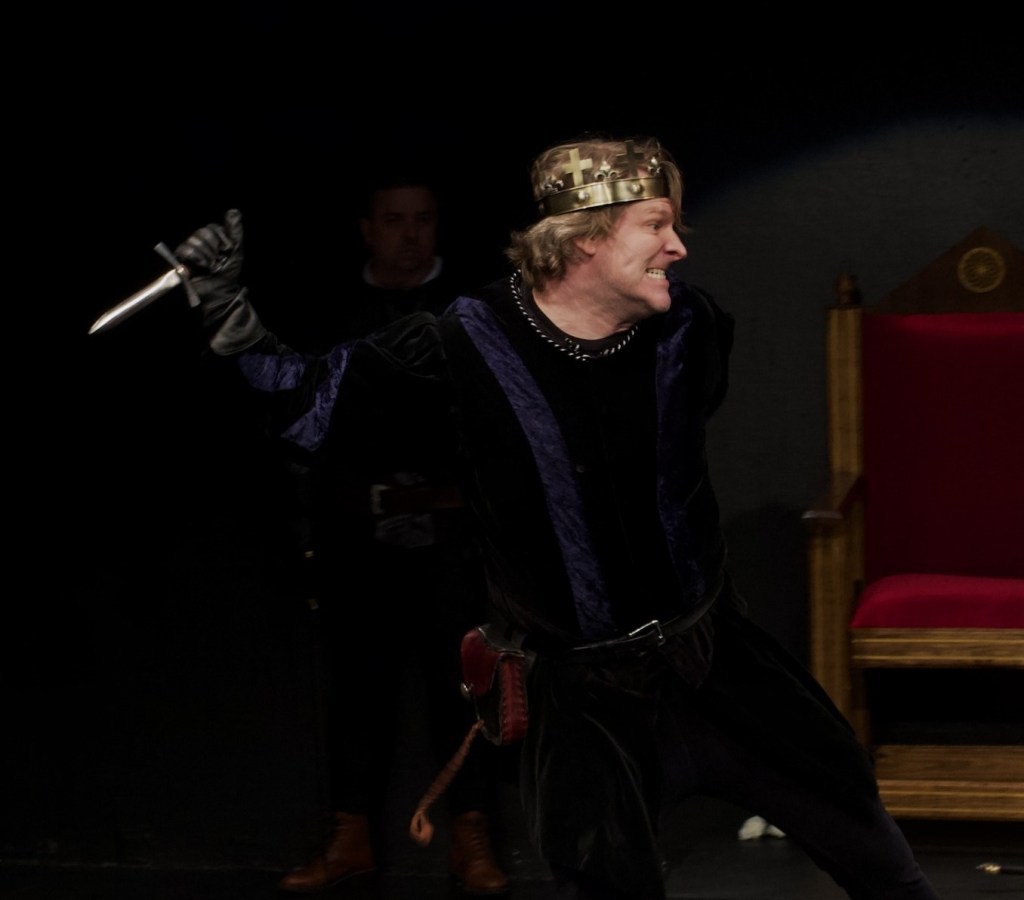
As the conniving cad of the title, Clark delivers a tour-de-force performance: charming, devious, funny and sly. He skillfully uses the audience as his “co-conspirators”, delivering asides and glances that make us feel part of the story.
“(Richard III) is very insecure in a lot of ways,” said director Adriana Alter in a talkback following a recent performance. “And very motivated by the need for external validation which he’s trying to get from the audience. We essentially become his imaginary friends. He’s trying to impress with how clever he is.” Clark is excellent at portraying Richard’s rollercoaster ride from the heights of power to the depths of slipping sanity. “He’s going to have to come face to face with the fact that he hates himself,” said Alter. “His coping mechanisms for keeping up, that pretense starts to melt away.”
Clark is joined by a sterling cast including Tonia E. Anderson as Cecily the Dutchess of York; Joscelyne Wilmouth as Queen Elizabeth; Nick Stevens as her brother Anthony (Lord Rivers); Matthew Tiemstra as Henry, the Duke of Buckingham; Quinlan Welch as Thomas Grey; Nicholas Grevera as William (Baron Hastings); Timm Coleman as Thomas Stanley; Chris Clark as Sir Richard Ratcliffe; and Gabe Girson as lawyer Sir William Catesby. (Baker, Blacklock, Sousa, Ellis, Viktor, and Welch each play two roles to round out the kingdom.)
The costumes—designed by Madeline Rostmeyer and coordinated by Nancy Nichols—are glorious in their elegance, and the sterling cast delivers Shakespeare’s iconic dialogue with a delighting deftness that captivates with every turn of phrase. Atlas’ mission statement is to present Shakespeare’s work as it was intended, and they do so here with a production that is true to the text and to the era it was initially performed, but still completely accessible to a 21st Century theatregoer.

Director Alter has presented a fantastic edition of the oft-performed classic, neatly trimmed and dynamically realized with all story beats intact. It is immensely engaging—from Richard’s first sinister speech, to the appearance of the ghosts of all his victims, to the incendiary final battle. That last sequence is astonishing, an edge-in-your-seat experience delivered with dance-like precision by the cast under the expert guidance of fight choreographer Leighton Schlanger.
This explosive conclusion to the saga is a positive triumph for Alter and Producer and Founder Alexander Nero. It’s a must-see for this “Winter of Discontent” or for any season.
Trade your kingdom for a horse and go see Richard III at the Wild Project through March 1, 2026. Learn more at atlasshakespearecompany.com/.

Jim Catapano examines A Legend Restored with the ATA production of Kenthedo Robinson‘s The Lewis & Clark Expedition: The Story of York
Kenthedo Robinson‘s The Lewis & Clark Expedition: The Story of York Returns a Hero to His Rightful Place in American History
“If a man can become a slave, a slave can become a man.”
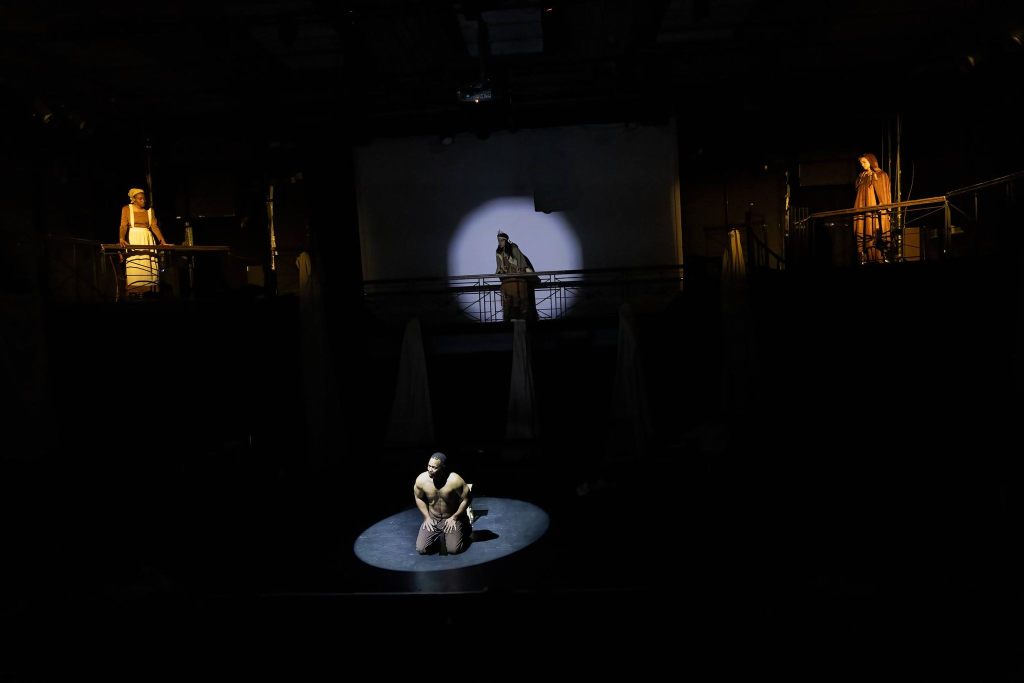
In 1804, a country in its infancy was determined to explore the uncharted land that would soon be part of its territory. The treacherous and dangerous journey was famously undertaken by Meriwether Lewis and William Clark, but few know of the man who accompanied them and was utterly essential to the success of the quest: York, an African-American enslaved by Clark.
York is portrayed with astonishing power and authenticity by Rommell Sermons, who we see discussing his being chosen for the expedition with his wife Reeva (Marsha St. Julien; portrayed later in the run by Zsay Moore). Reeva is deeply unhappy with the idea of York going into certain danger with his white oppressors. Though York is loyal to Clark (Nicholas Dodge) because “Clark is loyal to him”, Reeva is much more skeptical about the nature of the relationship, a foreshadowing that will lead to a devastating revelation at the end of the play. Indeed, Clark seems somewhat benevolent, especially in contrast to Lewis (Travis Bergmann). Lewis here is seen to be a raging bigot, seething with contempt for York and threatening him with the whip at every opportunity (despite not having the “authority” to do so), something his “master” Clark has never done. Lewis is out for fortune and glory while Clark purports to be more nobly motivated by the chance to grow and unite the young country.
“I hate you because you exist!” screams Lewis at York, forever paranoid that the slaves and the indigenous people they are about to displace will rise up against their oppressors. Though Clark appears to respect and even care for York, he still refers to him as property and refuses to agree to give him his freedom, only mumbling that he will “revisit” the notion upon their return. It becomes clear that Clark is only good to York because he needs him.
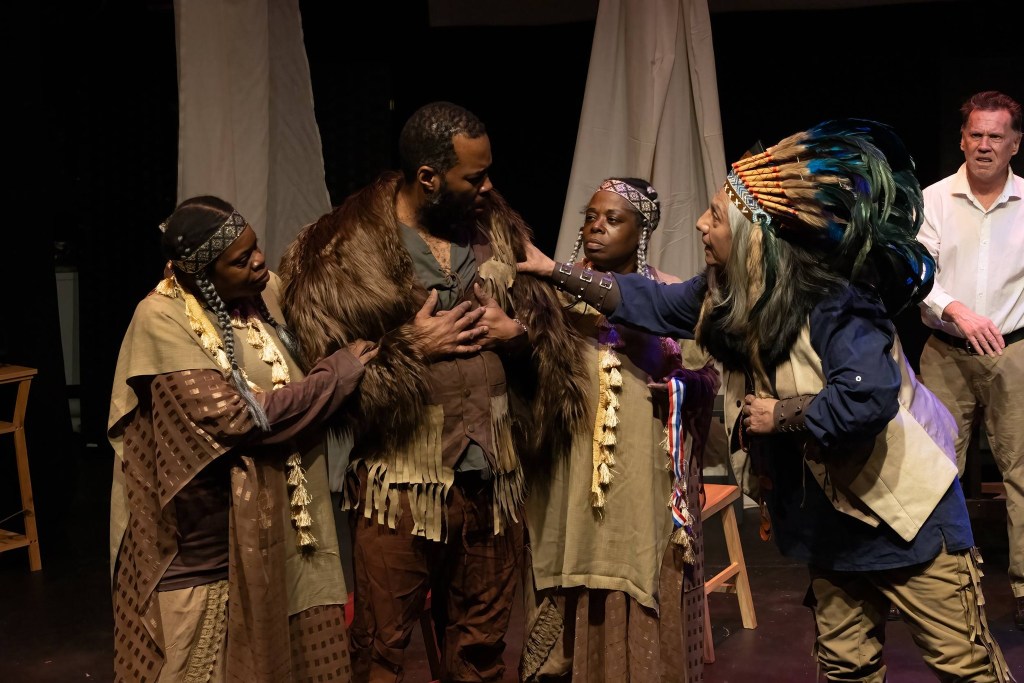
And York is indeed crucial to the treacherous journey, his intelligence, skills and strength proving indispensable. The indigenous tribes encountered are fascinated by York, having never seen a person of African descent before, astonished that his dark “paint” doesn’t wipe off. After a tense face-off with Chief Cameawaite (Kevin Leonard), it is shown that his very presence provides essential assistance to the expedition in their dealings with the Native Americans they encounter. The indigenous peoples are portrayed by a talented cast including Sebastian Arteta (Chief Anapae), James Oliver (Chief Tall Crow), LeeSandra Moore (Sonomo/Stage Manager) and Ms. D (Highshee/Assistant Stage Manager). As the journey continues, events are cleverly linked by Clark’s correspondence with his back-home brother John (Alex Silverman).
York saves the day at every turn, becoming an icon to the native tribes but taken for granted by his own team, who still see him as property. He cares for a very ill Clark; he looks after Sacagawea (Natasha Sahs), an indigenous teenager who assists the expedition and travels with them all the way to the Pacific Ocean; and even saves his nemesis Lewis from a bear attack, in a sequence that is fantastically realized through excellent choreography and sound design (Lighting/Sound Liam Riordan).
Lewis’ utter lack of gratitude and his doubling down on his profound hatred is a chilling reminder of the depths of white supremacy that are still in evidence over 200 years later.
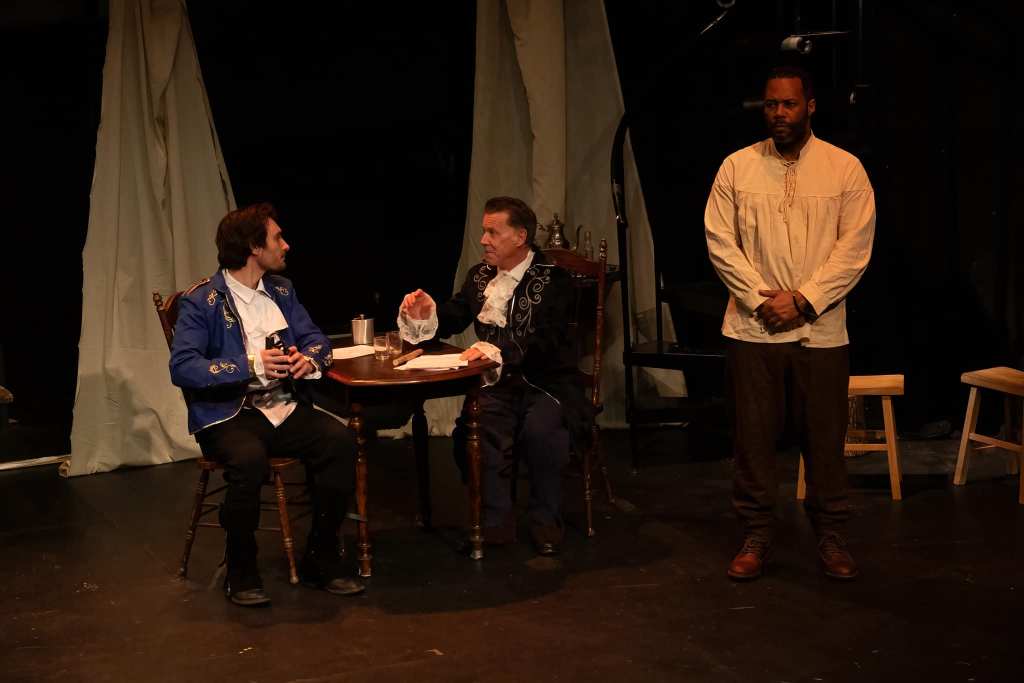
York’s spiritual encounter with the One From The Mountain Top (Jimena Rosas) gives him agency, self-worth, and a sense of purpose that will prove crucial upon his return from the journey, as the play concludes in a sequence of horrifying but powerfully depicted events that reveal the fates of Lewis and Reeva, and destroy any notion of Clark being a good man—sometimes evil and bigotry is more subtle than that displayed by the raging Lewis (a fact that those watching in 2026 need to stay aware of). This is where the production is at its most moving, as York refuses to be dominated and oppressed any longer; his self-actualization as he rises from the horror around him creates a triumphant resolution.
Written and directed by Kenthedo Robinson (with assistant direction by Andre Minkins), The Lewis & Clark Expedition: The Story of York sets history right, putting the man who was known as “The Bear God” back into the narrative, pulled from the obscurity where the history books had unfairly but predictably relegated him. The three leads, and the always exceptional Leonard and Sahs, are a wonder to watch, abetted deftly by a supporting cast that gels beautifully and is clearly moved by the important story they’re here to tell.
“It is better to walk into freedom.”
The Lewis & Clark Expedition: The Story of York runs at the John Collum Theatre at the American Theatre of Actors through February 22. It is presented as part of the African American Playwrights Initiative at the ATA.
PHOTOS BY DAN LANE WILLIAMS

The American Theatre of Actors invites you to join us for A REPERTORY OF TWO PLAYS from ground-breaking playwright, Anne L. Thompson-Scretching
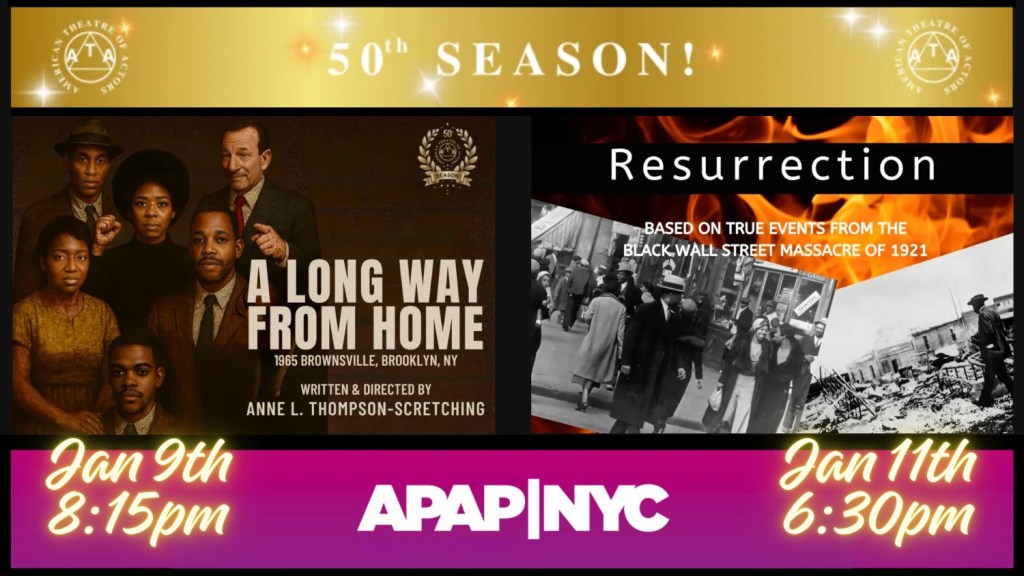
The American Theatre of Actors invites you to join us for A REPERTORY OF TWO PLAYS from ground-breaking playwright, Anne L. Thompson-Scretching: A LONG WAY FROM HOME & RESURRECTION (American Theatre of Actors, 314 W. 54th Street, New York City)
A LONG WAY FROM HOME featuring Ms. D, Gina McKinney, Rommell Sermons, Joy Foster, Kevin Leonard, Laquan Hailey, and Phil Oetiker, A Long Way From Home is the second play in Ms. Thompson-Scretching’s “Blood Trilogy.”

Set in the 1960’s, and follows Shanna Taylor’s family, who has migrated from Macon, Georgia to Brooklyn, New York. They rent an old walk-up in an area called Brownsville.
Escaping from Jim Crow and the Klan in the south, the family realizes segregation and civil unrest is in the North too.
Luella, the daughter, is so disenchanted, she gets involved with the “Black Power Movement.” Jacob, her husband, is away from home carousing for women in the streets. His son, Willie, is duty bound to follow in his father’s footsteps.
Shanna is focused on keeping the family together while saving for her dream home and maintaining her Southern values. Jacob’s older brother, Chester, is a New York big shot. He’s employed as a broker at Falco & Son, who shows Shanna a worthless house that’s been redlined by the bank. Chester steals her money and blames it on her husband. Joe Falco is Chester’s boss, who has him blockbusting the neighborhood.
APAP Members, use code ‘APAP’ for a free seat. Use link or Book in APP under “PHYSICAL THEATRE” Contacts: Jessica Jennings at Conference: 917-773-2933 or Jay Michaels at 646-338-5472 / info@jaymichaelsarts.com
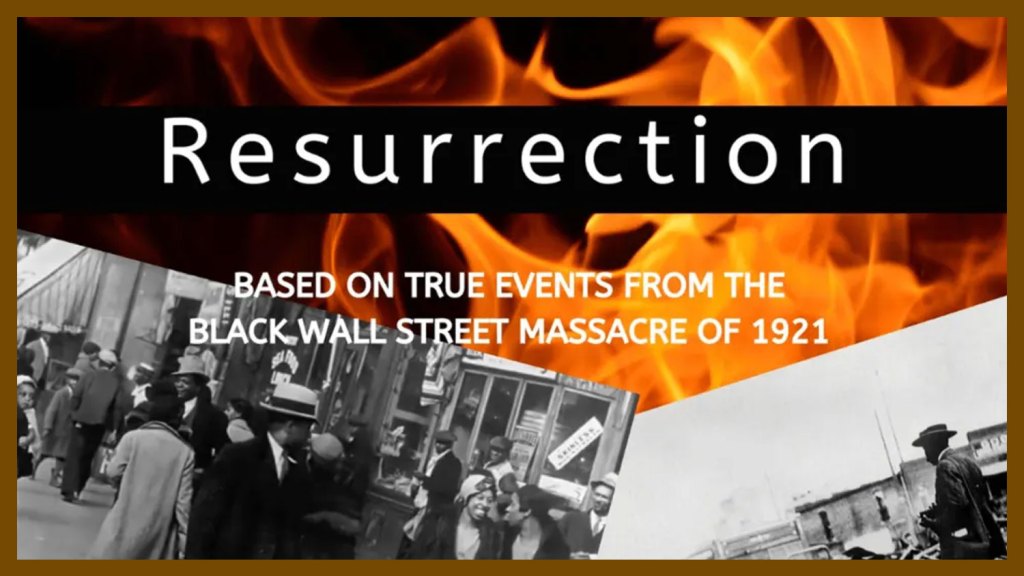
RESURRECTION Featuring Ms. D, Gina McKinney, Rommell Sermons, Joy Foster, Kevin Leonard, Laquan Hailey, and Phil Oetiker, A Long Way From Home is the second play in Ms. Thompson-Scretching’s “Blood Trilogy.” Set in the 1960’s, and follows Shanna Taylor’s family, who has migrated from Macon, Georgia to Brooklyn, New York. They rent an old walk-up in an area called Brownsville.
Escaping from Jim Crow and the Klan in the south, the family realizes segregation and civil unrest is in the North too.
Luella, the daughter, is so disenchanted, she gets involved with the “Black Power Movement.” Jacob, her husband, is away from home carousing for women in the streets. His son, Willie, is duty bound to follow in his father’s footsteps.
Shanna is focused on keeping the family together while saving for her dream home and maintaining her Southern values. Jacob’s older brother, Chester, is a New York big shot. He’s employed as a broker at Falco & Son, who shows Shanna a worthless house that’s been redlined by the bank. Chester steals her money and blames it on her husband. Joe Falco is Chester’s boss, who has him blockbusting the neighborhood.
APAP Members, use code ‘APAP’ for a free seat. Use link or Book in APP under “PHYSICAL THEATRE” Contacts: Jessica Jennings at Conference: 917-773-2933 or Jay Michaels at 646-338-5472 / info@jaymichaelsarts.com
American Theatre of Actors, Inc.
American Theatre of Actors, Inc. (ATA) was founded in 1976 by James Jennings to promote the development of new playwrights, directors and actors, and to provide them a creative atmosphere in which to work. The plays are dramas, comedies, and hybrids, dealing with the social and ethical problems of contemporary society.
12,000 actors have worked at ATA including Dennis Quaid, Bruce Willis, Dan Lauria, Chazz Palminteri, Danny Aielo, David Morse, Edie Falco and Kathryn Hahn. Our productions are sometimes grouped as ‘festivals,’ such as a Playwrights Festival or a Directors Festival. In 2016 we began an initiative to feature women in theatre as directors and playwrights, today this is our WIT! (Women in Theatre) program.

Marlin Thomas’s REPARATIONS Set for Limited New York Run After International Win
Acclaimed Playwright Confronts the “Impossible Moral Debt” of American History at Teatro LATEA
Anya Kai, reporting
New York native and celebrated playwright Marlin Thomas is set to present a limited run of his latest, award-winning work, REPARATIONS, at Teatro LATEA (107 Suffolk St., New York, NY 10002). The production, which recently earned the top honor at the International Theater Script Competition 2024, promises an unflinching and sophisticated exploration of the debt owed for American chattel slavery and its lingering consequences.
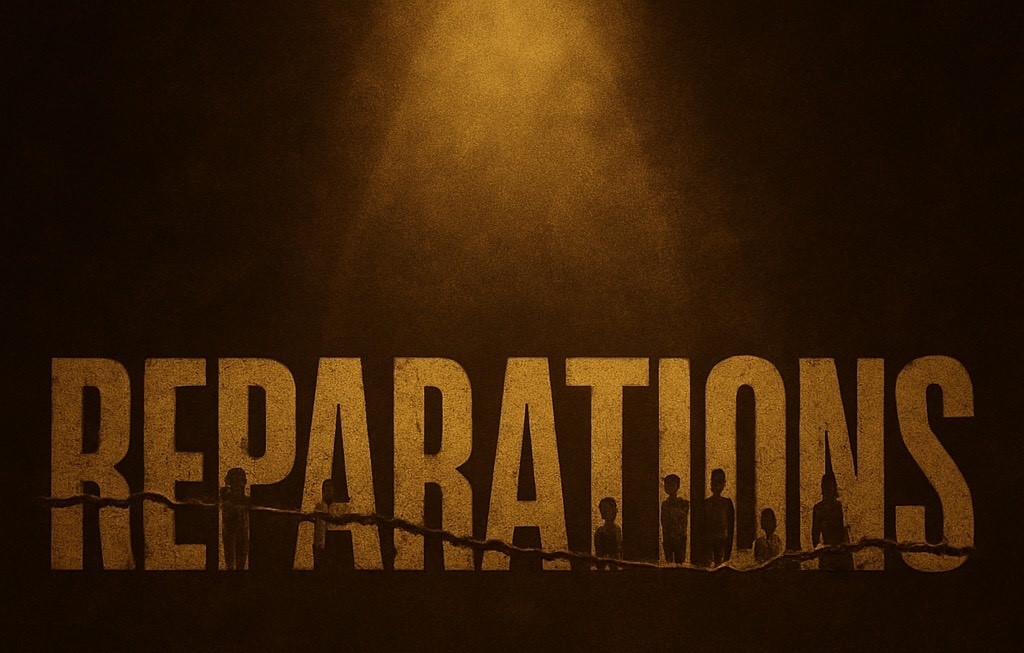
A Confrontation at the Door
REPARATIONS centers on William McCrory, a wealthy white man whose comfortable life is shattered by an unexpected visitor—a Black man who shares both his name and his birthday. This mysterious stranger arrives carrying documents that connect the two men through a painful history rooted in slavery.
As the stranger’s intentions unfold, the play dramatically excavates painful histories, both public and private. It forces the protagonist—and the audience—to grapple with an impossible moral debt. The work has been lauded by the competition jury for its commitment to thoughtful discourse on a polarizing subject, balancing challenging political ideas with compelling, character-driven drama.
The production asks, but deliberately leaves unanswered, a host of urgent and contentious questions that resonate deeply in contemporary society, including:
- What does the present owe the past?
- Can historical injuries ever truly be repaired?
- What individual responsibility exists for distant sins?
- Should individuals be held accountable for the actions of their social and racial group?
Playwright’s Journey: From Skepticism to Drama
Marlin Thomas, an academic and writer whose background spans the humanities and the sciences (including literature, philosophy, and computer science), wrote REPARATIONS to satisfy his own curiosity about the issue.
“I was viscerally opposed to reparations,” Thomas explains, “so I was curious to find out how someone could be in favor of them.”
His research led him to gradually shift his perspective, realizing that the arguments presented on both sides of the issue had “as many flaws as merits.” Thomas sought to dramatize this intellectual and emotional movement, expressing his belief that “reasonable people can disagree about an issue as emotional and personal as that of reparations.”
When asked about his message, Thomas states, “History is on nobody’s side. No argument stands without engaging with its counter argument.” The timing of the play’s production, he notes, is not a direct response to current government action, but rather a function of his “slow writing pace and the length of time it took to gain recognition.”
The most significant obstacle in producing the show, according to Thomas, was finding a director who could “acknowledge the complexity of the characters” and approach the script with an open mind. He found this collaborator in DeMone Seraphin, who “broadly appreciates the humanity reflected in the characters.”
The Man Behind the Play
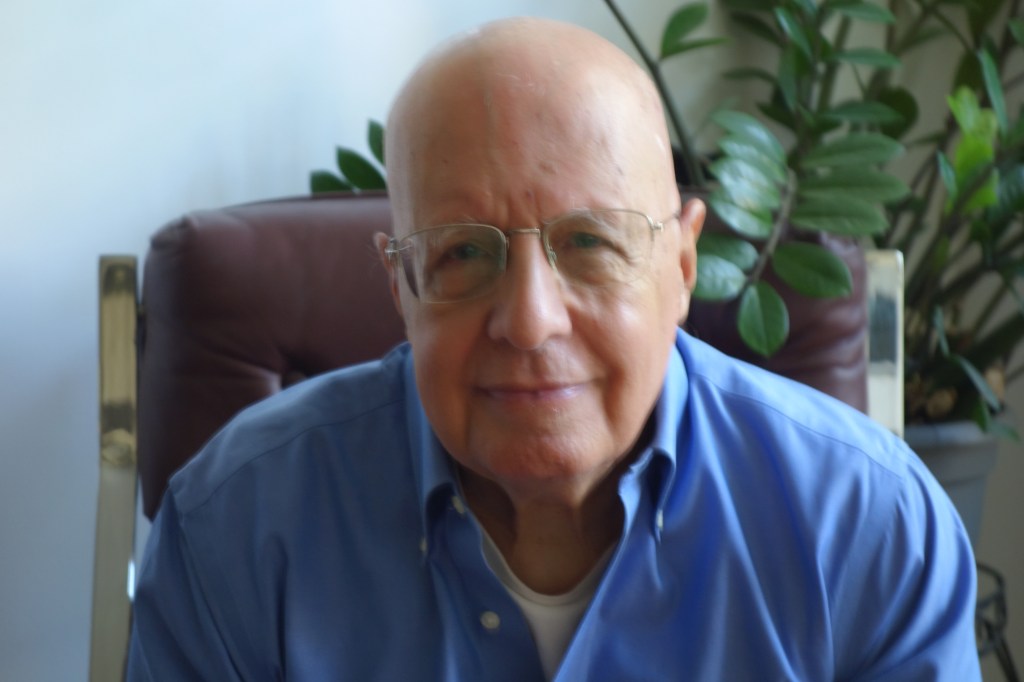
Born in the Bronx and raised in the Queensbridge Houses, Thomas was educated at Queens College (CUNY), Johns Hopkins University, and New York University. His academic work is extensive, with his piece on Alan Turing: The Enigma being named Computing Reviews’ best review of 2015.
As a creative writer, Thomas is also known for his full-length play FreudMahler (published in English and Italian) and The Middleman, a finalist for Best Play in the 2020 New York Theater Festival.
Regarding his unique perspective, Thomas introduces himself as: “An academic who has taught in departments of English and computer science. A writer who is political but non-partisan. An atheist trying to have enough faith to become an agnostic.”
Looking Ahead: The Humanity of Queensbridge
Following the run of REPARATIONS, Thomas will turn his focus to a deeply personal project: a new full-length play titled “Queensbridge.”
Queensbridge Houses, the country’s largest public-housing project, is often celebrated as the birthplace of rap but is also long associated with poverty and violence. Thomas intends to give the community a nuanced treatment, one that recognizes the “humanity and quiet heroism” of its residents. The play will dramatize the experiences of a decades-long resident who recounts his life, detailing the trauma endured by those he lived with, his own complicity in it, and his path toward partial redemption.
Performance Schedule
REPARATIONS will have a limited run at Teatro LATEA on the following dates:
- Thursday, November 20 at 9:00 PM
- Saturday, November 22 at 12:00 PM
- Sunday, November 23 at 8:30 PM
TICKETS for the limited engagement are available now.

History is NOW: Jim Catapano views ZAGŁADA
Richard Vetere Brings t His Gripping Zaglada and the Great Len Cariou to the ATA Stage
“How do you judge human behavior when human life is judged to be worthless?”
Zaglada is a polish word meaning “annihilation, or extermination.” The astonishingplay that takes this nameexplores the moral dilemma faced by human beings in the horrific, life-and-death situation that this describes. What would you do to save yourself, or the person you love most? And how far would you go to render justice, even decades later? Should a person in the last days of their life face punishment for the crimes of a near century ago—crimes that to some eyes, they were forced to commit?
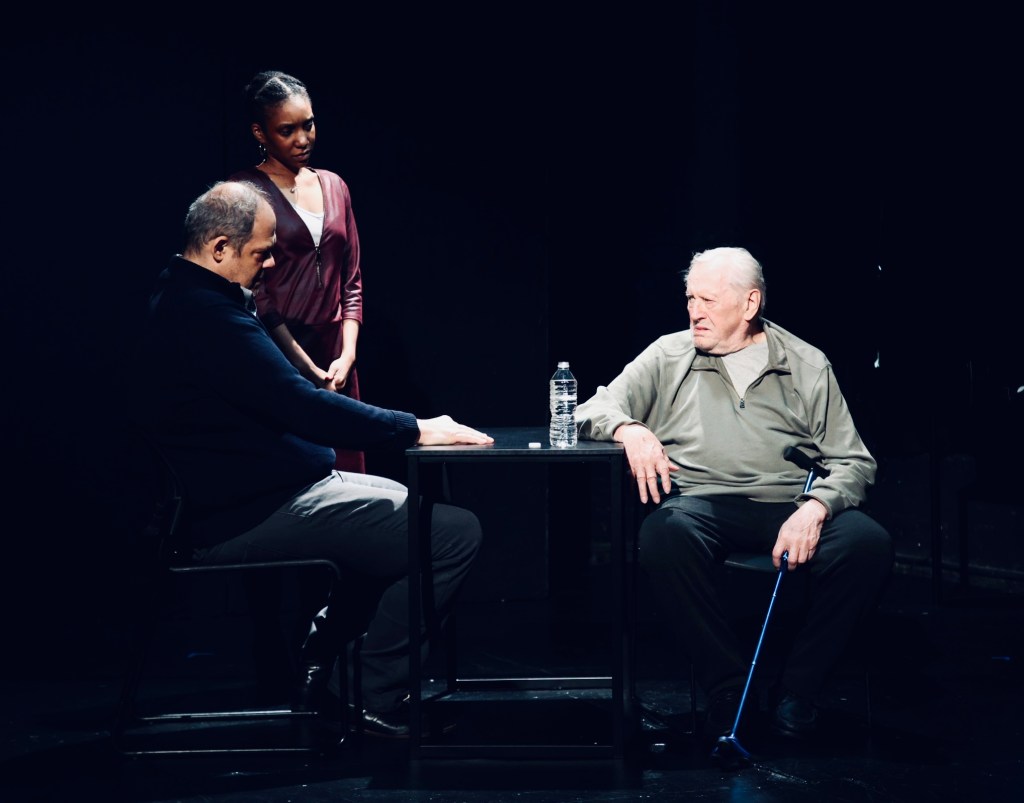
The Marvelous Len Cariou, a 65-year veteran of the stage and a Tony winner renowned for his performance as Sweeney Todd, isJerzy Kozlowski. He is a 93-year-old Polish Queens resident who has been arrested for shooting at Danielle Hooper (Jes Washington), a woman of color and a journalist. Danielle has discovered that Kozlowski was a kapo in a Buchenwald concentration camp in World War II, a prisoner who became an enforcer in the camp in exchange for his own life…and more. The arresting officer Frank Napoli (Salvatore Inzerillo) finds himself in an unexpected conflict with Sonia Sakalow (Maja Wampuszyc), a Homeland Security Officer who is hellbent on finally bringing Kozlowski to justice.
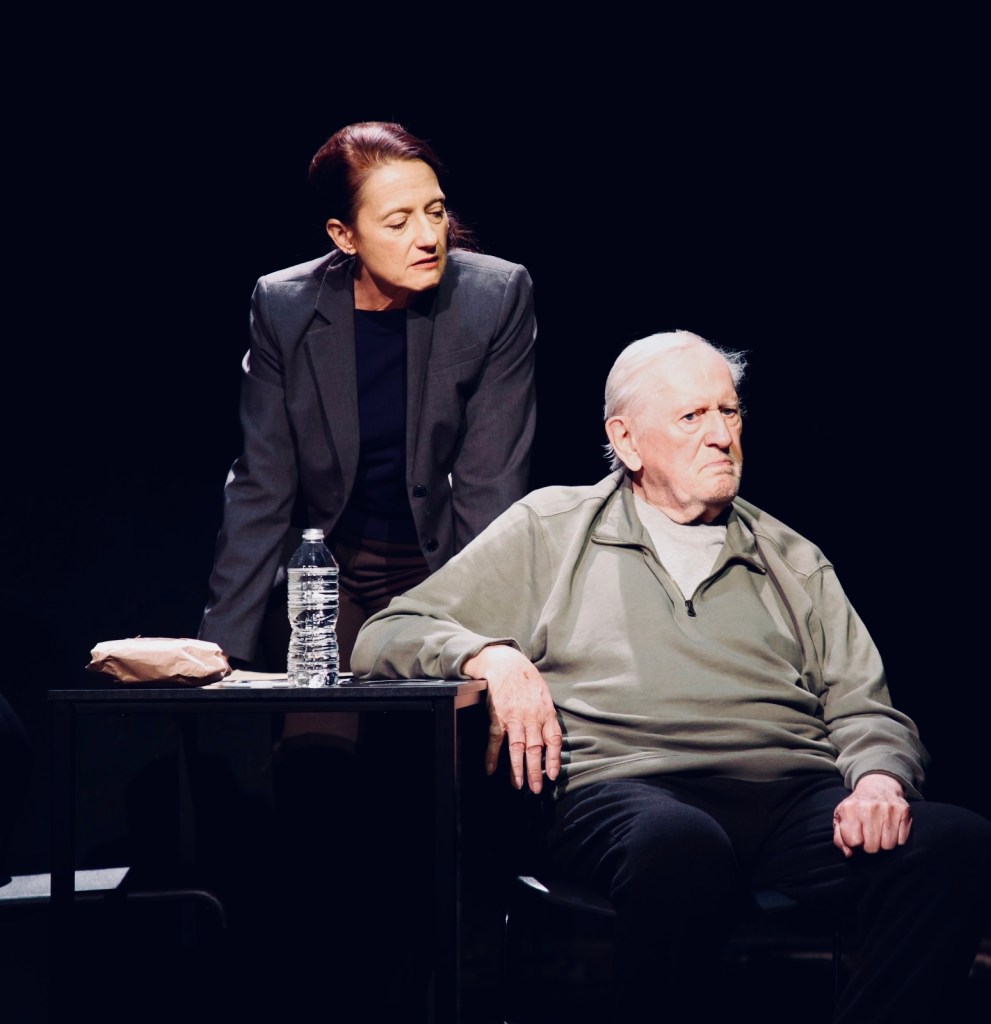
Powerfully directed by Wampuszyc, Zaglada is a fiction based on a very real reality—a history that is in danger of being forgotten, which creates the very real possibility that it will be repeated.
Napoli takes pity on the dying Kozlowski, giving him his pills and making sure he’s comfortable. He appears to be on the side of “moving on” from history.
“We spend most of our time worrying about things, dealing with things that happened when we weren’t even here,” he says to Hooper.
“Like Kozlowski?” she asks.
“Like Christopher Columbus, like Confederate statues, like reparations for slaves,” he replies, adding that his family wasn’t even in the country when the events transpired.
“That is the usual argument,” she notes. “But it is history, isn’t it?”
“Yours, maybe,” he dismisses, “not mine.”
Hooper, who is writing a book getting a PHD in International Human Rights, sees a parallel between the atrocities of the War and the persecution of African Americans, and seeks to make the world see it as well.
“The economy of this country was built on slavery,” reminds Hooper. “Now whether they were here or not, your people certainly benefited by the time they got here. Slavery was also a crime against humanity if you ask me, and there’s no statutory limit on that.”
Wampuszyc also sees no statute of limitations on Kozlowski’s actions in the latter days of WWII. She looks upon the old man with contempt and hatred that feels unusually personal, and is determined to see him be extradited and tried. Napoli is not on board; he sees Kozlowski as having been coerced into his actions.
“An elderly man, forced to work for the SS in a war that nobody thinks about anymore, needs to be punished?” Napoli protests.
“I am well aware that he did not volunteer to be a kapo at Buchenwald,” Wampuszyc retorts, dismissing that aspect as irrelevant. “…He is guilty, those are the facts.”
“I’m not sure that I would survive in a camp,” acknowledged Napoli. “But I know one thing…I would do all I could to survive.”
“You don’t know what you would do, nobody does,” says Wampuszyc. “Not until you are there, and it is real.”
The legendary Cariou is a wonder to behold; the experiences of a near-century are all in his eyes. You can literally see him putting himself back in 1945 as he gazes into the middle distance in agony. His fellow actors are also remarkable in their intensity, each suffering from their own form of PTSD that manifests in their passionate resolve and in the haunted, pained expressions on their weary faces. As circumstances unfold there are revelations that paint a vivid picture of why these particular people have found themselves battling in a small police station in 2018; every moment is riveting as more and more comes to the surface to create deeper shades of gray.
Zaglada is a masterpiece that is a must-see from both a creative standpoint and due to its undeniable relevancy in a time when humanity is at a moral crossroads and is already beginning to repeat the atrocities of the past.
Zaglada is performed at the American Theater of Actors through November 2.

Jim Catapano at Blood Orange: A Masterful Study of Hurt, Love, and Loss
Et Atalia Theater Presents Abigail Duclos’ Stunning Experimental New Play
How do adolescents survive when all the grown-ups have disappeared? Blood Orange is like a domestic Lord of The Flies, but the abandonment and isolation on display cuts much deeper. The teenagers here aren’t just separated from their parental figures; they have been utterly failed by them.
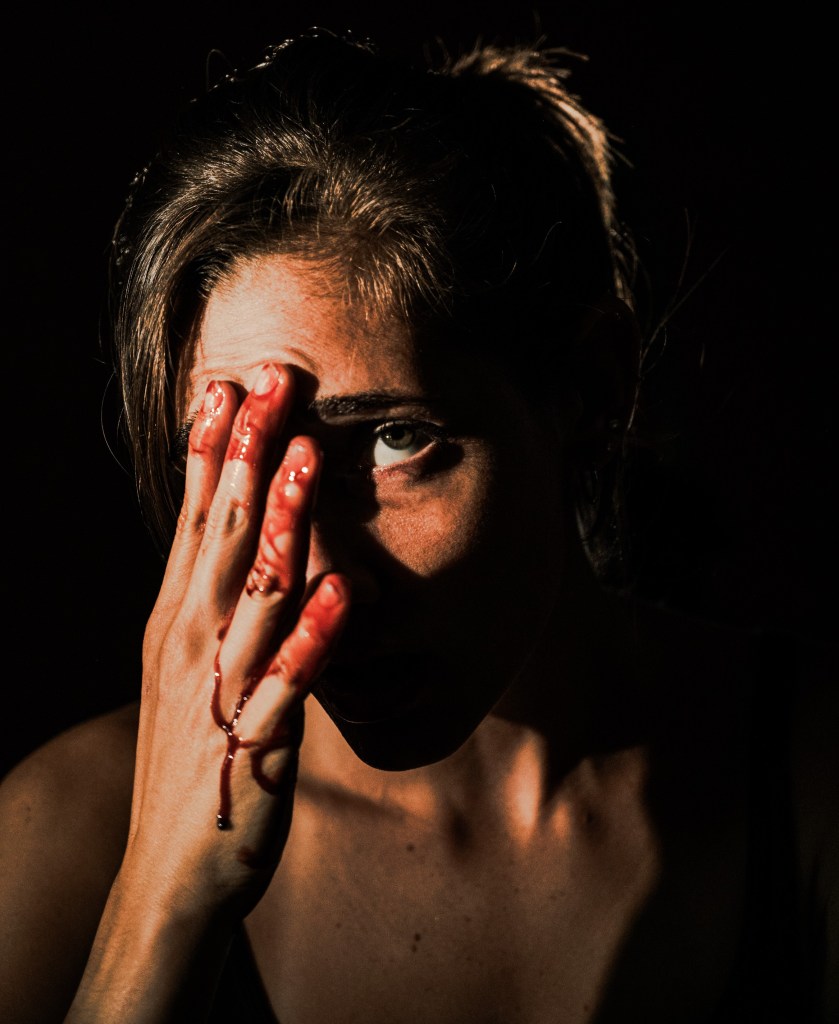
Maria Müller is astonishing as Faye, a North Carolina high schooler whose father died violently a few weeks before the story begins. Faye’s stepmother has retreated to her bedroom, devastated, and extremely physically and emotionally unwell. The suddenly alone Faye brings over her school friend Eden for company; the lonely outcast Eden is happy for the attention but disturbed by Faye’s manic dark humor, a symptom of the trauma she’s been through. Faye keeps begging the appalled Eden to physically assault her (perhaps deep down to “see if she can still feel,” as Nine Inch Nails suggested).
Eden’s unease fades as her attraction strengthens. The two begin to connect on a deeper level, but the situation is disturbed by the arrival of Faye’s friend Georgia, who is the polar opposite of Eden; loud, assertive and hyper-sexual, she strides in and dominates proceedings, flirting with Faye and gazing with disdain upon Eden.
Now without a father and essentially without a mother, Faye feels abandoned by God as well. She devises her own deity out of a dead animal she found on the road and placed in a paper bag in a refrigerator, below her stash of frozen dinners. The creature is so mangled they can’t even tell what kind of animal it was (they decide on probably bunny), but Faye and later Eden are entranced by its appearance and even its stench of decay. They suddenly find a tangerine in the bag with the animal and declare it to be a miracle. The grounded Georgia is of course disgusted and condemns the horrific turn of events; she is also clearly threatened by Faye and Eden’s growing bond, which is now being solidified by Eden’s joining Faye’s new religion. Georgia is a Regina George in “Mean Girls”-type but is realized in three dimensions by Giorgia Valenti. The sassy, cynical Georgia can’t hide her insecurity and jealousy; it’s clear that her insults towards Eden are coming from that place. (The cast rotates throughout the run; Müller alternates as Georgia when Luisa Galatti appears as Faye.)
Ana Moioli charms as the awkward, innocent, appropriately named Eden, searching for connection and for an escape from her abusive father. She shows Faye the beloved stuffed animal her father tried to destroy, which foreshadows a climactic moment with Georgia and the “deity” later in the play. Faye prays to her roadkill god to bring her father back; Eden prays for it to make her own father go away. The two become one over their despair, dancing (literally) around their attraction to each other as they chant and pray to their new savior. It is a striking sequence, enthralling and horrifying at the same time, and speaks to the heart of the matter: these are young women who have been abandoned, abused, and cast adrift, and desperately looking for hope, love, and something to believe in.
One of the play’s most surprising moments is the sudden appearance of Faye’s stepmother Mariah in the flesh. If you have not consulted the playbill beforehand it would be understandable to expect her to remain an unseen character, represented only by the sound of footsteps making floorboards creak. But Doreen Oliver arrives to pull at our heartstrings, the loving mother weakened by illness and grief, desperately trying to regain her strength and faculties to make a simple tomato soup dinner for her daughter. It is a glimmer of hope for Faye, but a brief one; Mariah heartbreakingly collapses back into her desperate state, suddenly unable to even recognize Faye. The tomato soup is spilled onto the floor, a puddle of dark red, again foreshadowing the darkness to come. When Georgia returns to put the situation to an end, events spiral to a horrific conclusion that is deeply unsettling—but also excellently staged and acted.
The production is brought to life with powerful direction by Vernice Miller, and meticulously choreographed by associate director Amelia Rose Estrada, with an exceptional scenic design by Ningning Yang. The sound design by Laura Perreira and lighting by Hayley Garcia Parnell contribute so much that they can almost be considered other characters in the play. The compelling group of actors, whose chemistry is electric, stay completely in character even through the many scene changes, keeping the audience immersed in the world of the play. Duclos and the actors have combined to bring us real people that we get to deeply feel for as we hang on their every word and action.
Blood Orange is an absolute triumph for Duclos and the cast, a masterful work that will stay with you long after the lights in Faye’s apartment go out.
The production of Blood Orange is supported by the Romanian Cultural Institute. It runs through Sept. 17, 2025.


ATA kicks off the 50th Season with the revival of their acclaimed production of Shakespeare’sKING LEAR. September 10 – 21 with a special 50th Season Kick-off Event, Sunday, September 14 after the performance. Refreshments will be served.
King Lear begins as the Earl of Gloucester introduces his illegitimate son, Edmund, to the Earl of Kent. Lear, King of Britain, enters with his court. Now that he is an old man, Lear has decided to divide his kingdom between his three daughters. The division will depend on the quality of each princess’ declarations of love for her father before the court. Goneril, Duchess of Albany, and Regan, Duchess of Cornwall, both speak enthusiastically and earn their father’s praise. But Cordelia, the youngest, says nothing because she cannot voice her deep love for Lear. Misunderstanding his daughter, Lear disowns and banishes her from the kingdom. He also banishes the Earl of Kent, who had taken Cordelia’s side against the King.
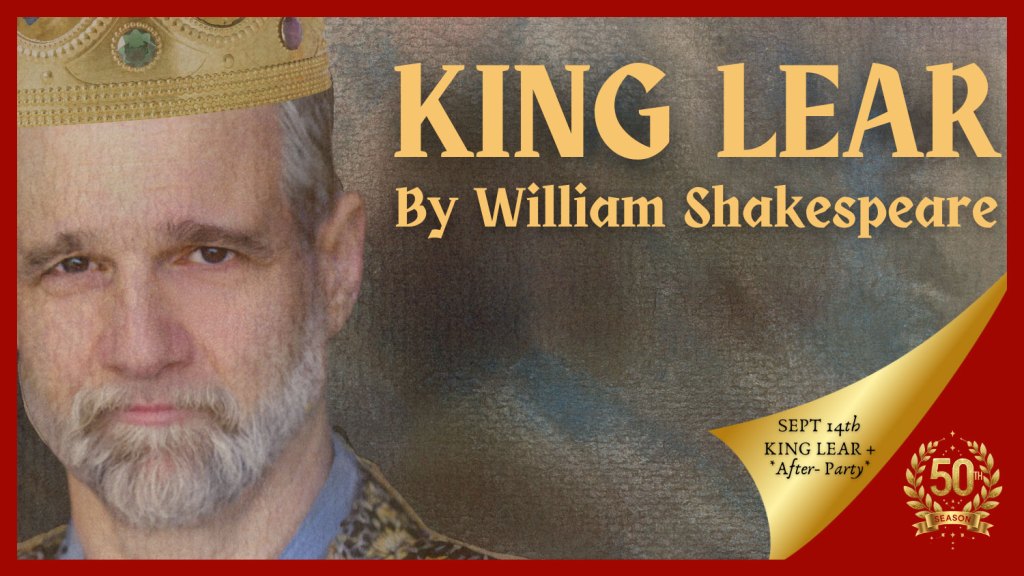
Despairing for his daughters, and deeply regretting rejecting Cordelia, Lear goes mad at the height of a great storm. He and the Fool run wild on the heath until Gloucester takes them into a hut for shelter. He then seeks the aid of Kent to get them away to the coast, where Cordelia has landed with a French army to fight for her father against her sisters and their husbands.
In this family drama, greed is a driving force and remorse comes too late.
Alan Hasnas returns to the title role Featured in the cast is Josh Bartosch, Amber Brookes, Tom Ciorciari, Sam Cruz, Jane Culley*, Oliver Figueroa, Adonis Guzman, Sam Hardy, Karolina Larion, Emery Lawrence, Paul Maurizio, Jake Minter, Dustin Pazar, Alex Silverman, and Reese Villiger.*Ms. Culley appears courtesy of Actors Equity Association

The American Theatre of Actors was founded in 1976 by James Jennings, who continues as its President and Artistic Director. It is a repertory theatre company consisting of 50 actors, 15 playwrights and 8 directors. Its purpose is to promote the development of new playwrights, directors and actors and provide them a creative atmosphere in which to work without the pressures of commercial theatre.The plays deal with the social and ethical problems of contemporary society. Over 1,000 new works have been presented and more than 11,000 actors have worked at A.T.A., including Dennis Quaid, Bruce Willis, Danny Aiello, Dan Lauria, Chazz Palminteri, Kevin O’Connor, William Fichtner, Edie Falco and Kathryn Hahn.
CONTACT: info@jaymichaelsarts.com or 646-338-5472

Spotlight on Authors Domnica Radulescu and Carol Campbell
Domnica Radulescu and Carol Campbell are the creative duo behind the play Sappho’s Garden. Radulescu is a highly accomplished Romanian-American novelist, playwright, and educator, with numerous awards and accolades to her name, including three acclaimed novels and two volumes of original plays. She is also a two-time Fulbright scholar and the founding Director of the National Symposium of Theater in Academe.
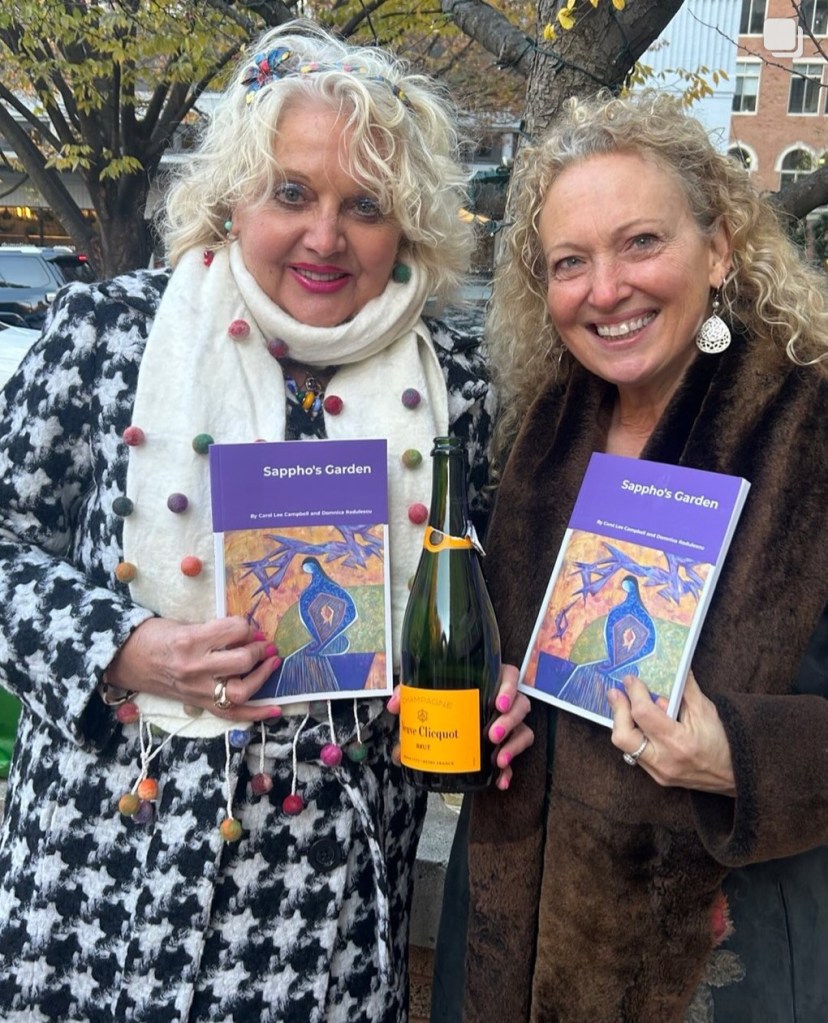
Their partnership began over a decade ago when Campbell directed one of Radulescu’s plays. The collaboration deepened through a shared passion for feminist theater, ancient goddess culture, and eco-feminism. Their “riveting marriage of minds” has produced several theatrical works, with Sappho’s Garden being their “most luminous and accomplished.”
The Book: Sappho’s Garden
The play Sappho’s Garden was born during the COVID-19 pandemic after the authors received a collaborative art grant. The project was inspired by their rediscovery of the verses of the ancient poet Sappho and a shared obsession with ancient goddesses. The work tackles the intersection of violence against women and the destruction of Mother Earth.
The central message of the play is to “Cultivate your garden” in both a literal and a metaphorical sense. This means taking care of the Earth and believing in the power of art, poetry, and imagination to offer “intimations of a better world.” The authors hope the play will inspire audiences to strive for a more sustainable, peaceful, and just world.
Looking ahead, the authors plan to continue developing the play, with a staged reading scheduled in Virginia and the ultimate goal of a full production.
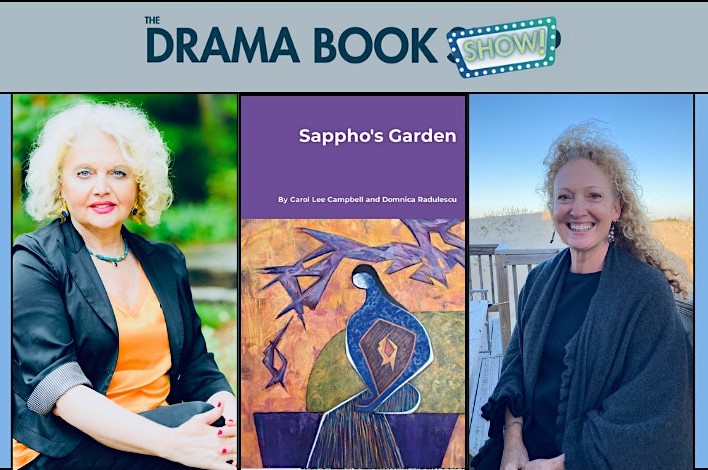
Carol Lee Campbell and Domnica Radulescu
A talkback, signing, and live podcast recording
Thursday, October 16 · 7:30 – 8:30pm EDT
The Drama Book Shop266 West 39th Street New York, NY 10018Get directions
The Drama Book Shop presents, in association with Jay Michaels Global Communications, “Sappho’s Garden” A talkback, signing, and live podcast recording.
An expansive, poetic play about the legendary poet, Sappho. A startling evocation of a feminist ethos.
This Eventbrite ticket is your reservation for the event. Please note that the purchase of “ Sappho’s Garden” ($10.00) is required for entry. Upon arrival, our team will direct you to the register to obtain your copy and complete your admission. The store will begin welcoming guests at 7:15 pm.
CAST ANNOUNCED for “the other Shakespeare in the Park:” Shakespeare Sports’ Comedy of Errors directed by Michael Hagins
CAST ANNOUNCED for “the other Shakespeare in the Park”
Shakespeare Sports Theatre Company opens its SHAKESPEARE SUMMER TOUR with a new production of the Comedy of Errors directed by Michael Hagins; Adam Sherwin, stage manager, coming to a park or performance space near you!
SCHEDULES THUS FAR: Riverside Church July 17 @ 7 pm RESERVE A SEAT
St. Francis Cabrini Shrine July 19 and 20 @ 4 pm RESERVE A SEAT
Summit Rock in Central Park July 26 and August 2 — BOTH @ 2 PM RESERVE A SEAT
Pat’s Lawn in Inwood Hill Park July 27 @ 2 pm RESERVE A SEAT
ALL EVENTS ARE FREE
Shakespeare’s Hilariously Haywire “Comedy of Errors,” a frolicsome farce so fantastically foolish, it’s practically a recipe for roaring laughter! “The Comedy of Errors,” a play where mistaken identities run riot features the following cast: Vic Gitre, Charlie Keegan James, Emily Glaser, Jennifer Kim, Melissa Meli, Erica Gerold, Katie Freimann, Lila Ashley Meyers, Kasey Cznowski, Hayley Berketa, and Molly Feisher
Imagine, if you will, a bustling ancient Ephesus, where not one, but TWO sets of identical twins are about to stumble headlong into a hilarious hullabaloo! We’re talking Antipholus of Syracuse and his ever-so-loyal (and equally confused) servant, Dromio of Syracuse, who unwittingly wander into the very city inhabited by their spitting images, Antipholus of Ephesus and his own bewildered Dromio!
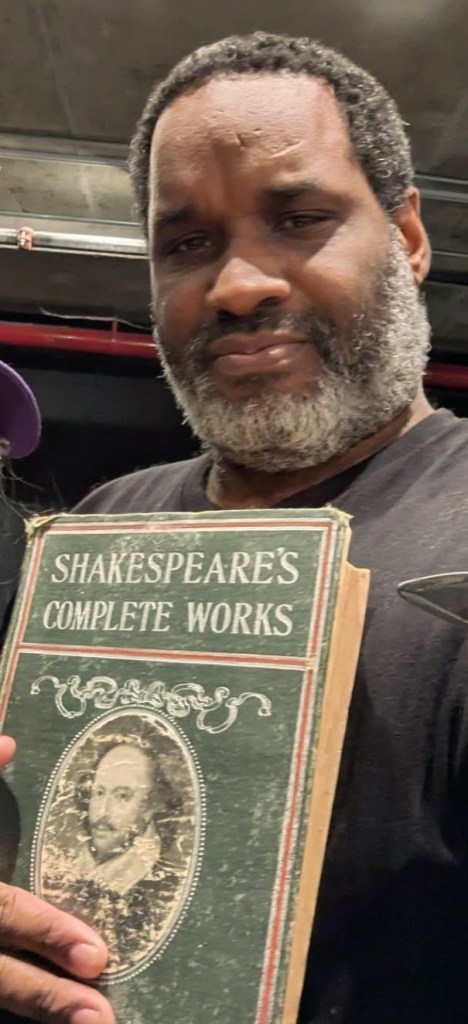
This uproarious rendition, brought to life by the visionary direction of Michael Hagins who is a celebrated Shakespearean artist in NYC with productions of Macbeth, Hamlet, Romeo and Juliet, A Midsummer Night’s Dream, Two Gentlemen of Verona, Twelfth Night or What You Will, Titus Andronicus, King Lear, Othello, Julius Caesar, Pericles, King John, King Henry IV, Part 1, King Henry IV, Part 2, King Henry V, King Henry VI, Part 1, King Henry VI, Part 3, King Richard III, The Winter’s Tale, As You Like It, The Taming of the Shrew, The Comedy of Errors, The Tempest, The Merchant of Venice,Timon of Athens, All’s Well That Ends Well, Troilus and Cressida, Love’s Labour’s Lost, Henry VIII, Two Noble Kinsman, Cardenio\Double Falsehood, Edward III, Merry Wives of Windsor, Cymbeline, Richard II, Antony & Cleopatra, Coriolanus, Much Ado About Nothing, King Henry VI, part 2 and part 3, and Measure for Measure.
ALL EVENTS ARE FREE
Jim Catapano views the ATA’s New Life for Prince Hal
Shakespeare’s Henry V is revived with a Sparkling New Production at the American Theatre of Actors
“We Happy Few, We Band of Brothers,” Henry V famously proclaims—and Sam Hardy, the actor who currently brings him to life, could well be addressing his castmates and crew of this accomplished production, now playing at the ATA as presented by Jonathan G. Power.
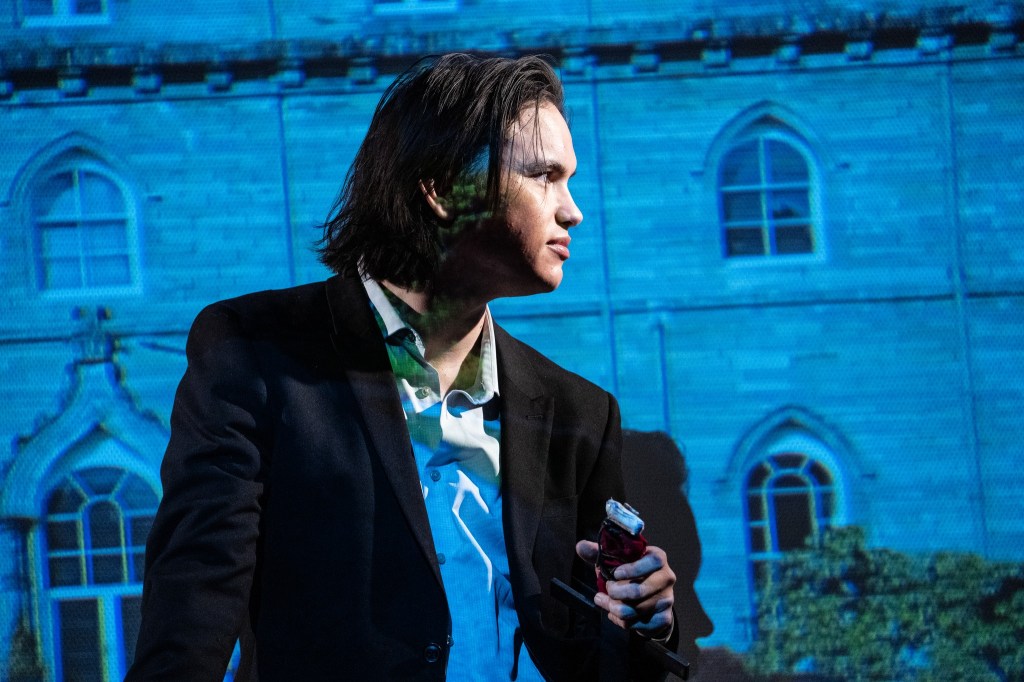
Henry V is the final piece in a tetralogy by Shakespeare that was basically the 16th century stage version of the Marvel Cinematic Universe. It was preceded by Richard II, Henry IV, Part 1, and Henry IV, Part 2. Henry V would have been a familiar character to theatre fanatics of the Renaissance, having appeared in Henry IV Parts 1 and 2 in youthful form as the wayward, tavern-loving Prince Hal.
This “sequel” depicts Hal/Henry (also known as “Harry”) rising to the throne with a new maturity. At the English court Henry is convinced after a discussion about land laws with the Archbishop of Canterbury (David Allard) that he has a claim to the Throne of France. Thus, he prepares to do battle with the French near Agincourt. His regiment is comparatively small, but the king is armed with a of heart and spirit that he is determined to share with his soldiers.
Shakespeare veteran Hardy is perfect in the title role; his commanding voice, powerful stage presence and impressive physicality adding an extra electricity to the Bard’s 1599(ish) play. He brings great poignancy to a sequence where Henry disguises himself to walk among his soldiers, in order to get to know them and bring them hope and encouragement.
One of the most popular of Shakespeare’s historicals, Henry V is engaging and witty throughout, with many humorous interludes and an incredibly quotable text. The actors handle the complex languages, lengthy soliloquies, and Bill’s famous wordplay with astonishing skill and a clear love for the source material; they also excel at the tricky, operatic fight sequences, which are expertly choreographed for this production. The English soldiers are in tan T-Shirts, the French in blue; and the overall dress is contemporary. Even with the large cast many of the actors play multiple roles, switching demeanors and characterizations with deftness.
Dustin Pazar is engaging as The Chorus (“Narrator”) as well as The Duke of Exeter, Noy Marom is Princess Catherine of France; in one of the play’s most amusing scenes she asks her maid Alice (Annie Unger) for a lesson in how to say a selection of English words, with Alice responding with rather suspect pronunciation. Marom also plays the conspiratorial Sir Thomas Grey, and Unger doubles as “the Boy,” page to comedic trio Pistol (Joe Patrick Marshall), Nym (Kieran Wylie), and Bardolph (Paul Maurizio). (These four characters also appear in multiple Shakespeare works.) The prolific Jane Culley (over 50 off and off-Broadway credits) is the Queen of France and also Pistol’s wife, Mistress Quickly. Producer Power appears as Henry’s counterpart on the chessboard, the King of France. Adam Lyons is very amusing as the French Herald, who periodically appears on the balcony to taunt the English warriors.
Dukes and Earls of course abound. Christian Miranda appears as both the Duke of Orleans and the Earl of Salisbury; Reese Villiger is the loyal Earl of Westmoreland;
For audiences unfamiliar, I’d equate the relationships among the characters to the conflicts, and camaraderie in another more recent hero’s journey, The Lord of The Rings franchise (subtracting magic rings and dragons, but adding the tennis balls that the Dauphin of France sends to his rival Henry as a gag gift). Cruz is an entertaining presence as the aggressive, always screaming Dauphin.
Directed with panache by ATA founder and artistic director James Jennings, Henry V makes great use of the multi-leveled, atmospheric John Cullum Theatre. Moving video backdrops portraying castles, battlefields and graveyards add a nice sense of place and time. As usual for this highly regarded entry into Shakespeare’s canon, this edition Henry V earns it’s 3-hour runtime, captivating throughout on its way to a rousing denouement.
Henry V runs at the ATA through April 19, 2025.
 Arts Independent