
Home » Posts tagged 'horror'
Tag Archives: horror
A Jim Catapano Review: Don Nigro’s In the Wilderness of Demons Blends Ukranian Legend with Life’s Great Questions
Myth and Reality Meet in the Darkness
On a very dark and very stormy night, a folklore enthusiast (Tatyana Kot) appears at the Ukrainian cottage of a mysterious woman (Iryna Malygina). The isolated home deep in the woods is shared only by faceless dolls, represented by 4 dancers who lurk silently, witnesses to the unfolding events. Thus begins a journey In the Wilderness of Demons, a compelling tale by the acclaimed Don Nigro—one steeped in Ukrainian legend, mixed with dark wit, suspense, a touch of horror, and a deep dive into the existential.
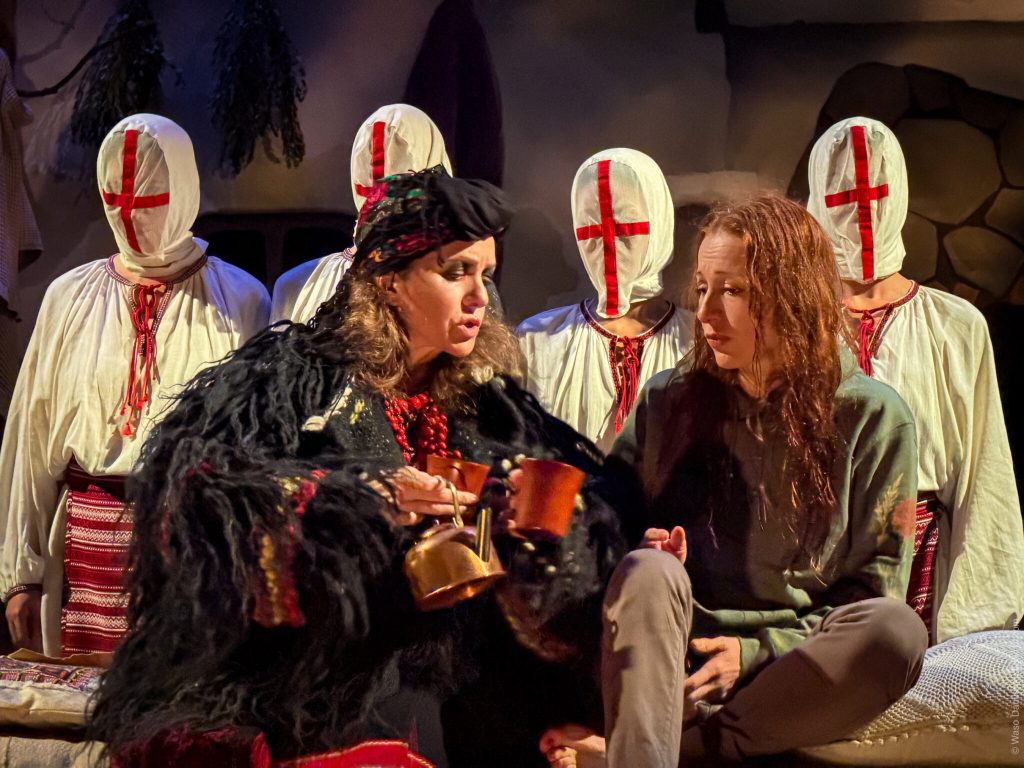
“What a night to be creeping around out there,” the woman scolds. “It’s pouring down ice cubes…there is a raven frozen to the pump!” (An image that immediately sets the tone.)
When the folklorist explains she got lost in the woods, the woman turns philosophical. “Getting lost on the way is all part of God’s plan,” she responds. “He wants us to get lost, to sell us outdated roadmaps and compasses that don’t work.” She admits that she thought the folklorist might have been one of the dead, “who come out of their graves this time of year…they try to get back in their houses.”
The eccentric, assertive cottage dweller pivots between doting on the soaked and shivering folklorist and appearing to intentionally frighten and unsettle her. She dries her feet, gives her slippers owned by her late grandmother, serves her tea, and makes up a bed for her—only to turn around and tease her by suggesting she’ll be sharing it with a dead rat.
“I’m joking,” she says. “He’s probably just sleeping—or pretending to sleep.”
Malygina (who also produced) is outstanding at bringing the witch-like character to life, creating a mystery and unease that is palpably felt by the audience. She is also intensely philosophical and astute, as when the folklorist mentions her realization that “all men are a—holes.”
“Men think we’re vampires,” notes Malygina’s character. “The thing they want most is to drive a stake into us…but it’s the men who prey upon us. I had my fourth husband buried face down to make sure he didn’t come back after he died.”
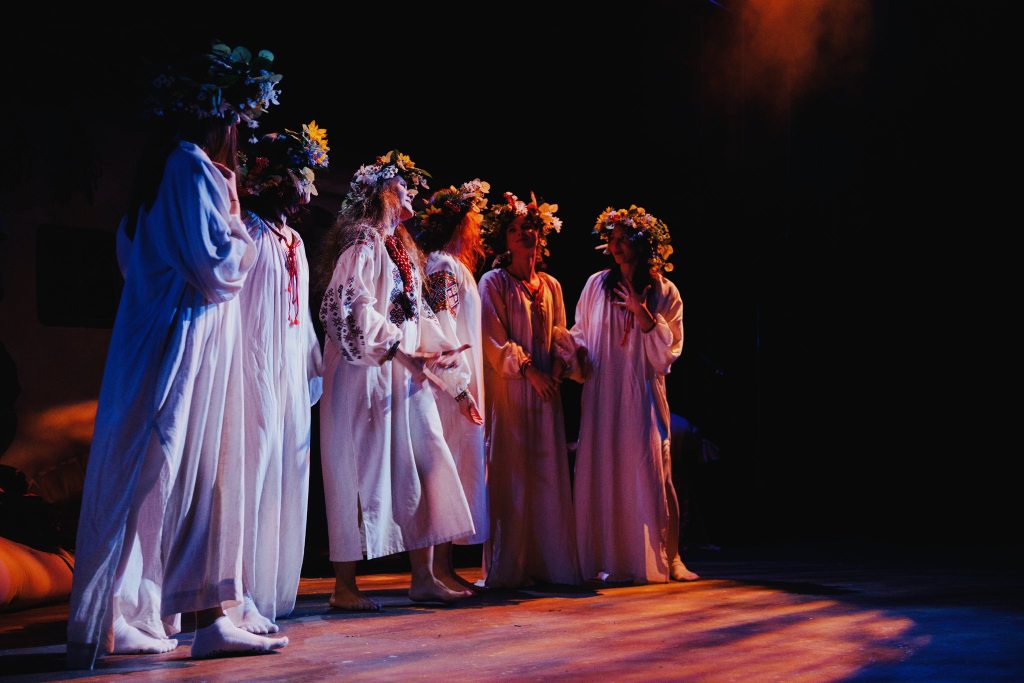
Along the way we get an education in the Ukranian folklore our protagonist is so intrigued by, as we learn of the Rusalka, the legendary water nymphs who would lure men to their deaths under the sea, and the demonic Chorts.
“Do you really think that they exist?” asks the folklorist.
“Define exist,” says the woman. “Does a dream exist? It always seems real when it’s happening in your head…but then you wake up…or, you wake up into another dream.”
The set design by Lesya Verba is a perfect complement to the unfolding thriller, allowing the faceless dolls to wander about menacingly, always watching (and judging? As the woman suspects). “It’s their job to make guests feel uncomfortable so they leave.”
As the audience identification character, Kot is fantastic, imbuing the wary folklorist with an intense existential dread, as she begins to suspect that she has been in this strange place before.
The soundscape adds further atmosphere with thunder, whistling winds, and ticking old-fashioned clocks. The woman explains that her father liked to collect broken clocks—in her opinion, as a way to control time.
The disturbing atmosphere is pierced mid-play by an exhilarating dance sequence, where our protagonists join the no-longer faceless dolls, all transformed into Rusalka-like spirits. Following this cathartic interlude (which makes the folklorist wonder what’s in the tea), the story ends (or begins?) with a shocking revelation—and an invitation…
In the Wilderness of Demons is a magical, frightening, funny, and exhilarating experience that celebrates both Ukrainian culture and legend, and women’s empowerment.
The production is expertly shepherded by director Eduard Tolokonnikov, with expert choreography by Kot. The doll dancers are Shoko Tamai, Marija Obradovic, Evelina Pristovsek and Iren Kamyshev.
In the Wilderness of Demons is a production by MOVA Theater Company. It runs at The John Cullum Theatre at the American Theater of Actors through 11/02/25. Learn more at movatheater.com/.

The Aftermath of Murder: Jim Catapano reviews John Galsworthy’s “The First and The Last” at the ATA
John Galsworthy’s Compelling The First and The Last is Brought into the 21st Century at the ATA
Cleaning up after a killing is never going to be an easy task (unless you’re Harvey Keitel’s character in Pulp Fiction). Such is the dilemma of Keith (Clay von Carlowitz), a young, successful, and ambitious lawyer with a wayward younger brother, Larry (Jonathan Beebe). Larry is madly in love with Wanda (Natasha Sahs), with a fervor that leads to tragedy. A distraught Larry visits Keith with the news that he has killed Wanda’s estranged ex after an altercation, and the couple had casually dumped the body under an archway. The murder is now all over the media, and Keith’s dilemma is how to make this “problem” disappear for his brother while protecting his own reputation. Keith’s investigation has him conclude that nothing directly implicates Larry, and the news of a vagrant discovering the body makes for a convenient distortion of the truth…
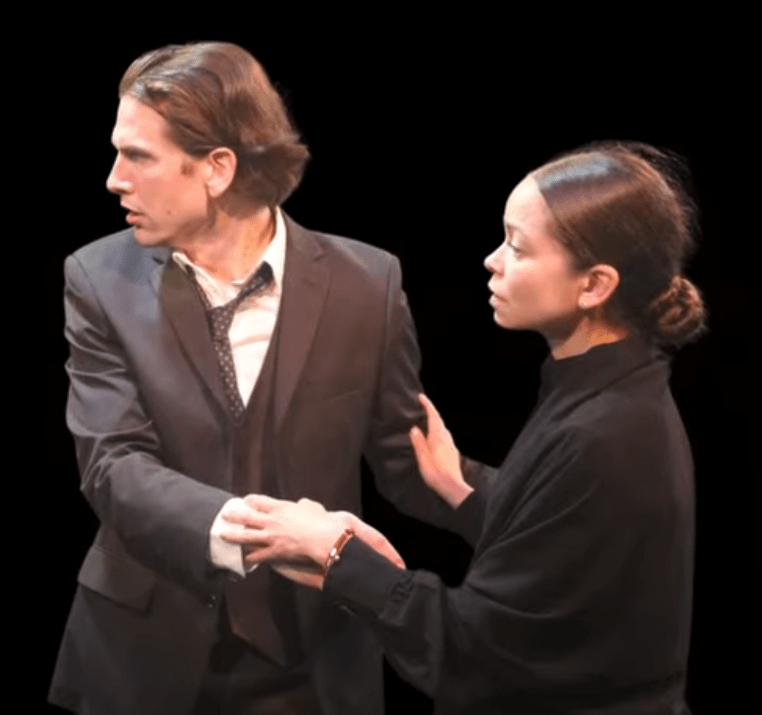
The provocative circumstances ensure that The First and The Last goes to 100 mph and stays there throughout its brief running time. Galsworthy’s play of over 100 years ago, itself based on a 1917 short story, is brought hurtling into 2025 by the actors, whose collective intensity is palpable. Amidst the powerful dialogue, the desperation of the situation is conveyed in their eyes, the glances between each other, the body language conveying human beings watching their very existences unravel. Beebe’s Larry is a deer in the headlights, his every expression and movement illustrating a man horrified by the dark corner of reality he has found himself in. Carlowitz’ dapper Keith is the picture of a man at a crossroads, trying to protect family while making sure his professional life is not tarnished, and grappling over which of those is most important to him. Sahs’ imbues Wanda with an astonishing potency that depicts a woman consumed by passion; Wanda starts in a black dress of mourning and traditions to a white wedding gown, hopelessly attempting to suggest an innocence that is no longer there. Ovid Radbauer provides a sinister, foreboding presence in the roles of a policeman and a paper seller, two people whose professions symbolize the very forces that could doom the brothers and Wanda.
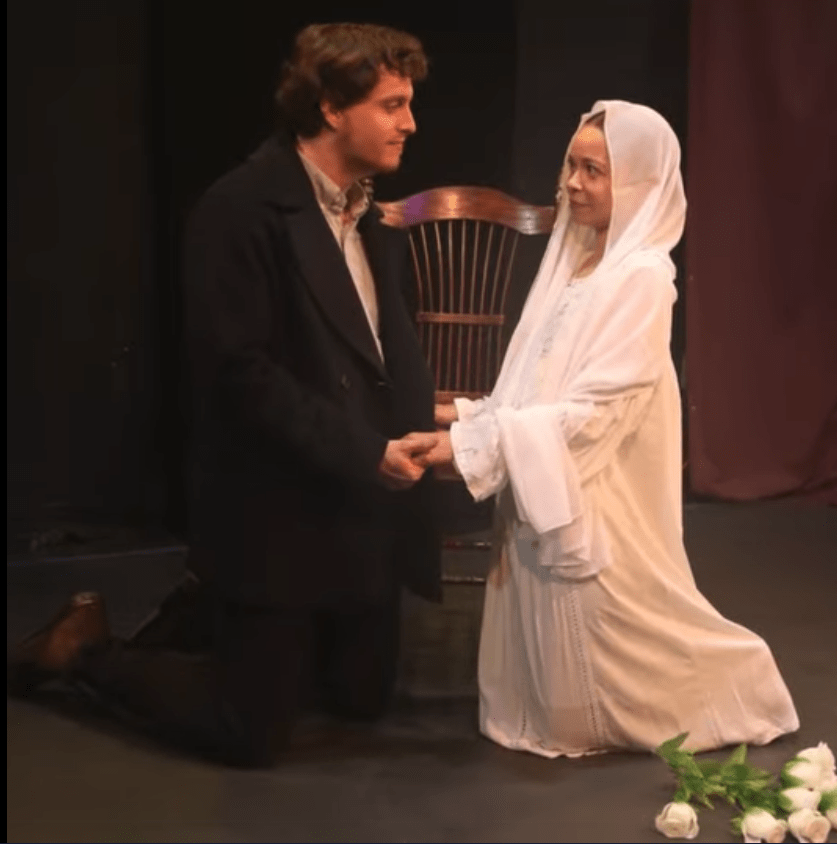
Directed with a flourish by John DeBenedetto, The First and The Last is like a runaway train heading towards a brick wall of an ending that is shocking and yet somehow inevitable, and makes for a gripping hour of theatre. It runs at the Beckmann Theatre at the American Theatre of Actors through June 15, 2025.
Jim Catapano reviews (beyond) Doomsday Scrolling: A Timely Tale of Feminist Resistance
(beyond) Doomsday Scrolling Raises a Collective Voice Against Patriarchal Atrocities Past and Present
“One of the convenient afflictions of power is a lack of imaginative extension. For many men it begins in early childhood, with almost exclusively being read and given stories with male protagonists.” – Rebecca Solnit
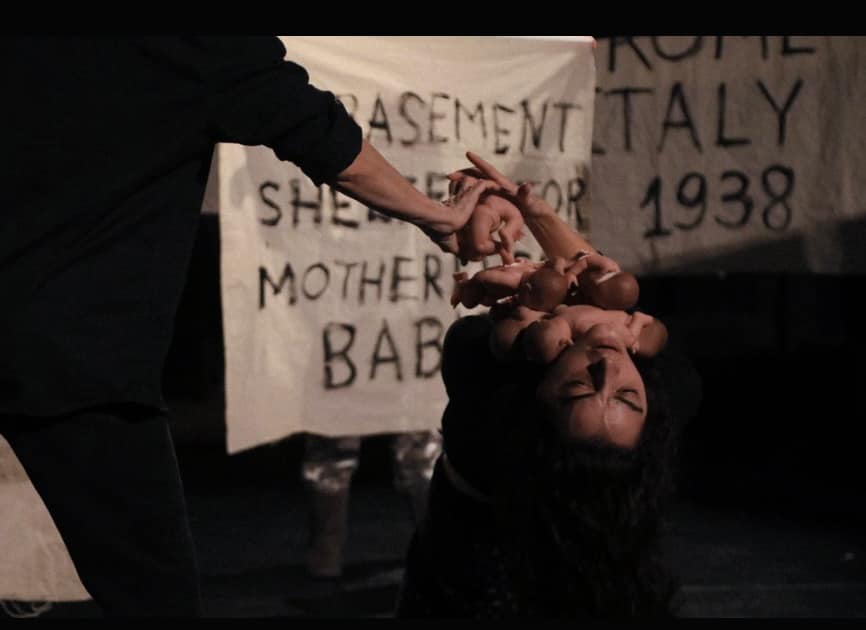
AnomalousCo’s (beyond) Doomsday Scrolling is a production of protest against the male-led oppressive, destructive course of human history which continues to this very moment, told through the stories of women who were there. It was first realized in 2022, and now returns for a run at the American Theatre of Actors. In the early, frightening days of 2025, its re-imagining is not a moment too soon.
The play is the ever-evolving creation of an ensemble—AnomalousCo is a women-led collective of predominately queer-identifying feminist artists and performers. All the actors are descendants of people who lived through these events; they are literally portraying their ancestors. The actors developed their individual characters themselves, drawing on the stories and experiences of their own families. The reality that the historic horrors they depict are also happening to and around them, here and now, lends a palpable emotional poignancy. You can see it in the actors’ eyes, feel it in their voices. Their work is a unified cry of resistance against the horrors of war and subjugation, caused by a system perpetually run by men.
(beyond) Doomsday Scrolling imagines women from different times and places, taking sanctuary in a theater to escape the horrors they have all faced. We meet refugees of violent conflict and disaster from all over the world; from the Warsaw uprising of 1944 to the 2022 invasion of Ukraine, and right up to the current day horrors of the Altadena fires. It is a tense scene—a siren sound mixes with the pleading cries of a baby; news reports, read matter-of-factly, are heard throughout, depicting tragic historical events from the last two centuries. These reports heartbreakingly intertwine with news from just days ago, in the aftermath of the repressive actions of the new US administration, and the ongoing horrors of Gaza. Quotations from women writers, including Rebecca Solnit (as noted above) Evgeniya Byelorusets and Naomi Klein, appear on a screen to bear witness, and to warn.
Speaking in their native tongues, the women try to communicate; they compare weapons and pass around a bottle of rum. A Red Cross volunteer comes to the “rescue”. The women open his box of supplies only to find that it’s useless: it’s filled with burlesque-type outfits, glittering dresses and feather boas. Through it all the women argue, they bond, they sing (notably a beautiful “Bella Ciao,” an Italian resistance folk piece); they try to escape in sleep, in long stretches of ominous silence. United by their experiences, they ultimately rise above their language barriers and cultural differences to come together in solidarity and understanding.
The initial incarnation of the show debuted shortly after the Russian Invasion of Ukraine, and is as crucial and relevant as ever in the cloud of chaos and uncertainty that is the here and now. Sheets line the walls, and ultimately the women’s clotheslines, listing the historic, patriarchy-caused catastrophes that caused them to flee. They all note the year, and ultimately, about half of them say 2025. The mantra of “it couldn’t happen here” is proven painfully incorrect; and history repeats, and repeats.
It’s noted that shortly before this production, the Doomsday Clock was moved from 90 seconds to 89. As (beyond) Doomsday Scrolling powerfully demonstrates,art—and the voices of women everywhere, from across time and distance—play a large part in slowing that second hand.
The performers/creators are: Alina Mihailevschi (Moldova), Claudia Godi (Italy), Diana Zhdanova (Russia), Jeremy Goren (US), Kikki Lau (China), Lesya Verba (Ukraine), Merve Atabek (Turkey), Simona DeFeo (Italy), Tia Cassmira (US), Wilemina Olivia-Garcia (Cuba), Weronika Wozniak (Poland), Ylfa Edelstein (Iceland).
(beyond) Doomsday Scrolling is directed brilliantly by Kathryn Mederos Syssoyeva, with Dramaturgy by Rhiannon Ling. It runs at the American Theatre of Actors through February 9, 2025.
Content warning: Presence of gun prop, partial nudity, siren sound.
Jim Catapano reviews a Letter-Perfect Power Play
Frank Cossa’s Witty Character Study Bows at the ATA
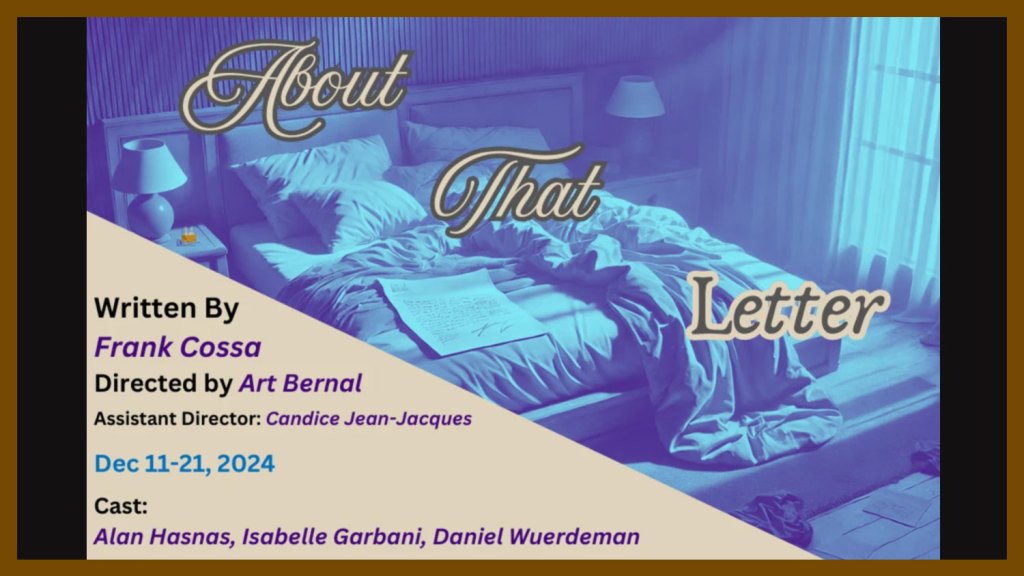
While sipping an adult beverage at a professional conference, Doctor Emma Vanderlyn (Isabelle Garbani) meets a charming man who she describes as “oddly cute, in a cutely odd kind of way.” However, to her horror the man turns out to be her arch-nemesis, tenured professor Pete Brasso (Alan Hasnas). Years earlier, Brasso had single-handedly brought to a near-halt the academic career of Emma’s husband, Josh Sperling (Dan Wuerdeman). Brasso had sent a letter to the editor of The Art Review, pointing out a serious factual error in Sperling’s article in the journal regarding the artist Whistler. This action led to Sperling’s credentials being questioned, culminating in the rejection of his own tenure. The incident, in her estimation, “ruined her life”— and she’s ready for revenge, but in a very unusual manner.
Thus begins About That Letter, a sharp and engaging one-act by Bronx-born Frank Cossa. To the sounds of the Pomp and Circumstance Graduation March, we flash back to Emma and Josh learning of Brasso’s letter; Josh is in despair—admitting Brasso is right, and correctly predicting the dire consequences of it. Emma seethes that the triumphant life path she had sought through her husband’s success is about to be denied her; she is almost Lady Macbeth-like in her rage. She scoffs at Josh’s suggestion that it will end up ok: “I don’t want OK, I want pretty damn good!”
Returning to the present, things have taken an unexpected turn—after copious drinks, Emma has “slept with the enemy.” Wearing the fluffy white robes of the hotel they are staying in, they bask in the afterglow the next morning, until Emma reveals her motives and gives us a clearer picture of the calculating, success-obsessed person underneath the professional charm and decorum.
“I wanted to know what it felt like to have sex with a man I detest,” she proclaims unapologetically. (There’s a slang term for that, but I won’t repeat it here.) Still reveling in the satisfaction of this, she gleefully assassinates his character, dismissing him as a poser and a hypocrite who rambles on meaninglessly (“A Rebel Without a Pause” is one of her more memorable dismissals). And circumstances only escalate from there…
The three actors bring Cossa’s compelling story beautifully to life, delivering his insightful and humorous observations with relish. It’s a terrific study of human interaction and dysfunction, and how the desperate desire to be somebody leads to some shocking life choices.
About That Letter is directed by Art Bernal with co-direction by Candice Jean-Jacques. It is presented at the Beckman Theatre at the American Theatre of Actors through December 21, 2024.
 Arts Independent