
Home » Posts tagged 'movies' (Page 2)
Tag Archives: movies

CHAZZ PALMINTERI will appear Saturday, August 2 ONLY for a talkback after the performance of LIGHTHOUSE REPERTORY THEATRE’s production of A BRONX TALE, the musical
CHAZZ PALMINTERI will appear Saturday, August 2 ONLY for a talkback after the performance of LIGHTHOUSE REPERTORY THEATRE’s production of A BRONX TALE, the musical running Friday, August 1 thru Sunday, August 10 AT The Bellmore Showplace, 222 Pettit Ave.Bellmore, NY TICKETS
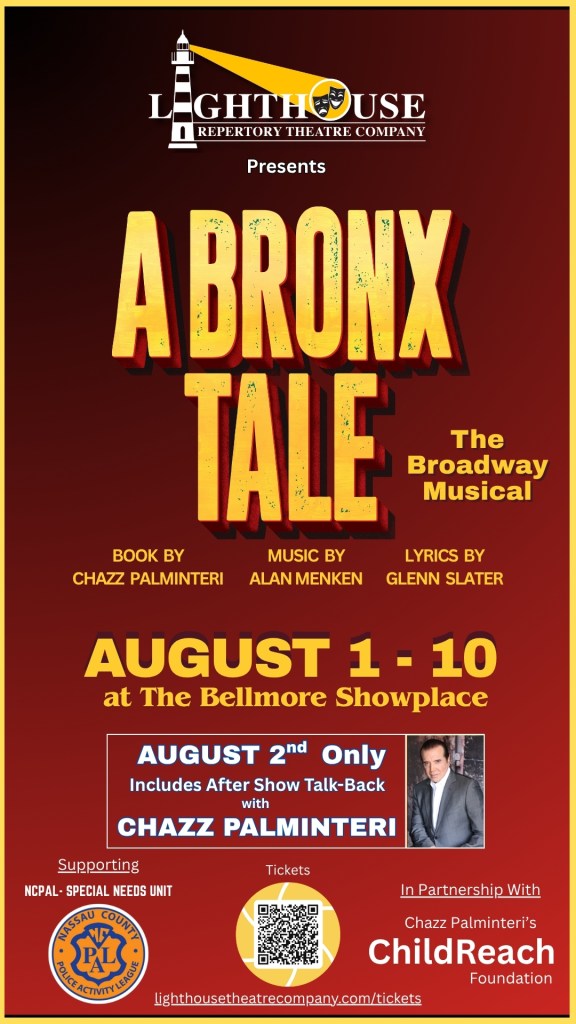
Based on the critically acclaimed play that inspired the now classic film, this streetwise musical will take you to the stoops of the Bronx in the 1960s—where a young man is caught between the father he loves and the mob boss he’d love to be. Book by Academy Award nominee, Chazz Palminteri, music by Oscar, Grammy, and Tony Award winner Alan Menken, and lyrics by Grammy Award winner and Oscar and Tony Award nominee Glenn Slater, A Bronx Tale is a story about respect, loyalty, love, and above all else… family.
AUGUST 2nd ONLY – your ticket includes an after-show talk back with CHAZZ PALMINTERI.
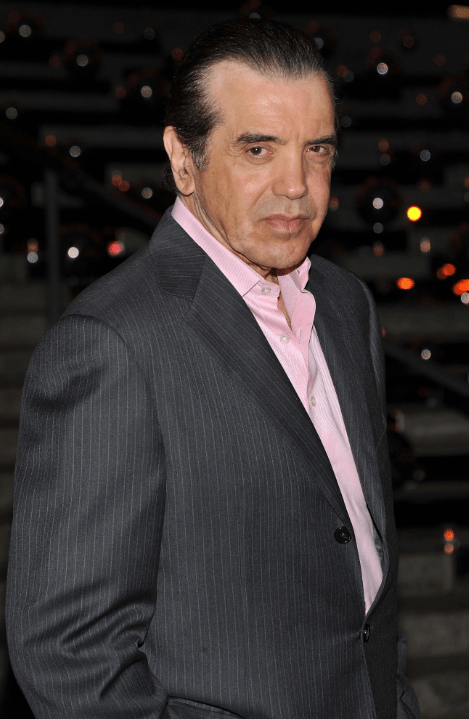
Bronx-born and raised Chazz Palminteri was a natural choice to continue the Italianate tradition set forth in the 1970s by such icons as director Martin Scorsese and actors Robert De Niro, Al Pacino, John Cazale and Joe Pesci.In 1988 he wrote for himself a play entitled “A Bronx Tale,” a powerful one-man stage commentary in which he depicted his bruising childhood in great detail, which included witnessing gangland slayings. Palminteri brought each and every character to life (18 in all) in this autobiographical piece — his friends, enemies, even his own family. He showcased for years in both Los Angeles and New York, finally sparking the interest of his film idol, Robert De Niro. DeNiro, wanting to direct for the first time, saw the potential of this project and brought both it and the actor/writer to the screen. Palminteri played one of the flashier roles, Sonny, a gangster, in the movie version. An unknown film commodity at the time, Chazz had stubbornly refused to sell his stage property (the offers went into the seven figures) unless he was part of the package as both actor and screenwriter. DeNiro, who became his mentor, backed him up all the way, and the rest is history. A Bronx Tale (1993), which featured his actress/producer/wife Gianna Palminteri, earned strong reviews.
He received a well-deserved Oscar nomination the following year for his portrayal of a Runyonesque hit man in Woody Allen‘s hilarious jazz-era comedy Bullets Over Broadway (1994). He was on the right side of the law in both The Perez Family (1995), his first romantic lead, and then the classic crimer The Usual Suspects (1995). He played the ill-fated brute in Diabolique (1996) and wrote a second screenplay, Faithful (1996), in which he again plays a hit man, terrorizing both Cher and Ryan O’Neal.
Parental Advisory: Contains adult language and mild violence.
Jim Catapano reviews a dying gasp of a senator’s soul with Michael Hagins’ “The Senator Speaks”
Michael Hagins’ Powerful New Play The Senator Speaks Examines the Human Consequences of Playing Politics
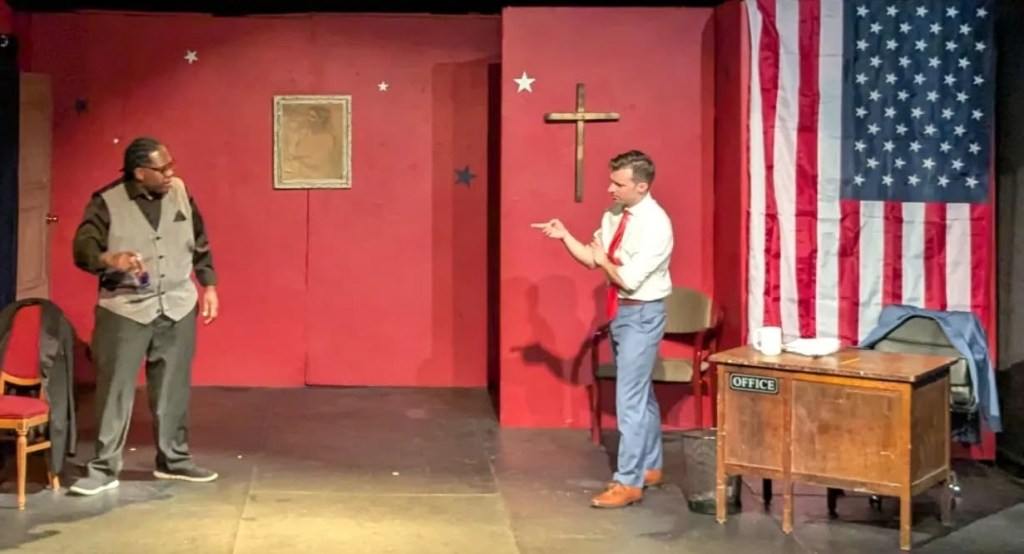
“We are all mired in dark times,” proclaims Conservative Republican Senator Calvin Shepherd (Michael J. Whitten). “At a time when the hard left is helping to ruin this country. Liberty is under assault…we are going to arm up and fight back.” Shepherd is spending the morning at home, surrounded by portraits of Reagan, Bush I, a large cross, and an even larger American Flag. He is practicing the Keynote speech he is scheduled to deliver to the National Rifle Association.
“It’s just rhetoric,” he admits to his religious, reserved wife Martha (Mary Sheridan). “I don’t believe any of it.”
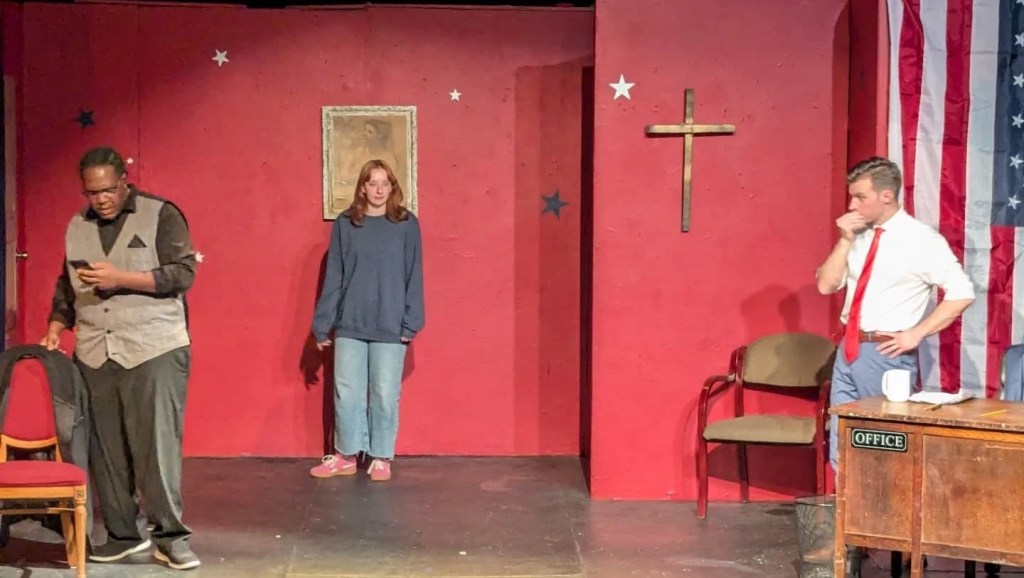
Unsure of his own talking points, Shepherd keeps running to his desk to double-check his prepared script; he humorously has trouble saying the word “statistician.” But these are the least of his issues; his liberal activist, liberal arts-studying daughter Corinne (Olivia Whicheloe) is home from college, and they’re destined for another shouting match, which Martha wearily prepares to referee. (The relationship between father and daughter is exemplified by Corinne having thrown red paint on him during one of her many protest outings.)
Adding exponentially to the tension is the presence of Danny Johns (Xavier Rodney/Michael Hagins at Friday performances). Political Machiavelli Danny is essentially Shepherd’s Chief of Staff, and the devil on his shoulder, pulling the strings to advance Shepherd’s career and reap for himself the resulting rewards. (He also boasts that he’s the guy that makes potential “problems” go away for anyone who does what he wants.)
As events unfold, we learn that Shepherd’s voting history—the details of which he often struggles to recall—is coming back to haunt him. His rejection of background checks has put a gun in the hands of a young man who is now an active school shooter, just a few miles away, and ironically, mere hours before Shepherd is to go before the NRA. To the Shepherds’ horror, their young niece Jamie is one of the students trapped inside. Danny reveals that he’d been aware that the gunman was a potential threat to the community for some time, and he had strategically swept the information under the rug. But even now, this “incident” is all a mere inconvenience, and one that can be spun for political gain. “You can be America’s rock,” he later implores Shepherd. “The senator who overcame tragedy to bring this country to a stronger future.”
Amid an agonizing tug-of-war between Danny and the Shepherd family for the soul of the Senator, Corinne reveals that something terrible had recently happened to her at college. It’s indeed a crime against her, but one that she will receive no justice or recompense for—as a result of her father’s earlier political decisions. A further family revelation drives home the hypocrisy at the heart of Shepherd’s very being. Thus, at the urging of Danny and for the sake of some perks hidden in big wordy bills, Shepherd has essentially sold out his own family, to tragic consequences.
Brilliantly written and directed with no punches pulled by Michael Hagins, The Senator Speaks comes at a pivotal moment in history, when the chasm between congressman and constituent has never been greater. Hagins exposes the rot at the center of the politician’s heart; Shepherd is both callous and clueless, and this characterization is far from hyperbole in the turbulent early days of 2025. Corinne refers to Danny as “Rasputin,” and she is not far off; the kingmaker is not only a puppet master, but also so powerful in the political sphere as to be seemingly invincible. A disgusted Corinne asks him what he believes in. “Money,” he replies cooly. Shepherd is caught between Danny and his pleading family in a gripping and heartbreaking battle that singlehandedly sums up all that is wrong with American society.
The actors perfectly embody their roles, to the extent that the audience feels they are eavesdropping on a real family’s despair and disintegration. Rodney/Hagins’ Danny is a supervillain oozing with evil—but chillingly, he’s also completely realistic. The same is true for Whitten’s corrupted Shepherd, a man so consumed with his career and so brainwashed by his puppeteer that he can barely discern right from wrong anymore. Whicheloe’s assertive, fed-up Corinne is at turns defiant and heartbreaking—as is Sheridan’s disillusioned Martha, whose wavering admiration of her husband gives way to complete contempt. Whicheloe and Sheridan are compelling as their characters come to terms with the reality that their father/husband is not a person they can ever again stand with or depend on.
The Senator Speaks is a must-see production in an era when the creative voice is needed more than ever to speak to the troubles of our times, and to be our companion as we navigate the turbulent seas ahead of us.

The Senator Speaks is part of the African American Playwrights Initiative at the ATA. It is playing through March 8 at the Sargent Theater at the American Theatre of Actors.
Jim Catapano reviews (beyond) Doomsday Scrolling: A Timely Tale of Feminist Resistance
(beyond) Doomsday Scrolling Raises a Collective Voice Against Patriarchal Atrocities Past and Present
“One of the convenient afflictions of power is a lack of imaginative extension. For many men it begins in early childhood, with almost exclusively being read and given stories with male protagonists.” – Rebecca Solnit
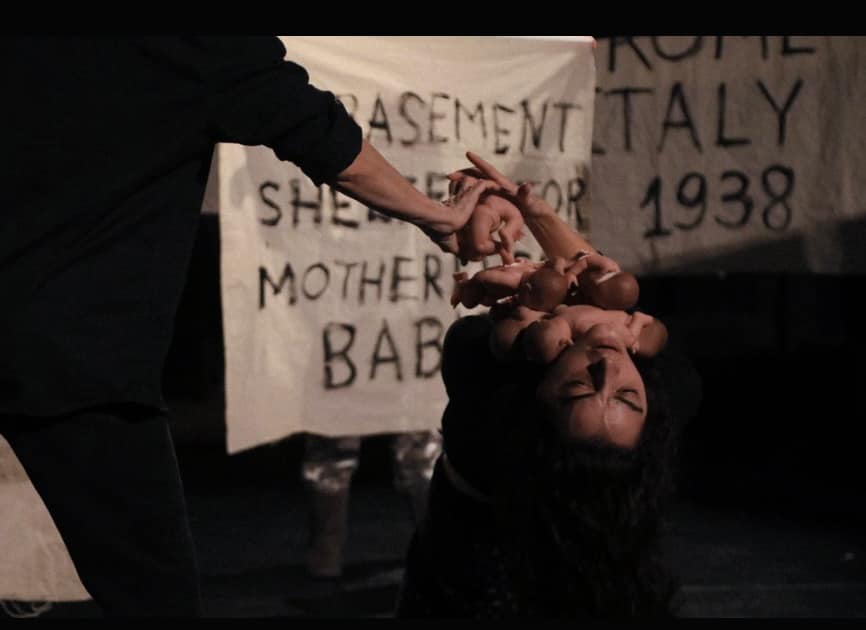
AnomalousCo’s (beyond) Doomsday Scrolling is a production of protest against the male-led oppressive, destructive course of human history which continues to this very moment, told through the stories of women who were there. It was first realized in 2022, and now returns for a run at the American Theatre of Actors. In the early, frightening days of 2025, its re-imagining is not a moment too soon.
The play is the ever-evolving creation of an ensemble—AnomalousCo is a women-led collective of predominately queer-identifying feminist artists and performers. All the actors are descendants of people who lived through these events; they are literally portraying their ancestors. The actors developed their individual characters themselves, drawing on the stories and experiences of their own families. The reality that the historic horrors they depict are also happening to and around them, here and now, lends a palpable emotional poignancy. You can see it in the actors’ eyes, feel it in their voices. Their work is a unified cry of resistance against the horrors of war and subjugation, caused by a system perpetually run by men.
(beyond) Doomsday Scrolling imagines women from different times and places, taking sanctuary in a theater to escape the horrors they have all faced. We meet refugees of violent conflict and disaster from all over the world; from the Warsaw uprising of 1944 to the 2022 invasion of Ukraine, and right up to the current day horrors of the Altadena fires. It is a tense scene—a siren sound mixes with the pleading cries of a baby; news reports, read matter-of-factly, are heard throughout, depicting tragic historical events from the last two centuries. These reports heartbreakingly intertwine with news from just days ago, in the aftermath of the repressive actions of the new US administration, and the ongoing horrors of Gaza. Quotations from women writers, including Rebecca Solnit (as noted above) Evgeniya Byelorusets and Naomi Klein, appear on a screen to bear witness, and to warn.
Speaking in their native tongues, the women try to communicate; they compare weapons and pass around a bottle of rum. A Red Cross volunteer comes to the “rescue”. The women open his box of supplies only to find that it’s useless: it’s filled with burlesque-type outfits, glittering dresses and feather boas. Through it all the women argue, they bond, they sing (notably a beautiful “Bella Ciao,” an Italian resistance folk piece); they try to escape in sleep, in long stretches of ominous silence. United by their experiences, they ultimately rise above their language barriers and cultural differences to come together in solidarity and understanding.
The initial incarnation of the show debuted shortly after the Russian Invasion of Ukraine, and is as crucial and relevant as ever in the cloud of chaos and uncertainty that is the here and now. Sheets line the walls, and ultimately the women’s clotheslines, listing the historic, patriarchy-caused catastrophes that caused them to flee. They all note the year, and ultimately, about half of them say 2025. The mantra of “it couldn’t happen here” is proven painfully incorrect; and history repeats, and repeats.
It’s noted that shortly before this production, the Doomsday Clock was moved from 90 seconds to 89. As (beyond) Doomsday Scrolling powerfully demonstrates,art—and the voices of women everywhere, from across time and distance—play a large part in slowing that second hand.
The performers/creators are: Alina Mihailevschi (Moldova), Claudia Godi (Italy), Diana Zhdanova (Russia), Jeremy Goren (US), Kikki Lau (China), Lesya Verba (Ukraine), Merve Atabek (Turkey), Simona DeFeo (Italy), Tia Cassmira (US), Wilemina Olivia-Garcia (Cuba), Weronika Wozniak (Poland), Ylfa Edelstein (Iceland).
(beyond) Doomsday Scrolling is directed brilliantly by Kathryn Mederos Syssoyeva, with Dramaturgy by Rhiannon Ling. It runs at the American Theatre of Actors through February 9, 2025.
Content warning: Presence of gun prop, partial nudity, siren sound.

Cleats, Chords, and Connections: Jim Catapano reviews 2 by Ken Couglin
Ken Coughlin’s New Plays Are Love Letters to Two Legendary Pastimes
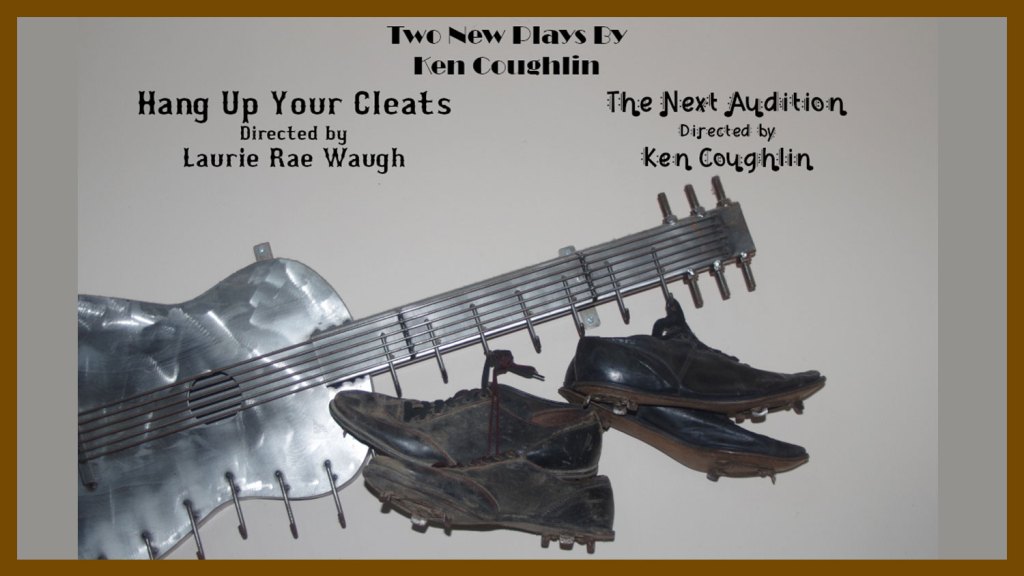
The award-winning Ken Coughlin has turned his attention to two of the most cherished pursuits of modern times: Baseball and Music. Hang Up Your Cleats, directed by Laurie Rae Waugh, and The Next Audition, directed by Coughlin, are performed together at the American Theatre of Actors, and truly fit like a glove. They are an insightful look at two of the passions that define modern culture, and how they inspire and connect people from all walks of life. Both plays are realized by a cast that brings a fitting charm and warmth to Coughlin’s resonant words.
Hang Up Your Cleats follows its characters over the course of over 20 years, beginning in 1931 during the prohibition era. The setting is a Speakeasy in a town with a popular baseball team at its center. The team’s star hitter, Otto Grafton (Kevin Ford), is in a 27-week slump, which he responds to by slumping into the bar to nurse his wounds. He tells the bar’s owner, Bart (Phil Oetiker), a devoted fan, that he is going to quit. The kindly Bart talks him into giving it one more go, promising that he will hang up Otto’s cleats behind the bar as a tribute when he eventually does retire (and giving the play’s title a second, more positive meaning).
This leads to a series of emotional vignettes over the course of the next two decades, segueing to the sounds of many different renditions of “Take Me Out to The Ballgame.” Bart’s son, Bart Jr. (Brian Michael O’ Neill) takes over the bar, Prohibition ends, and soon, the cleats above the bar multiply—a makeshift Wall of Fame for the town’s ballplayers, both famous and under-the-radar. We meet Cliff Samson (Dennis Mullikin), a kid who has just been cut from the local team. Soon we see that Bart Jr. has not only inherited his dad’s bar, but his compassion and love of the game as well—he urges Cliff not to give up.
In the spring of 1943, the bar is host to ballplayers Luke (Daniel Dennehy), Jim (Jacob Ward), and Benny (Luc Mitchell). The trio announce to Bart that they are not reporting to spring training, and due to the year, we immediately know why. Moved by their sacrifice, Bart hangs up their cleats in honor of the men. After the war ends, Women’s Baseball players Shirley (Julianne Lorndale) and Nadine (Sonia Halle) come into Bart’s to lament the end of their league, considered superfluous when all the male stars returned from overseas. Bart gives them both a place on the cleat wall, and starts a relationship with Shirley. Now partners in life and in business, the two meet Calvin Briggs (Will Allen). Calvin is a ballplayer from the Negro Leagues whose team has disbanded. Bart and Shirley welcome and honor him, rebuking former ballplayer Sam (also played by Oetiker) for his bigotry when he encounters Calvin.
The kind heart and compassion of Bart Jr., beautifully portrayed by O’Neill, is at the center of the play, coupled with the magical ability of baseball to bring people together. Bart’s bar becomes the “Cheers” of the town, and as the story progresses into the 1950s, all the characters come together as a kind of family—including Eloise (Aileen Bergin) and Martha (Valerie O’ Hara), sister and mom of one of the ballplayers. The group is united by their support of each other in hard times, shared history, and their devotion to the National Pastime. It all comes together to make Hang Up Your Cleats a moving tribute to human resilience and connection.
The topic shifts to music with The Next Audition. It’s the story of gigging lifelong guitarist Ken (Coughlin), as relayed and debated by Tom (Thomas J. Kane) and Val (Valerie O’Hara). The play is cleverly staged In Ken’s workshop, where he wordlessly tinkers with five guitars in the background while Tom and Val regale us with stories of his misadventures on the local concert circuit over the years—the gig on the boardwalk that lasted one night; the residency at the Italian restaurant that made it to a miraculous three weeks.
“Who wants to hear a bad, loud version of ‘Good Golly Miss Molly’ while they’re trying to enjoy their Risotto alle coste?” scoffs Tom.
Ken is seemingly oblivious to their conversation as he meditatively works on his collection. As opposed to the cynical Tom, Val is generally encouraging of Ken’s goals.
“You never get more unless you demand it,” she proclaims, suggesting that Tom is a dream-destroyer.
“Well maybe he should have spent more time getting the gigs that paid more,” he snarks back, suggesting that each failed endeavor only causes Ken to slide into despair. “He’s just going to get hurt again.”
Tom and Val are our guides to Ken’s journey from one project to the next, including a chaotic turn in one of the infamous Beatles Tribute bands. We hear the stories of Ken battling egos, creative differences, and frequent rejections, and ending up with little money or recognition to show for it. Though Ken never says a word, he’s clearly wondering if he’s wasting his time too by trying again and again. The dénouement, with Ken alone, is poignant, but fittingly, he performs a beautiful song, signaling that the show must go on. The funny and poignant play is a moving and familiar story for all of us in the entertainment business who have been constantly knocked down and always gotten up again.
Hang Up Your Cleats and The Next Audition are performed together at the Sargent Theatre at the American Theatre of Actors through November 3, 2024.
 Arts Independent