
Home » Posts tagged 'politics'
Tag Archives: politics

History is NOW: Jim Catapano views ZAGŁADA
Richard Vetere Brings t His Gripping Zaglada and the Great Len Cariou to the ATA Stage
“How do you judge human behavior when human life is judged to be worthless?”
Zaglada is a polish word meaning “annihilation, or extermination.” The astonishingplay that takes this nameexplores the moral dilemma faced by human beings in the horrific, life-and-death situation that this describes. What would you do to save yourself, or the person you love most? And how far would you go to render justice, even decades later? Should a person in the last days of their life face punishment for the crimes of a near century ago—crimes that to some eyes, they were forced to commit?
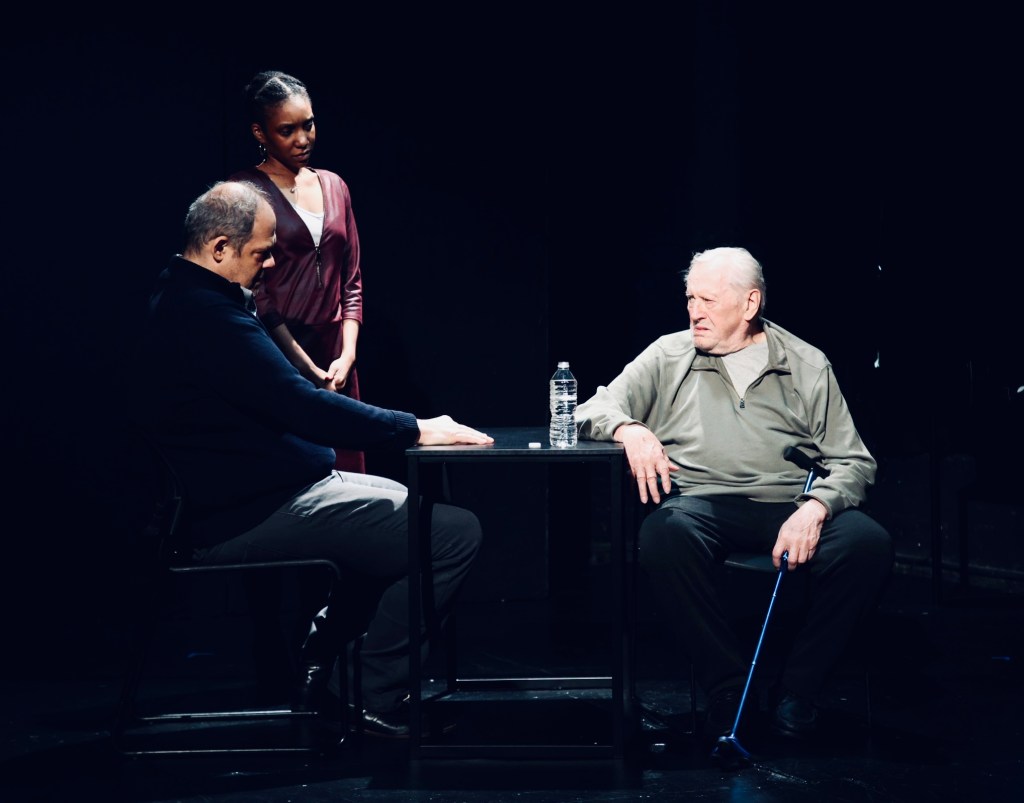
The Marvelous Len Cariou, a 65-year veteran of the stage and a Tony winner renowned for his performance as Sweeney Todd, isJerzy Kozlowski. He is a 93-year-old Polish Queens resident who has been arrested for shooting at Danielle Hooper (Jes Washington), a woman of color and a journalist. Danielle has discovered that Kozlowski was a kapo in a Buchenwald concentration camp in World War II, a prisoner who became an enforcer in the camp in exchange for his own life…and more. The arresting officer Frank Napoli (Salvatore Inzerillo) finds himself in an unexpected conflict with Sonia Sakalow (Maja Wampuszyc), a Homeland Security Officer who is hellbent on finally bringing Kozlowski to justice.
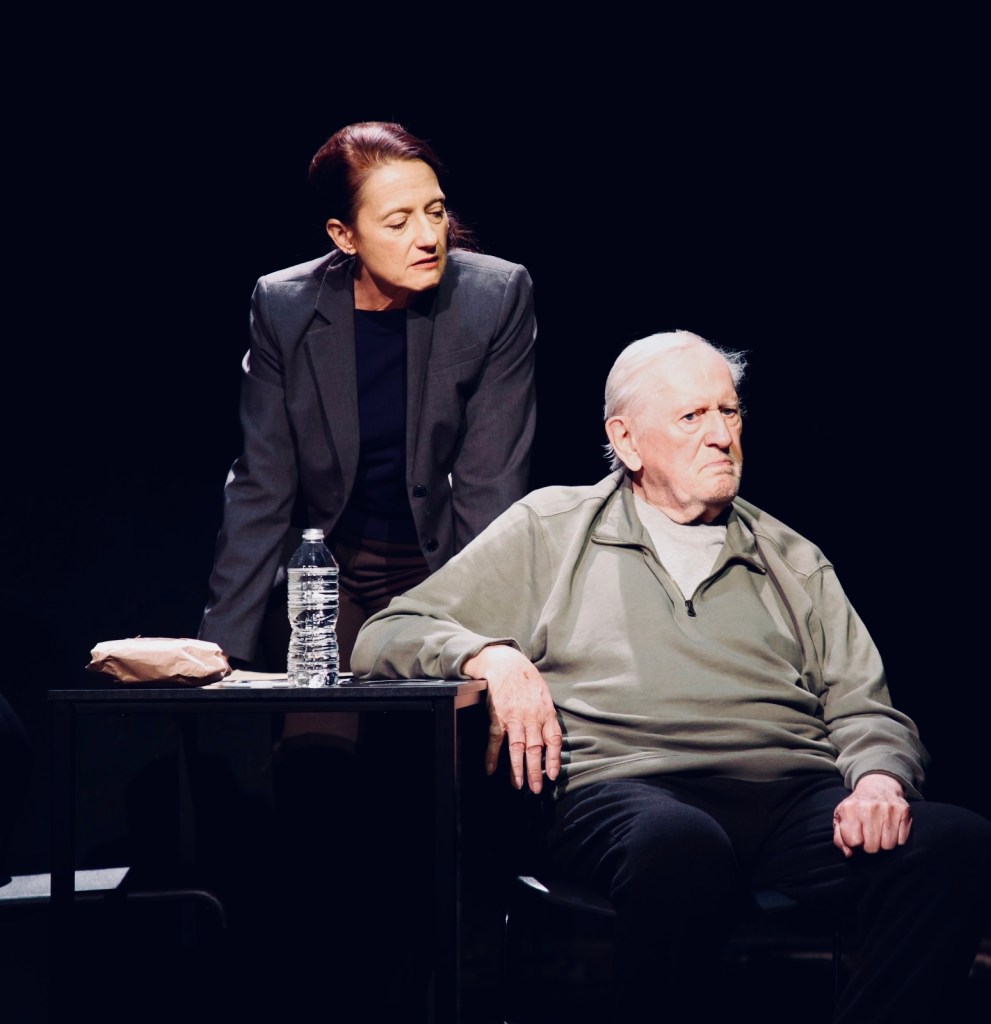
Powerfully directed by Wampuszyc, Zaglada is a fiction based on a very real reality—a history that is in danger of being forgotten, which creates the very real possibility that it will be repeated.
Napoli takes pity on the dying Kozlowski, giving him his pills and making sure he’s comfortable. He appears to be on the side of “moving on” from history.
“We spend most of our time worrying about things, dealing with things that happened when we weren’t even here,” he says to Hooper.
“Like Kozlowski?” she asks.
“Like Christopher Columbus, like Confederate statues, like reparations for slaves,” he replies, adding that his family wasn’t even in the country when the events transpired.
“That is the usual argument,” she notes. “But it is history, isn’t it?”
“Yours, maybe,” he dismisses, “not mine.”
Hooper, who is writing a book getting a PHD in International Human Rights, sees a parallel between the atrocities of the War and the persecution of African Americans, and seeks to make the world see it as well.
“The economy of this country was built on slavery,” reminds Hooper. “Now whether they were here or not, your people certainly benefited by the time they got here. Slavery was also a crime against humanity if you ask me, and there’s no statutory limit on that.”
Wampuszyc also sees no statute of limitations on Kozlowski’s actions in the latter days of WWII. She looks upon the old man with contempt and hatred that feels unusually personal, and is determined to see him be extradited and tried. Napoli is not on board; he sees Kozlowski as having been coerced into his actions.
“An elderly man, forced to work for the SS in a war that nobody thinks about anymore, needs to be punished?” Napoli protests.
“I am well aware that he did not volunteer to be a kapo at Buchenwald,” Wampuszyc retorts, dismissing that aspect as irrelevant. “…He is guilty, those are the facts.”
“I’m not sure that I would survive in a camp,” acknowledged Napoli. “But I know one thing…I would do all I could to survive.”
“You don’t know what you would do, nobody does,” says Wampuszyc. “Not until you are there, and it is real.”
The legendary Cariou is a wonder to behold; the experiences of a near-century are all in his eyes. You can literally see him putting himself back in 1945 as he gazes into the middle distance in agony. His fellow actors are also remarkable in their intensity, each suffering from their own form of PTSD that manifests in their passionate resolve and in the haunted, pained expressions on their weary faces. As circumstances unfold there are revelations that paint a vivid picture of why these particular people have found themselves battling in a small police station in 2018; every moment is riveting as more and more comes to the surface to create deeper shades of gray.
Zaglada is a masterpiece that is a must-see from both a creative standpoint and due to its undeniable relevancy in a time when humanity is at a moral crossroads and is already beginning to repeat the atrocities of the past.
Zaglada is performed at the American Theater of Actors through November 2.

Jim Catapano reviews a dying gasp of a senator’s soul with Michael Hagins’ “The Senator Speaks”
Michael Hagins’ Powerful New Play The Senator Speaks Examines the Human Consequences of Playing Politics
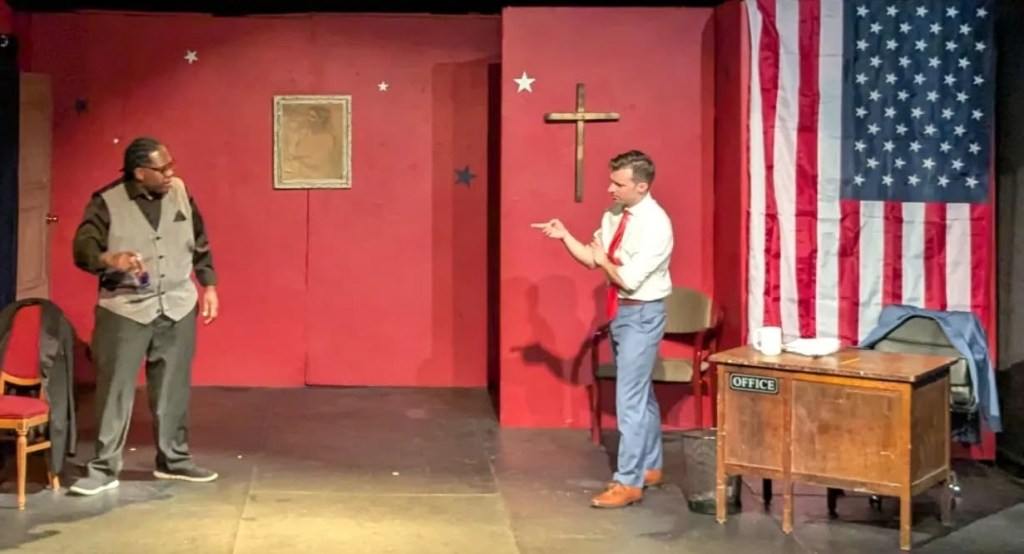
“We are all mired in dark times,” proclaims Conservative Republican Senator Calvin Shepherd (Michael J. Whitten). “At a time when the hard left is helping to ruin this country. Liberty is under assault…we are going to arm up and fight back.” Shepherd is spending the morning at home, surrounded by portraits of Reagan, Bush I, a large cross, and an even larger American Flag. He is practicing the Keynote speech he is scheduled to deliver to the National Rifle Association.
“It’s just rhetoric,” he admits to his religious, reserved wife Martha (Mary Sheridan). “I don’t believe any of it.”
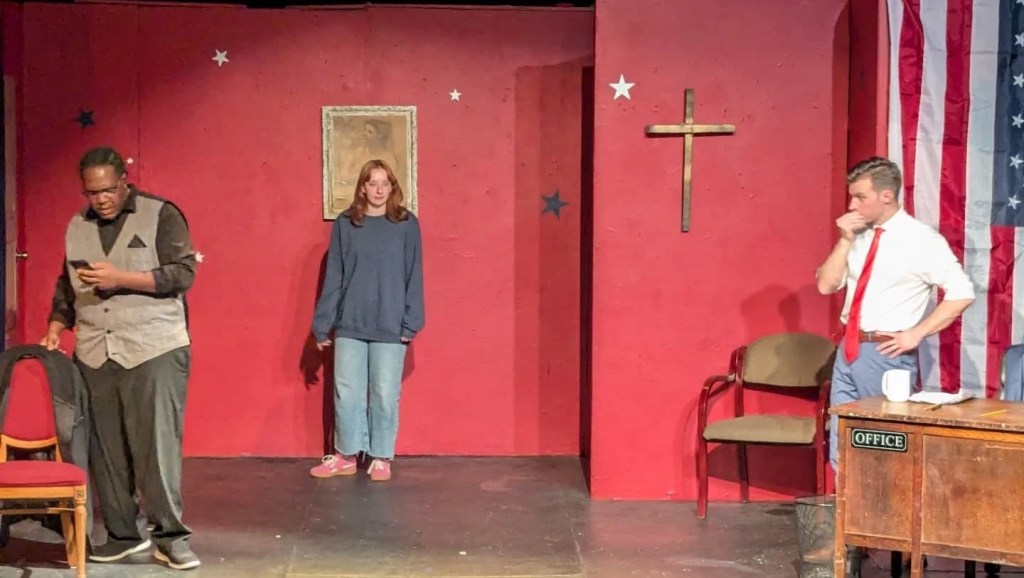
Unsure of his own talking points, Shepherd keeps running to his desk to double-check his prepared script; he humorously has trouble saying the word “statistician.” But these are the least of his issues; his liberal activist, liberal arts-studying daughter Corinne (Olivia Whicheloe) is home from college, and they’re destined for another shouting match, which Martha wearily prepares to referee. (The relationship between father and daughter is exemplified by Corinne having thrown red paint on him during one of her many protest outings.)
Adding exponentially to the tension is the presence of Danny Johns (Xavier Rodney/Michael Hagins at Friday performances). Political Machiavelli Danny is essentially Shepherd’s Chief of Staff, and the devil on his shoulder, pulling the strings to advance Shepherd’s career and reap for himself the resulting rewards. (He also boasts that he’s the guy that makes potential “problems” go away for anyone who does what he wants.)
As events unfold, we learn that Shepherd’s voting history—the details of which he often struggles to recall—is coming back to haunt him. His rejection of background checks has put a gun in the hands of a young man who is now an active school shooter, just a few miles away, and ironically, mere hours before Shepherd is to go before the NRA. To the Shepherds’ horror, their young niece Jamie is one of the students trapped inside. Danny reveals that he’d been aware that the gunman was a potential threat to the community for some time, and he had strategically swept the information under the rug. But even now, this “incident” is all a mere inconvenience, and one that can be spun for political gain. “You can be America’s rock,” he later implores Shepherd. “The senator who overcame tragedy to bring this country to a stronger future.”
Amid an agonizing tug-of-war between Danny and the Shepherd family for the soul of the Senator, Corinne reveals that something terrible had recently happened to her at college. It’s indeed a crime against her, but one that she will receive no justice or recompense for—as a result of her father’s earlier political decisions. A further family revelation drives home the hypocrisy at the heart of Shepherd’s very being. Thus, at the urging of Danny and for the sake of some perks hidden in big wordy bills, Shepherd has essentially sold out his own family, to tragic consequences.
Brilliantly written and directed with no punches pulled by Michael Hagins, The Senator Speaks comes at a pivotal moment in history, when the chasm between congressman and constituent has never been greater. Hagins exposes the rot at the center of the politician’s heart; Shepherd is both callous and clueless, and this characterization is far from hyperbole in the turbulent early days of 2025. Corinne refers to Danny as “Rasputin,” and she is not far off; the kingmaker is not only a puppet master, but also so powerful in the political sphere as to be seemingly invincible. A disgusted Corinne asks him what he believes in. “Money,” he replies cooly. Shepherd is caught between Danny and his pleading family in a gripping and heartbreaking battle that singlehandedly sums up all that is wrong with American society.
The actors perfectly embody their roles, to the extent that the audience feels they are eavesdropping on a real family’s despair and disintegration. Rodney/Hagins’ Danny is a supervillain oozing with evil—but chillingly, he’s also completely realistic. The same is true for Whitten’s corrupted Shepherd, a man so consumed with his career and so brainwashed by his puppeteer that he can barely discern right from wrong anymore. Whicheloe’s assertive, fed-up Corinne is at turns defiant and heartbreaking—as is Sheridan’s disillusioned Martha, whose wavering admiration of her husband gives way to complete contempt. Whicheloe and Sheridan are compelling as their characters come to terms with the reality that their father/husband is not a person they can ever again stand with or depend on.
The Senator Speaks is a must-see production in an era when the creative voice is needed more than ever to speak to the troubles of our times, and to be our companion as we navigate the turbulent seas ahead of us.

The Senator Speaks is part of the African American Playwrights Initiative at the ATA. It is playing through March 8 at the Sargent Theater at the American Theatre of Actors.
 Arts Independent