
Home » Posts tagged 'writing'
Tag Archives: writing
Jim Catapano reviews Anne L. Thompson-Scretching’s Home Is Sweet Sorrow: “A Masterful Conclusion to a Momentous Family Saga”
The War That Never Ends
Home Is Sweet Sorrow is a must-see and a devastatingly powerful third chapter in the Blood trilogy, which also includes the highly regarded A Lesson in Blood and A Long Way From Home. Anne L. Thompson-Scretching’s prolific pen and deft direction again triumph in a depiction of an American family wounded by war and the trials of the mid-20th Century.
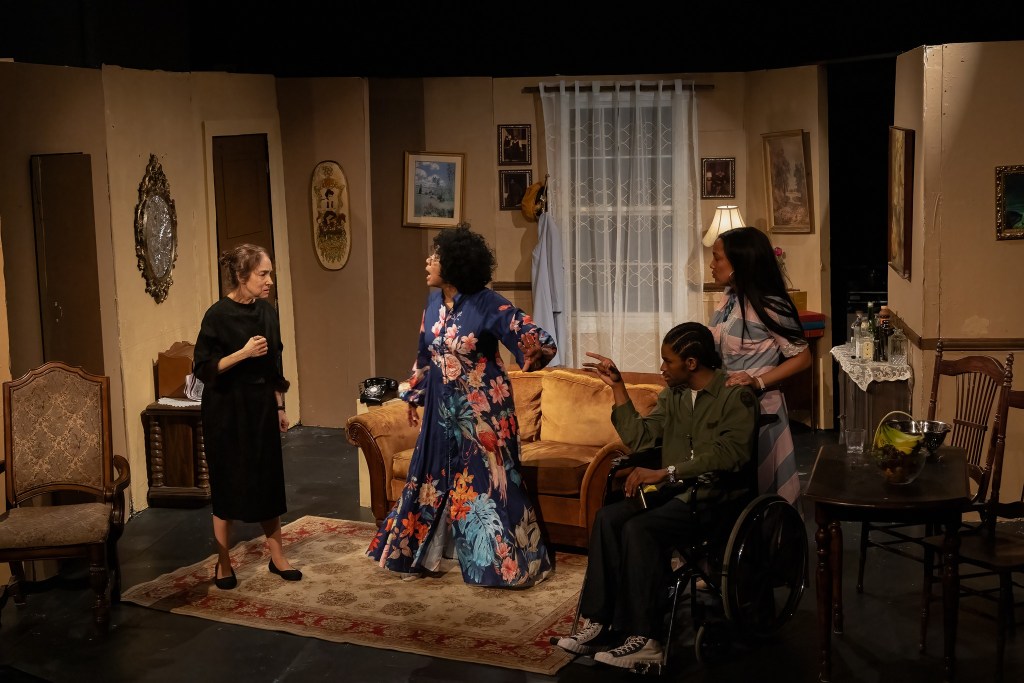
It is 1971, and PFC Willie Taylor (Laquan Hailey, reprising his role from A Long Way From Home) has come home from Vietnam. He is in a wheelchair, but his prognosis to walk again is good. Though he may soon regain his mobility, the damage to his mind is far less likely to ever be healed. He is a stranger to himself and to his family: mother Shanna (Gina McKinney), father Jacob (Kevin Leonard), and sister Luella (Joy Foster). Non-blood cousin Ceola Red Feather (Carrie Johnson) is the daughter of Oceola (the lead character of A Lesson in Blood); she has gone to school and now has medical training that she can help Willie with, and the two eventually begin the romantic relationship they were destined for. Rommell Sermons (Chester in A Long Way From Home) appears as Thomas Avery, a sergeant who visits to try to get Willie help for his PTSD.
That PTSD has shattered Willie’s personality and threatens his very sanity. After he arrives home (significantly not wearing his uniform), the mother he had missed so very much tries to help him navigate a tight hallway in his chair, and he snaps instantly and violently. He has developed a drinking problem—reaching for the bottle when the nightmares come (and they do, every time he closes his eyes), when the cars backfire like rifle shots, and when the flashbacks in his head threaten to consume him.
“I don’t know who I am or what I’ve done,” Willie despairs. “Them doctors, they only patched up the hole inside me and sent me on my merry way…sometimes when I wake up, I still feel like I’m dead. I can’t be the same person I was before I left here.”
Adding to his own trauma is that his friend and fellow PFC Jamie Lofton perished under suspicious circumstances in Vietnam. Jamie’s devastated mother Abigail (Elly-Anne Ehrman), aware of the secret that was her son’s burden, has come looking for answers from Willie, and a painful revelation adds even more horror to the already devastating effects of a war that no one wanted.
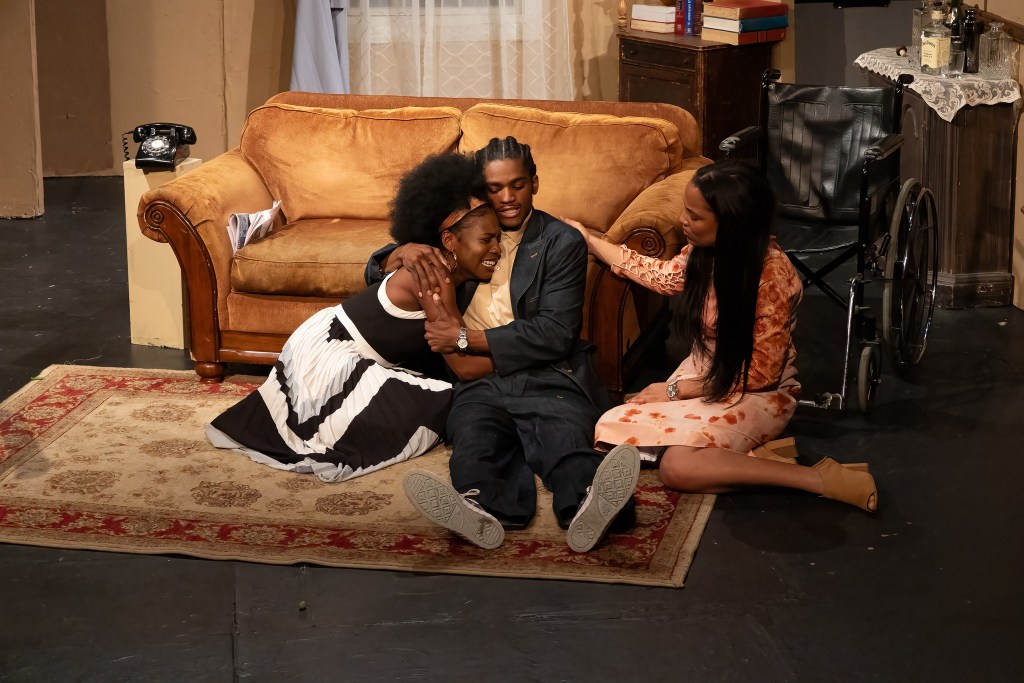
The relationships among the characters are so well-realized and so well-acted, anyone watching Home is Sweet Sorrow could almost feel like they truly are in the home of the Taylors in 1971. They share many a meal and many a drink, namecheck All in The Family and Ed Sullivan, and truly give the sense of having been through a great deal together. Each and every one of them feels like a real living and loving human being, and so their happiness and pain are felt viscerally. We find joy in their warmth and connection, thus making the moments when that connection is severed all the more painful to witness. Willie’s devotion to his Shanna is damaged by what he sees as her inability to grasp what he’s been through, and she is left terrified, forced to walk on eggshells in fear of the traumatized shell that her son has become. Shaina and Abigail, ostensibly friends, clash over their grief and their individual need to honor their sons, one who is gone physically and one emotionally. Jacob plays peacemaker and is anguished that any returns to normality are short-lived. Anne L. Thompson-Scretching’s powerful dialogue and skillful world-building are astonishing, as is her bravery in reminding us that resolutions and closure are not to be found in the brutal reality that Home Is Sweet Sorrow so poignantly depicts.
Layton Lamell, Patricia Fields and Sania Hyatt are Swings for Willie, Shanna, and Luella respectively.
Presented as part of the African American Playwrights Initiative, Home Is Sweet Sorrow is performed at the Sargent Theatre at The American Theatre of Actors through March 29, 2026.

Music Among the Tumbleweeds: Jim Catapano reviews James Jennings’ New Dancing in the Meadow.
James Jennings’ New Dancing in the Meadow Brings Feel Good Vibes to the ATA
James Jennings, legendary Founder of the American Theatre of Actors, brings another rich character study to the Beckmann Theatre, along with “a little night music”. The setting of Dancing in the Meadow, his latest production, is the home of songwriter Hank Anderson (Rick Jordan) and his wife June (Ginger Kipps), during a New York snowstorm. Hank, now past retirement age but still wonderfully motivated to pursue his art, is working on new material. June, however, is not impressed with the snippets she hears Hank singing, and with his apparent inability to see any of his works in progress to completion.
“If I hear any more of that sh—t, I’m gonna get one of the kids over here to toss your a-ss out into the snowdrift,” snarks June. “Now just cut this crap.” (June’s language is delightfully colorful throughout the play.) Hank was once involved with the Whispering Tumbleweeds, a country band fronted by his old friend Marvin Swing (Ken Coughlin), and boasts of the song he got on their sixth album. But that was 40 years ago, and the two haven’t crossed paths since. June is troubled by what she sees as Hank’s delusions, and would rather he focus on shoveling the snow. But Hank feels sure that a reunion with Marvin is imminent.
“Hey, I got to get ready,” says Hank, “you never know when he might show up.”
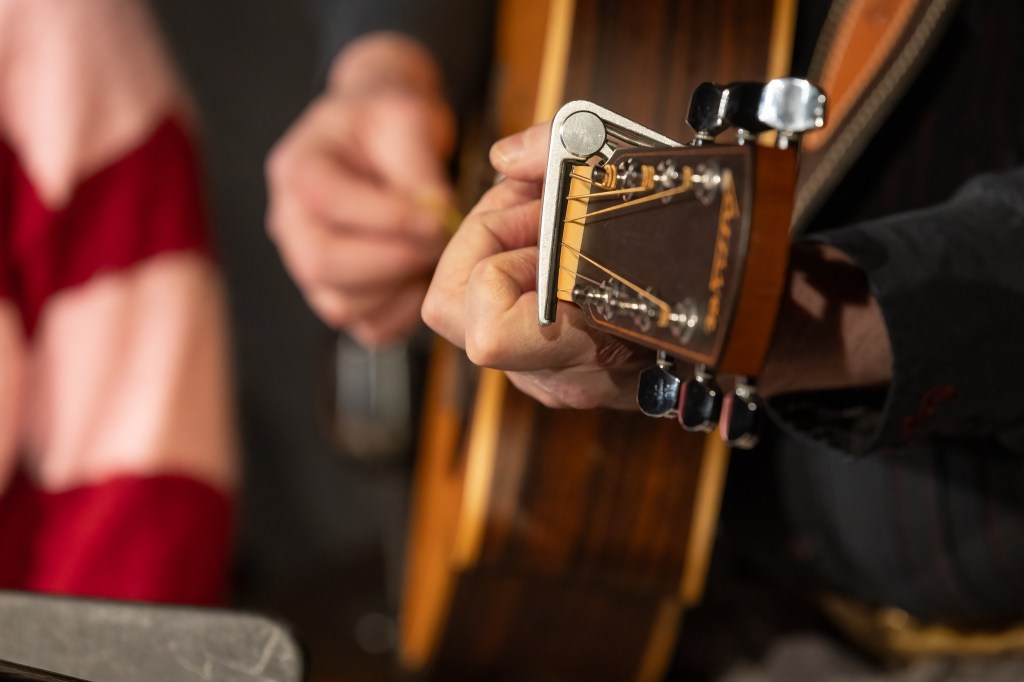
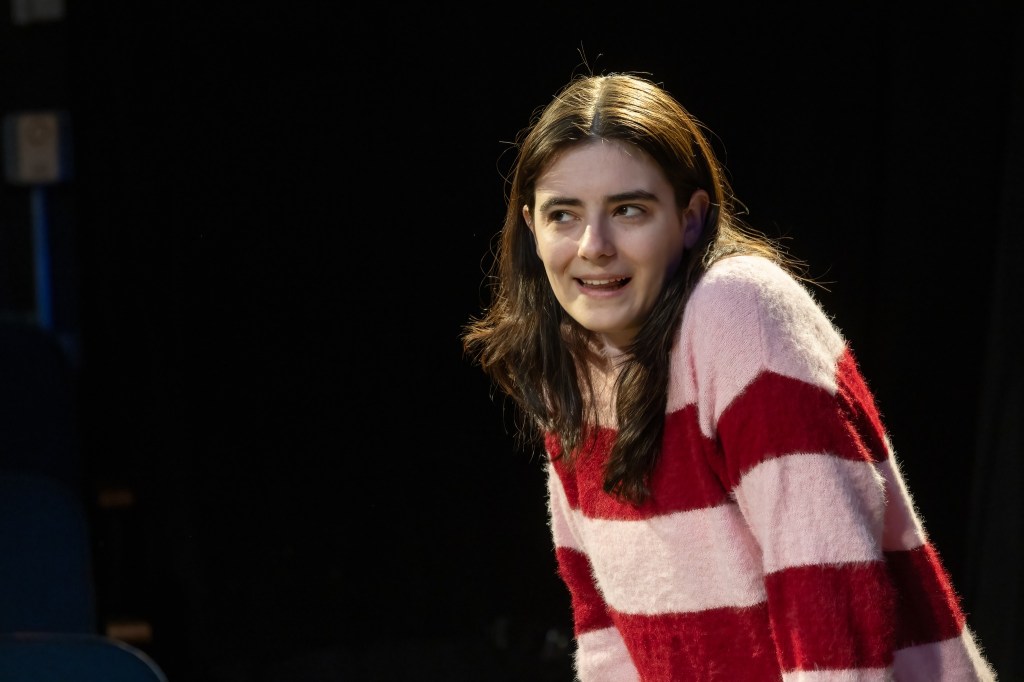
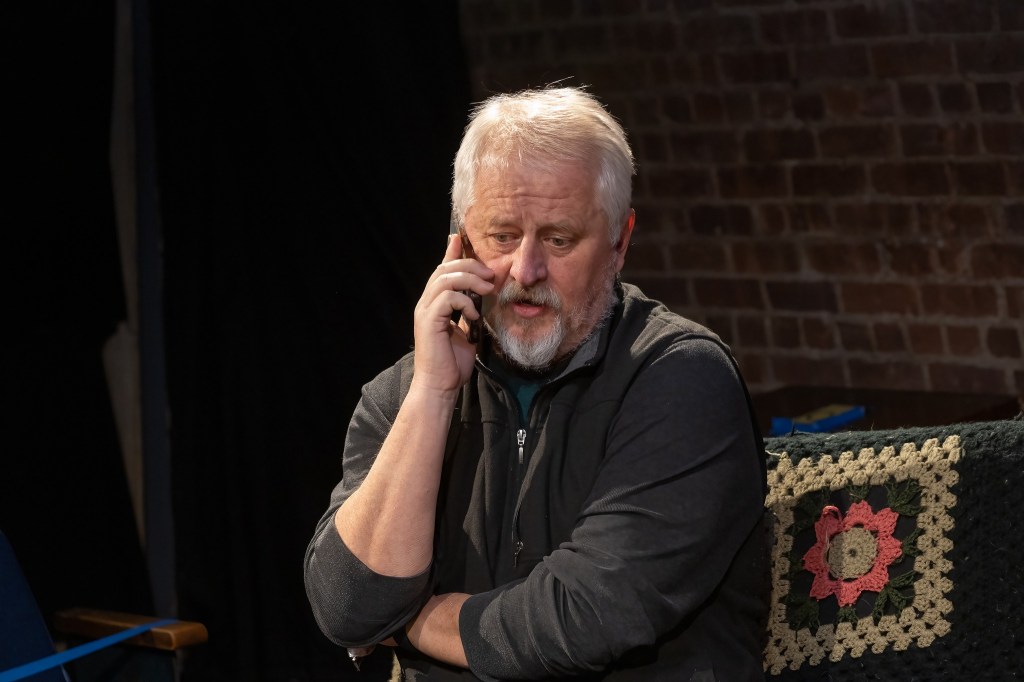
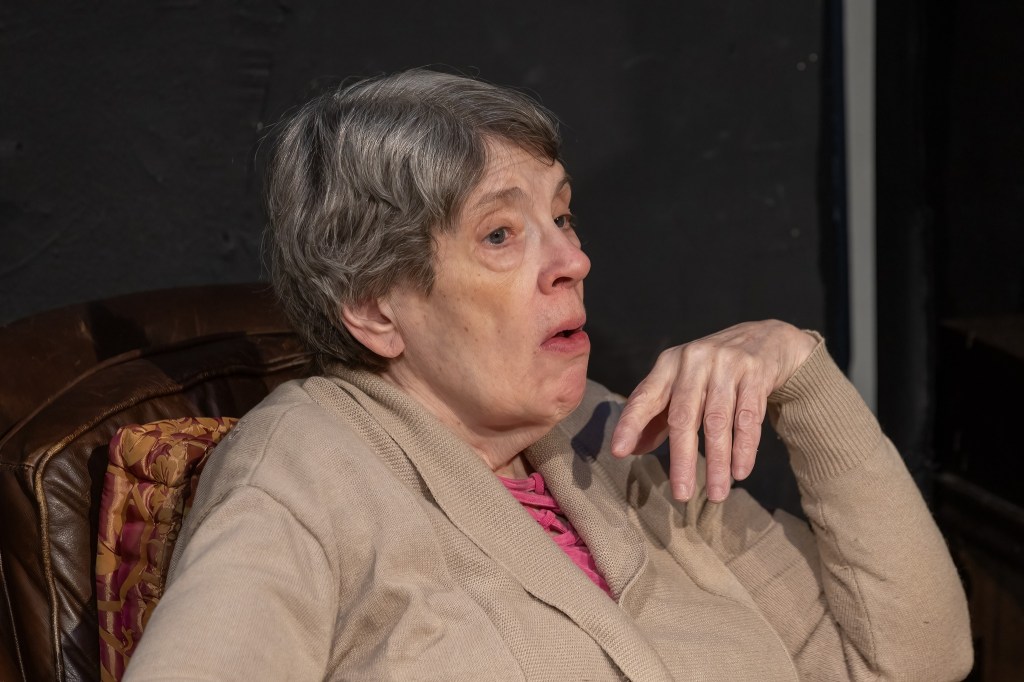
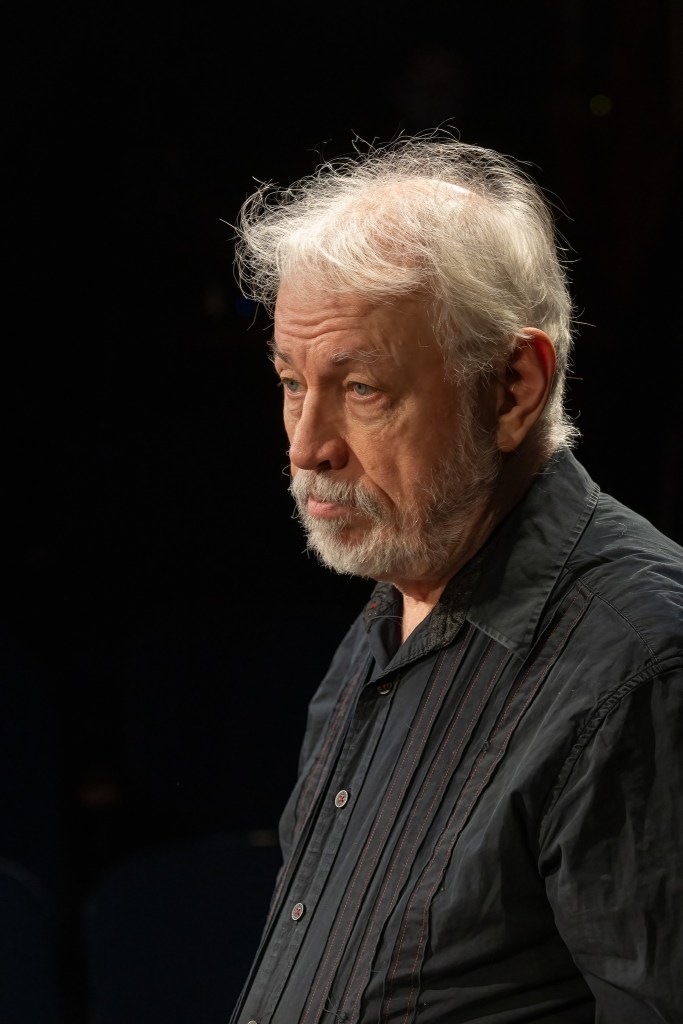
Their daughter Lucy (Chiara Aiello), an aspiring singer who just played The Bitter End, arrives to hear her dad’s old stories and her mom’s scoffing. But then, Marvin does indeed appear on their doorstep, resplendent in leather jacket and guitar-emblazoned scarf. He tunes Hank’s 12-string guitar and announces he is indeed here to make music, but wants it to involve more than one Anderson…
Dancing in the Meadow is a lovely piece that shows how the power of music can reunite old friends and connect generations. The interactions among the characters are genuine, moving, and fueled by Jennings’ trademark sparkling dialogue and wisdom about what makes people tick. The veteran cast sparkles in the first act of the production, and then return to the stage for a delightful surprise: Harmony in the Meadow, a concert with Aiello and Coughlin dueting as their characters. Coughlin’s excellent work on the 12-string and rich singing are accompanied by Aiello’s utterly gorgeous vocals, and we are treated to a set of some of the most beloved songs of the 1960s and beyond. Gems such as Joni Mitchell’s “Both Sides Now,” Simon and Garfunkel’s “The Boxer,” and the Righteous Brothers “You’ve Lost That Loving Feeling” are given marvelous readings by the duo, who I’d certainly love to see again in a concert setting. “Send in the Clowns” from the aforementioned A Little Night Music provides one of the most poignant moments, and “(I’ve Had) Time of My Life” from Dirty Dancing is the most uplifting. The half-play, half concert is one of the more joyous experiences you’ll have at the theatre this season, and another feather in the cap of James Jennings and the ATA.
Directed by James Jennings, Dancing in The Meadow runs at the American Theatre of Actors.

“Are We Friends, and Were We Ever?” asks Jim Catapano at YEARS TO DATE’s New York Premiere
Allen Barton’s Masterpiece Years to the Day Takes a Hard Look at Modern Relationships
“How the hell do you live your life unless you know who you are?”
Jeff (Jeff LeBeau) and Dan (Peter Zizzo) met each other and their later partners at the very beginning of college and have been “best friends” ever since…and yet they haven’t seen each other in person in six years. They finally meet over coffee, and it’s the precise anniversary of their last get-together in the flesh. They are in their mid-fifties, a time when a certain “rigidity” can set in for a person in terms of habits and point of view, accompanied by a “this is who I am, deal with it” attitude.
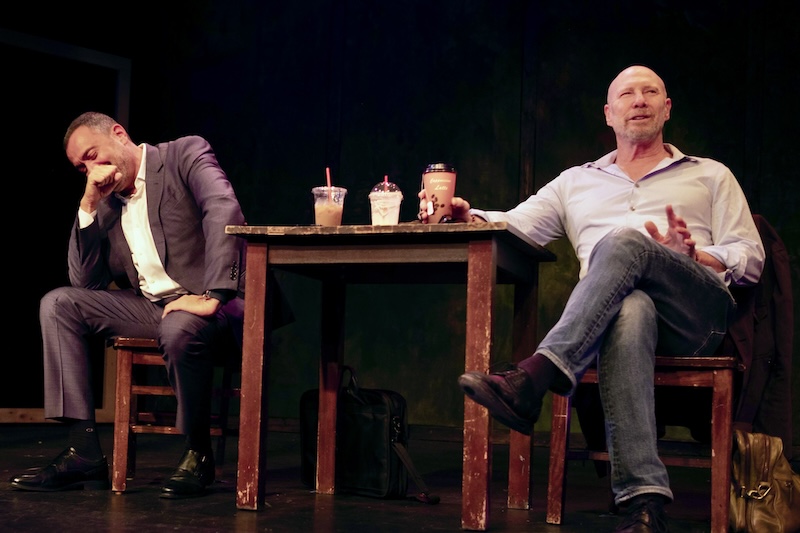
“You are the king of rudeness,” snarks Jeff as they settle in.
“You are the king of puerile, nanny-state intervention!” Dan claps back, but this “old buddy banter” is foreshadowing of the severe disconnection that is soon revealed. They discuss the “latest movie,” which Dan despises but Jeff saw twice; they debate about whether they’re middle-aged or old, and if “50 is the new 40” and how does that effect who they date.
But there’s a discomfort ever-present as the two try to slip into their old roles. The fiery Dan and the comparatively reserved Jeff come across like strangers that just happen to have known some of the same people and shared some experiences. We start to wonder immediately how these two came to be close, as their opposing energies and outlooks are brought to the table. Stunning revelations about each other’s lives come pouring out—important, life-changing, traumatic events that any close friend should have already known about. It’s clear that the notion of them having a deep connection is nonsense; their “friendship” is just a habit, and not one that they’ve cultivated in a healthy way. Jeff and Dan are on opposite sides of the political fence, but it’s never been a problem because Jeff used to downplay his beliefs; his refusal to take up the placating Avatar of old leads to a verbal explosion that nearly drives him out of the get-together. (The political climate is smartly kept vague and thus evergreen; we learn of an unnamed president that has somehow managed a third term, to Jeff’s delight and Dan’s horror.) Now that neither Jeff or Dan are “playing characters”, they find that the “actors” who brought them to life have little basis for a relationship. And yet somehow, their shared history and a genuine caring despite of all the differences just might be strong enough to lower the temperature and leave open the possibility of another meeting in the near future…maybe.
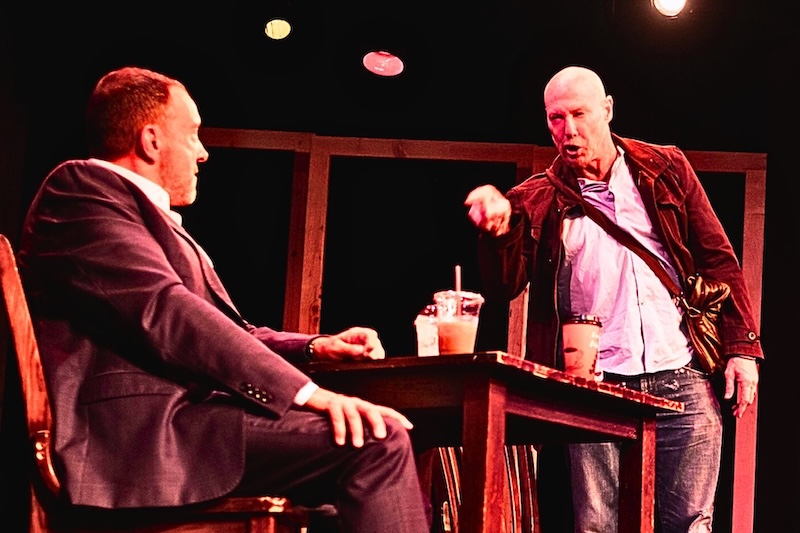
Written and directed by Barton and produced by Mia Christou, Years to The Day first premiered in 2013 to great acclaim and now makes its New York debut in a time when its themes are ever more relevant. Emmy winners LeBeau and Zizzo disappear deftly into their characters, delivering Barton’s musical, witty, rapid-fire dialogue with tremendous skill yet always appearing spontaneous in their interaction. Their body language, tense and awkward, is like another character in the play; seeing these two “buddies” barely look at each other for most of the meeting is chilling. Their unconvincing promise to “call Brenda” after a sad event for the unseen character stuns the audience; we all have a Brenda in our lives we’ve neglected. Seeing Jeff and Dan’s supposed closeness exposed as simply the product of having been in the same place at the same time is devastating as it certainly reflects reality for many in the modern world. In a time of social media false personas, fishing for “likes,” and a phone addiction that allows us to retreat at the first sign of boredom or discomfort, it becomes too easy to not even bother to cultivate a deep connection.
Hilarious, heartbreaking, and thought-provoking, Years to the Day is a must-see and a triumph for Barton, LeBeau, Zizzo and Christou.
“One thing exists at a time,” observes Dan throughout the play; it’s a simple yet astonishing declaration that will stay with you once you realize what it truly means, and the ark of Years to the Day reveals it powerfully.
Years to The Day is performed at the American Theatre of Actors through February 28, 2026.

New Theatrical Production Company, Diamond Mesh Inc., Announces “The Manifestival:” A New Frontier for NYC Independent Theater
In a world increasingly defined by digital isolation and existential questioning, a new theatrical force is rising to reclaim the stage. Diamond Mesh Inc.Theatrical Productions, led by producers Matt Bader and Faith Pasch, is proud to announce the inaugural Manifestival, a new works festival running from July 16th to August 9th in New York City.

The Search for Connection
Diamond Mesh is more than a production company; it is a response to the modern human condition. Launching with a provocative philosophical inquiry, the company’s mission centers on the “why” behind our collective loneliness.
“You did not stumble upon these questions. You found them. Just like you found this,” says the company’s statement. “We are Diamond Mesh. We have been looking for you too.”
The Manifestival: A Call for Submissions
The Manifestival is currently seeking digital submissions of new, 60–75 minute plays designed for intimate, character-driven production. Designed to strip theater down to its rawest, most impactful form, the festival emphasizes storytelling over spectacle.
Submission Guidelines & Opportunities:
- The Format: Scripts must feature a cast of five actors or fewer.
- The Aesthetic: Adaptable to minimal design (sparse set: one table, two chairs).
- The Series:
–The Signature Series: a Group of productions having a limited three performances during the festival.
–One Night Only Series: A high-impact, single-evening performance.
The MODEL: In a rare move for the NYC festival circuit, selected productions keep 100% of their ticket sales, providing a sustainable platform for playwrights & creators. Playwrights are encouraged to submit their work via the Official Manifestival Submission Form. Slots are assigned on a first-come, first-served basis.
Meet the Founding Executive Producers:

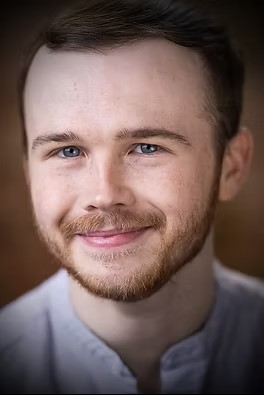
Faith Pasch — A New York City-based powerhouse, Pasch is an actress, singer, and producer with credits ranging from the I Was a Teenage She-Devil UK Premier to the Disney Cruise Line. A champion for marginalized voices, Pasch recently founded Faith Pasch Productions and co-founded Fate Productions, a company dedicated to highlighting female and non-binary voices in the cabaret circuit.
Matt Bader — A versatile actor, writer, and producer hailing from Milford, CT, Bader brings a wealth of international experience to Diamond Mesh. His past producing credits include The Silly William Gambit at the Edinburgh Fringe Festival. As a performer, he is known for his work in The Mystery of Edwin Drood (Connecticut Repertory Theater), the series The Startup, and his ongoing work with The Dinner Detective.
Join the Movement
- Website: diamondmeshinc.com
- Instagram: @diamondmeshinc
- Email: Mattbader@diamondmeshinc.com | Faithpasch@diamondmeshinc.com

When the Truth Is Found To (Possibly) Be Lies: Jim Catapano attends David Gutierrez’ RETRACTION
David Guiterrez’ Masterful RETRACTION Looks at Real Life Events that Nearly Damaged a Movement for Change
“If your mother tells you she loves you… check it out,” is the first statement we hear from journalist Wendy Denison (Renata Friedman), ambitious reporter for the popular magazine Heart Rhythm. This stunning declaration immediately sets the tone of uncertainty and discomfort that shadows RETRACTION, a compelling and timely work by David Gutierrez.
The title refers to what Rolling Stone actually found itself having to print in the aftermath of an article they published in November 2014. The piece, “A Rape on Campus,” claimed that a woman had been attacked by several fraternity members as part of an initiation ritual. Discrepancies in the account of that evening led to doubt and finally discredit, leading to lawsuits, and ultimately threatening the very cause the magazine was attempting to champion.
RETRACTION goes backwards and forwards in time to tell a fictionalized version of this event—at the center of which is Lacey (Rachel Resheff), a college student at Carolina Atlantic University. Lacey’s revelations regarding her attack at the Frat House draw the attention of Wendy, who wishes to bring awareness to the epidemic of sexual assault against women, and is supported in this endeavor by her editor Zack (Nathaniel Stampley). Wendy also speaks to Gillian (Bella Serrano), a fellow student and assault survivor, who is a steady presence during the rollercoaster of events that follow. Wendy publishes Lacey’s story in Heart Rhythm, and the article is scathing in its condemnation of the failure of University authorities to address the issue. It’s enough to create widespread outrage and make a Pariah of Carolina Atlantic’s Dean Gasso (Shannon Dorsey), who begins getting death threats for her perceived failure to protect her student.
But it is soon learned that the usually thorough Wendy was blinded by her passion for the cause, and made fundamental mistakes in her reporting. The recollections of the friends that Lacey had run to on the night of the alleged attack do not align with the events as portrayed in the piece. Chief among these is Travis (Charlie Webb), who had failed to reciprocate Lacey’s feelings right before she went on the date with the junior that ended in the attack she describes; along with Chris (Carson McCalley) and Melissa (Eliana Rowe), Wendy had failed to fact check with him or get any information from or regarding the alleged perpetrators. Lacey claims abandonment by all her friends, accusing them of words and actions that they later vehemently deny Add to that a competing reporter Victor (also McCalley) who suspects that things are not what they seem, plus Lacey’s subsequent admission that she felt her story “was true at the time,” and the situation implodes to the point where the movement to identify and stop rampant sexual abuse is in itself in danger.
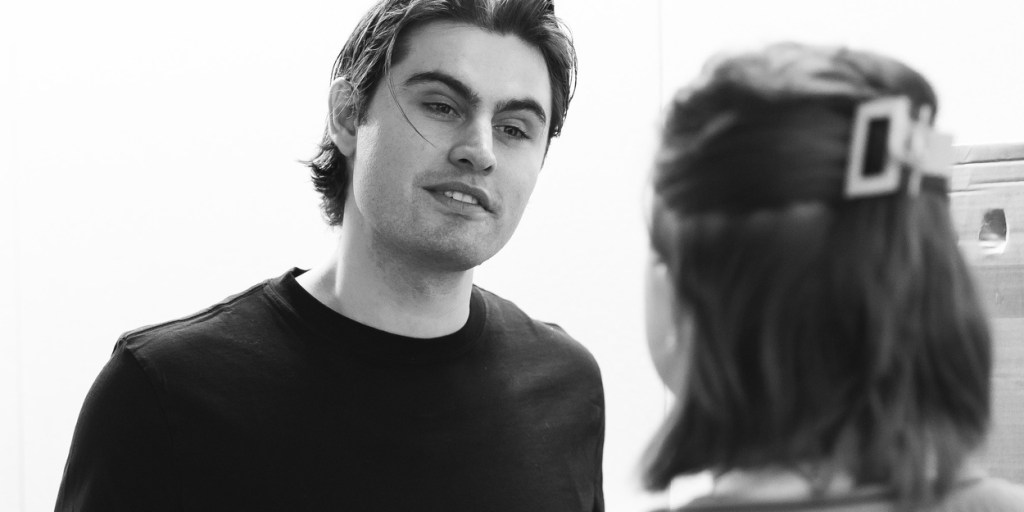
The cast are collectively compelling in these difficult roles, with Friedman and Resheff anchoring with intensity and a command of their difficult roles. All the others deftly play dual parts…a podcaster, reporters, and lawyers who are all woven into the storyline. The stark set design by Julian van Haubrich complements the production well, with its white office tables, towering street lights and rolling chairs that at one powerful moment are rolled across the stage by the actors under the harsh, interrogation room -like lighting (by Adrien Yuen).
Under the expert guidance of director Caroline Fairweather and with the skillful writing by Guiterrez, RETRACTION handles an extremely delicate issue with sensitivity and without condemnation. It is never implicitly stated that Lacey is lying; it’s made clear in the narrative that PTSD could be affecting her memory of what was a very real assault. Were there 6 guys or 4? Was it dark or could she see them? Was the blood on her dress not there at all, or just too subtle for her friends to notice? Though the real truth (or at least the truth within Wendy and Lacey’s fictional story) is never arrived at in RETRACTION, what we know to be at fault here is the careless reporting that was certainly in evidence in the real life situation, which impacted many lives and ended up putting the safety of women on campus and beyond at further risk. It is a powerful and necessary reminder that these issues must be handled carefully and delicately, both in art and in life. RETRACTION doesn’t provide easy answers, but it will leave one determined to ask the right questions.
RETRACTION runs at the The Shiner Theatre at The Sheen Center for Thought and Culture through January 31, 2026.

Jim Catapano attends A Powerful Double Bill for Dark Times
AnomalousCo’s Stiffler and Bounds Resonate at the ATA
In December of its 50th year, The American Theatre of Actors was host to two astonishing one-act plays that take on the oppression and abandonment of women and the plight of migrants—two of the most important issues facing the world as it sees out 2025.
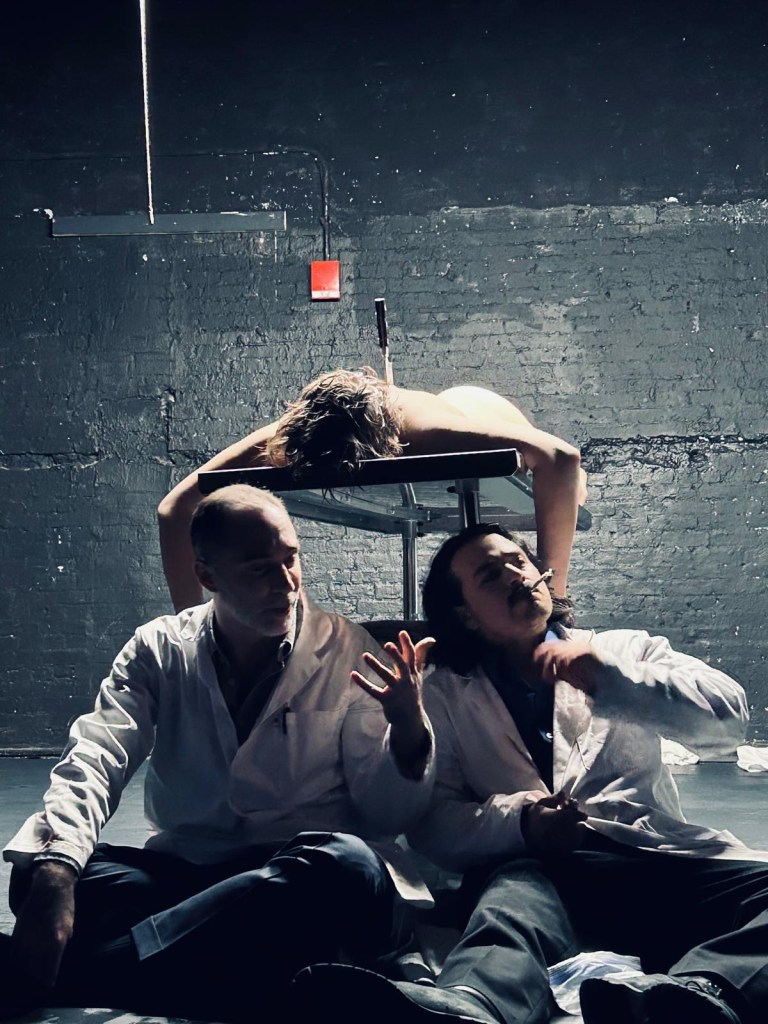
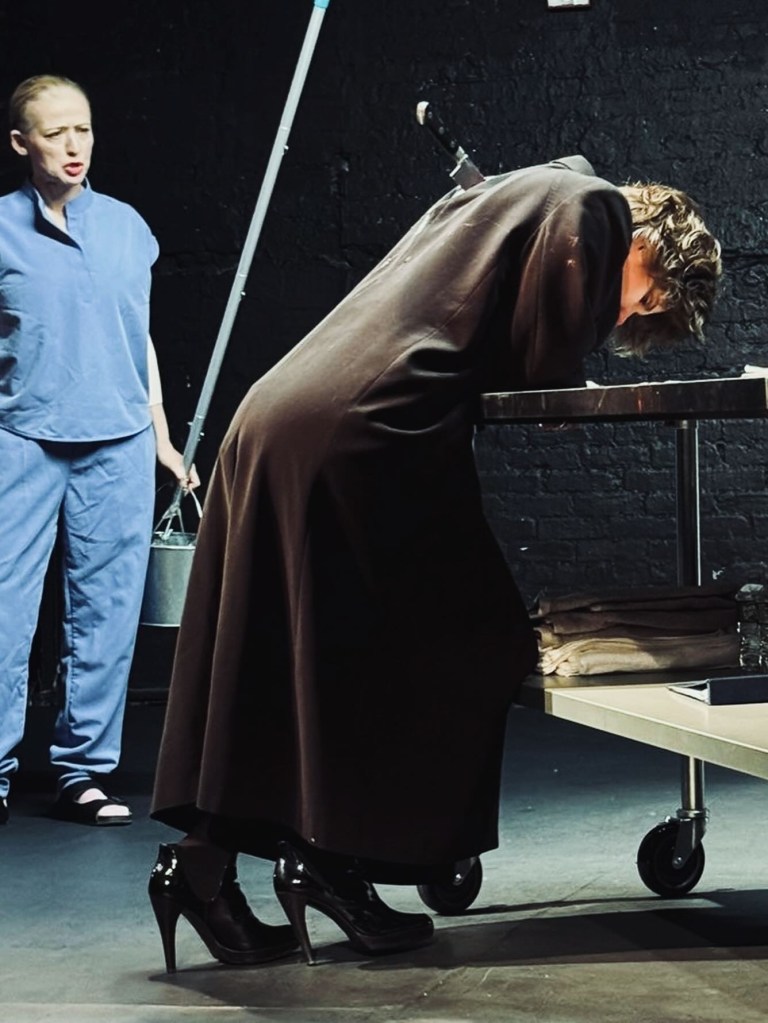
Stiffler is the work of award-winning Kosovan playwright Doruntina Basha. It is not an easy watch in any way, but as a study of systemic oppression, violence against women, and femicide, a completely crucial, unmissable one. Though some laughter emanated from the audience during moments of dark humor, the world of Stiffler is bleak and brutal; the stark set and harsh lighting complement the hopelessness of the situation and the cruelty of most of its characters. Diana Zhdanova gives an astonishing, heartbreaking performance as the mortally wounded Hava, desperate for help but finding only callousness and contempt, ridicule and revulsion. Stumbling into the ER after feeling a sharp pain and getting knocked out at a motel, Hava gets little compassion from the nurse on duty (Ylfa Edelstein); when Hava begs for water the nurse points to the sign above her station prohibiting it from being dispensed to patients; and later when she gets sick at the desk from the pain, the nurse makes her clean up the vomit herself, tut-tutting that she didn’t try to do it farther away.
“I’m sorry for the state you’re in,” sighs the nurse before noting in the same breath, “there’s some (vomit) left in the corner.”
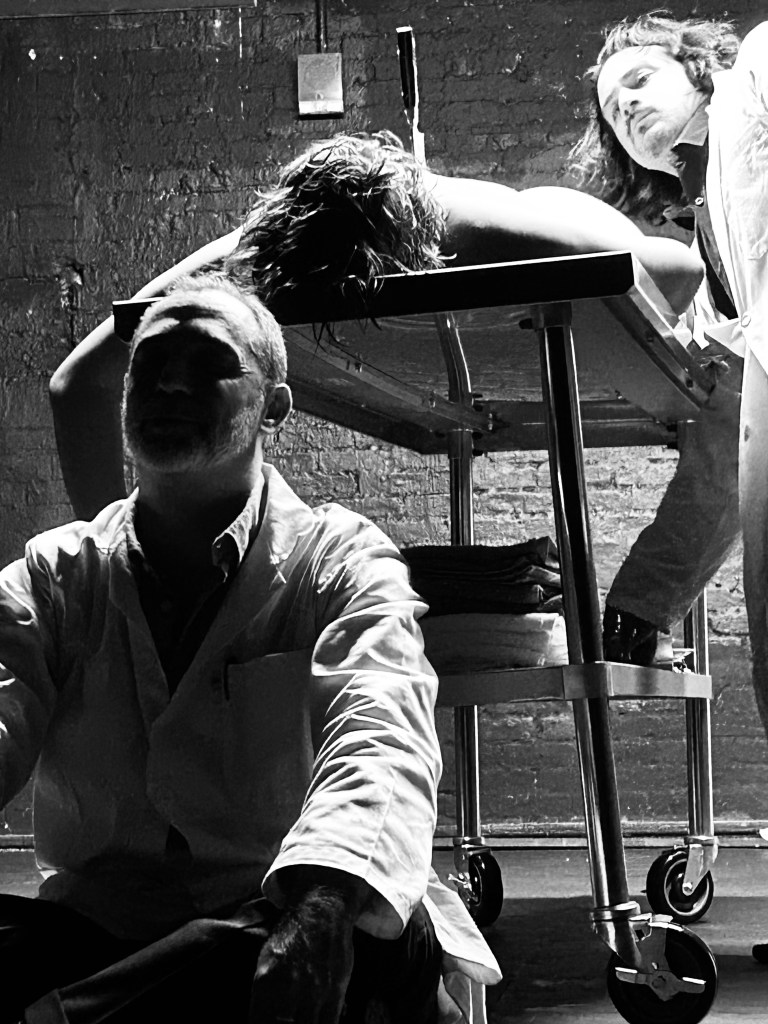
When the nurse sees the huge knife sticking out of Hava’s back she’s more interested than concerned, and concedes to let Hava see a doctor…after she’s signed the necessary forms. This lack of empathy for human life—particularly that of a woman, coupled with the callous dedication to procedure, places Stiffler squarely in our own reality. The contempt for Hava among the people she encounters in her most desperate hour grows as it is revealed she is a sex worker, and those in authority deduce that she “must have done something to provoke” her client into attacking her.
“You and your kind paint a bad picture of us,” seethes the nurse.
Thus Hava is now treated as the criminal rather than the victim, and she is subjected to verbal abuse, and psychological and physical torture by the vicious investigating police (Jeremy Goren and Giovanni Sandoval) that are purported to be helping her. When she has trouble breathing, the men say she can have the window opened—but she has to do it herself. During this latest ordeal the knife stays firmly in her back, a symbol of what the world at large has done to women. Zhdanova is incredible as a woman crying out to be seen as she fights physical and psychological agony, completely alone.
Hava’s story ends in a morgue, where even after death she is humiliated and treated as less-than-nothing; the attendants (Goren and Sandoval) roll her lifeless body around, and prop their clipboards and dictionary on top of her as if she were a table, as they consult the latter to come up with an appropriate but condemnatory name for her profession. And all the while, the knife remains. The only faint trace of compassion comes from Sandoval’s character, who literally takes a walk in Hava’s discarded shoes as he openly hopes someone will come to claim the body.
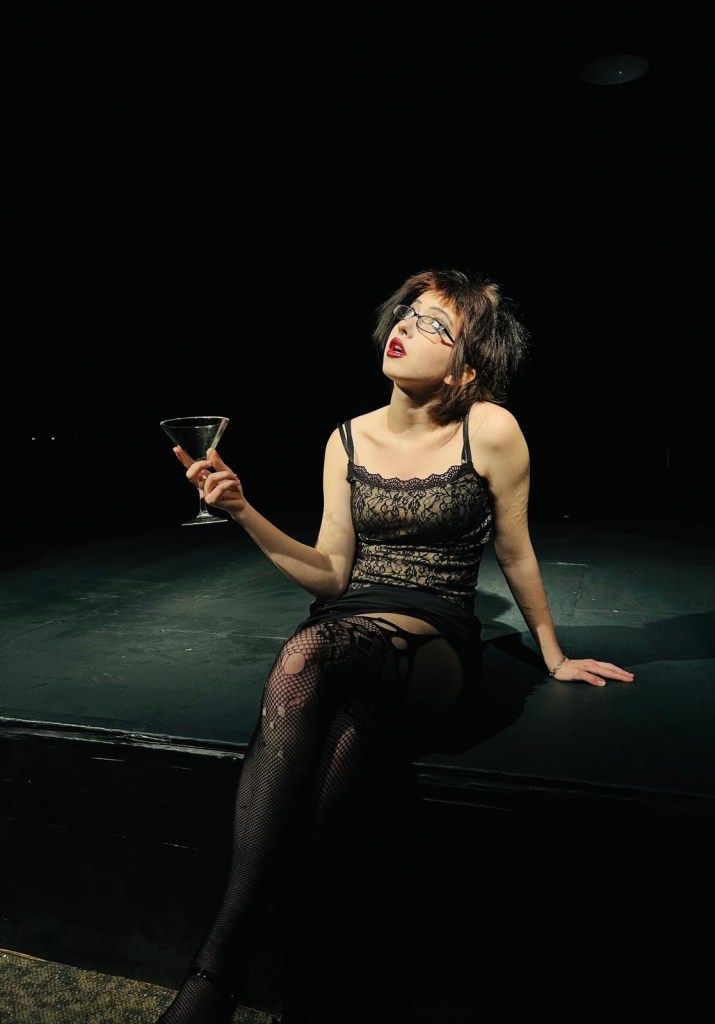
The scenes each end with a musical performance, powerfully punctuating what we’ve witnessed. Zhdanova joins Edelstein and Rina Brown in the fierce “Dead Men Don’t Rape” by Dellah Bon, and “I Love You Like an Alcoholic” by the Taxpayers. Edelstein also performs a chilling monologue as “Eyeless/Mindless Girl,” narrating her own story of being condemned and humiliated at the gynecologist. She describes herself as a “child of the roadside motel/gynecological clinic…all grown up with her very own souvenir” (now 8 weeks after conception), and muses that daughters who do bad things make their mothers sick.
“Boys can be lost in the dark, nothing happens to them,” she observes. “Girls can’t be lost in the dark because they’ll give their mothers cancer.”
Brown later narrates a first-person tale as the “Girl of the Two Hundred-Year-Old Cobblestone,” another woman brutalized and left for dead—abandoned like an empty bottle, broken on the cold streets.
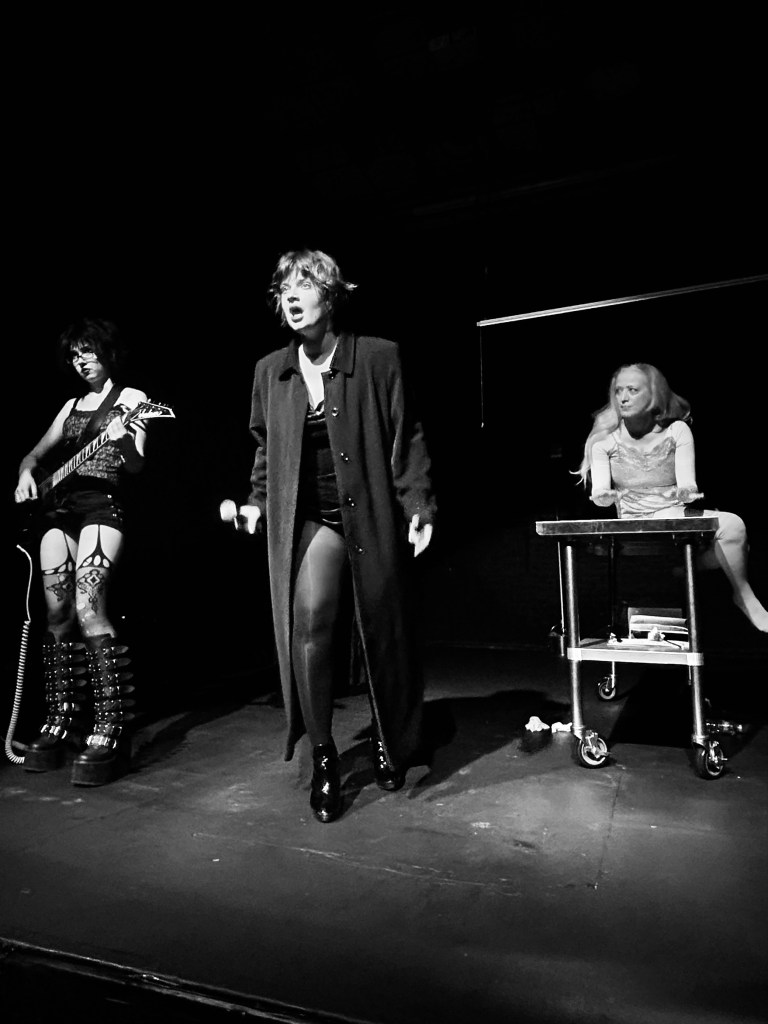
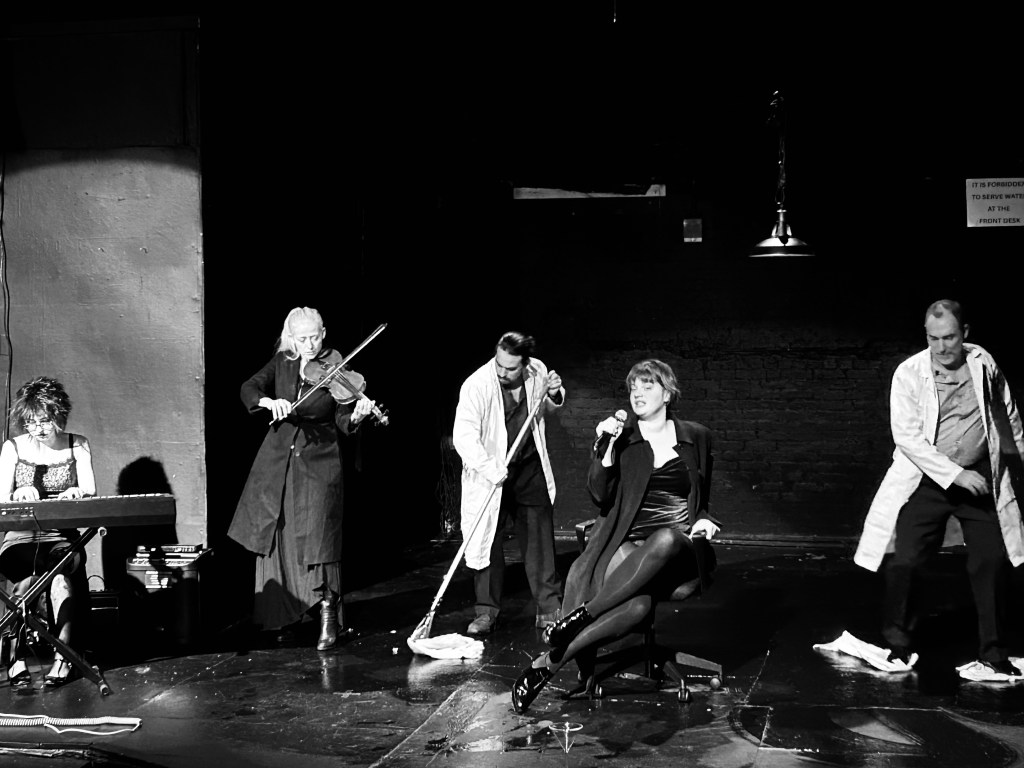
Diana Zhdanova
Stiffler is a stunning work that drives home the barely concealed contempt that our patriarchal society has for women, and devastatingly reminds us that its tragic, operatic story is not in any way removed from our current reality.
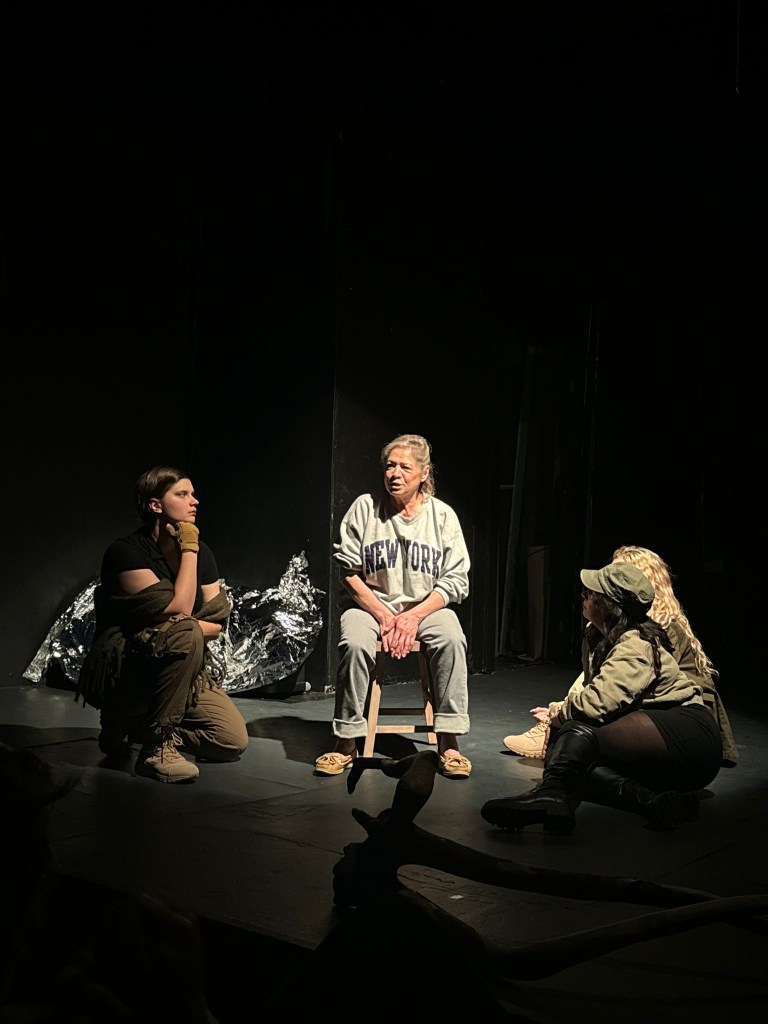
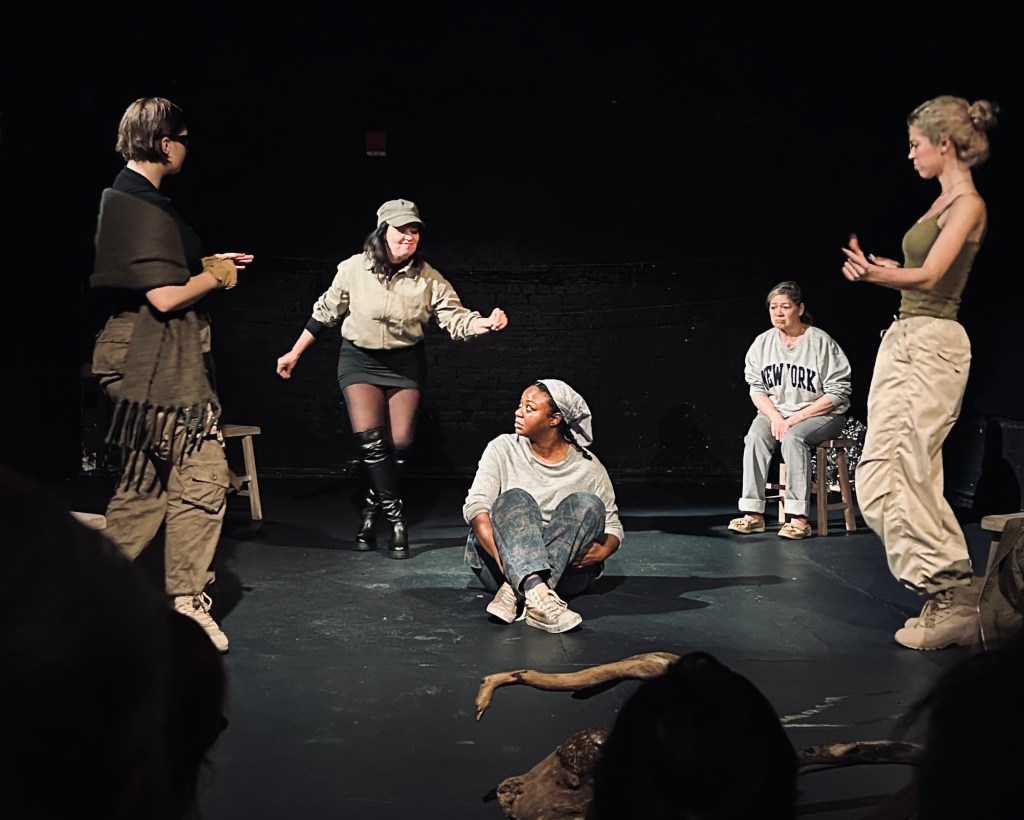
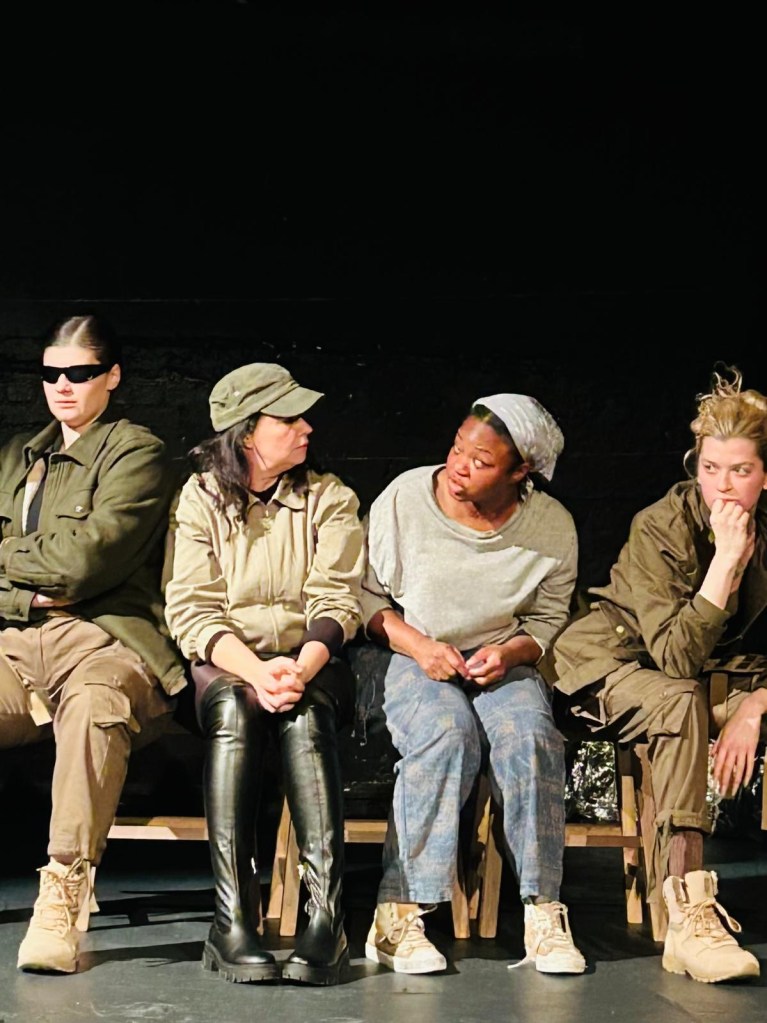
Bounds, by award-winning Italian playwright Tino Caspanello, was written in 2012 in a response to the recent migrant crisis in Europe. It was a time when thousands perished; others made it to freedom only to be rejected; and some were trapped in camps where they remain to this day. The playdepicts five women brought together in this frightening predicament, adrift on an unnamed shore. Two are military guards, two are migrants; the fifth woman is both.
One woman (Tia Cassmira) poignantly and powerfully sings of her desire and intention to simply have her own chair: “to sit on, to rest on, to dream on, for traveling, for laughing…a chair to sing my song on, for looking at the stars, for taking the air, for collecting rain…a chair to hide from death.” But the one actual chair among the women, symbolically, has to be “won.”
The group try to occupy themselves but grow restless. “There must be something else we could be doing,” sighs one woman.
“Like what?” says another. “We talked, we ate, we kept quiet, we slept and then we slept again, and now we’re playing. What more can we do?”
“What if we dance?”
Thus begins a brief moment of pure joy, where the women come together as one in transcendent movement, but also are likely imagining themselves as individuals on the road to freedom. But in the end, they know only one of them can ultimately be “chosen,” with the imagery of the childhood game “Musical Chairs” again illustrating the brutal point that most of them won’t make it.
Zhdanova, Cassmira, Simona DeFeo, Wilemina Olivia-Garcia, and Greta Rustani are the women; the actors hail from diverse backgrounds and experiences, and seeing them passionately joining together to tell the story of migrants, and to champion not only their rights but the rights of women everywhere, is intensely moving and inspiring.
These two crucial works are directed with compassion and extraordinary skill by Kathryn Mederos-Syssoyeva.
“There are a couple of really key issues which ground AnomalousCo theatre company,” noted Mederos-Syssoyeva while introducing the plays. “One is elevating, foregrounding, giving space to the perspectives of women…in some cases the writers themselves are women; in other cases it means that the plays are female-centric; and the second equally important thing is foregrounding the voices of immigrants, migrants, and also very broadly, voices from abroad interesting in bringing to New York a very strongly global, international, multicultural perspective through the work that we do. I don’t think we’re alone in thinking this increasingly urgent with every passing hour, if not every passing minute.”
Learn more about the Company’s work at Anomalousco.com/.

Jim Catapano, Danny, and Roberta, take a Plunge into the Deep End
John Patrick Shanley’s Stunning Two-Hander is Revived at the ATA
The renowned one-act playDanny and the Deep Blue Sea, which originallypremiered off-Broadway in 1983, is given a magnificent retelling at the American Theatre of Actors in its 50th season. Penned by prolific playwright and Oscar winner John Patrick Shanley (Moonstruck), it is an intense and compelling study of loneliness and human frailty, and the desperate desire to be seen and understood, forgiven and loved.
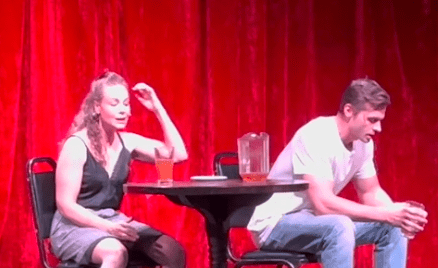
As observed in a holiday season where the “meet-cute” scenario is one of its hallmarks (pun intended), Danny stands out as a “meet-ugly”, and feels all the more real as a result.
Tashia Gates (producer) is Roberta, a divorced mom who encounters Danny (James Liddell) in a dilapidated, empty Bronx dive bar. Danny’s black eye and bruised hands indicate a recent altercation, creating an unsettling mood from the outset and the implication that he might erupt at any moment. He asks for one of Roberta’s pretzels and wants to leave it at that, but Roberta decides that she needs company and goes to sit with him, prompting Danny to act like a bear who’s been poked with a stick. Danny is bad news and makes no attempt to hide that, but Roberta is a woman in pain, trapped in her own life but yearning for some kind of human connection and normality that will release her from reality, at least for a handful of heartbeats.
“I can’t stay like I am,” she says to the only person she’s ever found who just might listen. “I can’t stay in this effing head anymore, I’ll go crazy.”
Danny is in a prison of his own. Feral and fearful and unable to connect to anyone except with his fists, he is in danger of losing his blue-collar job where his coworkers have labeled him “the beast.”
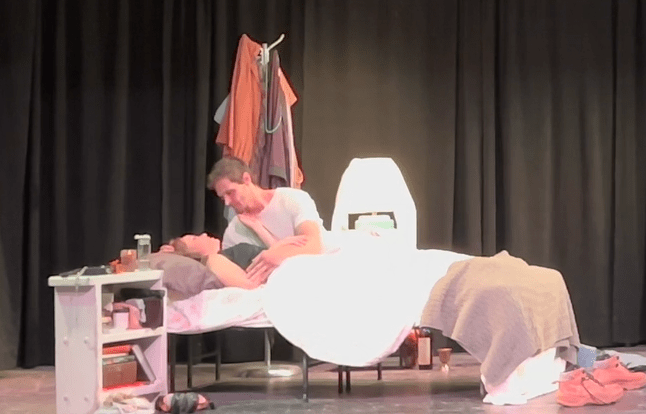
Undeterred, Roberta goes all in and tells this stranger of a dark, horrifying secret from her past, making Danny the only person who knows it and forcing a bond between them. Danny also suspects that his most recent actions may have led to tragedy, and the two debate the severity of their crimes and the depth of their pain until things get edge-of-your-seat frightening. As Danny grows more violent Roberta grows more defiant, winning the psychological and physical battle and convincing Danny to come home with her. She wants to play at “domestic bliss”, if only for one night; she even coaches her new partner in the art of being nice. But when Danny decides he wants the dream to become reality, they awake to a new nightmare that now imprisons them both.
Gates is astonishing as the broken Roberta, so trapped in her own mind that she wonders if prison would be a nice change of pace. She is looking for punishment, and then maybe forgiveness, though she suspects the latter impossible. Liddell is at turns terrifying and heartbreaking, a ticking time bomb who solves every issue with fighting, but crumples into a scared child as his unanticipated new lover takes him on a rollercoaster of emotions. These two damaged souls coming together in mutual desperation is portrayed compassionately and genuinely; and though most of us haven’t had Danny and Roberta’s experiences, Gates and Liddell make them relatable and even lovable.
Presented on a sparse stage and clocking in at a tight 80 minutes, this new incarnation of Danny and the Deep Blue Sea is a remarkable piece of work and a triumph for producer Gates and Liddell, who beautifully portray their characters in three dimensions. It is directed impeccably by Tessa Welsch, who makes brilliant use of the sparse surroundings to portray the dark, empty lives of the protagonists. And serving as executive producer along with Nick Milodragovich, this is Dr. Cynthia Hsiung’s first foray into theater, adding to an accomplished career in Film and TV. This iteration of Danny is a jewel in the crown for all involved.
Danny and the Deep Blue Sea is performed at the Sargent Theater at the American Theatre of Actors through December 7. It is dedicated to the memory of Maxine R. Gibbs.

Stage Whisper Celebrates Five Years as LeadingIndependent Arts Podcast
Stage Whisper, the celebrated podcast dedicated to independent artists of stage and screen, is proudly marking its fifth anniversary. What began as a “little show that could” has now firmly established itself as the #1 podcast in its category, achieving significant milestones and laying the groundwork for exciting future growth.
Over the past five years, Stage Whisper has become an essential platform for the independent arts community. The podcast has produced more than 1,300 interviews and episodes, with over 600 of those released in 2025 alone. Its commitment to showcasing diverse talent has resulted in over 100,000 content downloads and featured over 100 different festivals.
Reflecting its dedication to the local theatre scene, Stage Whisper staff attended over 1,000 productions in the New York City Area.
The podcast’s influence extends across digital platforms, having recently surpassed 10,000 followers across all social media platforms, generating more than 200,000 monthly interactions.
Stage Whisper is distinguished by its core mission to remain an unbiased and independent voice, open to all shows and stories without reliance on corporate sponsors, reviews, or social media trends. This commitment to artistic freedom has earned high praise from the industry’s top professionals:
- Award-winning playwright Marlin Thomas called his interview “a great experience.”
- Author and artist Betti Franceschi exclaimed, “I LOVED our talk!”
- Broadway performer Laura Shoop (Flying Over Sunset, She Loves Me) even dubbed the show “the NPR of Theatre Podcasts.”
Looking Ahead: 2026 and Beyond
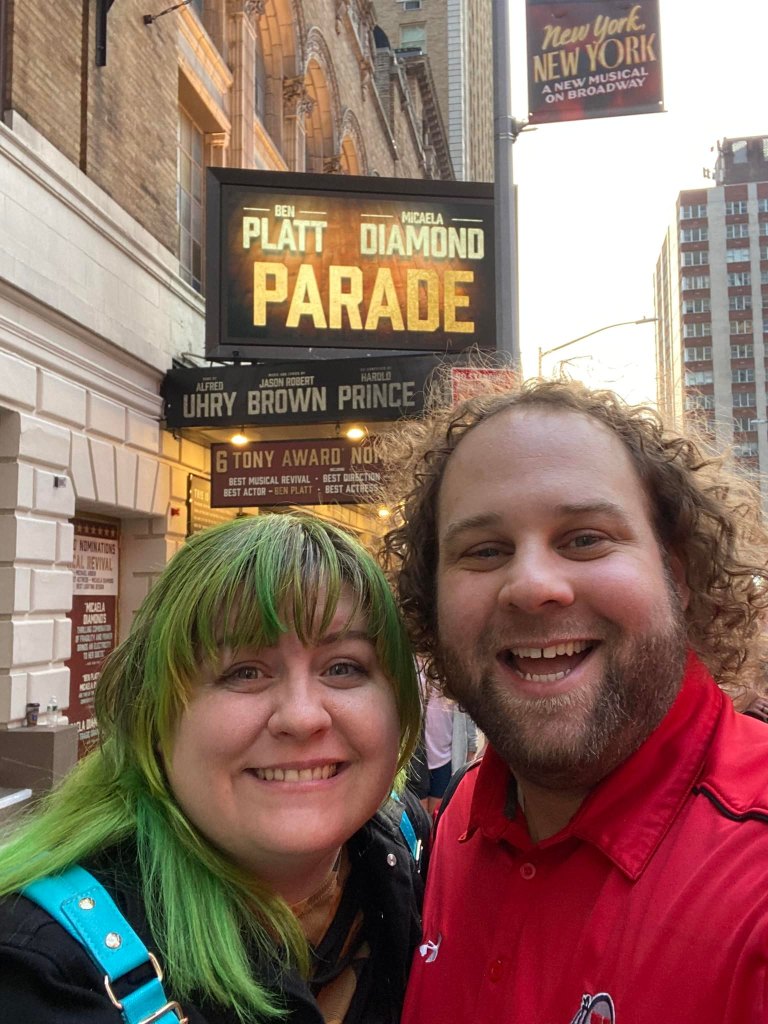
Co-hosts Andrew Cortes and Hope Bird have announced ambitious plans for 2026 and beyond, designed to further increase visibility for independent artists:
- Video Interviews launching via Channel Indie (ACW-TV).
- Special Panels and Discussions.
- Enhanced marketing efforts for increased visibility for guests.
- Exclusive Live Events.
A Call to the Community: Listener-Sustained Fundraising Drive
In the spirit of being a listener-sustained program, and recognizing the precarious financial nature of the arts, Stage Whisper is launching a critical holiday fundraising campaign. The goal is to raise $5,000 before the end of 2025 to ensure the podcast can continue its mission without compromising its independent ethos.
“We are reaching out to all of our listeners, guests, and collaborators,” the co-hosts stated. “We understand that money and art are precarious, but we are asking anyone who values our work to make a $5 donation in honor of our fifth year. Your support, at any level, is crucial to keeping Stage Whisper free for both artists and audiences globally.”
Stage Whisper aims to not only help the independent arts community survive difficult times but to foster its growth and help it thrive in 2026, which they anticipate will be an exciting year for the arts.
Donations can be made through the following platforms:
- Patreon: patreon.com/stagewhisperpod
- Venmo: @stagewhisperpod
- PayPal: https://www.paypal.com/ncp/payment/YVX5DQSAJWZXS
Stage Whisper extends its warmest wishes for a Happy Thanksgiving, Happy Holidays, and a Happy, Healthy, and Prosperous New Year to its entire community.
Media Contact: Jay Michaels / info@jaymichaelsarts.com / 646-338-5472

A Jim Catapano Review: Don Nigro’s In the Wilderness of Demons Blends Ukranian Legend with Life’s Great Questions
Myth and Reality Meet in the Darkness
On a very dark and very stormy night, a folklore enthusiast (Tatyana Kot) appears at the Ukrainian cottage of a mysterious woman (Iryna Malygina). The isolated home deep in the woods is shared only by faceless dolls, represented by 4 dancers who lurk silently, witnesses to the unfolding events. Thus begins a journey In the Wilderness of Demons, a compelling tale by the acclaimed Don Nigro—one steeped in Ukrainian legend, mixed with dark wit, suspense, a touch of horror, and a deep dive into the existential.
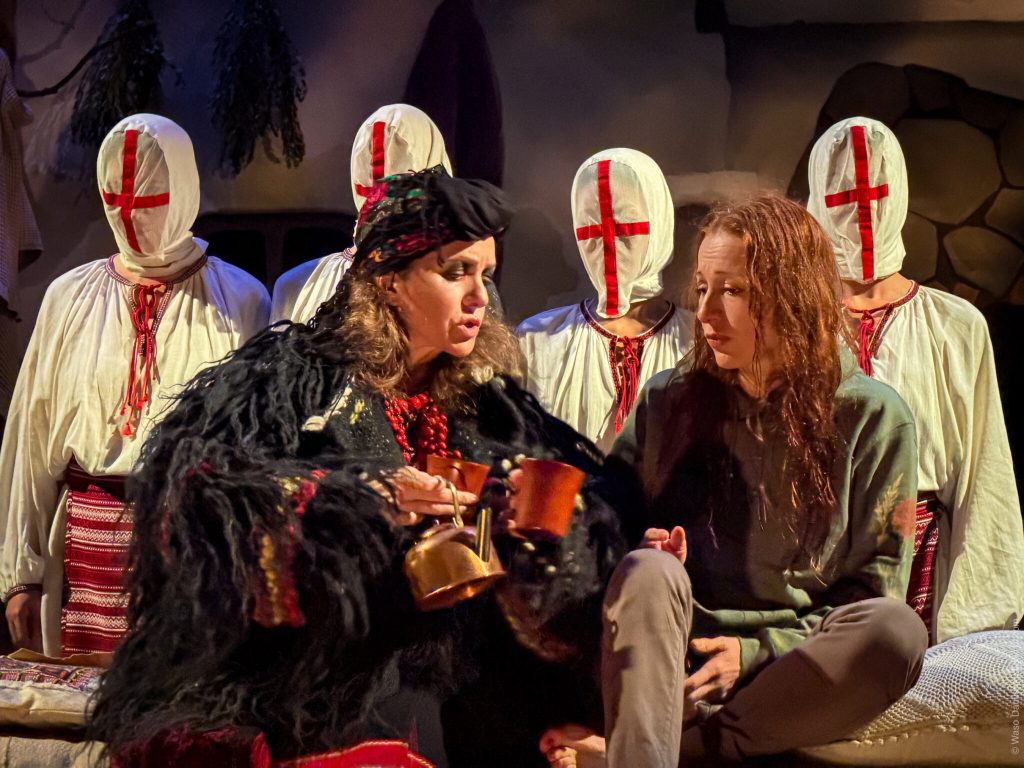
“What a night to be creeping around out there,” the woman scolds. “It’s pouring down ice cubes…there is a raven frozen to the pump!” (An image that immediately sets the tone.)
When the folklorist explains she got lost in the woods, the woman turns philosophical. “Getting lost on the way is all part of God’s plan,” she responds. “He wants us to get lost, to sell us outdated roadmaps and compasses that don’t work.” She admits that she thought the folklorist might have been one of the dead, “who come out of their graves this time of year…they try to get back in their houses.”
The eccentric, assertive cottage dweller pivots between doting on the soaked and shivering folklorist and appearing to intentionally frighten and unsettle her. She dries her feet, gives her slippers owned by her late grandmother, serves her tea, and makes up a bed for her—only to turn around and tease her by suggesting she’ll be sharing it with a dead rat.
“I’m joking,” she says. “He’s probably just sleeping—or pretending to sleep.”
Malygina (who also produced) is outstanding at bringing the witch-like character to life, creating a mystery and unease that is palpably felt by the audience. She is also intensely philosophical and astute, as when the folklorist mentions her realization that “all men are a—holes.”
“Men think we’re vampires,” notes Malygina’s character. “The thing they want most is to drive a stake into us…but it’s the men who prey upon us. I had my fourth husband buried face down to make sure he didn’t come back after he died.”
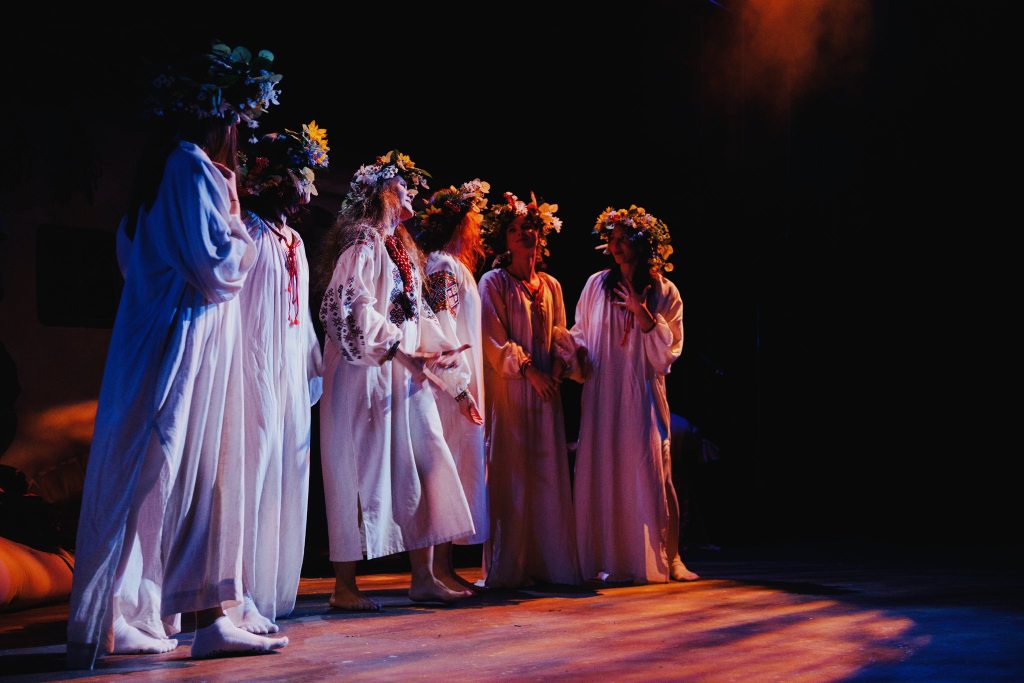
Along the way we get an education in the Ukranian folklore our protagonist is so intrigued by, as we learn of the Rusalka, the legendary water nymphs who would lure men to their deaths under the sea, and the demonic Chorts.
“Do you really think that they exist?” asks the folklorist.
“Define exist,” says the woman. “Does a dream exist? It always seems real when it’s happening in your head…but then you wake up…or, you wake up into another dream.”
The set design by Lesya Verba is a perfect complement to the unfolding thriller, allowing the faceless dolls to wander about menacingly, always watching (and judging? As the woman suspects). “It’s their job to make guests feel uncomfortable so they leave.”
As the audience identification character, Kot is fantastic, imbuing the wary folklorist with an intense existential dread, as she begins to suspect that she has been in this strange place before.
The soundscape adds further atmosphere with thunder, whistling winds, and ticking old-fashioned clocks. The woman explains that her father liked to collect broken clocks—in her opinion, as a way to control time.
The disturbing atmosphere is pierced mid-play by an exhilarating dance sequence, where our protagonists join the no-longer faceless dolls, all transformed into Rusalka-like spirits. Following this cathartic interlude (which makes the folklorist wonder what’s in the tea), the story ends (or begins?) with a shocking revelation—and an invitation…
In the Wilderness of Demons is a magical, frightening, funny, and exhilarating experience that celebrates both Ukrainian culture and legend, and women’s empowerment.
The production is expertly shepherded by director Eduard Tolokonnikov, with expert choreography by Kot. The doll dancers are Shoko Tamai, Marija Obradovic, Evelina Pristovsek and Iren Kamyshev.
In the Wilderness of Demons is a production by MOVA Theater Company. It runs at The John Cullum Theatre at the American Theater of Actors through 11/02/25. Learn more at movatheater.com/.

Review by Jim Catapano: Tom Nemec’s A Cat in a Box Is a Moving Journey from Trauma to Healing
From The Storm to The Breeze
Comedian and actor Tom Nemec has a story to tell. It’s a deeply personal one, but judging by the response at The Tank theatre as he told it in his one-person show, one that resonates far and wide.
One of the first things Nemec does upon taking the stage is to invoke his childhood self, calling for his mom. “This is the way I entered my childhood home my entire life,” he explains. “Screaming ‘Mom!’ often before I even got through the front door.” He shows a picture of the home, in Lyndhurst New Jersey (“Gateway to the Meadowlands,” he quips before adding, “I hated that house.”)
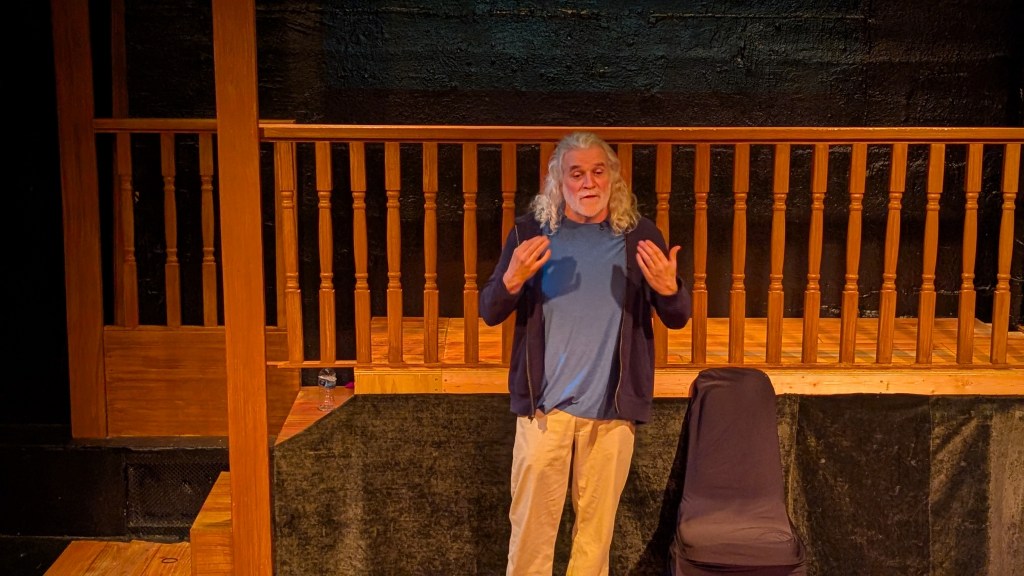
Over the course of an hour, A Cat in a Box reveals what happened in that house as Nemec and his three siblings grew up in the 1970s; and as these events unfold to us, Nemec bares his soul and shares his life. It was a childhood of dysfunction and isolation, of alcoholism and emotional and physical abuse.
Nemec warns early on not to expect any funny or sentimental anecdotes. “When most people hear the word ‘family’ they think love, stability, support,” he notes. “But that’s not the definition. That’s an ideal…My family was just a group living together as a unit.”
He hated the family photo that hung on the wall as much as the building that housed it, as it was a lie. “That was not us,” he observes. “But I continued to pretend it was for a long time.”
Nemec’s recollections are raw, and no punches are pulled. He speaks of nights that would end with Nemec’s severely inebriated father banging on the door, demanding to get in. “I’d just wish he’d wander off to someone else’s house and never bother us again,” Nemec admits. He is nostalgic for the Christmas holidays because “no matter how bad things were at home, everyone was in a slightly better mood (and besides I kind of believed in Santa Claus”). Though he concedes that any gifts were “more like an obligation wrapped in a bow.” He reveals sadly that his father’s addiction overshadowed his mother’s behavior, which was often accompanied by violence.
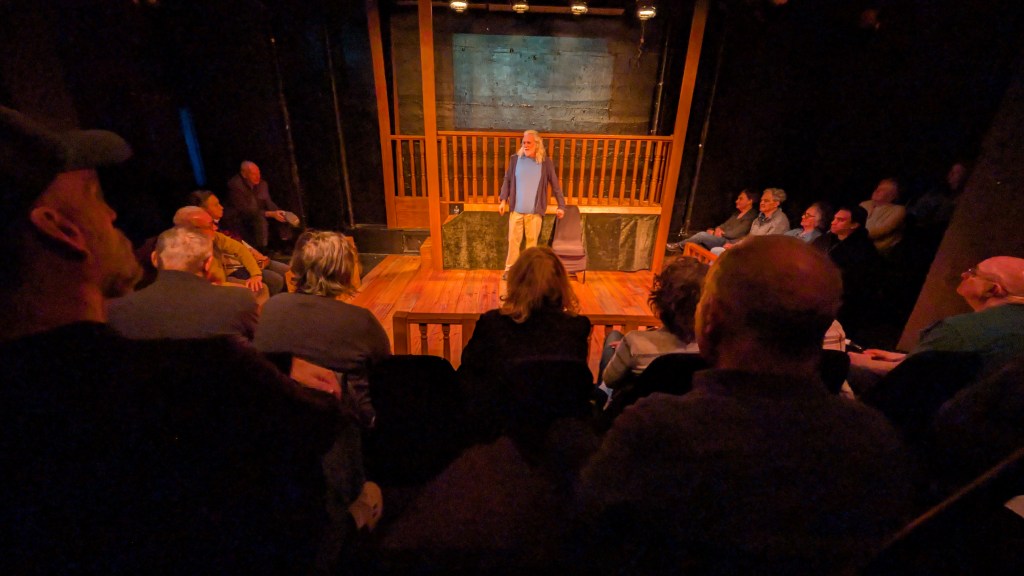
The audience was captivated by Nemec’s every word. One could almost picture themselves in that Lyndhurst home, so vivid is Nemec’s recollection and expert storytelling. The most moving part of his tale is his journey to adulthood and his path to reconciling with the past and conquering his own demons. He last entered that house in the year 2000, and is now not only an accomplished actor and comedian, but a teacher, helping young children make their first steps into life in a healthy, nurturing environment.
A brief Q&A after the performance revealed that many in attendance saw a lot of their own childhood in Nemec’s. For a moment, we were united in our collective experience, and in our resolve to heal; and to paraphrase Nemec’s powerful closing statement, “to see the breeze as our friend.”
A Cat in a Box is directed by Jim Mendrinos is performed at The Tank through November 8, 2025. For more information, visit https://thetanknyc.org/calendar-1/a-cat-in-a-box
 Arts Independent