
The Life of a Literary Legend
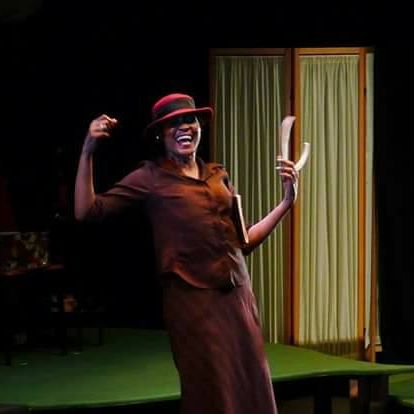
Actor Antonia Badón and Director Greg Freelon join forces to bring us the triumphant Zora!, a new staging of Laurence Holder’s play, realized as a one-woman show. It’s a love letter to not only the brilliant author, folklorist and anthropologist Zora Neale Hurston, but to a pivotal, landmark time in history.
Badón is astonishing as Hurston, “A Genius of the South” as novelist Alice Walker’s epitaph proclaimed. She embodies the author at various stages of her life, growing from a young hopeful to an accomplished elder with stunning realism, changing body language and the pitch of her voice dramatically to fit the time period. Hurston adventures from her home of Eatonville Florida, the first incorporated all-black town in America, winning a scholarship to Barnard college and launching herself into becoming a prominent force in the Harlem Renaissance. The most popular of her novels, Their Eyes Were Watching God, is published in 1937, and her essays, short stories and plays made her an essential voice in the black community of the time and well beyond.
In between (and often during) Badón’s monologues, a film projection of scenes from the early 20th century accompanies Zora’s story. Vivid images of New York City, and of the great icons of the era (such as Langston Hughes, James Van Der Zee, and Duke Ellington) flash by as we are treated to a soundtrack of the jazz classics of the age. The film interludes, while allowing us to delight in wistful time travel to another era, also allow Badón to change into one of her many fabulous outfits.
Armed with her powerful pen (and typewriter), Hurston’s voice holds tremendous power, brutal honesty, and necessary skepticism and criticism of the norms of the era. “I will jump up to support this democracy as soon as all those Jim Crow laws are gone,” she proclaims. “…But I am not selling out for no cheap, itchy suits!”
The most poignant sequence depicts Hurston as weary and ill in the late 1940s. She has written several acclaimed novels but with little money to show for it; she is now without a publisher but determined to raise her voice up and write again. After looking frail and spent she suddenly rises from her chair, stands up tall, and returns to her typewriter, stoic and strong once more, in a foreshadowing of her enduring legacy.
“Don’t worry about me,” she smiles.” Go down to your neighborhood bookstore. I’ll be there.”
Zora! is at the Sargent Theatre at the American Theater of Actors through Oct. 20, 2024.



 Arts Independent