
Content Note:
While A View from the Bridge is a period piece set in 1950s Brooklyn, it explores themes that may be difficult for some viewers. The production includes depictions of immigration raids, which despite their historical contextcmay evoke distressing parallels to modern-day ICE activity. Additionally, the story involves emotionally charged dynamics of incest-adjacent longing, sexual jealousy, and homophobia, particularly directed toward one of the immigrant characters. These elements are central to the dramatic tension and are portrayed with seriousness and emotional weight. Audience members sensitive to these topics are encouraged to approach the production with awareness.
A View from the Bridge
Presented by Modern Classic Theatre
Walking into the BACCA Arts Center in Lindenhurst for A View from the Bridge by Arthur Miller, directed by Emily Vaeth, was quite a treat. The team transformed the venue into a black-box-style theater, seating roughly 50 patrons depending on the arrangement, and the intimacy of the space was used to full advantage.
Before a single line of dialogue was spoken, the world was already pulsing with life. In the center, Beatrice (Camille Arnon) moved about the apartment, humming along to Perry Como’s Chi-Baba, Chi-Baba while prepping dinner. Catherine (Jules Donahue) bounced between reading, dancing, sipping, and sighing bored, bright, and bursting with that specific teenage ache. Beyond the apartment walls, the community stirred: Louis and Mike (Kevin Russo and Thaddeus C. Plezia) made their rounds like neighborhood fixtures; Mrs. Lipari (Natalia Cotto) dominated the public phone with everyday urgency; and the silent shadow of the immigration officer (Alex Rich) drifted in and out, a subtle yet constant reminder of looming consequence.
This immersive pre-show tableau was a brilliant directorial move. In such a close space, it pulled the audience inward slowly and organically. You weren’t just watching a play you were already inside a Brooklyn neighborhood, witnessing the rhythms of daily life before the conflict ever cracked through.
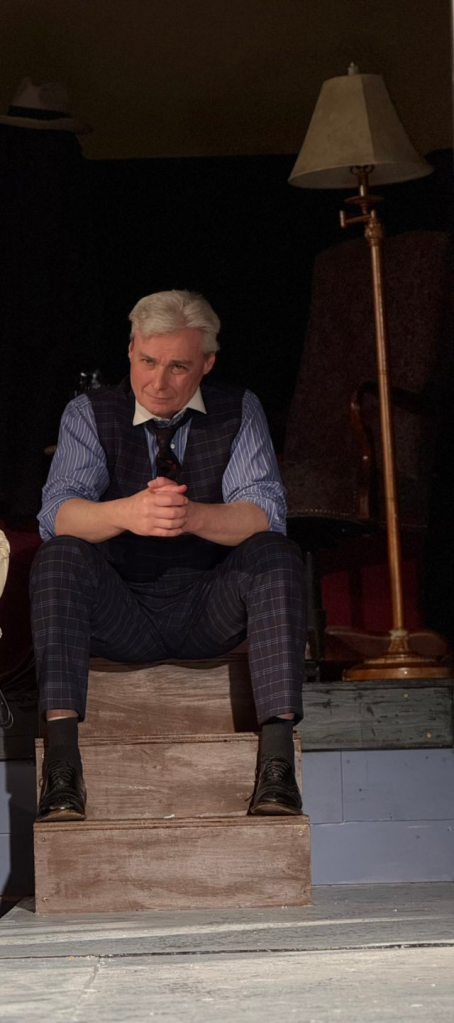
Big praise is due to set designer Ian Freed for the thoughtful, minimal design. The perimeter of the playing space, with its suggestive dockside textures and city street grit, subtly framed the action. Streetlights glowed just enough to evoke Red Hook’s moody hush. One particularly smart touch was the elevation used to frame Alfieri’s (Derek McLaughlin) office a raised area that gave the narrator a quiet vantage point from which to observe and reflect. It gave his role both physical and emotional distance, reinforcing the sense that this was a memory being retold, a tragedy already written in the bones of the set.
More well-deserved praise for the lighting and sound design by Dan Caney. The pre-show playlist Peggy Lee, Perry Como, Sarah Vaughan rooted the show in time and place before a single line of Miller’s text was spoken. The use of “practical” streetlamps, apartment lights, Alfieri’s office lamp was especially effective in establishing tone and texture. That said, during scenes staged on the far leg of the thrust (where one row of the audience was seated), lighting occasionally failed to fully illuminate the actors during key monologues. While these moments didn’t erase the emotional clarity of the scenes, they were noticeable. Still, given the challenges of lighting such an intimate, three-sided space, Caney’s work achieved a rare balance: immersive mood and respectful shadow that allowed the audience to observe, not intrude.
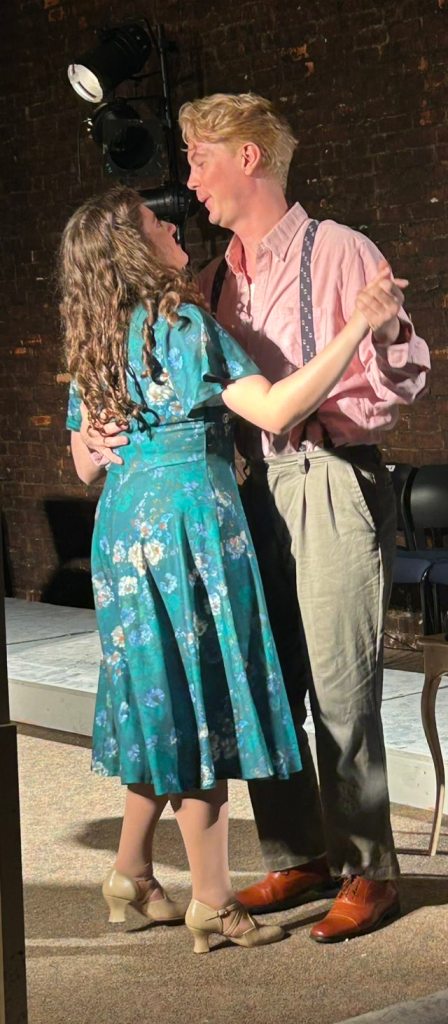
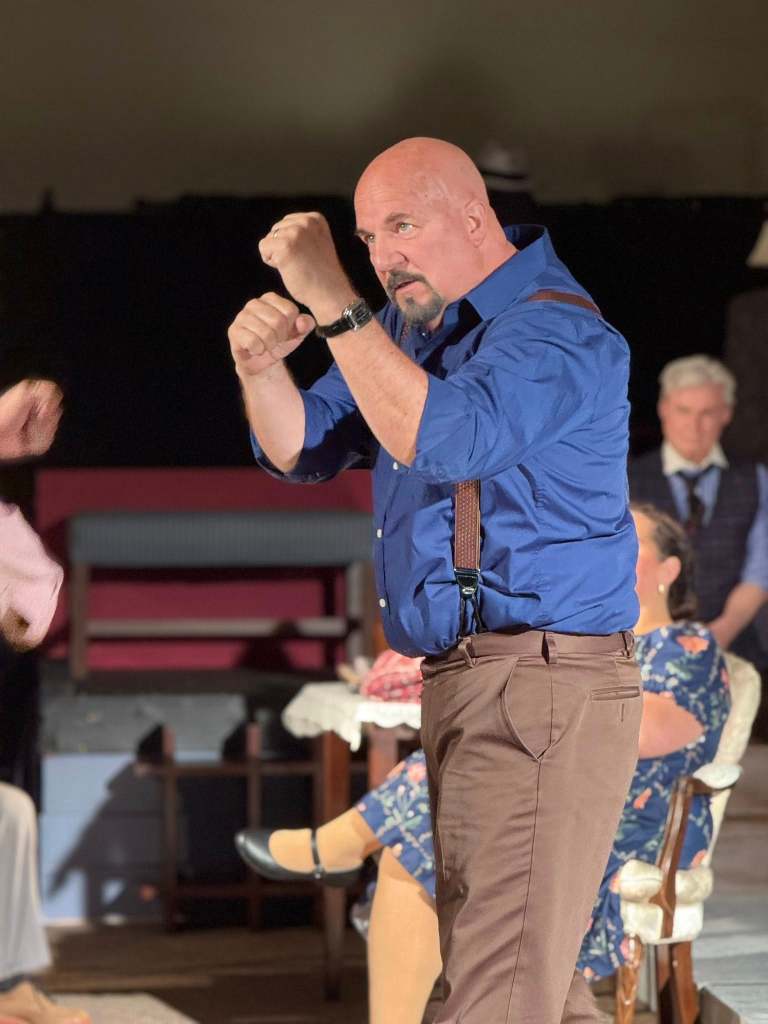
A special shout-out is due to the ensemble the so-called “smaller” roles that were anything but. Mr. and Mrs. Lipari (Leo Pompeo and Natalia Cotto), Mike and Louis (Thaddeus C. Plezia and Kevin Russo), and the Immigration Officers (Plezia and Alex Rich, pulling double duty) each brought thoughtful, grounded performances to the stage. Nothing felt phoned in or filler. Mike and Louis’ roughhousing camaraderie added humor and heart, while Mrs. Lipari’s no-nonsense phone habits brought real texture to the neighborhood. And Mr. Lipari? With his bloodstained apron and commanding stillness, Leo Pompeo exuded strength a figure you didn’t want to cross. Every glance, every shrug, every entrance had intention. This was an ensemble that knew how to build a world.
Derek McLaughlin’s Alfieri the narrator, conscience, and weary moral anchor was another standout. He brought a quiet, almost grandfatherly presence to the role, the kind of man who’s seen too much but still hopes for better. His lines were delivered with calm clarity and deep empathy, grounding the narrative in reflection and grief. Though a lawyer by trade, McLaughlin’s Alfieri radiated heart. You never doubted he wanted to do right by everyone involved, even as the story slipped through his fingers like sand.
Tim Smith as Eddie Carbone delivered a powerhouse performance. At first, he was the everyman: likable, steady, the guy who’d give you the shirt off his back. But as the undercurrent of possessiveness and jealousy surged, Smith didn’t miss a beat. His descent into emotional torment was layered and fully believable. One minute, you felt for him this man losing the only world he’s known. The next, you recoiled as the truth of his desires surfaced. He made Eddie both monster and man, and it was riveting.
Camille Arnone’s Beatrice was a masterclass in restraint and heartbreak. With every glance and carefully timed outburst, she built a woman trying to hold her world together while watching it slip away. Her keeping her jealousy of Catherine from boiling over was never cartoonish; it was human. She gave Beatrice dignity, fire, and unbearable sorrow all at once. You just want to hug her.
Jules Donahue’s Catherine was precise and technically strong never a line dropped, never a mark missed. Her portrayal leaned slightly more self-aware than one might expect for such a sheltered character, which occasionally made her feel more rehearsed than raw. Still, she captured Catherine’s central confusion especially in scenes with Eddie beautifully. You saw the girl trying to define love, identity, and independence in a world that hadn’t given her a language for any of it.
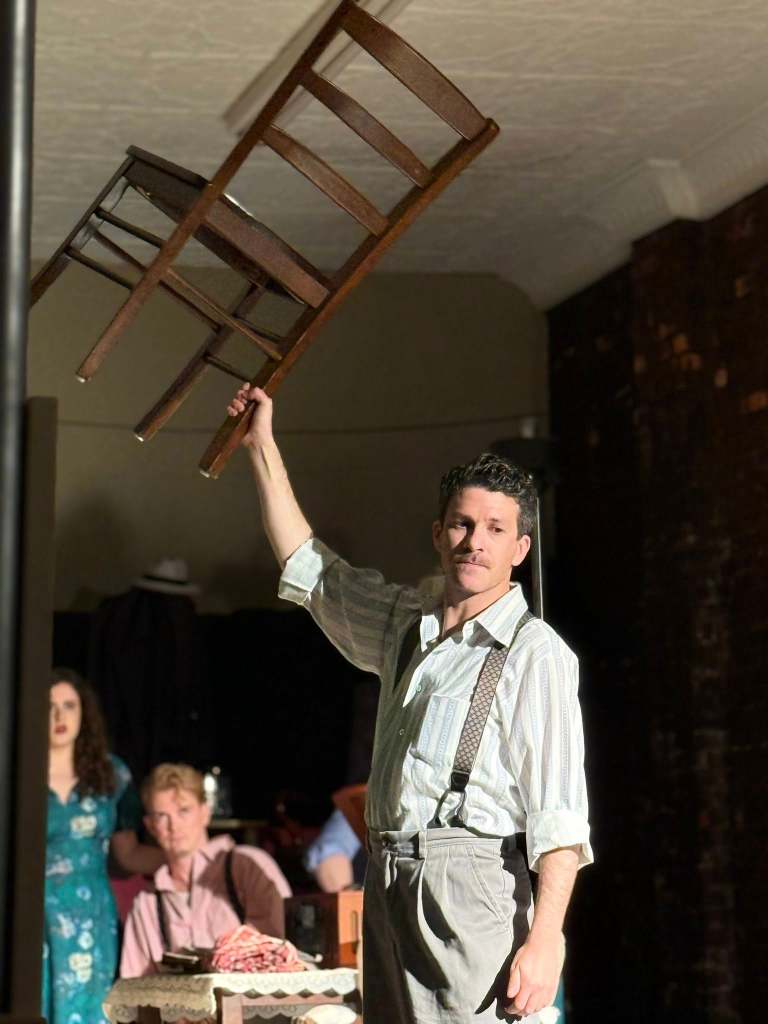
Andrew Accardi’s Marco brought big brother gravity in a small frame. With solemnity, strength, and just the right amount of quiet threat, he made it clear this man had crossed oceans for his children and would not be disrespected. The iconic chair-lift moment landed like thunder. Accardi’s Marco was no con artist, no passive guest. He was a protector. A man of few words but boundless integrity.
And then John McGowan. Rodolpho.
If there was a show-stealer, it was him. McGowan’s boyish charm was undeniable. He made it crystal clear why Catherine might fall for this wide-eyed Italian dreamer. He was goofy and elegant, sweet and proud. And when the accusations came, when his future was questioned, McGowan showed us the urgency and reason for the dream. This was a man who wanted to become something not just escape something. Even after the show, the audience was buzzing. Rodolpho was unforgettable, and McGowan lit up the stage with every step.
If there was one element that didn’t fully land, it was the larger fight choreography. While the boxing scene between Eddie and Rodolpho was sharp and brilliantly executed tense, clean, and full of subtext the ensemble fight sequences near the end felt a bit chaotic. With action happening so close to the audience on all sides, clarity was occasionally lost. That said, it never dulled the emotional impact of the story, nor the performances within it.
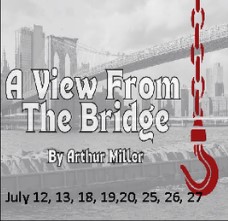
In all, A View from the Bridge was a stunning piece of theater. Intimate, emotionally charged, and brimming with heart. The performances were grounded. The design was intentional. The direction was brave. If you have the chance to catch it, do. The show runs one more weekend: Friday, Saturday, and Sunday at the BACCA Arts Center in Lindenhurst.
Support local theater. Let it break your heart and feel things.



 Arts Independent