
Around 2016, an 86-year-old Stephen Sondheim participated in his first Escape Room in Midtown New York City. The lifelong lover and prolific creator of games of all kinds was in his element. The director of the actors who were working there that day say that he even crawled through the tunnel that was an optional part of the game, emerging to see a puzzle that he himself had designed in 1968 with Anthony Perkins.
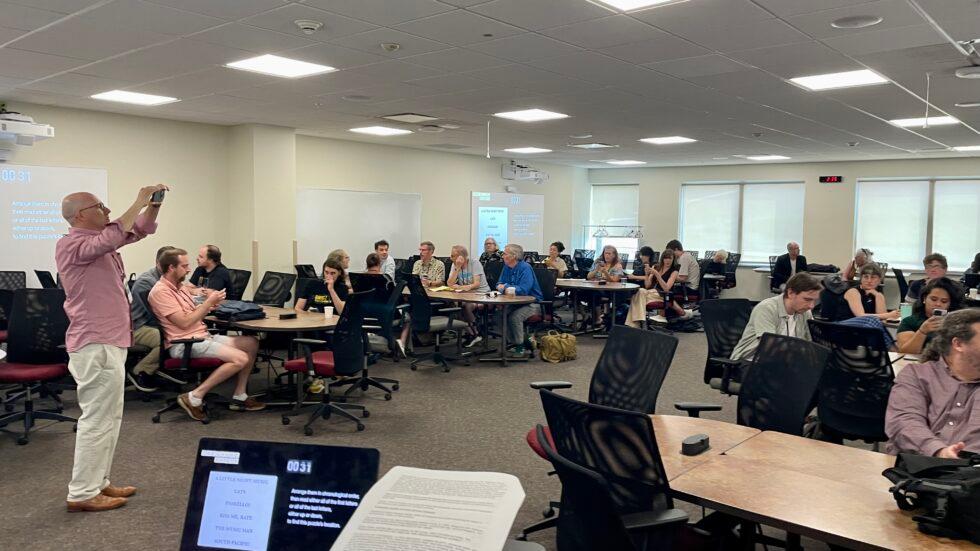
Sondheim was said to have grinned with glee. The puzzle was a built-in regular feature of the Escape Room; the surprise appearance of Sondheim himself was an unanticipated, delightful coincidence. (Sondheim continued to participate in Escape Room Adventures with famous friends like Mia Farrow and Bernadette Peters.)
Writer, Sondheim expert, and cofounder of the Games for Change Festival Barry Joseph recounted this in a Drama Book Show podcast recorded at the Drama Book Shop, as part of a talk and Q&A discussing his new book, Matching Minds with Sondheim. Joseph appeared before a rapt audience alongside acclaimed playwright and songwriter Michael Mitnick (whose works include Fly by Night, the Drama Desk-nominated Best Musical, Playwrights Horizons). Mitnick is also a Sondheim authority, whose insights contributed greatly to the book.
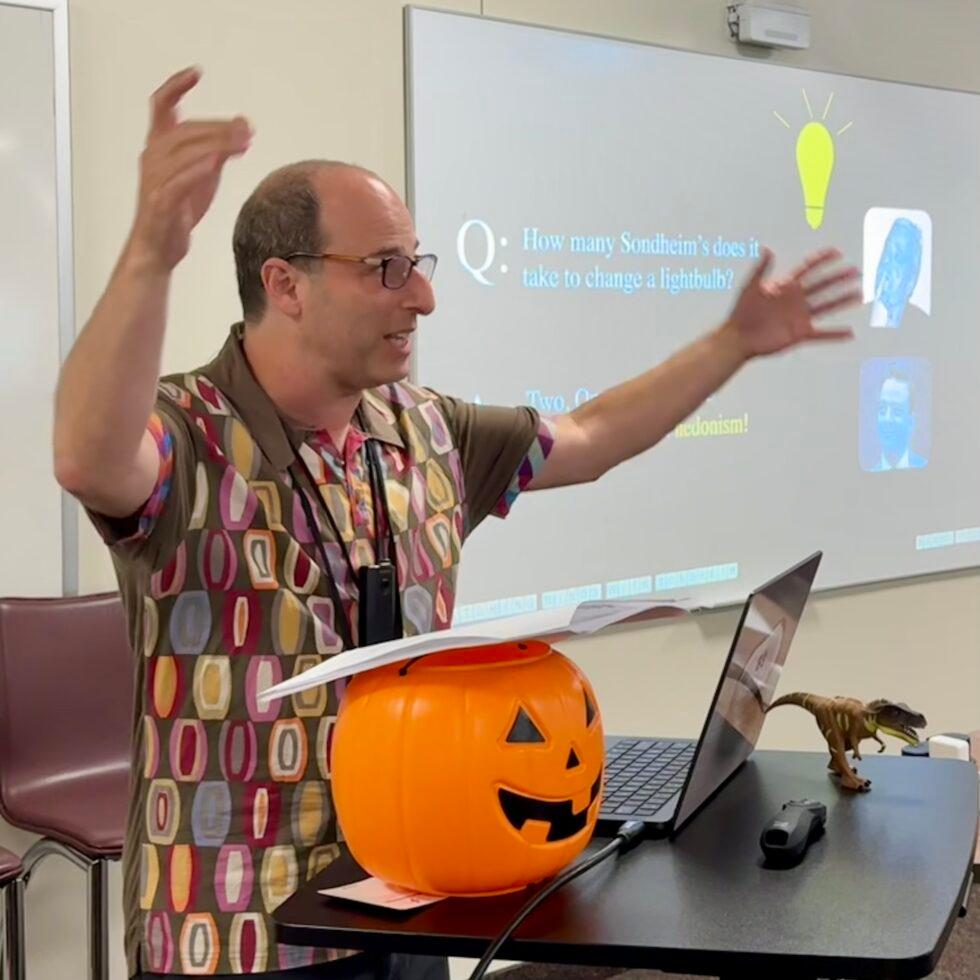
“This project started in April 2022, a few months after Sondheim passed away,” noted Joseph. “…I had just read three books (on Sondheim)…and I learned this idea that he once said he wanted to go into video game design. And that got me to start exploring.” Joseph spent two years doing research, “…contacting research institutions and finding out if they had anything related to his games and puzzles; talking to people who played games with Sondheim; who party-managed some of the events that he was at; and people who had co-designed some with him.”
As this was just a few months after Sondheim passed away, it was a time when the legend was on everyone’s minds as they both mourned the loss and celebrated his life and their connection to him.
“It meant saying ‘hi, you don’t know me, but would you be willing to open up your memory box and trust me with this piece?” said Joseph. “You can imagine many of these people had been spending months talking about, ‘this is what it was like to work with Stephen Sondheim’…but no one was asking what I was asking: ‘What was it like to play with Stephen Sondheim? And so for many of them, it was an opportunity to explore an aspect of their relationship that they never had a chance to do publicly—and maybe not even privately—for years.”
Joseph explained that once they got going, the recollections of Sondheim’s colleagues became joyfully vivid. “Not only would their memories flood back, but the memories would overwhelm them in a way where they were so excited and passionate to share them, and so that created not only an honor for me, but also a responsibility to own those stories until I could shape them together for the book.”
The search for examples of Sondheim’s game and puzzle design work became a hunt for treasure in itself. “Someone who was in the cast of A Little Night Music had saved her winning sheet from a treasure hunt that Sondheim designed—from 1973; people who had party-managed his last treasure hunt at City Center still had all the print materials and could make them all available.”
And as Joseph noted, though the book is now complete and available, the research continues today. He revealed that Mitkin had brought him a new piece of literal treasure right before the event—from Sondheim’s 1998 musical Putting it Together. “The stage manager had prepared as the opening night gift, a collection of logic puzzles,” explained Joseph. “It traces the narrative and production of the show, but all in puzzle form.” Thus, Sondheim’s two greatest passions are now seen to dovetail beautifully. And in a sense, both musical theatre and game playing have the same intent—to create among people, as Joseph put it, those “moments of connection” that are so integral to the human experience.
Case in point: The game Among Us, which became a sensation as it brought people together on Zoom during the 2020 pandemic, was based on Sondheim’s own murder mystery design. In Rian Johnson’s film Glass Onion (2022), Sondheim is seen playing Among Us with (fittingly) Murder She Wrote’s legendary Angela Lansbury. (Fun fact: Sondheim’s username is “FleetST,” while Lansbury’s is “MSheSolved” (Funner Fact: Lansbury was in a 1980’s production of Sondheim’s Sweeney Todd as well. It all comes together. Add to this Sondheim’s time as a cryptic crossword master for New York Magazine in the late 60s; the story of the two board games he developed in the ‘50s that were presumed lost, and the collection of jigsaw puzzles found after a half-century, and the journey just gets more compelling.
“When I started looking up where (the games) fell in his life, they actually had a chronology,” said Joseph. “As I started structuring the order of those chapters, they actually had an organic feel to them…you have a sense that you’re moving through the eras of Sondheim’s life.” Joseph exclaimed that the majority of the book is indeed a biography of Sondheim, but told through looking at his games.” “I study games, that means I’m a ludologist; this is a ludological biography.”
The rest of the book spotlights the creations themselves—“the games and puzzles of Stephen Sondheim that you can do yourself, and—more interesting to me as a ludologist—the design values. What are the things that we can learn from Stephen Sondheim’s game designs and puzzle designs?”
Matching Minds with Sondheim does even more than the title suggests. It actually allows the reader to live inside the mind of the icon and live through the eras marked by the games he was passionate about at the time. It takes them on an adventure through puzzles and parlor games, crosswords and anagrams, murder mysteries and escape rooms, giving them a fascinating glimpse into the thought process that leads to joyful creation.
Joseph noted that there is a structure to the book—and tantalizingly, that there are two puzzles hidden in the book related to that structure. Good luck solving!
To learn more and get your game on, go to matchingmindswithsondheim.com




 Arts Independent