
Home » Uncategorized (Page 34)
Category Archives: Uncategorized
Creating Within the Carceral Surveillance State
Creating Within the Carceral Surveillance State
Review by Brendan McCall
Language Reversal: Move Past What We Know
Co-created by Aaron Landsman, Clarinda Mac Low, and Ogemdi Ude
With Natalia Tikhonova
12 April 2021
Online performance & discussion
Abrons Arts Center
Earlier this month on the 58-year-anniversary of Cosmonautics Day, Abrons Arts Center presented the third and final instalment of Language Reversal: Move Past What We Know, an online collaborative project that seems to fuse performance, discussion, and social activism. Co-created by Aaron Landsman, Clarinda Mac Low, and Ogemdi Ude, this latest episode also featured the contributions of multidisciplinary artist Natalia Tikhonova from St. Petersburg, Russia.
(To read my reviews of this creative team´s earlier Language Reversal performances, please go here for their collaboration with Milan Vračar; and here, featuring Amrita Hepi).
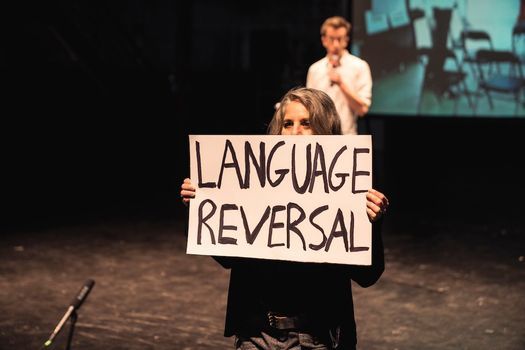
Like its two predecessors, Language Reversal opens with each contributing artist posing a series of questions, framing the piece as both a dialogue and an art work. In response to how her community is policed in Russia, Tikhonova asks what is needed, distinguishing what can be expected from the government versus what must come from a local community. Mac Low then follows with a recitation of a letter written in code to Tikhonova, speculating if any form of communication is truly safe and secure anymore. Landsman recalls his communication with Nicolai Khalezin of Belarus Free Theatre from a decade earlier, and how initially naive or idealistic he was about solutions to their politicized theater in Minsk. And Ude quoted a letter from June 2020 written to her alma mater at Princeton, regarding her earlier graduate thesis, and how she would write it differently today.
These articulate and humble offerings segway into the first pre-recorded video segment. Featuring excerpted conversations between Tihonova and Mac Low during the beginning of 2021, when different insurrections were running near simultaneously in both countries. The two discuss the high proportion of police to citizens in Russia and the United States, and wonder what are effective means to create mutual aid for incarcerated protestors when institutional resources fail us. Images of protests from both countries intertwine, becoming nearly indistinguishable. The the dense black helmets of police in riot gear evoke the lightness of the black balloons which Mac Low tosses in slow motion.
Maps of the two countries emphasize the daunting scale of the problem: how to create mutual aid for local communities when each country, especially Russia, are so huge? Tikhonova´s hand diagrams some possibilities, her vertical and horizontal lines appearing elemental, or like atoms, or perhaps snowflakes. “My practice is just drawing dots, and looking for the connections,” Tikhonova says at one point. “How can we make an impact, to change the situation?”
From the outset with this series, Landsman, Mac Low, and Ude have described Language Reversal as a means to examine oligarchy and translation. Collectively, these pieces are a toolkit, a kind of connective tissue between art, activism, and inquiry. Each of iteration of these succinct online works merits repeat viewings, as their questions and provocations can only be answered off of our screens.

The Burdens of Silence
Review by Brendan McCall
1993
Written, performed, scored, and designed by finkle
Directed by Jonathan Silverstein
Premiered October-December 2020
8-part online audio theater
Keen Company
“Genius is not a gift, but the way out one invents in desperate cases.”
–Jean-Paul Sartre, Saint Genet, Actor and Martyr (1952)
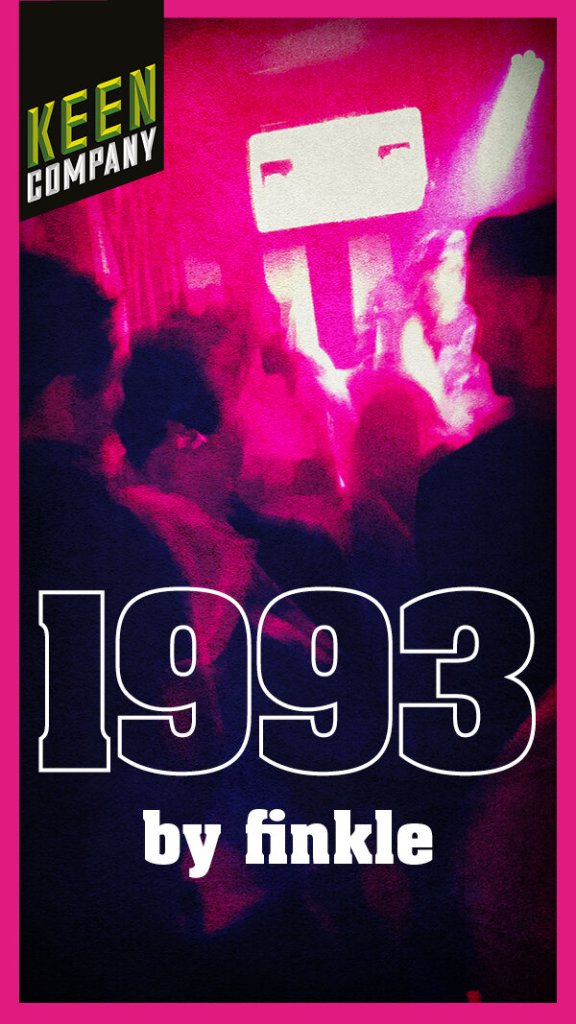
Theater companies, like individual theater artists, have all needed to adapt and change how they produce theater during the course of this pandemic. To kick off its 21st season, Off-Broadway´s Keen Company pivoted from presenting live productions into offering an online-only season of audio plays in a series entitled “Hear/Now”. The first, 1993 by the multi-talented finkle, is an eight-part radio drama
Hold on a sec: 1993´s not really a radio drama. Maybe it´d be more accurate to describe this piece as…an online musical? The piece has a number of original songs which appear throughout the episodes, all written & performed by finkle.
Sorry, no, “musical” isn’t quite right, either. 1993 feels closer to a concept album, except this one is wrapped in the digital pages of a Playbill. One of the characters is spending that year recording an album on a 4-track, and listeners could interpret the songs in 1993 as excerpts from that demo recording. And, like quintessential examples of the genre (“Quadrophenia”, “American Idiot”, “Sgt. Pepper´s Lonely Hearts Club Band”), 1993´s audio episodes feature characters (all played by finkle) and scenes (in a script he wrote) that unfold like tracks on a double-LP, interconnecting by theme more than dramatic action. Rather than progressing forward in a realistic linear narrative, these eight almost psychedelic episodes fit together like tiles of an almost psychedelic mosaic, perhaps describing a dream or a memory whose logic remains elusive. finkle´s piece is about sex, about identity, about AIDS; it is also about the burdens of silence, of memory´s complicated intimacy between the past and the present. Listening to 1993 feels like a raw, intimate conversation with a stranger.
But finkle isn´t a stranger–not to me, anyway. We went to the same university, and he graduated one year ahead of me, so basically we´re part of the same extended experimental theater family for life. During the time of finkle´s eponymous world blending fact and fiction, where his primary characters resided at 512 East 5th Street, I was living at 122 St. Mark´s Place. Practically neighbors. Each of the episodes inspired me to revisit my own personal geography from that year, which also held a potent yet complicated importance in my life.
So what happens?
1993 is set mostly in the East Village of Lower Manhattan, a neighborhood and scene that doesn’t quite exist anymore. The characters inhabiting finkle´s piece–Steven, Byron, Loreena, Jean Wayne Genet, a younger version (or two) of finkle himself–pass through a variety of remembered spaces in this time-capsule along kaleidoscopic pathways. There’s Wonder Bar and The Tunnel, as well as Leshko´s and Kiev. There’s a key scene in an elevator at the Twin Towers, as well as a fateful late night trip into the deep regions of New Jersey. We flip through the pages of the Village Voice, hop onto phone sex lines, and check out the Robin Bird Show on Channel 35.
As a script, 1993 is raw. It’s like re-reading pages from that journal you kept the year you graduated college, while trying to describe to someone who wasn’t there what it was all about. Generally, finkle´s story is one of gay adolescence, of coming out, of clumsy and occasionally hot sex with other men, of the experience of a first kiss after many earlier fucks.
But more than this, 1993 is also about memory–about looking back on who we were then, and how this informs who we are, now. Within the world of his audio theater, finkle plays all of the characters, collapsing biography and artifice into a dynamic blur. Events largely occur in 1993, of course, but a few happen in 2013, too. Further, there’s also a frequent layering between our current coronavirus pandemic with the AIDS epidemic during the early ´90s. The author´s “present self” also interrupts 1993´s dramatic action frequently to speculate, interrogate, and reconsider what happened. It’s an invitation for the listener to reflect upon our own past choices, and how we recollect them. How were we during this year–what do we remember, and how do we remember? What events changed us?
With any narrative work that places memory as a central subject, it is tempting to reference Marcel Proust and his seven-part novel À la recherche du temps perdu (1913-27). While previously translated into English as Remembrance of Things Past, the more current (and accurate) translation of Proust´s magnum opus as In Search of Lost Time points to one of the novel´s central themes: a quest, through recollection, to find a kind of redemption. Such a theme seems fitting, at least in part, with finkle´s 1993, which breaks a series of important silences through his work.
But perhaps a more fitting comparison can be found in the writing of another Frenchman, one who is referenced a number of times throughout 1993: the brilliant outsider, Jean Genet. Inside the younger finkle´s apartment, Steven notices a poster for Querelle, Fassbender´s 1982 adaptation of Genet´s 1947 novel. While in prison, finkle explains, Genet´s manuscript was destroyed, and so he rewrote it on toilet paper. “It was a kind of porn for him,” finkle says, before popping the cassette he got from Kim´s Video into the VCR, “he needed to jerk off to his own writing.”
finkle´s 1993 ultimately offers more questions than answers, its fiction and facts frequently having unsafe sex. True, the narrative time-line gets a little squishy sometimes, but the themes of the piece can always be touched and felt. Instead of seeking the objectivity of cold hard facts,1993 celebrates subjectivity, warmth, contradiction, even confusion. It’s warmer. While 1993 recalls events (real or imaginary) from a defining year in finkle´s life, there´s plenty of room within this tactile audio theater for each listener to feel and experience.
Look At Me: A response by Brendan McCall
Indelible: Christine Blasey Ford as performance artist
By Holly Hughes
Lecture & Performance via Zoom
8 April 2021
Department of Gender, Women´s, and Sexuality Studies
University of Iowa
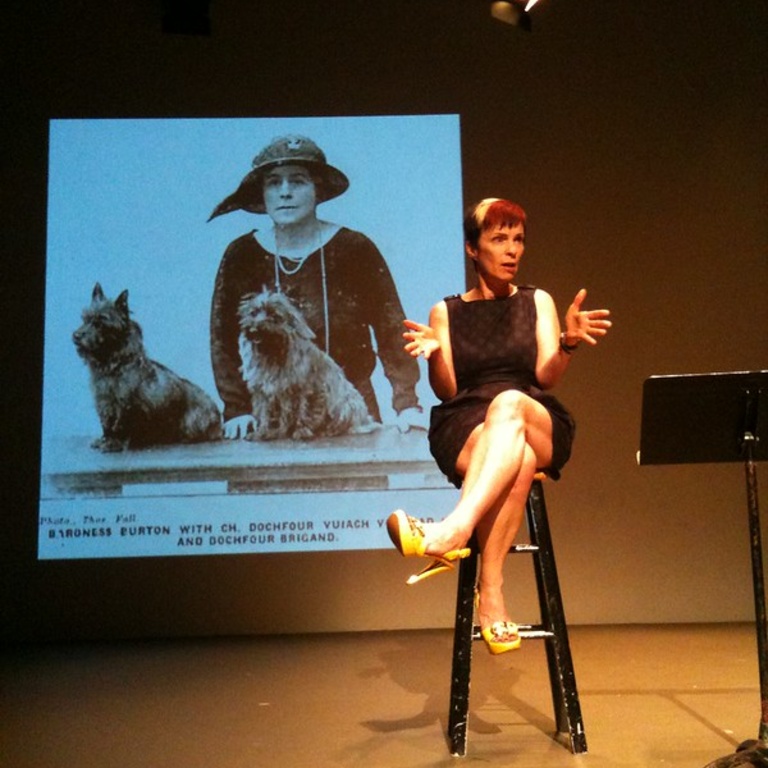
Depending on which invitation you may have seen online from the University of Iowa’s Department of Gender, Women´s, and Sexuality Studies, Holly Hughes´ Indelible: Christine Blasey Ford as performance artist was billed as a webinar, a talk, or a lecture/performance. Given the rigor with which Hughes has approached her own work, both as a pioneering American performance artist as well as a thinker and academic, it can certainly be framed in any of these categories. This is less a review, more of a response to this engaging and stimulating talk by one of America’s most incisive artists.
Performance art is notoriously difficult to codify or define, Hughes admits early on, but she emphasizes that the form´s concerns tend to be less about beauty, and more about ideas. Unlike theater, there is no artifice in performance art, no rehearsal in preparation for the event; performance art occurs between the artist and the audience, together.
This important point connects us to the Senate Judiciary Committee hearings in September 2018, when Dr. Christine Blasey Ford challenged the confirmation of Supreme Court nominee Brett Kavanaugh on the grounds that he sexually assaulted here in 1982. This event is not only about these two individuals, but to larger systems of sexism and patriarchy held in place by power and violence. Dr. Ford is an endurance artist, Hughes contends, demanding that all of us look at her when she speaks to us. But if performance art, like feminism, cannot happen by oneself, what are we collectively doing? How many more stories like Dr. Ford´s do we need to hear, or to experience, before meaningful change occurs?
During this piece, Hughes references a number of exceptional performance artists whose work takes seemingly simple actions and reveals the deeper ideas inherent within them. In creating a link with the testimony of Dr. Ford, however, Hughes highlights two disturbing works in particular: Cut Piece (1964) by Yoko Ono, and Marina Abramovic´s Rhythm Zero(1974). In both instances, these women create a space filled with sharp objects, and invite the audience to do whatever they wish. The power of their work is a form of martyrdom, as they commit to incredible endurance and passivity, despite having their bodies stripped, injured, threatened. And while both of these are considered seminal examples of performance art by women that Hughes respects tremendously, are they not also normalizing violence against women, aestheticizing their harm and humiliation? Is Dr. Ford´s 2018 testimony doing the same?
Indelible: Christine Blasey Ford as performance artist does not provide simple or easy answers to these and other questions contained within this 47-minute work. Instead, using imagery and quotations from the worlds of politics and performance art, Hughes asks us to reflect on our roles within each of these spaces. Like the audiences in Abramovic´s infamous The Artist is Present (2010) at MoMA, Dr. Ford´s 2018 testimony is an unflinching gaze marked with courage, vulnerability, and pain. Are we able to look back? And if yes, what are we going to do about it?

The time is now for Caytha Jentis
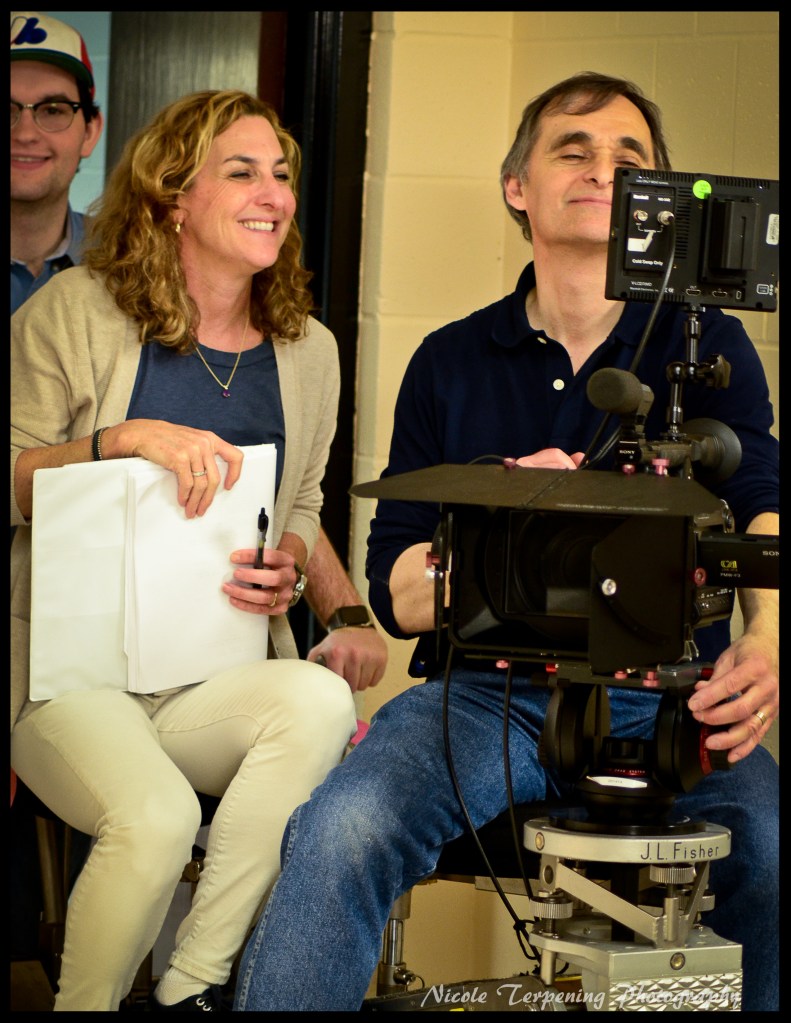
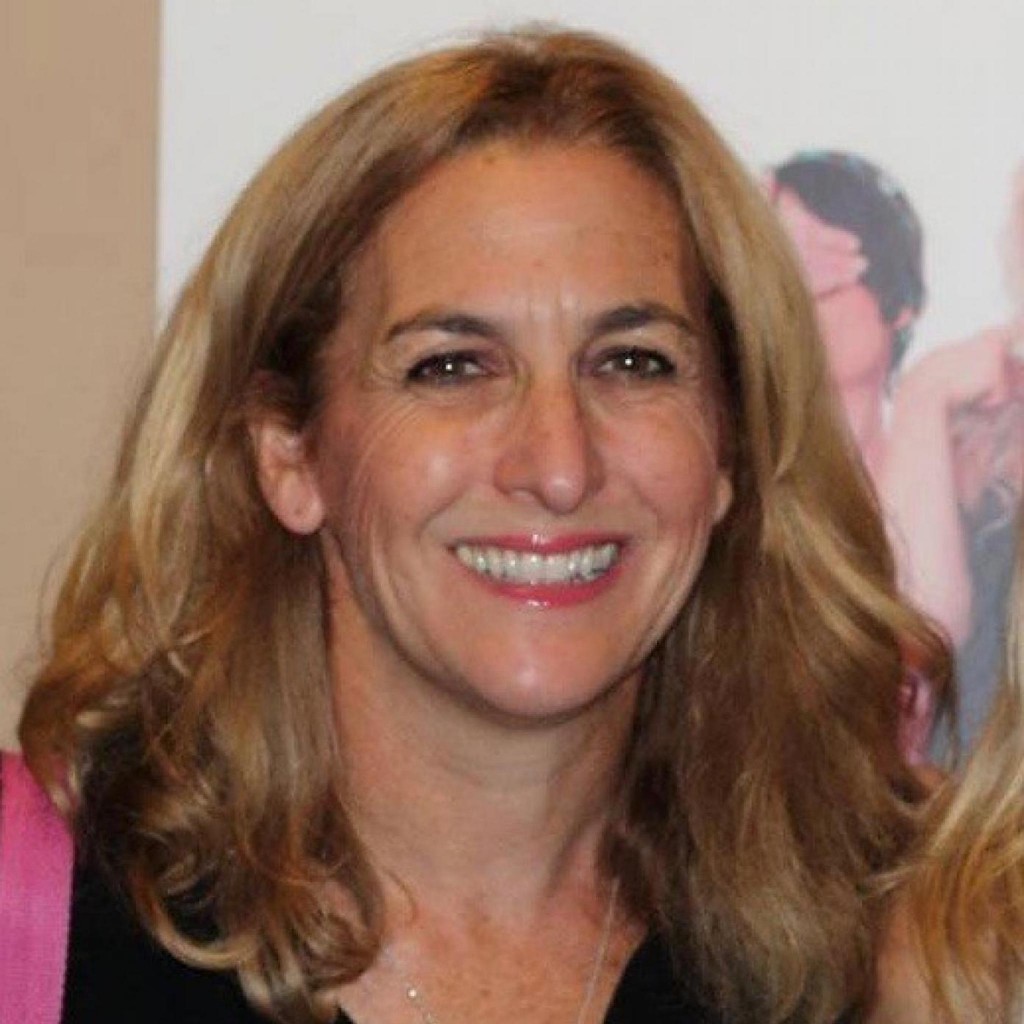
Caytha Jentis is an American writer, producer, director and filmmaker. She is also ambitious and clever. She also understood the symbiosis between theatre and film long before the pandemic created this burgeoning hybrid.
Jentis’ feature films include And Then Came Love, which stars Vanessa Williams, Ben Vereen and Eartha Kitt (in her final film appearance). The movie was filmed at her alma mater, Syracuse University, where Jentis gave university students the opportunity to be interns, assisting with pre-production and post-production activities.
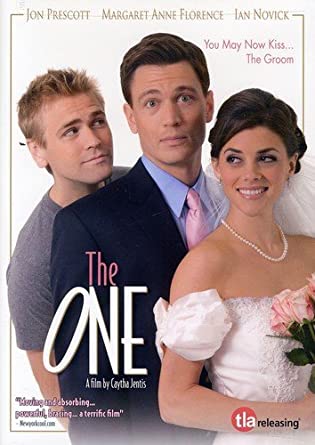
Her directorial debut was in 2011 with the coming-out film The One, starring Jon Prescott, Margaret Anne Florence and Ian Novick, Jentis also produced and wrote the script for the movie. The film is a romantic dramedy about a man who plans to marry a woman, when a month before his wedding, he falls in love with a man from his past. Jentis said she wrote the screenplay “after spending several nights with friends discussing true love”, and it was the fastest script she had ever written.
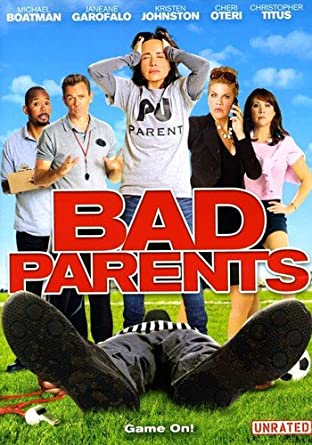
Bad Parents, released in 2012, is based on her award-winning play It’s All About the Kids, and was produced, written and directed by Jentis. The film stars Janeane Garofalo, Cheri Oteri and Kristen Johnston, and was inspired by Jentis’ personal experiences as a soccer mom. The film was shot entirely in New Jersey and used several kids from local soccer teams in the area where Jentis once lived. The movie won Best Feature Film in 2013 at the Hoboken International Film Festival.
In 2010 Jentis wrote and produced Dream House, a short directed by Darien Sills-Evans, that explores the dark side of the suburban dream. Jentis is also creator and director of The Other F Word, a comedy web series that premiered in September 2016 on Amazon Prime. The series is set in New York City, where Jentis now resides, and stars Steve Guttenberg, Judy Gold, Michael Boatman, Gilbert Gottfried and Reiko Aylesworth.
Her production and management company, Fox Meadow Films, produced all three of her feature films and the web series The Other F Word. She also wrote and produced the short film Dream House in 2010. Jentis was selected as one of Good Housekeeping’s 50 over 50 in 2016.
According to Jentis, the “F” in the show stands for being in your forties, fifty, friendship, fearless, family and fun. Jentis also went out of her way to include many commercial products in the series that were developed by women entrepreneurs. Season 1 was a top-ranked show on Amazon for over 4 months, season 2 premiered in September 2017.
“I have been telling stories since elementary school, worked in the film business in my twenties, pivoted to raise my kids and became a filmmaker when my kids were in middle school. I am a writer first and foremost,” exclaimed the highly visible and important filmmaker, “I love to tell stories – either in script form for theater or film/tv as well as write memoir essays. I produce and direct as well as a way to further stories along – mine and others,” she continued.

We were lucky to find a moment when she was not writing, directing or producing for this interview. We’re especially lucky as her most recent film, a millennial coming-of-age roadtrip comedy, Pooling for Paradise is running both as a film and a play!
Where do you get your ideas … your inspirations?
My ideas come from life. I see a human condition, ponder it and then typically refer to philosophy and psychology to did deeper into what it is that draws me to the idea.
You are making an active crossover to live theater. What promoted this decision?
I am not making an active cross-over per se, I am just trying to focus more on that art form. I have always loved theater as it’s live and so connected to the audience. Also, with theater it relies more on the written word.
What was the hardest decision you’ve had to make in your career (so far)?
The hardest decision I made was pausing my career to raise my children. I knew it was the right choice, but knew I personally couldn’t be good at both simultaneously when my children were very little.
What obstacles do you face a female filmmaker/producer?
It’s a reality I faced after my first feature – a romantic comedy about a donor inseminated single mother played by Vanessa Williams. I got a deal with Warner Brothers. My last feature is a dark comedy about suburban sports parents and is on HBO right now. My films typically are about motherhood and have all found audiences and have been successful, but I have yet to find a manager or agent or some power that be that truly values my work and help get me meetings. It’s a tough business that values youth and I re-started in earnest in mid-life, so it is what it is….
Do you find obstacles in the theatre are the same? Different? How?
Regarding theater, I assume it’s the same but don’t really know. I know that some of the places that consider new works want it submitted through an agent, and I don’t have one. It’s tough for all artists though. There are a lot of very talented playwrights and just so many theater companies. The thing with theater though, is there are inventive ways to find audiences for your work.
What’s next?
I have a couple of new works in various stages of development that hope will find a stage and have been writing essays for Medium as well as producing a storytelling YouTube channel.

A Journal of Our Plague Year
Review by Brendan McCall
What the Fuck Just Happened?
Created & performed by Mike Daisey
Friday, 2 April 2021
Frigid New York at The Kraine Theater
(live performance and live-stream)
With less than 20% of New Yorkers fully vaccinated, Governor Cuomo announced that the city’s venues could resume presenting live performances again at one-third capacity beginning on 2 April. And while some, after being bombarded with advertisements on social media, certainly purchased tickets for an Off-Broadway production with zero performers, what about other kinds of theater? How to ensure people amidst the continuing reality of a pandemic can safely show up at a tiny black box with limited resources but which also tends to incubate theatrical artistry which is daring, experimental, and bold?
Enter the Frigid New York team, who addressed these challenges with precision and aplomb. For the 22 audience members who attended their one-night-only show live on Good Friday, a battery of protocols needed to be observed: from documentation of completed vaccination (ie two weeks since the last shot), to wearing masks and socially distancing inside the Kraine Theater´s intimate East Village venue. All theatrical staff were fully vaccinated, too, as was the evening’s sole performer–veteran monologist Mike Daisey.
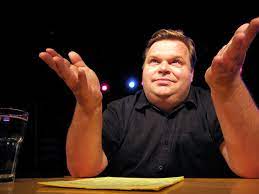
Superficially, one might argue that “not much is happening” in Daisey’s show, that “it’s just a guy sitting there and talking.” Reminiscent of Spaulding Gray, the production values here are simple and stark: Daisy never rises from his seat at the simple wooden table, moving only occasionally to drink from a glass of water or dab the sweat away from his forehead with a handkerchief. Yet the 99-minute What the Fuck Just Happened? is absolutely riveting.
I got to see the show from my apartment because the Kraine also live-streamed the show to over 500 “ghosts”, as Daisey referred to those viewing this brilliant and searing work through our screens. Like many moments in What the Fuck…, Daisey´s seemingly extemporaneous talk belies deep structure: images and themes appear, withdraw, then arise again, providing new connections. The ghosts are not just those sitting at home, witnessing this unfolding monologue, but also the presence of everyone lost during the last 13 months (and counting) of the plague.
How to parse the eloquence of the script from the power of the performance, when the author delivers his own work? Early on, Daisey confesses that, originally, the piece would be called a loud moan blending rage and despair. But how to shape that primal cry into any kind of coherent meaning, when all you have are words? With gallows humor, outrage, and pointed silences, What the Fuck… is Daisey´s attempt to describe the unimaginable which is maddeningly all-too-familiar, to articulate some of the anxiety, stress, and trauma that he experienced and witnessed. His story is both highly personal, as well as a kind of community chronicle journaling the major seasons of our pandemic year.
Daisey begins What the Fuck… not in 2020, but in 2019. We dive into the everyday nuances of his and his girlfriend´s lives in Brooklyn, a pre-pandemic prologue of professional gigs, research for a new show about climate collapse, and a serious bedbug problem. By opening a window into his life during “the before times,” we can identify with what we were thinking and feeling, too, before everything changed in March 2020. Especially as a New Yorker, Daisey´s description of those first fearful months of the shelter-in-place were haunting: the compulsive use of hand-sanitizer, the banging of pots and pans at seven o´clock, the incessant sound of sirens´ wail from ambulances.
What the Fuck… continues to walk us through the major chapters of the previous year, up to the previous moment: the murder of George Floyd, the heated 2020 Presidential Election, the run-off in Georgia, the insurrection on 6 January on the nation´s Capitol. Even briefly re-visiting them chronologically recalls profound fatigue, perhaps because we are still reeling in their aftermath. Derek Chauvin, the former police officer who kneeled on the neck of an unarmed Black man in Minneapolis last May, is currently on trial. A significant percentage of Republicans still believe that the 2020 election was “stolen” from Donald Trump. New voter restriction laws were quickly passed in Georgia, and the armed mob who broke into the Capitol building three months ago have yet to begin their trial.
And the pandemic itself continues, along with the debate over whether masks or social distancing are even necessary for a “really bad flu” which has killed nearly 600,000 Americans so far. Towards the end of What the Fuck Just Happened?, a fully-vaccinated Mike Daisey describes the ordinary magic of attending a small dinner party recently with other fully-vaccinated friends in Brooklyn. He describes how easy it is to slide back into pre-pandemic routines and ways of thinking, as if it were all behind us. And this ease, this impulse to forget and “return to normal”, is perhaps this powerful show´s message and warning. There is no vaccine for fascism, Daisey reminds us. What did we learn, from this experience, if anything? Did this crisis provide us with the courage to make the long overdue changes necessary in our society–from health care, climate change, systemic racism, democratic governance? Humbly, quietly, the show ends with uncertainty–because this plague and all of our discontents remains far from over.

Audio Theater of War
Review by Brendan McCall
In Their Footsteps
Written by Ashley Adelman
Directed by Ashley Adelman & Andrew Dunn
Documentary Theatre / Radio Play
Infinite Variety Productions
Broadcast on WLIW-FM on 28 March 2021
Our stories about the US-Vietnam War is vast and culturally familiar: from big budget films (Platoon, Casualties of War, Apocalypse Now) to novels (Going After Cacciato) and plays (Streamers). They also tend to be decidedly male-dominated. In fact, in many cases, women are completely absent from their fictional universes.
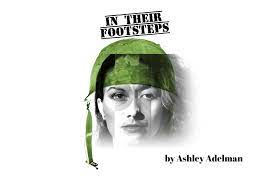
Ashley Adelman´s In Their Footsteps, broadcast on WLIW-FM and produced by her company Infinite Variety Productions, offers a refreshing addition to our understanding about that chaotic conflict. Originally presented live in 2016 as a documentary theatre piece–ie oral histories with five American women who served in Vietnam form the basis of the script–the work was turned into a radio play as a scheduled two-week international tour to Italy was cancelled. The release of In Their Footsteps remains especially timely: during the same week, WNYC´s On The Media released a fascinating segment about the pioneering women who covered the War as print and photo journalists. Like the women whose stories comprise Adelman´s work, their contributions and accomplishments have been largely invisible.
In Their Footsteps begins by introducing its real-life characters like a canon perpetuus, whose melody is surreal and contradictory. Ann Kelsey (Kate Szekely) is a devoted librarian who encounters a soldier playing Mozart on a piano; while the Red Cross sends Jeanne “Sam” Christie (Niki Hatzidis) to the front to serve as a “Donut Dollie”–a way to keep up the (male) soldiers´ morale through conversation and activities. They remark how hard it is finding any tampons on base because the men claim these are effective tools to keep their gun barrels´ clean. Based on the play´s oral histories, it seems that the US military not only brought its weapons to Southeast Asia, but its misogynistic attitudes towards women, as well.
About fifteen minutes in, …Footsteps brings the listener right up to some of the horrors of the War, particularly through Doris “Lucki” Allen (Chrystal Bethell), a tragically Cassandra-like figure serving in intelligence for the Women’s Army Corps whose warnings about what would later be known as the Tet Offensive fell on deaf ears from her male counterparts. Was she ignored because she was Black, or because she was a woman? Or both? Meanwhile, Lily Adams (Criena House) questions what she and the rest of her country’s military is doing, exactly, in Vietnam; as an army nurse, Lily sees the homelessness and despair inflicted upon adults and very young children by the seemingly senseless American intervention. Returning home from their service, each of these women remain haunted and affected.
All of the actors in Adelman´s piece speak with clarity and heart. Andrew Dunn, who co-directed the piece as well as served as sound editor, includes just the right mix of sound effects to create a deeper soundscape of verisimilitude.
Towards the end of the piece, when Lucki and Lily visit the Memorial in DC, we learn that over 2000 American women served in Vietnam, yet there is no official acknowledgement of them anywhere. 67 American women died in the War, and yet only 8 of their names are on the Wall. In The Footsteps is an important and powerful beginning towards remedying this, by sharing some of the heroism and humanity of these relatable women during a time of exceptional and insane violence.
Polite Nibbles
Review by Brendan McCall
The Fierce Urgency of Now
Radio play
Written by Doug DeVita
Directed by Dennis Corsi
Premiered on 29 March, as part of the Fresh Fruit Festival
We are now faced with the fact that tomorrow is today. We are confronted with the fierce urgency of now. In this unfolding conundrum of life and history, there “is” such a thing as being too late. This is no time for apathy or complacency. This is a time for vigorous and positive action.
–Dr. Martin Luther King, 28 August 1963
To name your work with a title referencing Dr. King’s famous speech from the March on Washington is bold, insinuating that this story will be impassioned and fervent. Especially when your play premieres the same day as the historic trial of former Minneapolis police officer Derek Chauvin for the murder of George Floyd in 2020. Doug DeVita´s The Fierce Urgency of Now is not about systemic racism, however. Kicking off a series of radio plays for the Fresh Fruit Festival, the piece is polite instead of political, and its edges never really cut.
The radio play–which began as a stage play, and is apparently being adapted into a screenplay–is described as a “fast-moving caustic comedy” exploring homophobia and ageism in the ad world. Ostensibly, this is true. To be sure, the energy of the dramatic writing aims for comparisons with Oscar Wilde or Noel Coward, where perhaps every other line prickles with barbed wit. But in DeVita´s play, the clever humor evinces a few smiles but oddly, given the subject matter, never erupts into scathing confrontational laughter. The teeth of this play nibbles, when it needs to bite.
Openly gay and perenially snarky Kyle (Matthew Jellison) is angry that he is being pulled off of a number of accounts at his New York advertising agency, and instead partnered with the older Dodo (Laura Crouch). The narrative arc of their relationship is conventional and predictable: you know that this odd couple will inevitably bond and help one another, each learning new things along the way. But while the facts of Kyle´s sexual identity and Dodo´s age arise throughout the play, the bulk of the dramatic action in The Fierce Urgency of Now is focused on completing some project deadlines over the Christmas holiday. What consequences do these two really suffer from this New York ad agency of the mind? What is at stake, if they do not complete their assignments in time over the winter? By the end of the piece, as Dodo joins Kyle on a significant and symbolic flight, we never really know.
Director Dennis Corsi harnesses clear and articulate vocal performances from each of the actors in DeVita´s play, and the use of sound and music during scene transitions helps to keep the hour-long piece moving.
Maybe I´m the wrong audience for this work, but experiencing this radio play as a bisexual male or a long time performance artist was disappointing. The Fierce Urgency of Now plays it safe, both in terms of content as well as form, and feels unintentionally akin to a magazine ad: glossy, hinting at politics and power, but ultimately remaining only on the surface.
The Caged Bird Sings
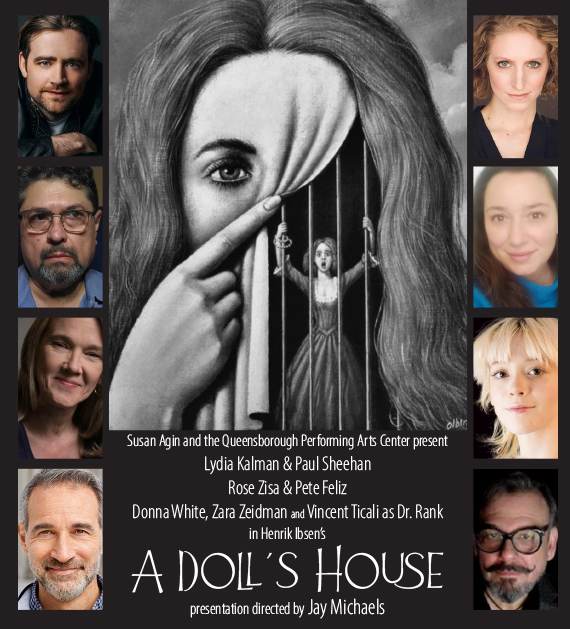
Susan Agin and the Queensborough Performing Arts Center will present Henrik Ibsen’s classic play, A DOLL’s HOUSE for an invited audience in April as part of an arts and education program.
Ibsen’s play still projects a substantial message – one of female empowerment, abuse, misogyny, and – as we look at it through the lens of post-Trump America – high crime and corruption.
Ms. Agin brought Jay Michaels aboard to direct the production. Michaels, a professor of communications and theater are various universities, is also known for his direction and production of much of Shakespeare’s canon felt right at home with Ibsen: “this play was banned in Germany because of its ending – highly unconventional for the time,” he said, “what exactly was too shocking?” he added. “I think anyone who has been raised in a very sheltered environment or a more conservative environment and had an epiphany moment or has not been free to be themselves because of certain views, will be able to relate to Nora,” chimed Lydia Kalman, who plays the focus of the piece … Nora.
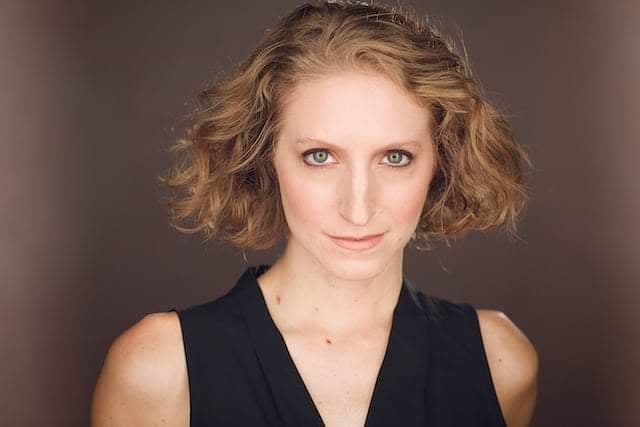
Kalman, a classically trained actor for both theater and film/TV, is credited with work Off and Off-Off Broadway, as well as several indie films. Kalman has been seen in heavy dramas, lighted-hearted comedies, Shakespeare, sketch comedy, and everything in between. She and co-star Paul Sheehan even shot an indie horror film – an historic one. Marcus Slabine’s The Dark Offerings was one of the first indie films to shoot during the pandemic adhering to all CDC guidelines and will be released later this year.
Lydia took a few minutes to share her thoughts on the production.
Is Doll’s House still groundbreaking today?
I think in some ways it is. For the majority of modern/western culture, it’s very normal for women to be independent and to lead independent lives. Though we are still fighting for equal pay for equal work and reproductive rights and so forth. But, for the most part we are allowed to lead our own independent lives. But there are still households in this country and around the world where women are expected to be the dutiful wife and mother and dedicate her life to such service. And for women who are not fulfilled by such a lifestyle, there is still that same struggle.
How has the role of Nora changed over the century since its writing?
I don’t think the role of Nora has changed too much over the century. I think audience members, women especially, will be routing for her to find her wings and fly. And I think anyone who has been raised in a very sheltered environment or a more conservative environment and had an epiphany moment or has not been free to be themselves because of certain views, will be able to relate to Nora.
Hiw important to offer-up the classics to colleges, universities, and other institutes of learning?
It’s very important to share classic works with college students and younger audiences. Classic works reflect the times they were written in, art imitates life imitates art. And just like studying history, it’s important to have a full picture of history so as not to repeat mistakes of the past. And…classics can still inspire and move hearts and make people laugh and cry and entertain!
What’s Next?
My next project is a recurring role on the first season of a new mystery series. I can’t give away any more details quite yet, sorry about that. But I’ll start filming at the end of April.
A Correspondence of Grief
A Correspondence of Grief
Review By Brendan McCall
Language Reversal: Move Past What We Know
Co-created by Aaron Landsman, Clarinda Mac Low, Ogemdi Ude, and Amrita Hepi
Virtual performance
Presented by Abrons Arts Center (New York, NY)
8 March 2021
Can theater be an essay? Co-creator Aaron Landsman (Manhattan, New York) poses this question near the beginning of this second installment of the virtual performance Language Reversal: Move Past What We Know (Abrons Arts Center, New York). Even two weeks after witnessing it earlier this month, my mind keeps returning to images, moments, and phrases that these artists offered on 8 March 2021. Perhaps because its showing was approaching the one-year anniversary since lockdowns began sweeping the United States, a grim milestone of how all of our lives upended. Or maybe it was because, like the first installment of this project I saw last month, Language Reversal does so much with so little, its seemingly small economy supply sinking beneath my skin and penetrating my heart.
Translated in real-time to ASL for the hearing-impaired, Landsman reads excerpts from a series of emails with another one of the piece´s Co-creators, Ogemdi Ude (Brooklyn, New York). He asks questions from the beginning of the pandemic–what shall we do? What are we doing? How can we keep working together? After this revealing and slightly panicked prologue, we shift to Ude´s calming, vital presence, following her observations and feelings as she recounts how she spent part of last summer on a porch in Atlanta that feels almost mythic. As we listen to her sonorous voice, we see the silhouette of hands along a wall. Is it two pairs of hands dancing, or simply the appearance of four hands communicating with one another? Inquiries more than discovering answers seem important in Language Reversal. It’s a quest.
Ude remembers how, on the porch, news of the social upheaval sweeping the country would filter in and out. She and a friend talk about the coming apocalypse, and how to redirect grief. They also talk about how to choreograph, and the video games they like to play the most on their phones, for pleasure and for therapy. This is a memory, but also a letter from Ude to Co-creator Amrita Hepi (Melbourne, Australia).
If Ude is on the porch of grief, Hepi says at one point, then she is on the island. Her monologue is a kind of letter in reply to her long-distant friend, while we watch collages from some of her participatory dance projects. As a First Nations Australian artist, Hepi says she wants to making caring for one’s country a choreography unto itself. During this year of Covid-19, she doesn´t wish to avoid sadness, but neither does she want to search for the “drug of happiness.” Instead of being defined by struggle, why not focus, care, and to “have moments of incredible mediocrity.” Her piece ends with images from past works, often involving simple gestures such as hugs. Ordinary, perhaps, but for most of us this past year, utterly rare, magical, a memory.
After their visual and auditory correspondence of grief, Ude asked Co-creator Clarinda Mac Low to respond to the twenty-five work we had all just witnessed. Mac Low´s observations inspired me to remember moments within the work, as well, including ones she didn’t mention. It also left me reflecting upon how I have grieved this year, through my work, and out of it. Who have I entrusted my own grief with?
The friendship shared by Ogemdi Ude and Amrita Hepi is deep, and one which articulates some of their own relationships to grief, love, and how to focus during a time when everything has turned completely upside down. Language Reversal: Move Past What We Know shares just enough of their communication to provide permission for us to do the same with ourselves and the relationships in our own lives.
The Empty Space of the Telephone
The Empty Space of the Telephone
By Brendan McCall
Les Consultations Poétiques
Via Telephone
Theatre de la Ville (Paris)
This past Friday, shortly after 10 in the morning, my phone rang. Marie, a woman whose voice seemed to sparkle with her bright British accent, asked, “Are you ready for your poetic consultation today?”
One could speak endlessly about Paris, and the conversation would never exhaust its rich literature, dance, music, and theater. Like many cultural capitals around the world, this past year of the coronavirus pandemic has devastated the performing arts community here. At the time of this writing, all cultural venues that produce live dance, theater, cabaret, music (as well as cinemas and museums) have been shuttered since October. Notwithstanding some theaters being occupied by students in the past week in an attempt to pressure Prime Minister Macrón to reopen them (so far, the French government hasn’t budged), it appears that the theaters will continue to be closed until at least mid-April. Combined with daily curfews from six at night to six in the morning, the delightful din of the City of Light´s social scene feels muffled, muted by months of social distancing and isolation.
“How are you feeling today?” Marie asked.
One silver lining of this horrible year during covid is witnessing the many innovative ways performance artists have continued to create. And while many are creating live projects specifically to be seen on a computer screen, the Theatre de la Ville (Paris) has chosen to go old school. Spanning anywhere between 25-40 minutes, Les Consultations Poétiques is a free interactive experience between one actor and one audience member at a time through the telephone. Audience members can choose from twenty different languages, book a time, and then an actor calls you for this intimate and novel theatrical experience. (NOTE: if calling with a phone outside of France, your “poetic consultation” will come through WhatsApp).
“I´m tired, but I know that that´s not really an emotion,” I replied. “I guess the best word to describe how I’m feeling is….overwhelmed.”
Marie and I spoke for nearly thirty minutes, in a conversation that felt immediately intimate as well as welcoming–in other words, like attending a play or other live performance. We talked about some of the hardships over the past year during this pandemic, particularly the economic difficulties, and the loneliness. We compared responses to the pandemic by our country’s politicians. I mentioned how much I missed my daughter, and she encouraged me to move back to Europe full-time. Part of me was surprised at how quickly our “poetic consultation” got so deep and personal. But another part of me recalled hundreds of theatrical experiences from the past; how the theater is a space where each of us can be safely vulnerable, and affected by what unfolds onstage as well as between us in the audience. With Les Consultations Poétiques, Theatre de la Ville had taken that interactive nature of theater and stripped it down to its core, one actor to one audience member, mouth to ear.
“Based on our conversation,” Marie said, “I have a couple of poems I´m thinking of reading to you. Which would you like?”
Like most Americans, the one she suggested by Robert Frost was beloved to me, a poem no less dense for its brevity. However, seeking to take a road less traveled before the call was concluded, I opted for her suggestion of the one by Rudyard Kipling:
They shut the road through the woods
Seventy years ago.
Weather and rain have undone it again,
And now you would never know
There was once a road through the woods
Before they planted the trees…..
Peter Brook once famously remarked that if a man walks across any empty space, while being watched by at least one other person, that “this is all that is needed for an act of theatre to be engaged” (1). Arguably, the empty space Marie and I shared during Les Consultations Poétiques existed in the silences framing our voices. By listening to one another, who was performing and who was witnessing kept alternating. Or perhaps both of us simply connected, engaged in this brief exchange, a live theater moment created together.
(1) Peter Brook, The Empty Space. London: Penguin (1968, 2008), p. 11

