Girl Interrupted, a World Deconstructed
“Where’s the girl to save us all?”
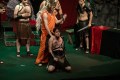
The walls that surround us are covered with torn book pages. A stuffed animal sits in the center of the stage. To the side is a screen with the title of the play, but it is soon to be filled with the images of war. As described by the production, we are in a “technofeudal, post-apocalyptic ice age.”
Iphigenia (playwright Mackenzie Robin Krestul) emerges out of the darkness, joined by a chorus (Quinn Andrews, Kaitlyn Rose RaBocse, Sam Hardy). They giggle joyfully together and play with children’s letter blocks on the floor. The serene scene gives way to the arrival of the warrior Agamemnon (Travis Bergmann), Iphiginia’s father, who is seen asking ChatGPT for advice—plunging us unsettingly into the darkness of the here and now. “King Artemis is holding up all our ships because she is angry I killed her deer,” he explains to the machine. “The soldiers are pissed and we all want to get back to fighting. What do I do?”
“Sure, I can help with that!” responds the chillingly cheery AI. “…If you want your ships to sail, you must sacrifice your daughter on the altar.”
Thus begins a stunning production that takes the text of the Euripedes’ original tragedy Iphigenia in Aulis and deconstructs it through a powerful postmodern lens, shining a black light at the heart of the problem that has plagued the world ever since humans crawled out of the muck and learned to walk and talk, and eventually to wage war.
“Imagine embarking on a journey through a tapestry of ships sailing across the sea,” continues the joyful but soulless computer simulation. “Think about the vibrant and bustling community you’ll burn to the ground! A circle of blood…the cries of women, young girls, children sobbing, eyes bloodshot, choking on the crimson dust that clogs the air.”
Before long we witness Agamemnon literally pleasuring himself to the war footage that is shown on the TV, in a lengthy sequence that is wordless but speaks volumes about man’s fetish for war and history of bloodshed and oppression.
“One burning desire driving this machine of war,” chants the chorus.
“Why do bad things always happen to men?” Agamemnon whines following his self-exploration.
“It’s worth noting that men are the primary protectors of our entire world!” chimes ChatGPt gleefully, reminding him that his daughter must both symbolically and literally die for the greater glory.
Cadence Lamb provides remarkable support as the “motherwife” Clytemnestra. “No one fights fiercer than a mother for her children,” she proclaims, reminding Iphigenia of the 27 hours she spent in labor, and of her daughter’s own “biological imperative.”
“You have to fulfill your duty as a woman,” she insists, echoing the creepy cheeriness of the AI. “Like me, and my mom, her mom, her mom…” she goes on and on and on, as if reaching back to the beginnings of our society’s hegemonic discourse. Her advice to the soon-to-be-wed Iphigenia to “hold still until it’s over,” speaks chilling volumes about a woman’s role in the world as far as the patriarchy is concerned.
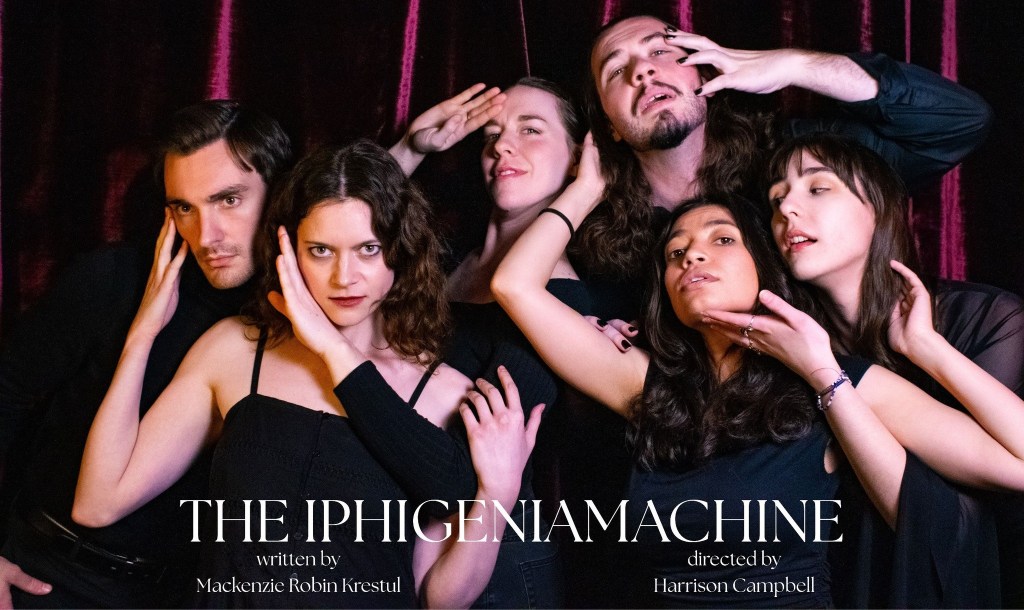
The production, directed impeccably by Harrison Campbell, is masterful, with a startling 4th wall break late in the show that puts the audience at the edge of their seats. This electric sequence is anchored by an incredible performance from Hardy, embodying the latest threat to civilization, which we heard earlier in the play giving Agamemnon horrific advice. The deconstruction of the original Euripedes story is then mirrored by an actual destruction of the impressive set. Kudos to Emily McManus for her terrific puppeteering of the “deer” we meet mid-play, who is so expressive that they feel like another living character (and wonderfully designed by Annie McGowan).
“Were you snatched from your mother too?” asks Iphigenia of the elegant creature. “There’s a handprint on your flank, but your eyes are blank. Are mine?”
Iphigenia recognizes that she’s speaking to a puppet. “I’m one too!” she announces. “I play the girl on the gallows. She’s been hiding since the dawn of time. From the corner of the sky, she sees…everything.” Iphigenia encourages the deer to escape the fate that has been handed to both of them. “You can leave…abandon your role. Travel the path through the dark and the heat where a light stands waiting. All you have to do…is drop the sticks.” And the puppet pulls free of the puppeteer.
Writer Krestul has pulled no punches whatsoever in holding up a mirror to the uncomfortable truth of who we are as a society and how little we’ve evolved. In addition to her sharp, biting, poetic, and extremely powerful crafting of the story and its dialogue, she also gives a stunning performance in the role of our tragic hero. Her voice and artistry are exactly what we need right now.
The Iphigeniamachine was performed at The American Theatre of Actors in May 2026.