
Home » Posts tagged 'life'
Tag Archives: life

Jim Catapano reviews A Moving Musical About Identity Lost and Found
Richard Uhrlaub’s For the Record(s) Tells a Very Personal Story in Song
It’s the mid-90s, and Joshua Greenman (Gabe DeRose) is on an emotional journey. His adoptive parents Eliana (Taylor Simon) and Fred (Josh Ilan) have given him a good life and a loving home. But they didn’t tell him he was adopted until he was 11 years old, and then only because Joshie (as his mom calls him) was getting teased at sleepaway camp as the rumor leaked out. This triggers an identity crisis and sends him on a mission to find out who he is and who gave him away, and why. But answers are hard to come by in a complicated world, as Joshua learns all too quickly.

For the Record(s) is a deeply resonant musical about a sensitive subject from someone who understands. An adoptee himself, Richard Uhrlaub, MEd (book, music and lyrics) is a renowned adoptee advocate, speaker, and legislative advocate; he is also a contributing author and collaborator for Finding Our Place: 100 Memorable Adoptees, Fostered Persons and Orphanage Alumni.
“I try not to think about her,” Joshua initially says regarding his adoptive mother. “She didn’t want me anyway, so what’s the point?”
But in a devastating flashback to 1967, we learn that this wasn’t true. The play is constructed in a way that allows the audience to find out the full truth before Joshua does, which creates tremendous dramatic tension and great sympathy for the confused young man and the characters that inhabit the story. His teenage birth mom Blanca Gonzales (Lauren Cristina Updyke) wants to keep the baby but is pressured not to by the authority figures around her. To add to the heartbreak, the father, Joey (Michael Norman) is being sent to Vietnam, and has no legal right to the baby as the couple are unwed.
And Joshua’s suggestion that he doesn’t think of his birth mom proves untrue as well:
“What does she look like, is she OK?” he sings. “Would she remember me if we met today?”
Joshua has joined a support group where he bonds with Link (Christopher Cheng), an adoptee of Korean descent who is in danger of being deported to a country he’s never set foot in. The dynamic Riki Stevens in Germaine, who counsels and helps Joshua and the adoptees as what she calls a “Search Angel.” Sabrina Acosta is Consuela, the grandmother Joshua never knew he had, who welcomes him home in a tear-jerking scene. Paul Fraccalvieri, also an adoptee, plays Father Kilpatrick, and Heidi-Liz Johnson is Sister Magdalene; Maija Johnson and Daniel Calderon round out the exceptional cast.
The relationship dynamics and emotions surrounding this delicate situation are handled with sensitivity, and the complexity of the circumstances and the people facing them are realistic, clearly the work of someone who’s lived through them. Joshua and both his sets of parents are all confused and devastated by events, and all are portrayed with sympathy. The problems of navigating the adoption system and the rulings of the United States courts are also a powerful part of the narrative. Thus, For the Record(s) is not only a riveting theatre experience, but an education on what real-life adoptees and all involved on a familial and legal level genuinely go through.
The 18 songs accompanying the story add to the emotional weight, and are beautifully rendered by the leads and ensemble. They are also tremendously catchy; highlights are the opening soul number “Baby Fever” and the gospel rouser “Testify.” The drama is peppered with humor and warmth as well, giving the characters a three-dimensionality that adds depth to the already emotional story.
The musical arrangements are by Dan Sander-Wells, who performed keyboards at the reading, accompanied by Will Shishmanian (guitar), Ryan Blivohde (drums) and Keaton Viavattine (bass and orchestration).
The play was given a staged reading (directed by Abigail Rebekah) at The Producers Club in spring 2026 in cooperation with the New Step Theatre Festival. It provided a terrific preview of what will no doubt be a memorable theatrical experience once fully realized, and a deeply moving experience for anyone who has searched for a sense of both self and genuine connection.
To learn more about For the Record(s), visit https://www.ftrmusical.com.
“Anger Turned Inward Is…: find out from Jim Catapano as he reviews How to Swallow a Volcano
How to Swallow a Volcano Looks at Trauma, Self-Abandonment, and the Therapist Who Sees It All
Brooklyn-based writer/performer Anne McDermott’s solo show is a cautionary, soul-baring tale about what you get when you’ve been falling on the sword your entire life. Swallowing your words and feelings to avoid rocking the boat; people-pleasing, shrugging “it’s fine” at every incidence of mistreatment; venting to a therapist and then repeating the bad choices in between sessions. And it’s also about the very important place that therapist has in a person’s life. The protagonist’s two-decade relationship with her counselor Pamela is shown to be the most important: Pamela is the only one who knows the whole story, who sees behind the avatar; and is therefore more connected and more crucial to the real Anne than any parent, friend, or partner could ever be.

Dancing onto center stage to the tune of Sly & The Family Stone’s “Hot Fun in the Summertime,” McDermott commands our attention and brings us into her world and the year 2021. It is quickly revealed that her relationship with therapist Pamela may be coming to an end, which casts a shadow over the story before we go back to the beginnings of their sessions in the pivotal year 2001. The perpetually single Anne—child of alcoholics, dysfunction, and many a traumatic familial encounter—has become too “nice” for her own good, and this is leading to self-sabotaging relationship and career choices. She does the traditional “lying on the couch” during sessions with the stoic Pamela, revealing that a failed relationship with a guy named Seamus had led to depression, which led to Prozac.
“Depression is anger turned inward,” warns Pamela. But Pamela continues down the same road, going from Seamus to the poorly endowed Bill to the much younger Peter, blissfully unaware of her own role in her unhappiness.
Anne quotes a book “written by a PhD” to rationalize her choices. “Every relationship goes through ‘the switch’…someone gets afraid, they back off, you give them space, and they come back.”
“This will be our last session,” she says in her third week after meeting Peter. “Therapy worked, I have a boyfriend now!” But therapy continues for decades, along with the failed relationships and bad decisions, with Pamela becoming the one constant in her life, slowly helping her patient go from self-betrayal to self-actualization.
Directed by Padraic Lillis as part of the Midtown International Theatre festival (and development with Matt Hoverman), McDermott gives a powerhouse performance in her hour upon the stage. Her words are witty and her emotions raw, and the descriptions of moments in her life so vivid that one could almost see them playing on an imaginary screen behind her. She has a profound connection with the audience members, each of whom no doubt caught a glimpse of themselves somewhere along her 20-year journey. Her performance is so magnetic and so grounded in truth that one cannot help but feel her feelings with her, especially in the final moments when she stands alone but more fully herself than ever before—with many thanks to Pamela, to whom the show is dedicated.

“My Bestie, The Car” says Jim Catapano about Let Mezaluca Buy Your Car Revs Its Engine at the Downtown Urban Arts Festival
National Latinx Playwriting Award winner and O’Neill finalist Desi Moreno-Penson has brought a side-splitting story of Pains, Strains, and Automobiles to La Mama. It begins with Joey (Wilson Hernandez) and Caterina (Kathleen Guerrero) arguing in his beloved ‘94 Camaro after leaving a party. The car was “born” the same year Joey was, as he is proud to point out. Caterina calls the old Camaro “a piece of sh-t”, and Joey insists that she stop badmouthing his “best friend.”
“It can hear you, and it’s not old, it’s vintage!” he retorts. Suddenly there is a (very well-realized) accident, and the shaken couple, having been thrown from the car, are quick to take sides on who’s at fault. Driver Joey blames Caterina for aggravating him, while Caterina thinks the blame lies elsewhere: Joey for doing tequila shots at the party they just left, and the Camaro for being junk.

“No don’t, it doesn’t like you!” yells Joey at Caterina when she goes to retrieve her phone from the car. “It knows you say bad things about it, so it feels a little resentful towards you!” Joey begins to talk so lovingly about the car that Caterina starts to wonder if he’s sleeping with it (a dynamic that many frustrated partners can no doubt relate to).
And if that wasn’t bizarre enough, suddenly a third character arrives on the scene to give its testimony on the situation: THE ACTUAL CAR (a hilarious Jayson Kerr, who enters to the sound of alarms and headlights on his shoulders). And this injured, outraged Camaro has a lot to say, especially to his “disrespectful” nemesis Caterina—suggesting that if it were up to him, he’d “send her back to the t-tty bar where she belongs!”
It is then that the plot thickens as Caterina reminds Joey that she wants him to sell the car to the unseen Mezaluca of the title, basically asking her partner to abandon his best pal for cash. Noting that Mezaluca is importantly Latine, Caterina triggers a discussion about how “there are all kinds of Latino,” as Joey and the Car uncomfortably but hilariously run down a series of old-fashioned stereotypes, much to her disgust.
“I’m Puerto Rican,” notes Caterina.
“Well maybe you’re a little bit shady,” the car claps back.
“None of this is based in reality!” exclaims Caterina in a slightly meta moment.
Stylishly directed by KM Jones Associate Member of the League of Professional Theatre Women, and with a winning cast, Let Mezaluca Buy Your Car is a quick and fun dive into the surreal combined with an astute look at relationships, prejudices, and the personality traits that can alternately create tension and yet somehow, connection.
Let Mezaluca Buy Your Car was performed at La Mama on June 3, 2026. Keep a look out for further performances and other works from this dynamic team.

A Jim Catapano Review: The Iphigeniamachine Rages Against the Neverending Atrocities of the Patriarchy
Girl Interrupted, a World Deconstructed
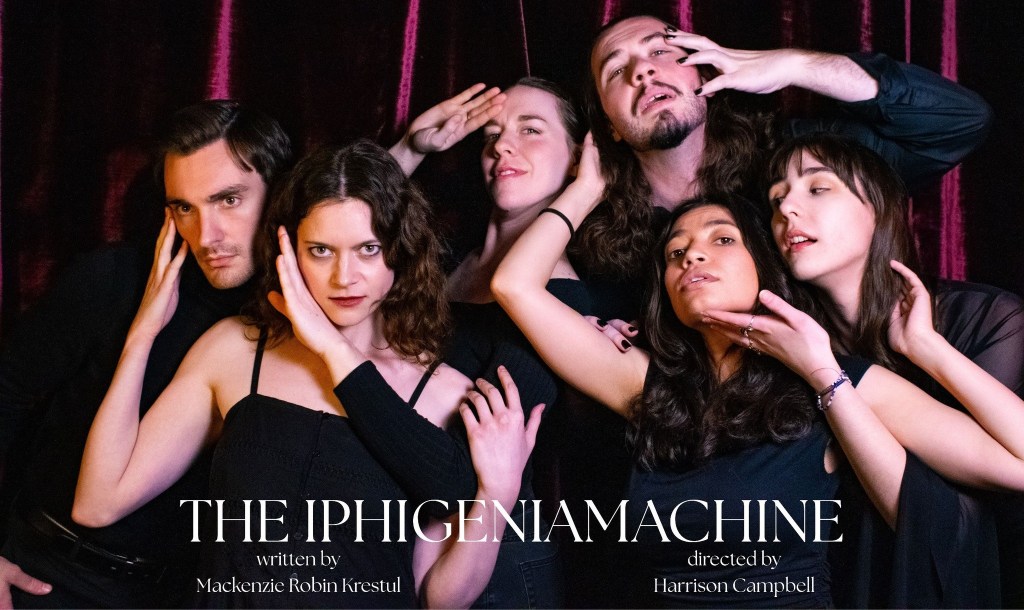
“Where’s the girl to save us all?”
The walls that surround us are covered with torn book pages. A stuffed animal sits in the center of the stage. To the side is a screen with the title of the play, but it is soon to be filled with the images of war. As described by the production, we are in a “technofeudal, post-apocalyptic ice age.”
Iphigenia (playwright Mackenzie Robin Krestul) emerges out of the darkness, joined by a chorus (Quinn Andrews, Kaitlyn Rose RaBocse, Sam Hardy). They giggle joyfully together and play with children’s letter blocks on the floor. The serene scene gives way to the arrival of the warrior Agamemnon (Travis Bergmann), Iphiginia’s father, who is seen asking ChatGPT for advice—plunging us unsettingly into the darkness of the here and now. “King Artemis is holding up all our ships because she is angry I killed her deer,” he explains to the machine. “The soldiers are pissed and we all want to get back to fighting. What do I do?”
“Sure, I can help with that!” responds the chillingly cheery AI. “…If you want your ships to sail, you must sacrifice your daughter on the altar.”
Thus begins a stunning production that takes the text of the Euripedes’ original tragedy Iphigenia in Aulis and deconstructs it through a powerful postmodern lens, shining a black light at the heart of the problem that has plagued the world ever since humans crawled out of the muck and learned to walk and talk, and eventually to wage war.
“Imagine embarking on a journey through a tapestry of ships sailing across the sea,” continues the joyful but soulless computer simulation. “Think about the vibrant and bustling community you’ll burn to the ground! A circle of blood…the cries of women, young girls, children sobbing, eyes bloodshot, choking on the crimson dust that clogs the air.”
Before long we witness Agamemnon literally pleasuring himself to the war footage that is shown on the TV, in a lengthy sequence that is wordless but speaks volumes about man’s fetish for war and history of bloodshed and oppression.
“One burning desire driving this machine of war,” chants the chorus.
“Why do bad things always happen to men?” Agamemnon whines following his self-exploration.
“It’s worth noting that men are the primary protectors of our entire world!” chimes ChatGPt gleefully, reminding him that his daughter must both symbolically and literally die for the greater glory.
Cadence Lamb provides remarkable support as the “motherwife” Clytemnestra. “No one fights fiercer than a mother for her children,” she proclaims, reminding Iphigenia of the 27 hours she spent in labor, and of her daughter’s own “biological imperative.”
“You have to fulfill your duty as a woman,” she insists, echoing the creepy cheeriness of the AI. “Like me, and my mom, her mom, her mom…” she goes on and on and on, as if reaching back to the beginnings of our society’s hegemonic discourse. Her advice to the soon-to-be-wed Iphigenia to “hold still until it’s over,” speaks chilling volumes about a woman’s role in the world as far as the patriarchy is concerned.
The production, directed impeccably by Harrison Campbell, is masterful, with a startling 4th wall break late in the show that puts the audience at the edge of their seats. This electric sequence is anchored by an incredible performance from Hardy, embodying the latest threat to civilization, which we heard earlier in the play giving Agamemnon horrific advice. The deconstruction of the original Euripedes story is then mirrored by an actual destruction of the impressive set. Kudos to Emily McManus for her terrific puppeteering of the “deer” we meet mid-play, who is so expressive that they feel like another living character (and wonderfully designed by Annie McGowan).
“Were you snatched from your mother too?” asks Iphigenia of the elegant creature. “There’s a handprint on your flank, but your eyes are blank. Are mine?”
Iphigenia recognizes that she’s speaking to a puppet. “I’m one too!” she announces. “I play the girl on the gallows. She’s been hiding since the dawn of time. From the corner of the sky, she sees…everything.” Iphigenia encourages the deer to escape the fate that has been handed to both of them. “You can leave…abandon your role. Travel the path through the dark and the heat where a light stands waiting. All you have to do…is drop the sticks.” And the puppet pulls free of the puppeteer.
Writer Krestul has pulled no punches whatsoever in holding up a mirror to the uncomfortable truth of who we are as a society and how little we’ve evolved. In addition to her sharp, biting, poetic, and extremely powerful crafting of the story and its dialogue, she also gives a stunning performance in the role of our tragic hero. Her voice and artistry are exactly what we need right now.
The Iphigeniamachine was performed at The American Theatre of Actors in May 2026.

Jim Catapano Wishes for Many Beautiful Hours at “Birthday Candles”
Noah Haidle’s Moving Masterpiece Birthday Candles is Beautifully Realized by the Lighthouse Repertory Theatre Company

Ernestine Ashworth celebrates her 17th birthday with her mom Alice (Alissa Wexler) as per family tradition—a homemade birthday cake. In between anxiously wondering about her place in the universe, she excitedly recruits Alice in helping her rehearse for her school’s production of “Queen” Lear, and then takes an annual turn at the height chart next to the front door of their Grand Rapids, Michigan home. That height chart will be filled with names we’ll get to know over the next century, and we’ll spend pivotal moments of those years with Ernestine and family, but always accompanied by the unseen but always felt antagonist of Birthday Candles: Time.
The idea for Birthday Candles came to Noah Haidle after his friend’s eight-year-old daughter asked her mom if she thought she had wasted her life. That question is also Ernestine’s first line, directed at herself, and thus a profound question from a child led to a profound play.
We get to spend Ernestine’s birthday with her over the course of 90 years; every year she bakes that same cake, and is accompanied by a version of her goldfish Atman (Sanskrit for “essence,”) always sitting in a bowl on the kitchen table. It is noted that goldfish only have 3 seconds of memory before they “start over”, and the other characters wonder if Atman is better off that way, as the years and the memories wear them down.
Kami Crary gives a magnificent performance as Ernestine Ashworth, whose life spans “one hundred years and ninety minutes concurrently.” With no makeup and only very slight costume changes, Crary embodies Ernestine at 17 and 107 and everything in between so convincingly it’s astonishing. Her castmates complement her wonderfully, going on their own life journeys filled with both sadness and joy, sometimes in the same scene.
The 17-year-old Ernestine is aggressively but charmingly courted by Kenneth (usually played by Kevin Russo, but in this performance played by producer Tony Chiofalo, in a stellar “one-night-only” turn). However, she instead marries Matt (Rian Romeo), and they have many happy years together until tragedy leads to a devastating betrayal. But, it also means that Kenneth may have a chance with Ernestine after all, if he waits long enough…
An ominous tickling clock accompanies blackouts that depict time moving forward. Sometimes the scene is brief and humorous (like when Ernestine’s daughter goes from College Senior to College Graduate to Unpaid Intern in a matter of real-life seconds, or when Matt is seen to give Ernestine the same gift three birthdays in a row). But sometimes the circumstances are heartwrenching (one short scene is just of the characters sobbing). Most scenes are longer, depicting poignant life-changing turning points. The fact that Ernestine lives for over a century means that tremendous sadness and loss are inevitable, and this casts a backwards shadow over the events of her life, even the happier ones. Ernestine is determined to keep her loved ones alive through her rituals, even if it means breaking into the house that she no longer lives in to bake that cake one more time, a full century after the tradition began—much to the chagrin of new owner Beth (Julie Lorson) and to the amusement of Beth’s domestic partner John (played by Chiofalo). “Ernestine: Age Eternity,” she introduces herself with pride.
Shea James plays Ernestine and Matt’s daughter Madeline (Maddy), who later wishes to be called Athena, and finally “Anonymous.” She is a troubled soul who is existentially perceptive, lending a perspective that complements the transitory nature of life that the play so keenly demonstrates. Stephen Anastasia is Billy, who rebelliously criticizes his parents for settling and selling out, only to have the same charges leveled at him by his own daughter Alex (Stephanie Curley) decades later. Billy is a musician who is heard practicing the Beatles’ “Let It Be” (a fitting song for this play), and his rendition gets better and better over the years. Liz Spencer is hilarious as Billie’s girlfriend (and later wife) Joan, an anxious person who berates herself in the third person after every faux pas. Amanda Luong and Glenn McKay are Ernestine’s grandchildren Ernie and William, seen rehearsing “Queen” Lear decades after their grandma’s initial triumph.
Birthday Candles is a heartbreaker for the ages, but also incredibly funny; and it is a stunning celebration of all that matters, and a reminder that a life well lived and full of love is worth the tears. To paraphrase Ernestine, let’s all make a wish for “so many beautiful hours.”
Birthday Candles is directed with finesse and poignancy by Kate Russo. It is performed at the Merrick Theatre and Center for the Arts through June 29, 2025. The production benefits Birthday Wishes of Long Island, whose mission is to improve and empower the lives of homeless children and their families. To learn more, visit birthdaywishes.org.

The Wit and Wisdom of Felipe Luz as written by Jim Catapano
An Up-and-Coming Cabaret Star Looks at Life, Love, Lust, and Everything Else That Happens Under the Covers
“As tempting as it is, please refrain from opening your dating apps during this show,” requests Felipe Luz in a voiceover at the beginning of their show, dubbed “Men Are Trash and I’m a Raccoon.”
Luckily, Luz is too engaging for that to be a concern. They’re not performing in a one-person show; They are a one-person show.
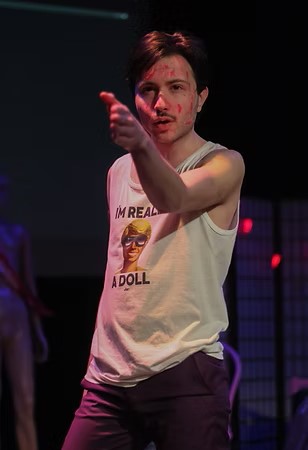
Luz is a Manhattanite who pursued an MFA in Acting at Ohio University (where they recently brought their show). They are a self-described “Brazilian multi-hyphenate and teaching artist” who believes “we should all live our lives as works of art.” And they are fulfilling this 100 percent in their ongoing theatrical journey, where they regale the crowd with persona life stories and lessons—with plenty of laughs along the way.
A stage is set with Japanese byōbu screens flanking a semi-dressed mannequin behind a makeup mirror and table, and a satin-sheeted bed. Luz emerges, a lighthouse beacon coming to rescue us from our denial of how modern life works (or doesn’t).
“How much will people put themselves into boxes only to get laid?” they observe. “Isn’t Grindr the LinkedIn of Sex”? And thus, the tone is set, and it’s lots of Truth and implied Dare. Luz proceeds to lay down the ground rules that must be followed if anyone wants their attention—no sex with idiots, no politics, no questions asked—while acknowledging that all those rules get dropped if Luz is feeling “super-horny.”
Luz’s honesty is refreshing and hilarious, and we laugh as they shine the spotlight back on us, urging us to consider our own motives in life and love. The show is filled with Luz’s astute observations and revelations; they admit they’ve always been a
“manic pixie dream boy,” who often exists solely as a “plot device” for people to learn about themselves before they move on to someone else (a stunning realization that surely hits home for many of us).
Lux is the kind of performer who holds your attention from beginning to end (an end that arrives too soon and leaves the audience wanting more). Their storytelling is rich and poignant, peppered with hilarity and familiarity, emotion and vulnerability. A relationship begins, addictions are addressed and conquered, feelings increase and diminish, restlessness and doubt creep in, and a wondering of what else is out there leads to growing apart and finally, a breakup.
“I’ll be forever grateful to you for showing me that I deserve love,” Luz says to their unseen former partner in a bittersweet, teary moment. Then the mood changes, as Luz, jumping excitedly on the bed, announces a plan to message all the boys they’ve ever dated and call them out— “just for the drama!”
Social media, and its impact on modern dating, gets a turn under Luz’ powerful microscope. In a nutshell, they observe that our addiction to checking on people from our past online means we can never truly turn the page and free ourselves, and our former objects of affection know this. “I’ll start dating someone else in two weeks, and they won’t even be that pretty, and you’ll wonder what’s wrong with you!” Luz proclaims to a past paramour (another shot to the heart).
It’s then that a true shot to the heart is delivered. “We’re always waiting for someone, so we don’t want to get too attached, because there might be someone better waiting around the next corner.” Luz knows themself—and us—very well.
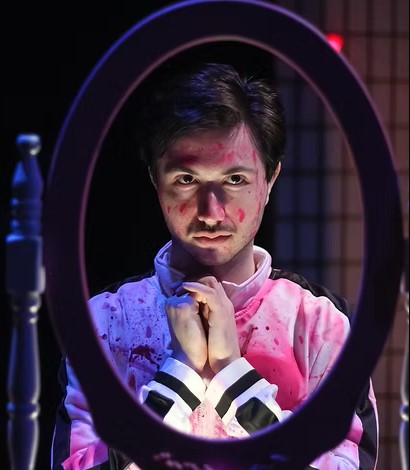
“Men Are Trash and I’m a Racoon” recently ran at Brooklyn’s The Rat, and further NYC shows are coming this year. Follow Felipe on Instagram at @letherebefelipeluz to see what they do next (and where you can see them do it!).

