
How to Swallow a Volcano Looks at Trauma, Self-Abandonment, and the Therapist Who Sees It All
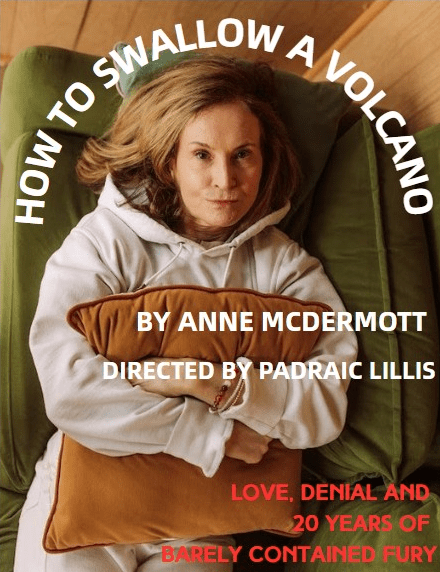
Brooklyn-based writer/performer Anne McDermott’s solo show is a cautionary, soul-baring tale about what you get when you’ve been falling on the sword your entire life. Swallowing your words and feelings to avoid rocking the boat; people-pleasing, shrugging “it’s fine” at every incidence of mistreatment; venting to a therapist and then repeating the bad choices in between sessions. And it’s also about the very important place that therapist has in a person’s life. The protagonist’s two-decade relationship with her counselor Pamela is shown to be the most important: Pamela is the only one who knows the whole story, who sees behind the avatar; and is therefore more connected and more crucial to the real Anne than any parent, friend, or partner could ever be.
Dancing onto center stage to the tune of Sly & The Family Stone’s “Hot Fun in the Summertime,” McDermott commands our attention and brings us into her world and the year 2021. It is quickly revealed that her relationship with therapist Pamela may be coming to an end, which casts a shadow over the story before we go back to the beginnings of their sessions in the pivotal year 2001. The perpetually single Anne—child of alcoholics, dysfunction, and many a traumatic familial encounter—has become too “nice” for her own good, and this is leading to self-sabotaging relationship and career choices. She does the traditional “lying on the couch” during sessions with the stoic Pamela, revealing that a failed relationship with a guy named Seamus had led to depression, which led to Prozac.
“Depression is anger turned inward,” warns Pamela. But Pamela continues down the same road, going from Seamus to the poorly endowed Bill to the much younger Peter, blissfully unaware of her own role in her unhappiness.
Anne quotes a book “written by a PhD” to rationalize her choices. “Every relationship goes through ‘the switch’…someone gets afraid, they back off, you give them space, and they come back.”
“This will be our last session,” she says in her third week after meeting Peter. “Therapy worked, I have a boyfriend now!” But therapy continues for decades, along with the failed relationships and bad decisions, with Pamela becoming the one constant in her life, slowly helping her patient go from self-betrayal to self-actualization.
Directed by Padraic Lillis as part of the Midtown International Theatre festival (and development with Matt Hoverman), McDermott gives a powerhouse performance in her hour upon the stage. Her words are witty and her emotions raw, and the descriptions of moments in her life so vivid that one could almost see them playing on an imaginary screen behind her. She has a profound connection with the audience members, each of whom no doubt caught a glimpse of themselves somewhere along her 20-year journey. Her performance is so magnetic and so grounded in truth that one cannot help but feel her feelings with her, especially in the final moments when she stands alone but more fully herself than ever before—with many thanks to Pamela, to whom the show is dedicated.