
Home » Posts tagged 'fiction'
Tag Archives: fiction

Jim Catapano at the Movies with “BLACK BOX”
Joshua Crone’s Compelling Black Box Takes a Compassionate Look at Hurting and Healing After 9/11

“It’s not the kind of black box that tells you what happened before a crash,” Dante (Alec Stephens III) notes to us, directly. “I want to know what happened after. Who died? Who remarried? Who took pills or went to war? What about that?”
It’s September 2002, and forgetting is not an option. Dante is a fireman who lost his life at the Towers, but nevertheless is here to tell the story of the ones left behind. “Funny where a name can take you,” Dante says, noting the bitter irony of what he is called. “I don’t remember much, just running up the stairs,” he says. “It’s always like that…except this time the stairs ran out.”
He introduces us to his widow Mary (Weronika Helena Wozniak), who pole dances at a New Jersey club called (again ironically) The Fire Station; her stage persona is Magda, created with a blond wig and a Polish accent. Army man Sgt. Dooley, back from Afghanistan, is one of her biggest fans, and Dante announces to us that he will play the “character” of Drew “so he can be close to Mary.”
Mary visits the fire house where he once worked, where his chronically coughing, survivor-guilt ridden boss Frank (Richard Roddy) is beginning his shift. Frank finds her dancing around the firepole, recognizes her, and their roles in Dante’s life do not stop them from connecting in the Biblical sense. Shift to Frank’s confused, often-stoned 18-year-old son Drew (Tim Palmer) spending time with his 9/11 conspiracy theory-obsessed Uncle Nate (Thoeger Hanson), and then cut to Frank’s wife Sarah (Stephanie Roseman), whose instincts tell her Frank is not being faithful, and we get a clear picture of where many people were on that somber anniversary. These are human beings who are all suffering in their own way, and searching for connection and understanding from others who are themselves too traumatized to give it.
The characters continue to intersect, as Drew comes to the recruiting office and meets Dooley, who encourages him to enlist, much to the horror of Sarah who now feels in danger of losing both her husband and son. Mary and Sarah become friends as well (and Nate humorously keeps appearing in unexpected places, first as a café waiter and then a bouncer at the Fire Station). Sarah and Dooley bond as well, over mutual concern for Drew but each of course wanting a different path for him.
Black Box is a moving, gripping and relatable story of people in pain, confused and looking to make connection in any way they can. Some isolate; some make bad choices; some look for answers in the fantastical; some choose to go numb. The film is also beautifully shot, with some scenes looking like a stage play (and fittingly in the “black box” of many theatres), and others taking place in the streets of NYC—then a city still healing. One pivotal scene takes place with the lights of the 9/11 memorial shining in the background, and the effect is stunning; as the 25th anniversary of that tragedy looms, Black Box succeeds in taking us right back there in a way that is painful but necessary. Writer/Director Crone shows an incredible understanding of the human condition following a traumatic event that is brought to life deftly by the talented cast. The narrative threads and the characters come together at the end in a very natural and satisfying way that leaves us with a feeling of hope and an understanding that people just need to be seen and heard, and supported by each other, especially after tragedy—even if getting there is extremely hard to navigate.
Black Box is a production of Yellow Bicycle Theater. To learn more, visit https://yellowbicycle.com/

Jim Catapano asks “How’s Annie and The American Dream?” at Kate Gill’s AMERICARING at the MITF
Kate Gill’s Heartfelt and Socially Sharp Americaring Depicts a Family Failed by the System

Annie (Quinn Davis) is a high schooler who has much more to deal with than homework. Her father Mac (Kevin Patrick Dowling) turned to alcohol after Annie’s mother passed after a long (and very expensive) illness, and now only comes home from the bar to borrow drinking money. Her brother Mickey (Carlos Fruzzetti) has become a drug dealer because it’s the only way to bring in decent money. Annie’s pre-teen brother Jimmy (Teagan Guertin) is depressed and cynical, preferring to spend their time with the family’s violent orange cat Buzz, “the terror of the South End” as Mickey puts it. And Annie is working to exhaustion as a diner waitress while trying to keep her family from imploding further. As the story unfolds, we learn that the struggling family is one of many who have become victims of a capitalist society and a healthcare system that has robbed them of their mother, damaged their relationships, and shattered their hopes for the future. The American Dream they were promised has become a waking nightmare.
When Annie meets Kyle (Preston Ottaviano) as a charity event, the two bond over the mutual loss of their mothers. The connection leads to romance and a glimmer of happiness for Annie. But when she meets Kyle’s father Frank (Mark Gilchrist) and his new wife Marilyn (Fredda Takacs), the shocking truth about the wealthy Frank’s hand in her family’s fate threatens to destroy it all.
Skillfully steered by director Frank Licato, Americaring is a realistic depiction of an American family in tatters, drowning in its own dysfunction and reeling from the actions of a system that has turned its back on them. To its credit, it stays grounded and real, never descending into melodramatic pathos, and is sprinkled with humor along the way (much of it surrounding the unseen Buzz the cat), giving it a true-to-life feel. It ends with a spark of hope thanks to the resilient Annie, as she recovers from her obstacles and refuses to give up on the chance at a better life for her and her family. The characters feel real and evoke genuine sympathy, with tremendous work in particular by the sibling actors, who are heartbreakingly numb and world-weary at such a tragically young age. The family are the heart of the story, but given equal weight is the utter failure of the American healthcare system to put people over profit, and Gill pulls no punches in depicting the human cost of the injustice that pervades modern society. Americaring is one to catch and one to think about.
Americaring was presented at the American Theatre of Actors in June as a featured selection of The Midtown International Theatre Festival.

“My Bestie, The Car” says Jim Catapano about Let Mezaluca Buy Your Car Revs Its Engine at the Downtown Urban Arts Festival
National Latinx Playwriting Award winner and O’Neill finalist Desi Moreno-Penson has brought a side-splitting story of Pains, Strains, and Automobiles to La Mama. It begins with Joey (Wilson Hernandez) and Caterina (Kathleen Guerrero) arguing in his beloved ‘94 Camaro after leaving a party. The car was “born” the same year Joey was, as he is proud to point out. Caterina calls the old Camaro “a piece of sh-t”, and Joey insists that she stop badmouthing his “best friend.”
“It can hear you, and it’s not old, it’s vintage!” he retorts. Suddenly there is a (very well-realized) accident, and the shaken couple, having been thrown from the car, are quick to take sides on who’s at fault. Driver Joey blames Caterina for aggravating him, while Caterina thinks the blame lies elsewhere: Joey for doing tequila shots at the party they just left, and the Camaro for being junk.

“No don’t, it doesn’t like you!” yells Joey at Caterina when she goes to retrieve her phone from the car. “It knows you say bad things about it, so it feels a little resentful towards you!” Joey begins to talk so lovingly about the car that Caterina starts to wonder if he’s sleeping with it (a dynamic that many frustrated partners can no doubt relate to).
And if that wasn’t bizarre enough, suddenly a third character arrives on the scene to give its testimony on the situation: THE ACTUAL CAR (a hilarious Jayson Kerr, who enters to the sound of alarms and headlights on his shoulders). And this injured, outraged Camaro has a lot to say, especially to his “disrespectful” nemesis Caterina—suggesting that if it were up to him, he’d “send her back to the t-tty bar where she belongs!”
It is then that the plot thickens as Caterina reminds Joey that she wants him to sell the car to the unseen Mezaluca of the title, basically asking her partner to abandon his best pal for cash. Noting that Mezaluca is importantly Latine, Caterina triggers a discussion about how “there are all kinds of Latino,” as Joey and the Car uncomfortably but hilariously run down a series of old-fashioned stereotypes, much to her disgust.
“I’m Puerto Rican,” notes Caterina.
“Well maybe you’re a little bit shady,” the car claps back.
“None of this is based in reality!” exclaims Caterina in a slightly meta moment.
Stylishly directed by KM Jones Associate Member of the League of Professional Theatre Women, and with a winning cast, Let Mezaluca Buy Your Car is a quick and fun dive into the surreal combined with an astute look at relationships, prejudices, and the personality traits that can alternately create tension and yet somehow, connection.
Let Mezaluca Buy Your Car was performed at La Mama on June 3, 2026. Keep a look out for further performances and other works from this dynamic team.

A Jim Catapano Review: The Iphigeniamachine Rages Against the Neverending Atrocities of the Patriarchy
Girl Interrupted, a World Deconstructed
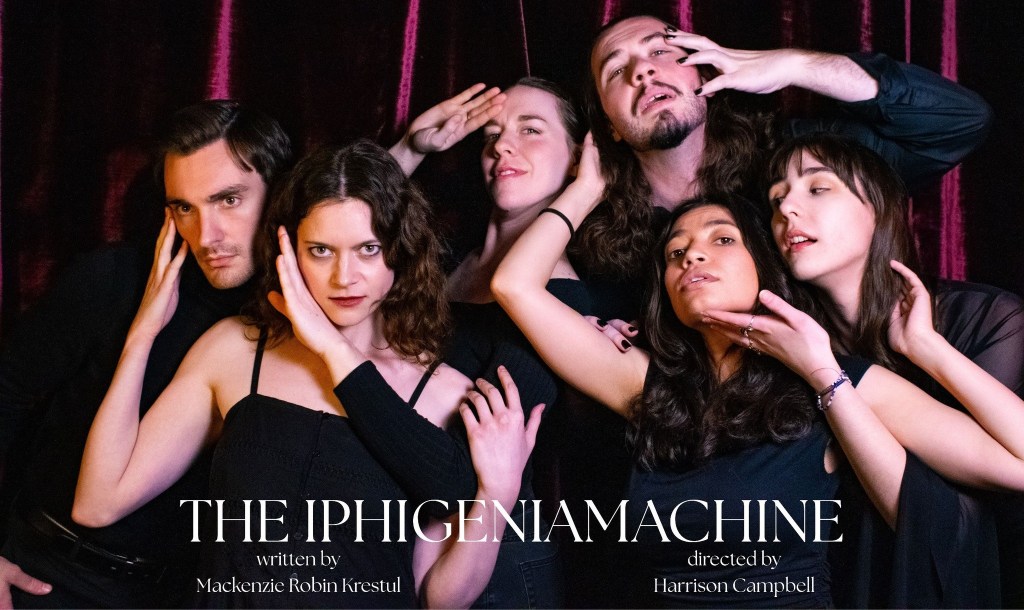
“Where’s the girl to save us all?”
The walls that surround us are covered with torn book pages. A stuffed animal sits in the center of the stage. To the side is a screen with the title of the play, but it is soon to be filled with the images of war. As described by the production, we are in a “technofeudal, post-apocalyptic ice age.”
Iphigenia (playwright Mackenzie Robin Krestul) emerges out of the darkness, joined by a chorus (Quinn Andrews, Kaitlyn Rose RaBocse, Sam Hardy). They giggle joyfully together and play with children’s letter blocks on the floor. The serene scene gives way to the arrival of the warrior Agamemnon (Travis Bergmann), Iphiginia’s father, who is seen asking ChatGPT for advice—plunging us unsettingly into the darkness of the here and now. “King Artemis is holding up all our ships because she is angry I killed her deer,” he explains to the machine. “The soldiers are pissed and we all want to get back to fighting. What do I do?”
“Sure, I can help with that!” responds the chillingly cheery AI. “…If you want your ships to sail, you must sacrifice your daughter on the altar.”
Thus begins a stunning production that takes the text of the Euripedes’ original tragedy Iphigenia in Aulis and deconstructs it through a powerful postmodern lens, shining a black light at the heart of the problem that has plagued the world ever since humans crawled out of the muck and learned to walk and talk, and eventually to wage war.
“Imagine embarking on a journey through a tapestry of ships sailing across the sea,” continues the joyful but soulless computer simulation. “Think about the vibrant and bustling community you’ll burn to the ground! A circle of blood…the cries of women, young girls, children sobbing, eyes bloodshot, choking on the crimson dust that clogs the air.”
Before long we witness Agamemnon literally pleasuring himself to the war footage that is shown on the TV, in a lengthy sequence that is wordless but speaks volumes about man’s fetish for war and history of bloodshed and oppression.
“One burning desire driving this machine of war,” chants the chorus.
“Why do bad things always happen to men?” Agamemnon whines following his self-exploration.
“It’s worth noting that men are the primary protectors of our entire world!” chimes ChatGPt gleefully, reminding him that his daughter must both symbolically and literally die for the greater glory.
Cadence Lamb provides remarkable support as the “motherwife” Clytemnestra. “No one fights fiercer than a mother for her children,” she proclaims, reminding Iphigenia of the 27 hours she spent in labor, and of her daughter’s own “biological imperative.”
“You have to fulfill your duty as a woman,” she insists, echoing the creepy cheeriness of the AI. “Like me, and my mom, her mom, her mom…” she goes on and on and on, as if reaching back to the beginnings of our society’s hegemonic discourse. Her advice to the soon-to-be-wed Iphigenia to “hold still until it’s over,” speaks chilling volumes about a woman’s role in the world as far as the patriarchy is concerned.
The production, directed impeccably by Harrison Campbell, is masterful, with a startling 4th wall break late in the show that puts the audience at the edge of their seats. This electric sequence is anchored by an incredible performance from Hardy, embodying the latest threat to civilization, which we heard earlier in the play giving Agamemnon horrific advice. The deconstruction of the original Euripedes story is then mirrored by an actual destruction of the impressive set. Kudos to Emily McManus for her terrific puppeteering of the “deer” we meet mid-play, who is so expressive that they feel like another living character (and wonderfully designed by Annie McGowan).
“Were you snatched from your mother too?” asks Iphigenia of the elegant creature. “There’s a handprint on your flank, but your eyes are blank. Are mine?”
Iphigenia recognizes that she’s speaking to a puppet. “I’m one too!” she announces. “I play the girl on the gallows. She’s been hiding since the dawn of time. From the corner of the sky, she sees…everything.” Iphigenia encourages the deer to escape the fate that has been handed to both of them. “You can leave…abandon your role. Travel the path through the dark and the heat where a light stands waiting. All you have to do…is drop the sticks.” And the puppet pulls free of the puppeteer.
Writer Krestul has pulled no punches whatsoever in holding up a mirror to the uncomfortable truth of who we are as a society and how little we’ve evolved. In addition to her sharp, biting, poetic, and extremely powerful crafting of the story and its dialogue, she also gives a stunning performance in the role of our tragic hero. Her voice and artistry are exactly what we need right now.
The Iphigeniamachine was performed at The American Theatre of Actors in May 2026.

Jim Catapano has [Camp] Growing Pains thanks to Esme Roberts Hilarious Coming-of-Age Comedy Little Bitches Lights Up the Fresh Fruit Festival

Little Bitches is a lively, authentic play about maturing teens that starts at 60mph, opening with a call-and-response chant of “Little Red Wagon” led by Gabriel Ryan-Kern and Sarah Brown that gets the audience pumped. It stays at full speed from there, as we see Jenna (Hailey Gates) and Natasha (Gigi Kazanjian) meet as little kids in 2016.
“If you were a boy I would love to marry you,” says a charmed Jenna.
“Actually my mommy says that you can marry girls too,” Natasha replies. “My aunt is part of this religion called ‘lesbianity’ where she just gets to marry girls all day!” But we soon learn that while Jenna grows up to be on board with that, to her heartbreak Natasha may not actually be joining that “religion” after all.
Following that foreshadowing we fast-forward to the girls at age 15 at a California summer camp, surrounded by many peers of wildly different personalities and persuasions, under the guidance of Counselor Kiwi (Veronica Piurek). Natasha’s bestie Sophie (Lucy Kirkland) arrives from Spain, and intrigued “ally” Billy (Samantha Fath) is thrilled to meet a “real immigrant” but then is disappointed to learn that Sophie was only vacationing there. Jenna, meanwhile, is surprised to be only finding out now about Natasha’s supposed BFF, while Natasha wishes for a date with Tyler (Leo Ruckenstein) from the boy’s camp. Significantly Jenna is not interested in anyone from that camp, and is upset that Natasha seems so different from the previous summer.
“I think it’s normal for people to change in school,” says bunkmate Kate (Charlotte Gilbreth).
“I guess but I don’t want them to change,” says Jenna.
“Change is inevitable,” Kate says, and thus we have the theme of Little Bitches, handled lightheartedly but genuinely from a writer who knows, and a talented cast who delivers.
Roberts was 17 when she crafted Little Bitches, and therefore close enough to her own experience of the era she is depicting for it to still be fresh fruit (pun, as always, intended).
Our adventures with the camp company lead to a very bizarre yoga class led by Humuh (Dominik Valcin), where bunkmate Rian (Chiara Di Giorgio) gets hurt in a game of leapfrog with Racie (Ruby Carlon), but is thrilled to be accompanied by her crush Jack R (Devan Martin). As the girls distill alcohol from hand sanitizer, Jenna struggles with her feelings for Natasha and her jealousy of Sophie, who suspiciously disappears, leading the group to hold a hilarious séance. This is followed later by some equally uproarious (and impressive) musical numbers, including one from the now “in love” Rian and Jack R (“Don’t judge me, I’m sick right now”) says Rian.
The angst, the budding romances and the teenage anxiety over sexuality and orientation are generally played for laughs, but without sacrificing the reality of the character’s experience. Roberts has mentioned the show PEN 15 as an influence, and that is delightfully evident here. The characters fly near the top, but their feet are still close enough to the ground to feel genuine and relatable. It’s a lead-off home run from Roberts and makes one excited to see what the up-and-coming author does next.
Little Bitches is a Production of the Next Door Theatre Company, produced and directed at The Wild Project in Spring 2026 by Samantha Lako and Victoria Smith.

Jim Catapano has a view of the ‘80s from the Edge of Your Seat at Sean Szak Prasso’s Obscene Desire at the ATA
Following on from his first original play last year, the acclaimed Angel in the Heat, writer/director Prasso has delivered another intense character study, featuring many actors from that production but this time taking us back to 1986 Long Island. Obscene Desire centerson Emma Reed (Annie Unger), on the night before she leaves for college. Her BFF Scarlett (Samantha Seiff) wants to go on a girls’ night before the big move, though Emma had promised to see her possessive boyfriend Greg (Dustin Pazar) that night. The brooding Greg has returned to the drinking problem that has caused many past issues, and Emma is on the cusp of leaving him. Emma and Scarlett’s adventure leads them past the home of Emma’s teacher Henry Johnson (Travis Bergmann), who they see through the window striking his wife Jennifer (Jean-Marie Stodolski). Despite Scarlett’s protests Emma is called to take an action that puts her in danger, as she soon finds that the woman she thinks she is rescuing is not what she seems. Meanwhile the tortured Greg meets with his pot-loving buddy Adam (Jonathan Beebe), who urges him to move on from both Emma and the booze. He puts a gun on the table and asks Greg to go to the shooting range with him. The pot begins to boil as the three sets of characters get ever closer to climactically converging.
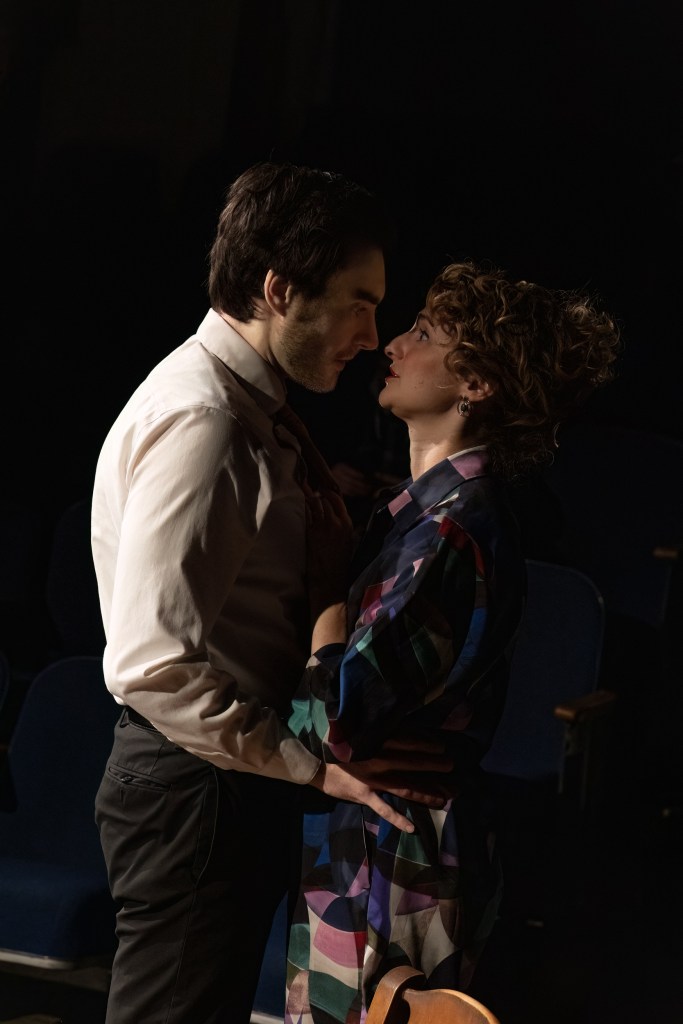
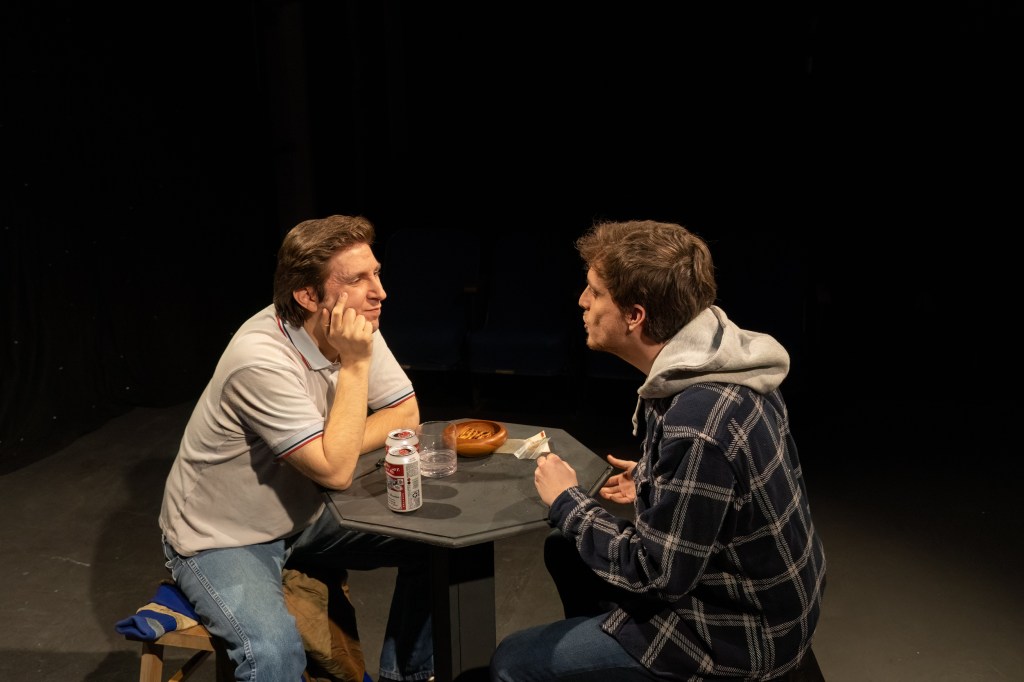
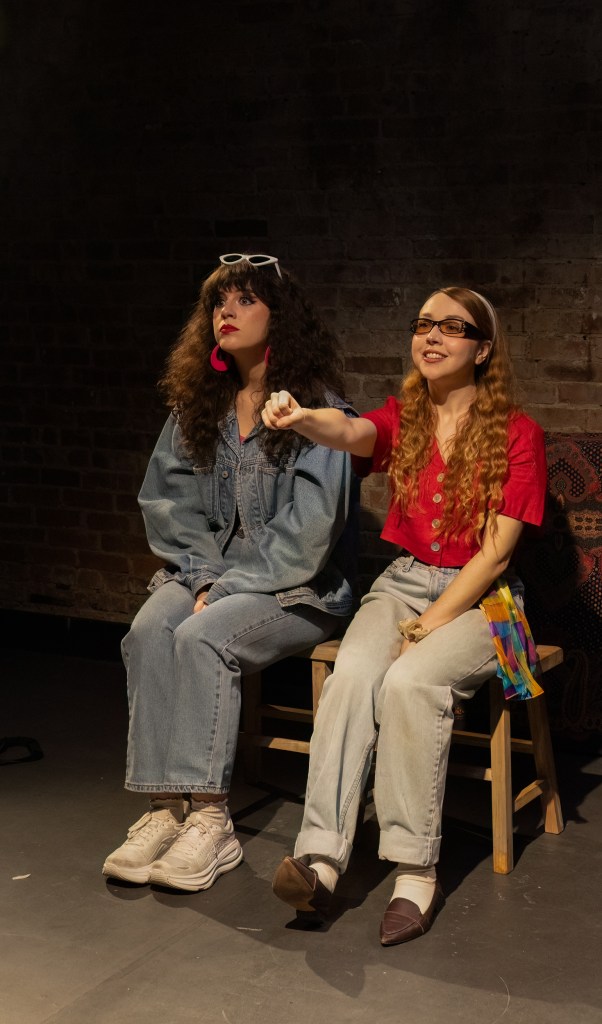
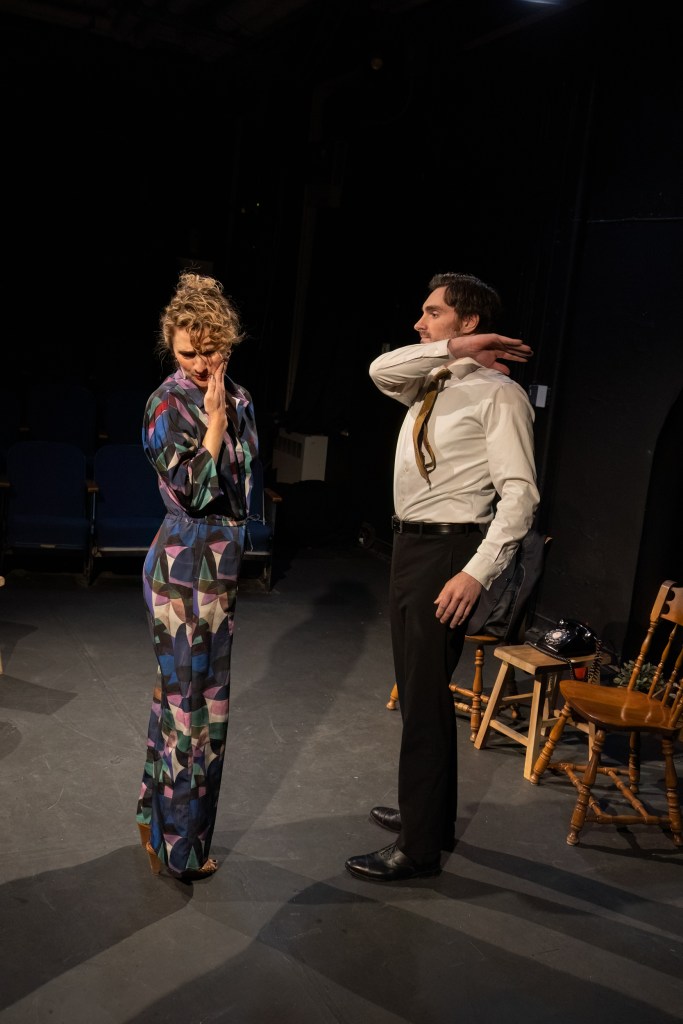
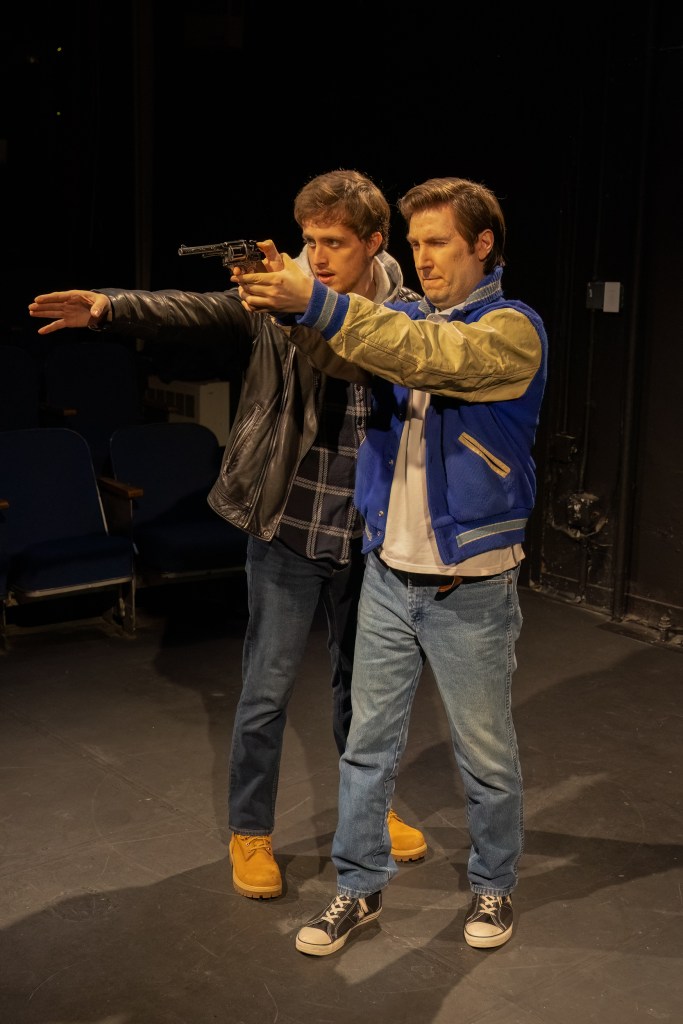
PHOTOS BY DAN LANE WILLIAMS/DLWPhotographyNYC
The twists, turns and revelations that follow make Obscene Desire a gripping one-act; none of them will be spoiled here, but what can be said is that Prasso has done a masterful job of making the characters grow more 3-dimensional before our eyes. The dark past is revealed and motivations become clear, as the characters go from sinister to sympathetic, well played by actors who are clearly quite comfortable working with each other in such an intense situation. The 80s vibe—the music, the hair and outfits, and the pivotal lack of cell phones, coupled with the normal-at-the surface suburban atmosphere (homemade cookies, gardening, baseball and cruising through town) give an old-school horror movie vibe, which shifts to psychological drama as we learn the tragic backstory that brought them all to this fateful night.
It all comes together to make Obscene Desire a very satisfying theatre experience, with a writer/director and his cast at the top of their game and telling a thrilling nail-biter of a story. One looks forward to seeing much more from this talented team.
Obscene Desire runs at the Beckmann Theatre at the American Theatre of Actors through May 10, 2026.

A Tangled Web Gives Way to Connection and Love: Jim Catapano reviews Reginald T. Jackson’s Hilarious and Heartfelt When We Practice to Deceive Shines at the Fresh Fruit Festival
With When We Practice to Deceive, performed at The Wild Project in Spring 2026, renowned playwright Reginald T. Jackson lets the trans community know that he sees, hears, and supports them. The delightful production is mostly lighthearted; as Jackson has observed, many theatrical dishes on pivotal subjects are best served with humor. Thus the characters are instantly familiar, sympathetic, and believable.

Veterinarian Kevin Cooper (Maddoux) is catching up in NYC with his Louisiana-residing mom Martha (Yvette Dingwall). He is late because he had just been in surgery to remove a dog’s spleen. “This is what you do with that expensive medical degree you have?” chides Martha, who wants to know when he’s going to find a nice partner. He in fact, has, in Lady Jasmine (Sunna Bee), and nervously plans to have them meet. He confides in Beth (Jasmyn Green), his friend at the hospital, over how to broach the subject that Lady Jasmine is a transgender woman to his kind-but-conservative mom. But Martha finds that out on her own, when sharing a restaurant restroom with Lady Jasmine before realizing that she’s her son’s new partner. The exchanges to follow are tense and realistic but with a light touch that keeps the audience engaged and sympathetic to all the characters. Martha claims to not drink (“you can’t serve both the lord and the bottle”) but then orders and chugs a Manhattan after the revelation. Bee pulls at the heartstrings as Lady Jasmine, wanting to be seen and accepted for who she is after being tragically disowned by her own parents. Cooper’s relatable Kevin is stressed to the high heavens, terrified that he will have to choose between Lady Jasmine and his own mother. But the wise and loving Martha comes around, embracing Lady Jasmine and (over) enthusiastically planning the wedding after the couple gets engaged right in front of her. “Don’t be so surprised, I’m capable of growth!” she announces to laughter and relief.
A charming and believable performance from Dingwall gives the story a warmth and realism; this is aided by a hilarious and effervescent Chetan Rao as Lady Jasmine’s BFF Diamond Dupree. Amiere A . Bell is Charlie the bartender, who oversees the events and provides a calming presence, as does Green’s charismatic Beth.
The entire cast brings a heart and depth to their characters that realize Jackson’s intent, and bring tremendous life to his witty and thoughtful dialogue. The road to the wedding is incredibly fun, but balanced with a sad moment when Lady Jasmine is once again confronted by her intolerant, dead-naming parents. It is a scene that is heartbreaking but necessary, as a reminder that violence against the trans community, both emotional and physical, is a tragic epidemic (as Jackson has observed).
Deftly directed by Kubbi, When We Practice to Deceive is, a Jackson puts it “a love letter to the trans community.” It’s an essential work that comes at a pivotal moment, and a triumph for Jackson and the cast and crew.

Jim Catapano reviews Anne L. Thompson-Scretching’s Home Is Sweet Sorrow: “A Masterful Conclusion to a Momentous Family Saga”
The War That Never Ends
Home Is Sweet Sorrow is a must-see and a devastatingly powerful third chapter in the Blood trilogy, which also includes the highly regarded A Lesson in Blood and A Long Way From Home. Anne L. Thompson-Scretching’s prolific pen and deft direction again triumph in a depiction of an American family wounded by war and the trials of the mid-20th Century.
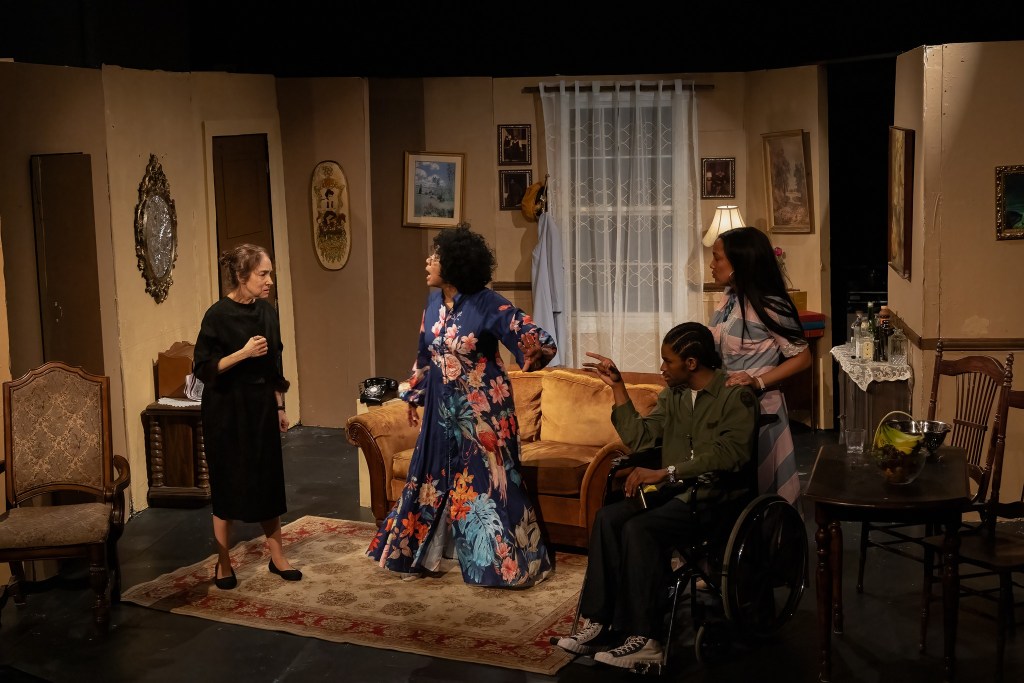
It is 1971, and PFC Willie Taylor (Laquan Hailey, reprising his role from A Long Way From Home) has come home from Vietnam. He is in a wheelchair, but his prognosis to walk again is good. Though he may soon regain his mobility, the damage to his mind is far less likely to ever be healed. He is a stranger to himself and to his family: mother Shanna (Gina McKinney), father Jacob (Kevin Leonard), and sister Luella (Joy Foster). Non-blood cousin Ceola Red Feather (Carrie Johnson) is the daughter of Oceola (the lead character of A Lesson in Blood); she has gone to school and now has medical training that she can help Willie with, and the two eventually begin the romantic relationship they were destined for. Rommell Sermons (Chester in A Long Way From Home) appears as Thomas Avery, a sergeant who visits to try to get Willie help for his PTSD.
That PTSD has shattered Willie’s personality and threatens his very sanity. After he arrives home (significantly not wearing his uniform), the mother he had missed so very much tries to help him navigate a tight hallway in his chair, and he snaps instantly and violently. He has developed a drinking problem—reaching for the bottle when the nightmares come (and they do, every time he closes his eyes), when the cars backfire like rifle shots, and when the flashbacks in his head threaten to consume him.
“I don’t know who I am or what I’ve done,” Willie despairs. “Them doctors, they only patched up the hole inside me and sent me on my merry way…sometimes when I wake up, I still feel like I’m dead. I can’t be the same person I was before I left here.”
Adding to his own trauma is that his friend and fellow PFC Jamie Lofton perished under suspicious circumstances in Vietnam. Jamie’s devastated mother Abigail (Elly-Anne Ehrman), aware of the secret that was her son’s burden, has come looking for answers from Willie, and a painful revelation adds even more horror to the already devastating effects of a war that no one wanted.
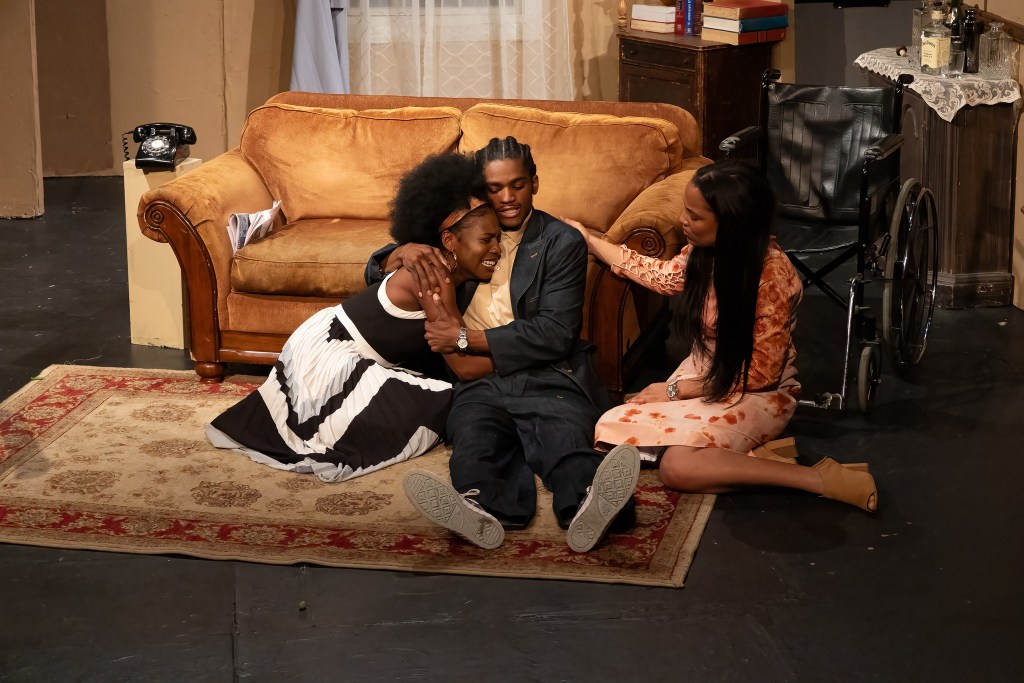
The relationships among the characters are so well-realized and so well-acted, anyone watching Home is Sweet Sorrow could almost feel like they truly are in the home of the Taylors in 1971. They share many a meal and many a drink, namecheck All in The Family and Ed Sullivan, and truly give the sense of having been through a great deal together. Each and every one of them feels like a real living and loving human being, and so their happiness and pain are felt viscerally. We find joy in their warmth and connection, thus making the moments when that connection is severed all the more painful to witness. Willie’s devotion to his Shanna is damaged by what he sees as her inability to grasp what he’s been through, and she is left terrified, forced to walk on eggshells in fear of the traumatized shell that her son has become. Shaina and Abigail, ostensibly friends, clash over their grief and their individual need to honor their sons, one who is gone physically and one emotionally. Jacob plays peacemaker and is anguished that any returns to normality are short-lived. Anne L. Thompson-Scretching’s powerful dialogue and skillful world-building are astonishing, as is her bravery in reminding us that resolutions and closure are not to be found in the brutal reality that Home Is Sweet Sorrow so poignantly depicts.
Layton Lamell, Patricia Fields and Sania Hyatt are Swings for Willie, Shanna, and Luella respectively.
Presented as part of the African American Playwrights Initiative, Home Is Sweet Sorrow is performed at the Sargent Theatre at The American Theatre of Actors through March 29, 2026.

Jim Catapano examines A Legend Restored with the ATA production of Kenthedo Robinson‘s The Lewis & Clark Expedition: The Story of York
Kenthedo Robinson‘s The Lewis & Clark Expedition: The Story of York Returns a Hero to His Rightful Place in American History
“If a man can become a slave, a slave can become a man.”
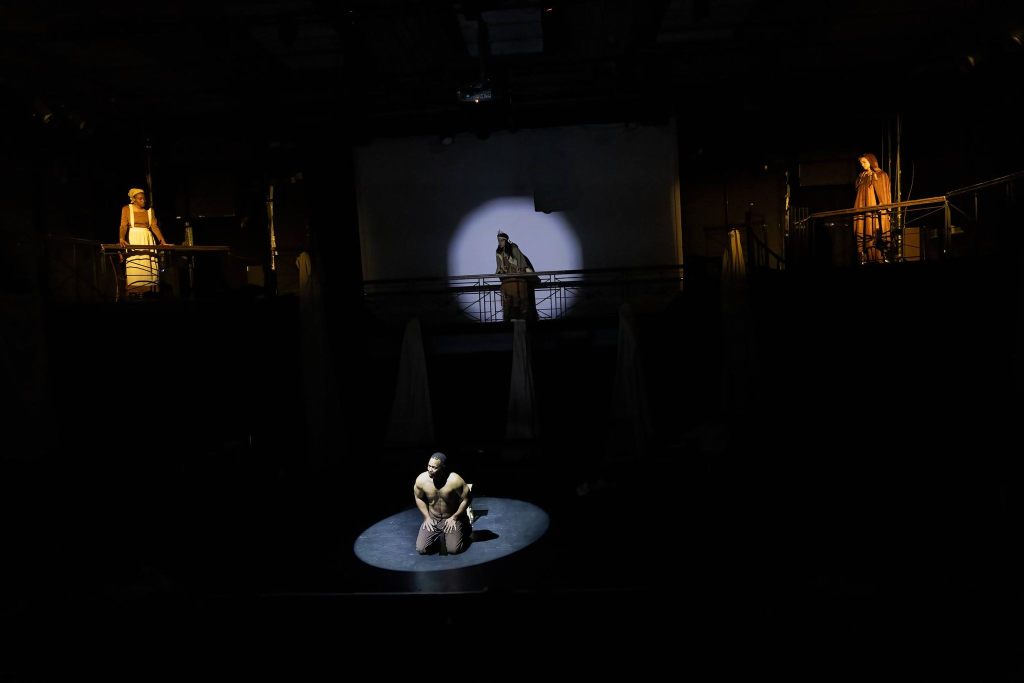
In 1804, a country in its infancy was determined to explore the uncharted land that would soon be part of its territory. The treacherous and dangerous journey was famously undertaken by Meriwether Lewis and William Clark, but few know of the man who accompanied them and was utterly essential to the success of the quest: York, an African-American enslaved by Clark.
York is portrayed with astonishing power and authenticity by Rommell Sermons, who we see discussing his being chosen for the expedition with his wife Reeva (Marsha St. Julien; portrayed later in the run by Zsay Moore). Reeva is deeply unhappy with the idea of York going into certain danger with his white oppressors. Though York is loyal to Clark (Nicholas Dodge) because “Clark is loyal to him”, Reeva is much more skeptical about the nature of the relationship, a foreshadowing that will lead to a devastating revelation at the end of the play. Indeed, Clark seems somewhat benevolent, especially in contrast to Lewis (Travis Bergmann). Lewis here is seen to be a raging bigot, seething with contempt for York and threatening him with the whip at every opportunity (despite not having the “authority” to do so), something his “master” Clark has never done. Lewis is out for fortune and glory while Clark purports to be more nobly motivated by the chance to grow and unite the young country.
“I hate you because you exist!” screams Lewis at York, forever paranoid that the slaves and the indigenous people they are about to displace will rise up against their oppressors. Though Clark appears to respect and even care for York, he still refers to him as property and refuses to agree to give him his freedom, only mumbling that he will “revisit” the notion upon their return. It becomes clear that Clark is only good to York because he needs him.

And York is indeed crucial to the treacherous journey, his intelligence, skills and strength proving indispensable. The indigenous tribes encountered are fascinated by York, having never seen a person of African descent before, astonished that his dark “paint” doesn’t wipe off. After a tense face-off with Chief Cameawaite (Kevin Leonard), it is shown that his very presence provides essential assistance to the expedition in their dealings with the Native Americans they encounter. The indigenous peoples are portrayed by a talented cast including Sebastian Arteta (Chief Anapae), James Oliver (Chief Tall Crow), LeeSandra Moore (Sonomo/Stage Manager) and Ms. D (Highshee/Assistant Stage Manager). As the journey continues, events are cleverly linked by Clark’s correspondence with his back-home brother John (Alex Silverman).
York saves the day at every turn, becoming an icon to the native tribes but taken for granted by his own team, who still see him as property. He cares for a very ill Clark; he looks after Sacagawea (Natasha Sahs), an indigenous teenager who assists the expedition and travels with them all the way to the Pacific Ocean; and even saves his nemesis Lewis from a bear attack, in a sequence that is fantastically realized through excellent choreography and sound design (Lighting/Sound Liam Riordan).
Lewis’ utter lack of gratitude and his doubling down on his profound hatred is a chilling reminder of the depths of white supremacy that are still in evidence over 200 years later.
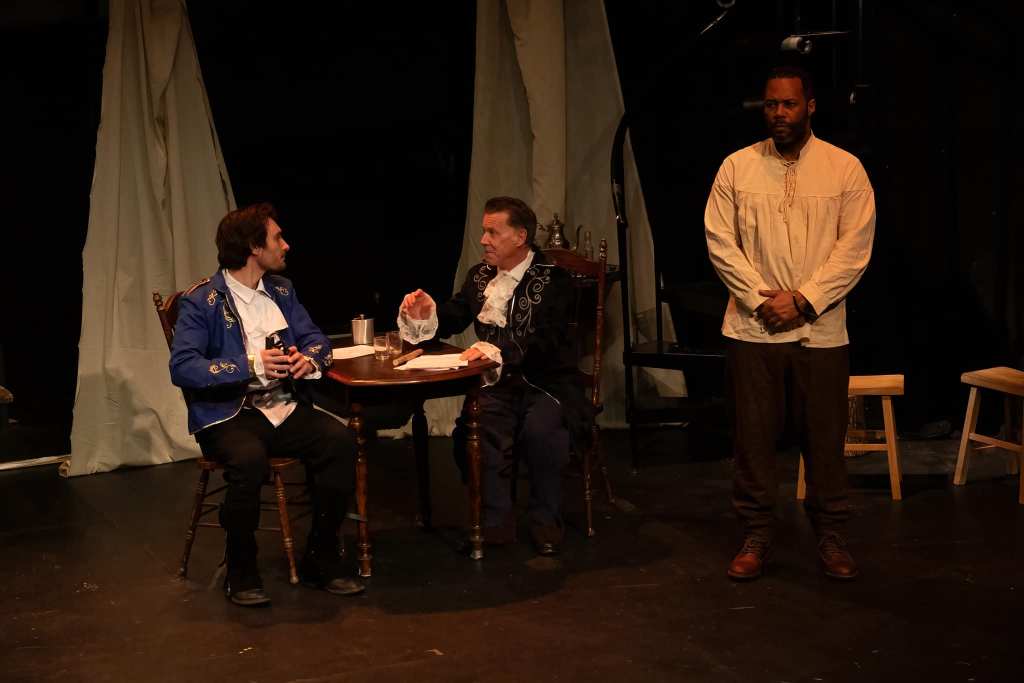
York’s spiritual encounter with the One From The Mountain Top (Jimena Rosas) gives him agency, self-worth, and a sense of purpose that will prove crucial upon his return from the journey, as the play concludes in a sequence of horrifying but powerfully depicted events that reveal the fates of Lewis and Reeva, and destroy any notion of Clark being a good man—sometimes evil and bigotry is more subtle than that displayed by the raging Lewis (a fact that those watching in 2026 need to stay aware of). This is where the production is at its most moving, as York refuses to be dominated and oppressed any longer; his self-actualization as he rises from the horror around him creates a triumphant resolution.
Written and directed by Kenthedo Robinson (with assistant direction by Andre Minkins), The Lewis & Clark Expedition: The Story of York sets history right, putting the man who was known as “The Bear God” back into the narrative, pulled from the obscurity where the history books had unfairly but predictably relegated him. The three leads, and the always exceptional Leonard and Sahs, are a wonder to watch, abetted deftly by a supporting cast that gels beautifully and is clearly moved by the important story they’re here to tell.
“It is better to walk into freedom.”
The Lewis & Clark Expedition: The Story of York runs at the John Collum Theatre at the American Theatre of Actors through February 22. It is presented as part of the African American Playwrights Initiative at the ATA.
PHOTOS BY DAN LANE WILLIAMS

When the Truth Is Found To (Possibly) Be Lies: Jim Catapano attends David Gutierrez’ RETRACTION
David Guiterrez’ Masterful RETRACTION Looks at Real Life Events that Nearly Damaged a Movement for Change
“If your mother tells you she loves you… check it out,” is the first statement we hear from journalist Wendy Denison (Renata Friedman), ambitious reporter for the popular magazine Heart Rhythm. This stunning declaration immediately sets the tone of uncertainty and discomfort that shadows RETRACTION, a compelling and timely work by David Gutierrez.
The title refers to what Rolling Stone actually found itself having to print in the aftermath of an article they published in November 2014. The piece, “A Rape on Campus,” claimed that a woman had been attacked by several fraternity members as part of an initiation ritual. Discrepancies in the account of that evening led to doubt and finally discredit, leading to lawsuits, and ultimately threatening the very cause the magazine was attempting to champion.
RETRACTION goes backwards and forwards in time to tell a fictionalized version of this event—at the center of which is Lacey (Rachel Resheff), a college student at Carolina Atlantic University. Lacey’s revelations regarding her attack at the Frat House draw the attention of Wendy, who wishes to bring awareness to the epidemic of sexual assault against women, and is supported in this endeavor by her editor Zack (Nathaniel Stampley). Wendy also speaks to Gillian (Bella Serrano), a fellow student and assault survivor, who is a steady presence during the rollercoaster of events that follow. Wendy publishes Lacey’s story in Heart Rhythm, and the article is scathing in its condemnation of the failure of University authorities to address the issue. It’s enough to create widespread outrage and make a Pariah of Carolina Atlantic’s Dean Gasso (Shannon Dorsey), who begins getting death threats for her perceived failure to protect her student.
But it is soon learned that the usually thorough Wendy was blinded by her passion for the cause, and made fundamental mistakes in her reporting. The recollections of the friends that Lacey had run to on the night of the alleged attack do not align with the events as portrayed in the piece. Chief among these is Travis (Charlie Webb), who had failed to reciprocate Lacey’s feelings right before she went on the date with the junior that ended in the attack she describes; along with Chris (Carson McCalley) and Melissa (Eliana Rowe), Wendy had failed to fact check with him or get any information from or regarding the alleged perpetrators. Lacey claims abandonment by all her friends, accusing them of words and actions that they later vehemently deny Add to that a competing reporter Victor (also McCalley) who suspects that things are not what they seem, plus Lacey’s subsequent admission that she felt her story “was true at the time,” and the situation implodes to the point where the movement to identify and stop rampant sexual abuse is in itself in danger.

The cast are collectively compelling in these difficult roles, with Friedman and Resheff anchoring with intensity and a command of their difficult roles. All the others deftly play dual parts…a podcaster, reporters, and lawyers who are all woven into the storyline. The stark set design by Julian van Haubrich complements the production well, with its white office tables, towering street lights and rolling chairs that at one powerful moment are rolled across the stage by the actors under the harsh, interrogation room -like lighting (by Adrien Yuen).
Under the expert guidance of director Caroline Fairweather and with the skillful writing by Guiterrez, RETRACTION handles an extremely delicate issue with sensitivity and without condemnation. It is never implicitly stated that Lacey is lying; it’s made clear in the narrative that PTSD could be affecting her memory of what was a very real assault. Were there 6 guys or 4? Was it dark or could she see them? Was the blood on her dress not there at all, or just too subtle for her friends to notice? Though the real truth (or at least the truth within Wendy and Lacey’s fictional story) is never arrived at in RETRACTION, what we know to be at fault here is the careless reporting that was certainly in evidence in the real life situation, which impacted many lives and ended up putting the safety of women on campus and beyond at further risk. It is a powerful and necessary reminder that these issues must be handled carefully and delicately, both in art and in life. RETRACTION doesn’t provide easy answers, but it will leave one determined to ask the right questions.
RETRACTION runs at the The Shiner Theatre at The Sheen Center for Thought and Culture through January 31, 2026.

