
American Theatre of Actors presents what is considered by some to be Shaksepeare’s masterpiece: King Lear (article by Kaitlyn E. Clark)

August 14 – 25 ( 7:00 PM (Wednesday through Saturday), 3:00 PM (Sunday) on the John Cullum Stage of the American Theatre of Actors. Purchase here.
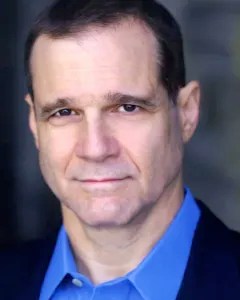
Directed by James Jennings himself, the production features Alan Hasnas (as KING LEAR) with Jonathan Beebe, Travis Bergmann, Amber Brookes, Jane Culley, Oliver Figueroa, Richard Fisher, Sam Cruz, Sam Hardy, and Jake Minter.
Lear, King of Britain, enters with his court, now an old man, decided to divide his kingdom between his three daughters. The criteria: how convinciningly they can express their love. Goneril, Duchess of Albany, and Regan, Duchess of Cornwall, both speak enthusiastically, but – ironically – Cordelia, the youngest, says nothing because she cannot voice her deep love for her father. Misunderstanding her, Lear disowns and banishes her from the kingdom. He also banishes the Earl of Kent, who had taken Cordelia’s side against the King.
Needless to say, his eldest daughters both reject him at their homes, thus, madness and regret overtake him and he wanders through a storm. His banished daughter returns with an army, but they lose the battle and prompting the inevitable shakespearean fate.
At its core, Lear is a family drama offering condemnation for greed.
In this family drama, greed is a driving force and remorse comes too late.
To learn more about the cast, please visit this link.
AMERICAN THEATRE OF ACTORS
The ATA was founded in 1976 by James Jennings to promote the development of new playwrights, directors, and actors, and to provide them a creative atmosphere in which to work. The plays are dramas, comedies, musicals, and everything in between, dealing with the social and ethical problems of contemporary society.
More than 12,000 actors worked at the ATA including Dennis Quaid, Bruce Willis, Dan Lauria, Chazz Palminteri, Danny Aielo, David Morse, Edie Falco and Kathryn Hahn. ATA’s productions are sometimes grouped as ‘festivals,’ such as a Playwrights or Directors Festival. In 2016, ATA began an initiative to feature women in theater as directors and playwrights, today this is our WIT! (Women in Theatre) program.
For press inquiries or more information, please contact Kaitlyn E. Clark at
Jay Michaels Global Communications at info@jaymichaelsarts.com
Pall in the Family: Jim Catapano reviews “Bringer of Doom”
Bringer of Doom Shines a Black Light on the Human Condition
Lotte (Lena Drake) is a directionless woman whose main motivation appears to be getting revenge on her mother Esme (Laura Botsacos), who she sees as the source of all the misery in her life. To achieve this, she employs the services of alcoholic, homeless ex-comedian Demetrius (David Z. Lanson), who she had let stay in her apartment overnight. Demetrius appears the next morning in Lotte’s bathrobe and slippers and immediately heads to the bar cart, ready to begin his day of delirium. Lotte offers to let Demetrius continue to crash at her place and have all the booze he wants—if he will play the role of Lotte’s artist boyfriend. Lotte wants Demetrius to use his alleged comedic skills to completely humiliate her mother. Thus begins Bringer of Doom, a darkly comedic slice-of-life (and death) brilliantly devised by Joe Thristino.
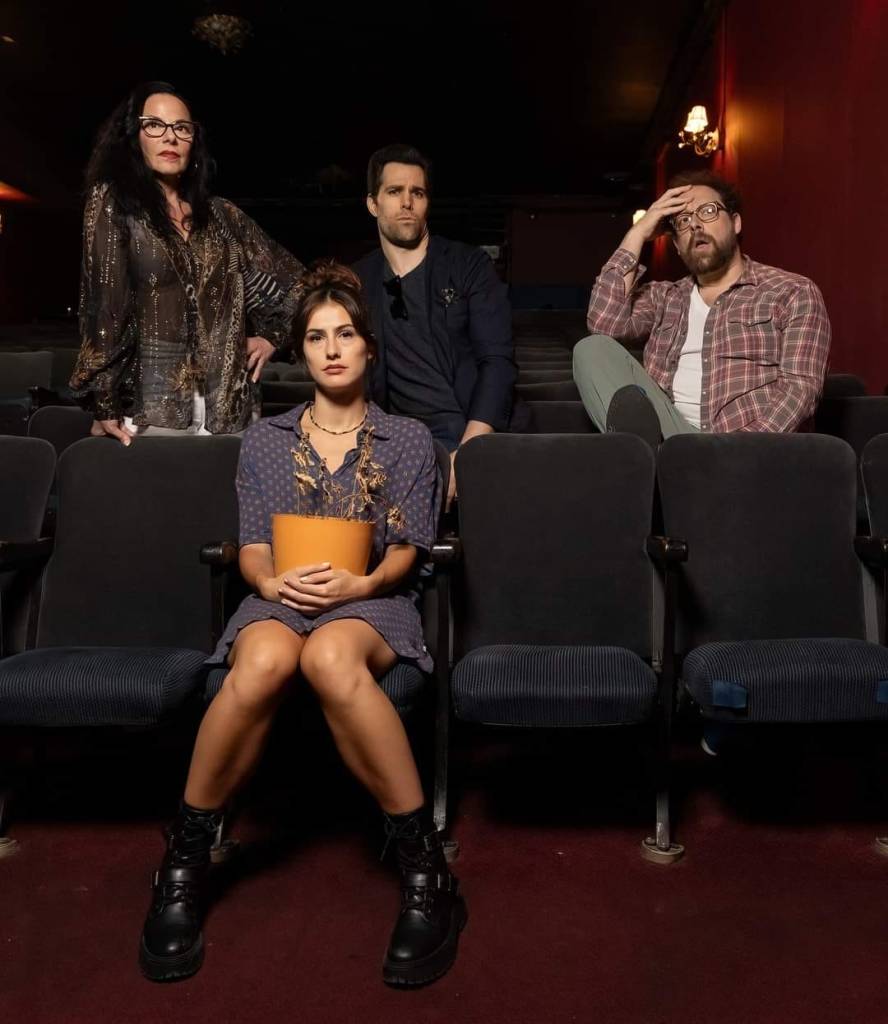
Esme arrives with her “Toy Boy” (as Lotte calls him), a young stud named Clancy (James Andrew Fraser). Esme at first appears to be the monster that Lotte has described her to be, but as the layers peel back, we see that despite her obnoxious demeanor she is not entirely in the wrong, nor the sole source of Lotte’s troubles. Demetrius warms up by insulting Clancy’s career as a Cranio-Sacral Therapist, and Clancy responds by declaring Demetrius’ (non-existent) art to be mediocre. Lotte and Esme’s initial conversation is filled with an icy tension that would make Lorelai and Emily Gilmore shudder.
Demetrius begins his attack on Esme, but his jokes fall completely flat; when he uses an embarrassing moment in Esme’s past to humiliate her, she erupts in horror and demands an explanation; and despite what we’ve heard about Esme, it’s hard not to take her side at this point. More revelations occur about the characters’ tragic pasts, and they are simultaneously humorous and horrifying.
The play technically has two Acts, though there is no intermission. A Carbon Monoxide leak knocks out the foursome to end the first Act, but Demetrious awakens quickly and saves Lotte and Esme. (Demetrius muses that his dedication to substance abuse must have made him immune to the fumes.) Clancy seems to have succumbed—he is prone on the floor without a pulse—but suddenly returns from beyond, singing the praises of the Afterlife. He insists on going back immediately and implores the others to follow. His big adventure fuels the second part of the show, as the characters, with only their despair in common, ponder whether to give the CO another go. At this point the play takes on an existentialist air, as the four debate whether they have any reason to continue their corporeal lives, intrigued by Clancy’s insistence that the grass is greener on the literal Other Side.
The actors all excel at balancing the humor and pathos of their life journeys, which have come to an individual and collective standstill. It’s all skillfully brought together by the direction of Mark Koenig. The set design mimics that of a classic sitcom, with the fully stocked bar cart symbolizing the characters’ daily means of escape and foreshadowing their desire to be permanently free of their troubled reality. Despite this dark turn, the shadows give way to a very hopeful denouement.
Bringer of Doom runs at The Players Theatre through August 25, 2024.

Nick Payne’s Constellations takes a Quantum Leap Across the Roads Not Taken — and Jim Catapano was there.
The Darkest Timelines
For the overthinker that resides in most people’s heads, one constant obsession is: “What if I said or did something differently that night?”
Nick Payne shows us the results of a multitude of scenarios across the multiverse in Constellations, a new two-hander.

Marianne (Derrien Kellum) and Roland (Alex Benjamin) encounter each other for the first time while brandishing beers at a rainy party. Thus begins their story in every reality. “There’s nothing worse than a soggy barbecue” is Marianne’s opening gambit in every version. But from there we witness several versions of what happens next. In some it’s a meet cute; in others, not so much. Sometimes she says (or admits) the wrong thing that messes it all up; sometimes he does. In some universes they part company, in others they make a commitment to each other. The scenes range from lengthy to extremely brief, with the switch to a new reality signaled by sound and lighting effects. Marianne being well educated in Quantum Physics adds a nice touch of science to the proceedings.
Much of the comedy comes from the very slight differences in the early scenes, and from the awkwardness and anxiety of a new connection—the desperate desire to get every word and action exactly right is one that we can all relate to.
Things take a darker turn when one of the pair gets terrible news, and the narrative becomes far more intense across each reality. In one version everything turns out OK; in another, the couple’s world collapses. There is a unique fascination in watching things play out very differently depending on a single misstep by the protagonists; and in some cases, even a single thought put into inelegantly expressed words can set circumstances hurtling towards a point of no return.
The actors are astonishingly skillful in hopping from one version of their storylines to another in a split-second. Benjamin has a Ross Gellar-style angst and desperation that carries over across universes; Kellum is steady and heartfelt, and her characterization and narrative throughline ground the play. Watching Kellum and Benjamin play out different versions of the same scene has a meta quality; we’re not just seeing characters make different choices, we’re actually seeing the craft of acting in real-time as they make subtle changes in their words and inflections. The effect is like watching an ongoing rehearsal within a production. Michael Grenham’s deft direction holds it all together, as does Malena Logan’s stark set painted in evening shades, and illuminated with strung lights symbolizing stars in the sky.
Constellations runs through July 28 at the American Theatre of Actors.

A Warrior to Direct Warriors
ATA Journeyman KEN COUGHLIN has been chosen to direct MACBETH for the American Theatre of Actors’ Shakespeare Summer Fest 2024.
Kaitlyn Clark spoke to Ken about with version of “That Scottish Play”

Congratulations on your upcoming run at ATA! Can you tell us how this came to be?
Late last year, I was speaking with my friend Michael Finn, who I had previously acted with in The Tempest, and directed in Othello. During our talk, he mentioned a desire to play MacBeth. We discussed the possibilities with timing and the viability of him coming up from Atlanta, GA to perform. It seemed possible, so I discussed it with James Jennings, the Founder and Artistic Director of ATA. We agreed on dates and venue, and so the production proceeded.
Tell us about your career as a director.
My career as a director starts with me as an actor. I performed as Roger in the Wesley St. John play Winter Love. Shortly thereafter I performed as Cliff in the Wesley St. John play Undefeated, where Cliff is pitching the play Winter Love to a studio. The director didn’t find a suitable scene partner for me, and decided to take on the role himself. While that show was running, James Jennings handed me the play Censored, by Wesley St. John, and asked if I’d be interested in directing it. The play opens with the line, “My friend, Jeffrey — a friend of many years — agreed to direct a play of mine. After the leading man quit he stepped into the role, so now he directs and plays the lead. ”. Life imitating Art.
I have since directed a number of plays by my late friend James Crafford, among them, Rosa Raine, The General, Neptune and Mary, Oxygen, I Think It’s Gonna Rain Today and 10 one act plays that I had promised him I would get mounted. We opened on the first anniversary of his passing.
My first foray into directing Shakespeare was in 2013, when the aforementioned Michael Finn told me that he would like to take on the role of Iago. I went to James Jennings and proposed directing Othello that summer. He agreed and the show went on.
Two of my personal favorite directing assignments were directing my daughter Krista in Steve Silvers’ play Tiger of Greenwich Village, and directing her, and playing her Father in James Crafford’s I Think It’s Gonna Rain Today.
What drew you to this specific play as your next project?
My previously mentioned discussion with Michael Finn, who is playing MacBeth, and my confidence in being able to direct a project of the size and scope.
What do you enjoy about working with ATA?
I met James Jennings in February of 1994. About a month later, he recommended me for a role in Hawk Dreaming, by Frank Casso, who I have also maintained a long friendship with, and last year, directed his play After Zero. In the summer of 1994, James asked me to take on the role of Bedford in Shakespeare’s Henry VI pt I. Through the past 30 years James has been instrumental in my ever expanding skillset, which started as an actor, and has since expanded to include directing, sound design, set design, lighting design, video design and even acting teacher. He has also given me so much freedom with regard to the productions I have asked to do, such as last year’s production of Coni Koepfinger’s Wilber’s New Wife, which I brought to him, and asked if I could put it up.
What is your approach to managing and guiding your cast?
Have you heard the expression Herding Cats? Trying to get 17 actors to commit to a rehearsal schedule, while still earning the money they need to support themselves, is at best, a trial. Aside from that aspect, I try to treat all of my actors with respect, and insist they do the same with their fellow actors. I encourage collaboration, while insisting that all direction come from me. There is an old axiom to the effect that no one can serve two masters. I am also of the belief that if you’re not having fun doing this, you’re doing it wrong.
Has this production posed any specific challenges for you? How did you get through them?
In that we haven’t opened yet, the biggest problem so far has been casting. Casting usually presents two problems. The first is that you are presented with multiple actors who would do well in a particular role, while bringing different energies to the role. There is frequently a desire to want to cast multiple people for the same role, when you know you can only cast one. The other problem is offering the role to an actor, only to find out that scheduling won’t permit them to accept. Then you’re in a frenzy to replace the role you thought you had locked up. It’s even worse when an emergency pops up after you have been cast and started rehearsals. All of these things have happened on this production, but in the end, I think I have a great cast who will work well together and put on wonderful performances for the audiences.
What’s next for you?
One of the roles I have been able to expand into at ATA is the role of Playwright. This October I will be presenting 2 new plays that I have written, The Next Audition and Hang Up Your Cleats. I will direct The Next Audition, which will star good friends and excellent actors Valerie O’Hara and Thomas J. Kane, who I have known since 1962. I will also play a small non-speaking role in the play. The reason for my playing that role will become clear when you see it. My dear friend Laurie Rae Waugh will be directing Hang Up Your Cleats.
Is there anything else you’d like to share about your show?
Come see the show. The actors are working very hard to present a show that will be well worth seeing.


Who did it better? Paris Martino
By Kaitlyn E. Clark for Jay Michaels Global Communications
Excitement is building as the next edition of “Women Do It Better” is set to hit the stage in just eight months! 54 Below has placed its trust in the dynamic co-producer and co-director duo, Meghan Fitton and Paris Martino, to bring this project to life once again!

These young powerhouses are making waves in the Broadway community, using their early careers to create an engaging feminist space for Broadway alumni and other talented performers to shine. Paris, in particular, has caught attention for her undeniable grit, starting her career at the height of the pandemic and still managing to stay busy!
Who is this Rising Star?

Paris Martino is a name you’ll want to remember! Just a few years ago, this multi-faceted performer hit the New York City theatre scene with a bang! Known for her impressive skills as a singer, dancer, and actress, she was quickly hailed as the newest rising triple threat. She tantalized audiences in standout productions such as “Heathers” and “Carousel.”
Her ongoing series, “Women Do It Better” is just one highlight of her busy career. The show serves as an opportunity for female performers to take a stab at typically male solos. These ladies reframe these male ballads and make them their own, showing us how much better women really do it! Paris and Meghan pride themselves on creating a show that is entertaining and makes a difference with their continued contributions to Planned Parenthood.
Always in Motion
The most remarkable part of Paris’ young career is her persistence. Since moving from Toronto, she hasn’t stopped moving! Her natural range makes her the perfect pick for the variety of productions she’s been featured in!
In September 2023, Paris was selected for the highly competitive New York Theatre Barn’s Choreo Lab Showcase. This showcase serves as a place to present original musicals that are still in their development stage. This incubator for new writers and choreographers gave Paris a chance to hone her skills among Broadway stars like Linedy Genao of “Bad Cinderella,” Evan Kinnane of “Moulin Rouge,” and Maya Imani of “Mean Girls.” Paris had no problem chining among these stars!
Only a few months later in December, Paris was selected by the luminary Chryssie Whitehead to perform in her Steps On Broadway Industry Showcase. This feature seemed to come to her naturally as she continued to ascend the ladder of the theatre industry, and her performance was stellar!
More recently in May, Paris participated as a featured dancer at the New York City Center Choreography Fellowship Encores Showcase. Paris expressed how flattered she was to be chosen by Niana Feelings, a former fellow of Ann Reinking, to dance in her 45-minute piece. During her time in this iconic showcase, she was able to work with such notable individuals as Mary Antonini of “Aladdin” and Evan Kinnane of “Moulin Rouge.”
Later on in May, Paris worked closely with Tony-nominated director Anne Kauffman and Broadway choreographer Danny Mefford on the pre-production of “Titanic” at the New York City Center. She helped create choreography and staging, showcasing her collaborative spirit and natural creative eye!
Only a few weeks ago, Paris’s career reached a new milestone when she was selected to play Dee Dee in “The Prom” at 54 Below. This springtime production took place as a part of Ryan Scott Oliver and Lindsey Mendez’s “Actor Therapy” project, aimed to foster and uplift talent in the theatre community. Here, Paris performed in front of a sold-out audience and left a lasting impression on the crowd!
A Lifelong Passion
Paris’s love for performing started early on! Born and raised in Toronto, she has always been surrounded by music and dance. In fact, her mother was a dance teacher, and inspired her to push herself and pursue the arts! Reflecting on her childhood, Paris said, “By the time I turned 12, all I wanted was to be a musical theatre actor.”
It is clear that this passion has been growing her entire life. Paris’s “Women Do It Better” project is one of the many ways we can see her goodwill for the theatre community. She has spoken about the vision she has for her future and the desire she has to make an impact on New York City.
With Paris Martino’s career growing so rapidly, and her clear fervor to make a difference, she is poised for great success. Her recent performances and projects highlight just how much traction she is gaining, and she certainly has the chops to keep up!
For more about Paris Martino and her upcoming projects, visit her website. As this rising star continues to light up stages across New York City, we can’t wait to see what she’ll do next. Broadway is indeed graced by this new, vibrant talent, and we eagerly anticipate her future endeavors!
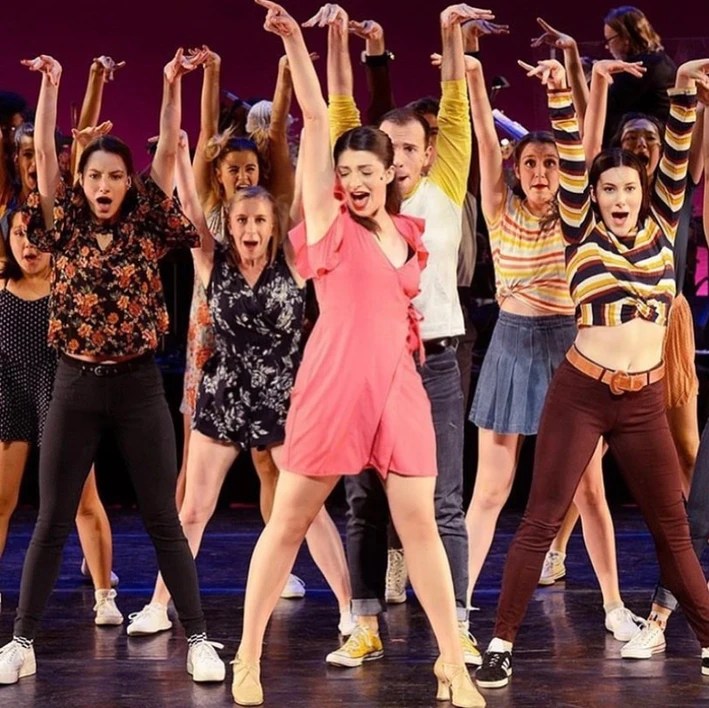

Where Have You Gone, Lefty? Jim Catapano wants to know
A Sequel to the Classic Play Concludes That Nothing Has Changed

Inspired by the Taxi Drivers’ Strike of 1934, the original Waiting for Lefty by Clifford Odetswas an indictment of the social ills and travesties of the time, and a call for radical reform.
But as the Producers point out in the Program, “This is Not That Play.”
Still Waiting for Lefty, stagedat the elegant Teatro Latea on the Lower East Side,returns to survey the state of affairs over a century later. The play finds that Pete Townshend and the Who were correct in their own conclusion: Meet the New Boss, Same as The Old Boss.
The production begins with the site of over a dozen union members storming the stage with picket signs, angry and defiant. A strike is looming that will either help the workers, hurt them, or change nothing at all. They wear the caps famously associated with the cabbies of the Great Depression, but we soon learn that the setting is not 1934 or even 2024; it’s a not-too distant future, and the outlook is decidedly grim.
Vignettes involving the employees of the corporation in question, the ominous New World Tech, play out one-by-one as they wait with trepidation for the strike announcement. Their individual stories eventually coalesce Seinfeld-style, but in a far from lighthearted manner. New York Tech is riding on their backs, and any “horse” that refuses to gallop is shot on the spot.
-Lamar (Ron Brice) is an older man who has gotten his life back together after many personal trials but is suddenly dismissed from his job because he won’t betray the union. This sends him hurtling back into despair, and to a fateful meeting at the edge of a subway platform later in the play. His monologue as he eulogizes the happy future cruelly torn away from him will haunt anyone who witnesses it for a long time to come.
-Mr. Hopkins (Greg Seel) is the intimidating whiskey-sipping corporate lead. He entices Tech expert Miller (Brian Welton Cook) with a raise, but only if he will act as a “rat” for management, monitoring a friend and colleague who is union friendly. Miller makes a fateful decision and then returns in a sequence that is somehow both hilarious and harrowing, as he goes to a department store to buy ridiculous-looking and absurdly expensive new clothes for his next career endeavor, only to run into a suicide attempt by one of the store’s employees, Eva (Maria Christina Perry).
-Julio (Federico Mallet) and his sister Mariam (Majo Bermudez) argue in the face of their sick mother’s impending (and likely expensive) death, and her boyfriend’s inability to financially contribute to the family. “You’ve got to be hard as a rock or just go under,” says Julio, speaking to not only Mariam but to everyone who is struggling. “You don’t have to be strong all the time,’ she protests, addressing the same audience.
-Mariam’s boyfriend arrives brandishing imaginary flowers because he can’t afford the real ones, and she movingly plays along by pretending they got squished while the couple hugged and pricking herself on an imaginary thorn.
-Dr. Anderson (Alexander Morrison), a therapist working at a hospital wing that suspiciously bears the same last name as him, loses all control of a group counseling session to Kayla (Hannah Williams), a patient with no filter and nothing left to lose.
-A man (Luke Hodgson) brings a sex worker (Kamailyah Floyd) to his apartment, and the shocking reveal of both their true identities brings the overall story to an intense and dramatic climax.
Woven into the narrative on a screen behind the actors are all-too-familiar hallmarks of life in the 21st century: A PowerPoint presentation (promising a corporate version of the MCU) and later an intrusive product placement ad by a Social Media Influencer. They are a potent source of comedy while being an all-too-familiar reminder of the clinical callousness of current culture.
The final scenes of the play are punctuated by a violence that can only be described as inevitable in the wake of the desperation that has played out over the last few hours. The sequences are staged deftly with Fight Choreography by Gabriel Rosario with assistance by Tristan Mesmer. But there’s room for dance amidst the darkness, and this is beautifully guided by Choreographer Silvana Gonzalez. (And New World Tech Mascot Ricky the Rat fittingly gets to join in on the dance party.)
Still Waiting for Lefty is, as promised in the Program, an understandably uncomfortable watch, but also an essential and rewarding experience, brought to life by an astonishing 22-person cast. It’s a necessary reminder of the human cost of corporate greed masquerading as cultural and technological advancement. It lays to waste the vicious lie of employees as “family”, reminding us that these siblings can be dismissed and replaced at the slightest sign of individuality or disloyalty. It is a call to arms for our times, a story of poignant sadness and tragedy, but shimmering with a glimmer of hope.
Still Waiting for Lefty is written and directed by Luke Bond.

The Theater Under St. Marks has many exits, but none of them are meant for our three already-doomed protagonists, says Jim Catapano.
Michael Hagins’ New Spin on Sartre’s Masterwork
Jean-Paul Sartre’s No Exit has been given a fresh coat of existential dread by Michael Hagins as part of this season’s Frigid NYC. It’s a can’t-miss look at the troubled minds and hearts of the 21st Century through the always-resonant lens of the past.

Before the journey into hell even begins, the perfectly costumed Valet (Charlotte Vaughn Raines) greets the audience from the stage with an unsettling Cheshire Grin. She then welcomes Joseph Garcin (Matthew Tiemstra), who bursts into what is to be his rent-controlled studio apartment for eternity. Garcin immediately looks under the three couches for the expected implements of torture—they’re on their way, but not in the form he was anticipating.
Torture Device Number One is Inez Serrano (Alaina Hammond), an admitted sadist who is doing eternal time for cruelty to others. She is followed by Estelle Rigault (Gigi Principe), a prim-and-proper, “holier than thou” type who is sure this must all be a mistake. There’s no bonding in sight, in fact the stage is practically dripping with contempt; and it doesn’t take long for our three “heroes” to realize that they themselves are each other’s torturers.
The more they learn about each other the more the antagonism builds, and it’s portrayed expertly in this production; the effect is like a ticking time bomb that is perpetually a second away from exploding. Garcin and Estelle’s decision to have what basically equates to “hate sex” is perhaps the most disturbing sequence. While not graphic, it is animalistic, completely devoid of emotion and affection in a way that portrays the bleakness of this unexpected shared eternal living arrangement, and the wasted potential of three human lives.
The atmosphere is suitably claustrophobic, and this production, in a suitably underground venue, allows the audience to feel just a twinge of the characters’ nightmarish predicament in a way that really enhances the experience and drives home Sartre’s original intent. (The enticing door that the characters cannot escape through is the actual door to the outside of the theatre, a nice touch.) The actors are all powerful and distinct in their roles and play off each other magnificently, feeding each other’s insecurity and desperation. They are symbolically naked in a fishbowl, and unable to access the masks of arrogance that disguised their flaws while they were alive, and the growing realization that this is it, forever, is a point drawn brutally—and beautifully—home.
No Exit is directed by Michael Hagins and Stage Managed by Maile Binion. It runs through July 13 at the Theater Under St. Mark’s.
Fernando Buzhar Segall can kill it!
“I’m a Brazilian writer who has been based in NYC since 2016. In my formative years in Brazil, I was part of a traveling troupe of clowns for a couple of years before I came to NYU to double major in Drama and TV Writing.”
WELL!
International writer comes to America after years as a traveling clown to write at NYU1
Now, that’s how you introduce yourself as a murder mystery writer!

Peppering his MFA with the desire to write farcical stories, Fernando Buzhar Segall “hides his veggies” — as a professor of his once said about the deep meanings encased in his whimsical stories — in plots involving mythical small towns in mythical small countries.
But — we countered when chatting with Fernando — there is a math that goes with murder mysteries. Fernando regaled us in his answers and aired some detail of his latest triumph … THE WORLD’S MOST BORING MURDER MYSTERY.
| THE WORLDS MOST BORING MURDER Written by: Fernando Buzzar Segall Director: Patrick Swailes Caldwell July 11 – 28 (Thursdays, Fridays, Saturdays at 7pm, Sundays at 3pm) at The Players Theatre115 MacDougal Street between West 3rd and Bleecker streets New York City TICKETS HERE When the world’s most boring small town experiences its very first crime — a violent murder — an inexperienced police inspector and her two bumbling assistants must interrogate the towns’ most colorful characters to uncover the killer…who could very well be the person everyone least suspects! The World’s Most Boring Murder is a wild and irreverent dark comedic send-up of the classic Agatha Christie style murder mystery genre with bits of Commedia and Brazilian Clown traditions thrown in. All of this at a breakneck 90 minute, no intermission pace, The World’s Most Boring Murder will keep you laughing and screaming till the end. The cast includes Sheridan Stevens, Rebecca Ho, Krishna Doodnauth, Ashley Everhart, and Catherine Waller. Design team inclues: Scenic & Props — Vincent Gunn; Lighting — Asa Lipton; and Costume & Sound — Patrick Swailes Caldwell. Emily Elizabeth Wasenda, stage management. Visit @mostboringmurder on both Tiktok and Instagram for more info.The Steve & Marie Sgouros Theatre (Players Theatre 3rd floor loft) A, C, E, B, D, F & M trains to west 4th street. Exit at west 3rd and walk one block east to Macdougal street. The theatre is located on the corner above Cafe Wha. The theatre is located on the third floor up two flights of stairs. No elevator available at this time. |


How do you write an effective murder mystery?
I’m a big research guy, and think that the first thing necessary when it comes to writing in a medium as structurally sound as a murder mystery, is research. A good murder mystery needs lots of twist, as well as multiple characters that need to be simultaneously engaging and possible suspects. If the audience ever gets ahead of the author in this genre, it’s a huge problem. Information needs to be uncovered in a deeply structured way, so the audience never knows what may happen next, and if they think they know, you better be sure their assumptions are red hearings. Then it’s always good to have a protagonist with a rich inner and outer life. If on top of having a detective who simply “needs to solve the crime”(for its their job), it’s always more interesting to have someone who “deeply wants to solve the crime” for they have some kind of inner connection to it. As this is a farcical murder mystery, I am able to use comedy to misguide and distract the audience, but at the same time the comedy can never get so heavy handed that the core of the play, “who did it and why?” gets lost.
Who are your inspirations in the genre?
As I mentioned, I think research is everything. Though the very first inspiration to this play was a Brazilian comedy from the 60s, O Bem Amado, it was more of an inspiration in tone than in subject matter. Once I realized I wanted to write a farcical murder mystery, I first researched the base: Your usual Mousetrap, Poirot, Columbo, Sherlock Holmes, etc… Then I moved to the more specific farcical mysteries: Clue, Murder by Death, Arsenic and Old Lace, Pay That Goes Wrong, Pink Panther, etc.… I’ve been lucky to have spent part of the last two years working as an assistant to the playwright of the immensely successful Clue stage adaptation, Sandy Rustin. She, as a writer, and her work certainly served as an inspiration as well, and working with her was something that definitely helped the play take the shape it has today.
What do you hope the audience takes away from this show?
Above all else, I want the audience to have a really good time. We have a lot of inspirations from Brazilian clown traditions and Commedia, along with a cast and crew of incredible comedians. I hope the audience has an evening that breezes through, filled with laughter, intrigue, and joy… Until they have the rug pulled from under them and they have a nice serving of veggies. Therefore, hopefully a good time at the theatre, with something to talk about on the ride home.
What’s next for it and you?
It’s hard to say what’s next for this show after we wrap up our 12 performances but there are suddenly many wild dreams, from a transfer to a site-specific touring company… But we’ll have to wait and see! As for myself, right off graduating from my MFA this May, life as a working writer in NYC seems very promising! I have some film projects coming out soon in Brazil that I am very excited about, have recently finished translating a collection of plays from two-time Pulitzer winner Lynn Nottage, which will be published in Brazil later this year as well. But above all else, I want to focus on my theatre projects here in New York as much as I can. I’m led to believe some exciting developments will come from that end soon too and I’m looking very forward to sharing more then!
Life, Love, and Basketball: a review by Jim Catapano
A Pivotal Moment in the Journey of a Young Athlete, and the Story of How She Got There
The tension of a win-or-go-home college championship game is compounded by the drama of the players’ lives off the court in David Zaragoza Gutierrez’s Awake and Breathing, a production of the 2024 CreateTheater New Works Festival. It’s subtitled “Love, Acceptance, Hope”—everything required for a fulfilling life, and yet so devastatingly illusive.
At the forefront is Stephanie Giacomo (Cecili Trippiedi), a senior readying for the NCAA Women’s College Basketball National Championship in Miami. Originally from Texas, Stephanie is a starting player for Tennessee International University against the University of Southern California. Stephanie is very much in her head these days, and the constant rumination involves far more than basketball. She is essentially doing a post-game analysis of her romantic relationship with Michael De La Cruz (J. Antonio Rodriguez), which has recently come to a sad end. But there’s another urgent topic about to arrive at center court—her growing feelings for her teammate and longtime friend and confidant, Tanya (Daria Redus).
The sequences of the play go back and forth in time. We flashback to see Stephanie arriving as a freshman, and her first encounters with orientation leader Michael and new classmate Tanya. Stephanie and Michael play a flirty game of one-on-one streetball and connect over their love of sandcastles; and she and Tanya bond over the shared stress of schoolwork and the unavoidable angst of their formative years. She shares with Michael the events of her childhood; some heartwarming, some decidedly harrowing. She admits to Tanya that her heart is forever in flux.
“Some days I’m crazy about (Michael)”, Stephanie admits to Tanya. “But some days I have other feelings.”
The friends’ backstories fill in and their stories grow richer before our eyes. It’s a smart narrative choice that makes us care deeply for them, and drives home the truth of how much things can change in a handful of heartbeats—we’re different people every single day, and our feelings and relationships are as complicated as that undeniable truth would suggest.
Trippiedi gives a heartfelt performance; Stephanie feels absolutely real and relatable in every phase of the story, and one is compelled to root for her to win, both in basketball and life. She is complemented beautifully by Rodrigues and Redus, and all three make their relationships feel genuine. They embody their characters with the sense that they’ve all come a long way together to reach this pivotal moment in their intertwined lives. The juxtaposition of the basketball drama with the happiness and heartbreak of real life is masterful. The depictions of the basketball tournament are authentic, complete with play-by-play and cheerleader routines. Dani Kucera, Chloe Simone Crawford and Madeline Hudelson provide dynamic support in the ensemble and as fellow teammates. It all makes for a powerful play that celebrates not only the emergence of women’s basketball, but the true-to-life stories of the players between the hoops.
Awake and Breathing is directed by NJ Agwuna.

A Reading from the Book of Renovations: Jim Catapano reviews Ripple Effect’s RADIANT VERMIN
Philip Ridley’s Radiant Vermin is Dark, Devastating, and True to Our Times
Ollie (Matt Braddak) and Jill (Mimi Brill) are an upbeat, upwardly mobile couple having their first child and looking into buying their first house. This brings them to the attention of the mysterious Miss Dee (Mejiah), who is brandishing a contract that holds the key to their dream home. In a visible red flag, the contract is a long, ancient-looking scroll. But the couple is determined to renovate their new abode into a virtual palace, and they fall under Miss Dee’s spell. Soon after, Ollie catches a hungry homeless person in the house and brutally murders them—and magically, one of the rooms of the house is instantly transformed into the very picture of what the couple have always envisioned.
Ollie and Jill realize that the key to this magic is the “sacrifice” of the homeless in the neighborhood, and begin an abominable murder spree, luring the less fortunate into their parlor with promises of food and a bath. With each murder, another room is instantly refurbished. They refer to the homeless they kill as their “renovators”, and thrill to the wonders of their paradisial home, all while their psyches begin to fracture at the horror of their actions. As events spiral into darkness the audience gets to play a part as well, as Ollie and Jill break the 4th Wall and address us directly, asking us to vote on and judge their choices and actions. It is a genius way of bringing the onlookers into the narrative and leaving us ruminating about the part we ourselves play in the ever-creeping social-economic inequality of the world today.
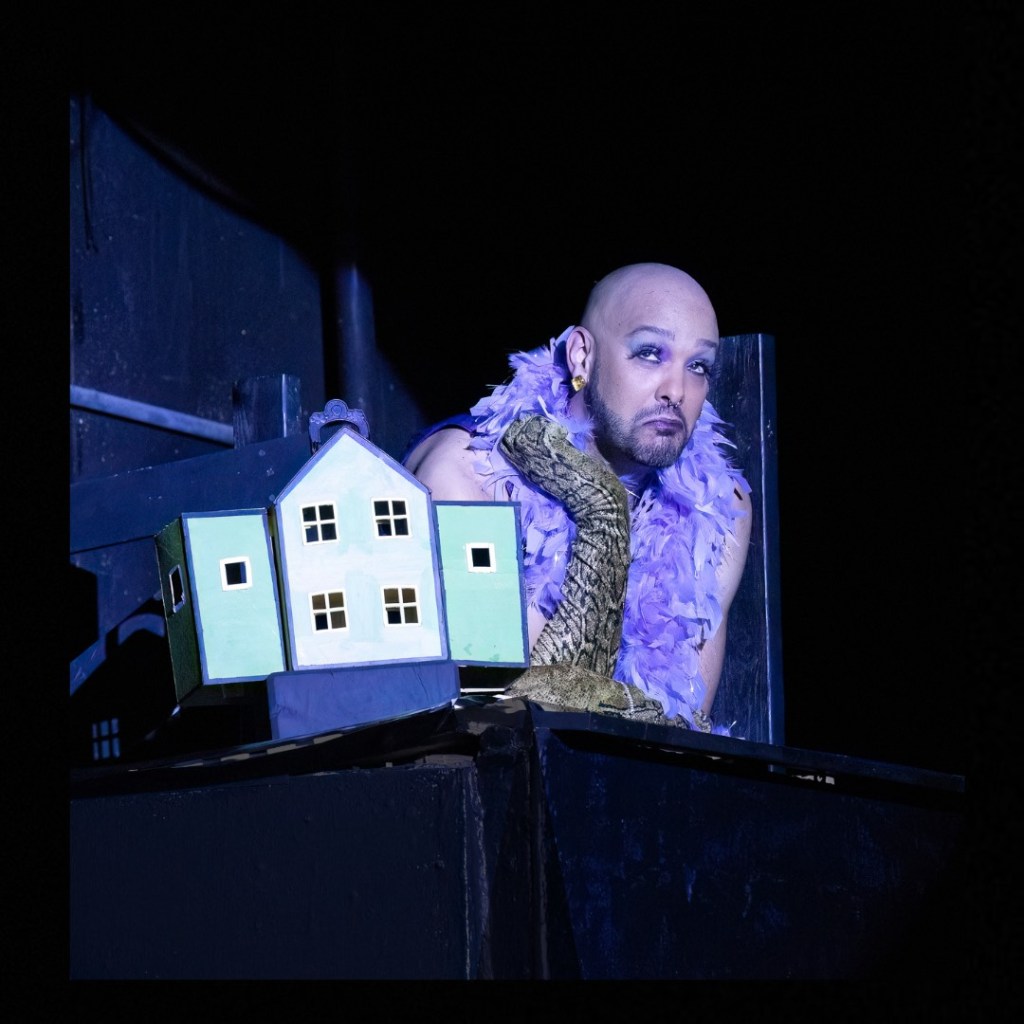
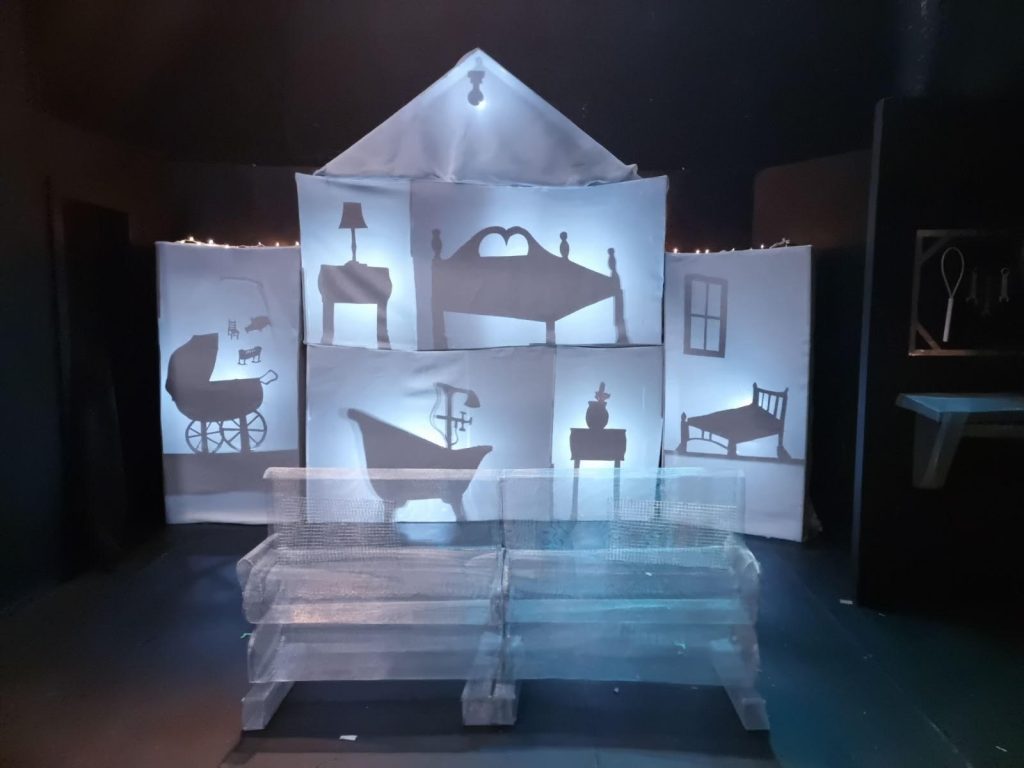
As events unfold, Miss Dee watches from the balcony from behind a dollhouse, symbolizing a God’s Eye View of events (or in this case, perhaps the opposite supernatural being). The effect is a brutal indictment of human greed, the current state of the housing market, and the willingness of the privileged to ride to success on the backs of the impoverished.
The three actors are individually and collectively astonishing. Mejiah does a star turn as the flamboyant Miss Dee, who is at times sensational and satanic, sunny and sinister. In the most heartbreaking moment of the play, Mejiah returns as another character—a kind, desperate young homeless man with a tragic family backstory—who gets caught in Ollie and Jill’s masterplan. When he realizes what is happening, he makes a shocking decision that will haunt anyone who witnesses it for a long time to come.

Braddak and Brill are magnificent together. The couple’s journey from murder to madness rivals the titular couple of Shakespeare’s Scottish play. In the most humorous scene, the couple invite their neighbors to a birthday garden party for their now one-year-old son Benjamin. In this sequence, Braddak and Brill play not only Ollie and Jill, but all of their guests, deftly changing demeanors, voices, and body language in a split-second and back again. Ollie and Jill are at their most paranoid here, triggered by words like “kill” and wondering if their neighbors are on to their heinous actions.
The play is powerfully directed by Kimberly Loren Eaton, who paints a vivid picture of the conquest of the privileged through clever use of shadowy backdrop images, jarring sound cues and well-timed lighting effects. Radiant Vermin is unique and powerful, and not to be missed.
Note: This production features gunshot sounds and flashing non-strobe bright lights.
Radiant Vermin is presented by Ripple Effect Artists, Inc. A portion of proceeds benefits The Bowery Mission.
Latest Posts
-

Jim Catapano reviews Anne L. Thompson-Scretching’s Home Is Sweet Sorrow: “A Masterful Conclusion to a Momentous Family Saga”
The War That Never Ends Home Is Sweet Sorrow is a must-see and a devastatingly powerful third chapter in the Blood trilogy, which also includes…
-

THE BARD TAKES BROADWAY: SIXTH ANNUAL NEW YORK SHAKESPEARE AWARDS CELEBRATES RECORD-BREAKING 2025 SEASON
THE BARD TAKES BROADWAY: SIXTH ANNUAL NEW YORK SHAKESPEARE AWARDS CELEBRATES RECORD-BREAKING 2025 SEASON The New York Shakespeare Awards has officially unveiled its list of…
-

American Theatre of Actors Announces 50th Anniversary Gala; Playwright LYLE KESSLER and TONY-winning actor, LEN CARIOU to Receive Lifetime Achievement Honors.
NEW YORK, NY — The American Theatre of Actors (ATA), a cornerstone of the New York theatrical landscape since 1976, is proud to announce ATA 50, a…
-

Music Among the Tumbleweeds: Jim Catapano reviews James Jennings’ New Dancing in the Meadow.
James Jennings’ New Dancing in the Meadow Brings Feel Good Vibes to the ATA James Jennings, legendary Founder of the American Theatre of Actors, brings…
 Arts Independent