
Robert Viagas in the Twilight Zone … with ABDICATION
Abdication! By Naya James
Reviewed by Robert Viagas
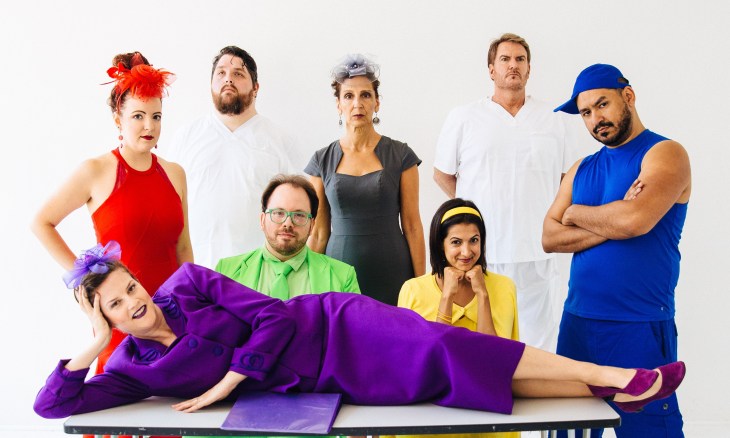
Millennials get a bad rap for their supposed propensity to tune in (to their cell phones) and drop out (of jobs and relationships). But Abdication!, Naya James’ new triptych of one-act plays about the phenomenon, brings insight, humor and a touch of science-fiction to the phenomenon—which is by no means restricted to any single age group
Having its New York premiere as part of Theatre for a New City’s 2019 “Dream Up” Festival, Abdication! tells three micro-“Twilight Zone” stories of people willing to go to extremes in vain attempts to flee their unhappy lives.
Stuck is set in a society where people can “go into the goo”—slang for hooking themselves up to the full virtually reality of their choosing. The comedy arises when a nerdy young Italian-American man tries to explain to his close-knit sitcom family (over dinner, of course) why he has decided to take this radical step. They prefer to think that finding the right girl will cure his unhappiness.
The second playlet, Love Lobotomy, takes things a step further. Two people who meet at a clinic to undergo “Amigdalar Resurfacing,” (a.k.a. a “Love Lobotomy”) to make them immune to love, actually fall in love right there in the waiting room. We then go with them as their relationship poignantly blossoms, then withers, then dies. In the end, they’re back at the clinic, sadder but wiser. The play is subtitled “A Tragicomedy in 3 Episodes” and this segment gets closer to the heart than the others, thanks especially to author Naya James onstage as the disappointment-bound young woman.
The third short play, Color Scheme, takes place in a dystopian “near alternative future” where everyone has been sorted into color-coded groups based on their personalities. The play chronicles the Kafkaesque battle of a “Purple” (passive?) woman who feels she ought to be an “Orange” (pushy, rude, and a little crazy?) and collides with a “Grey” (officious and bossy?) who is determined to keep Purple purple. The question marks are there because the play offers only glimpses about how each color is defined, though anyone can relate to the lady in purple’s struggle against bureaucracy. As Viola, Meredith Rust makes us feel her anguish.
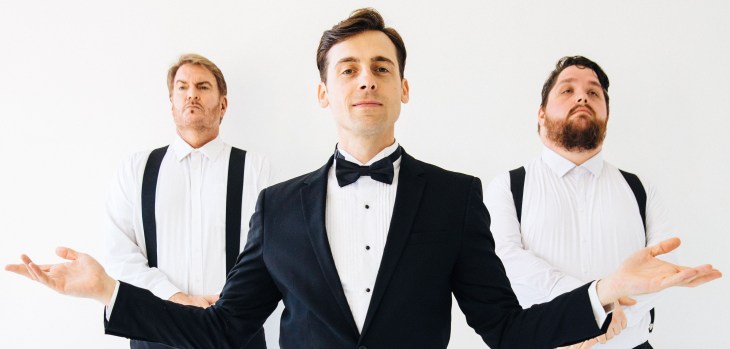 The evening is narrated in song by a top-hatted Astaire-like host (Trenton Clark) who is backed up by two largely silent comic goons (Stephen Keyes and Topher Wallace). Though these segments need polishing, they help maintain the show’s alternately funny and bleak tone.
The cast also features Amanda Cannon, Alan Cordoba, Janet Donofrio, Cesar Lozada, Mike Ivers, Sid Ross, and Tony Scheer.
Directed by Lucia Bellini, Abdication! played a limited run through September 7 at the TFTNC’s Johnson Theater Space in the East Village section of Manhattan.
ARTIST PROFILE: Robert Liebowitz, in-coming artistic director, FROM SCRATCH PERFORMANCE COMPANY
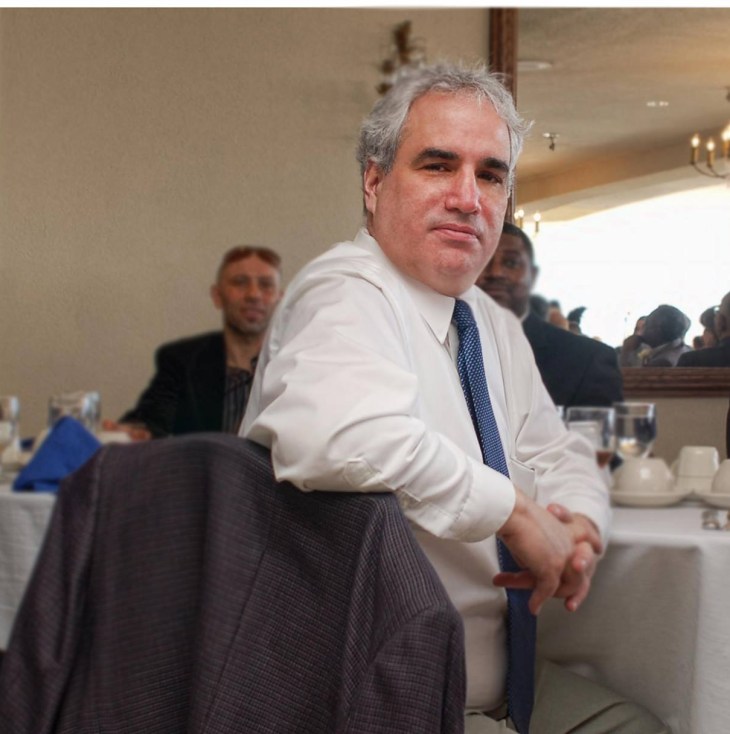
Robert Liebowitz began his journey in the arts in 1976 and never looked back. A Life in the Theater, primarily as a playwright, garnered 16 plays produced (and published) in New York City and nationally. This past summer, had the wonderful opportunity to teach 2nd graders the beauty of the art of theater for the NYC Board of Education.
The Accidental Artistic Director
On a whim and from an invite from an old college classmate, he joined the company. Within seconds, his nearly 40 years’ experience earned him his [new] lofty title. Liebowitz is now charged with getting the group off the ground and keeping it in the air. “We do original theater PLUS dance PLUS music,” he said. He has a LARGE list of plays, musical pieces and movement moments to mount before running for Mayor of New York. “It looks like ANYONE can be a politician these days,” he said with snark.
When asked about City Center as the opening venue, Liebowitz, who is looking at 60 shortly, took a deep sigh and a long pause and said “go big … or go home.”
The rest, as they say, will be history.

Robert Viagas is on a Steeplchase
Steeplechase by By Chris Nelson
Reviewed by Robert Viagas
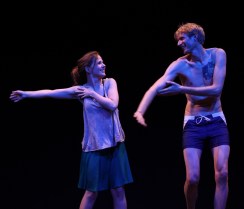
A young woman goes on a rocky lifelong voyage of experimentation and self-discovery in Steeplechase, Chris Nelson’s offbeat but fun new “dark comedy” being presented at the Hudson Guild Theater as part of New York Theater Festival’s Summerfest 2019.
The play draws its perfect title from two sources: a ride at the old Coney Island amusement park that featured mechanical horses running along a track, and an Olympic obstacle course race. Despite the similar names, the first race always delivers its riders to safety, while the second is full of hurdles and potential pitfalls. Viv (Ariel Lauren), the central character of the play, is always searching for the first experience, but all too often winds up with the second.
Raised near Coney Island, Viv becomes addicted to drugs, addicted to abusive men, and addicted to the kind of pain that comes from feelings of worthlessness. Despite her repeated rejection of an actress (Allison Pappas) who plays her yet-unborn daughter, Viv finally wearies of the heartbreaks and humiliations of the high life and settles down with a dull but sweet guy who actually cares for her, and finally embraces the little girl, along with a traditional family life. In many ways, the play resembles a modern-dress version of the musical Pippin.
Nelson’s script treats the subject with a knowing humor that often breaks the fourth wall and acknowledges the audience. Director Maridee Slater’s fluidly kaleidoscopic staging keeps Viv and the story sprinting along from hurdle to hurdle. When she needs to bring in Viv’s mom ex machina, Amy Laird Webb comes crawling up to the stage literally over the backs of the audience, like some monster from the id.
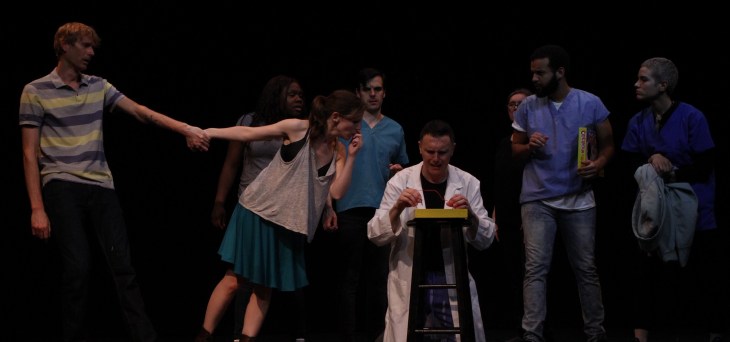 The nine-member cast also includes Valerie Redd, James O’Hagan-Murphy, Amy Laird Webb, Rob McDermott, Joel Reyer, Schuyler Van Amson, Tyra Hardy, Cristina Lucas and Allison Pappas. Costume design is by Corina Chase. Lighting and set design are by John Salutz. Moody original music is provided by Mitch Wells, who leads the cast in a pre-curtain freestyle dance.
Steeplechase is playing a limited run through August 25 at the Hudson Guild Theatre in the Chelsea neighborhood of Manhattan.
Robert Viagas at the SEA WALL/A LIFE
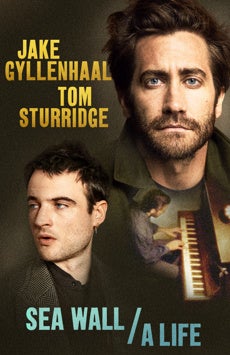 Sea Wall/A Life
by Simon Stephens and Nick Payne
Reviewed by Robert Viagas
Parents, children and the incredible fragility of life are the subjects of Sea Wall/A Life, a pair of deeply dramatic monologues by Simon Stephens (author of Tony winner The Curious Incident of the Dog in the Night-time) and Nick Payne, as performed on Broadway with master class brio by Jake Gyllenhaal and Tom Sturridge.
So many plays and films deal with family dysfunction for dramatic or comic effect. After all, conflict is the soul of drama. But these two plays find their drama in a pair of deeply loving families. The enemies are literally birth and death. These are plays about the unbearable preciousness of our closest relatives, and the agony associated with gaining and losing them. Though written by different authors, the two playlets are very similar in feeling.
In Payne’s Seawall,a moment of inattention has dire consequences. Sturridge plays a man who led a fairly colorless life until the birth of his daughter. The child in question comes alive in Payne’s exquisitely detailed script, related by a master storyteller. She is so innocent and adorable, that you just know some dreadful fate awaits her. That dread is the only overtly manipulative note in an otherwise glowing and harrowing play.
Stephens’A Life is more complex and creative. Gyllenhaal plays a man reliving the two most emotional nights of his life, the night his father died and the night his daughter was born.
At first it seems like they both happened the same night because he tells the stories overlappingly. But it gradually emerges that the events converge in his memory. Gyllenhaal conveys every emotion of the twin situations—the joy, the fear, the grief, the anticipation—and combines memories of his father with his expectations for his child. Both stories wind up in different wings of what is apparently the same hospital, and we pace with him and share his apprehensions and hopes as he waits for his life to be changed forever.
Presented on a nearly bare stage, Seawall/A Life is a double dose of raw storytelling. Walking out of the show and audience member was heard to say “Now that’s Broadway.” He said it about two one-act plays with no singing, no tap-dancing, no flashy costumes nor confetti cannon. In fact, little more than the proverbial two plans and a passion. That passion is love. Family love—the most fraught kind.
Directed by Carrie Cracknell, Seawall/A Life is playing a limited run at the Hudson Theatre on Broadway.

Robert Viagas goes BACK
Back by Matt Webster
Reviewed by Robert Viagas
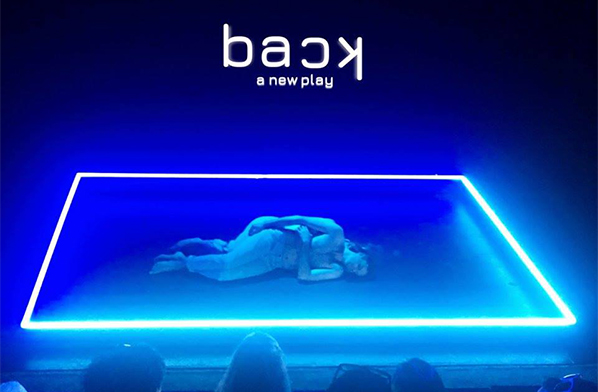
If you could go back in time with just ten precious seconds to fix the biggest mistake of your life, would you be able to do it? Would you still do it if it meant you would forever lose everything that happened since then in your current life?
These are the two burning questions facing Leah and Derek, the would-be couple at the heart of Back, Matt Webster’s fascinating science-fiction conundrum of a drama, presented as part of producer Ken Davenport’s RAVE Theatre Festival.
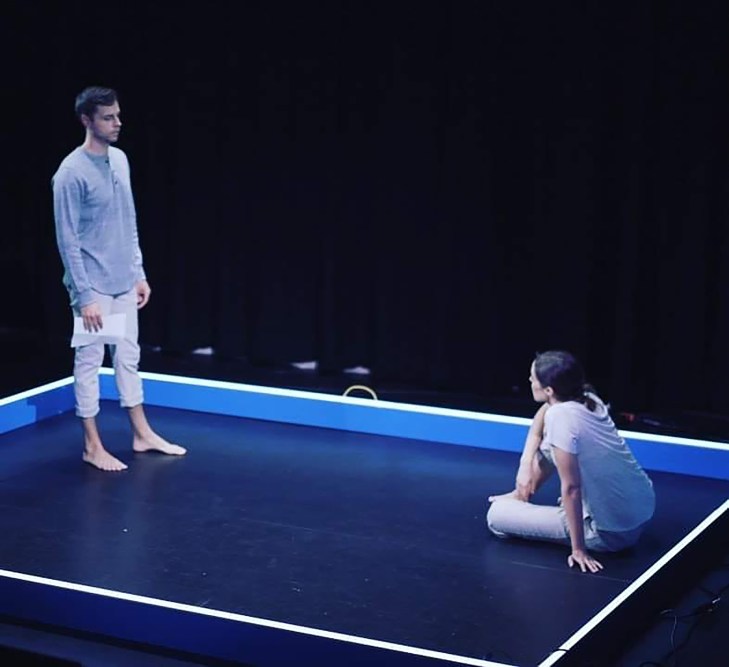 The sci-fi at element never overwhelms the emotional core of the story. Playwright Webster co-stars with Terra Mackintosh as a pair of lifelong friends and occasional lovers who do emotional dances around each other. The attraction is plain, but somehow even the warmest moments somehow turn into arguments. Despite how articulate both of them are, they are failing to deal with the central issue of their relationship.
Most of their arguments involve their failed dreams. Leah wanted to be a doctor, but a she was at the wheel in a car accident that killed a friend, and now her life seems to be a downward spiral. Derek dreams of success as an actor in New York, but apart from a fondly-remembered underwear commercial, his career is a bit of a bust. He longs for Leah to join him in the city; she longs for him to return home. Something always gets in the way of a stronger connection between them, and her solution is to use the “Back” option, leap back a decade and start over. To Derek, however, Backing is tantamount to suicide, since you disappear from this thread in the multiverse forever.
Derek finally realizes that he is not living in Leah’s original life, but in one of her failed Backs, and can think of only one way that he might undo all their mistakes, false starts and dead ends. But he knows the plunge will have its cost.
Beautifully written and acted, with genuine mystery and adult romance at its heart, Back plays like an especially intelligent episode of Black Mirror, though with a minimalist charm of its own.
The production features lighting design by Greg Solomon, which simply and effectively conveys the sense of going Back on the intriguing rectangular set designed by Tim McMath.
Directed by David Perlow, Back is playing a limited run through August 23 at the Clemente Soto Vélez Cultural & Educational Center, 107 Suffolk St. in Manhattan.
Robert Viagas picks DANDELION
Dandelion: An Original Musical
Music and lyrics by Colleen Francis, book by Jessica Francis Fichter and Sean Riehm, additional music and lyrics by Bill Zeffiro
Reviewed by Robert Viagas
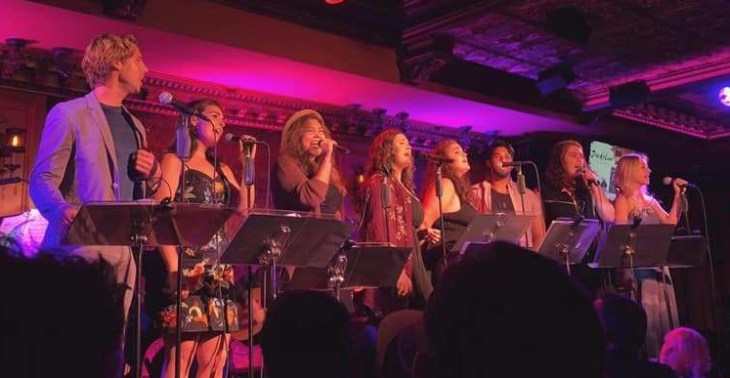
To go to college or not to go to college? That is the question confronting the title character of the new musical Dandelion, which was presented in a one-night-only 75-minute concert version at Feinstein’s/54 Below in Manhattan. It’s a question confronting many young people, but for Jane (Hailee Beltzhoover), the stakes are considerably higher.
Jane’s mom (Colleen Francis, also the show’s composer-lyricist) has multiple unhealthy issues. She is mentally ill and alcoholic, and she has a contentious relationship with her ex, Jane’s dad. The mom is needy and dependent and, while there is a part of her that understands it is Jane’s time to head off to college and start her own life, she also oppresses Jane with guilt to remain her perpetual caretaker. Jane is torn.
As presented in its truncated form at 54 Below, this lite foray into Next to Normal territory displays a great deal of promise but still needs sharpening, focus and, above all, its own distinctive voice.
In addition to a performance that paints heartbreakingly vivid picture of the mom’s struggles, Francis has composed a musically diverse score that shows her skill at soul, folk, gospel, and above all, country. The choice of style often seems arbitrary, however. A lot of the songs play like pop rather than theatre songs: the character is at the same place at the end of the song as at the beginning.
The best songs reflect the various conflicts of the story. “Get Your Shit Together” is a snarling fight song between the mother and her ex (Adam James King). Jane and her BFF Gabbie (the funny and endearing Lillie Ricciardi) contemplate the non-academic joys of college life in “North.” “Stay” is the mother’s cri de coeur.
To dramatize the conflict within the mom’s head, Dandelion uses an Inside Out-style quartet to voice her Depression (Allison Sike), Control (Miranda Lane), Rage (Brianne Wylie) and Paranoia (Adam James King). At least that’s what it says in the program. They are not as well defined in actual performance, and seem just like a regular chorus. Much more can be done here to make the show interesting and special.
Because Jessica Francis Fichter and Sean Riehm’s libretto was presented in highly condensed form in the showcase, we also didn’t get to see the character development of the brother, Jordan (Brenden McDonald), who is introduced as not caring about his mother with a funny country song (“Sucks to Suck”) but makes an abrupt transition in Act II. Also, as presented, the story starts promisingly, then goes around in circles for a while as Jane decides to go to college, then decides to stay home with her mother, then college again, then mother again, etc. However the issue is settled in a very satisfying way that was skillfully set up in the first moment of the show.
There is a lot here. The writers should keep striving to find that voice and make it sing out.
Directed by librettist Jessica Francis Fichter, with music direction by Neveda Lozano, Dandelion: An Original Musical played a single performance at 54 Below in Manhattan on August 14, 2019.
THIS Mr. Rogers’ Neighborhood is far darker
This Will Rogers doesn’t do rope tricks!
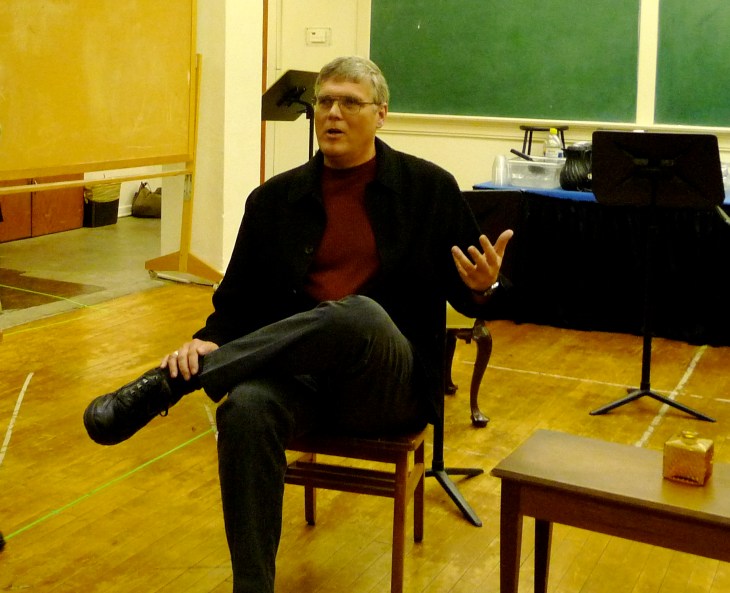
William Roger’s play, “Dangerous to Dance With,” directed by Gerald vanHeerden, is a featured event of DREAM UP FESTIVAL 2019, presented by Theater For The New City, Crystal Field, Artistic Director. Performing at the theater’s Johnson Space at 155 First Avenue (between 9th and 10th Streets), NYC, for five showings: 8/30 Friday, 9pm; 09/01 Saturday, 8pm; 09/02 Sunday, 6:30pm; 09/04 Wednesday, 9pm; and 09/05 Thursday, 6:30pm is a dark comedy in the tradition of Pretty Little Lies begs the question, What’s funnier than a play about SEX, GREED, AND SELF-DECEPTION?
In Rogers’ tome we meet a paranoid playwright, a broken acrobat, a porn star, a neurotic farmer, and a plumber (who may be a hitman). The play premiered as part of the 2014 Kansas City Fringe Festival at the Off Center Theater in Kansas City’s Crown Center. This is its New York premiere. Learn more at https://rogersbill.com/plays/dangerous-to-dance-with
Bill Rogers is a writer and educator who has won several awards as a playwright and for teaching history and English in colleges in the United States and Australia. He has written four full-length plays, the book and lyrics for a full-length musical, two sixty-minute plays, and four ten-minute plays and is currently writing his first novel.
“I’ve written a couple of dark comedies. I enjoy this genre because it offers the opportunity to explore the sinister side of the human experience without becoming overly depressed,” he said, “as Randle P. McMurphy says in One Flew Over the Cuckoo’s Nest, “You gotta laugh…especially when things aren’t funny.”
What is your creative process and where do you get your ideas?
Inspiration comes from diverse sources: snippets of conversations overheard in coffee shops; a news report or a piece of music. I usually have only a general idea of the subject and setting of a play when I begin writing. Distinct characters emerge fairly quickly with their own unique physical attributes, accents, histories, and personalities. As the characters develop, their interactions direct plots and define the ideas and issues the plays explore. So, I suppose it’s fair to say that character development inspires my story telling more than anything else. Unfortunately, once they start talking, it’s hard to get them to shut up. They often blurt out their best lines at three in the morning. They have no respect for a playwright’s need for sleep.
What do you hope the audience takes away from this piece?
Dangerous to Dance With is a brutally honest examination of colorful people undergoing identity crises. I tried to give my characters very human strengths, vulnerabilities, and contradictions as they endeavor to move on with their lives. If the play entertains, amuses, and causes audience members to reflect upon the choices they’re making in own lives, I will have accomplished my goals.
What’s next?
I hope to publish my first novel before the end of this year.
What do you think of the NY Festival Circuit?
It’s always a great thrill to do theater in New York City. If you count a staged reading of my play, Caldwell’s Bomb, at the Midtown International Theatre Festival, this is the third time I’ve had a play appear in a New York Festival. A fully staged production of Caldwell’s Bomb was nominated in the “Best Play” category at the Venus/Adonis Festival in 2016. This production also garnered a Best Director nomination for Gerald vanHeerden and two Best Actor nominations. On the whole, I’ve had very positive experiences with the festivals. They’ve given me the chance to develop relationships with talented actors and creative associates like our director, Gerald vanHeerden and stage manager, Roumel Reaux.
What was the inspiration for this project?
In his poem, London, William Blake refers to “mind forg’d manacles” that impose restraints upon the human spirit. Dangerous to Dance With offered me the chance to explore these self-imposed manacles by examining an array of concerns that inhibit its characters from living fully authentic lives. The play also allows me to suggest strategies for escaping these restraints.
He concluded the interview with the hope that as many people as possible see this work. Sounds good.

The Professor and the Theatre Festival
The theatre festival – once a rare event – is now a staple of New York arts & culture – not to mention tourism. These festivals open the door for playwrights to get their work seen. It becomes a de-facto battleground for visibility and continuity. Some can’t stand the heat and vanish after a play (or two) and then…
But then there are others that weather the storm to go to become a respected member of the indie arts community. One such member is Matthew Ethan Davis.
 A distinguished college professor, Matthew Ethan Davis earned his stripes is a familiar name in the New York Theater Festival circuit. His name was celebrated at the Midtown International Theatre Festival, the International Solo Festival (and was published in an anthology of plays from that festival), the New York International Fringe Festival, the Emerging Artists Theatre Company, Gorilla Theatre Group, the 14 One-Act program at Oasis Theatre Group, the Queerly Festival as part of the Frigid Fest.
And he’s still going strong.
His currently play is part of the Hudson Guild Theatre’s ongoing festival (Summer and WinterFest).
We wanted to take a moment to chat with Prof. Davis about life in New York Indie Theater.
Tell us about the show and about you – the playwright.
I have been writing plays since I was 8 when one Jewish Christmas morning, I found a typewriter under the tree for me. I never took it seriously until the The North Hollywood Theatre asked me to become a member (I was shocked) and then produced one of my plays (I was shocked).
It was pointed out to me that if I was going to be a playwright I should move back to NYC. I had been thinking about this anyway, because someone I loved very deeply was dying of AIDS. It turned out to be over my head because my mother died of lung cancer at the same time.
However, I kept writing and getting little productions of my plays until my boyfriend, now husband, insisted I go to college and I went to NYU where I got my BFA & MFA in Dramatic Writing and then a MA in Deaf Education.
I was the Writer in Residence for two theatre companies and found that I needed to be on my own. I kept writing and having little productions. My most current production was “Sleep At Your Own Risk,” a one-man comedy staring Rick Sky. We got a sweet review and paid. We’re going to keep building on the play, along with William Roudebusch, the dramaturge, and try to take it as far as we can.
As far as “Faster Than Shadows” goes, I’ve never seen it on it’s feet and in front of an audience. I love the characters and really feel for them. My director Ivette Dumeng, and the actor Bryan Hamilton have both been with me on this play for two years and deserve some kind of award. The rest of my cast Meghan E. Jones and Alfredo Diaz are both also wildly talented.
Your plays have a variety of topics and characters. Where do you get your ideas?
I get my ideas from my imagination which, as for everyone, is infinite. I always use aspects of myself in all my characters. I try to find what’s deepest and most private and share that, and that usually turns out to receive universal positive response.
What’s it like being a self-producing artist?
A nightmare. However, I have always been extremely lucky that really talented, incredible people surround me to help out with everything.
Does the festival circuit help or hinder?
The festival circuit is like a miracle because it allows me to see my plays on their feet. I’ve been in many festivals and they’ve always helped me tremendously get to the next draft. For me, playwriting is all re-writing and cutting. I love both so much. Sometimes directors forbid me to keep rewriting.
Where do you hope this play goes? What’s next?
I have no idea where the play goes next. Next is trying to get all my plays to the next level, and continue studying screenwriting at the Jacob Krueger Studio, writeyourownscreenplay.com, which I consider my Artistic home.
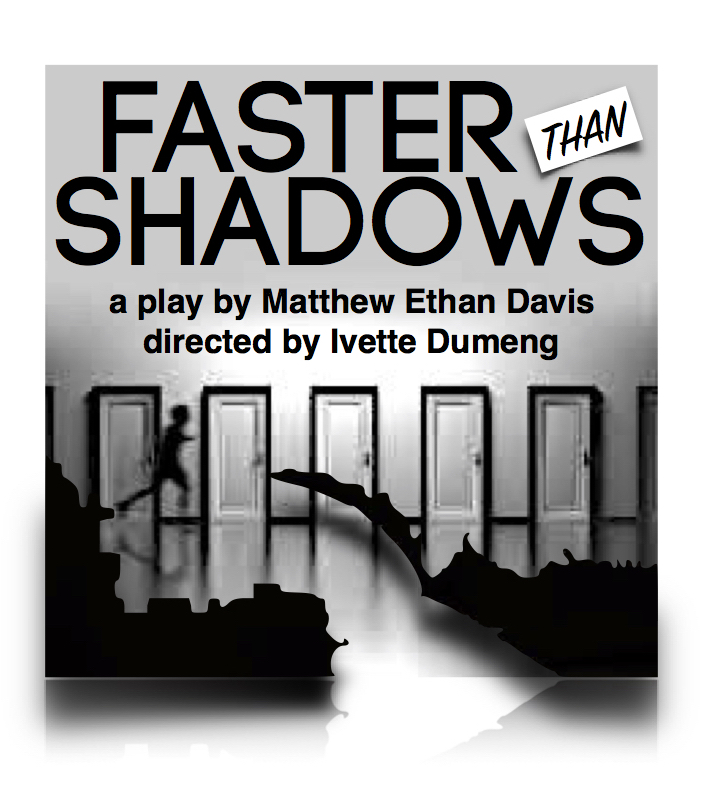
New York Theatre Festival
Starring Meghan E. Jones, Alfredo Diaz, and Bryan James Hamilton
Dates:
August 27th 9:00 PM
August 28th 6:15 PM
August 31st 4:00 PM
Hudson Guild as part of New York Theatre SummerFest
441 West 26th between 9th/10th Avenue
https://www.brownpapertickets.com/event/4242357
Robert Viagas is in 2071
2071 by Duncan MacMillan and Chris Rapley
Reviewed by Robert Viagas

There’s a lot of talk about the upcoming 2020 presidential elections, and sometimes those in 2024 as well.
But America as a culture—once upon a time enthusiastic about the future—now rarely collectively thinks about or plans for what our world will or should or could be like in the late 2020s, let alone the 2030s or 2040s, where many of us, our children and our grandchildren will be living. Perhaps it has become too scary to contemplate.
It takes an author from Great Britain, Chris Rapley, to jolt us into thinking hard about that future in his theatrical monologue 2071. And it is indeed scary. Human activity, especially the burning of coal, oil and other carbon-based fuels, is driving up the temperature of the Earth’s oceans and atmosphere in ways that are already being felt, and which, if not checked, will create flooding and violent weather in the decades and centuries to come. Rapley, as impersonated Off-Off-Broadway by actor Robert Meksin, asks us to contemplate that future anyway, so that perhaps, if we wake up and act wisely, it won’t be quite so scary in the end.
Presented successfully in London in 2014, and now hosted in it U.S. premiere by the environmentalist theatre group Ripple Effect Artists, the 90-minute solo show tells a compelling story, though it is weighted down with statistics. The word “percent” makes up a way-too-hefty “percentage” of the script. Rather than focus on the real-life impact of these changes—that global warming will raise sea level to the point that the 29thStreet location of the theatre could soon become waterfront property, or that our most productive farmlands could turn into desert, or that summertime temperatures in New York could regularly bake in the 110s—the script harps on the fact that average global temperatures could rise one to three degrees—which makes it sound to the layman’s ear like no big problem (though it certainly is).
Not helping is Meksin’s schoolmarm-ish delivery that robs this drama of its drama. The bottom line is that humanity is indeed very quickly running out of time to return the planet to normal weather patterns, and that radical changes in the way we generate energy and grow our food will be required—immediately—if we want to bequeath a better world to the people of 2071 and beyond. That’s the story 2071 wanted to tell in a theatrical way, but lost in its dry, symposium-like format.
Directed by Carin Zakes, 2071 is playing a limited run through August 11 at the Episcopal Actors Guild at 1 East 29thStreet in Manhattan.
William Hand and HUNGER
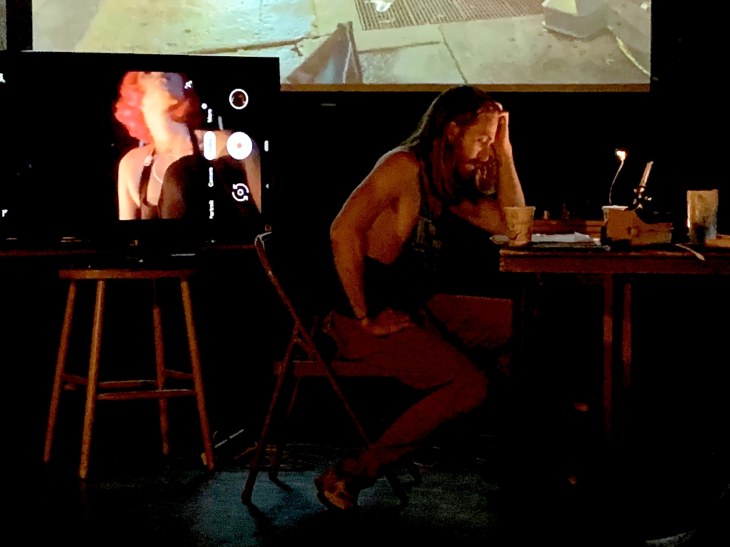
When a manic episode prompts a struggling artist to create a YouTube Live persona and disappear into Times Square for four days, he emerges with a primer on how to survive Late Capitalism.
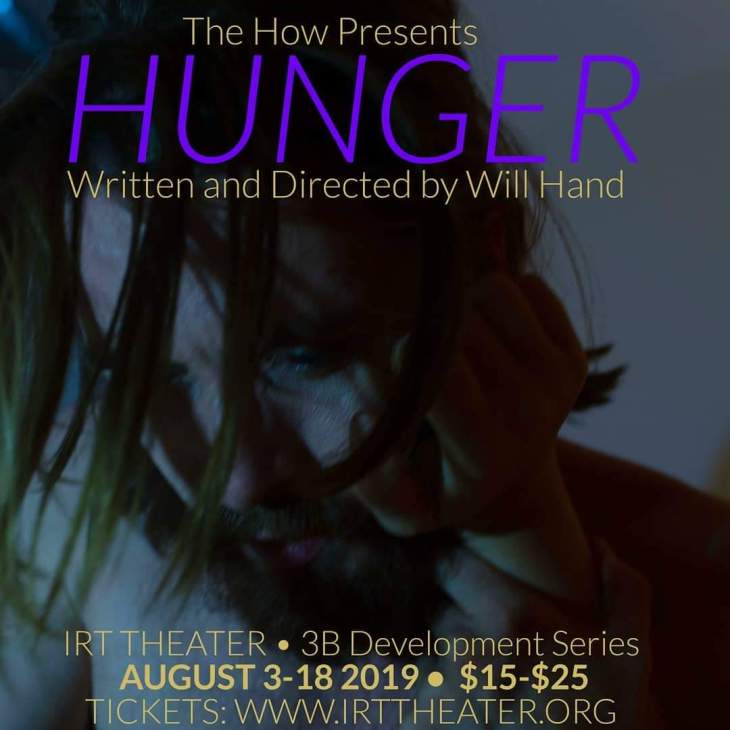
That is HUNGER presented by The How at IRT Theater, running through August 19. With showings on August 3, 4, 5, 10, 11, 12, 15, 16, 17, 18 at 8:00 pm (75 Minutes. Tickets: $15 General and $25 Patron). IRT: 154 Christopher st. NYC #3B (third floor).
This fascinating exploration is brought to you by William Hand (author/performer),
Polina Ionina (performer), and Paulina Jurzec (designer/videographer).
Tickets available at https://hunger.brownpapertickets.com/
Hunger specifies theater-making as an act of labor, and examines the collective reimagining of labor in our digital fame economy.
William Hand says “I am exploring the work of Knut Hamsun, whose extraordinary novel, Hunger, shares my assumption that artistic endeavor is a means of survival. Hamsun and I believe that art making is a high wire act. My production of Hunger is a schizoanalysis of Hamsun after Deleuze and Guattari. I got hungry to superimpose that analysis onto the contemporary mode of celebrity guru status, i.e. for everything that is a job, there is someone on the internet who plays at that job as a performance for extra cash.”
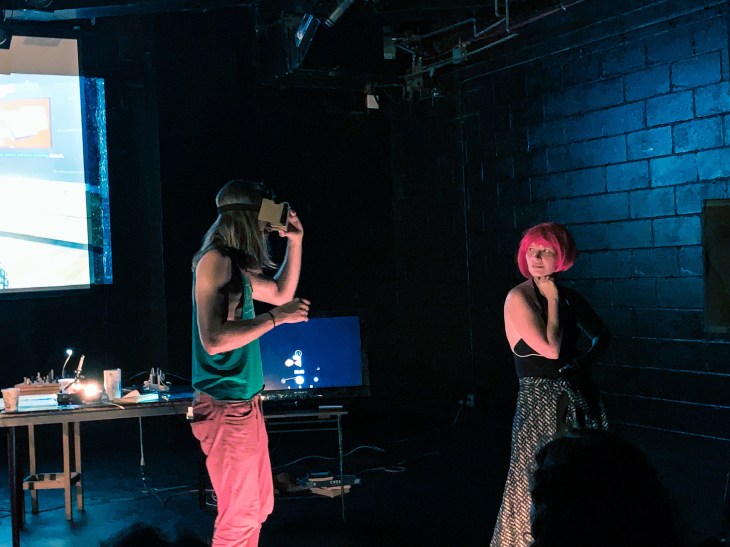
The How joined forces for this residency with Dirt[Contained]. We took a moment to speak with Mr. Hand about HUNGER.
Ionina used a blend of somatic practices and musical experimentation to unite the artists across disciplines and create a language of improvisation and formal experimentation.
June, 2017: In a brownstone/artist collective/gallery space in Bushwick, Brooklyn. Polina Ionina, Akmal Rakhimov and Lucie Vitkova played in Jon Fosse’s I Am the Wind. directed by Will Hand. Coming off the success of Vyuga Project, the collective wanted to explore the ways in which musicians and actors can deepen their collaborative relationships in the rehearsal process to find new ways of telling stories. Vitkova, a composer and accordionist, created a soundscape that served to translate Fosse’s imagistic poetry into a more immediate, visceral, and inherently dramatic allegorical space.
Throughout 2017 The How created an experimental music and dance series that premiered new cutting edge pieces throughout Brooklyn. Premiering monthly, the How showcased over 50 different artists on 40 different acts in 2017.
October, 2017: Again a part of Dixon Place’s summer residency program, the company developed a devised piece around the topic of Confederate monuments in America. With artists Tanya Chattman, David Glover, Weronika H. Wozniak, Linus Ignatius, and Ilker Oztop, Hand and Ionina developed a rehearsal process that allowed for a deeply diverse and international cast to reflect on monumentality in their hometowns and native countries. Discontent with the style of political theater in our current climate, the ensemble attempted to create a space that worked towards utopia in the theater in real time, with art action protests personally devised and performed by every member of the ensemble. The piece was developed over the next year, and premiered at The Tank in Midtown Manhattan in October 2018. Based on the success of this piece, Hand was selected as one of six North Americans to attend the Politik Im Freien Theater Festival (Politics in the Independent Theater Festival) in Munich, Germany.
Latest Posts
-
Jim Catapano reviews Anne L. Thompson-Scretching’s Home Is Sweet Sorrow: “A Masterful Conclusion to a Momentous Family Saga”
The War That Never Ends Home Is Sweet Sorrow is a must-see and a devastatingly powerful third chapter in the Blood trilogy, which also includes…
-

THE BARD TAKES BROADWAY: SIXTH ANNUAL NEW YORK SHAKESPEARE AWARDS CELEBRATES RECORD-BREAKING 2025 SEASON
THE BARD TAKES BROADWAY: SIXTH ANNUAL NEW YORK SHAKESPEARE AWARDS CELEBRATES RECORD-BREAKING 2025 SEASON The New York Shakespeare Awards has officially unveiled its list of…
-

American Theatre of Actors Announces 50th Anniversary Gala; Playwright LYLE KESSLER and TONY-winning actor, LEN CARIOU to Receive Lifetime Achievement Honors.
NEW YORK, NY — The American Theatre of Actors (ATA), a cornerstone of the New York theatrical landscape since 1976, is proud to announce ATA 50, a…
-

Music Among the Tumbleweeds: Jim Catapano reviews James Jennings’ New Dancing in the Meadow.
James Jennings’ New Dancing in the Meadow Brings Feel Good Vibes to the ATA James Jennings, legendary Founder of the American Theatre of Actors, brings…
 Arts Independent