
Home » Posts tagged 'books' (Page 2)
Tag Archives: books

Marlin Thomas’s REPARATIONS Set for Limited New York Run After International Win
Acclaimed Playwright Confronts the “Impossible Moral Debt” of American History at Teatro LATEA
Anya Kai, reporting
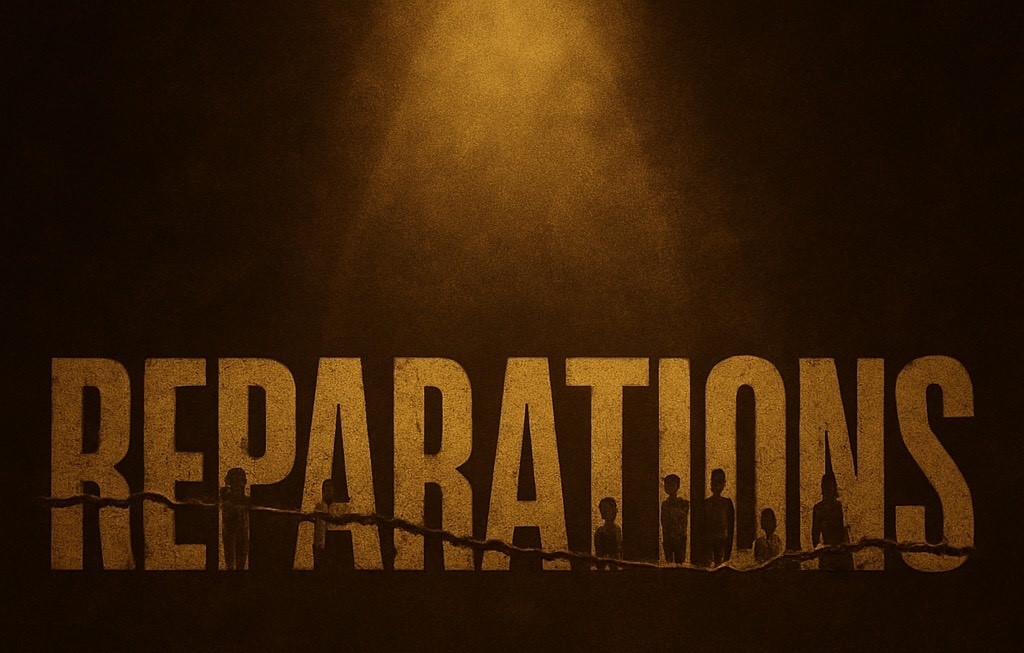
New York native and celebrated playwright Marlin Thomas is set to present a limited run of his latest, award-winning work, REPARATIONS, at Teatro LATEA (107 Suffolk St., New York, NY 10002). The production, which recently earned the top honor at the International Theater Script Competition 2024, promises an unflinching and sophisticated exploration of the debt owed for American chattel slavery and its lingering consequences.
A Confrontation at the Door
REPARATIONS centers on William McCrory, a wealthy white man whose comfortable life is shattered by an unexpected visitor—a Black man who shares both his name and his birthday. This mysterious stranger arrives carrying documents that connect the two men through a painful history rooted in slavery.
As the stranger’s intentions unfold, the play dramatically excavates painful histories, both public and private. It forces the protagonist—and the audience—to grapple with an impossible moral debt. The work has been lauded by the competition jury for its commitment to thoughtful discourse on a polarizing subject, balancing challenging political ideas with compelling, character-driven drama.
The production asks, but deliberately leaves unanswered, a host of urgent and contentious questions that resonate deeply in contemporary society, including:
- What does the present owe the past?
- Can historical injuries ever truly be repaired?
- What individual responsibility exists for distant sins?
- Should individuals be held accountable for the actions of their social and racial group?
Playwright’s Journey: From Skepticism to Drama
Marlin Thomas, an academic and writer whose background spans the humanities and the sciences (including literature, philosophy, and computer science), wrote REPARATIONS to satisfy his own curiosity about the issue.
“I was viscerally opposed to reparations,” Thomas explains, “so I was curious to find out how someone could be in favor of them.”
His research led him to gradually shift his perspective, realizing that the arguments presented on both sides of the issue had “as many flaws as merits.” Thomas sought to dramatize this intellectual and emotional movement, expressing his belief that “reasonable people can disagree about an issue as emotional and personal as that of reparations.”
When asked about his message, Thomas states, “History is on nobody’s side. No argument stands without engaging with its counter argument.” The timing of the play’s production, he notes, is not a direct response to current government action, but rather a function of his “slow writing pace and the length of time it took to gain recognition.”
The most significant obstacle in producing the show, according to Thomas, was finding a director who could “acknowledge the complexity of the characters” and approach the script with an open mind. He found this collaborator in DeMone Seraphin, who “broadly appreciates the humanity reflected in the characters.”
The Man Behind the Play
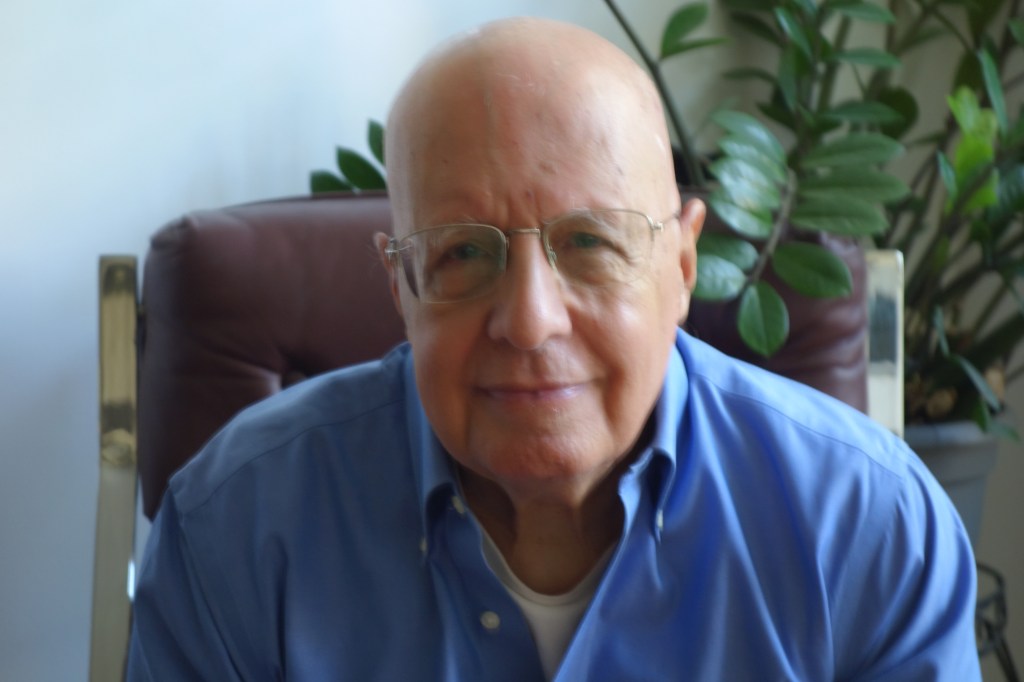
Born in the Bronx and raised in the Queensbridge Houses, Thomas was educated at Queens College (CUNY), Johns Hopkins University, and New York University. His academic work is extensive, with his piece on Alan Turing: The Enigma being named Computing Reviews’ best review of 2015.
As a creative writer, Thomas is also known for his full-length play FreudMahler (published in English and Italian) and The Middleman, a finalist for Best Play in the 2020 New York Theater Festival.
Regarding his unique perspective, Thomas introduces himself as: “An academic who has taught in departments of English and computer science. A writer who is political but non-partisan. An atheist trying to have enough faith to become an agnostic.”
Looking Ahead: The Humanity of Queensbridge
Following the run of REPARATIONS, Thomas will turn his focus to a deeply personal project: a new full-length play titled “Queensbridge.”
Queensbridge Houses, the country’s largest public-housing project, is often celebrated as the birthplace of rap but is also long associated with poverty and violence. Thomas intends to give the community a nuanced treatment, one that recognizes the “humanity and quiet heroism” of its residents. The play will dramatize the experiences of a decades-long resident who recounts his life, detailing the trauma endured by those he lived with, his own complicity in it, and his path toward partial redemption.
Performance Schedule
REPARATIONS will have a limited run at Teatro LATEA on the following dates:
- Thursday, November 20 at 9:00 PM
- Saturday, November 22 at 12:00 PM
- Sunday, November 23 at 8:30 PM
TICKETS for the limited engagement are available now.

History is NOW: Jim Catapano views ZAGŁADA
Richard Vetere Brings t His Gripping Zaglada and the Great Len Cariou to the ATA Stage
“How do you judge human behavior when human life is judged to be worthless?”
Zaglada is a polish word meaning “annihilation, or extermination.” The astonishingplay that takes this nameexplores the moral dilemma faced by human beings in the horrific, life-and-death situation that this describes. What would you do to save yourself, or the person you love most? And how far would you go to render justice, even decades later? Should a person in the last days of their life face punishment for the crimes of a near century ago—crimes that to some eyes, they were forced to commit?
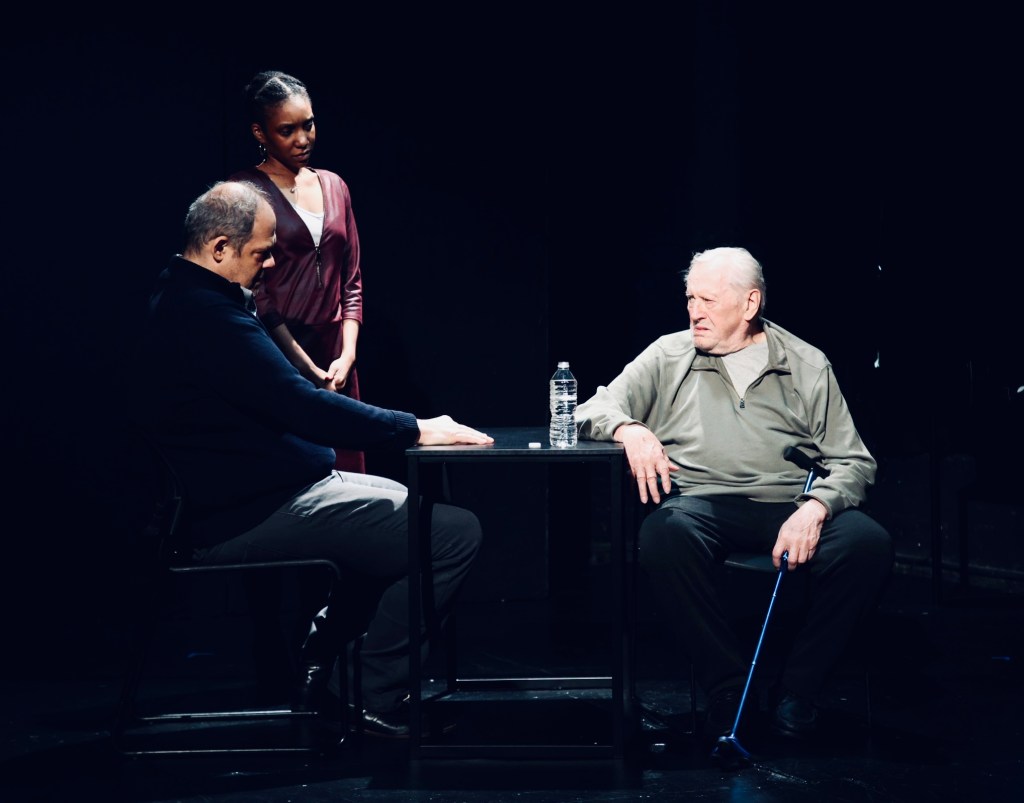
The Marvelous Len Cariou, a 65-year veteran of the stage and a Tony winner renowned for his performance as Sweeney Todd, isJerzy Kozlowski. He is a 93-year-old Polish Queens resident who has been arrested for shooting at Danielle Hooper (Jes Washington), a woman of color and a journalist. Danielle has discovered that Kozlowski was a kapo in a Buchenwald concentration camp in World War II, a prisoner who became an enforcer in the camp in exchange for his own life…and more. The arresting officer Frank Napoli (Salvatore Inzerillo) finds himself in an unexpected conflict with Sonia Sakalow (Maja Wampuszyc), a Homeland Security Officer who is hellbent on finally bringing Kozlowski to justice.
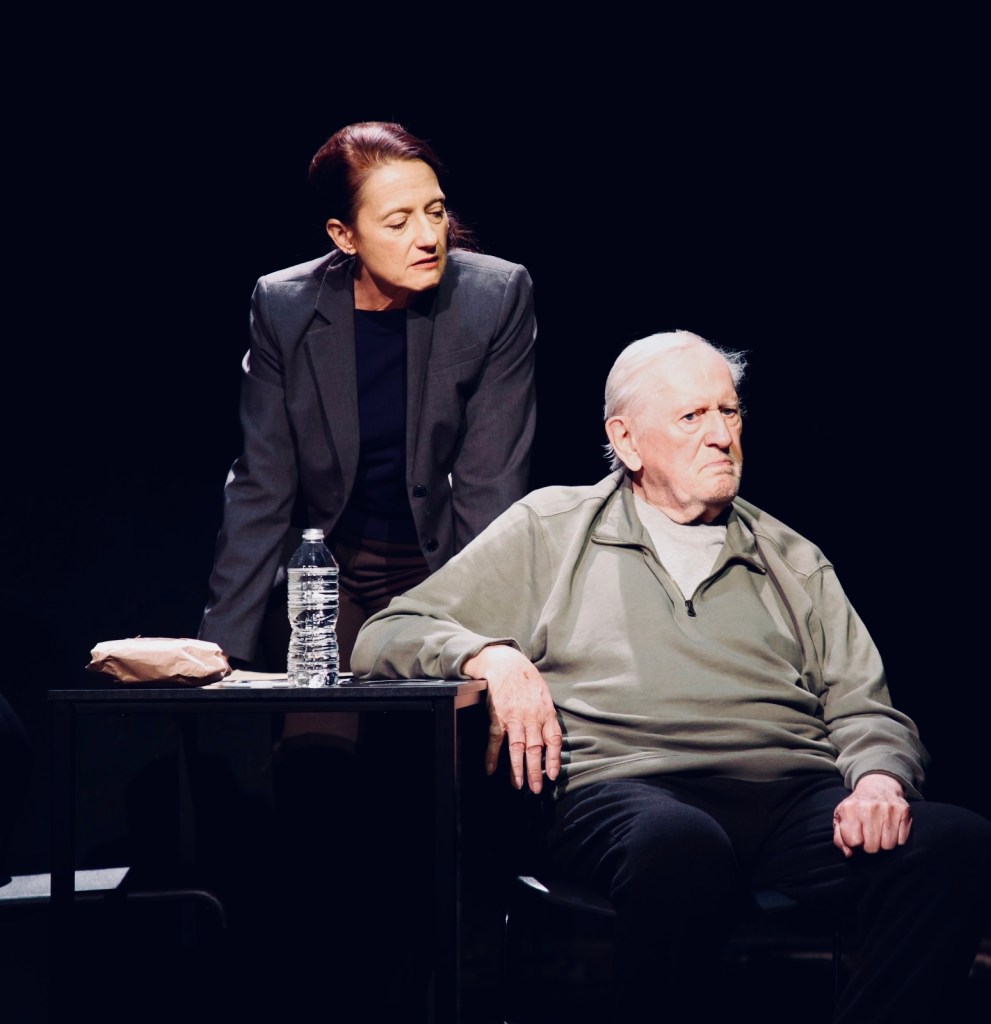
Powerfully directed by Wampuszyc, Zaglada is a fiction based on a very real reality—a history that is in danger of being forgotten, which creates the very real possibility that it will be repeated.
Napoli takes pity on the dying Kozlowski, giving him his pills and making sure he’s comfortable. He appears to be on the side of “moving on” from history.
“We spend most of our time worrying about things, dealing with things that happened when we weren’t even here,” he says to Hooper.
“Like Kozlowski?” she asks.
“Like Christopher Columbus, like Confederate statues, like reparations for slaves,” he replies, adding that his family wasn’t even in the country when the events transpired.
“That is the usual argument,” she notes. “But it is history, isn’t it?”
“Yours, maybe,” he dismisses, “not mine.”
Hooper, who is writing a book getting a PHD in International Human Rights, sees a parallel between the atrocities of the War and the persecution of African Americans, and seeks to make the world see it as well.
“The economy of this country was built on slavery,” reminds Hooper. “Now whether they were here or not, your people certainly benefited by the time they got here. Slavery was also a crime against humanity if you ask me, and there’s no statutory limit on that.”
Wampuszyc also sees no statute of limitations on Kozlowski’s actions in the latter days of WWII. She looks upon the old man with contempt and hatred that feels unusually personal, and is determined to see him be extradited and tried. Napoli is not on board; he sees Kozlowski as having been coerced into his actions.
“An elderly man, forced to work for the SS in a war that nobody thinks about anymore, needs to be punished?” Napoli protests.
“I am well aware that he did not volunteer to be a kapo at Buchenwald,” Wampuszyc retorts, dismissing that aspect as irrelevant. “…He is guilty, those are the facts.”
“I’m not sure that I would survive in a camp,” acknowledged Napoli. “But I know one thing…I would do all I could to survive.”
“You don’t know what you would do, nobody does,” says Wampuszyc. “Not until you are there, and it is real.”
The legendary Cariou is a wonder to behold; the experiences of a near-century are all in his eyes. You can literally see him putting himself back in 1945 as he gazes into the middle distance in agony. His fellow actors are also remarkable in their intensity, each suffering from their own form of PTSD that manifests in their passionate resolve and in the haunted, pained expressions on their weary faces. As circumstances unfold there are revelations that paint a vivid picture of why these particular people have found themselves battling in a small police station in 2018; every moment is riveting as more and more comes to the surface to create deeper shades of gray.
Zaglada is a masterpiece that is a must-see from both a creative standpoint and due to its undeniable relevancy in a time when humanity is at a moral crossroads and is already beginning to repeat the atrocities of the past.
Zaglada is performed at the American Theater of Actors through November 2.

Jim Catapano goes to the Other Side of Sondheim with Barry Joseph’s New Book
Around 2016, an 86-year-old Stephen Sondheim participated in his first Escape Room in Midtown New York City. The lifelong lover and prolific creator of games of all kinds was in his element. The director of the actors who were working there that day say that he even crawled through the tunnel that was an optional part of the game, emerging to see a puzzle that he himself had designed in 1968 with Anthony Perkins.
Sondheim was said to have grinned with glee. The puzzle was a built-in regular feature of the Escape Room; the surprise appearance of Sondheim himself was an unanticipated, delightful coincidence. (Sondheim continued to participate in Escape Room Adventures with famous friends like Mia Farrow and Bernadette Peters.)
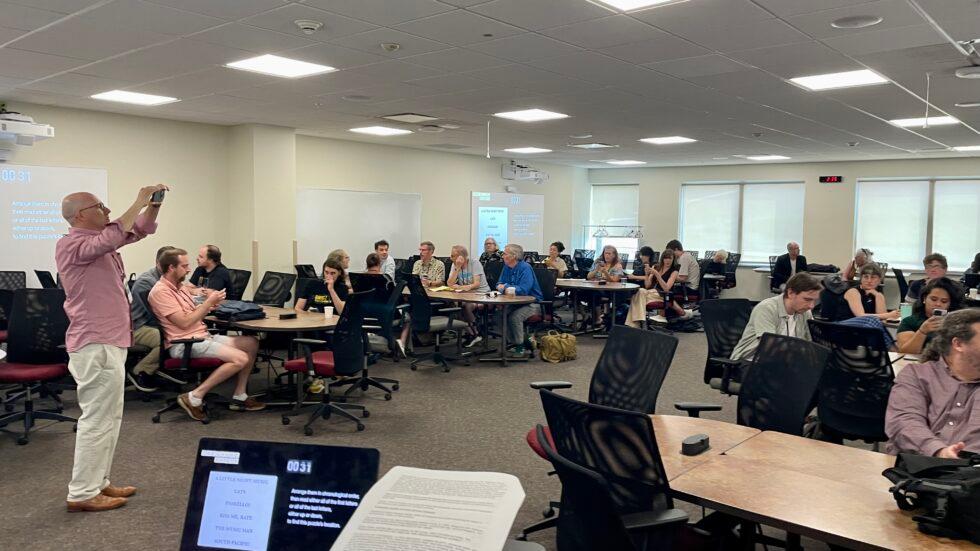
Writer, Sondheim expert, and cofounder of the Games for Change Festival Barry Joseph recounted this in a Drama Book Show podcast recorded at the Drama Book Shop, as part of a talk and Q&A discussing his new book, Matching Minds with Sondheim. Joseph appeared before a rapt audience alongside acclaimed playwright and songwriter Michael Mitnick (whose works include Fly by Night, the Drama Desk-nominated Best Musical, Playwrights Horizons). Mitnick is also a Sondheim authority, whose insights contributed greatly to the book.
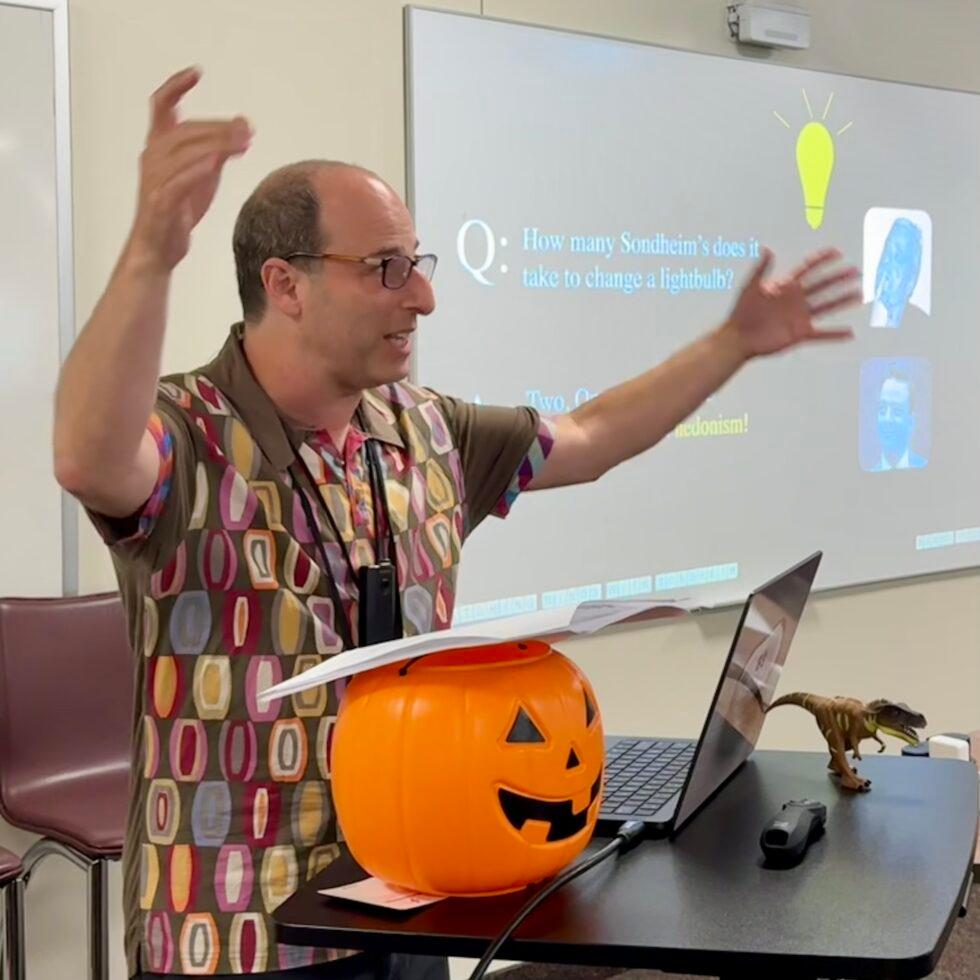
“This project started in April 2022, a few months after Sondheim passed away,” noted Joseph. “…I had just read three books (on Sondheim)…and I learned this idea that he once said he wanted to go into video game design. And that got me to start exploring.” Joseph spent two years doing research, “…contacting research institutions and finding out if they had anything related to his games and puzzles; talking to people who played games with Sondheim; who party-managed some of the events that he was at; and people who had co-designed some with him.”
As this was just a few months after Sondheim passed away, it was a time when the legend was on everyone’s minds as they both mourned the loss and celebrated his life and their connection to him.
“It meant saying ‘hi, you don’t know me, but would you be willing to open up your memory box and trust me with this piece?” said Joseph. “You can imagine many of these people had been spending months talking about, ‘this is what it was like to work with Stephen Sondheim’…but no one was asking what I was asking: ‘What was it like to play with Stephen Sondheim? And so for many of them, it was an opportunity to explore an aspect of their relationship that they never had a chance to do publicly—and maybe not even privately—for years.”
Joseph explained that once they got going, the recollections of Sondheim’s colleagues became joyfully vivid. “Not only would their memories flood back, but the memories would overwhelm them in a way where they were so excited and passionate to share them, and so that created not only an honor for me, but also a responsibility to own those stories until I could shape them together for the book.”
The search for examples of Sondheim’s game and puzzle design work became a hunt for treasure in itself. “Someone who was in the cast of A Little Night Music had saved her winning sheet from a treasure hunt that Sondheim designed—from 1973; people who had party-managed his last treasure hunt at City Center still had all the print materials and could make them all available.”
And as Joseph noted, though the book is now complete and available, the research continues today. He revealed that Mitkin had brought him a new piece of literal treasure right before the event—from Sondheim’s 1998 musical Putting it Together. “The stage manager had prepared as the opening night gift, a collection of logic puzzles,” explained Joseph. “It traces the narrative and production of the show, but all in puzzle form.” Thus, Sondheim’s two greatest passions are now seen to dovetail beautifully. And in a sense, both musical theatre and game playing have the same intent—to create among people, as Joseph put it, those “moments of connection” that are so integral to the human experience.
Case in point: The game Among Us, which became a sensation as it brought people together on Zoom during the 2020 pandemic, was based on Sondheim’s own murder mystery design. In Rian Johnson’s film Glass Onion (2022), Sondheim is seen playing Among Us with (fittingly) Murder She Wrote’s legendary Angela Lansbury. (Fun fact: Sondheim’s username is “FleetST,” while Lansbury’s is “MSheSolved” (Funner Fact: Lansbury was in a 1980’s production of Sondheim’s Sweeney Todd as well. It all comes together. Add to this Sondheim’s time as a cryptic crossword master for New York Magazine in the late 60s; the story of the two board games he developed in the ‘50s that were presumed lost, and the collection of jigsaw puzzles found after a half-century, and the journey just gets more compelling.
“When I started looking up where (the games) fell in his life, they actually had a chronology,” said Joseph. “As I started structuring the order of those chapters, they actually had an organic feel to them…you have a sense that you’re moving through the eras of Sondheim’s life.” Joseph exclaimed that the majority of the book is indeed a biography of Sondheim, but told through looking at his games.” “I study games, that means I’m a ludologist; this is a ludological biography.”
The rest of the book spotlights the creations themselves—“the games and puzzles of Stephen Sondheim that you can do yourself, and—more interesting to me as a ludologist—the design values. What are the things that we can learn from Stephen Sondheim’s game designs and puzzle designs?”
Matching Minds with Sondheim does even more than the title suggests. It actually allows the reader to live inside the mind of the icon and live through the eras marked by the games he was passionate about at the time. It takes them on an adventure through puzzles and parlor games, crosswords and anagrams, murder mysteries and escape rooms, giving them a fascinating glimpse into the thought process that leads to joyful creation.
Joseph noted that there is a structure to the book—and tantalizingly, that there are two puzzles hidden in the book related to that structure. Good luck solving!
To learn more and get your game on, go to matchingmindswithsondheim.com

Jim Catapano at Blood Orange: A Masterful Study of Hurt, Love, and Loss
Et Atalia Theater Presents Abigail Duclos’ Stunning Experimental New Play
How do adolescents survive when all the grown-ups have disappeared? Blood Orange is like a domestic Lord of The Flies, but the abandonment and isolation on display cuts much deeper. The teenagers here aren’t just separated from their parental figures; they have been utterly failed by them.
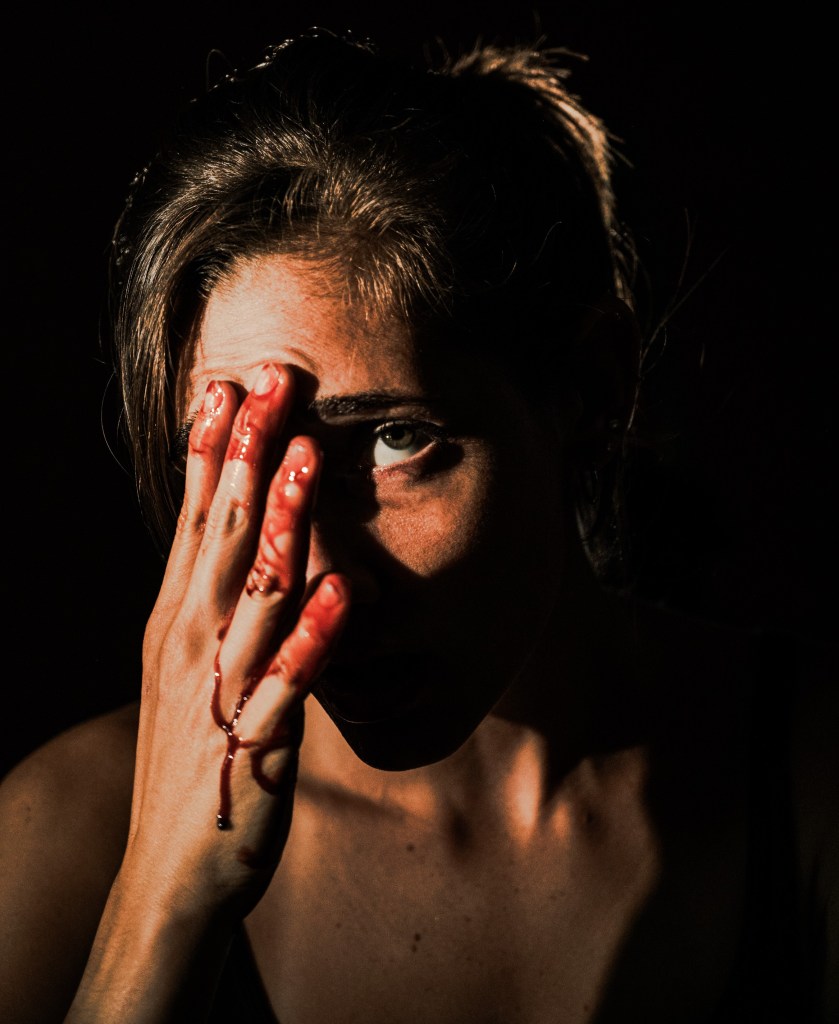
Maria Müller is astonishing as Faye, a North Carolina high schooler whose father died violently a few weeks before the story begins. Faye’s stepmother has retreated to her bedroom, devastated, and extremely physically and emotionally unwell. The suddenly alone Faye brings over her school friend Eden for company; the lonely outcast Eden is happy for the attention but disturbed by Faye’s manic dark humor, a symptom of the trauma she’s been through. Faye keeps begging the appalled Eden to physically assault her (perhaps deep down to “see if she can still feel,” as Nine Inch Nails suggested).
Eden’s unease fades as her attraction strengthens. The two begin to connect on a deeper level, but the situation is disturbed by the arrival of Faye’s friend Georgia, who is the polar opposite of Eden; loud, assertive and hyper-sexual, she strides in and dominates proceedings, flirting with Faye and gazing with disdain upon Eden.
Now without a father and essentially without a mother, Faye feels abandoned by God as well. She devises her own deity out of a dead animal she found on the road and placed in a paper bag in a refrigerator, below her stash of frozen dinners. The creature is so mangled they can’t even tell what kind of animal it was (they decide on probably bunny), but Faye and later Eden are entranced by its appearance and even its stench of decay. They suddenly find a tangerine in the bag with the animal and declare it to be a miracle. The grounded Georgia is of course disgusted and condemns the horrific turn of events; she is also clearly threatened by Faye and Eden’s growing bond, which is now being solidified by Eden’s joining Faye’s new religion. Georgia is a Regina George in “Mean Girls”-type but is realized in three dimensions by Giorgia Valenti. The sassy, cynical Georgia can’t hide her insecurity and jealousy; it’s clear that her insults towards Eden are coming from that place. (The cast rotates throughout the run; Müller alternates as Georgia when Luisa Galatti appears as Faye.)
Ana Moioli charms as the awkward, innocent, appropriately named Eden, searching for connection and for an escape from her abusive father. She shows Faye the beloved stuffed animal her father tried to destroy, which foreshadows a climactic moment with Georgia and the “deity” later in the play. Faye prays to her roadkill god to bring her father back; Eden prays for it to make her own father go away. The two become one over their despair, dancing (literally) around their attraction to each other as they chant and pray to their new savior. It is a striking sequence, enthralling and horrifying at the same time, and speaks to the heart of the matter: these are young women who have been abandoned, abused, and cast adrift, and desperately looking for hope, love, and something to believe in.
One of the play’s most surprising moments is the sudden appearance of Faye’s stepmother Mariah in the flesh. If you have not consulted the playbill beforehand it would be understandable to expect her to remain an unseen character, represented only by the sound of footsteps making floorboards creak. But Doreen Oliver arrives to pull at our heartstrings, the loving mother weakened by illness and grief, desperately trying to regain her strength and faculties to make a simple tomato soup dinner for her daughter. It is a glimmer of hope for Faye, but a brief one; Mariah heartbreakingly collapses back into her desperate state, suddenly unable to even recognize Faye. The tomato soup is spilled onto the floor, a puddle of dark red, again foreshadowing the darkness to come. When Georgia returns to put the situation to an end, events spiral to a horrific conclusion that is deeply unsettling—but also excellently staged and acted.
The production is brought to life with powerful direction by Vernice Miller, and meticulously choreographed by associate director Amelia Rose Estrada, with an exceptional scenic design by Ningning Yang. The sound design by Laura Perreira and lighting by Hayley Garcia Parnell contribute so much that they can almost be considered other characters in the play. The compelling group of actors, whose chemistry is electric, stay completely in character even through the many scene changes, keeping the audience immersed in the world of the play. Duclos and the actors have combined to bring us real people that we get to deeply feel for as we hang on their every word and action.
Blood Orange is an absolute triumph for Duclos and the cast, a masterful work that will stay with you long after the lights in Faye’s apartment go out.
The production of Blood Orange is supported by the Romanian Cultural Institute. It runs through Sept. 17, 2025.


Jim Catapano attends A Majestic Production in Celebration of 50 Great Years
King Lear Rises Again to Mark the Golden Anniversary of The American Theatre of Actors
As the curtain opens on its 50th year, the ATA has turned to a signature piece to mark the very special occasion. King Lear, itself enjoying its 420th anniversary, returns to the John Cullen stage after a great run last year, and featuring faces familiar and new.

Alan Hasnas reprises the role of the titular tragic monarch in this energetic rendering, directed with panache by ATA president and founder James Jennings. In a special presentation after the show, Hasnas noted he is celebrating his own anniversary, having debuted at the ATA in the role of Claudius in a production of Hamlet 20 years ago.
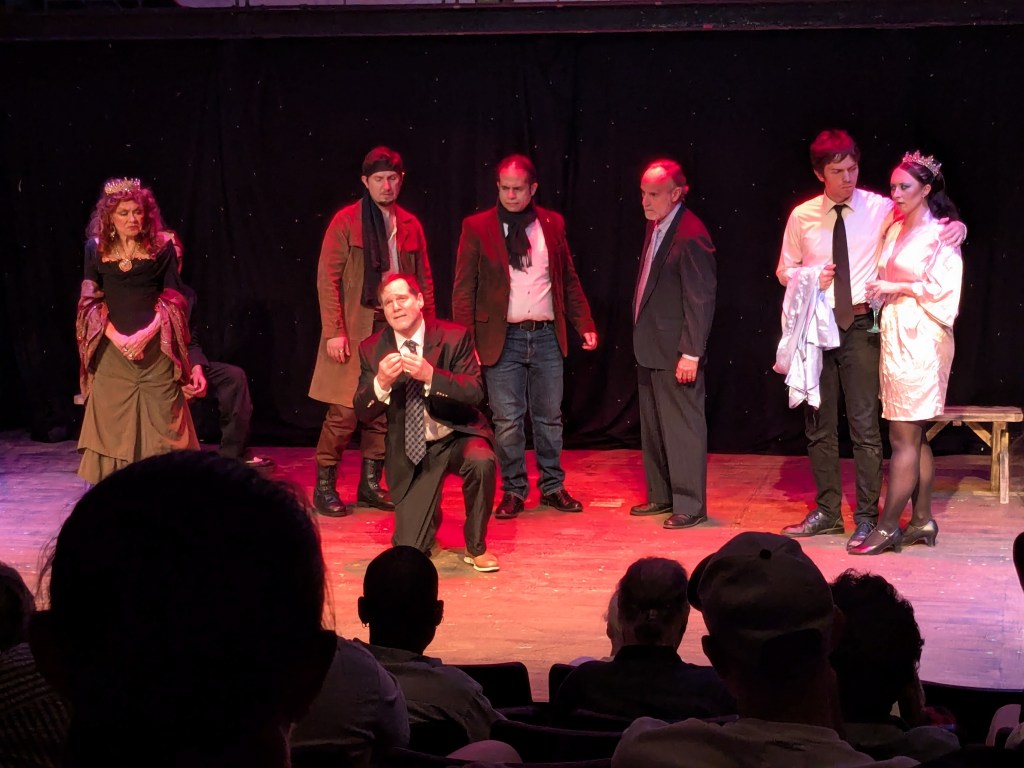
Amber Brookes returns as the icy, scheming Regan, oozing malevolence in every scene, such as when she puts her cigarette out on the ill-fated Earl of Gloucester (a heartstring-pulling Tom Corciari in his ATA debut). Dramaturge Jane Culley is grand in her reprise of Regan’s sister Goneril, who tops her sibling’s villainy by tampering with Regan’s ubiquitous goblet. Sam Hardy, who recently excelled as Henry V, brings his powerhouse voice and presence to Edgar. Jake Minter returns to bring a powerful intensity in the role of the villainous Edmund, a part he also played in a recent film adaptation. Dustin Pazar shines, a dashing figure in the pivotal role of Kent. Karolina Larion takes on the role of Cordelia, whose actions at the top of the play start a chain reaction leading to her father’s descent into madness and despair. Larion’s expressive face and performance beautifully portray the punished daughter’s sadness and her later resolve to make things right and attempt to rescue her betrayed father. Sam Cruz is a dynamic Fool, providing the levity to balance out the dark events. However, he is not the only source of mirth—moments of humor are drawn from the text through clever interpretations of the dialogue by the actors, while never betraying the solemnity of the piece. The ensemble’s love of the play is palpable, and they work as a collective to bring it alive with astonishing skill.
The entire production is an incredibly engaging, high-energy rendering of the classic material; completely unabridged, the three-plus hours of King Lear are continuously riveting as well as moving. The space of the elegant John Cullen theatre is fully utilized, from its balcony to its stairs to its wings. The Fool hovers on the balcony watching events unfold; the increasingly mad Lear strides past the audience to command center stage; Edgar leads his blinded father down the winding staircases. Backdrops showing castle grounds and interiors, the sea, the hovel, an eclipse, and the famous thunderstorm provide a dynamic sense of place and time. The swordfights are beautifully coordinated and executed, and the relationships among the characters well realized, leading to the unforgettable, heartbreaking climax that will break your heart no matter how well you know the story. It’s another terrific success for the ATA, and the perfect way to start its milestone year.
The performance of King Lear on September 14th was followed by a rousing celebration of a half-century of the American Theatre of Actors, and of all who have honed their craft there.
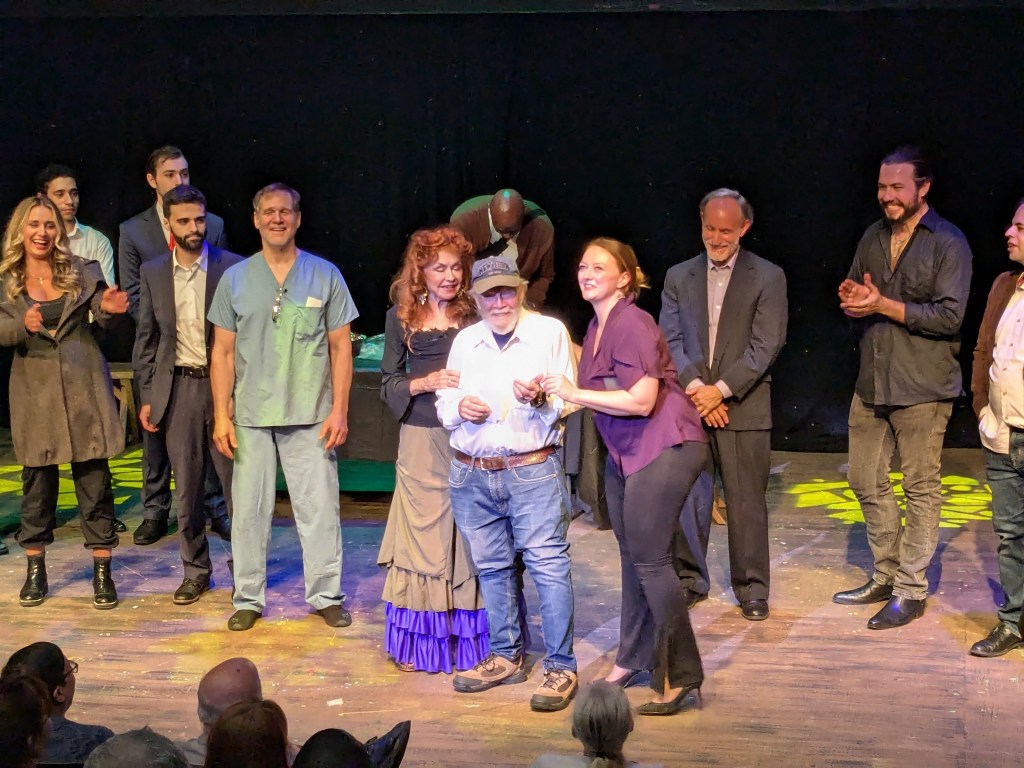
King Lear runs at the ATA through September 21, 2025.

Et Alia Theater presents a limited engagement of Blood Orange, a horror play by Abigail Duclos
“One of the most intense plays you will see this season!”

Et Alia Theater presents a limited engagement of Blood Orange, a horror play by Abigail Duclos, at The Jeffrey & Paula Gural Theatre of A.R.T./New York, 502 West 53rd Street, New York City, ADA accessible. Previews begin: 11 September (Invitation Only); Opening: 13 September; Closing: 27 September TICKETS
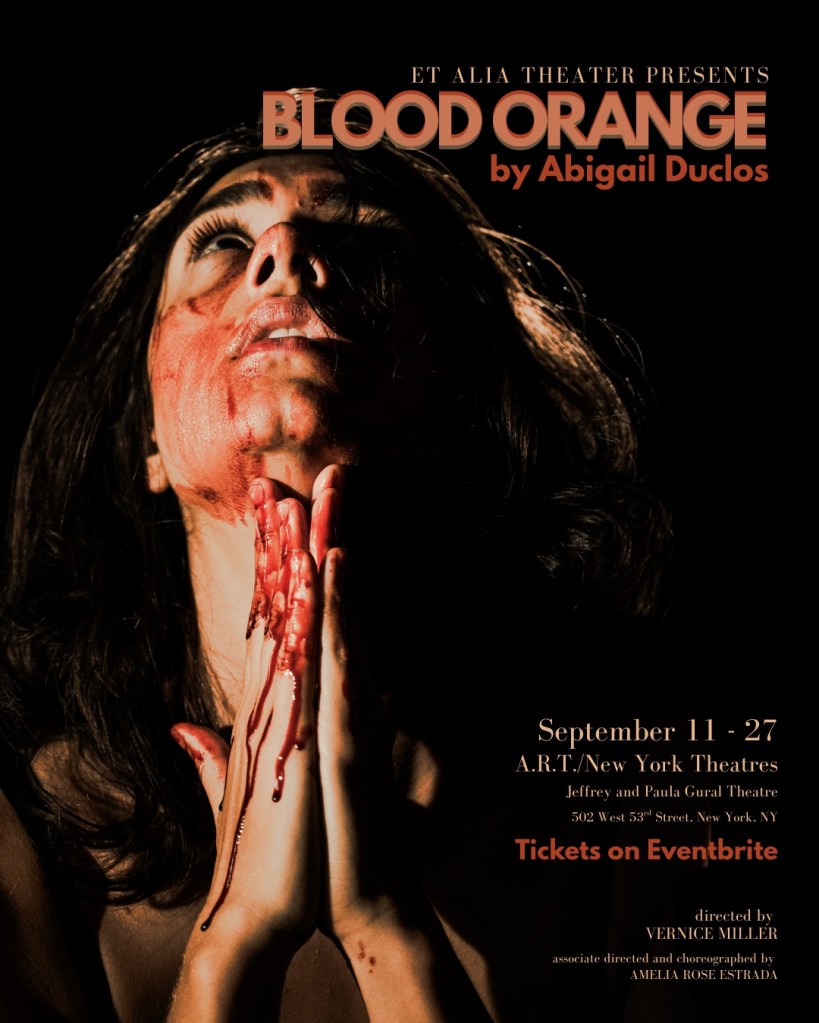
Performed in Repertory: September 11, 13, 14, 19, 21, 22, 27: Luísa Galatti as Faye, Ana Moioli as Eden, Maria Müller as Georgia
September 12, 15, 18, 20, 25 and 26: Maria Müller as Faye, Ana Moioli as Eden, Giorgia Valenti as Georgia
Doreen Oliver as Mariah for all showings

Blood Orange, by Abigail Duclos and produced by Et Alia Theater, tells the story of Faye, a teenage girl who — feeling abandoned by God and her mother in the wake of her father’s violent death — turns to a nightmarish roadkill creature for salvation. Faye then draws her awkward friend, Eden, into a strange religion filled with prayer, blood, and budding love.
The play delves deeply into grief and depicts it as an ugly, intricate, and biting experience, examining the complexities of modern teenage girlhood and sexuality. The play asks, “how do young women navigate a culture that hypersexualizes them while demonizing their desires?” “What happens when the hunt for pleasure intertwines with pain?”

Production Directed by Vernice Miller with Amelia Estrada as Associate Director/Choreographer; Scenic and Property Design by Ningning Yang; Costumes Designed & Associate Props Design by Whitney Fabre; Sound Designed by Laura Pereira; Lighting Designed by Hayley Garcia Parnell; Fight and Intimacy Direction by Leana Gardella.
For Et Alia Theater: Production and Box Office Management by Covi Loveridge Brannan; Stage Management by Isabel Criado; Deck Management by Thais Fernandes.
The play runs about 90 minutes with no intermission.
CONTENT WARNING: explicit scenes of violence and of self harm.
Production design support provided by the Edith Lutyens and Norman Bel Geddes Design Enhancement Fund, a program of the Alliance of Resident Theatres/New York (A.R.T./NY).
Established in 1972 by an innovative collective, A.R.T./New York has matured into an indispensable cornerstone for over 475 theatres and more than 150 individual producers and artists throughout all five boroughs of New York City and across the state. As the singular membership organization dedicated to encompassing New York’s entire not-for-profit theatre sector, A.R.T./New York’s reach extends from playwriting collectives and developmental labs to producing organizations and pioneering independent artists. A.R.T./NY continues to serve the field through four essential service areas — Funding, Space, Professional Development and Advocacy — in order to help theatremakers put their creative ideas on stage.

ATA kicks off the 50th Season with the revival of their acclaimed production of Shakespeare’sKING LEAR. September 10 – 21 with a special 50th Season Kick-off Event, Sunday, September 14 after the performance. Refreshments will be served.
King Lear begins as the Earl of Gloucester introduces his illegitimate son, Edmund, to the Earl of Kent. Lear, King of Britain, enters with his court. Now that he is an old man, Lear has decided to divide his kingdom between his three daughters. The division will depend on the quality of each princess’ declarations of love for her father before the court. Goneril, Duchess of Albany, and Regan, Duchess of Cornwall, both speak enthusiastically and earn their father’s praise. But Cordelia, the youngest, says nothing because she cannot voice her deep love for Lear. Misunderstanding his daughter, Lear disowns and banishes her from the kingdom. He also banishes the Earl of Kent, who had taken Cordelia’s side against the King.

Despairing for his daughters, and deeply regretting rejecting Cordelia, Lear goes mad at the height of a great storm. He and the Fool run wild on the heath until Gloucester takes them into a hut for shelter. He then seeks the aid of Kent to get them away to the coast, where Cordelia has landed with a French army to fight for her father against her sisters and their husbands.
In this family drama, greed is a driving force and remorse comes too late.
Alan Hasnas returns to the title role Featured in the cast is Josh Bartosch, Amber Brookes, Tom Ciorciari, Sam Cruz, Jane Culley*, Oliver Figueroa, Adonis Guzman, Sam Hardy, Karolina Larion, Emery Lawrence, Paul Maurizio, Jake Minter, Dustin Pazar, Alex Silverman, and Reese Villiger.*Ms. Culley appears courtesy of Actors Equity Association

The American Theatre of Actors was founded in 1976 by James Jennings, who continues as its President and Artistic Director. It is a repertory theatre company consisting of 50 actors, 15 playwrights and 8 directors. Its purpose is to promote the development of new playwrights, directors and actors and provide them a creative atmosphere in which to work without the pressures of commercial theatre.The plays deal with the social and ethical problems of contemporary society. Over 1,000 new works have been presented and more than 11,000 actors have worked at A.T.A., including Dennis Quaid, Bruce Willis, Danny Aiello, Dan Lauria, Chazz Palminteri, Kevin O’Connor, William Fichtner, Edie Falco and Kathryn Hahn.
CONTACT: info@jaymichaelsarts.com or 646-338-5472

Spotlight on Authors Domnica Radulescu and Carol Campbell
Domnica Radulescu and Carol Campbell are the creative duo behind the play Sappho’s Garden. Radulescu is a highly accomplished Romanian-American novelist, playwright, and educator, with numerous awards and accolades to her name, including three acclaimed novels and two volumes of original plays. She is also a two-time Fulbright scholar and the founding Director of the National Symposium of Theater in Academe.
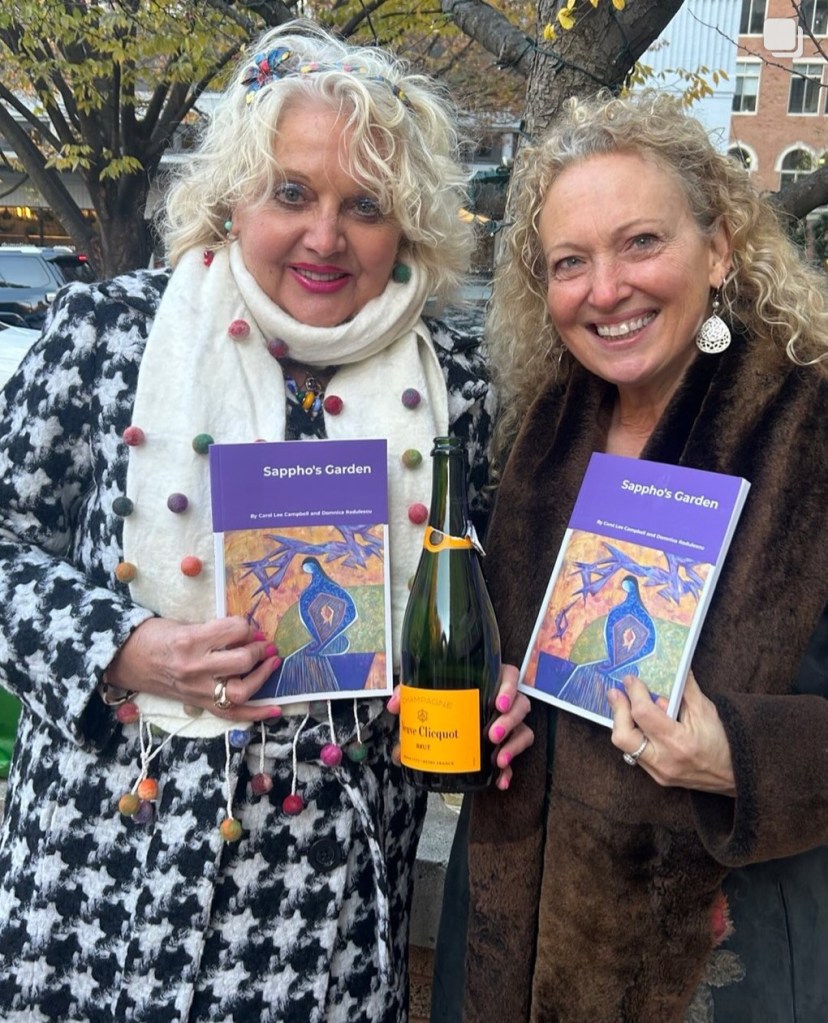
Their partnership began over a decade ago when Campbell directed one of Radulescu’s plays. The collaboration deepened through a shared passion for feminist theater, ancient goddess culture, and eco-feminism. Their “riveting marriage of minds” has produced several theatrical works, with Sappho’s Garden being their “most luminous and accomplished.”
The Book: Sappho’s Garden
The play Sappho’s Garden was born during the COVID-19 pandemic after the authors received a collaborative art grant. The project was inspired by their rediscovery of the verses of the ancient poet Sappho and a shared obsession with ancient goddesses. The work tackles the intersection of violence against women and the destruction of Mother Earth.
The central message of the play is to “Cultivate your garden” in both a literal and a metaphorical sense. This means taking care of the Earth and believing in the power of art, poetry, and imagination to offer “intimations of a better world.” The authors hope the play will inspire audiences to strive for a more sustainable, peaceful, and just world.
Looking ahead, the authors plan to continue developing the play, with a staged reading scheduled in Virginia and the ultimate goal of a full production.
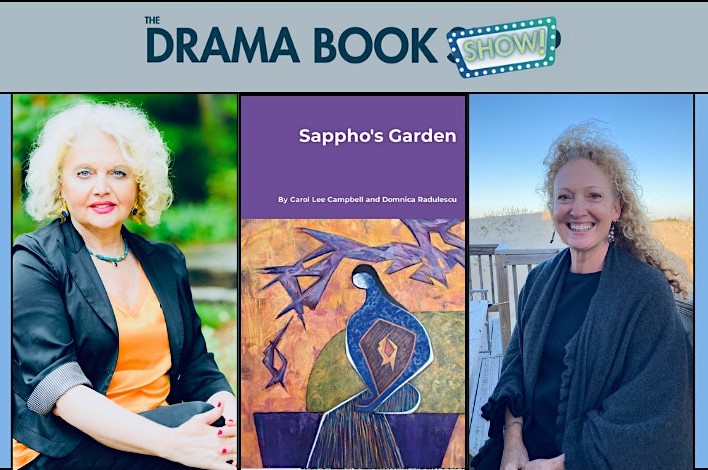
Carol Lee Campbell and Domnica Radulescu
A talkback, signing, and live podcast recording
Thursday, October 16 · 7:30 – 8:30pm EDT
The Drama Book Shop266 West 39th Street New York, NY 10018Get directions
The Drama Book Shop presents, in association with Jay Michaels Global Communications, “Sappho’s Garden” A talkback, signing, and live podcast recording.
An expansive, poetic play about the legendary poet, Sappho. A startling evocation of a feminist ethos.
This Eventbrite ticket is your reservation for the event. Please note that the purchase of “ Sappho’s Garden” ($10.00) is required for entry. Upon arrival, our team will direct you to the register to obtain your copy and complete your admission. The store will begin welcoming guests at 7:15 pm.

Broadway Icon, LEN CARIOU to star in New York Premiere of RICHARD VETERE’s riveting new drama, ZAGŁADA
Broadway Icon, LEN CARIOUto star in New York Premiere of RICHARD VETERE’s riveting new drama, ZAGŁADA. Production directed by MAJA WAMPUSZYC
October 16 — November 2 The AMERICAN THEATRE OF ACTORS 314 W. 54th Street. New York City Contact info@jaymichaelsarts.com for further info
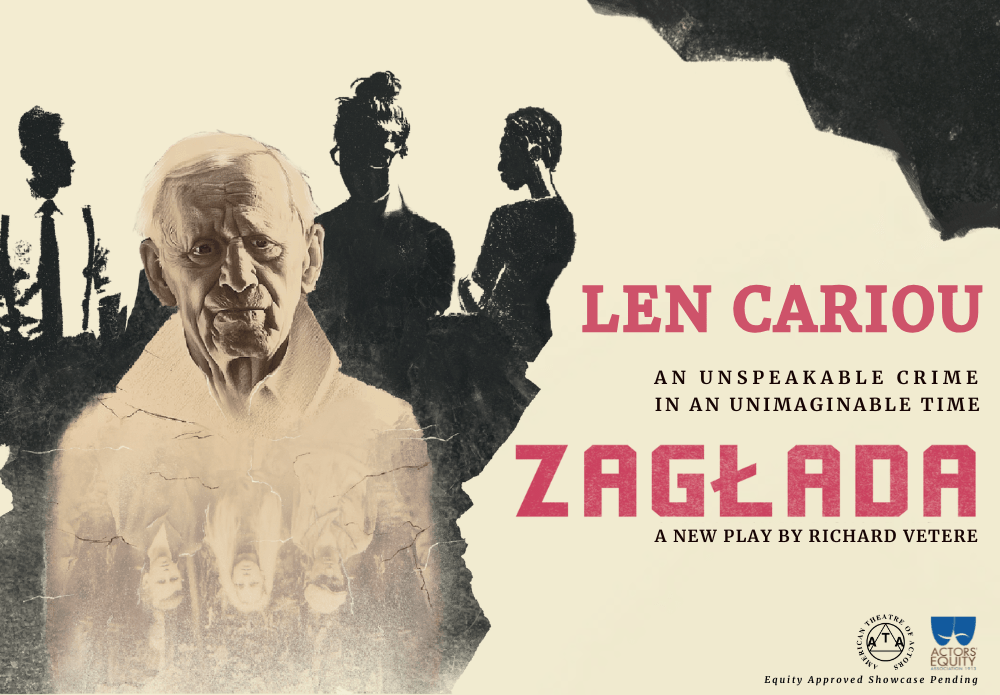
ZAGŁADA is a Polish word meaning annihilation used within Poland to refer to the HOLOCAUST, particularly in the context of the systematic, state-sponsored genocide of six million European Jews by the Nazi German regime and its allies and collaborators.
Journalist Danielle Hooper goes to interview 90-year-old Jerzy Kozlowski, in a quiet residential neighborhood in Queens for her book on World War II; he fires a gun at her, prompting his arrest. This gets the attention of Homeland Security Agent, Sonia Sokolow and NYPD Intelligence Bureau Officer, Frank Napoli.
Apparently, not only did Kozlowski lie on his immigration application when entering the United States after World War II; but he is suspected of collaborating with the Nazis at BUCHENWALD CONCENTRATION CAMP where he himself was a prisoner.
Agent Sokolow has 48 hours to prove Kozlowski’s collaboration so she can charge and extradite him to a country willing to try him for International War Crimes.
Sokolow must not only win the race against time but confront her own personal history through the mirror of Napoli’s mission to hunt down radical Islamic terrorists and White supremacists and Hooper’s righteous defense of the truth. What is a human being capable of doing to protect themselves and the ones they love and will justice prevail?
The play ZAGŁADA is inspired by history. All characters are fictional.
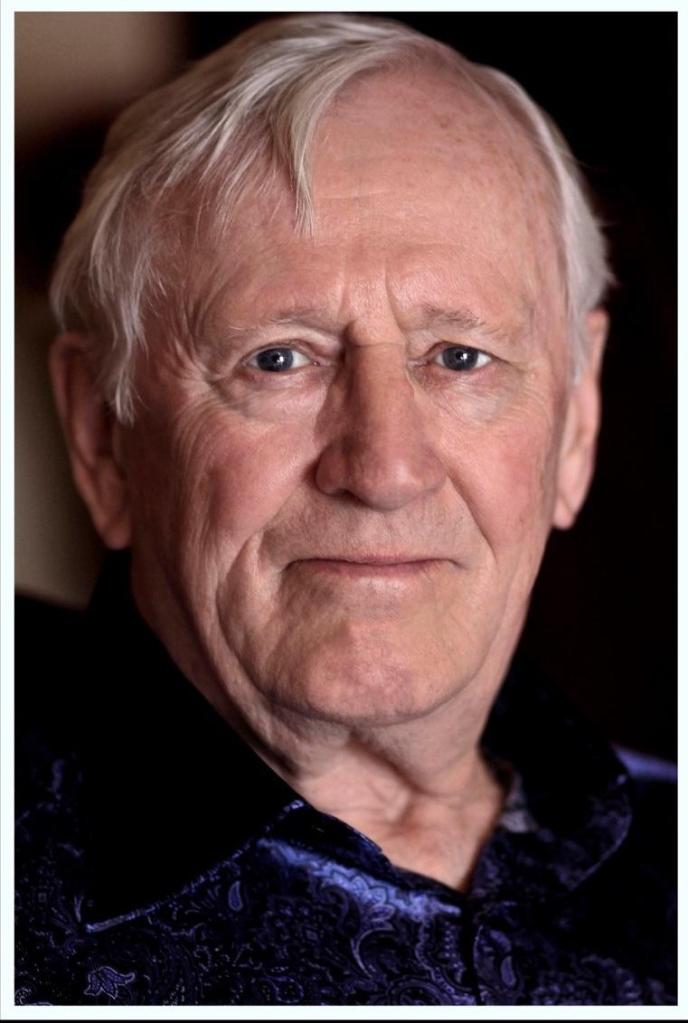
LEN CARIOU gained prominence for his Tony Award-winning title role in the original cast of Sweeney Todd: The Demon Barber of Fleet Street (1979). Prior to that, he earned nominations for Applause (1970) and A Little Night Music (1973). Cariou has had supporting roles in films such as The Four Seasons (1981), Thirteen Days (2000), About Schmidt (2002), Flags of Our Fathers (2006), Prisoners (2013), and Spotlight (2015). On television, Len was nominated for an Emmy for Into The Storm (2009) and is known for recurring roles in the shows Murder, She Wrote (1985–1992), Brotherhood (2005-2006), and Damages (2010) and his starring role in Blue Bloods (2010–2024).
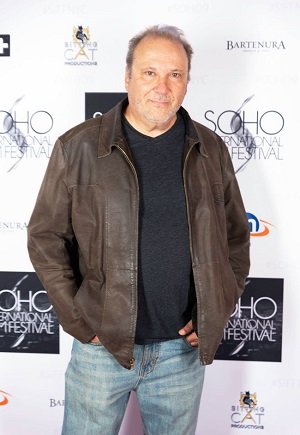
RICHARD VETERE, a Lifetime and Current Member of the Writers Guild of America East since 2012. His prolific career allowed him the opportunity to work with Oscar, Emmy, Tony, Grammy and Golden Globe award winners and nominees like Francis Ford Coppola, Walter Matthau, Carol Brunett, Robert Forester, Phil Ramone, Agnieszka Holland, Ed Harris, Elisabeth Shue, Armin Mueller-Stahl, Danny Aiello, Len Cariou and Jason Alexander. Recently, his stage play, Black & White City Blues, had an extended run and recieved rave reviews some critics calling his play a “masterpiece” at the Amrican Theatre of Actors. His screenplay, Caravaggio won the Golden Palm Award for Best Screenplay at the Beverly Hills International Film Festival 2021. His adaptation of his own stage play The Marriage Fool is now streaming on Amazon starring Walter Matthau, Carol Burnett and John Stamos. Mr. Vetere co-wrote the screenplay adaptation of his own novel The Third Miracle which premiered at the Toronto Film Festival in 1999, produced by Francis Ford Coppola, directed by Agneiszka Holland and starring Ed Harris and Anne Heche. It is considered by critics to be one of the best movies about faith ever filmed.Mr. Vetere’s first feature film Vigilante is an original screenplay, starring Robert Forester and Fred Williamson. Vigilante, released in 1983, became a blockbuster movie overnight making it the 20th highest grossing picture in 1983 and was just now re-released in Blu-Ray. It was named “a cult classic” by critic David Denby in the New York Times and one of the “best indies of the 1980s” by BAM. Over the years Mr. Vetere has written screenplays and adaptations for Paramount, Warner Bros, New Line, Zoetrope and CBS. As a member of the PD Workshop Unit at the Actors Studio he has developed several plays including ZagŁada

MAJA WAMPUSZYC has worked with Tony & Oscar Award winners. Film & TV credits include: The Immigrant (Cannes & NY Film Festival); Mona Lisa Smile; Going Shopping; The Knick; Madam Secretary; Search Party; and Law & Order: SVU. Broadway: Irena’s Vow. Off-Broadway, NYC, & regional credits include: Irena’s Vow; Lady Macbeth & Her Lover; House of Connelly; Foggy Bottom; An Oak Tree (Obie Award Winning Production); The Pearl Theatre; Precious Stones, and pool (no water) at The Barrow Street Theater. March 2020: Anna Akhmatova in Night Shadows Or: One Hundred Million Voices Shouting at Irondale. In 2021: Wampuszyc played the title role in Clytemnestra in Hades; and most recently played Ayn Rand in The Disciple for Thirdwing, LTD. PDW member of the Actors Studio, she has collaborated with Vetere as a director on developing six new plays; and with Lanie Robertson on his new play, a reimagining of the early years of Marie Curie, Unknown Objects of Desire. Member of The Actors Gym. Maja is Represented by Bret Adams, LTD.
The American Theatre of Actors, founded in 1976 by James Jennings, continues its mission of spotlighting socially and historically resonant works. The company has produced over 1,000 original plays and has been a creative home to actors such as Dennis Quaid, Edie Falco, and Chazz Palminteri.

Guest Writer, Manda Slew, discusses Miller’s A View From the Bridge at Modern Classics Theatre
Content Note:
While A View from the Bridge is a period piece set in 1950s Brooklyn, it explores themes that may be difficult for some viewers. The production includes depictions of immigration raids, which despite their historical contextcmay evoke distressing parallels to modern-day ICE activity. Additionally, the story involves emotionally charged dynamics of incest-adjacent longing, sexual jealousy, and homophobia, particularly directed toward one of the immigrant characters. These elements are central to the dramatic tension and are portrayed with seriousness and emotional weight. Audience members sensitive to these topics are encouraged to approach the production with awareness.
A View from the Bridge
Presented by Modern Classic Theatre
Walking into the BACCA Arts Center in Lindenhurst for A View from the Bridge by Arthur Miller, directed by Emily Vaeth, was quite a treat. The team transformed the venue into a black-box-style theater, seating roughly 50 patrons depending on the arrangement, and the intimacy of the space was used to full advantage.
Before a single line of dialogue was spoken, the world was already pulsing with life. In the center, Beatrice (Camille Arnon) moved about the apartment, humming along to Perry Como’s Chi-Baba, Chi-Baba while prepping dinner. Catherine (Jules Donahue) bounced between reading, dancing, sipping, and sighing bored, bright, and bursting with that specific teenage ache. Beyond the apartment walls, the community stirred: Louis and Mike (Kevin Russo and Thaddeus C. Plezia) made their rounds like neighborhood fixtures; Mrs. Lipari (Natalia Cotto) dominated the public phone with everyday urgency; and the silent shadow of the immigration officer (Alex Rich) drifted in and out, a subtle yet constant reminder of looming consequence.
This immersive pre-show tableau was a brilliant directorial move. In such a close space, it pulled the audience inward slowly and organically. You weren’t just watching a play you were already inside a Brooklyn neighborhood, witnessing the rhythms of daily life before the conflict ever cracked through.
Big praise is due to set designer Ian Freed for the thoughtful, minimal design. The perimeter of the playing space, with its suggestive dockside textures and city street grit, subtly framed the action. Streetlights glowed just enough to evoke Red Hook’s moody hush. One particularly smart touch was the elevation used to frame Alfieri’s (Derek McLaughlin) office a raised area that gave the narrator a quiet vantage point from which to observe and reflect. It gave his role both physical and emotional distance, reinforcing the sense that this was a memory being retold, a tragedy already written in the bones of the set.
More well-deserved praise for the lighting and sound design by Dan Caney. The pre-show playlist Peggy Lee, Perry Como, Sarah Vaughan rooted the show in time and place before a single line of Miller’s text was spoken. The use of “practical” streetlamps, apartment lights, Alfieri’s office lamp was especially effective in establishing tone and texture. That said, during scenes staged on the far leg of the thrust (where one row of the audience was seated), lighting occasionally failed to fully illuminate the actors during key monologues. While these moments didn’t erase the emotional clarity of the scenes, they were noticeable. Still, given the challenges of lighting such an intimate, three-sided space, Caney’s work achieved a rare balance: immersive mood and respectful shadow that allowed the audience to observe, not intrude.
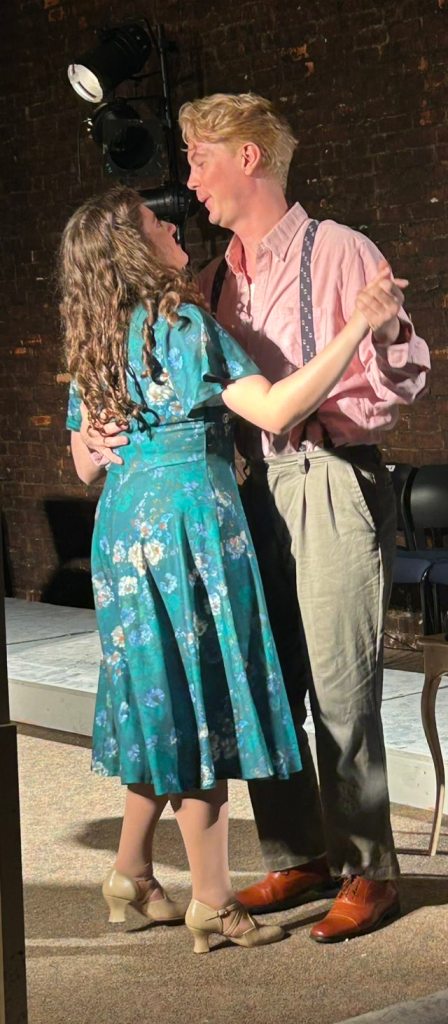
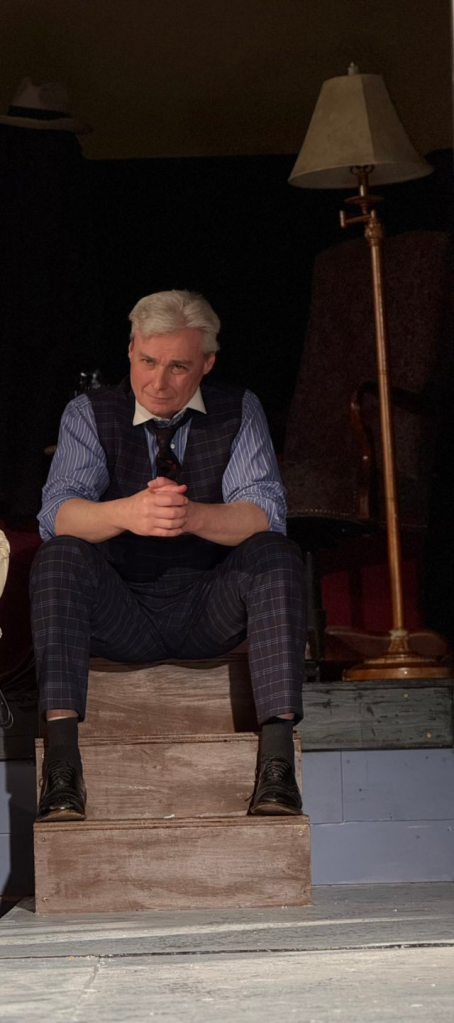
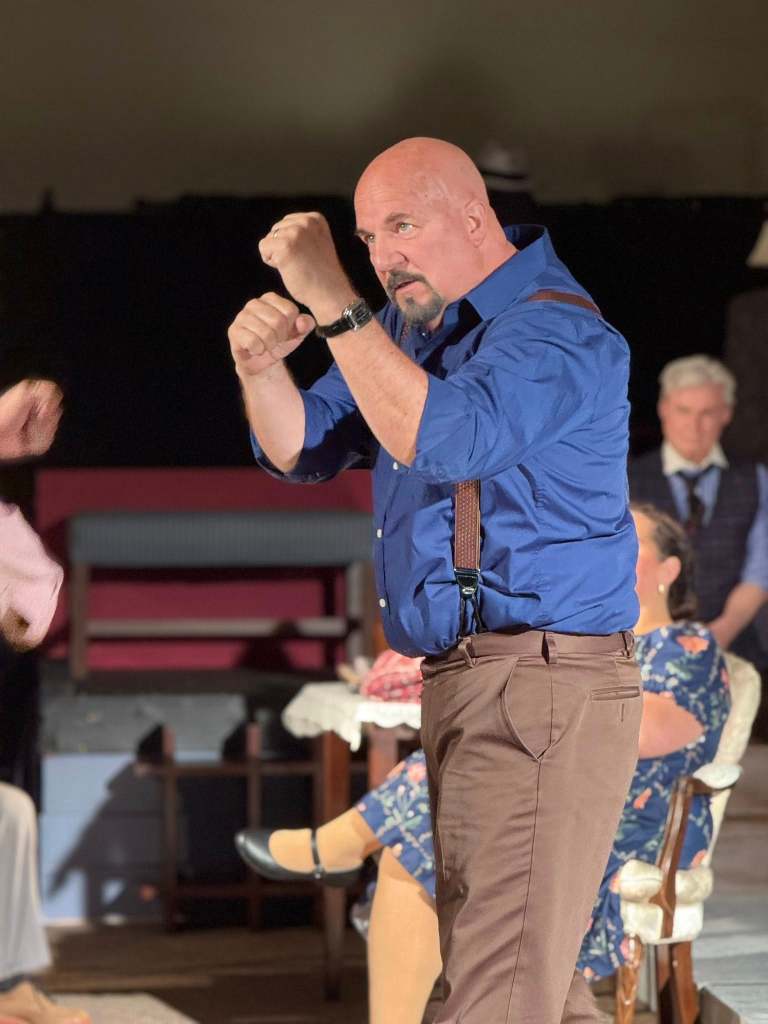
A special shout-out is due to the ensemble the so-called “smaller” roles that were anything but. Mr. and Mrs. Lipari (Leo Pompeo and Natalia Cotto), Mike and Louis (Thaddeus C. Plezia and Kevin Russo), and the Immigration Officers (Plezia and Alex Rich, pulling double duty) each brought thoughtful, grounded performances to the stage. Nothing felt phoned in or filler. Mike and Louis’ roughhousing camaraderie added humor and heart, while Mrs. Lipari’s no-nonsense phone habits brought real texture to the neighborhood. And Mr. Lipari? With his bloodstained apron and commanding stillness, Leo Pompeo exuded strength a figure you didn’t want to cross. Every glance, every shrug, every entrance had intention. This was an ensemble that knew how to build a world.
Derek McLaughlin’s Alfieri the narrator, conscience, and weary moral anchor was another standout. He brought a quiet, almost grandfatherly presence to the role, the kind of man who’s seen too much but still hopes for better. His lines were delivered with calm clarity and deep empathy, grounding the narrative in reflection and grief. Though a lawyer by trade, McLaughlin’s Alfieri radiated heart. You never doubted he wanted to do right by everyone involved, even as the story slipped through his fingers like sand.
Tim Smith as Eddie Carbone delivered a powerhouse performance. At first, he was the everyman: likable, steady, the guy who’d give you the shirt off his back. But as the undercurrent of possessiveness and jealousy surged, Smith didn’t miss a beat. His descent into emotional torment was layered and fully believable. One minute, you felt for him this man losing the only world he’s known. The next, you recoiled as the truth of his desires surfaced. He made Eddie both monster and man, and it was riveting.
Camille Arnone’s Beatrice was a masterclass in restraint and heartbreak. With every glance and carefully timed outburst, she built a woman trying to hold her world together while watching it slip away. Her keeping her jealousy of Catherine from boiling over was never cartoonish; it was human. She gave Beatrice dignity, fire, and unbearable sorrow all at once. You just want to hug her.
Jules Donahue’s Catherine was precise and technically strong never a line dropped, never a mark missed. Her portrayal leaned slightly more self-aware than one might expect for such a sheltered character, which occasionally made her feel more rehearsed than raw. Still, she captured Catherine’s central confusion especially in scenes with Eddie beautifully. You saw the girl trying to define love, identity, and independence in a world that hadn’t given her a language for any of it.
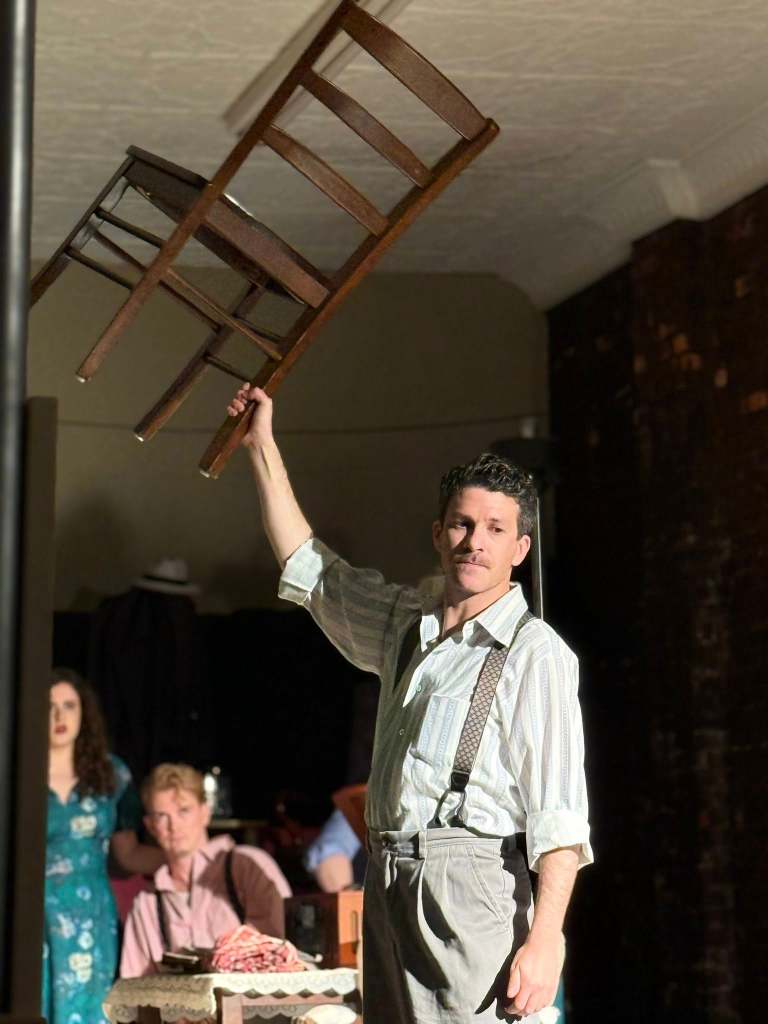
Andrew Accardi’s Marco brought big brother gravity in a small frame. With solemnity, strength, and just the right amount of quiet threat, he made it clear this man had crossed oceans for his children and would not be disrespected. The iconic chair-lift moment landed like thunder. Accardi’s Marco was no con artist, no passive guest. He was a protector. A man of few words but boundless integrity.
And then John McGowan. Rodolpho.
If there was a show-stealer, it was him. McGowan’s boyish charm was undeniable. He made it crystal clear why Catherine might fall for this wide-eyed Italian dreamer. He was goofy and elegant, sweet and proud. And when the accusations came, when his future was questioned, McGowan showed us the urgency and reason for the dream. This was a man who wanted to become something not just escape something. Even after the show, the audience was buzzing. Rodolpho was unforgettable, and McGowan lit up the stage with every step.
If there was one element that didn’t fully land, it was the larger fight choreography. While the boxing scene between Eddie and Rodolpho was sharp and brilliantly executed tense, clean, and full of subtext the ensemble fight sequences near the end felt a bit chaotic. With action happening so close to the audience on all sides, clarity was occasionally lost. That said, it never dulled the emotional impact of the story, nor the performances within it.
In all, A View from the Bridge was a stunning piece of theater. Intimate, emotionally charged, and brimming with heart. The performances were grounded. The design was intentional. The direction was brave. If you have the chance to catch it, do. The show runs one more weekend: Friday, Saturday, and Sunday at the BACCA Arts Center in Lindenhurst.
Support local theater. Let it break your heart and feel things.
 Arts Independent