Home » Posts tagged 'books' (Page 3)
Tag Archives: books

Jim Catapano attends A Majestic Production in Celebration of 50 Great Years
King Lear Rises Again to Mark the Golden Anniversary of The American Theatre of Actors
As the curtain opens on its 50th year, the ATA has turned to a signature piece to mark the very special occasion. King Lear, itself enjoying its 420th anniversary, returns to the John Cullen stage after a great run last year, and featuring faces familiar and new.

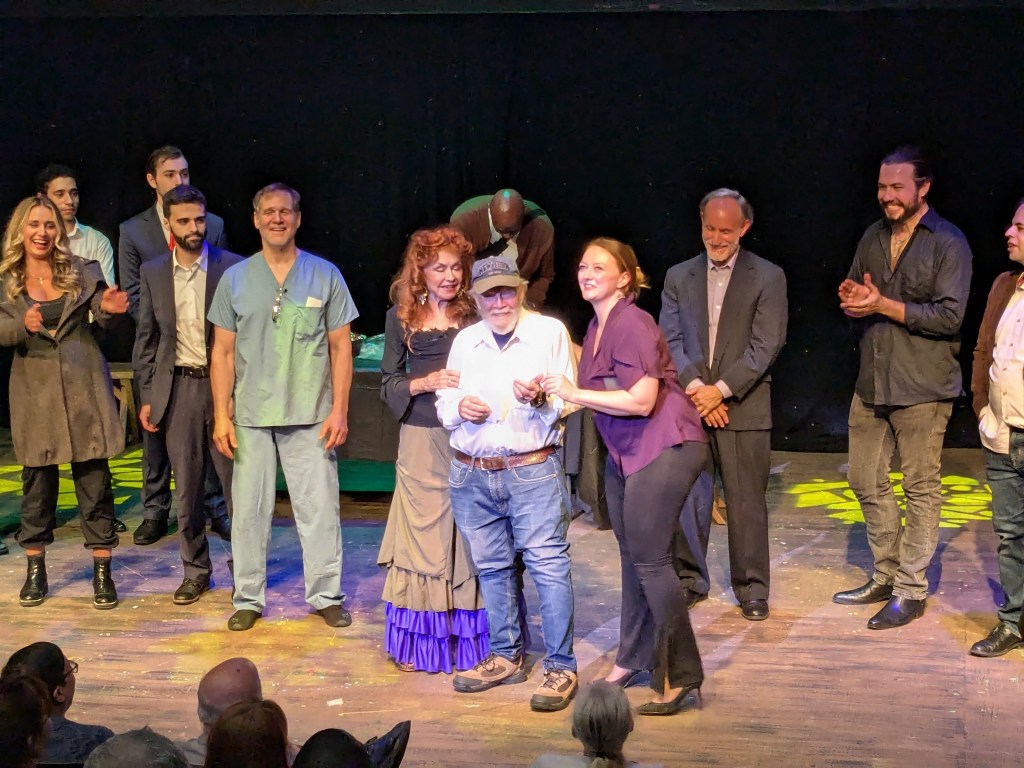
Alan Hasnas reprises the role of the titular tragic monarch in this energetic rendering, directed with panache by ATA president and founder James Jennings. In a special presentation after the show, Hasnas noted he is celebrating his own anniversary, having debuted at the ATA in the role of Claudius in a production of Hamlet 20 years ago.
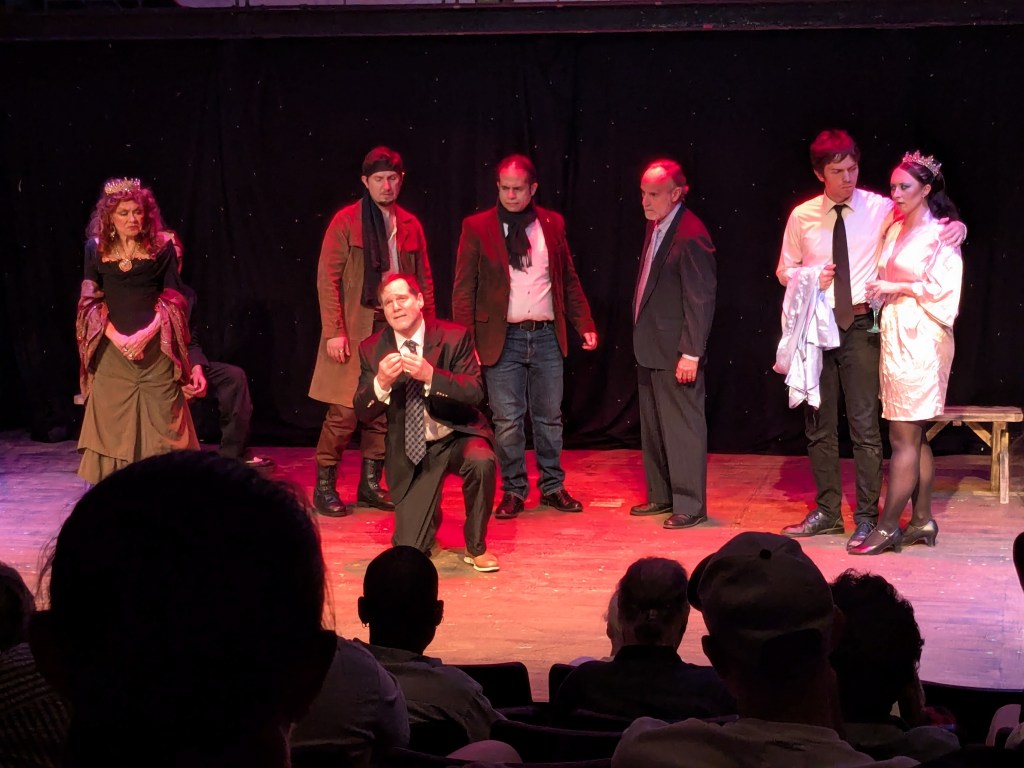
Amber Brookes returns as the icy, scheming Regan, oozing malevolence in every scene, such as when she puts her cigarette out on the ill-fated Earl of Gloucester (a heartstring-pulling Tom Corciari in his ATA debut). Dramaturge Jane Culley is grand in her reprise of Regan’s sister Goneril, who tops her sibling’s villainy by tampering with Regan’s ubiquitous goblet. Sam Hardy, who recently excelled as Henry V, brings his powerhouse voice and presence to Edgar. Jake Minter returns to bring a powerful intensity in the role of the villainous Edmund, a part he also played in a recent film adaptation. Dustin Pazar shines, a dashing figure in the pivotal role of Kent. Karolina Larion takes on the role of Cordelia, whose actions at the top of the play start a chain reaction leading to her father’s descent into madness and despair. Larion’s expressive face and performance beautifully portray the punished daughter’s sadness and her later resolve to make things right and attempt to rescue her betrayed father. Sam Cruz is a dynamic Fool, providing the levity to balance out the dark events. However, he is not the only source of mirth—moments of humor are drawn from the text through clever interpretations of the dialogue by the actors, while never betraying the solemnity of the piece. The ensemble’s love of the play is palpable, and they work as a collective to bring it alive with astonishing skill.
The entire production is an incredibly engaging, high-energy rendering of the classic material; completely unabridged, the three-plus hours of King Lear are continuously riveting as well as moving. The space of the elegant John Cullen theatre is fully utilized, from its balcony to its stairs to its wings. The Fool hovers on the balcony watching events unfold; the increasingly mad Lear strides past the audience to command center stage; Edgar leads his blinded father down the winding staircases. Backdrops showing castle grounds and interiors, the sea, the hovel, an eclipse, and the famous thunderstorm provide a dynamic sense of place and time. The swordfights are beautifully coordinated and executed, and the relationships among the characters well realized, leading to the unforgettable, heartbreaking climax that will break your heart no matter how well you know the story. It’s another terrific success for the ATA, and the perfect way to start its milestone year.
The performance of King Lear on September 14th was followed by a rousing celebration of a half-century of the American Theatre of Actors, and of all who have honed their craft there.
King Lear runs at the ATA through September 21, 2025.

Et Alia Theater presents a limited engagement of Blood Orange, a horror play by Abigail Duclos
“One of the most intense plays you will see this season!”

Et Alia Theater presents a limited engagement of Blood Orange, a horror play by Abigail Duclos, at The Jeffrey & Paula Gural Theatre of A.R.T./New York, 502 West 53rd Street, New York City, ADA accessible. Previews begin: 11 September (Invitation Only); Opening: 13 September; Closing: 27 September TICKETS

Performed in Repertory: September 11, 13, 14, 19, 21, 22, 27: Luísa Galatti as Faye, Ana Moioli as Eden, Maria Müller as Georgia
September 12, 15, 18, 20, 25 and 26: Maria Müller as Faye, Ana Moioli as Eden, Giorgia Valenti as Georgia
Doreen Oliver as Mariah for all showings

Blood Orange, by Abigail Duclos and produced by Et Alia Theater, tells the story of Faye, a teenage girl who — feeling abandoned by God and her mother in the wake of her father’s violent death — turns to a nightmarish roadkill creature for salvation. Faye then draws her awkward friend, Eden, into a strange religion filled with prayer, blood, and budding love.
The play delves deeply into grief and depicts it as an ugly, intricate, and biting experience, examining the complexities of modern teenage girlhood and sexuality. The play asks, “how do young women navigate a culture that hypersexualizes them while demonizing their desires?” “What happens when the hunt for pleasure intertwines with pain?”

Production Directed by Vernice Miller with Amelia Estrada as Associate Director/Choreographer; Scenic and Property Design by Ningning Yang; Costumes Designed & Associate Props Design by Whitney Fabre; Sound Designed by Laura Pereira; Lighting Designed by Hayley Garcia Parnell; Fight and Intimacy Direction by Leana Gardella.
For Et Alia Theater: Production and Box Office Management by Covi Loveridge Brannan; Stage Management by Isabel Criado; Deck Management by Thais Fernandes.
The play runs about 90 minutes with no intermission.
CONTENT WARNING: explicit scenes of violence and of self harm.
Production design support provided by the Edith Lutyens and Norman Bel Geddes Design Enhancement Fund, a program of the Alliance of Resident Theatres/New York (A.R.T./NY).
Established in 1972 by an innovative collective, A.R.T./New York has matured into an indispensable cornerstone for over 475 theatres and more than 150 individual producers and artists throughout all five boroughs of New York City and across the state. As the singular membership organization dedicated to encompassing New York’s entire not-for-profit theatre sector, A.R.T./New York’s reach extends from playwriting collectives and developmental labs to producing organizations and pioneering independent artists. A.R.T./NY continues to serve the field through four essential service areas — Funding, Space, Professional Development and Advocacy — in order to help theatremakers put their creative ideas on stage.

ATA kicks off the 50th Season with the revival of their acclaimed production of Shakespeare’sKING LEAR. September 10 – 21 with a special 50th Season Kick-off Event, Sunday, September 14 after the performance. Refreshments will be served.
King Lear begins as the Earl of Gloucester introduces his illegitimate son, Edmund, to the Earl of Kent. Lear, King of Britain, enters with his court. Now that he is an old man, Lear has decided to divide his kingdom between his three daughters. The division will depend on the quality of each princess’ declarations of love for her father before the court. Goneril, Duchess of Albany, and Regan, Duchess of Cornwall, both speak enthusiastically and earn their father’s praise. But Cordelia, the youngest, says nothing because she cannot voice her deep love for Lear. Misunderstanding his daughter, Lear disowns and banishes her from the kingdom. He also banishes the Earl of Kent, who had taken Cordelia’s side against the King.

Despairing for his daughters, and deeply regretting rejecting Cordelia, Lear goes mad at the height of a great storm. He and the Fool run wild on the heath until Gloucester takes them into a hut for shelter. He then seeks the aid of Kent to get them away to the coast, where Cordelia has landed with a French army to fight for her father against her sisters and their husbands.
In this family drama, greed is a driving force and remorse comes too late.
Alan Hasnas returns to the title role Featured in the cast is Josh Bartosch, Amber Brookes, Tom Ciorciari, Sam Cruz, Jane Culley*, Oliver Figueroa, Adonis Guzman, Sam Hardy, Karolina Larion, Emery Lawrence, Paul Maurizio, Jake Minter, Dustin Pazar, Alex Silverman, and Reese Villiger.*Ms. Culley appears courtesy of Actors Equity Association

The American Theatre of Actors was founded in 1976 by James Jennings, who continues as its President and Artistic Director. It is a repertory theatre company consisting of 50 actors, 15 playwrights and 8 directors. Its purpose is to promote the development of new playwrights, directors and actors and provide them a creative atmosphere in which to work without the pressures of commercial theatre.The plays deal with the social and ethical problems of contemporary society. Over 1,000 new works have been presented and more than 11,000 actors have worked at A.T.A., including Dennis Quaid, Bruce Willis, Danny Aiello, Dan Lauria, Chazz Palminteri, Kevin O’Connor, William Fichtner, Edie Falco and Kathryn Hahn.
CONTACT: info@jaymichaelsarts.com or 646-338-5472

Spotlight on Authors Domnica Radulescu and Carol Campbell
Domnica Radulescu and Carol Campbell are the creative duo behind the play Sappho’s Garden. Radulescu is a highly accomplished Romanian-American novelist, playwright, and educator, with numerous awards and accolades to her name, including three acclaimed novels and two volumes of original plays. She is also a two-time Fulbright scholar and the founding Director of the National Symposium of Theater in Academe.
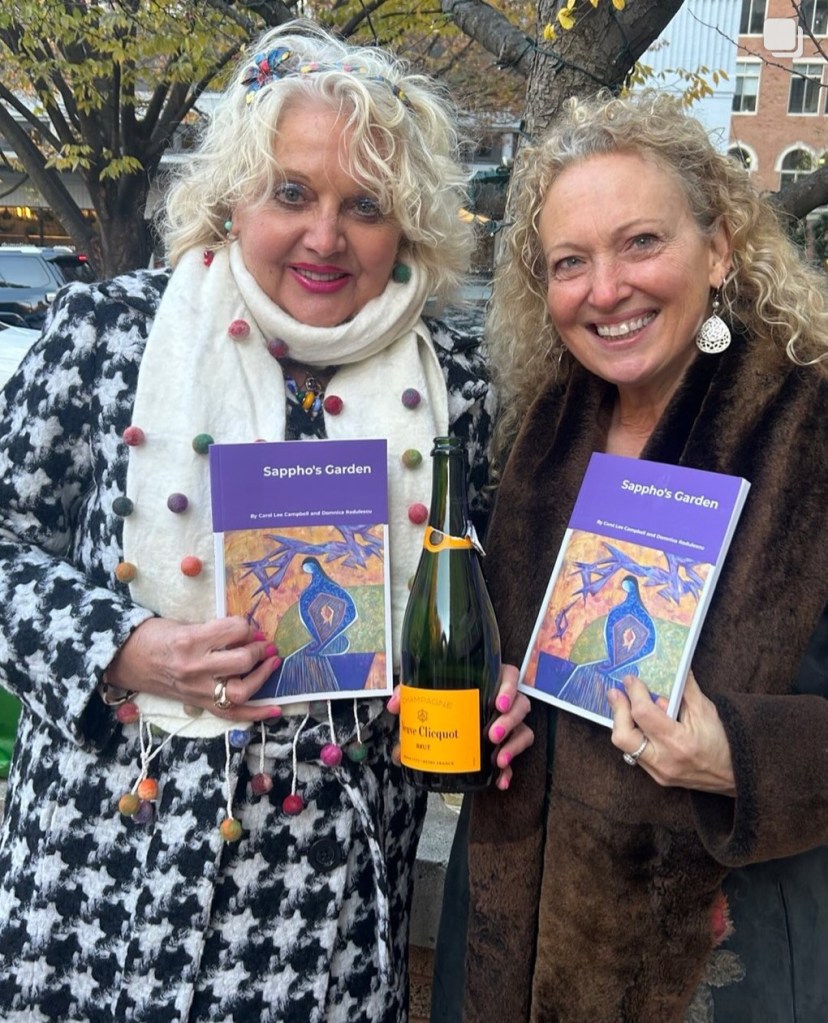
Their partnership began over a decade ago when Campbell directed one of Radulescu’s plays. The collaboration deepened through a shared passion for feminist theater, ancient goddess culture, and eco-feminism. Their “riveting marriage of minds” has produced several theatrical works, with Sappho’s Garden being their “most luminous and accomplished.”
The Book: Sappho’s Garden
The play Sappho’s Garden was born during the COVID-19 pandemic after the authors received a collaborative art grant. The project was inspired by their rediscovery of the verses of the ancient poet Sappho and a shared obsession with ancient goddesses. The work tackles the intersection of violence against women and the destruction of Mother Earth.
The central message of the play is to “Cultivate your garden” in both a literal and a metaphorical sense. This means taking care of the Earth and believing in the power of art, poetry, and imagination to offer “intimations of a better world.” The authors hope the play will inspire audiences to strive for a more sustainable, peaceful, and just world.
Looking ahead, the authors plan to continue developing the play, with a staged reading scheduled in Virginia and the ultimate goal of a full production.

Carol Lee Campbell and Domnica Radulescu
A talkback, signing, and live podcast recording
Thursday, October 16 · 7:30 – 8:30pm EDT
The Drama Book Shop266 West 39th Street New York, NY 10018Get directions
The Drama Book Shop presents, in association with Jay Michaels Global Communications, “Sappho’s Garden” A talkback, signing, and live podcast recording.
An expansive, poetic play about the legendary poet, Sappho. A startling evocation of a feminist ethos.
This Eventbrite ticket is your reservation for the event. Please note that the purchase of “ Sappho’s Garden” ($10.00) is required for entry. Upon arrival, our team will direct you to the register to obtain your copy and complete your admission. The store will begin welcoming guests at 7:15 pm.

Broadway Icon, LEN CARIOU to star in New York Premiere of RICHARD VETERE’s riveting new drama, ZAGŁADA
Broadway Icon, LEN CARIOUto star in New York Premiere of RICHARD VETERE’s riveting new drama, ZAGŁADA. Production directed by MAJA WAMPUSZYC
October 16 — November 2 The AMERICAN THEATRE OF ACTORS 314 W. 54th Street. New York City Contact info@jaymichaelsarts.com for further info
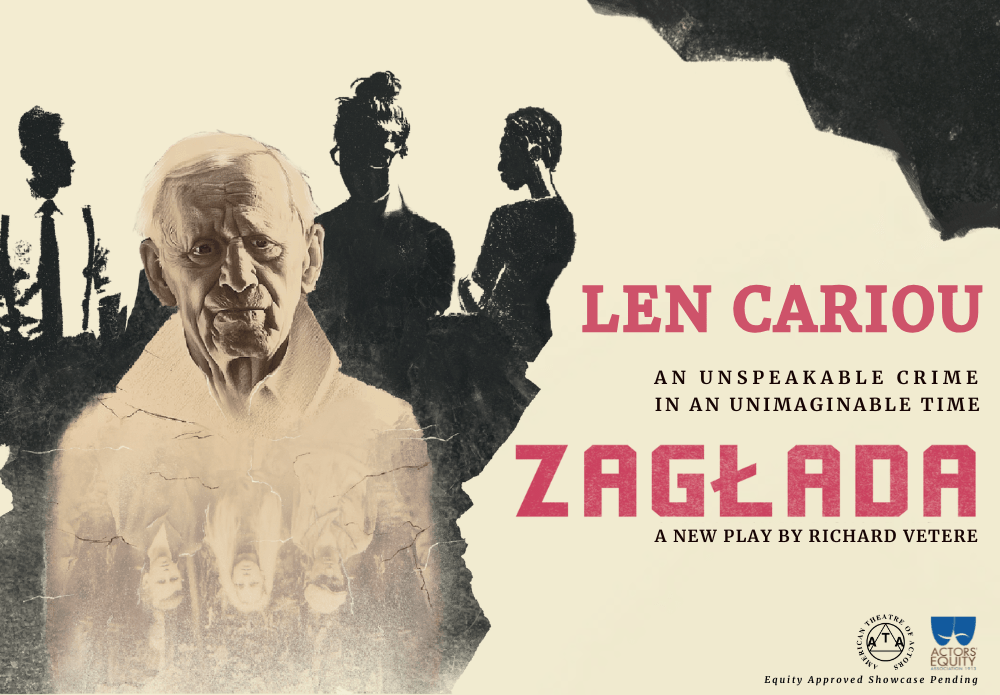
ZAGŁADA is a Polish word meaning annihilation used within Poland to refer to the HOLOCAUST, particularly in the context of the systematic, state-sponsored genocide of six million European Jews by the Nazi German regime and its allies and collaborators.
Journalist Danielle Hooper goes to interview 90-year-old Jerzy Kozlowski, in a quiet residential neighborhood in Queens for her book on World War II; he fires a gun at her, prompting his arrest. This gets the attention of Homeland Security Agent, Sonia Sokolow and NYPD Intelligence Bureau Officer, Frank Napoli.
Apparently, not only did Kozlowski lie on his immigration application when entering the United States after World War II; but he is suspected of collaborating with the Nazis at BUCHENWALD CONCENTRATION CAMP where he himself was a prisoner.
Agent Sokolow has 48 hours to prove Kozlowski’s collaboration so she can charge and extradite him to a country willing to try him for International War Crimes.
Sokolow must not only win the race against time but confront her own personal history through the mirror of Napoli’s mission to hunt down radical Islamic terrorists and White supremacists and Hooper’s righteous defense of the truth. What is a human being capable of doing to protect themselves and the ones they love and will justice prevail?
The play ZAGŁADA is inspired by history. All characters are fictional.
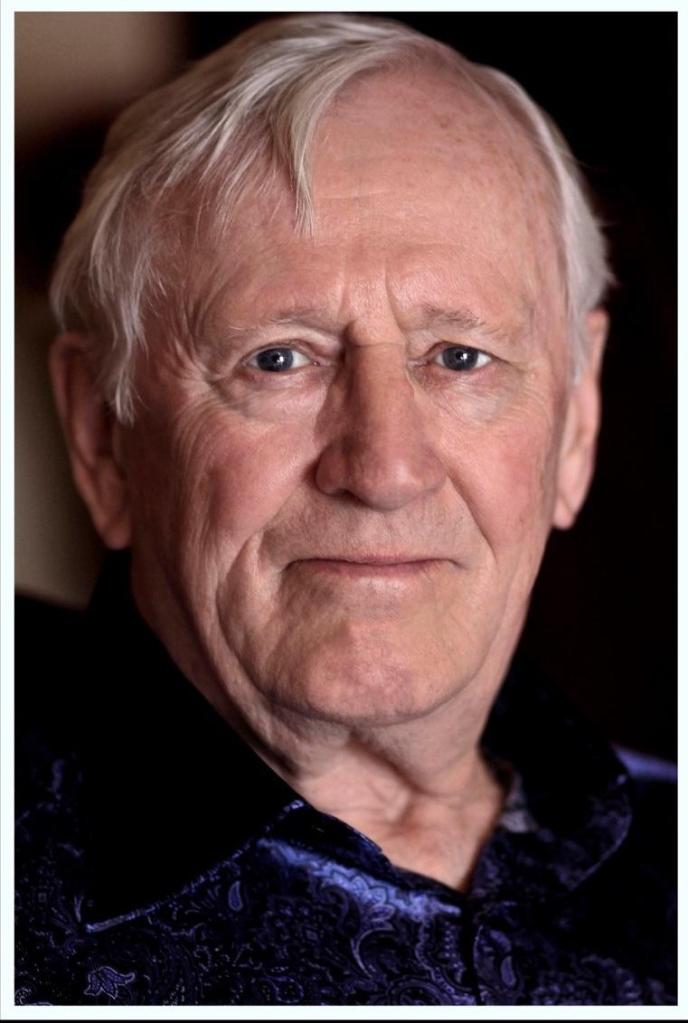
LEN CARIOU gained prominence for his Tony Award-winning title role in the original cast of Sweeney Todd: The Demon Barber of Fleet Street (1979). Prior to that, he earned nominations for Applause (1970) and A Little Night Music (1973). Cariou has had supporting roles in films such as The Four Seasons (1981), Thirteen Days (2000), About Schmidt (2002), Flags of Our Fathers (2006), Prisoners (2013), and Spotlight (2015). On television, Len was nominated for an Emmy for Into The Storm (2009) and is known for recurring roles in the shows Murder, She Wrote (1985–1992), Brotherhood (2005-2006), and Damages (2010) and his starring role in Blue Bloods (2010–2024).
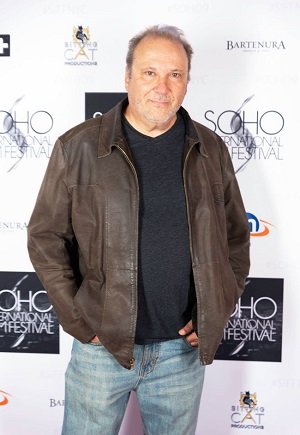
RICHARD VETERE, a Lifetime and Current Member of the Writers Guild of America East since 2012. His prolific career allowed him the opportunity to work with Oscar, Emmy, Tony, Grammy and Golden Globe award winners and nominees like Francis Ford Coppola, Walter Matthau, Carol Brunett, Robert Forester, Phil Ramone, Agnieszka Holland, Ed Harris, Elisabeth Shue, Armin Mueller-Stahl, Danny Aiello, Len Cariou and Jason Alexander. Recently, his stage play, Black & White City Blues, had an extended run and recieved rave reviews some critics calling his play a “masterpiece” at the Amrican Theatre of Actors. His screenplay, Caravaggio won the Golden Palm Award for Best Screenplay at the Beverly Hills International Film Festival 2021. His adaptation of his own stage play The Marriage Fool is now streaming on Amazon starring Walter Matthau, Carol Burnett and John Stamos. Mr. Vetere co-wrote the screenplay adaptation of his own novel The Third Miracle which premiered at the Toronto Film Festival in 1999, produced by Francis Ford Coppola, directed by Agneiszka Holland and starring Ed Harris and Anne Heche. It is considered by critics to be one of the best movies about faith ever filmed.Mr. Vetere’s first feature film Vigilante is an original screenplay, starring Robert Forester and Fred Williamson. Vigilante, released in 1983, became a blockbuster movie overnight making it the 20th highest grossing picture in 1983 and was just now re-released in Blu-Ray. It was named “a cult classic” by critic David Denby in the New York Times and one of the “best indies of the 1980s” by BAM. Over the years Mr. Vetere has written screenplays and adaptations for Paramount, Warner Bros, New Line, Zoetrope and CBS. As a member of the PD Workshop Unit at the Actors Studio he has developed several plays including ZagŁada

MAJA WAMPUSZYC has worked with Tony & Oscar Award winners. Film & TV credits include: The Immigrant (Cannes & NY Film Festival); Mona Lisa Smile; Going Shopping; The Knick; Madam Secretary; Search Party; and Law & Order: SVU. Broadway: Irena’s Vow. Off-Broadway, NYC, & regional credits include: Irena’s Vow; Lady Macbeth & Her Lover; House of Connelly; Foggy Bottom; An Oak Tree (Obie Award Winning Production); The Pearl Theatre; Precious Stones, and pool (no water) at The Barrow Street Theater. March 2020: Anna Akhmatova in Night Shadows Or: One Hundred Million Voices Shouting at Irondale. In 2021: Wampuszyc played the title role in Clytemnestra in Hades; and most recently played Ayn Rand in The Disciple for Thirdwing, LTD. PDW member of the Actors Studio, she has collaborated with Vetere as a director on developing six new plays; and with Lanie Robertson on his new play, a reimagining of the early years of Marie Curie, Unknown Objects of Desire. Member of The Actors Gym. Maja is Represented by Bret Adams, LTD.
The American Theatre of Actors, founded in 1976 by James Jennings, continues its mission of spotlighting socially and historically resonant works. The company has produced over 1,000 original plays and has been a creative home to actors such as Dennis Quaid, Edie Falco, and Chazz Palminteri.

Guest Writer, Manda Slew, discusses Miller’s A View From the Bridge at Modern Classics Theatre
Content Note:
While A View from the Bridge is a period piece set in 1950s Brooklyn, it explores themes that may be difficult for some viewers. The production includes depictions of immigration raids, which despite their historical contextcmay evoke distressing parallels to modern-day ICE activity. Additionally, the story involves emotionally charged dynamics of incest-adjacent longing, sexual jealousy, and homophobia, particularly directed toward one of the immigrant characters. These elements are central to the dramatic tension and are portrayed with seriousness and emotional weight. Audience members sensitive to these topics are encouraged to approach the production with awareness.
A View from the Bridge
Presented by Modern Classic Theatre
Walking into the BACCA Arts Center in Lindenhurst for A View from the Bridge by Arthur Miller, directed by Emily Vaeth, was quite a treat. The team transformed the venue into a black-box-style theater, seating roughly 50 patrons depending on the arrangement, and the intimacy of the space was used to full advantage.
Before a single line of dialogue was spoken, the world was already pulsing with life. In the center, Beatrice (Camille Arnon) moved about the apartment, humming along to Perry Como’s Chi-Baba, Chi-Baba while prepping dinner. Catherine (Jules Donahue) bounced between reading, dancing, sipping, and sighing bored, bright, and bursting with that specific teenage ache. Beyond the apartment walls, the community stirred: Louis and Mike (Kevin Russo and Thaddeus C. Plezia) made their rounds like neighborhood fixtures; Mrs. Lipari (Natalia Cotto) dominated the public phone with everyday urgency; and the silent shadow of the immigration officer (Alex Rich) drifted in and out, a subtle yet constant reminder of looming consequence.
This immersive pre-show tableau was a brilliant directorial move. In such a close space, it pulled the audience inward slowly and organically. You weren’t just watching a play you were already inside a Brooklyn neighborhood, witnessing the rhythms of daily life before the conflict ever cracked through.
Big praise is due to set designer Ian Freed for the thoughtful, minimal design. The perimeter of the playing space, with its suggestive dockside textures and city street grit, subtly framed the action. Streetlights glowed just enough to evoke Red Hook’s moody hush. One particularly smart touch was the elevation used to frame Alfieri’s (Derek McLaughlin) office a raised area that gave the narrator a quiet vantage point from which to observe and reflect. It gave his role both physical and emotional distance, reinforcing the sense that this was a memory being retold, a tragedy already written in the bones of the set.
More well-deserved praise for the lighting and sound design by Dan Caney. The pre-show playlist Peggy Lee, Perry Como, Sarah Vaughan rooted the show in time and place before a single line of Miller’s text was spoken. The use of “practical” streetlamps, apartment lights, Alfieri’s office lamp was especially effective in establishing tone and texture. That said, during scenes staged on the far leg of the thrust (where one row of the audience was seated), lighting occasionally failed to fully illuminate the actors during key monologues. While these moments didn’t erase the emotional clarity of the scenes, they were noticeable. Still, given the challenges of lighting such an intimate, three-sided space, Caney’s work achieved a rare balance: immersive mood and respectful shadow that allowed the audience to observe, not intrude.
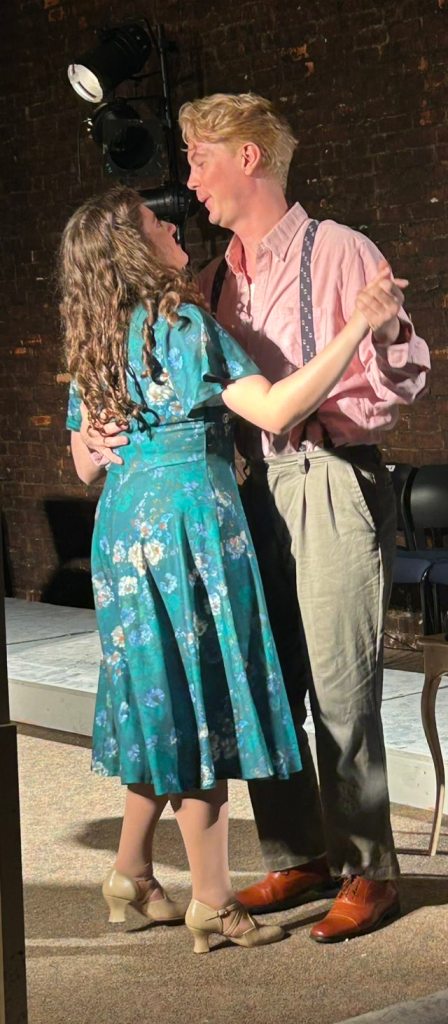
A special shout-out is due to the ensemble the so-called “smaller” roles that were anything but. Mr. and Mrs. Lipari (Leo Pompeo and Natalia Cotto), Mike and Louis (Thaddeus C. Plezia and Kevin Russo), and the Immigration Officers (Plezia and Alex Rich, pulling double duty) each brought thoughtful, grounded performances to the stage. Nothing felt phoned in or filler. Mike and Louis’ roughhousing camaraderie added humor and heart, while Mrs. Lipari’s no-nonsense phone habits brought real texture to the neighborhood. And Mr. Lipari? With his bloodstained apron and commanding stillness, Leo Pompeo exuded strength a figure you didn’t want to cross. Every glance, every shrug, every entrance had intention. This was an ensemble that knew how to build a world.
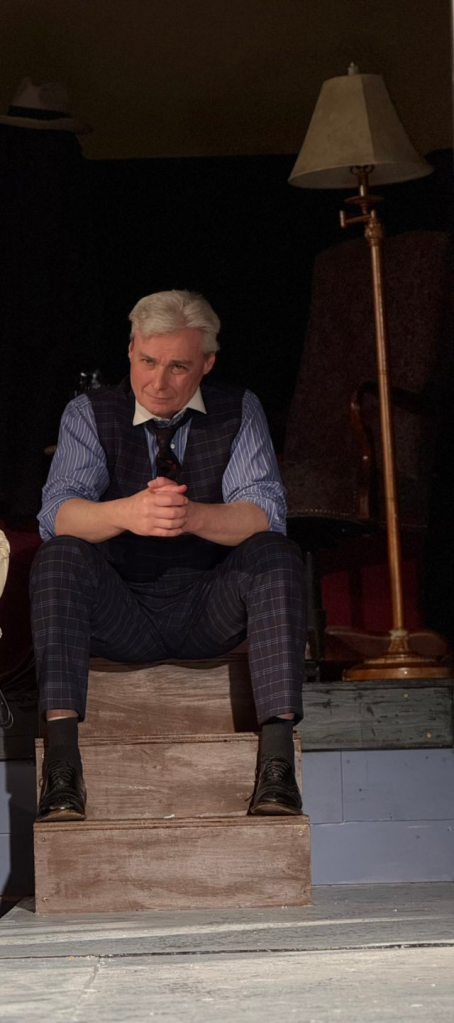
Derek McLaughlin’s Alfieri the narrator, conscience, and weary moral anchor was another standout. He brought a quiet, almost grandfatherly presence to the role, the kind of man who’s seen too much but still hopes for better. His lines were delivered with calm clarity and deep empathy, grounding the narrative in reflection and grief. Though a lawyer by trade, McLaughlin’s Alfieri radiated heart. You never doubted he wanted to do right by everyone involved, even as the story slipped through his fingers like sand.
Tim Smith as Eddie Carbone delivered a powerhouse performance. At first, he was the everyman: likable, steady, the guy who’d give you the shirt off his back. But as the undercurrent of possessiveness and jealousy surged, Smith didn’t miss a beat. His descent into emotional torment was layered and fully believable. One minute, you felt for him this man losing the only world he’s known. The next, you recoiled as the truth of his desires surfaced. He made Eddie both monster and man, and it was riveting.
Camille Arnone’s Beatrice was a masterclass in restraint and heartbreak. With every glance and carefully timed outburst, she built a woman trying to hold her world together while watching it slip away. Her keeping her jealousy of Catherine from boiling over was never cartoonish; it was human. She gave Beatrice dignity, fire, and unbearable sorrow all at once. You just want to hug her.
Jules Donahue’s Catherine was precise and technically strong never a line dropped, never a mark missed. Her portrayal leaned slightly more self-aware than one might expect for such a sheltered character, which occasionally made her feel more rehearsed than raw. Still, she captured Catherine’s central confusion especially in scenes with Eddie beautifully. You saw the girl trying to define love, identity, and independence in a world that hadn’t given her a language for any of it.
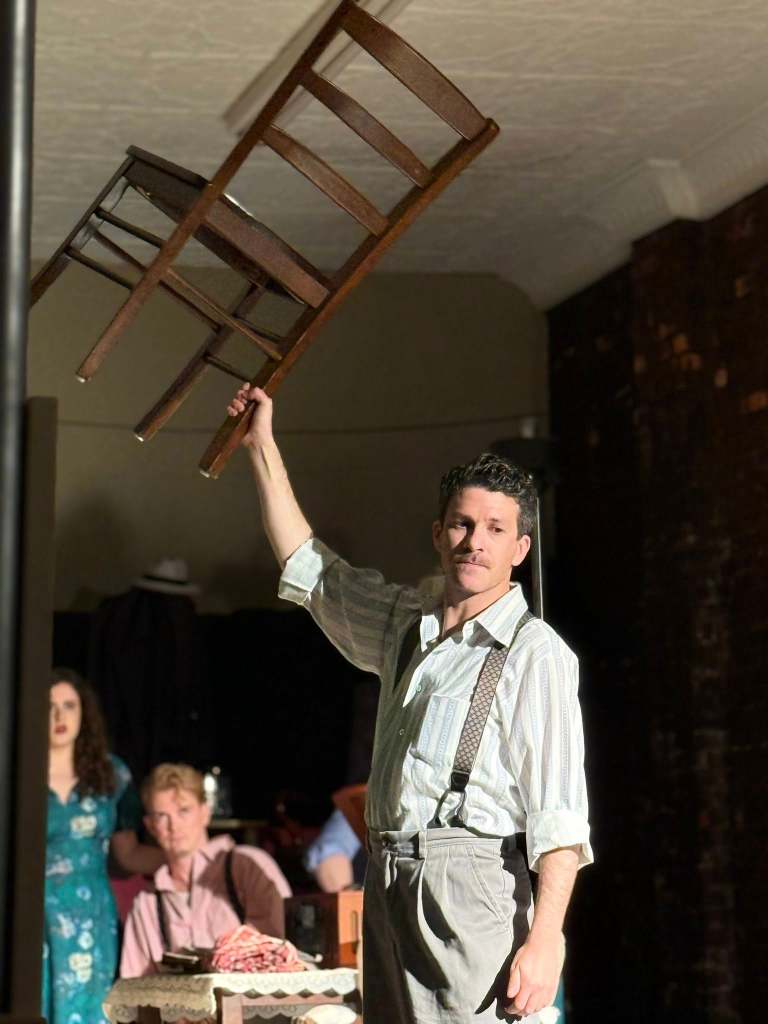
Andrew Accardi’s Marco brought big brother gravity in a small frame. With solemnity, strength, and just the right amount of quiet threat, he made it clear this man had crossed oceans for his children and would not be disrespected. The iconic chair-lift moment landed like thunder. Accardi’s Marco was no con artist, no passive guest. He was a protector. A man of few words but boundless integrity.
And then John McGowan. Rodolpho.
If there was a show-stealer, it was him. McGowan’s boyish charm was undeniable. He made it crystal clear why Catherine might fall for this wide-eyed Italian dreamer. He was goofy and elegant, sweet and proud. And when the accusations came, when his future was questioned, McGowan showed us the urgency and reason for the dream. This was a man who wanted to become something not just escape something. Even after the show, the audience was buzzing. Rodolpho was unforgettable, and McGowan lit up the stage with every step.
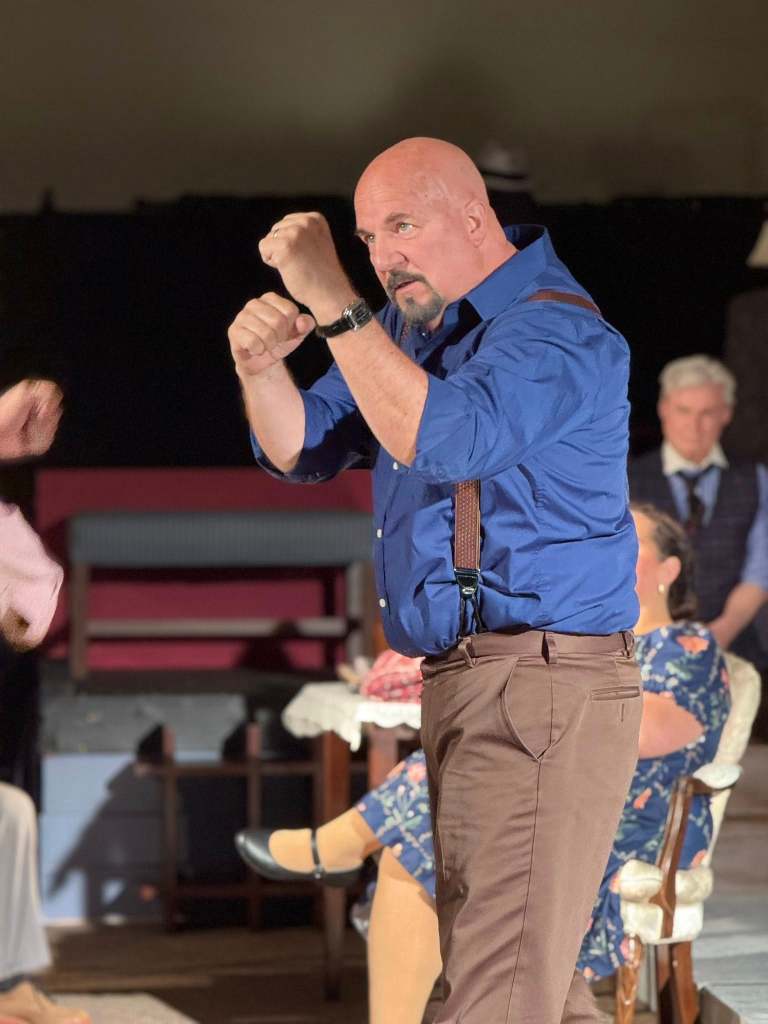
If there was one element that didn’t fully land, it was the larger fight choreography. While the boxing scene between Eddie and Rodolpho was sharp and brilliantly executed tense, clean, and full of subtext the ensemble fight sequences near the end felt a bit chaotic. With action happening so close to the audience on all sides, clarity was occasionally lost. That said, it never dulled the emotional impact of the story, nor the performances within it.
In all, A View from the Bridge was a stunning piece of theater. Intimate, emotionally charged, and brimming with heart. The performances were grounded. The design was intentional. The direction was brave. If you have the chance to catch it, do. The show runs one more weekend: Friday, Saturday, and Sunday at the BACCA Arts Center in Lindenhurst.
Support local theater. Let it break your heart and feel things.

Jim Catapano spies a Glimmer of Hope Amidst the Misery, wallowing in MUD (at the ATA)
MUD, María Irene Fornés’ 1980s social commentary, is reborn at the ATA
“I am a hungry soul. I am a longing soul. I am an empty soul,” laments Mae, an impoverished, illiterate young woman in an old torn dress. “Can’t I Have a Decent Life?”

Mae is living a bleak existence with an unwanted life partner, Lloyd—a man who is a virtual animal in human form. Their toxic relationship is marked by harrowing screaming matches as she goes about ironing and pressing clothes, desperately trying to maintain a civilized demeanor amidst the chaos. Mae finds what appears to be a way out in a possible relationship with the suit-and-tie clad Henry, a seemingly successful neighbor who to her is a symbol of education and escape. “I feel like heaven had come to this place and I still feel so,” Mae proclaims defiantly. But even that brief candle of hope is quickly extinguished due to an unexpected turn of events that leaves Mae in an even more dire situation than before.
MUD is a contemporary groundbreaker by María Irene Fornés’, the late Cuban-American playwright whose work was known for depicting characters who dared to dream themselves out of the dire and unfair circumstances that social and cultural realities imposed upon them. This important and relevant piece is now brought to life in 2025 by Utopia for Losers, “a New York-based theatre company of young actors and directors staging work by a variety of contemporary playwrights.”
Mae explains to Henry that her late father found Lloyd on the street and took him in; he is literally a feral stray that has resisted all attempts at domestication. He is dominated by base impulses of hunger and carnal desire, the latter hampered by an illness that leaves him physically impotent but still craving at a feverish level. “We’re like animals who got together and mated,” Mae admits with disgust. This leaves her forced to care for a person who is essentially an unwanted pet, a burden that hampers her desperate attempts to rise above the unfair cards that have been dealt her.
Chloe Margot gives a stunning performance as Mae, a heartbreaking heroine trapped in an utterly hellish situation; one roots for her to escape while recognizing how tragically unlikely that is. Mae is driven to better herself through education and a firm work ethic; she goes to school and has trouble retaining what she learns, but forges on regardless; she tries to develop her reading skills, narrating aloud (slowly but determinedly) books about starfishes and hermit crabs while trying to ignore the pathetic creature she is stuck in cohabitation with.
Brian Beckerle as Lloyd perfectly realizes the bestial, pitiful nature of the difficult character while never allowing him to tip over into being utterly repugnant. His physical acting is remarkable—Lloyd jumps onto the table repeatedly, exemplifying his subhuman nature, and cartwheels across the stage to demonstrate his virility and vigor. Aiden Castillo as Henry excels at an extremely difficult task of showing the character at first dominating but sinister, and supposedly civilized, until circumstances leave him compromised and forced to a state of dependency similar to Lloyd’s. The trio of actors give a masterclass in the realization of a playwright’s intent, expertly interpreting Fornes’ poetic style and bringing to life her themes of psychological and relationship complexity fueled by poverty. It’s a triumph for the cast, Director/Producer Dylan Pitanza, Assistant Director Christopher Paul Richards, Dramaturg Ava Lamantia, and Producer Sawyer Barth; and a home run production for Utopia for Losers and the American Theatre of Actors.
Content Warnings: Profanity, discussion of sexual acts, simulation of a sexual act, gun violence, discussion of bestiality, misogyny.
MUD was performed by the American Theatre of Actors through June 29, 2025.

The Aftermath of Murder: Jim Catapano reviews John Galsworthy’s “The First and The Last” at the ATA
John Galsworthy’s Compelling The First and The Last is Brought into the 21st Century at the ATA
Cleaning up after a killing is never going to be an easy task (unless you’re Harvey Keitel’s character in Pulp Fiction). Such is the dilemma of Keith (Clay von Carlowitz), a young, successful, and ambitious lawyer with a wayward younger brother, Larry (Jonathan Beebe). Larry is madly in love with Wanda (Natasha Sahs), with a fervor that leads to tragedy. A distraught Larry visits Keith with the news that he has killed Wanda’s estranged ex after an altercation, and the couple had casually dumped the body under an archway. The murder is now all over the media, and Keith’s dilemma is how to make this “problem” disappear for his brother while protecting his own reputation. Keith’s investigation has him conclude that nothing directly implicates Larry, and the news of a vagrant discovering the body makes for a convenient distortion of the truth…

The provocative circumstances ensure that The First and The Last goes to 100 mph and stays there throughout its brief running time. Galsworthy’s play of over 100 years ago, itself based on a 1917 short story, is brought hurtling into 2025 by the actors, whose collective intensity is palpable. Amidst the powerful dialogue, the desperation of the situation is conveyed in their eyes, the glances between each other, the body language conveying human beings watching their very existences unravel. Beebe’s Larry is a deer in the headlights, his every expression and movement illustrating a man horrified by the dark corner of reality he has found himself in. Carlowitz’ dapper Keith is the picture of a man at a crossroads, trying to protect family while making sure his professional life is not tarnished, and grappling over which of those is most important to him. Sahs’ imbues Wanda with an astonishing potency that depicts a woman consumed by passion; Wanda starts in a black dress of mourning and traditions to a white wedding gown, hopelessly attempting to suggest an innocence that is no longer there. Ovid Radbauer provides a sinister, foreboding presence in the roles of a policeman and a paper seller, two people whose professions symbolize the very forces that could doom the brothers and Wanda.
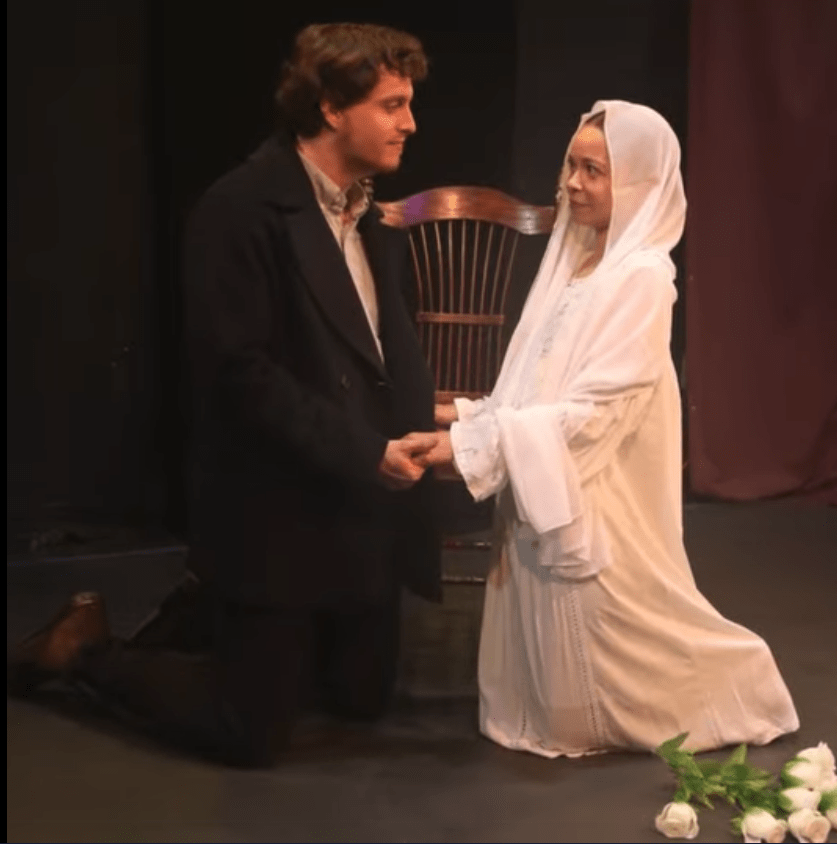
Directed with a flourish by John DeBenedetto, The First and The Last is like a runaway train heading towards a brick wall of an ending that is shocking and yet somehow inevitable, and makes for a gripping hour of theatre. It runs at the Beckmann Theatre at the American Theatre of Actors through June 15, 2025.
Nothing Left but the Kindness of Strangers: A Jim Catapano Review
Bernard J. Taylor’s Tennessee Williams: Portrait of a Gay Icon Brings a Legend to Life at the ATA
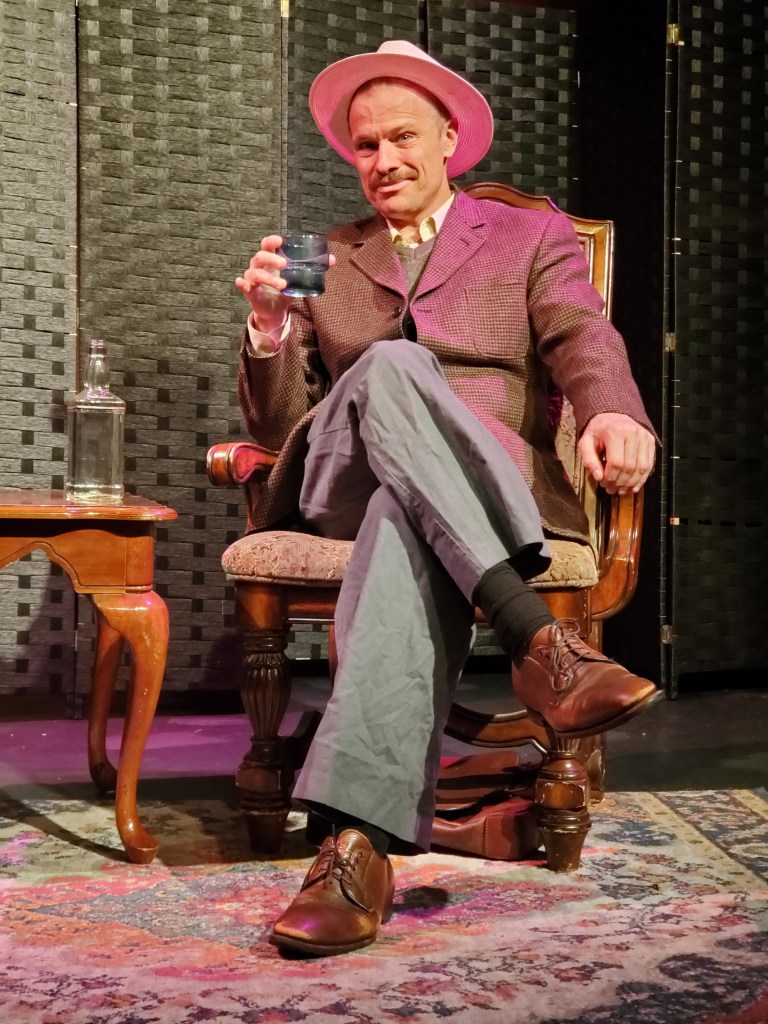
Tennessee Williams is alone on stage, and at this point, apparently alone in life. Seen on a lecture tour, he is surrounded by posters of his most famous works: A Streetcar Named Desire, The Glass Menagerie, Cat on a Hot Tin Roof; the face of his muse, Anna Magnani, stares out at us from a poster of The Rose Tattoo. Another wall is plastered with manuscript pages, relics of an era when creativity flowed. Pictures of his beloved sister Rose, his parents (one loving and one abusive), and his life partner Frank Merlo are on the table next to the chair from which he tells his story. They are all ghosts now—the only companion he has with him is a bottle of Vodka. He reminds himself to take “small sips”, but as his trauma comes to the surface these become heavy gulps. His laughter gives way to gasps of despair; he hugs the chair and sobs, imagining it to be Frank in his late partner’s last moments. He screams out Anna’s name in utter desperation for a companion for comforting and understanding than a liquor bottle.
John Stillwaggon as Williams is astonishing; one feels they are genuinely spending an evening with the legendary writer. Williams bares his soul, exorcises his demons and welcomes them back in again, and we feel we are witness to something extraordinary, as turns triumphant and tragic. The south of the mid-20th century comes to life in his words, and his disdain for the dreaded city of St. Louis is a hilarious running theme amidst the sadness.
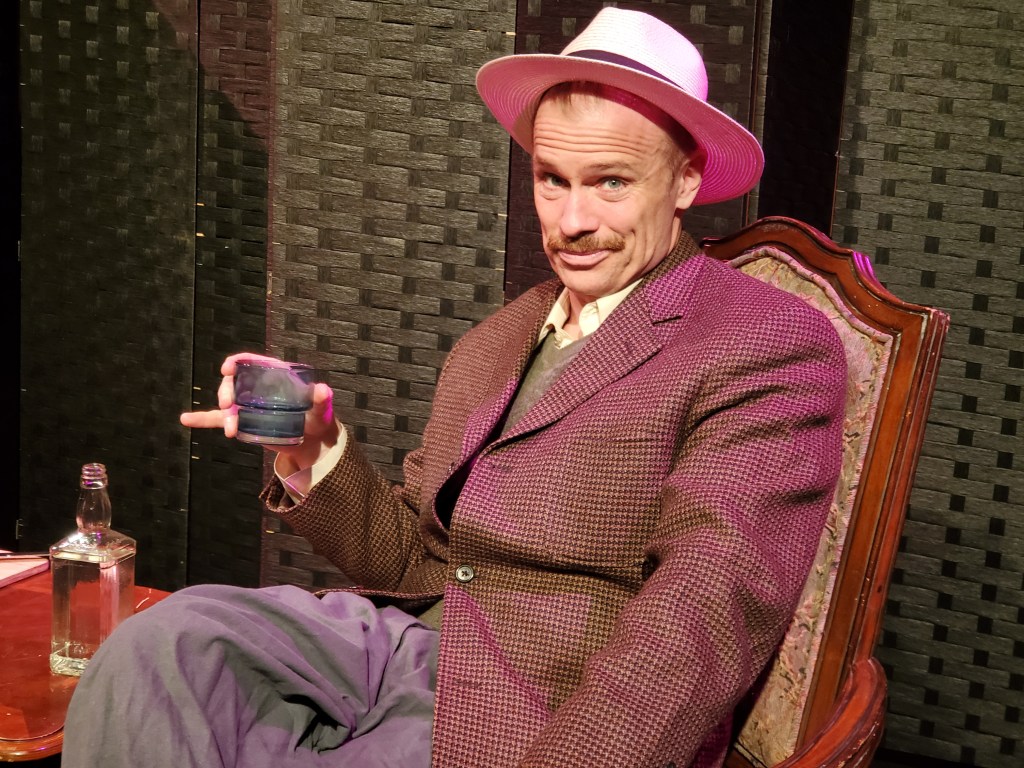
A gay man in a time and place where that was not treated kindly, Williams is portrayed by Stillwaggon as defiant, boisterous and charismatic, while simultaneously tragic and heartbreaking. He laments the fate of his beloved Rose, inspiration for Laura in The Glass Menagerie, and the victim of a lobotomy in a time when mental health was even more misunderstood than it is today. He mourns his beloved Frank and curses his vile father, who he says he only got along with “after he died.”
He gushes at the magnificence of the young Brando and rages against the critics—and at “the dying of the light,” noting that he’s once again “graverobbing” from other artists. “They say Dylan Thomas went to the White Horse Tavern…drank 18 shots of whiskey and dropped dead,” he remembers, glancing at the Vodka bottle and musing that he’s likely halfway there himself. It’s funny until you realize he likely wants to complete the journey.
The production is a must-see for the masterful performance of Stillwaggon, who recreates the swagger, wit, charm and pathos of Williams perfectly. It is directed deftly by Carolyn Dellinger, with a brisk pacing that complements Stillwaggon’s performance and Taylor’s writing expertly. It provides great insight into not only the story of one legendary artist, but the very notion of the highs and lows of fame, and the “having and losing” nature of life itself.
Tennessee Williams: Portrait of a Gay Icon, as part of the Icons Festival, runs at the American Theatre of Actors through June 15, 2025.

The Bees Still Can’t Help Themselves! says Jim Catapano
Douglas Carter Beane’s 90s Classic As Bees In Honey Drown Gets a Masterful Revival
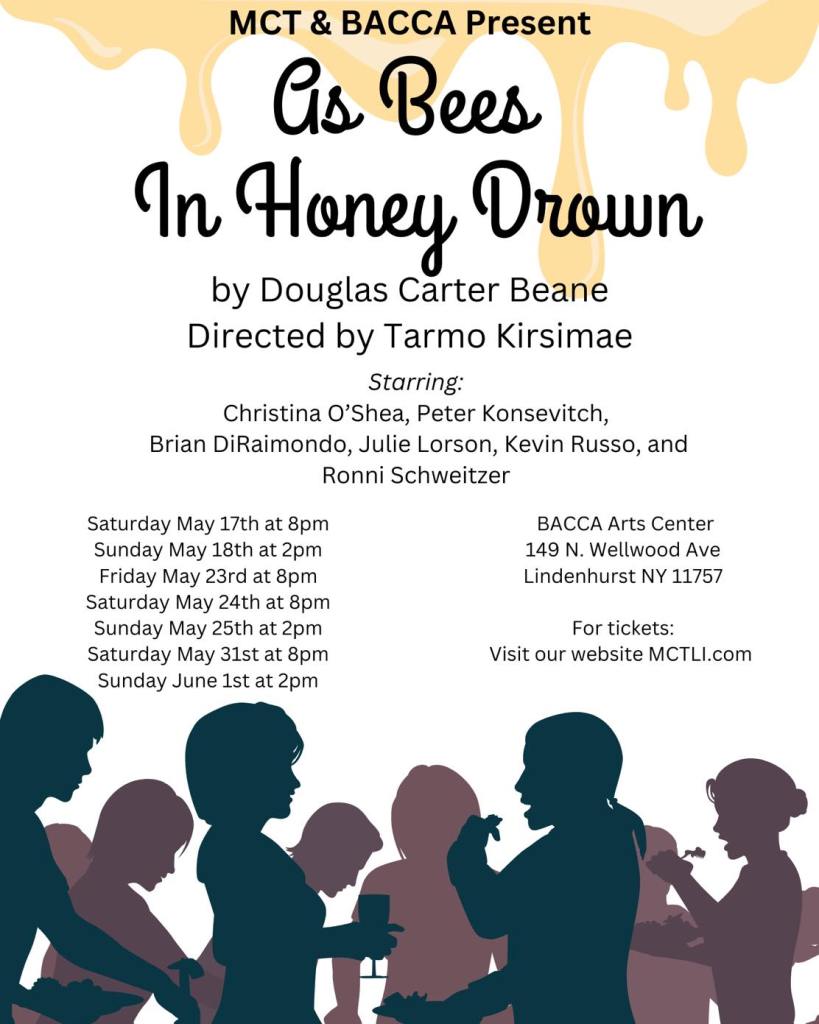
“Once, I saw a bee drown in honey, and I understood,” is a famous quote attributed to the 20th Century Greek writer Nikos Kazantzakis. He recognized the danger of wanting too much, the trap that is set for us by our own unquenchable desires. Douglas Carter Beane took this fact of life and fashioned As Bees In Honey Drown, an astute and incredibly witty play that takes a brutal look at the fame game and how seduction can lead us down a dark path, and eventually destroy us. The Modern Classics Theatre Company has brought this masterwork roaring into the (new) 20s with panache and a sterling cast.
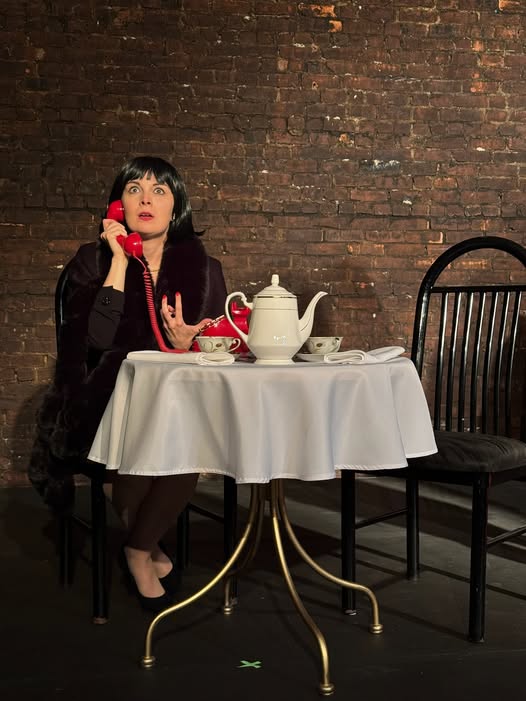
New York City con artist Alexa Vere de Vere (Christina O’ Shea), the villain of As Bees in Honey Drown, recognizes the power of the “honey” that is fame and fortune, and makes a living out of exploiting those who hunger for it. Alexa is a force of nature, a narcissistic socialite in designer dresses who sports an Uma Thurman Pulp Fiction-style black bob and an air of being the most important person at the party. She claims a thousand connections and drops a name at every opportunity, in an exotic, unplaceable accent rivaling that of Kathleen Turner (as she freely points out). As her story unfolds we learn that she is both Frankenstein, and the monster. The latest bee in her honey pot, Evan Wyler (Peter Konsevich), is a writer on the cusp of fame. At a magazine photoshoot for his upcoming book he is convinced by the photographer to pose without a shirt, and this gets Alexa’s attention, outing him as a person desperate for success. She seduces her prey with promises of fortune and glory—convincing him that she is the one who can take him to the top. They dine, they banter, they party, and he foots the bills. She even gets the openly gay Evan to fall for her: Just when it seems like Alexa’s pretentious phoniness is getting too obvious, she “humanizes” herself with a tragic backstory that’s really too “bad” to be true, but reels Evan in anyway. “I love you,” he proclaims at her weepy suggestion that she is unlovable. Before long he is down thousands of dollars, alone, still not famous, and desperate to get revenge—or so he says. Does he hate Alexa, or is he still infatuated?
O’Shea gives a powerhouse performance as the conniving Alexa. She is at turns over-the-top, hilarious, irresistible, and even at times almost sympathetic, and it all comes together brilliantly. When Evan finds artist Mike (Kevin Russo), Alexa’s overall-clad ex-partner and the focus of her tallest tale, we see in a flashback that he was the first victim of her crime spree. (She even chillingly calls him “lamb” before their falling out, just as she would later dub Evan.) As with Anakin Skywalker/Darth Vader, this compelling prequel shows us how the “Alexa” persona came to be, down to the accent and the bizarre surname, and O’Shea is remarkable portraying the ordinary girl behind the curtain who slowly morphs into the supervillain.

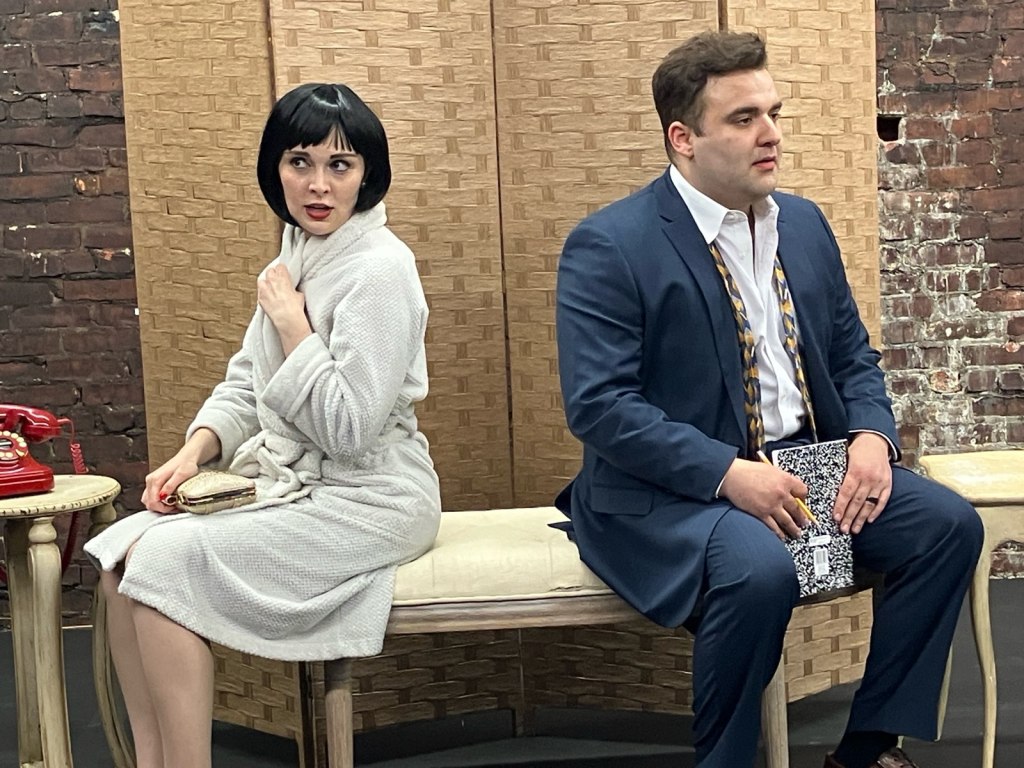
Konsevich is sympathetic and very funny as the befuddled, relatable Evan. Brian DiRaimondo, Julie Lorson, and Ronni Schweitzer round out the cast wonderfully in multiple roles, including several of the other bees caught in Alexa’s honey whom Evan calls on in his plan to get even. It all makes for an entertaining and faithful rendering of Keane’s clever classic, a cautionary tale that is all the more relevant in this modern age of Social Media, Influencers, and the “almost famous” who will do anything to get to the top of the search engine.
As Bees in Honey Drown is deftly directed by Tarmo Kirsimäe. It runs through June 1 at the Bacca Arts Center in Lindenhurst, Long Island. For more information, go to https://modernclassicsli.booktix.com/dept/main/e/Bees