
Home » Uncategorized (Page 38)
Category Archives: Uncategorized
The PaperKids answer: What is this thing called LOVE.
A conclave of talented energetic artists has burst on the scene. They suffer from one defect … they are genuinely humble!
In it for the joy of sharing their art with others, the PaperKids Theatre Company announces their take on love, thanks to playwright John Cariani. LOVE/SICK takes the sonnet out of romance and allows us to see what it really means to love and be loved.
Love/Sick sounds like a Netflix series – and that’s a good thing. It’s nine short plays in one ranging from love-at-first-sight to long-time marriage. “The audience watches as couples in realistic situations are disrupted by absurdist impulses, acts of confession, and devilish desires. Rife with insecurity, notions of what “should be,” misunderstandings, and more. Basically, LOVE/SICK explores the rise and fall … and rise again… of love,” says Tory Delahunt, a member of PaperKids Theater.
Leaving it all up to the talents of the talented casts, the minimalist production features¨
“Obsessive Impulsive” featuring Jeff Brackett & Tory Delahunt;
“The Singing Telegram” featuring Kristi Donna Ng & Sudheer Gaddam;
“Uh-Oh” featuring Lucia Bellini & Jeremy Rafal;
and “What?!” featuring Shawn Zylberberg & Joseph Segot
All directed by Carlos Moreno Henninger.
“Lunch and Dinner” featuring Sudheer Gaddam & Tory Delahunt;
“Forgot” featuring Jaimie Wallace & Shawn Zylberberg;
and “Where Was I?” featuring Leah Serinksy & Kristi Donna Ng,
All in the able hands of Eric Holgerson as director.
Ruben Vellekoop will handle directing duties for “Destiny” featuring Lucia Bellini & Joseph Segot and “The Answer” featuring Jaimie Wallace and Jeff Brackett.
Love/Sick, a 90-minute production, will be at the Hudson Gild Theatre, 441 W 26th St, New York City, with performances on February 24 @ 9pm; February 26 @ 9pm; and February 29 @ 6:45pm
Tickets at: https://www.paperkidstheatre.com/love-sick
Ai chatted with the directors about their vision and that of love.
 “Thinking of myself as an artist isn’t something I’m all that familiar with- mostly the art I create feels like a sort of inevitable overflow of an interest I have in some story or concept rather than a formal and cohesive artistic statement- but in as far as I AM an artist, I’m interested in shamelessness,” says Carlos Moreno Henninger, citing that humility that I mentioned that ruins throughout the company. “In both art and life, I love it when the veneer of public image gives way to people’s real, raw, ugly, embarrassing insides. The movies you’d never admit you watch when you’re alone, the childhood embarrassments that keep you up at night, the resentment building between you and your lovely roommate, the saccharine Instagram quote that secretly moved you to tears- when these things force their way to the surface, that’s when I get interested. When people are shamelessly themselves, almost anything is art.”
The collaborative nature of PaperKids also came through in his interview.
“Speaking of trusting actors, Lu Bellini and Jeff Bracket brought me to these plays! We had a large group of theatre friends that all wanted to be working, and at our first meeting, these guys brought Love/Sick forward for its huge potential cast of characters. That was enough to consider it, and then the play spoke for itself. It’s lonely without being bitter in a way that I think our generation is pretty familiar with; it’s funny and sweet but also deeply weird in a way that speaks to being young-but-not-that-young in our current moment.”

Eric Holgerson chimed in similarly. “I am a collaborator first. I believe that everyone has an artistic voice that should be heard. My job as the director is to have a structural vision that can be pushed, pulled and stretched in order to fit the unique talent of the writer as well as the artists that will perform the piece. I need to lead us to the goal of telling the story in a realistic way that will touch our audience.” He elaborated, mentioning his own style of directing, “I love what improvisation and listening can bring. I’m influenced by everything that I have ever studied as both an actor and director. Sanford Meisner Technique as well as Seth Barrish strategies for actors have very much influenced my approach to the work. I also like Scene Study and Improvisation work in order to help the actors get comfortable with each other as well as the piece. What drew me to this project was two things. One was the idea of being able to show the different stages of relationship, with the key being how we communicate (or don’t) within those relationships. Second was to opportunity to work with this pool of talented artists. This group of directors and actors are some of the most talented that I have worked with to date.”

Ruben Vellekoop jumped into the conversation – again in the collaborative sense but also something else that this company has a lot of: “As an artist, I aim to celebrate the ugliness of truth by beautifying it on stage. Honesty can be ugly – from the rolls my mirror shows to crying alone in the living room. My thinking is that I’m not the only one who has those moments and if I – as a director, choreographer, or designer – can portray those as beautifully as possible, my audience will go along with me. I hope that audiences will connect in those ugly moments because what we internally judge as ugly (see aforementioned rolls and cries), others can experience as beautiful.”
When asked why these plays, he reiterated “The chance to celebrate ugly love and to collaborate with friends and colleagues.”
These directors aren’t just that – they are also poets. I found this ironic. Doing a show that shines realism on love is being heled by those whose words show the abundance of love in their hearts! One has to imagine that this production will be like Shakespeare’s Sonnet 130.
No, I won’t tell you why … treat yourself on Valentine’s Day and read it.
https://www.poetryfoundation.org/poems/45108/sonnet-130-my-mistress-eyes-are-nothing-like-the-sun
These guys are keeping it real and warming our hearts.
That’s rare.
Happy Valentine’s Day

Robert Viagas in Blackwell Asylum
Nellie and the Women of Blackwell
By Ashley Adelman
Reviewed by Robert Viagas
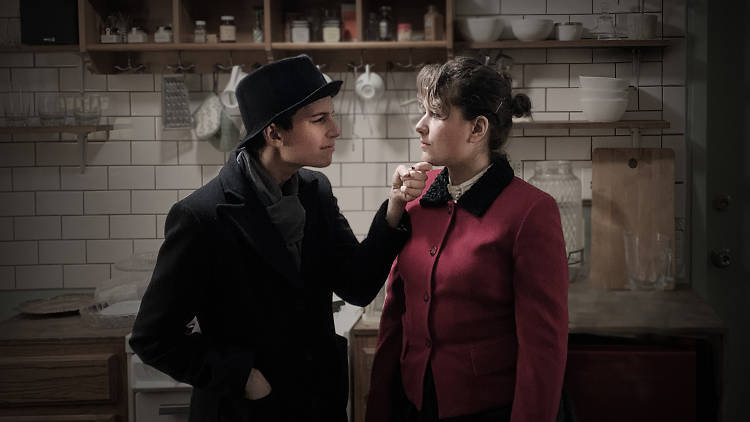
In 1887, an investigative reporter named Nellie Bly faked insanity so she could be committed to a notorious New York City lunatic asylum, as they were called in those days. Bly planned to report on what she had heard were appalling abuses of the mentally ill there.
In the new play Nellie and the Women of Blackwell, billed as a “terrifying immersive theatrical experience,” audiences join her and undergo some of the horrors she found there.
Staged by Jessica Schechter in a claustrophobic cluster of too-dark or harshly-lit rooms in the basement of an old building on the Lower East Side, Nellie and the Women of Blackwell, asks small groups of audience members—16 at most—to adopt the names and personas of actual women who endured “treatment” at the facility. We accompany Nellie (Kate Szekely) as she subjects herself to recreations of the mental and physical anguish suffered by the inmates there: bathed in filthy ice water bath, fed scraps of bread infested with cockroaches, strapped to a metal cot, beaten, bullied, insulted, and gaslighted by a nightmarish pair of sadistic nurses (Nicole Orabona and Janessa Floyd).
The experience proves very harrowing in spots. Audience members are given a safe word to be released if the experience gets too intense.
In a prelude to the play, we are shown a list of reasons women could be declared a lunatic, including excess sexual desire and a bump on the head. Many were imprisoned because they didn’t speak English and were assumed to be mentally deficient. Representing the hundreds of such inmates who passed through the bowels of Blackwell is a pitiful young blonde woman named Tillie, who responds to the asylum’s ministrations by falling deeper and deeper into actual insanity. She gives the most heartrending performance of the evening, and it’s perhaps not surprising to learn that she is played by the author of Nellie and the Women of Blackwell, Ashley Adelman.
At the performance reviewed, the actors stayed resolutely in character despite one audience member who resisted immersing himself in the performance and kept trying to make a joke of it all.
Though aspiring to the tradition of immersive theatre landmark, Sleep No More, this show has been produced on a shoestring, but uses its low budget to suggest the ugliness and sparseness of the Blackwell Asylum’s environment.
Lessons of the play’s experience will not be lost on New Yorkers who see how a contemporary group of “outsiders”—illegal immigrants—are treated today.
A co-production of Infinite Variety Productions and Wildrence, Nellie and the Women of Blackwell is playing a limited run through March 7 at Off-Off-Broadway’s Wildrence performing space on the Lower East Side of Manhattan.
Jay Michaels takes Ten with Lenny, Desi, Monica, and Drew
A cavalcade of acclaimed Playwrights offer-up a plethora of playlets looking at the world through less-than rose-colored glasses in Planet Connections New Short Play Festival “DARK PLANET: Not Your Mother’s Valentine’s Day” at the Theater at the 14th Street Y, 344 E 14th St, New York City.
The evening is broken up into two sets of works and each is short enough that you can attend both. Like a box of candy … ten great pieces in one great night. Planet Connections New Short Play Festival “DARK PLANET: Not Your Mother’s Valentine’s Day” at the Theater at the 14th Street Y, 344 E 14th St, New York City. Showtimes:
Thursday, February 6: 7:00 PM & 8:30 PM; Friday, February 7: 7:00 PM & 8:30 PM; Thursday, February 13: 7:00 PM & 8:30 PM; Friday, February 14: 7:00 PM & 8:30 PM; Thursday, February 20: 7:00 PM & 8:30 PM; Friday, February 21: 7:00 PM & 8:30 PM
7:00 PM SHOWS:
PLAY WITH ME Written by Lenny Schwartz
THREE MEN WITH GUNS Written by Monica Bauer
RECONCILE, BITCH Written by Desi Moreno-Penson
SHADOW DANCE Written by Jake Brasch
ALL 8:30 PM SHOWS:
SUPERSTARS Written by Glory Kadigan
TEXT ANGEL Written by Drew Larimore
FIEVEL DRIDGE, THE GREAT ORATOR OF FISHINGSTILL Written by Erik Champney
THE SECOND COMING Written by Gabrielle Fox
PLAYTHINGS Written by Jan Rosenberg
A DAY AT THE BEACH Written by Quincy Long
Some very funny, some brutal, all engaging.
Ai spoke to three of the playwrights in the 7:00 p.m. slot and one in the later part of the night about their work and the impending premieres.
 Lenny Schwartz, a writer/director of such plays as Subject 62, Kung-Fu Babies, The Inside of His Severed Head, Ben Minus Zoe Minus Ben, The Social Avenger and Co-Creator amongst many others, is also an accomplished screenwriter of such films as Murder University, Normal, Accidental Incest and the upcoming The Haunted and The Hunted, Codename: Dynastud (Scorpio Films Releasing) Long Night in a Dead City (Scorpio Film Releasing) and Higher Methods (IM Filmworks) among others. Schwartz, with a flair for the fantastic, contributed a work called PLAY WITH ME. “My Initial idea for it was to have a romance set in a fetish club,” says the whimsical scribe, “And to be raw and honest with the language. I had originally thought that nobody would ever produce this but – lo and behold – here we are!” His clever retort is indicative of his faith and confidence he has in Planet Connections. Making sure we are “turned on” by the salacious settings, he interjected “It is a short play that Is designed for laughs and acceptance for all no matter who you are and what your proclivities or lifestyles are.”

Enter a caption
The second writer is Desi Moreno-Penson, a New York City-based playwright and actor. Her plays have been developed and produced at a vast array of recognizable venues: Ensemble Studio Theater (EST), The 14th Annual Women’s Playwriting Festival in Providence, RI, Urban Theater Company in Chicago, Teatro Coribantes in San Juan, PR, the SPF-Summer Play Festival, Henry Street Settlement, terraNOVA Collective, and The Downtown Urban Theater Festival (DUTF) @the Cherry Lane in New York City, among others. RECONCILE, BITCH, her entry in this short-play fest, is about a pair of passionate, overly dramatic hipsters that love each other and struggle to get back together. Although for the sake of the universe, they probably should not be together and should probably be in separate mental institutions! This piece was originally commissioned by Tiny Rhino, based out in Brooklyn. With only love and romance to go by, she went dark – even twisted. “I don’t care for rom-coms at all,” says Moreno-Penson, “so I took my inspiration from Shakespeare’s A Midsummer Night’s Dream, and specifically, the scene between Helena and Demetrius (“And even for that do I love you the more. I am your spaniel. And, Demetrius, the more you beat me, I will fawn on you.”)”
 Finally, Monica Bauer boasts a litany of works that were internationally produced. Her most recent full-length play, Vivian’s Music, 1969 (directed by Glory Kadigan) was seen Off Broadway at 59E59 Theaters, and is being published by Original Works. She has won awards like the Emerging Playwright Award from Urban Stages, and a Planet award for Best Script of a Comedy Award for Anne Frank and the Gaza Strip.
Her respect for the mission of Ms. Kadigan and Planet Connections was all the impetus she needed to pen a play just for this festival. “I wrote it specifically for Dark Planet, and for three of my favorite actors, John Fico, Randall Rodriguez, and Russell Jordan,” said the international produced playwright, “Two gay men with guns, and a future professor of African American studies, participate in what may or may not be a legitimate drug deal, potentially foiled by a comic flurry of accusations and explanations. May the person with the best story win!” Yes, this festival is designed to be packed with love stories but as Ms. Bauer put it: “it’s a twisted little play that doesn’t seem at all like a love story … and it isn’t. Except for the turn it takes that I hope takes the audience by surprise!”

Produced widely in both the United States and Australia, Drew Larimore made his Off-Broadway premiere of his new play OUT OF ICELAND in the spring of 2012 starring Lea Delaria at Walker Space. He has been a semi-finalist at the O’Neill Theatre Conference, The Lark Playwrights’ Week, the Heidman Award, the P73 Playwriting Fellowship, a writing residency at Hawthornden Castle in Scotland and former EVVY award-winnder. His short play, THE ANNIVERSARY, after receiving a world premiere in Australia and a U.S. premiere in New York, is published in Vintage Anthology’s recent SHORTER, FASTER, FUNNIER. His new play, THE CANNIBALS OF MCGOWER COUNTY was featured in Asolo Repertory’s Unplugged Festival of New Work, an O’Neill Finalist in 2016 and workshopped at Denizen Theatre in 2019.
His entry is awash in irony. TEXT ANGEL is a solo show about Bonnie, an entrepreneur/motivational text angel, who accidentally sends the wrong motivational text to the wrong person, thus resulting in tragedy. Drew offers up a piece that seems to echo the old phrase of the road to hell is paved with good intentions. “TEXT ANGEL is actually a part of a collection of inter connected monologues about a death-by-sexting, where people struggle with their own responsibility in the situation writ large,” says Larimore, who most recently, served as a writer-in-residence at the Studios of Key West, the Key West Literary Seminar, and the Djerassi Artist Residency Program in California.
The meat of this written matter was a question posed about short-form works. The ten-minute play is making a name for itself across the New York theatrical skyline. With so many larger festivals disappearing, there seems to be bigger space for little plays, but how do authors feel about it?
Ms. Moreno-Penson was most vocal: “Some stories can be easily told within the ten-minute parameter. Other stories need a little more time. As a playwright, I feel that I have a lot to say, so I much prefer the formats of the one-act play (15 to 25 minutes), or the full-length (45 to 90 minutes). However, one really great thing about writing within such tightly constrained limitations is that it forces you to be very specific in all your choices. Every word, idea, and nuance have to be very carefully chosen and decided upon. As challenging as that is, it can also be a very positive learning experience. And I’m all for learning new stuff!”
Mr. Larimore seemed the most exuberant: “Short form is great!” he said, “I started writing with short plays, and I still think there is a succinctness to them like nothing else.” One would imagine Ms. Bauer felt the same – being able to form a piece for her favorite actors and for her trusted colleague, Glory Kadigan. “If they’re good, they end before you feel it’s really over,” he concluded.
Mr. Schwartz agreed and summed it up in true ten-minute play style … one sentence: “get to the point and get the Hell out!”
With these being only one-third of what the bill-of-fare is on this valentine of vociferous verses … it looks to be a great night.
Robert Viagas and Rats
RaTs:SubwaySongsandStories
By Maguire Wilder, with music by Maguire, Gavin Knittle, Kiara Negroni, Lucas Saur, Kyle Best, Natalie Thomas, and Lo Williams
Reviewed by Robert Viagas
Most New Yorkers have contended with the sight of rats scurrying among the tracks in the subway system. But how many of us have thought to turn that experience into a stage musical—and from the rats’ point of view?
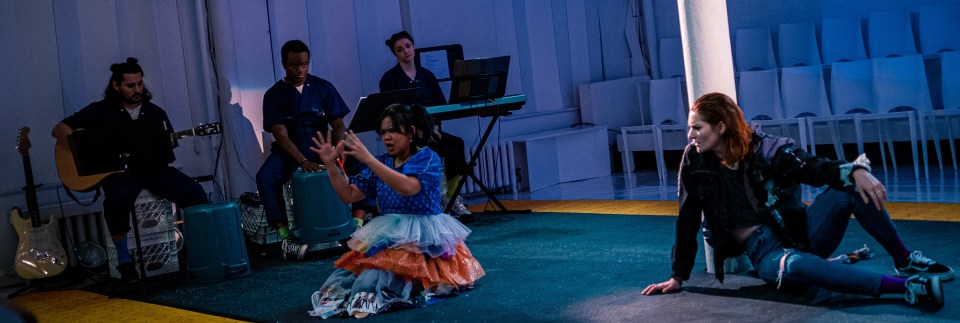 Well, Maguire Wilder and her composer collaborators have shouldered that challenge in RaTs: SubwaySongsandStories, getting a workshop production at TheatreLab in Hell’s Kitchen. This self-described “part fact-based narrative and part queer fantasy,” follows two lady rats on their quest for love and feasting on the night of the mystical Solstice—only to come to a tragic end.
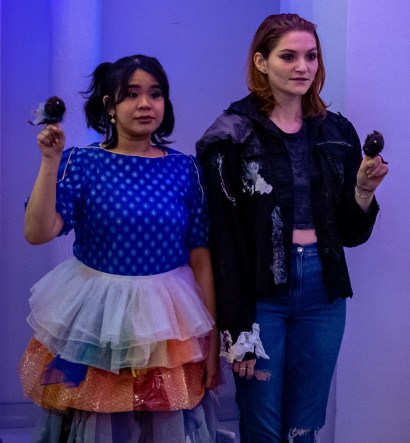 Fara Faidzan plays the Subway Rat Princess with a frantic but endearing gawkiness, brought on by her unrequited horniness. She is aided in her journey by Tabby Cat the Sewer Rat, played by Maiya Pascouche with a contrasting sensuous confidence. Their subterranean bildungsroman hits its high points with the rocking celebration song “Throw It Back, Little Rat,” and breaks your heart with the plaintive “Let Me Out.”
Other roles are taken by Claire-Frances Sullivan, Markese McLamb and John Knipsel, who also act as the chorus and three-piece orchestra.
Though vermin are not often portrayed sympathetically (Disney’s Ratatouille squirms to mind as an exception), the peculiar thing about this show is how militantly pro-rat it actually is. It makes a villain of New York’s Metropolitan Transportation Authority and its latest rat eradication campaign. The show is all about how the poor innocent rats just want to gobble fast food and have sex “just like you” and how sad it is when they get trapped and poisoned. And wind up ascending the stairs to Rat Heaven, where one supposes they will meet Cheese-us.
Offered as timely counterprogramming to the ill-fated Cats movie, RaTs scampers along for most of its ninety-minute intermissionless run time, but bogs down once the leads are trapped and singing about how they literally want to throw up. The audience needs to hear a bit of higher rat philosophy and aspiration than their simply wanting to eat and mate. But maybe that’s as high as rat eschatology goes.
RaTs: SubwaySongsandStories is playing a limited run through January 26 at TheaterLab in Manhattan.
An Angry Young Man Matures
 Jay Michaels sat down with playwright James Crafford regarding his latest works at the American Theatre of Actors.
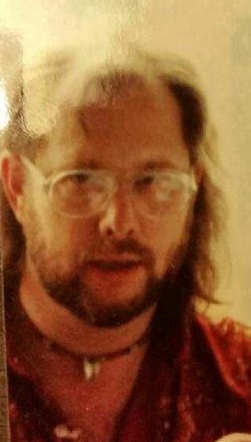
James Crafford began his theatre life studying with the legendary Stella Adler 46 years ago. After suffering through five showcases that failed prior to even opening he decided to do it himself. His first showcase of works as a playwright was approved and produced by Ms. Adler sight unseen. He continued contributing works for Ms. Adler for the next two years. One of his works was optioned for Broadway, which took him on a journey that continues today as a distinguished playwright.
It’s no wonder James Jennings – one of the founding fathers of the off-off Broadway movement – offered Crafford a home at the ATA. Crafford has since supplied plays and screenplays to Jennings and his merry troupe making him a household name in that house. One of that merry troupe, Laurie Rae Waugh, has been a major interpreter of Crafford’s works over the years – directing and thus winning awards for the work. This time around she is a member of huis cast.
Now, the American Theatre of Actors will present two dynamic works by this controversial author and influencer: Moves and Countermoves: New Works by James Crafford. Performances are January 22 – February 2, 2020 (Wednesday – Saturday @ 8:00 p.m. and Sunday at 3:00 p.m.) in The B.E.T. (Beckmann Experimental Theatre) of the American Theatre of Actors Complex, 314 W 54th St, New York City; (212) 581-3044 for tickets.
The Chaos Effect doesn’t need a butterfly or the span of the universe. It can be two people and the right – or wrong – words said at the right – or wrong – time. Michael Bordwell will serve as director and interpreter of these two new works by a political firebrand and unapologetic author.
“The Game Is Not Over” explores the relationship between a man and the two women in his life – his wife and his former lover. A simple living room becomes a battlefield as the wife confronts the former lover.
 “After the Hanging” explores the aftermath of a racist hanging of an African-American man in the deep south. The aforementioned man’s wife confronts one of the witnesses to the lynching.
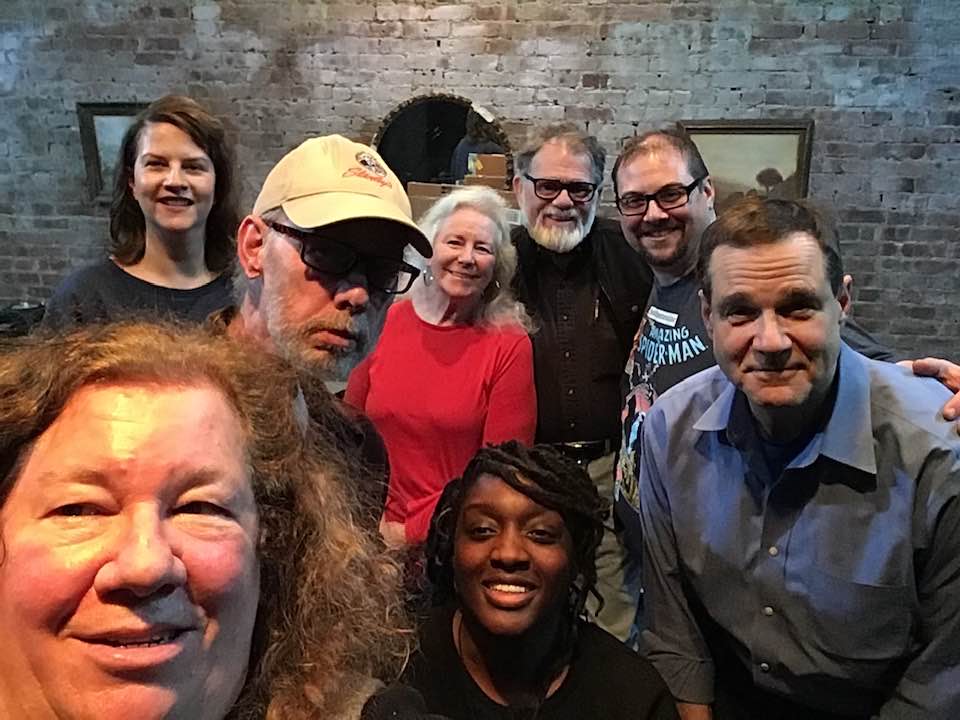
The plays feature a repertory company of seasoned professionals familiar with Mr. Crafford’s work and the landmark American Theatre of Actors: Alan Hasnas, Thomas J Kane, Tzena Nicole, Valerie O’Hara, and Meredith Rust; with a special appearance by stage and film actor/director Laurie Rae Waugh in “After The Hanging.”
Crafford – having started as an actor – makes sure that his cast are well fed – with dialogue. “My goal in writing plays is to offer juicy parts for ALL the actors involved,” he said.
A question recently asked of Granville Burgess due to his Lincoln/Douglass musical, Common Ground, has been asked of Crawford as well. “What’s an old white guy doing writing a play like After the Hanging?”
“[the play] banged around in my head for years after having read a short story by Erskine Caldwell called SATURDAY AFTERNOON that tells the story of a whimsical lynching that left me devastated,” he explained; “I recall throwing the book across the room in a fit of despair.” The book was surely his gauntlet if you know Mr. Crafford. Never backing down from a fight – which is evident due to his recent battles with Cancer and President trump (not sure which was worse) Crafford began creating this powerful play.


As “Rick” in his play VIOLENCE
(winner, Jean Dalrymple Award, presented at Sardis)
“I am deeply grateful to ATA for featuring my work and giving me the opportunity to grow as a writer, director and actor. I also hope that audiences will recognize current parallels in AFTER THE HANGING even though it takes place in 1927,” Crafford concluded.
As he alluded to a “glut of one acts” he is ready to have produced, we should prick-up-our-ears for more battlecrys with his by-line.
“Straights” Talk from Robert Viagas
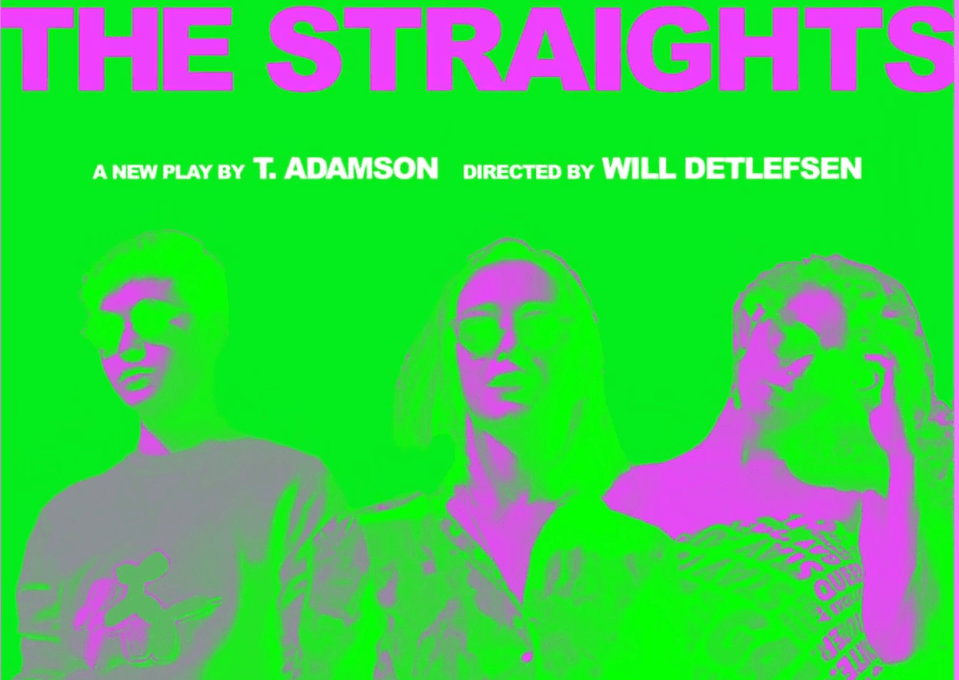
The Straights by T. Adamson
Reviewed by Robert Viagas
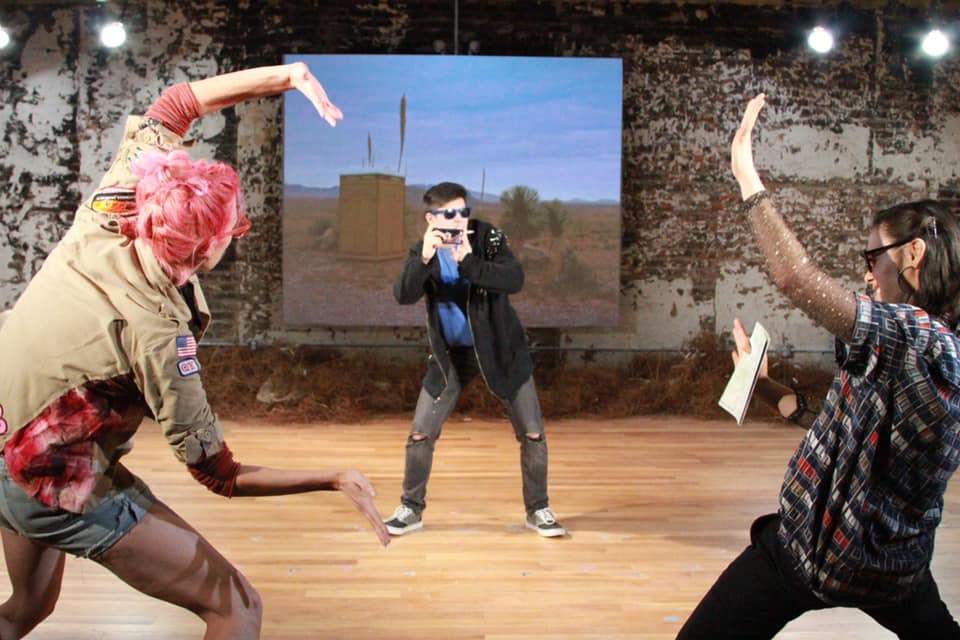
Two women launch an epic cross-country road trip full of madness, drugs, self-discovery, and a torrent of talk in T. Adamson’s frenzied new Off-Off-Broadway play, The Straights.
Tall, redheaded Mary Glen Fredrick dominates the action as Nina, a pure force of nature who machine-guns invective at her traveling companion/would-be lover Phoebe (Jennifer Paredes) in between virtual arias of p.c. vituperation and wheedling barked into her cell phone’s voice recognition software, complete with spoken punctuation.
In fact, he play consists of mainly of similar audition-worthy character speeches, though several would benefit from trimming, especially a rambling story purporting to be drawn from Inuit folklore. Nevertheless, The Straights revels in the pure joy of writing and speaking, created by a powerful and virtuosic voice in the American theatre. The show’s 11 o’clock speech is delivered with mounting power by Paredes, describing her desperate loves and unquenchable hates, presented as a mounting series of “Ifs,” building to a breathless climax, as the travelers complete their journey across what the play repeatedly calls “the long earth.”
But as for pure star power, it’s Fredrick as she rails at her friends, howls at fate, and even as she dashes across the stage joyfully in her birthday suit. The play contains one deathless line. Explaining why she won’t give a sample of her shampoo to her on-the-outs traveling companion, Nina snaps, “Shampoo for my real friends, real poo for my sham friends.”
The production featuring Neo Cihi, William Thomas Hodgson, Emily Shain, Lisa Ramirez, Tony Castellanos, Cat Crowley and Boscoe Barles.
Directed by Will Detlefsen The Straights is playing a limited run through Dec. 21 at JACK arts center in the Clinton Hill section of Brooklyn.
Robert Viagas gives a warm response to a Snowshow
Slava’s Snowshow
Created and staged by Slava Polunin
Reviewed by Robert Viagas
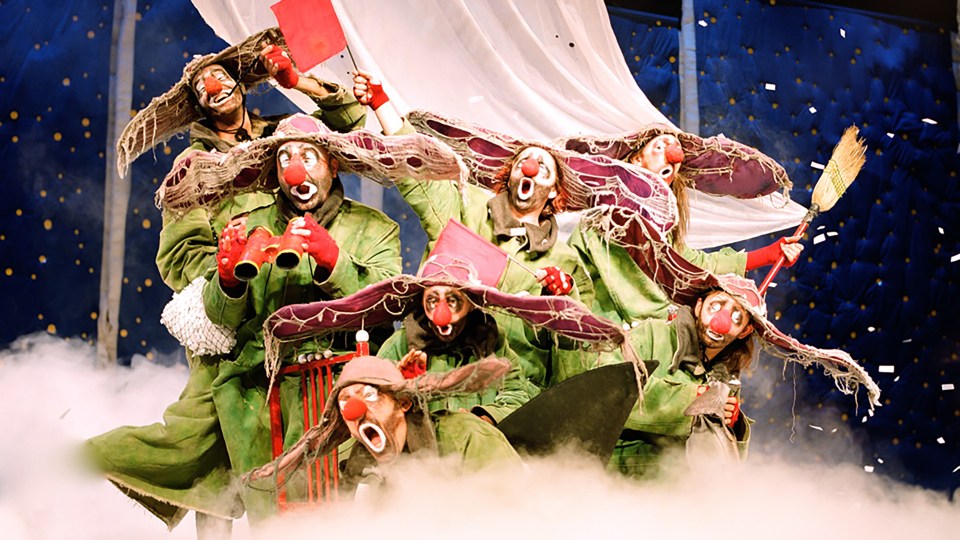
Halfway through Act I of Slava’s Snowshow, children in the Broadway audience left their seats, seemingly by magic, and began to speak directly to the clown performers in this New Vaudeville entertainment. The silent clowns hadn’t said a word at this point, but the kids understood the silly stories they were miming and responded to the pure playful charm of the experience by literally playing along.
Returning to Broadway eleven years after its first run, and twenty-six years after its Moscow premiere, this G-rated New Vaudeville entertainment launches a mostly silent clown (originated by Russian performer Slava Polunin) into a world of peculiar and offbeat tiny adventures filled with innocent delight. Polunin still plays the main role at some performances. At the performance reviewed, the role was played by Polunin lookalike Artem Zhimo.
What elevates it from being a mere side show? It is filled with wondrous special effects, designed by Polunin and Viktor Plotkinov, that fill the air with stage smoke, with the seat-shaking bass rumble of train locomotives and explosions, with amusing pop music choices, with giant balloons, and with a wave of gossamer floss that flows out over the audience (and sticks to everything). As the title indicates, the main special effect is the repeated use of artificial snow that falls from the ceiling, rolls in from the wings, and, in the climax of the show, blasts out into the house from a giant fan in a massive and powerful white hurricane.
But even with all these special effects, the true wonder of Slava’s Snowshow often comes from the tiniest of gestures by the main character and his six supporting clowns. The latter wear odd hats with huge side flaps, the source of ample comic invention. One of the sweetest moments came when Zhimo, preparing to leave on a train, approached an ordinary coat and hat on a coat tree. He slipped his arm into one of the sleeves, and suddenly the coat came alive, puppet-like, and hugged him in a sad goodbye. Moments like these, not the snow, are the true magic of Slava’s Snowshow.
The show has several casts. The performance reviewed here also featured Vanya Polunin as Zhimo’s main foil, and the Green Team of supporting clowns: Georgiy Deliyev, Francesco Bifano, Nikolai Terentiev, Aelita West, and Bradford West.
In its previous incarnations, the show won the 2005 Drama Desk Award for Unique Theatrical Experience and was nominated for the Tony Award for Best Special Theatrical Event.
Slava’s Snowshow is playing limited run through January 5, 2020 at the Stephen Sondheim Theatre on Broadway.
T. Adamson and the Road to Revolution
Playwright T. Adamson has entered the ring.
The Straights (https://www.thestraightstheplay.com/) is an epic play in the literal sense of the word as being a grand spoken endeavor. Grand in the literal sense of the word as being powerful in thought.
It follows millennial friends, Phoebe and Nina, as they navigate hitchhikers, shoplifting, drugs, and a flood of selfies on a cross-country no-boys-allowed adventure through the heart and heartlessness of the USA. This piece uses live action and video to bring about the dismantling of traditional American mythology by focusing its prose and politics on women, queer folx, non-human persons, and people of color as the primary subjects of the American democratic experiment.
And it all started thanks to the little election we had in 2016. Remember that?
Opening Thursday with the New York Times already reserving seats, Ai was lucky to get the playwright, T. Adamson, to jot down a few epic responses to our grand questions.
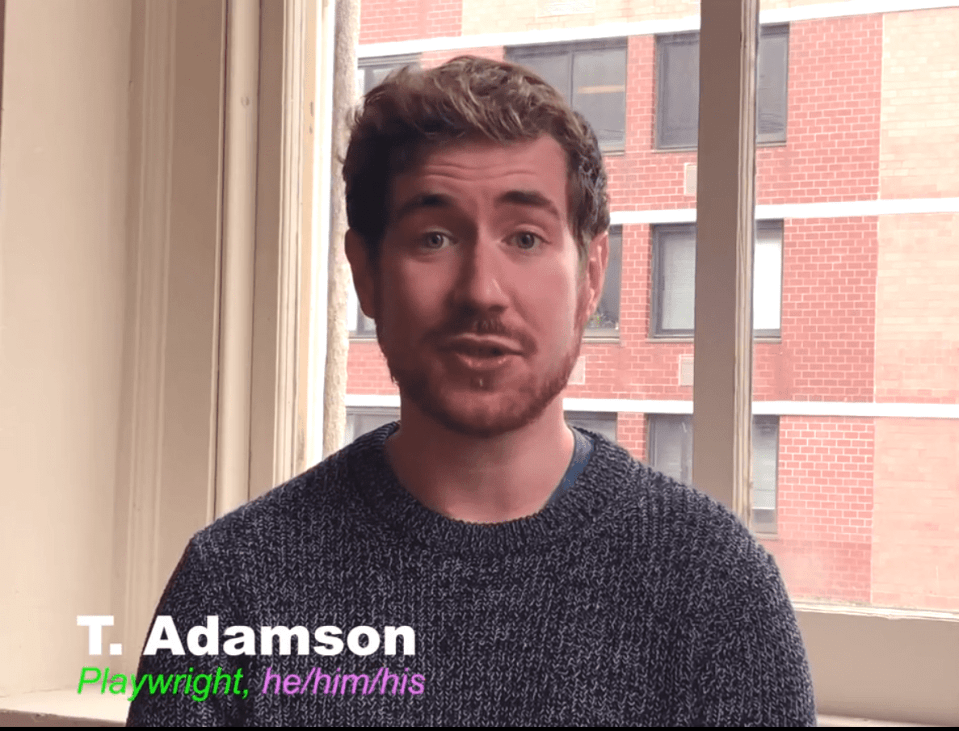
Tell us about yourself as an artist
As a writer I’m most interested in writing about complex challenging characters, particularly young people living in America right now. I feel people in their 20s and 30s are often depicted as vapid or self-centered in mainstream cultural narratives and I’m trying to counter those narratives by depicting young people in their full humanity, trying to navigate the difficulties of this economic and political climate. I’m also interested in plays that deeply explore the idiosyncrasies of modern speech and illustrate the ways in which everyday speech is rapidly changing in the digital era. I like subverting expectations and using bold formal gestures to inform the inner lives of my characters.

What made you write this play? Was it something you experienced? Is it a statement you’d like to make about our current State of affairs? Why the road trip motif?
I started this play shortly after Trump’s inauguration in 2017, which is also when the play is set. By whatever happenstance most of my best friends through my adult life have been queer women and it felt important to me at that time, as it does now still, to write a play that centers queer and femme folx and people of color- to firmly declare that these people are the real heart of this country, that the essence of this country is diversity and difference. I became obsessed with the road trip story as a distinctly American genre; there are so many narratives about young men finding themselves on the open road. I wrote this play as my counter-narrative about women living with the kind of abandon that the men in these classic road trip narratives take for granted. And I think there’s a little bit in the play of trying to hold myself accountable as a straight white man as well. Purposely writing people who look like me out of the story. I also just love road trips. I love long drives. I’m from Texas and I miss the wide open the road and the big sky that you rarely get in NYC. So this is both a critique and homage to typical road trip stories.
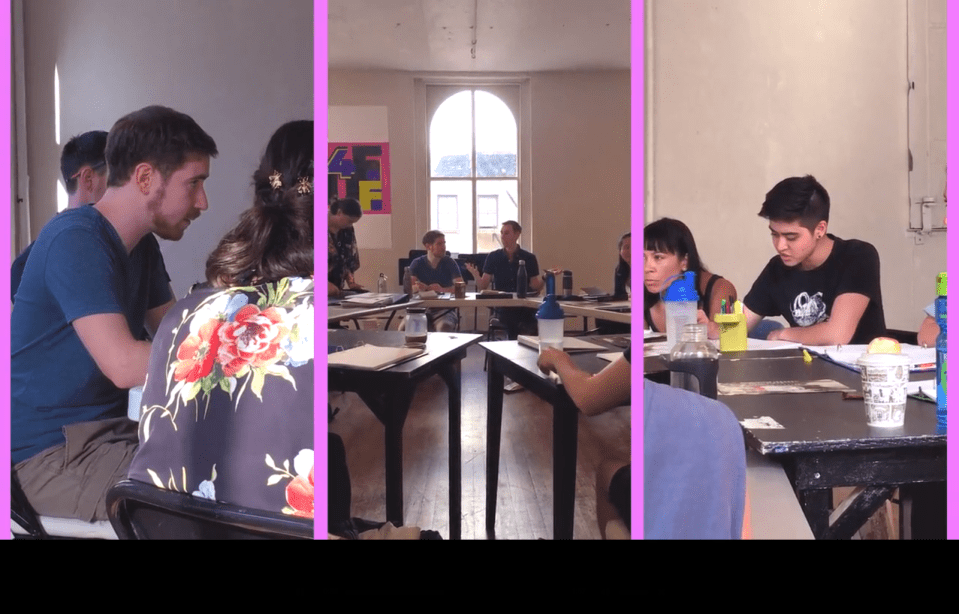
What do you want the audience to take away from this play?
I think the audience is going to takeaway whatever they takeaway! There’s so much going on in this play but the main thing I hope they take away is a sense of the richness and fullness of these human beings and the vastness and possibility that hopefully still exists in the United States. I hope the audiences feels like they met some interesting people- perhaps ones they wouldn’t normally spend time with- and that they spent some meaningful time with them and that meeting those people shifted their perspectives a bit.
TICKETS THRU OVATION
Evita still conquers.
Evita
Music by Andrew Lloyd Webber, book and lyrics by Tim Rice
Reviewed by Robert Viagas

Everything Evita warned us about has come true.
The 1978 Andrew Lloyd Webber-Tim Rice musical about the rise and fall of the real-life First Lady of Argentina, Eva Peron, is being presented as the annual fall gala production at the City Center in New York.
But, as directed by Sammi Cannold, it’s more than just a standard revival of a classic. This Webber-Rice epic was a caution about the scary power of charismatic mass-media stars to inspire the public with false promises, then pick their pockets while suppressing their civil rights. Allied with the army corporal Juan Peron, Evita promised to Make Argentina Great Again in the years immediately following World War II, then robbed the once-rich South American country blind while aggrandizing herself.
Cannold’s production never makes a direct reference to anything happening in American politics today. It doesn’t have to.
Cannold’s staging includes a great innovation. She has split the role of Evita in two. Younger Evita is played by the feisty but vulnerable Maia Reficco; Evita in Buenos Aires is played by the volcanic but ambiguous Solea Pfeiffer. But Reficco doesn’t disappear after the action moves to the capital, as you might expect. She continues to appear throughout the show like a sad ghost—a reminder of poverty-stricken and powerless past that the grown Evita spends her life trying to transcend. This bold staging choice doesn’t change the text but greatly strengthens it.
Pfeiffer brings great power to the title role, but never really takes us inside her character. Is she really an idealistic woman of the people, a she presents herself? Or is she a cynical opportunist who gets control of her country’s levers of power simply to enrich herself? This production tries to have it both ways, and, yes, there are strong elements of both in Evita. But this Evita doesn’t seem certain herself. She remains a cypher.
Enrique Acevedo is an excellent Juan Peron, displaying a ramrod-straight military bearing, but also showing a genuine caring for Eva as her final illness overtakes her. Narrator Jason Gotay has a fine voice, but is too flighty to play the dangerous international revolutionary Che Guevara.
The Webber-Rice score is served well throughout by the leads, by the big chorus performing the Latin-flavored choreography by Emily Malby and Valeria Solomonoff, and especially by the rich, full orchestra (24 chairs), conducted by Kristen Blodgette.
Evita is playing a limited run through November 24 at the City Center on 55th Street in midtown Manhattan.
It’s no Secret how good Derren Brown is.
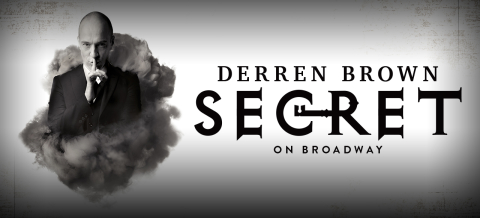
Derren Brown: Secret
Written by Andy Nyman, Derren Brown & Andrew O’Connor
Reviewed by Robert Viagas
One of the more popular attractions in the golden age of vaudeville was the mind reader—not a person with any special psi powers, but an otherwise perfectly normal person who had sharpened their skills of observation and their knowledge of human nature to the point that they could infer what audience members were thinking with uncanny accuracy.
Some were so good, it seemed like magic.
Fast forward to the present. Vaudeville is vanished, but mind readers like Broadway’s current Derren Brown still ply their trade with a sophistication and a psychological precision that their forebears could only dream of.
Brown, currently starring in Derren Brown: Secret, honed his craft in the U.K. and now comes to Broadway with a solo show that presents itself as pure entertainment, but which carries implications of how easy it is to fool crowds of people who naively trust in their own eyes and ears.
Brown constantly undercuts your skepticism. Are his audience-participation subjects carefully planted ringers? No, he chooses them by scaling a Frisbee-like disc into the house at random. Is he substituting one card or envelope for another through sleight-of-hand? No, he puts such object in the hands of an audience member for safekeeping. He then goes on to tell such people intimate details of their lives and things they have in their pockets, exclusively by reading their body language, their age, the slight changes of emphasis in words they say. Responding to audience gasps of amazement, he assures them, “I have no psychic ability.”
Moreover, he explains some of his feats in advance, or appears to. “I’m honest about my dishonesty,” he says. He warns you that he will bamboozle you, and then goes ahead and does it, all the while wearing the quiet assurance and smug smile of a master con man.
Brown is so good at directing your attention exactly where he pleases, that at one point an assistant in a gorilla suit was able to come onstage and remove a strategically placed envelope without the audience seeing it. It wasn’t invisible; Brown was just forcing you to look elsewhere at that moment because he knows how to do it and he knows that you will succumb to his covert misdirection. Magicians make a science of this. So do many politicians.
The show’s climax is a twenty-minute tour de force epic of divination involving multiple bemused audience members, multiple sealed envelopes, locked boxes, answers written before the show begins, a pre-recorded video, a song sung by a Saturday Night Live cast member, and even the long-promised revelation about the true meaning of the play’s title.
At the finale you’re left with a true sense of exhilaration at Brown’s skill, along with a sobering realization that people, including you, are so easy to “read”—and to manipulate.
Derren Brown: Secret is scheduled to play a limited run through Jan. 4, 2020 at the Cort Theatre on Broadway.

